1
Database Systems
October 15, 2014
Lecture #5
2
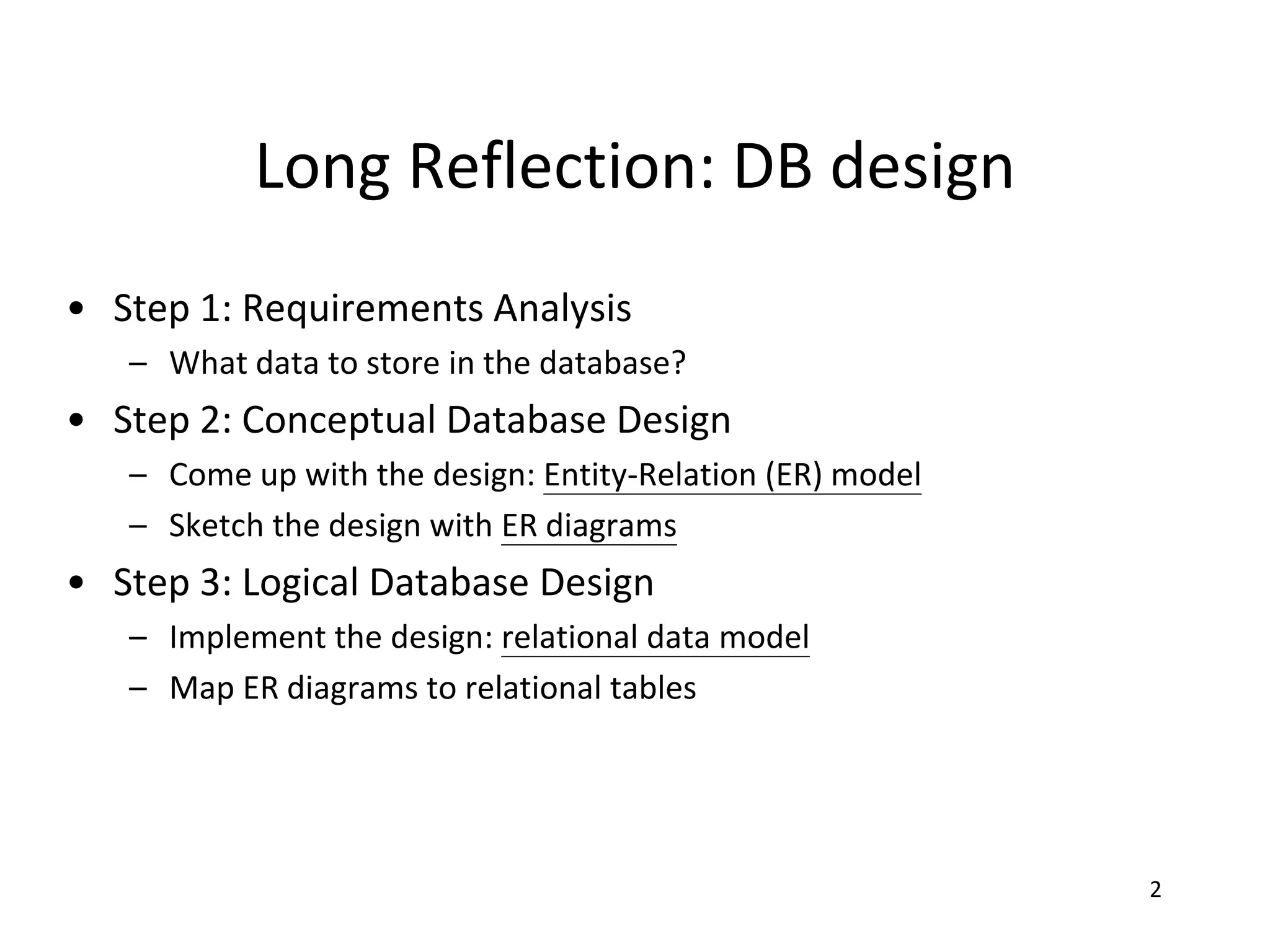
Long Reflection: DB design
• Step 1: Requirements Analysis
– What data to store in the database?
• Step 2: Conceptual Database Design
– Come up with the design: Entity-Relation (ER) model
– Sketch the design with ER diagrams
• Step 3: Logical Database Design
– Implement the design: relational data model
– Map ER diagrams to relational tables
3
Recent Reflection: DB design
• Last lecture:
– Query language: how to ask questions about the [relational] database?
– Mathematical query language: Relational Algebra
• This lecture
– A real query language: SQL (Structured Query Language)
4
Review: Relational Algebra
• A query is applied to table(s), and the result of a query is
also a table.
• Find the names of sailors who have reserved boat 103
πsname((σbid = 103 Reserves) ∞ Sailors)
5
Example Table Definitions
Sailors(sid: integer, sname: string, rating: integer, age: real)
Boats(bid: integer, bname: string, color: string)
Reserves(sid: integer, bid: integer, day: date)
6
Review: Relational Algebra
• Basic relational algebra operators:
– Selection (σ, pronounced sigma): Select a subset of rows from a
table.
– Projection (π): Delete unwanted columns from a table.
– Cross-product ( X ): Combine two tables.
– Set-difference ( - ): Tuples in table 1, but not in table 2.
– Union ( U ): Tuples in tables 1 or 2.
7
Review: Relational Algebra (more)
• Additional relational algebra operators:
– Intersection (∩) : tuples in both tables 1 and 2.
– Join (∞): conditional cross product
– Division (/)
– Renaming (p)
• Operations composed into complex query expression
• Query in English?
πsid (σ age > 20 Sailors) –
πsid ((σ color = ‘red’ Boats) ∞ Reserves ∞ Sailors)
8
W
Relational Algebra to SQL
• Relational operators → SQL commands
Relational Algebra:
πsname (σbid = 103 (Sailors∞ Reserves))
SQL:
SELECT S.sname
FROM Sailors S, Reserves R
WHERE S.sid=R.sid AND R.bid=103
• Guess the mapping?
– Notice the difference between SELECT (SQL) and σ
9
SQL: Queries, Constraints, Triggers
Chapter 5
10
Lecture Outline
• Basic Query
– SELECT
• Set Constructs
– UNION, INTERSECT, EXCEPT,
IN, ANY, ALL, EXISTS
• Nested Queries
• Aggregate Operators
– COUNT, SUM, AVG, MAX,
MIN, GROUP BY, HAVING
• Null Values
• Integrity Constraints
– CHECK, CREATE ASSERTION
• Triggers
– CREATE TRIGGER, FOR
EACH ROW
11
Example Table Definitions
Sailors(sid: integer, sname: string, rating: integer, age: real)
Boats(bid: integer, bname: string, color: string)
Reserves(sid: integer, bid: integer, day: date)
• Find names of sailors who’ve reserved boat #103
SELECT S.sname
FROM Sailors S, Reserves R
WHERE S.sid=R.sid AND R.bid=103
12
Basic SQL Query
SELECT [DISTINCT] target-list
FROM relation-list
WHERE qualification
• Relation-list: A list of relation names (possibly with range-
variable after each name).
• Target-list: A list of attributes of relations in relation-list
• Qualification: conditions on attributes (<, >, =, and, or, not,
etc.)
• DISTINCT: optional keyword for duplicate removal.
– Default = no duplicate removal!
13
How to evaluate a query?
SELECT [DISTINCT] target-list
FROM relation-list
WHERE qualification
• Conceptual query evaluation using relational operators:
1) Compute the cross-product of relation-list.
2) Discard resulting tuples if they fail qualifications.
3) Delete attributes that are not in target-list. (called column-list)
4) If DISTINCT is specified, eliminate duplicate rows.
• Only conceptual because of inefficiency computation
– An optimizer can find better strategy
SELECT S.sname
FROM Sailors S, Reserves R
WHERE S.sid=R.sid AND R.bid=103
14
Example of Conceptual Evaluation (1)
sid sname rating age
22 dustin 7 45.0
31 lubber 8 55.5
58 rusty 10 35.0
(1) Compute the cross-
product of relation-list.
SELECT S.sname
FROM Sailors S, Reserves R
WHERE S.sid=R.sid AND R.bid=103
Sailors Reserves
sid bid day
22 101 10/10/96
58 103 11/12/96
X
15
Example of Conceptual Evaluation (2)
(2) Discard tuples if they fail
qualifications.
S.sid sname rating age R.sid bid day
22 dustin 7 45.0 22 101 10/10/96
22 dustin 7 45.0 58 103 11/12/96
31 lubber 8 55.5 22 101 10/10/96
31 lubber 8 55.5 58 103 11/12/96
58 rusty 10 35.0 22 101 10/10/96
58 rusty 10 35.0 58 103 11/12/96
SELECT S.sname
FROM Sailors S, Reserves R
WHERE S.sid=R.sid AND R.bid=103
Sailors X Reserves
16
Example of Conceptual Evaluation (3)
(sid) sname rating age (sid) bid day
22 dustin 7 45.0 22 101 10/10/96
22 dustin 7 45.0 58 103 11/12/96
31 lubber 8 55.5 22 101 10/10/96
31 lubber 8 55.5 58 103 11/12/96
58 rusty 10 35.0 22 101 10/10/96
58 rusty 10 35.0 58 103 11/12/96
(3) Delete attribute columns that
not in target-list.
Sailors X Reserves
SELECT S.sname
FROM Sailors S, Reserves R
WHERE S.sid=R.sid AND R.bid=103 sname
rusty
17
A Note on Range Variables
• Really needed range variables
only if the same relation
appears twice in the FROM
clause.
SELECT S.sname
FROM Sailors as S, Reserves R
WHERE S.sid=R.sid AND bid=103
SELECT sname
FROM Sailors, Reserves
WHERE Sailors.sid=Reserves.sid AND bid=103
OR
SELECT sname
FROM Sailors S, Reserves R1,
Reserves R2
WHERE S.sid = R1.sid AND
S.sid = R2.sid AND
R1.bid <> R2.bid
18
Find the names of sailors who’ve reserved at
least one boat
(sid) sname rating age (sid) bid day
22 dustin 7 45.0 22 101 10/10/96
22 dustin 7 45.0 58 103 11/12/96
31 lubber 8 55.5 22 101 10/10/96
31 lubber 8 55.5 58 103 11/12/96
58 rusty 10 35.0 22 101 10/10/96
58 rusty 10 35.0 58 103 11/12/96
Sailors X Reserves
SELECT S.sid
FROM Sailors S, Reserves R
WHERE S.sid=R.sid
19
DISTINCT
• Find the names and ages of
all sailors
SELECT S.sname, S.age
FROM Sailors S
• Add DISTINCT to this query?
• Replace S.sname by S.sid in the
SELECT clause?
• Add DISTINCT to the above?
Sid Sname Rating Age
22 Dustin 7 45.0
29 Brutus 1 33.0
31 Lubber 8 55.5
32 Andy 8 25.5
58 Rusty 10 35.0
64 Horatio 7 35.0
71 Zorba 10 16.0
74 Horatio 9 35.0
85 Art 3 25.5
95 Bob 3 63.5
20
Find sailors whose names begin and end with
B and contain at least three characters.
SELECT S.age,
age1=S.age-5,
2*S.age AS age2
FROM Sailors S
WHERE S.sname LIKE ‘B_%B’
• AS and = are two ways to
name fields in result.
• LIKE for string matching.
– `_’ for one character
– `%’ for 0 or more characters.
Sid Sname Rating Age
22 Dustin 7 45.0
29 Brutus 1 33.0
31 Lubber 8 55.5
74 Horatio 9 35.0
85 Art 3 25.5
95 Bob 3 20
Age Age1 Age2
20 15 40
21
Find sid’s of sailors who’ve reserved a red or
a green boats.
SELECT DISTINCT S.sid
FROM Sailors S, Boats B, Reserves R
WHERE S.sid=R.sid AND R.bid=B.bid
AND (B.color=‘red’ OR B.color=‘green’)
• UNION: work on two union-compatible sets of tuples
SELECT S.sid
FROM Sailors S, Boats B, Reserves R
WHERE S.sid=R.sid AND R.bid=B.bid AND B.color=‘red’
UNION
SELECT S.sid
FROM Sailors S, Boats B, Reserves R
WHERE S.sid=R.sid AND R.bid=B.bid AND B.color=‘green’
Find sid’s of sailors who’ve reserved
a red and a green boat
SELECT S.sid
FROM Sailors S, Boats B, Reserves R
WHERE S.sid=R.sid AND R.bid=B.bid AND B.color=‘red’
INTERSECT
SELECT S.sid
FROM Sailors S, Boats B, Reserves R
WHERE S.sid=R.sid AND R.bid=B.bid AND B.color=‘green’
• (A Except B) returns tuples in A but not in B.
• What is the query in English if we replace INTERSECT by
EXCEPT?
– Find sids of all sailors who have reserved a red boat but not a
green boat. 22
SET Construct: UNION ALL
• UNION, INTERSECT, and EXCEPT delete duplicate by
default.
• To retain duplicates, use UNION ALL, INTERSECT ALL, or
EXCEPT ALL.
23
Sid Sname
71 Zorba
74 Horatio
74 Horatio
95 Bob
Sid Sname
22 Dustin
71 Zorba
74 Horatio
74 Horatio
INTERSECT
ALL
=
Sid Sname
71 Zorba
74 Horatio
74 Horatio
Nested Queries
• WHERE clause can contain an SQL subquery.
– (Actually, so can FROM and HAVING clauses.)
• Find names of sailors who’ve reserved boat #103:
SELECT S.sname
FROM Sailors S
WHERE S.sid IN (SELECT R.sid
FROM Reserves R
WHERE R.bid=103)
• (x IN B) returns true when x is in set B.
– To find sailors who’ve not reserved #103, use NOT IN.
• Nested loops Evaluation
– For each Sailors tuple, check the qualification by computing the subquery.
– Does the subquery result change for each Sailor row?
• When would subquery result change for each Sailor row?
24
Subquery: finds sids
who have reserved
bid 103
25
Nested Queries with Correlation
SELECT S.sname
FROM Sailors S
WHERE EXISTS (SELECT *
FROM Reserves R
WHERE R.bid=103 AND S.sid=R.sid )
• EXISTS is another set operator, like IN.
– (EXISTS S) returns true when S is not empty.
• What is the above query in English?
– Find sailors who have reserved boat #103
• In case of correlation, subquery must be re-computed for each
Sailors tuple.
Correlation: subquery finds all
reservations for
bid 103 from current sid
26
Nested Queries with UNIQUE
Sailors(sid: integer, sname: string, rating: integer, age: real)
Boats(bid: integer, bname: string, color: string)
Reserves(sid: integer, bid: integer, day: date)
• (UNIQUE S) returns true if S has no duplicate tuples or S is
empty.
SELECT S.sname
FROM Sailors S
WHERE UNIQUE (SELECT R.bid
FROM Reserves R
WHERE R.bid=103 AND S.sid=R.sid)
• What is the above query in English?
– Finds sailors with at most one reservation for boat #103.
• Replace R.bid with *?
– Finds sailors with at most one reservation for boat #103 in a given day.
Reserves
sid bid day
22 101 10/10/96
58 103 11/12/96
58 103 12/12/96
27
More on Set-Comparison Operators
• Have seen IN, EXISTS and UNIQUE. Can also use NOT IN, NOT EXISTS, and NOT
UNIQUE.
• Also available: op ANY, op ALL, where op can be >, <, =, ≠, ≤, ≥
– (a > ANY B) returns true when a is greater than any one element in set B.
– (a > ALL B) returns true when a is greater than all elements in set B.
SELECT *
FROM Sailors S
WHERE S.rating > ANY (SELECT S2.rating
FROM Sailors S2
WHERE S2.sname=‘Horatio’)
• What is the above query in English?
– Find sailors whose rating is greater than that of some sailor called Horatio.
• What is the above query in English if > ANY is replaced by > ALL?
– Find sailors whose rating is greater than all sailors called Horatio.
28
Find sid’s of sailors who’ve reserved a
red and a green boat
SELECT S.sid
FROM Sailors S, Boats B, Reserves R
WHERE S.sid=R.sid AND R.bid=B.bid AND B.color=‘red’
INTERSECT
SELECT S.sid
FROM Sailors S, Boats B, Reserves R
WHERE S.sid=R.sid AND R.bid=B.bid AND B.color=‘green’
• Rewrite INTERSECT with IN (plus a subquery)
– (x IN B) returns true when x is in set B.
– Strategy?
29
Rewriting INTERSECT Using IN
• Find sid’s of Sailors who’ve reserved red but not green boats
(EXCEPT)
– Replace IN with NOT IN.
SELECT S.sid
FROM Sailors S, Boats B, Reserves R
WHERE S.sid=R.sid AND R.bid=B.bid AND B.color=‘red’
AND S.sid IN (SELECT S2.sid
FROM Sailors S2, Boats B2, Reserves R2
WHERE S2.sid=R2.sid AND R2.bid=B2.bid
AND B2.color=‘green’)
Find sids who’ve
reserved a green
boat
30
Division in SQL
• Find sailors who’ve
reserved all boats.
• Strategy?
– Find all boats that have
been reserved by a sailor
– Compare with all boats
– Do the sailor’s reserved
boats include all boats?
• Yes → include this sailor
• No → exclude this sailor
SELECT S.sname
FROM Sailors S
WHERE NOT EXISTS
((SELECT B.bid
FROM Boats B)
EXCEPT
(SELECT R.bid
FROM Reserves R
WHERE R.sid=S.sid))
(A EXCEPT B)
returns tuples in
A but not in B.
31
Division in SQL
• Can you do it the hard way, without
EXCEPT & with NOT EXISTS?
• Strategy:
– For each sailor, check that there is no
boat that has not been reserved by this
sailor.
SELECT S.sname
FROM Sailors S
WHERE NOT EXISTS (
SELECT B.bid
FROM Boats B
WHERE NOT EXISTS (
SELECT R.bid
FROM Reserves R
WHERE R.bid = B.bid AND R.sid = S.sid))
bid bname color
101 xyz red
103 abc green
Boats
sid sname rating age
22 dustin 7 45.0
31 lubber 8 55.5
Sailors
Reserves
sid bid day
22 101 10/10/96
31 101 11/12/96
31 103 12/12/96
32
Aggregate Operators
• COUNT (*)
• COUNT ( [DISTINCT] A)
– A is a column
• SUM ( [DISTINCT] A)
• AVG ( [DISTINCT] A)
• MAX (A)
• MIN (A)
• Count the number of sailors
SELECT COUNT (*)
FROM Sailors S
33
Find the average age of sailors with
rating = 10
Sailors(sid: integer, sname: string, rating: integer, age: real)
SELECT AVG (S.age)
FROM Sailors S
WHERE S.rating=10
34
Count the number of different sailor
names
Sailors(sid: integer, sname: string, rating: integer, age: real)
SELECT COUNT (DISTINCT S.sname)
FROM Sailors S
35
Find the age of the oldest
sailor
Sailors(sid: integer, sname: string, rating: integer, age: real)
SELECT MAX(S.AGE)
FROM Sailors S
36
Find name and age of the oldest
sailor(s)
SELECT S.sname, MAX (S.age)
FROM Sailors S
• This is illegal, but why?
– Cannot combine a column with a value (unless we use
GROUP BY)
SELECT S.sname, S.age
FROM Sailors S
WHERE S.age = (SELECT MAX (S2.age) FROM Sailors S2)
• Okay, but not supported in every system
– Convert a table (of a single aggregate value) into a
single value for comparison
37
GROUP BY and HAVING
• So far, aggregate operators are applied to all (qualifying)
tuples.
– Can we apply them to each of several groups of tuples?
• Example: find the age of the youngest sailor for each
rating level.
– In general, we don’t know how many rating levels exist, and what
the rating values for these levels are!
– Suppose we know that rating values go from 1 to 10; we can write
10 queries that look like this:
SELECT MIN (S.age)
FROM Sailors S
WHERE S.rating = i
For i = 1, 2, ... , 10:
38
Find the age of the youngest sailor
for each rating level
SELECT S.rating, MIN (S.age) as age
FROM Sailors S
GROUP BY S.rating
(1) The sailors tuples are put into “same
rating” groups.
(2) Compute the Minimum age for each
rating group.
Sid Sname Rating Age
22 Dustin 7 45.0
31 Lubber 8 55.5
85 Art 3 25.5
32 Andy 8 25.5
95 Bob 3 63.5
Rating Age
3 25.5
3 63.5
7 45.0
8 55.5
8 25.5
Rating Age
3 25.5
7 45.0
8 25.5
(1)
(2)
39
Find the age of the youngest sailor for each
rating level that has at least 2 members
SELECT S.rating, MIN (S.age) as
minage
FROM Sailors S
GROUP BY S.rating
HAVING COUNT(*) > 1
1. The sailors tuples are put into
“same rating” groups.
2. Eliminate groups that have < 2
members.
3. Compute the Minimum age for
each rating group.
Sid Sname Rating Age
22 Dustin 7 45.0
31 Lubber 8 55.5
85 Art 3 25.5
32 Andy 8 25.5
95 Bob 3 63.5
Rating Age
3 25.5
3 63.5
7 45.0
8 55.5
8 25.5
Rating Minage
3 25.5
8 25.5
40
Queries With GROUP BY and
HAVING
SELECT [DISTINCT] target-list
FROM relation-list
WHERE qualification
GROUP BY grouping-list
HAVING group-qualification
• The target-list contains (i) attribute names (ii) terms with
aggregate operations (e.g., AVG (S.age)).
• The attribute list (e.g., S.rating) in target-list must be in
grouping-list.
• The attributes in group-qualification must be in grouping-
list.
SELECT S.rating, MIN (S.age) as
age
FROM Sailors S
GROUP BY S.rating
HAVING S.rating > 5
41
Say if Attribute list is not in
grouping-list
SELECT S.sname, S.rating,
AVG (S.age) as age
FROM Sailors S
GROUP BY S.rating
HAVING COUNT(S.rating) > 1
Sname Rating Age
Art 3 25.5
Bob 3 63.5
Dustin 7 45.0
Lubber 8 55.5
Andy 8 25.5
Sname Rating Age
? 3 44.5
? 8 40.5
Sid Sname Rating Age
22 Dustin 7 45.0
31 Lubber 8 55.5
85 Art 3 25.5
32 Andy 8 25.5
95 Bob 3 63.5
42
Say if attributes in the Group
qualification is not in grouping-list
SELECT S.rating, AVG (S.age)
as age
FROM Sailors S
GROUP BY S.rating
HAVING S.sname ≠ ‘Dustin’
Sname Rating Age
Art 3 25.5
Bob 3 63.5
Dustin 7 45.0
Lubber 8 55.5
Andy 8 25.5
Rating Age ?
Sid Sname Rating Age
22 Dustin 7 45.0
31 Lubber 8 55.5
85 Art 3 25.5
32 Andy 8 25.5
95 Bob 3 63.5
43
Conceptual Evaluation
• Without GROUP BY and HAVING:
– Compute cross-product of relation-list
– Remove tuples that fail qualification
– Delete unnecessary columns
• With GROUP BY and HAVING, continue with
– Partition remaining tuples into groups by the value of attributes in
grouping-list (specified in GROUP-BY clause)
– Remove groups that fail group-qualification (specified in HAVING
clause).
– Compute one answer tuple per qualifying group.
44
For each red boat, find the number
of reservations for this boat
SELECT B.bid, COUNT (*) AS
num_reservations
FROM Boats B, Reserves R
WHERE R.bid=B.bid AND
B.color=‘red’
GROUP BY B.bid
SELECT B.bid, COUNT (*) AS
num_reservations
FROM Boats B, Reserves R
WHERE R.bid=B.bid
GROUP BY B.bid
HAVING B.color=‘red’
• Illegal, why?
– B.color does not appear in
group-list
45
Find the age of the youngest sailor with age > 18 for
each rating with at least 2 sailors (of any age)
SELECT S.rating, MIN (S.age)
FROM Sailors S
WHERE S.age > 18
GROUP BY S.rating
HAVING COUNT(S) > 1
• What is wrong?
– COUNT(S) is counting
tuples after the
qualification (S.age > 18).
– Eliminate groups with
multiple sailors but only
one sailor with age > 18.
• How to fix it?
– Use subquery in the HAVING
clause.
SELECT S.rating, MIN (S.age)
FROM Sailors S
WHERE S.age > 18
GROUP BY S.rating
HAVING
1 < ANY (SELECT COUNT (*)
FROM Sailors S2
WHERE
S.rating=S2.rating)
46
Find rating(s) for (which the average age
is the minimum) over all rating groups
SELECT S.rating
FROM Sailors S
WHERE S.age =
(SELECT MIN (AVG (S2.age))
FROM Sailors S2
GROUP BY S2.rating)
• What’s wrong?
– Aggregate operations
cannot be nested
• How to fix it?
SELECT Temp.rating
FROM (SELECT S.rating, AVG
(S.age) AS avgage
FROM Sailors S
GROUP BY S.rating) AS
Temp
WHERE Temp.avgage = (SELECT
MIN (Temp.avgage)
FROM Temp)
A temp table
(rating, avg age)
47
Table Constraints
• Specify constraints over a
single table
– Useful when more general
ICs than keys are involved.
• Constraints can be
named.
CREATE TABLE Sailors
( sid INTEGER,
sname CHAR(10),
rating INTEGER,
age REAL,
PRIMARY KEY (sid),
CHECK ( rating >= 1
AND rating <= 10 )
CREATE TABLE Reserves
( sname CHAR(10),
bid INTEGER,
day DATE,
PRIMARY KEY (bid,day),
CONSTRAINT noInterlakeRes
CHECK (`Interlake’ ≠
( SELECT R.bname
FROM Reservers R
WHERE R.bid=bid)))
The boat ‘Interlake’
cannot be reserved
48
Assertions: Constraints Over
Multiple Tables
CREATE TABLE Sailors
( sid INTEGER,
sname CHAR(10),
rating INTEGER,
age REAL,
PRIMARY KEY (sid),
CHECK
( (SELECT COUNT (S.sid) FROM Sailors S)
+ (SELECT COUNT (B.bid) FROM Boats B) < 1
• Awkward and
wrong!
– If Sailors is empty,
the number of
Boats tuples can
be anything!
• ASSERTION is the
right solution; not
associated with
either table.
CREATE ASSERTION smallClub
CHECK
( (SELECT COUNT (S.sid) FROM Sailors S)
+ (SELECT COUNT (B.bid) FROM Boats B) < 1
Number of boats
plus number of
sailors is < 100
Triggers
• Trigger: procedure that starts automatically if specified
changes occur to the DBMS
• A trigger has three parts:
– Event (activates the trigger)
– Condition (tests whether the triggers should run)
– Action (what happens if the trigger runs)
CREATE TRIGGER incr_count AFTER INSERT ON Students // Event
WHEN (new.age < 18) // Condition
FOR EACH ROW
BEGIN // ACTION: a procedure in Oracle’s PL/SQL syntax
count := count + 1
END
49
50
Starwar Exercises
char(name, race, homeworld, affiliation)
planets(name, type, affiliation)
timetable(cname, pname, movie, arrival, departure)
Which planet does Princess Leia go to in movie3?
SELECT distinct pname
FROM timetable
WHERE cname ='Princess Leia' and movie=3
51
Starwar Exercises
char(name, race, homeworld, affiliation)
planets(name, type, affiliation)
timetable(cname, pname, movie, arrival, departure)
• How many people stay on Dagobah in movie 3?
SELECT count(DISTINCT characters.name)
FROM timetable, characters
WHERE movie=3 and pname ='Dagobah' and
timetable.cname=characters.name and
characters.race='Human'
52
Starwar Exercises
char(name, race, homeworld, affiliation)
planets(name, type, affiliation)
timetable(cname, pname, movie, arrival, departure)
• Who has been to his/her homeworld in movie 2?
SELECT distinct c.name
FROM characters c, timetable t
WHERE c.name=t.cname and t.pname=c.homeworld and
movie=2
53
Starwar Exercises
char(name, race, homeworld, affiliation)
planets(name, type, affiliation)
timetable(cname, pname, movie, arrival, departure)
• Find all characters that have been on all planets of rebels.
SELECT name
FROM characters c
WHERE not exists (
SELECT p.name FROM planets p
WHERE affiliation='rebels' and p.name NOT IN
(SELECT pname from timetable t where
t.cname=c.name and t.pname=p.name))
54
Starwar Exercises
char(name, race, homeworld, affiliation)
planets(name, type, affiliation)
timetable(cname, pname, movie, arrival, departure)
• Find distinct names of the planets visited by those of race
“droid”.
SELECT distinct t.pname
FROM char c, timetable t
WHERE c.name=t.cname and c.race='droid'
55
Starwar Exercises
char(name, race, homeworld, affiliation)
planets(name, type, affiliation)
timetable(cname, pname, movie, arrival, departure)
• For each character and for each neutral planet, how much
time total did the character spend on the planet?
SELECT c.name, p.name, SUM(t.departure-t.arrival+1) as amount
FROM characters c, timetable t, planets p
WHERE t.cname=c.name and t.pname=p.name and p.affiliation='neutral'
GROUP BY c.name, p.name

lecture05-14f.ppt

  • 1.
  • 2.
    2 Long Reflection: DBdesign • Step 1: Requirements Analysis – What data to store in the database? • Step 2: Conceptual Database Design – Come up with the design: Entity-Relation (ER) model – Sketch the design with ER diagrams • Step 3: Logical Database Design – Implement the design: relational data model – Map ER diagrams to relational tables
  • 3.
    3 Recent Reflection: DBdesign • Last lecture: – Query language: how to ask questions about the [relational] database? – Mathematical query language: Relational Algebra • This lecture – A real query language: SQL (Structured Query Language)
  • 4.
    4 Review: Relational Algebra •A query is applied to table(s), and the result of a query is also a table. • Find the names of sailors who have reserved boat 103 πsname((σbid = 103 Reserves) ∞ Sailors)
  • 5.
    5 Example Table Definitions Sailors(sid:integer, sname: string, rating: integer, age: real) Boats(bid: integer, bname: string, color: string) Reserves(sid: integer, bid: integer, day: date)
  • 6.
    6 Review: Relational Algebra •Basic relational algebra operators: – Selection (σ, pronounced sigma): Select a subset of rows from a table. – Projection (π): Delete unwanted columns from a table. – Cross-product ( X ): Combine two tables. – Set-difference ( - ): Tuples in table 1, but not in table 2. – Union ( U ): Tuples in tables 1 or 2.
  • 7.
    7 Review: Relational Algebra(more) • Additional relational algebra operators: – Intersection (∩) : tuples in both tables 1 and 2. – Join (∞): conditional cross product – Division (/) – Renaming (p) • Operations composed into complex query expression • Query in English? πsid (σ age > 20 Sailors) – πsid ((σ color = ‘red’ Boats) ∞ Reserves ∞ Sailors)
  • 8.
    8 W Relational Algebra toSQL • Relational operators → SQL commands Relational Algebra: πsname (σbid = 103 (Sailors∞ Reserves)) SQL: SELECT S.sname FROM Sailors S, Reserves R WHERE S.sid=R.sid AND R.bid=103 • Guess the mapping? – Notice the difference between SELECT (SQL) and σ
  • 9.
    9 SQL: Queries, Constraints,Triggers Chapter 5
  • 10.
    10 Lecture Outline • BasicQuery – SELECT • Set Constructs – UNION, INTERSECT, EXCEPT, IN, ANY, ALL, EXISTS • Nested Queries • Aggregate Operators – COUNT, SUM, AVG, MAX, MIN, GROUP BY, HAVING • Null Values • Integrity Constraints – CHECK, CREATE ASSERTION • Triggers – CREATE TRIGGER, FOR EACH ROW
  • 11.
    11 Example Table Definitions Sailors(sid:integer, sname: string, rating: integer, age: real) Boats(bid: integer, bname: string, color: string) Reserves(sid: integer, bid: integer, day: date) • Find names of sailors who’ve reserved boat #103 SELECT S.sname FROM Sailors S, Reserves R WHERE S.sid=R.sid AND R.bid=103
  • 12.
    12 Basic SQL Query SELECT[DISTINCT] target-list FROM relation-list WHERE qualification • Relation-list: A list of relation names (possibly with range- variable after each name). • Target-list: A list of attributes of relations in relation-list • Qualification: conditions on attributes (<, >, =, and, or, not, etc.) • DISTINCT: optional keyword for duplicate removal. – Default = no duplicate removal!
  • 13.
    13 How to evaluatea query? SELECT [DISTINCT] target-list FROM relation-list WHERE qualification • Conceptual query evaluation using relational operators: 1) Compute the cross-product of relation-list. 2) Discard resulting tuples if they fail qualifications. 3) Delete attributes that are not in target-list. (called column-list) 4) If DISTINCT is specified, eliminate duplicate rows. • Only conceptual because of inefficiency computation – An optimizer can find better strategy SELECT S.sname FROM Sailors S, Reserves R WHERE S.sid=R.sid AND R.bid=103
  • 14.
    14 Example of ConceptualEvaluation (1) sid sname rating age 22 dustin 7 45.0 31 lubber 8 55.5 58 rusty 10 35.0 (1) Compute the cross- product of relation-list. SELECT S.sname FROM Sailors S, Reserves R WHERE S.sid=R.sid AND R.bid=103 Sailors Reserves sid bid day 22 101 10/10/96 58 103 11/12/96 X
  • 15.
    15 Example of ConceptualEvaluation (2) (2) Discard tuples if they fail qualifications. S.sid sname rating age R.sid bid day 22 dustin 7 45.0 22 101 10/10/96 22 dustin 7 45.0 58 103 11/12/96 31 lubber 8 55.5 22 101 10/10/96 31 lubber 8 55.5 58 103 11/12/96 58 rusty 10 35.0 22 101 10/10/96 58 rusty 10 35.0 58 103 11/12/96 SELECT S.sname FROM Sailors S, Reserves R WHERE S.sid=R.sid AND R.bid=103 Sailors X Reserves
  • 16.
    16 Example of ConceptualEvaluation (3) (sid) sname rating age (sid) bid day 22 dustin 7 45.0 22 101 10/10/96 22 dustin 7 45.0 58 103 11/12/96 31 lubber 8 55.5 22 101 10/10/96 31 lubber 8 55.5 58 103 11/12/96 58 rusty 10 35.0 22 101 10/10/96 58 rusty 10 35.0 58 103 11/12/96 (3) Delete attribute columns that not in target-list. Sailors X Reserves SELECT S.sname FROM Sailors S, Reserves R WHERE S.sid=R.sid AND R.bid=103 sname rusty
  • 17.
    17 A Note onRange Variables • Really needed range variables only if the same relation appears twice in the FROM clause. SELECT S.sname FROM Sailors as S, Reserves R WHERE S.sid=R.sid AND bid=103 SELECT sname FROM Sailors, Reserves WHERE Sailors.sid=Reserves.sid AND bid=103 OR SELECT sname FROM Sailors S, Reserves R1, Reserves R2 WHERE S.sid = R1.sid AND S.sid = R2.sid AND R1.bid <> R2.bid
  • 18.
    18 Find the namesof sailors who’ve reserved at least one boat (sid) sname rating age (sid) bid day 22 dustin 7 45.0 22 101 10/10/96 22 dustin 7 45.0 58 103 11/12/96 31 lubber 8 55.5 22 101 10/10/96 31 lubber 8 55.5 58 103 11/12/96 58 rusty 10 35.0 22 101 10/10/96 58 rusty 10 35.0 58 103 11/12/96 Sailors X Reserves SELECT S.sid FROM Sailors S, Reserves R WHERE S.sid=R.sid
  • 19.
    19 DISTINCT • Find thenames and ages of all sailors SELECT S.sname, S.age FROM Sailors S • Add DISTINCT to this query? • Replace S.sname by S.sid in the SELECT clause? • Add DISTINCT to the above? Sid Sname Rating Age 22 Dustin 7 45.0 29 Brutus 1 33.0 31 Lubber 8 55.5 32 Andy 8 25.5 58 Rusty 10 35.0 64 Horatio 7 35.0 71 Zorba 10 16.0 74 Horatio 9 35.0 85 Art 3 25.5 95 Bob 3 63.5
  • 20.
    20 Find sailors whosenames begin and end with B and contain at least three characters. SELECT S.age, age1=S.age-5, 2*S.age AS age2 FROM Sailors S WHERE S.sname LIKE ‘B_%B’ • AS and = are two ways to name fields in result. • LIKE for string matching. – `_’ for one character – `%’ for 0 or more characters. Sid Sname Rating Age 22 Dustin 7 45.0 29 Brutus 1 33.0 31 Lubber 8 55.5 74 Horatio 9 35.0 85 Art 3 25.5 95 Bob 3 20 Age Age1 Age2 20 15 40
  • 21.
    21 Find sid’s ofsailors who’ve reserved a red or a green boats. SELECT DISTINCT S.sid FROM Sailors S, Boats B, Reserves R WHERE S.sid=R.sid AND R.bid=B.bid AND (B.color=‘red’ OR B.color=‘green’) • UNION: work on two union-compatible sets of tuples SELECT S.sid FROM Sailors S, Boats B, Reserves R WHERE S.sid=R.sid AND R.bid=B.bid AND B.color=‘red’ UNION SELECT S.sid FROM Sailors S, Boats B, Reserves R WHERE S.sid=R.sid AND R.bid=B.bid AND B.color=‘green’
  • 22.
    Find sid’s ofsailors who’ve reserved a red and a green boat SELECT S.sid FROM Sailors S, Boats B, Reserves R WHERE S.sid=R.sid AND R.bid=B.bid AND B.color=‘red’ INTERSECT SELECT S.sid FROM Sailors S, Boats B, Reserves R WHERE S.sid=R.sid AND R.bid=B.bid AND B.color=‘green’ • (A Except B) returns tuples in A but not in B. • What is the query in English if we replace INTERSECT by EXCEPT? – Find sids of all sailors who have reserved a red boat but not a green boat. 22
  • 23.
    SET Construct: UNIONALL • UNION, INTERSECT, and EXCEPT delete duplicate by default. • To retain duplicates, use UNION ALL, INTERSECT ALL, or EXCEPT ALL. 23 Sid Sname 71 Zorba 74 Horatio 74 Horatio 95 Bob Sid Sname 22 Dustin 71 Zorba 74 Horatio 74 Horatio INTERSECT ALL = Sid Sname 71 Zorba 74 Horatio 74 Horatio
  • 24.
    Nested Queries • WHEREclause can contain an SQL subquery. – (Actually, so can FROM and HAVING clauses.) • Find names of sailors who’ve reserved boat #103: SELECT S.sname FROM Sailors S WHERE S.sid IN (SELECT R.sid FROM Reserves R WHERE R.bid=103) • (x IN B) returns true when x is in set B. – To find sailors who’ve not reserved #103, use NOT IN. • Nested loops Evaluation – For each Sailors tuple, check the qualification by computing the subquery. – Does the subquery result change for each Sailor row? • When would subquery result change for each Sailor row? 24 Subquery: finds sids who have reserved bid 103
  • 25.
    25 Nested Queries withCorrelation SELECT S.sname FROM Sailors S WHERE EXISTS (SELECT * FROM Reserves R WHERE R.bid=103 AND S.sid=R.sid ) • EXISTS is another set operator, like IN. – (EXISTS S) returns true when S is not empty. • What is the above query in English? – Find sailors who have reserved boat #103 • In case of correlation, subquery must be re-computed for each Sailors tuple. Correlation: subquery finds all reservations for bid 103 from current sid
  • 26.
    26 Nested Queries withUNIQUE Sailors(sid: integer, sname: string, rating: integer, age: real) Boats(bid: integer, bname: string, color: string) Reserves(sid: integer, bid: integer, day: date) • (UNIQUE S) returns true if S has no duplicate tuples or S is empty. SELECT S.sname FROM Sailors S WHERE UNIQUE (SELECT R.bid FROM Reserves R WHERE R.bid=103 AND S.sid=R.sid) • What is the above query in English? – Finds sailors with at most one reservation for boat #103. • Replace R.bid with *? – Finds sailors with at most one reservation for boat #103 in a given day. Reserves sid bid day 22 101 10/10/96 58 103 11/12/96 58 103 12/12/96
  • 27.
    27 More on Set-ComparisonOperators • Have seen IN, EXISTS and UNIQUE. Can also use NOT IN, NOT EXISTS, and NOT UNIQUE. • Also available: op ANY, op ALL, where op can be >, <, =, ≠, ≤, ≥ – (a > ANY B) returns true when a is greater than any one element in set B. – (a > ALL B) returns true when a is greater than all elements in set B. SELECT * FROM Sailors S WHERE S.rating > ANY (SELECT S2.rating FROM Sailors S2 WHERE S2.sname=‘Horatio’) • What is the above query in English? – Find sailors whose rating is greater than that of some sailor called Horatio. • What is the above query in English if > ANY is replaced by > ALL? – Find sailors whose rating is greater than all sailors called Horatio.
  • 28.
    28 Find sid’s ofsailors who’ve reserved a red and a green boat SELECT S.sid FROM Sailors S, Boats B, Reserves R WHERE S.sid=R.sid AND R.bid=B.bid AND B.color=‘red’ INTERSECT SELECT S.sid FROM Sailors S, Boats B, Reserves R WHERE S.sid=R.sid AND R.bid=B.bid AND B.color=‘green’ • Rewrite INTERSECT with IN (plus a subquery) – (x IN B) returns true when x is in set B. – Strategy?
  • 29.
    29 Rewriting INTERSECT UsingIN • Find sid’s of Sailors who’ve reserved red but not green boats (EXCEPT) – Replace IN with NOT IN. SELECT S.sid FROM Sailors S, Boats B, Reserves R WHERE S.sid=R.sid AND R.bid=B.bid AND B.color=‘red’ AND S.sid IN (SELECT S2.sid FROM Sailors S2, Boats B2, Reserves R2 WHERE S2.sid=R2.sid AND R2.bid=B2.bid AND B2.color=‘green’) Find sids who’ve reserved a green boat
  • 30.
    30 Division in SQL •Find sailors who’ve reserved all boats. • Strategy? – Find all boats that have been reserved by a sailor – Compare with all boats – Do the sailor’s reserved boats include all boats? • Yes → include this sailor • No → exclude this sailor SELECT S.sname FROM Sailors S WHERE NOT EXISTS ((SELECT B.bid FROM Boats B) EXCEPT (SELECT R.bid FROM Reserves R WHERE R.sid=S.sid)) (A EXCEPT B) returns tuples in A but not in B.
  • 31.
    31 Division in SQL •Can you do it the hard way, without EXCEPT & with NOT EXISTS? • Strategy: – For each sailor, check that there is no boat that has not been reserved by this sailor. SELECT S.sname FROM Sailors S WHERE NOT EXISTS ( SELECT B.bid FROM Boats B WHERE NOT EXISTS ( SELECT R.bid FROM Reserves R WHERE R.bid = B.bid AND R.sid = S.sid)) bid bname color 101 xyz red 103 abc green Boats sid sname rating age 22 dustin 7 45.0 31 lubber 8 55.5 Sailors Reserves sid bid day 22 101 10/10/96 31 101 11/12/96 31 103 12/12/96
  • 32.
    32 Aggregate Operators • COUNT(*) • COUNT ( [DISTINCT] A) – A is a column • SUM ( [DISTINCT] A) • AVG ( [DISTINCT] A) • MAX (A) • MIN (A) • Count the number of sailors SELECT COUNT (*) FROM Sailors S
  • 33.
    33 Find the averageage of sailors with rating = 10 Sailors(sid: integer, sname: string, rating: integer, age: real) SELECT AVG (S.age) FROM Sailors S WHERE S.rating=10
  • 34.
    34 Count the numberof different sailor names Sailors(sid: integer, sname: string, rating: integer, age: real) SELECT COUNT (DISTINCT S.sname) FROM Sailors S
  • 35.
    35 Find the ageof the oldest sailor Sailors(sid: integer, sname: string, rating: integer, age: real) SELECT MAX(S.AGE) FROM Sailors S
  • 36.
    36 Find name andage of the oldest sailor(s) SELECT S.sname, MAX (S.age) FROM Sailors S • This is illegal, but why? – Cannot combine a column with a value (unless we use GROUP BY) SELECT S.sname, S.age FROM Sailors S WHERE S.age = (SELECT MAX (S2.age) FROM Sailors S2) • Okay, but not supported in every system – Convert a table (of a single aggregate value) into a single value for comparison
  • 37.
    37 GROUP BY andHAVING • So far, aggregate operators are applied to all (qualifying) tuples. – Can we apply them to each of several groups of tuples? • Example: find the age of the youngest sailor for each rating level. – In general, we don’t know how many rating levels exist, and what the rating values for these levels are! – Suppose we know that rating values go from 1 to 10; we can write 10 queries that look like this: SELECT MIN (S.age) FROM Sailors S WHERE S.rating = i For i = 1, 2, ... , 10:
  • 38.
    38 Find the ageof the youngest sailor for each rating level SELECT S.rating, MIN (S.age) as age FROM Sailors S GROUP BY S.rating (1) The sailors tuples are put into “same rating” groups. (2) Compute the Minimum age for each rating group. Sid Sname Rating Age 22 Dustin 7 45.0 31 Lubber 8 55.5 85 Art 3 25.5 32 Andy 8 25.5 95 Bob 3 63.5 Rating Age 3 25.5 3 63.5 7 45.0 8 55.5 8 25.5 Rating Age 3 25.5 7 45.0 8 25.5 (1) (2)
  • 39.
    39 Find the ageof the youngest sailor for each rating level that has at least 2 members SELECT S.rating, MIN (S.age) as minage FROM Sailors S GROUP BY S.rating HAVING COUNT(*) > 1 1. The sailors tuples are put into “same rating” groups. 2. Eliminate groups that have < 2 members. 3. Compute the Minimum age for each rating group. Sid Sname Rating Age 22 Dustin 7 45.0 31 Lubber 8 55.5 85 Art 3 25.5 32 Andy 8 25.5 95 Bob 3 63.5 Rating Age 3 25.5 3 63.5 7 45.0 8 55.5 8 25.5 Rating Minage 3 25.5 8 25.5
  • 40.
    40 Queries With GROUPBY and HAVING SELECT [DISTINCT] target-list FROM relation-list WHERE qualification GROUP BY grouping-list HAVING group-qualification • The target-list contains (i) attribute names (ii) terms with aggregate operations (e.g., AVG (S.age)). • The attribute list (e.g., S.rating) in target-list must be in grouping-list. • The attributes in group-qualification must be in grouping- list. SELECT S.rating, MIN (S.age) as age FROM Sailors S GROUP BY S.rating HAVING S.rating > 5
  • 41.
    41 Say if Attributelist is not in grouping-list SELECT S.sname, S.rating, AVG (S.age) as age FROM Sailors S GROUP BY S.rating HAVING COUNT(S.rating) > 1 Sname Rating Age Art 3 25.5 Bob 3 63.5 Dustin 7 45.0 Lubber 8 55.5 Andy 8 25.5 Sname Rating Age ? 3 44.5 ? 8 40.5 Sid Sname Rating Age 22 Dustin 7 45.0 31 Lubber 8 55.5 85 Art 3 25.5 32 Andy 8 25.5 95 Bob 3 63.5
  • 42.
    42 Say if attributesin the Group qualification is not in grouping-list SELECT S.rating, AVG (S.age) as age FROM Sailors S GROUP BY S.rating HAVING S.sname ≠ ‘Dustin’ Sname Rating Age Art 3 25.5 Bob 3 63.5 Dustin 7 45.0 Lubber 8 55.5 Andy 8 25.5 Rating Age ? Sid Sname Rating Age 22 Dustin 7 45.0 31 Lubber 8 55.5 85 Art 3 25.5 32 Andy 8 25.5 95 Bob 3 63.5
  • 43.
    43 Conceptual Evaluation • WithoutGROUP BY and HAVING: – Compute cross-product of relation-list – Remove tuples that fail qualification – Delete unnecessary columns • With GROUP BY and HAVING, continue with – Partition remaining tuples into groups by the value of attributes in grouping-list (specified in GROUP-BY clause) – Remove groups that fail group-qualification (specified in HAVING clause). – Compute one answer tuple per qualifying group.
  • 44.
    44 For each redboat, find the number of reservations for this boat SELECT B.bid, COUNT (*) AS num_reservations FROM Boats B, Reserves R WHERE R.bid=B.bid AND B.color=‘red’ GROUP BY B.bid SELECT B.bid, COUNT (*) AS num_reservations FROM Boats B, Reserves R WHERE R.bid=B.bid GROUP BY B.bid HAVING B.color=‘red’ • Illegal, why? – B.color does not appear in group-list
  • 45.
    45 Find the ageof the youngest sailor with age > 18 for each rating with at least 2 sailors (of any age) SELECT S.rating, MIN (S.age) FROM Sailors S WHERE S.age > 18 GROUP BY S.rating HAVING COUNT(S) > 1 • What is wrong? – COUNT(S) is counting tuples after the qualification (S.age > 18). – Eliminate groups with multiple sailors but only one sailor with age > 18. • How to fix it? – Use subquery in the HAVING clause. SELECT S.rating, MIN (S.age) FROM Sailors S WHERE S.age > 18 GROUP BY S.rating HAVING 1 < ANY (SELECT COUNT (*) FROM Sailors S2 WHERE S.rating=S2.rating)
  • 46.
    46 Find rating(s) for(which the average age is the minimum) over all rating groups SELECT S.rating FROM Sailors S WHERE S.age = (SELECT MIN (AVG (S2.age)) FROM Sailors S2 GROUP BY S2.rating) • What’s wrong? – Aggregate operations cannot be nested • How to fix it? SELECT Temp.rating FROM (SELECT S.rating, AVG (S.age) AS avgage FROM Sailors S GROUP BY S.rating) AS Temp WHERE Temp.avgage = (SELECT MIN (Temp.avgage) FROM Temp) A temp table (rating, avg age)
  • 47.
    47 Table Constraints • Specifyconstraints over a single table – Useful when more general ICs than keys are involved. • Constraints can be named. CREATE TABLE Sailors ( sid INTEGER, sname CHAR(10), rating INTEGER, age REAL, PRIMARY KEY (sid), CHECK ( rating >= 1 AND rating <= 10 ) CREATE TABLE Reserves ( sname CHAR(10), bid INTEGER, day DATE, PRIMARY KEY (bid,day), CONSTRAINT noInterlakeRes CHECK (`Interlake’ ≠ ( SELECT R.bname FROM Reservers R WHERE R.bid=bid))) The boat ‘Interlake’ cannot be reserved
  • 48.
    48 Assertions: Constraints Over MultipleTables CREATE TABLE Sailors ( sid INTEGER, sname CHAR(10), rating INTEGER, age REAL, PRIMARY KEY (sid), CHECK ( (SELECT COUNT (S.sid) FROM Sailors S) + (SELECT COUNT (B.bid) FROM Boats B) < 1 • Awkward and wrong! – If Sailors is empty, the number of Boats tuples can be anything! • ASSERTION is the right solution; not associated with either table. CREATE ASSERTION smallClub CHECK ( (SELECT COUNT (S.sid) FROM Sailors S) + (SELECT COUNT (B.bid) FROM Boats B) < 1 Number of boats plus number of sailors is < 100
  • 49.
    Triggers • Trigger: procedurethat starts automatically if specified changes occur to the DBMS • A trigger has three parts: – Event (activates the trigger) – Condition (tests whether the triggers should run) – Action (what happens if the trigger runs) CREATE TRIGGER incr_count AFTER INSERT ON Students // Event WHEN (new.age < 18) // Condition FOR EACH ROW BEGIN // ACTION: a procedure in Oracle’s PL/SQL syntax count := count + 1 END 49
  • 50.
    50 Starwar Exercises char(name, race,homeworld, affiliation) planets(name, type, affiliation) timetable(cname, pname, movie, arrival, departure) Which planet does Princess Leia go to in movie3? SELECT distinct pname FROM timetable WHERE cname ='Princess Leia' and movie=3
  • 51.
    51 Starwar Exercises char(name, race,homeworld, affiliation) planets(name, type, affiliation) timetable(cname, pname, movie, arrival, departure) • How many people stay on Dagobah in movie 3? SELECT count(DISTINCT characters.name) FROM timetable, characters WHERE movie=3 and pname ='Dagobah' and timetable.cname=characters.name and characters.race='Human'
  • 52.
    52 Starwar Exercises char(name, race,homeworld, affiliation) planets(name, type, affiliation) timetable(cname, pname, movie, arrival, departure) • Who has been to his/her homeworld in movie 2? SELECT distinct c.name FROM characters c, timetable t WHERE c.name=t.cname and t.pname=c.homeworld and movie=2
  • 53.
    53 Starwar Exercises char(name, race,homeworld, affiliation) planets(name, type, affiliation) timetable(cname, pname, movie, arrival, departure) • Find all characters that have been on all planets of rebels. SELECT name FROM characters c WHERE not exists ( SELECT p.name FROM planets p WHERE affiliation='rebels' and p.name NOT IN (SELECT pname from timetable t where t.cname=c.name and t.pname=p.name))
  • 54.
    54 Starwar Exercises char(name, race,homeworld, affiliation) planets(name, type, affiliation) timetable(cname, pname, movie, arrival, departure) • Find distinct names of the planets visited by those of race “droid”. SELECT distinct t.pname FROM char c, timetable t WHERE c.name=t.cname and c.race='droid'
  • 55.
    55 Starwar Exercises char(name, race,homeworld, affiliation) planets(name, type, affiliation) timetable(cname, pname, movie, arrival, departure) • For each character and for each neutral planet, how much time total did the character spend on the planet? SELECT c.name, p.name, SUM(t.departure-t.arrival+1) as amount FROM characters c, timetable t, planets p WHERE t.cname=c.name and t.pname=p.name and p.affiliation='neutral' GROUP BY c.name, p.name