reacts js with basic details Detailed_ReactJS_Presentation.pptx
1.
React.js - AJavaScript Library for
Building User Interfaces
Presented by: [Your Name]
Date: [Insert Date]
2.
Introduction to React
•React is an open-source JavaScript library used
for building user interfaces, especially single-
page applications. It allows developers to
create large web applications that can update
and render efficiently in response to data
changes.
3.
History of React
•- Developed by Jordan Walke, a software
engineer at Facebook
• - First released in 2013
• - Open-sourced at JSConf US in May 2013
• - Gained popularity due to its simplicity and
performance
4.
Core Concepts
• -Components: Reusable UI pieces
• - JSX: JavaScript XML to write HTML in JS
• - Virtual DOM: Efficient UI updates
• - State and Props: Data management within
components
5.
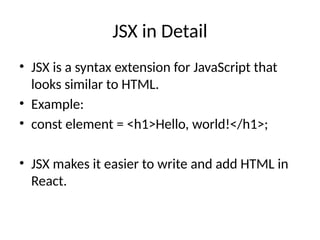
JSX in Detail
•JSX is a syntax extension for JavaScript that
looks similar to HTML.
• Example:
• const element = <h1>Hello, world!</h1>;
• JSX makes it easier to write and add HTML in
React.
6.
Components in React
•- Functional Components: Simple JavaScript
functions
• - Class Components: ES6 classes with lifecycle
methods
• - Components can accept inputs (props) and
return React elements
7.
Virtual DOM Explained
•The Virtual DOM is a lightweight JavaScript
representation of the actual DOM.
• - React updates only changed parts, improving
performance
• - Helps in building fast and dynamic web
applications
8.
React Hooks
• -Introduced in React 16.8 to use state and
other features without classes
• - Common hooks:
• • useState – Manage state
• • useEffect – Side effects
• • useContext – Context API
• • useRef, useReducer – Advanced state and
refs
9.
Routing in React
•- React Router is the standard library for
routing in React
• - Enables navigation among views of various
components
• - Manages browser history, URL paths
• Example:
• <Route path='/about' element={<About />} />
10.
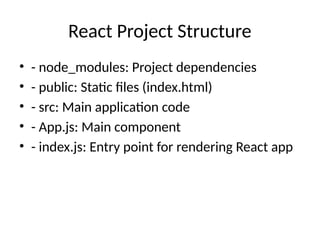
React Project Structure
•- node_modules: Project dependencies
• - public: Static files (index.html)
• - src: Main application code
• - App.js: Main component
• - index.js: Entry point for rendering React app
11.
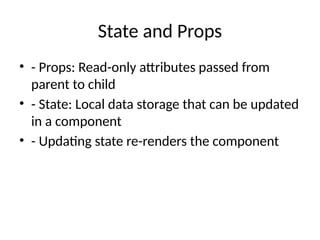
State and Props
•- Props: Read-only attributes passed from
parent to child
• - State: Local data storage that can be updated
in a component
• - Updating state re-renders the component
Advantages of React
•- Fast performance with Virtual DOM
• - Component reusability
• - Strong community and ecosystem
• - Easy integration with other frameworks
• - Suitable for mobile apps using React Native
15.
Conclusion
• React isa powerful library for building user
interfaces with speed and efficiency.
• With its modular architecture and growing
ecosystem, it is a top choice for modern web
development.
• Continue learning by building real-world
applications.
![React.js - A JavaScript Library for
Building User Interfaces
Presented by: [Your Name]
Date: [Insert Date]](https://image.slidesharecdn.com/detailedreactjspresentation-250623120659-d1b7d661/85/reacts-js-with-basic-details-Detailed_ReactJS_Presentation-pptx-1-320.jpg)
![React.js - A JavaScript Library for
Building User Interfaces
Presented by: [Your Name]
Date: [Insert Date]](https://image.slidesharecdn.com/detailedreactjspresentation-250623120659-d1b7d661/75/reacts-js-with-basic-details-Detailed_ReactJS_Presentation-pptx-1-2048.jpg)


![Full Stack React Workshop [CSSC x GDSC]](https://cdn.slidesharecdn.com/ss_thumbnails/fullstackreactworkshopcsscxgdsc-230221003415-b512c1cf-thumbnail.jpg?width=640&height=640&fit=bounds)


![[Final] ReactJS presentation](https://cdn.slidesharecdn.com/ss_thumbnails/65cfd4f9-740f-4f41-b769-b496b6e60802-170119143904-thumbnail.jpg?width=640&height=640&fit=bounds)


![[Deck] What's New in Spark-Iceberg Integration via DSV2.pptx](https://cdn.slidesharecdn.com/ss_thumbnails/deckwhatsnewinspark-icebergintegrationviadsv2-260210005337-25955b12-thumbnail.jpg?width=640&height=640&fit=bounds)