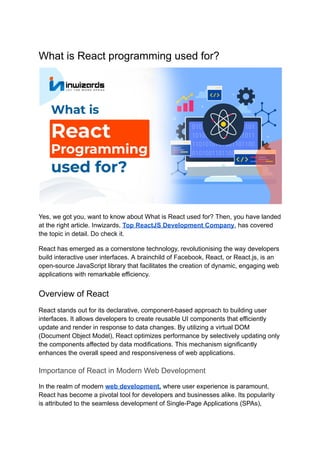
What is React programming used for?
Yes, we got you, want to know about What is React used for? Then, you have landed
at the right article. Inwizards, Top ReactJS Development Company, has covered
the topic in detail. Do check it.
React has emerged as a cornerstone technology, revolutionising the way developers
build interactive user interfaces. A brainchild of Facebook, React, or React.js, is an
open-source JavaScript library that facilitates the creation of dynamic, engaging web
applications with remarkable efficiency.
Overview of React
React stands out for its declarative, component-based approach to building user
interfaces. It allows developers to create reusable UI components that efficiently
update and render in response to data changes. By utilizing a virtual DOM
(Document Object Model), React optimizes performance by selectively updating only
the components affected by data modifications. This mechanism significantly
enhances the overall speed and responsiveness of web applications.
Importance of React in Modern Web Development
In the realm of modern web development, where user experience is paramount,
React has become a pivotal tool for developers and businesses alike. Its popularity
is attributed to the seamless development of Single-Page Applications (SPAs),
where users can enjoy fluid, uninterrupted navigation without the need for page
reloads. React's efficient handling of the virtual DOM ensures a smoother user
experience, making it an ideal choice for creating dynamic and visually appealing
interfaces.
Moreover, React's component-based architecture foster's code reusability,
simplifying the development process and reducing the likelihood of errors. This
modular approach not only enhances development speed but also makes
maintenance more manageable, crucial in the fast-paced world of web technologies.
Understanding the Applications of React and Exploring React
Development Services
This article serves as a comprehensive guide to shed light on the diverse
applications of React in modern web development. We will delve into its core
functionalities, exploring how it is employed to build intuitive user interfaces, enable
the creation of SPAs, and foster the development of reusable components.
Furthermore, we aim to unravel the significance of React Development Services in
the contemporary digital landscape. As businesses strive for dynamic, responsive,
and visually appealing web solutions, the demand for skilled React developers and
development services has surged. Through this exploration, readers will gain
insights into why React is a preferred choice for many, and how seeking professional
React Development Services can elevate the quality and efficiency of web
application development.
Join us on this journey as we unravel the power of React, its real-world applications,
and the role of React Development Services in shaping the digital experiences of
tomorrow. Whether you are a seasoned developer, a business owner, or an
enthusiast keen on understanding the pulse of web development, this article is
crafted to provide valuable insights and perspectives on the dynamic world of React.
Want to know Why Use ReactJS For Web Development? Check Detailed Article
What is React?
React, or React.js, is an open-source JavaScript library developed and maintained
by Facebook. Launched in 2013, React quickly gained popularity for its efficiency in
building interactive user interfaces (UIs) for web applications. It has since become a
cornerstone in the world of modern web development.
Key Features and Characteristics:
● Declarative Syntax:
React utilises a declarative syntax, allowing developers to describe the desired
outcome of their UI without specifying the step-by-step process to achieve it. This
makes the code more predictable and easier to understand.
● Virtual DOM:
One of React's standout features is its use of a virtual DOM. Instead of directly
manipulating the browser's DOM, React creates a lightweight virtual representation
of it. This approach improves performance by minimizing actual DOM manipulation
and efficiently updating only the necessary components.
● Component-Based Architecture:
React follows a component-based architecture, enabling developers to break down
the UI into independent, reusable components. Each component manages its state,
making it easier to maintain and update the application.
● Unidirectional Data Flow:
React enforces a unidirectional data flow, ensuring that the flow of data is predictable
and easy to understand. This helps in preventing common pitfalls associated with
two-way data binding.
Check the detailed comparison Between ReactJS and React Native.
React's Role in Building User Interfaces:
React plays a pivotal role in creating seamless, interactive, and high-performance
user interfaces. Its key contributions include:
● Efficient Updates:
React's virtual DOM enables efficient updates by selectively rendering only the
components that have changed. This results in faster rendering and a smoother user
experience.
● Component Reusability:
With React's component-based architecture, developers can create modular and
reusable UI components. This not only simplifies the development process but also
enhances maintainability.
● Responsive UIs:
React excels in building responsive UIs that dynamically update in real-time based
on user interactions or data changes. This is especially beneficial for SPAs where
seamless transitions are essential.
Introduction to React Components:
In React, components are the building blocks of UIs. A React component is a
self-contained module that encapsulates a specific piece of functionality and its
corresponding UI. Key aspects of React components include:
● Class Components:
Class components are ES6 classes that extend from React.Component. They have
a render method that defines what will be displayed in the UI.
● Functional Components:
With the introduction of React Hooks, functional components can now manage state
and lifecycle methods, providing a simpler and more concise way to define
components.
● Props:
React components can receive data through props (short for properties), which are
essentially parameters passed down from parent components. This allows for
dynamic and flexible component behaviour.
● State:
State in React represents the current condition of a component and determines its
rendering and behaviour. State can be updated using the setState method, triggering
re-rendering when modified.
Confused Between NativeScript vs React Native: Choosing the Right
Framework for Your App Development? Check Detailed Article
What is React Used For?
React, developed by Facebook, has become a cornerstone in modern web
development, offering a robust platform for building dynamic and responsive user
interfaces. Let's delve into the specific applications of React, exploring its key uses
and the advantages it brings to the table.
A. Building User Interfaces
1. Declarative Approach to UI Development
One of React's standout features is its declarative approach to user interface (UI)
development. Unlike the imperative approach, where developers specify each step
to achieve a desired outcome, React allows developers to declare the end result,
letting the framework handle the how.
This simplifies the codebase, making it more readable and maintainable. Developers
can focus on describing what they want, and React takes care of the underlying
processes. The result is cleaner, more efficient code that promotes collaboration
among developers.
2. Virtual DOM and Its Significance
React employs a Virtual DOM (Document Object Model) to enhance UI rendering
efficiency. The Virtual DOM is a lightweight copy of the actual DOM, and when
changes occur, React first updates the Virtual DOM before applying those changes
to the real DOM. This minimises unnecessary updates, significantly improving
performance.
By intelligently updating only the parts of the DOM that have changed, React
reduces the overall computational load, leading to faster rendering times and a
smoother user experience. This innovative approach has been pivotal in React's
widespread adoption.
Confused Between NodeJS vs ReactJS: What to choose? Read Inwizards Experts
Opinion
B. Single-Page Applications (SPAs)
1. Enhanced User Experience
React is particularly well-suited for building Single-Page Applications (SPAs), where
content is loaded dynamically on a single web page, eliminating the need for page
reloads. This results in a seamless and immersive user experience, similar to that of
a desktop application.
The ability to update content without refreshing the entire page enhances user
interaction, providing a more fluid and responsive feel. SPAs built with React can
deliver a highly engaging user interface, making them ideal for various web
applications.
2. Improved Performance with Virtual DOM
The Virtual DOM plays a crucial role in the performance of SPAs. Since React
utilises a Virtual DOM to identify and apply only the necessary changes, the
rendering process becomes more efficient. This leads to faster load times and
smoother transitions between different sections of the SPA.
React's efficient handling of the Virtual DOM contributes to a snappy user interface,
even in applications with complex structures and dynamic content updates.
C. Reusable Components
1. Component-Based Architecture
React's architecture is based on components, modular units that encapsulate
specific functionality and UI elements. This component-based approach allows
developers to break down complex UIs into manageable and reusable pieces. Each
component can be developed, tested, and maintained independently.
This modularity promotes code reusability, as components can be used across
different parts of an application or even in entirely different projects. It streamlines
development workflows and facilitates collaboration among teams working on
different sections of a project.
2. Advantages of Reusability in React
The advantages of reusability in React are multifaceted. First and foremost, it
accelerates development cycles. Developers can leverage existing components,
reducing the need to recreate similar elements from scratch. This not only saves
time but also ensures consistency throughout the application.
Furthermore, when updates or improvements are required, changes made to a
reusable component automatically propagate across all instances where it is used.
This simplifies maintenance, reduces the likelihood of errors, and contributes to a
more robust and scalable codebase.
D. React Native for Mobile App Development
1. Extending React to Mobile Platforms
React Native, an extension of React, enables the development of mobile applications
using the same principles of React for web development. This cross-platform
framework allows developers to use React components to build native mobile apps
for iOS and Android platforms.
The ability to leverage existing React skills and code for mobile development
streamlines the transition from web to mobile. Developers can build a consistent user
experience across both web and mobile applications, reducing the learning curve for
those already familiar with React.
Want to develop software for your business? Consult Inwizards, a Top Software
Development Company based in USA, UAE, India.
2. Benefits of Using React Native
● Code Reusability: Developers can reuse a significant portion of the
codebase between web and mobile applications, saving time and effort.
● Efficient Development: Changes made to the code reflect across both
platforms, ensuring consistent updates and reducing the need for separate
development teams.
● Native Performance: React Native apps offer near-native performance, as
the framework translates components into native views for optimal user
experience.
● Large Community and Ecosystem: With a vibrant community and extensive
third-party libraries, React Native provides a rich ecosystem for mobile app
development.
Conclusion
In conclusion, React has proven itself as a powerhouse in modern web development,
revolutionizing the way we build user interfaces and empowering developers to
create dynamic, efficient, and engaging applications.
Its versatility extends beyond traditional web development, making it a key player in
the realm of Single-Page Applications and even mobile app development through
React Native.
Want to develop software for your business? Consult Inwizards, Top Software
development Company based in USA, UAE, India.

What is React programming used for_ .pdf

  • 1.
    What is Reactprogramming used for? Yes, we got you, want to know about What is React used for? Then, you have landed at the right article. Inwizards, Top ReactJS Development Company, has covered the topic in detail. Do check it. React has emerged as a cornerstone technology, revolutionising the way developers build interactive user interfaces. A brainchild of Facebook, React, or React.js, is an open-source JavaScript library that facilitates the creation of dynamic, engaging web applications with remarkable efficiency. Overview of React React stands out for its declarative, component-based approach to building user interfaces. It allows developers to create reusable UI components that efficiently update and render in response to data changes. By utilizing a virtual DOM (Document Object Model), React optimizes performance by selectively updating only the components affected by data modifications. This mechanism significantly enhances the overall speed and responsiveness of web applications. Importance of React in Modern Web Development In the realm of modern web development, where user experience is paramount, React has become a pivotal tool for developers and businesses alike. Its popularity is attributed to the seamless development of Single-Page Applications (SPAs),
  • 2.
    where users canenjoy fluid, uninterrupted navigation without the need for page reloads. React's efficient handling of the virtual DOM ensures a smoother user experience, making it an ideal choice for creating dynamic and visually appealing interfaces. Moreover, React's component-based architecture foster's code reusability, simplifying the development process and reducing the likelihood of errors. This modular approach not only enhances development speed but also makes maintenance more manageable, crucial in the fast-paced world of web technologies. Understanding the Applications of React and Exploring React Development Services This article serves as a comprehensive guide to shed light on the diverse applications of React in modern web development. We will delve into its core functionalities, exploring how it is employed to build intuitive user interfaces, enable the creation of SPAs, and foster the development of reusable components. Furthermore, we aim to unravel the significance of React Development Services in the contemporary digital landscape. As businesses strive for dynamic, responsive, and visually appealing web solutions, the demand for skilled React developers and development services has surged. Through this exploration, readers will gain insights into why React is a preferred choice for many, and how seeking professional React Development Services can elevate the quality and efficiency of web application development. Join us on this journey as we unravel the power of React, its real-world applications, and the role of React Development Services in shaping the digital experiences of tomorrow. Whether you are a seasoned developer, a business owner, or an enthusiast keen on understanding the pulse of web development, this article is crafted to provide valuable insights and perspectives on the dynamic world of React. Want to know Why Use ReactJS For Web Development? Check Detailed Article What is React? React, or React.js, is an open-source JavaScript library developed and maintained by Facebook. Launched in 2013, React quickly gained popularity for its efficiency in building interactive user interfaces (UIs) for web applications. It has since become a cornerstone in the world of modern web development. Key Features and Characteristics: ● Declarative Syntax:
  • 3.
    React utilises adeclarative syntax, allowing developers to describe the desired outcome of their UI without specifying the step-by-step process to achieve it. This makes the code more predictable and easier to understand. ● Virtual DOM: One of React's standout features is its use of a virtual DOM. Instead of directly manipulating the browser's DOM, React creates a lightweight virtual representation of it. This approach improves performance by minimizing actual DOM manipulation and efficiently updating only the necessary components. ● Component-Based Architecture: React follows a component-based architecture, enabling developers to break down the UI into independent, reusable components. Each component manages its state, making it easier to maintain and update the application. ● Unidirectional Data Flow: React enforces a unidirectional data flow, ensuring that the flow of data is predictable and easy to understand. This helps in preventing common pitfalls associated with two-way data binding. Check the detailed comparison Between ReactJS and React Native. React's Role in Building User Interfaces: React plays a pivotal role in creating seamless, interactive, and high-performance user interfaces. Its key contributions include: ● Efficient Updates: React's virtual DOM enables efficient updates by selectively rendering only the components that have changed. This results in faster rendering and a smoother user experience. ● Component Reusability: With React's component-based architecture, developers can create modular and reusable UI components. This not only simplifies the development process but also enhances maintainability. ● Responsive UIs: React excels in building responsive UIs that dynamically update in real-time based on user interactions or data changes. This is especially beneficial for SPAs where seamless transitions are essential.
  • 4.
    Introduction to ReactComponents: In React, components are the building blocks of UIs. A React component is a self-contained module that encapsulates a specific piece of functionality and its corresponding UI. Key aspects of React components include: ● Class Components: Class components are ES6 classes that extend from React.Component. They have a render method that defines what will be displayed in the UI. ● Functional Components: With the introduction of React Hooks, functional components can now manage state and lifecycle methods, providing a simpler and more concise way to define components. ● Props: React components can receive data through props (short for properties), which are essentially parameters passed down from parent components. This allows for dynamic and flexible component behaviour. ● State: State in React represents the current condition of a component and determines its rendering and behaviour. State can be updated using the setState method, triggering re-rendering when modified. Confused Between NativeScript vs React Native: Choosing the Right Framework for Your App Development? Check Detailed Article What is React Used For? React, developed by Facebook, has become a cornerstone in modern web development, offering a robust platform for building dynamic and responsive user interfaces. Let's delve into the specific applications of React, exploring its key uses and the advantages it brings to the table. A. Building User Interfaces 1. Declarative Approach to UI Development One of React's standout features is its declarative approach to user interface (UI) development. Unlike the imperative approach, where developers specify each step
  • 5.
    to achieve adesired outcome, React allows developers to declare the end result, letting the framework handle the how. This simplifies the codebase, making it more readable and maintainable. Developers can focus on describing what they want, and React takes care of the underlying processes. The result is cleaner, more efficient code that promotes collaboration among developers. 2. Virtual DOM and Its Significance React employs a Virtual DOM (Document Object Model) to enhance UI rendering efficiency. The Virtual DOM is a lightweight copy of the actual DOM, and when changes occur, React first updates the Virtual DOM before applying those changes to the real DOM. This minimises unnecessary updates, significantly improving performance. By intelligently updating only the parts of the DOM that have changed, React reduces the overall computational load, leading to faster rendering times and a smoother user experience. This innovative approach has been pivotal in React's widespread adoption. Confused Between NodeJS vs ReactJS: What to choose? Read Inwizards Experts Opinion B. Single-Page Applications (SPAs) 1. Enhanced User Experience React is particularly well-suited for building Single-Page Applications (SPAs), where content is loaded dynamically on a single web page, eliminating the need for page reloads. This results in a seamless and immersive user experience, similar to that of a desktop application. The ability to update content without refreshing the entire page enhances user interaction, providing a more fluid and responsive feel. SPAs built with React can deliver a highly engaging user interface, making them ideal for various web applications. 2. Improved Performance with Virtual DOM The Virtual DOM plays a crucial role in the performance of SPAs. Since React utilises a Virtual DOM to identify and apply only the necessary changes, the rendering process becomes more efficient. This leads to faster load times and smoother transitions between different sections of the SPA.
  • 6.
    React's efficient handlingof the Virtual DOM contributes to a snappy user interface, even in applications with complex structures and dynamic content updates. C. Reusable Components 1. Component-Based Architecture React's architecture is based on components, modular units that encapsulate specific functionality and UI elements. This component-based approach allows developers to break down complex UIs into manageable and reusable pieces. Each component can be developed, tested, and maintained independently. This modularity promotes code reusability, as components can be used across different parts of an application or even in entirely different projects. It streamlines development workflows and facilitates collaboration among teams working on different sections of a project. 2. Advantages of Reusability in React The advantages of reusability in React are multifaceted. First and foremost, it accelerates development cycles. Developers can leverage existing components, reducing the need to recreate similar elements from scratch. This not only saves time but also ensures consistency throughout the application. Furthermore, when updates or improvements are required, changes made to a reusable component automatically propagate across all instances where it is used. This simplifies maintenance, reduces the likelihood of errors, and contributes to a more robust and scalable codebase. D. React Native for Mobile App Development 1. Extending React to Mobile Platforms React Native, an extension of React, enables the development of mobile applications using the same principles of React for web development. This cross-platform framework allows developers to use React components to build native mobile apps for iOS and Android platforms. The ability to leverage existing React skills and code for mobile development streamlines the transition from web to mobile. Developers can build a consistent user experience across both web and mobile applications, reducing the learning curve for those already familiar with React. Want to develop software for your business? Consult Inwizards, a Top Software Development Company based in USA, UAE, India.
  • 7.
    2. Benefits ofUsing React Native ● Code Reusability: Developers can reuse a significant portion of the codebase between web and mobile applications, saving time and effort. ● Efficient Development: Changes made to the code reflect across both platforms, ensuring consistent updates and reducing the need for separate development teams. ● Native Performance: React Native apps offer near-native performance, as the framework translates components into native views for optimal user experience. ● Large Community and Ecosystem: With a vibrant community and extensive third-party libraries, React Native provides a rich ecosystem for mobile app development. Conclusion In conclusion, React has proven itself as a powerhouse in modern web development, revolutionizing the way we build user interfaces and empowering developers to create dynamic, efficient, and engaging applications. Its versatility extends beyond traditional web development, making it a key player in the realm of Single-Page Applications and even mobile app development through React Native. Want to develop software for your business? Consult Inwizards, Top Software development Company based in USA, UAE, India.