Types of Reactions
1. Synthesis reactions
2. Decomposition reactions
3. Single displacement reactions
4. Double displacement reactions
5. Combustion reactions
You need to be able to identify each type.
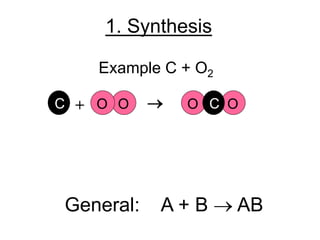
1. Synthesis
Example C + O2
O
O
C +  O O
C
General: A + B  AB
Ex. Synthesis Reaction
Practice
• Predict the products.
Na(s) + Cl2(g) 
Mg(s) + F2(g) 
Al(s) + F2(g) 
NaCl(s)
MgF2(s)
AlF3(s)
2
2
2 3 2
• Now, balance them.
2. Decomposition
Example: NaCl
General: AB  A + B

Cl Na Cl + Na
Ex. Decomposition Reaction
3. Single Displacement
Example: Zn + CuCl2

Zn
Cl
Cl
Cu +
General: AB + C  AC + B
Cl
Cl
Zn Cu
+
Zn was oxidized
Went from neutral (0) to (+2)
Cu was reduced
Went from (+2) to Neutral (0)
Ex. Single Replacement Reaction
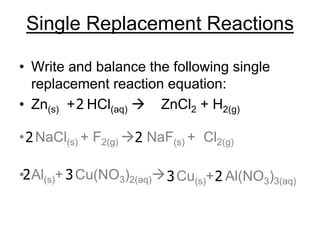
Single Replacement Reactions
• Write and balance the following single
replacement reaction equation:
• Zn(s) + HCl(aq)  ZnCl2 + H2(g)
2
• NaCl(s) + F2(g)  NaF(s) + Cl2(g)
• Al(s)+ Cu(NO3)2(aq)
2 2
Cu(s)+ Al(NO3)3(aq)
3 2
3
2
4. Double displacement
Example: MgO + CaS
General: AB + CD  AD + CB
S
O

Mg Ca
+
O
S
Mg Ca
+
Double Replacement Reactions
• Think about it like “foil”ing in algebra, first and
last ions go together + inside ions go together
• Example:
AgNO3(aq) + NaCl(s)  AgCl(s) + NaNO3(aq)
• Another example:
K2SO4(aq) + Ba(NO3)2(aq)  KNO3(aq) + BaSO4(s)
2
Practice
• Predict the products.
1. HCl(aq) + AgNO3(aq) 
2. CaCl2(aq) + Na3PO4(aq) 
3. Pb(NO3)2(aq) + BaCl2(aq) 
4. FeCl3(aq) + NaOH(aq) 
5. H2SO4(aq) + NaOH(aq) 
6. KOH(aq) + CuSO4(aq) 
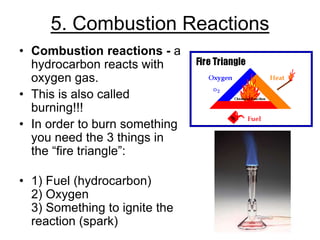
5. Combustion Reactions
• Combustion reactions - a
hydrocarbon reacts with
oxygen gas.
• This is also called
burning!!!
• In order to burn something
you need the 3 things in
the “fire triangle”:
• 1) Fuel (hydrocarbon)
2) Oxygen
3) Something to ignite the
reaction (spark)
Combustion Reactions
• In general:
CxHy + O2  CO2 + H2O
• Products are ALWAYS
carbon dioxide and water.
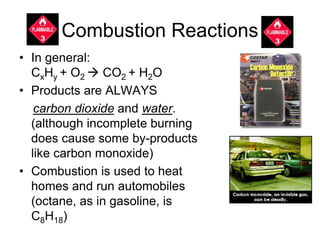
(although incomplete burning
does cause some by-products
like carbon monoxide)
• Combustion is used to heat
homes and run automobiles
(octane, as in gasoline, is
C8H18)
Combustion
• Example
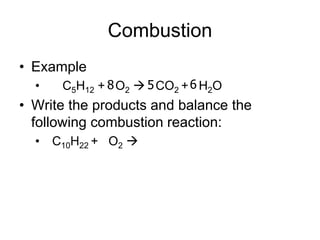
• C5H12 + O2  CO2 + H2O
• Write the products and balance the
following combustion reaction:
• C10H22 + O2 
5 6
8
Mixed Practice
• State the type & predict the products.
1. BaCl2 + H2SO4 
2. C6H12 + O2 
3. Zn + CuSO4 
4. Cs + Br2 
5. FeCO3 

Reaction.ppt

  • 1.
    Types of Reactions 1.Synthesis reactions 2. Decomposition reactions 3. Single displacement reactions 4. Double displacement reactions 5. Combustion reactions You need to be able to identify each type.
  • 2.
    1. Synthesis Example C+ O2 O O C +  O O C General: A + B  AB
  • 3.
  • 4.
    Practice • Predict theproducts. Na(s) + Cl2(g)  Mg(s) + F2(g)  Al(s) + F2(g)  NaCl(s) MgF2(s) AlF3(s) 2 2 2 3 2 • Now, balance them.
  • 5.
    2. Decomposition Example: NaCl General:AB  A + B  Cl Na Cl + Na
  • 6.
  • 7.
    3. Single Displacement Example:Zn + CuCl2  Zn Cl Cl Cu + General: AB + C  AC + B Cl Cl Zn Cu + Zn was oxidized Went from neutral (0) to (+2) Cu was reduced Went from (+2) to Neutral (0)
  • 8.
  • 9.
    Single Replacement Reactions •Write and balance the following single replacement reaction equation: • Zn(s) + HCl(aq)  ZnCl2 + H2(g) 2 • NaCl(s) + F2(g)  NaF(s) + Cl2(g) • Al(s)+ Cu(NO3)2(aq) 2 2 Cu(s)+ Al(NO3)3(aq) 3 2 3 2
  • 10.
    4. Double displacement Example:MgO + CaS General: AB + CD  AD + CB S O  Mg Ca + O S Mg Ca +
  • 11.
    Double Replacement Reactions •Think about it like “foil”ing in algebra, first and last ions go together + inside ions go together • Example: AgNO3(aq) + NaCl(s)  AgCl(s) + NaNO3(aq) • Another example: K2SO4(aq) + Ba(NO3)2(aq)  KNO3(aq) + BaSO4(s) 2
  • 12.
    Practice • Predict theproducts. 1. HCl(aq) + AgNO3(aq)  2. CaCl2(aq) + Na3PO4(aq)  3. Pb(NO3)2(aq) + BaCl2(aq)  4. FeCl3(aq) + NaOH(aq)  5. H2SO4(aq) + NaOH(aq)  6. KOH(aq) + CuSO4(aq) 
  • 13.
    5. Combustion Reactions •Combustion reactions - a hydrocarbon reacts with oxygen gas. • This is also called burning!!! • In order to burn something you need the 3 things in the “fire triangle”: • 1) Fuel (hydrocarbon) 2) Oxygen 3) Something to ignite the reaction (spark)
  • 14.
    Combustion Reactions • Ingeneral: CxHy + O2  CO2 + H2O • Products are ALWAYS carbon dioxide and water. (although incomplete burning does cause some by-products like carbon monoxide) • Combustion is used to heat homes and run automobiles (octane, as in gasoline, is C8H18)
  • 15.
    Combustion • Example • C5H12+ O2  CO2 + H2O • Write the products and balance the following combustion reaction: • C10H22 + O2  5 6 8
  • 16.
    Mixed Practice • Statethe type & predict the products. 1. BaCl2 + H2SO4  2. C6H12 + O2  3. Zn + CuSO4  4. Cs + Br2  5. FeCO3 