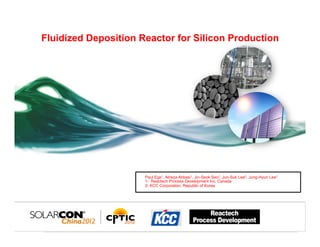
Fluidized Deposition Reactor for Silicon Production


                      Paul Ege1, Alireza Abbasi1, Jin-Seok Seo2, Jun-Suk Lee2, Jung-Hyun Lee2
                      1- Reactech Process Development Inc, Canada
                      2- KCC Corporation, Republic of Korea
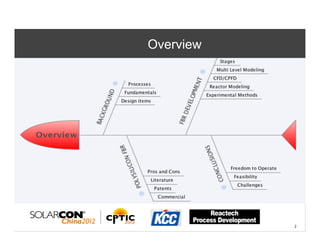
Overview


           2	
  
Background
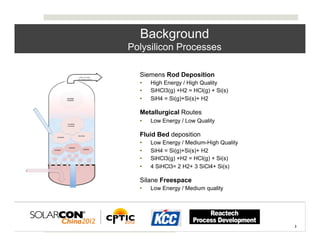
Polysilicon Processes

•    Siemens Rod Deposition
     •    High Energy / High Quality
     •    SiHCl3(g) +H2 = HCl(g) + Si(s)
     •    SiH4 = Si(g)+Si(s)+ H2

•    Metallurgical Routes
     •    Low Energy / Low Quality

•    Fluid Bed deposition
     •    Low Energy / Medium-High Quality
     •    SiH4 = Si(g)+Si(s)+ H2
     •    SiHCl3(g) +H2 = HCl(g) + Si(s)
     •    4 SiHCl3= 2 H2+ 3 SiCl4+ Si(s)

•    Silane Freespace
     •    Low Energy / Medium quality


                                             3	
  
                                                     3	
  
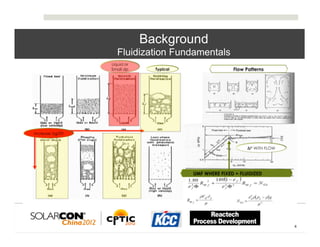
Background
Fluidization Fundamentals


                            4	
  
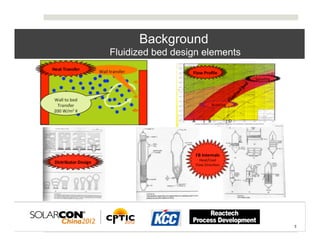
Background
Fluidized bed design elements


                                5	


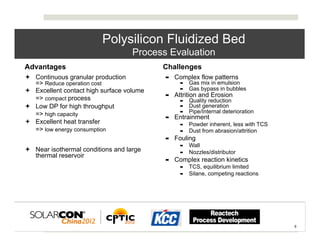
                          Polysilicon Fluidized Bed
                                     Process Evaluation
Advantages                                  Challenges
ª  Continuous granular production          -  Complex flow patterns
    => Reduce operation cost                     -  Gas mix in emulsion
ª  Excellent contact high surface volume        -  Gas bypass in bubbles
                                            -  Attrition and Erosion
    => compact process                           -  Quality reduction
ª  Low DP for high throughput                   -  Dust generation
    => high capacity                             -  Pipe/Internal deterioration
                                            -  Entrainment
ª  Excellent heat transfer                      -  Powder inherent, less with TCS
    => low energy consumption                    -  Dust from abrasion/attrition
                                            -  Fouling
                                                 -  Wall
ª  Near isothermal conditions and large         -  Nozzles/distributor
    thermal reservoir
                                            -  Complex reaction kinetics
                                                 -  TCS, equilibrium limited
                                                 -  Silane, competing reactions


                                                                                            6	
  
                                                                                                    6	
  
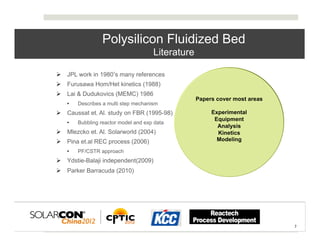
Polysilicon Fluidized Bed
                                       Literature

Ø  JPL work in 1980ʼ’s many references
Ø  Furusawa Hom/Het kinetics (1988)
Ø  Lai & Dudukovics (MEMC) 1986
    •    Describes a multi step mechanism
Ø  Caussat et. Al. study on FBR (1995-98)
    •    Bubbling reactor model and exp data
Ø  Mlezcko et. Al. Solarworld (2004)
Ø  Pina et.al REC process (2006)
    •    PF/CSTR approach
Ø  Ydstie-Balaji independent(2009)
Ø  Parker Barracuda (2010)


                                                    7	
  
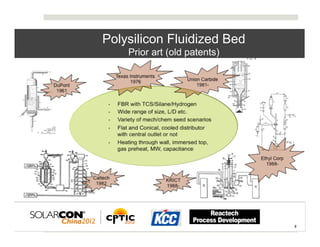
Polysilicon Fluidized Bed
    Prior art (old patents)


                              8	
  
Polysilicon Fluidized Bed
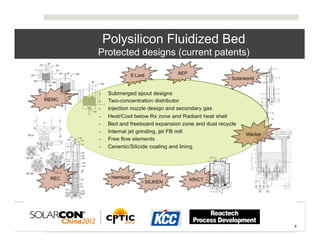
Protected designs (current patents)


                                      9	
  
Polysilicon Fluidized Bed
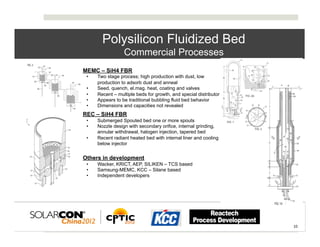
                  Commercial Processes
MEMC – SiH4 FBR
 •    Two stage process; high production with dust, low
      production to adsorb dust and anneal
 •    Seed, quench, el.mag. heat, coating and valves
 •    Recent – multiple beds for growth, and special distributor
 •    Appears to be traditional bubbling fluid bed behavior
 •    Dimensions and capacities not revealed
REC – SiH4 FBR
 •    Submerged Spouted bed one or more spouts
 •    Nozzle design with secondary orifice, internal grinding,
      annular withdrawal, halogen injection, tapered bed
 •    Recent radiant heated bed with internal liner and cooling
      below injector


Others in development
 •    Wacker, KRICT, AEP, SILIKEN – TCS based
 •    Samsung-MEMC, KCC – Silane based
 •    Independent developers


                                                                   10	
  
Polysilicon Fluidized Bed
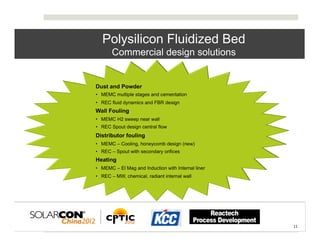
 Commercial design solutions


                               11	
  
FBR development
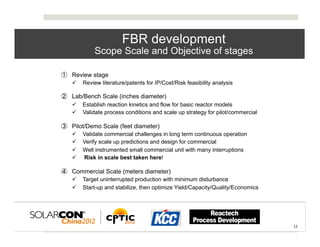
            Scope Scale and Objective of stages

①  Review stage
   ü  Review literature/patents for IP/Cost/Risk feasibility analysis

②  Lab/Bench Scale (inches diameter)
   ü  Establish reaction kinetics and flow for basic reactor models
   ü  Validate process conditions and scale up strategy for pilot/commercial

③  Pilot/Demo Scale (feet diameter)
   ü  Validate commercial challenges in long term continuous operation
   ü  Verify scale up predictions and design for commercial
   ü  Well instrumented small commercial unit with many interruptions
   ü  Risk in scale best taken here!

④  Commercial Scale (meters diameter)
   ü  Target uninterrupted production with minimum disturbance
   ü  Start-up and stabilize, then optimize Yield/Capacity/Quality/Economics


                                                                                12	
  
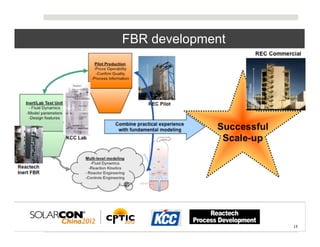
FBR development
  Multi Stage Effort


                       13	
  
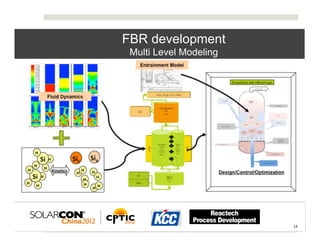
FBR development
 Multi Level Modeling


                        14	
  
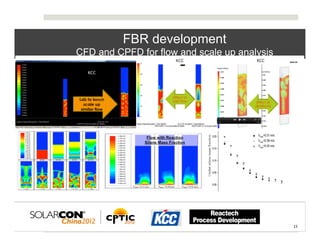
FBR development
                                             CFD and CPFD for flow and scale up analysis


Reactech	
  Process	
  Development	
  	
                                                   15	
  
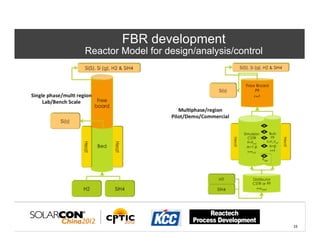
FBR development
Reactor Model for design/analysis/control


                                            16	
  
FBR development
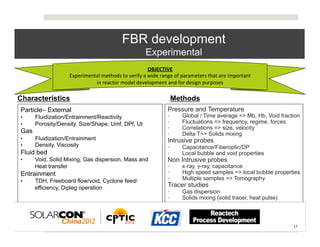
                                                                   Experimental
                                                                   OBJECTIVE	
  
                   Experimental	
  methods	
  to	
  verify	
  a	
  wide	
  range	
  of	
  parameters	
  that	
  are	
  important	
  	
  
                             in	
  reactor	
  model	
  development	
  and	
  for	
  design	
  purposes	
  

Characteristics                                                                    Methods
Particle– External                                                               Pressure and Temperature
•     Fluidization/Entrainment/Reactivity                                        •        Global / Time average => Mb, Hb, Void fraction
•     Porosity/Density, Size/Shape, Umf, DPf, Ut                                 •        Fluctuations => frequency, regime, forces
                                                                                 •        Correlations => size, velocity
Gas                                                                              •        Delta T=> Solids mixing
•     Fluidization/Entrainment                                                   Intrusive probes
•     Density, Viscosity                                                         •        Capacitance/Fiberoptic/DP
Fluid bed                                                                        •        Local bubble and void properties
•     Void, Solid Mixing, Gas dispersion, Mass and                               Non Intrusive probes
      Heat transfer                                                              •        x-ray, γ-ray, capacitance
Entrainment                                                                      •        High speed samples => local bubble properties
•     TDH, Freeboard flow/void, Cyclone feed/                                    •        Multiple samples => Tomography
      efficiency, Dipleg operation                                               Tracer studies
                                                                                 •        Gas dispersion
                                                                                 •        Solids mixing (solid tracer, heat pulse)


                                                                                                                                           17	
  
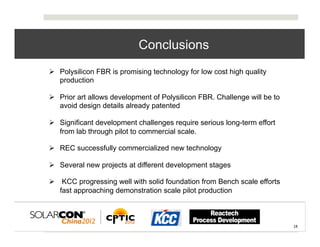
Conclusions
Ø  Polysilicon FBR is promising technology for low cost high quality
    production

Ø  Prior art allows development of Polysilicon FBR. Challenge will be to
    avoid design details already patented

Ø  Significant development challenges require serious long-term effort
    from lab through pilot to commercial scale.

Ø  REC successfully commercialized new technology

Ø  Several new projects at different development stages

Ø  KCC progressing well with solid foundation from Bench scale efforts
    fast approaching demonstration scale pilot production


                                                                            18	
  

Fluidized Deposition Reactor for Silicon Production

  • 1.
    Fluidized Deposition Reactorfor Silicon Production Paul Ege1, Alireza Abbasi1, Jin-Seok Seo2, Jun-Suk Lee2, Jung-Hyun Lee2 1- Reactech Process Development Inc, Canada 2- KCC Corporation, Republic of Korea
  • 2.
  • 3.
    Background Polysilicon Processes •  Siemens Rod Deposition •  High Energy / High Quality •  SiHCl3(g) +H2 = HCl(g) + Si(s) •  SiH4 = Si(g)+Si(s)+ H2 •  Metallurgical Routes •  Low Energy / Low Quality •  Fluid Bed deposition •  Low Energy / Medium-High Quality •  SiH4 = Si(g)+Si(s)+ H2 •  SiHCl3(g) +H2 = HCl(g) + Si(s) •  4 SiHCl3= 2 H2+ 3 SiCl4+ Si(s) •  Silane Freespace •  Low Energy / Medium quality 3   3  
  • 4.
  • 5.
  • 6.
        Polysilicon Fluidized Bed Process Evaluation Advantages Challenges ª  Continuous granular production -  Complex flow patterns => Reduce operation cost -  Gas mix in emulsion ª  Excellent contact high surface volume -  Gas bypass in bubbles -  Attrition and Erosion => compact process -  Quality reduction ª  Low DP for high throughput -  Dust generation => high capacity -  Pipe/Internal deterioration -  Entrainment ª  Excellent heat transfer -  Powder inherent, less with TCS => low energy consumption -  Dust from abrasion/attrition -  Fouling -  Wall ª  Near isothermal conditions and large -  Nozzles/distributor thermal reservoir -  Complex reaction kinetics -  TCS, equilibrium limited -  Silane, competing reactions 6   6  
  • 7.
    Polysilicon Fluidized Bed Literature Ø  JPL work in 1980ʼ’s many references Ø  Furusawa Hom/Het kinetics (1988) Ø  Lai & Dudukovics (MEMC) 1986 •  Describes a multi step mechanism Ø  Caussat et. Al. study on FBR (1995-98) •  Bubbling reactor model and exp data Ø  Mlezcko et. Al. Solarworld (2004) Ø  Pina et.al REC process (2006) •  PF/CSTR approach Ø  Ydstie-Balaji independent(2009) Ø  Parker Barracuda (2010) 7  
  • 8.
    Polysilicon Fluidized Bed Prior art (old patents) 8  
  • 9.
    Polysilicon Fluidized Bed Protecteddesigns (current patents) 9  
  • 10.
    Polysilicon Fluidized Bed Commercial Processes MEMC – SiH4 FBR •  Two stage process; high production with dust, low production to adsorb dust and anneal •  Seed, quench, el.mag. heat, coating and valves •  Recent – multiple beds for growth, and special distributor •  Appears to be traditional bubbling fluid bed behavior •  Dimensions and capacities not revealed REC – SiH4 FBR •  Submerged Spouted bed one or more spouts •  Nozzle design with secondary orifice, internal grinding, annular withdrawal, halogen injection, tapered bed •  Recent radiant heated bed with internal liner and cooling below injector Others in development •  Wacker, KRICT, AEP, SILIKEN – TCS based •  Samsung-MEMC, KCC – Silane based •  Independent developers 10  
  • 11.
    Polysilicon Fluidized Bed Commercial design solutions 11  
  • 12.
    FBR development Scope Scale and Objective of stages ①  Review stage ü  Review literature/patents for IP/Cost/Risk feasibility analysis ②  Lab/Bench Scale (inches diameter) ü  Establish reaction kinetics and flow for basic reactor models ü  Validate process conditions and scale up strategy for pilot/commercial ③  Pilot/Demo Scale (feet diameter) ü  Validate commercial challenges in long term continuous operation ü  Verify scale up predictions and design for commercial ü  Well instrumented small commercial unit with many interruptions ü  Risk in scale best taken here! ④  Commercial Scale (meters diameter) ü  Target uninterrupted production with minimum disturbance ü  Start-up and stabilize, then optimize Yield/Capacity/Quality/Economics 12  
  • 13.
    FBR development Multi Stage Effort 13  
  • 14.
    FBR development MultiLevel Modeling 14  
  • 15.
    FBR development CFD and CPFD for flow and scale up analysis Reactech  Process  Development     15  
  • 16.
    FBR development Reactor Modelfor design/analysis/control 16  
  • 17.
    FBR development Experimental OBJECTIVE   Experimental  methods  to  verify  a  wide  range  of  parameters  that  are  important     in  reactor  model  development  and  for  design  purposes   Characteristics Methods Particle– External Pressure and Temperature •  Fluidization/Entrainment/Reactivity •  Global / Time average => Mb, Hb, Void fraction •  Porosity/Density, Size/Shape, Umf, DPf, Ut •  Fluctuations => frequency, regime, forces •  Correlations => size, velocity Gas •  Delta T=> Solids mixing •  Fluidization/Entrainment Intrusive probes •  Density, Viscosity •  Capacitance/Fiberoptic/DP Fluid bed •  Local bubble and void properties •  Void, Solid Mixing, Gas dispersion, Mass and Non Intrusive probes Heat transfer •  x-ray, γ-ray, capacitance Entrainment •  High speed samples => local bubble properties •  TDH, Freeboard flow/void, Cyclone feed/ •  Multiple samples => Tomography efficiency, Dipleg operation Tracer studies •  Gas dispersion •  Solids mixing (solid tracer, heat pulse) 17  
  • 18.
    Conclusions Ø  Polysilicon FBRis promising technology for low cost high quality production Ø  Prior art allows development of Polysilicon FBR. Challenge will be to avoid design details already patented Ø  Significant development challenges require serious long-term effort from lab through pilot to commercial scale. Ø  REC successfully commercialized new technology Ø  Several new projects at different development stages Ø  KCC progressing well with solid foundation from Bench scale efforts fast approaching demonstration scale pilot production 18