Lorrie Apple Johnson
 Senior Librarian, Information Analysis & Services
Office of Scientific and Technical Information (OSTI)
Research Data Access & Preservation Summit 2013
                    Baltimore, MD
                      April 4, 2013
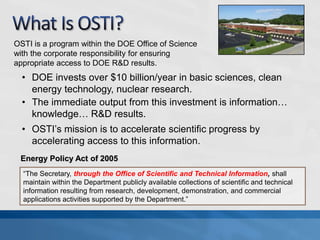
OSTI is a program within the DOE Office of Science
with the corporate responsibility for ensuring
appropriate access to DOE R&D results.
  • DOE invests over $10 billion/year in basic sciences, clean
    energy technology, nuclear research.
  • The immediate output from this investment is information…
    knowledge… R&D results.
  • OSTI’s mission is to accelerate scientific progress by
    accelerating access to this information.
 Energy Policy Act of 2005
  “The Secretary, through the Office of Scientific and Technical Information, shall
  maintain within the Department publicly available collections of scientific and technical
  information resulting from research, development, demonstration, and commercial
  applications activities supported by the Department.”
Department of Energy
Scientific and Technical
 Information Program
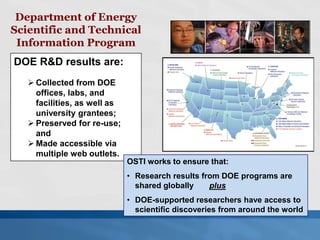
DOE R&D results are:
    Collected from DOE
     offices, labs, and
     facilities, as well as
     university grantees;
    Preserved for re-use;
     and
    Made accessible via
     multiple web outlets.
                              OSTI works to ensure that:
                              • Research results from DOE programs are
                                shared globally    plus
                              • DOE-supported researchers have access to
                                scientific discoveries from around the world
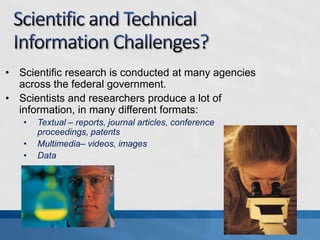
• Scientific research is conducted at many agencies
  across the federal government.
• Scientists and researchers produce a lot of
  information, in many different formats:
   •   Textual – reports, journal articles, conference
       proceedings, patents
   •   Multimedia– videos, images
   •   Data
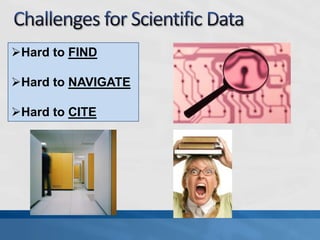
Hard to FIND

Hard to NAVIGATE

Hard to CITE
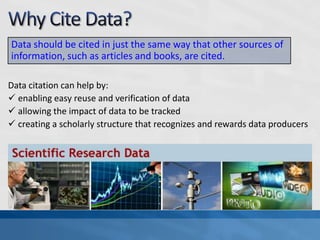
Data should be cited in just the same way that other sources of
information, such as articles and books, are cited.

Data citation can help by:
 enabling easy reuse and verification of data
 allowing the impact of data to be tracked
 creating a scholarly structure that recognizes and rewards data producers
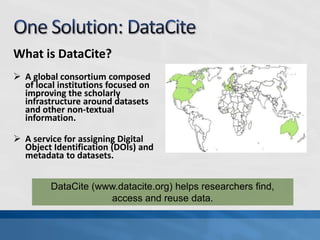
What is DataCite?
 A global consortium composed
  of local institutions focused on
  improving the scholarly
  infrastructure around datasets
  and other non-textual
  information.

 A service for assigning Digital
  Object Identification (DOIs) and
  metadata to datasets.


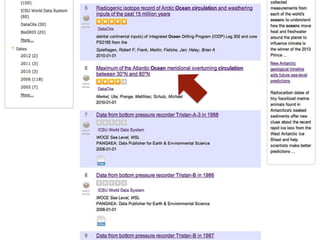
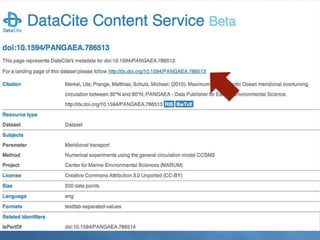
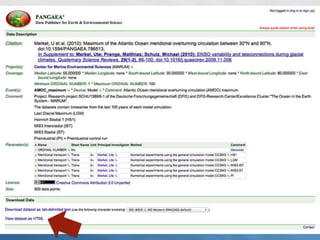
         DataCite (www.datacite.org) helps researchers find,
                     access and reuse data.
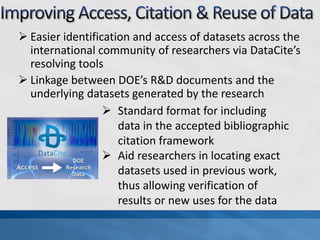
 Easier identification and access of datasets across the
  international community of researchers via DataCite’s
  resolving tools
 Linkage between DOE’s R&D documents and the
  underlying datasets generated by the research
                   Standard format for including
                     data in the accepted bibliographic
                     citation framework
                   Aid researchers in locating exact
                     datasets used in previous work,
                     thus allowing verification of
                     results or new uses for the data
DOE Data ID Service
• DOE/OSTI is the only U.S. federal member of DataCite.

• Interagency agreement in place with NIH project; in
  discussions with seven agencies representing 12 projects.

• OSTI Partnered with Oak Ridge National Laboratory to pioneer
  procedure.

• First DOI for a DOE dataset was minted and registered with
  DataCite on 8/10/2011.

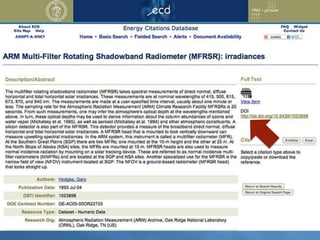
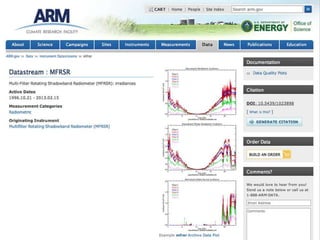
• DOE Atmospheric Radiation Measurement (ARM) has now
  registered over 400 datasets.
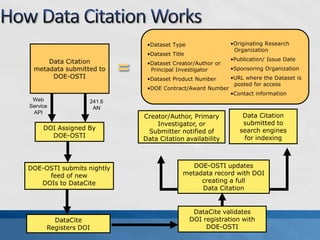
•Dataset Type                 •Originating Research
                                                               Organization
                                •Dataset Title
                                                              •Publication/ Issue Date

                           =
     Data Citation              •Dataset Creator/Author or
 metadata submitted to           Principal Investigator       •Sponsoring Organization
      DOE-OSTI                  •Dataset Product Number       •URL where the Dataset is
                                                               posted for access
                                •DOE Contract/Award Number
                                                              •Contact information
 Web              241.6
Service            AN
 API
                               Creator/Author, Primary            Data Citation
                                   Investigator, or               submitted to
     DOI Assigned By                                             search engines
                                Submitter notified of
       DOE-OSTI                                                   for indexing
                               Data Citation availability


DOE-OSTI submits nightly                        DOE-OSTI updates
     feed of new                             metadata record with DOI
   DOIs to DataCite                               creating a full
                                                  Data Citation


                                                  DataCite validates
        DataCite                                 DOI registration with
      Registers DOI                                   DOE-OSTI
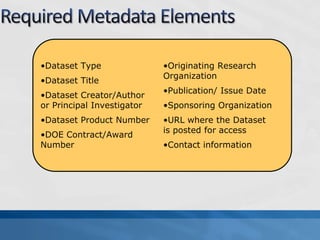
•Dataset Type               •Originating Research
                            Organization
•Dataset Title
                            •Publication/ Issue Date
•Dataset Creator/Author
or Principal Investigator   •Sponsoring Organization
•Dataset Product Number     •URL where the Dataset
                            is posted for access
•DOE Contract/Award
Number                      •Contact information
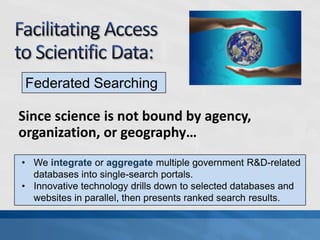
Federated Searching

Since science is not bound by agency,
organization, or geography…
• We integrate or aggregate multiple government R&D-related
  databases into single-search portals.
• Innovative technology drills down to selected databases and
  websites in parallel, then presents ranked search results.
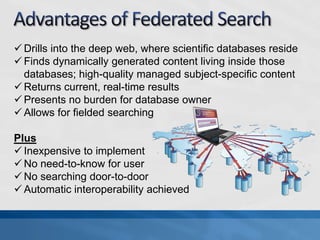
 Drills into the deep web, where scientific databases reside
 Finds dynamically generated content living inside those
  databases; high-quality managed subject-specific content
 Returns current, real-time results
 Presents no burden for database owner
 Allows for fielded searching

Plus
 Inexpensive to implement
 No need-to-know for user
 No searching door-to-door
 Automatic interoperability achieved
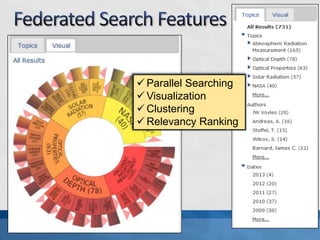
 Parallel Searching
 Visualization
 Clustering
 Relevancy Ranking
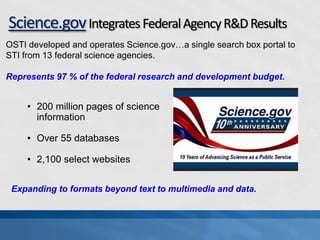
Science.gov Integrates Federal Agency R&D Results
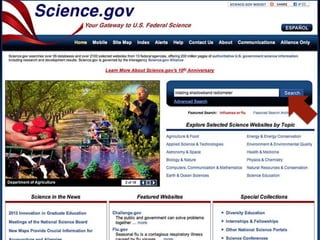
OSTI developed and operates Science.gov…a single search box portal to
STI from 13 federal science agencies.

Represents 97 % of the federal research and development budget.


     • 200 million pages of science
       information

     • Over 55 databases

     • 2,100 select websites


 Expanding to formats beyond text to multimedia and data.
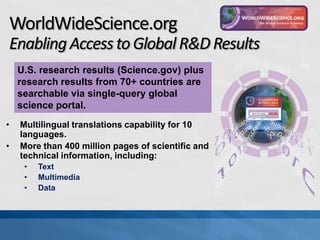
WorldWideScience.org
Enabling Access to Global R&D Results
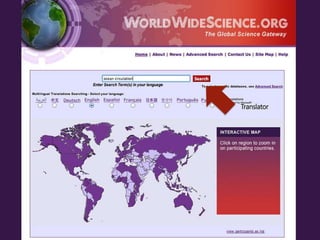
    U.S. research results (Science.gov) plus
    research results from 70+ countries are
    searchable via single-query global
    science portal.
•   Multilingual translations capability for 10
    languages.
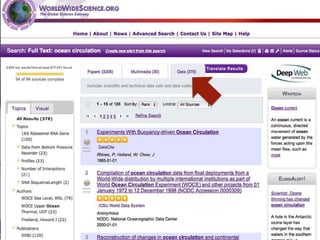
•   More than 400 million pages of scientific and
    technical information, including:
     •   Text
     •   Multimedia
     •   Data
Thank you!
            Lorrie Apple Johnson
         U.S. Department of Energy
Office of Scientific and Technical Information
             JohnsonL@osti.gov

RDAP13 Lorrie Johnson: Facilitating Access to Scientific Data

  • 1.
    Lorrie Apple Johnson Senior Librarian, Information Analysis & Services Office of Scientific and Technical Information (OSTI) Research Data Access & Preservation Summit 2013 Baltimore, MD April 4, 2013
  • 2.
    OSTI is aprogram within the DOE Office of Science with the corporate responsibility for ensuring appropriate access to DOE R&D results. • DOE invests over $10 billion/year in basic sciences, clean energy technology, nuclear research. • The immediate output from this investment is information… knowledge… R&D results. • OSTI’s mission is to accelerate scientific progress by accelerating access to this information. Energy Policy Act of 2005 “The Secretary, through the Office of Scientific and Technical Information, shall maintain within the Department publicly available collections of scientific and technical information resulting from research, development, demonstration, and commercial applications activities supported by the Department.”
  • 3.
    Department of Energy Scientificand Technical Information Program DOE R&D results are:  Collected from DOE offices, labs, and facilities, as well as university grantees;  Preserved for re-use; and  Made accessible via multiple web outlets. OSTI works to ensure that: • Research results from DOE programs are shared globally plus • DOE-supported researchers have access to scientific discoveries from around the world
  • 4.
    • Scientific researchis conducted at many agencies across the federal government. • Scientists and researchers produce a lot of information, in many different formats: • Textual – reports, journal articles, conference proceedings, patents • Multimedia– videos, images • Data
  • 5.
    Hard to FIND Hardto NAVIGATE Hard to CITE
  • 6.
    Data should becited in just the same way that other sources of information, such as articles and books, are cited. Data citation can help by:  enabling easy reuse and verification of data  allowing the impact of data to be tracked  creating a scholarly structure that recognizes and rewards data producers
  • 7.
    What is DataCite? A global consortium composed of local institutions focused on improving the scholarly infrastructure around datasets and other non-textual information.  A service for assigning Digital Object Identification (DOIs) and metadata to datasets. DataCite (www.datacite.org) helps researchers find, access and reuse data.
  • 8.
     Easier identificationand access of datasets across the international community of researchers via DataCite’s resolving tools  Linkage between DOE’s R&D documents and the underlying datasets generated by the research  Standard format for including data in the accepted bibliographic citation framework  Aid researchers in locating exact datasets used in previous work, thus allowing verification of results or new uses for the data
  • 9.
    DOE Data IDService • DOE/OSTI is the only U.S. federal member of DataCite. • Interagency agreement in place with NIH project; in discussions with seven agencies representing 12 projects. • OSTI Partnered with Oak Ridge National Laboratory to pioneer procedure. • First DOI for a DOE dataset was minted and registered with DataCite on 8/10/2011. • DOE Atmospheric Radiation Measurement (ARM) has now registered over 400 datasets.
  • 10.
    •Dataset Type •Originating Research Organization •Dataset Title •Publication/ Issue Date = Data Citation •Dataset Creator/Author or metadata submitted to Principal Investigator •Sponsoring Organization DOE-OSTI •Dataset Product Number •URL where the Dataset is posted for access •DOE Contract/Award Number •Contact information Web 241.6 Service AN API Creator/Author, Primary Data Citation Investigator, or submitted to DOI Assigned By search engines Submitter notified of DOE-OSTI for indexing Data Citation availability DOE-OSTI submits nightly DOE-OSTI updates feed of new metadata record with DOI DOIs to DataCite creating a full Data Citation DataCite validates DataCite DOI registration with Registers DOI DOE-OSTI
  • 11.
    •Dataset Type •Originating Research Organization •Dataset Title •Publication/ Issue Date •Dataset Creator/Author or Principal Investigator •Sponsoring Organization •Dataset Product Number •URL where the Dataset is posted for access •DOE Contract/Award Number •Contact information
  • 14.
    Federated Searching Since scienceis not bound by agency, organization, or geography… • We integrate or aggregate multiple government R&D-related databases into single-search portals. • Innovative technology drills down to selected databases and websites in parallel, then presents ranked search results.
  • 15.
     Drills intothe deep web, where scientific databases reside  Finds dynamically generated content living inside those databases; high-quality managed subject-specific content  Returns current, real-time results  Presents no burden for database owner  Allows for fielded searching Plus  Inexpensive to implement  No need-to-know for user  No searching door-to-door  Automatic interoperability achieved
  • 16.
     Parallel Searching Visualization  Clustering  Relevancy Ranking
  • 17.
    Science.gov Integrates FederalAgency R&D Results OSTI developed and operates Science.gov…a single search box portal to STI from 13 federal science agencies. Represents 97 % of the federal research and development budget. • 200 million pages of science information • Over 55 databases • 2,100 select websites Expanding to formats beyond text to multimedia and data.
  • 22.
    WorldWideScience.org Enabling Access toGlobal R&D Results U.S. research results (Science.gov) plus research results from 70+ countries are searchable via single-query global science portal. • Multilingual translations capability for 10 languages. • More than 400 million pages of scientific and technical information, including: • Text • Multimedia • Data
  • 29.
    Thank you! Lorrie Apple Johnson U.S. Department of Energy Office of Scientific and Technical Information JohnsonL@osti.gov