RCEP: Regional
Comprehensive
Economic Partnership
HAN XIAO (CHINA),
ZHANG YI HAN (CHINA),
LUCIE POLESOVSKA (CZECH REPUBLIC)
• Introduction of RCEP
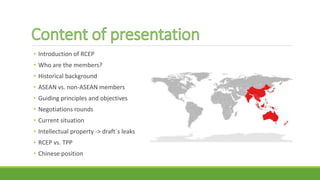
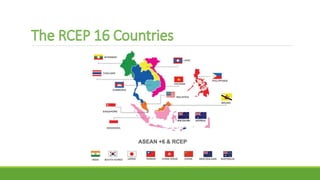
• Who are the members?
• Historical background
• ASEAN vs. non-ASEAN members
• Guiding principles and objectives
• Negotiations rounds
• Current situation
• Intellectual property -> draft´s leaks
• RCEP vs. TPP
• Chinese position
 Aimed at removing intra-region trade barriers, creating and optimizing liberal
investment climate and expanding trade of services
 RCEP will cover fields like intellectual property rights protection and
competition policies
 have broader and deeper engagement with significant improvements over
the existing FTAs between ASEAN and its partners while recognizing the
individual and diverse circumstances of the participating countries.
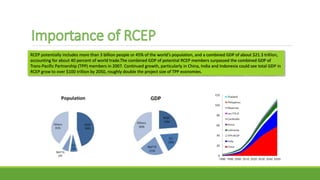
RCEP potentially includes more than 3 billion people or 45% of the world's population, and a combined GDP of about $21.3 trillion,
accounting for about 40 percent of world trade.The combined GDP of potential RCEP members surpassed the combined GDP of
Trans-Pacific Partnership (TPP) members in 2007. Continued growth, particularly in China, India and Indonesia could see total GDP in
RCEP grow to over $100 trillion by 2050, roughly double the project size of TPP economies.
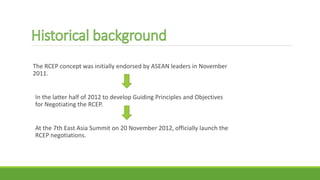
The RCEP concept was initially endorsed by ASEAN leaders in November
2011.
In the latter half of 2012 to develop Guiding Principles and Objectives
for Negotiating the RCEP.
At the 7th East Asia Summit on 20 November 2012, officially launch the
RCEP negotiations.
8 basic guiding principles:
• The RCEP will be consistent with the WTO, including GATT Article XXIV and GATS
Article V.
• … will include special and differential treatment, plus additional flexibility for the
least-developed ASEAN states.
• Any ASEAN FTA Partner that did not participate in the RCEP negotiations at the outset
would be allowed to join the negotiations, subject to terms and conditions that
would be agreed with all other participating countries.
• The negotiations on trade in goods, trade in services, investment and other areas will
be conducted in parallel to ensure a comprehensive and balanced outcome.
• Etc.
• Recognition of ASEAN centrality in the regional economic
integration process and the interest of ASEAN’s FTA partners in
broader and deeper engagement
• Special and differential treatment (S&DT) - the Least Developed
Countries (LDCs) in ASEAN namely Cambodia, Laos and Myanmar
• The Basic Concept for Initial Offers (BCIO) proposed a 3-tiered
approach
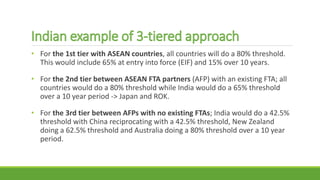
• For the 1st tier with ASEAN countries, all countries will do a 80% threshold.
This would include 65% at entry into force (EIF) and 15% over 10 years.
• For the 2nd tier between ASEAN FTA partners (AFP) with an existing FTA; all
countries would do a 80% threshold while India would do a 65% threshold
over a 10 year period -> Japan and ROK.
• For the 3rd tier between AFPs with no existing FTAs; India would do a 42.5%
threshold with China reciprocating with a 42.5% threshold, New Zealand
doing a 62.5% threshold and Australia doing a 80% threshold over a 10 year
period.
• Eliminating tariffs among members -> at least 95% of tariffs
• Market opening which exceeds WTO requirements
• Covers not just „traditional“ issues but also „New“ trade issues
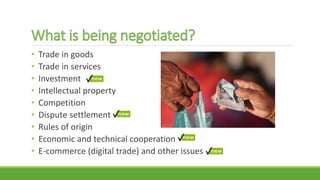
• Trade in goods
• Trade in services
• Investment
• Intellectual property
• Competition
• Dispute settlement
• Rules of origin
• Economic and technical cooperation
• E-commerce (digital trade) and other issues
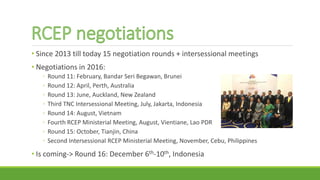
• Since 2013 till today 15 negotiation rounds + intersessional meetings
• Negotiations in 2016:
◦ Round 11: February, Bandar Seri Begawan, Brunei
◦ Round 12: April, Perth, Australia
◦ Round 13: June, Auckland, New Zealand
◦ Third TNC Intersessional Meeting, July, Jakarta, Indonesia
◦ Round 14: August, Vietnam
◦ Fourth RCEP Ministerial Meeting, August, Vientiane, Lao PDR
◦ Round 15: October, Tianjin, China
◦ Second Intersessional RCEP Ministerial Meeting, November, Cebu, Philippines
• Is coming-> Round 16: December 6th-10th, Indonesia
• Negotiations in Tianjin (October) focused on delineating market access
on trade in goods, services, and investment, as well as on rules of origin,
intellectual property, competition, and e-commerce + economic and
technical cooperation.
• TBD: negotiations in 2017
• The latest development during meeting in Philippines (November):
“The ministers…underscored the urgency of a swift conclusion of the
RCEP negotiations as a single undertaking, which will provide a much
needed boost to confidence for the global economy.”
• „Look East“ policy
• August (Laos): India is willing to drop the three-tiered approach
on tariff liberalisation -> it would like to have a tariff schedule with
"limited deviations"
• Why? In order to negotiate better conditions on trade in services
and investment
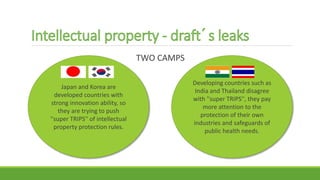
TWO CAMPS
Japan and Korea are
developed countries with
strong innovation ability, so
they are trying to push
''super TRIPS'' of intellectual
property protection rules.
Developing countries such as
India and Thailand disagree
with ''super TRIPS'', they pay
more attention to the
protection of their own
industries and safeguards of
public health needs.
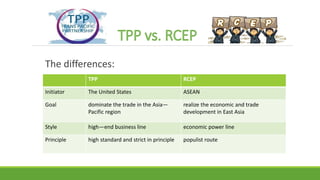
The differences:
TPP RCEP
Initiator The United States ASEAN
Goal dominate the trade in the Asia—
Pacific region
realize the economic and trade
development in East Asia
Style high—end business line economic power line
Principle high standard and strict in principle populist route
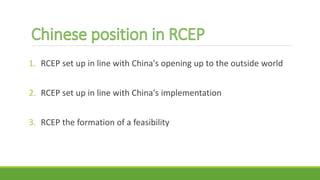
1. RCEP set up in line with China's opening up to the outside world
2. RCEP set up in line with China's implementation
3. RCEP the formation of a feasibility
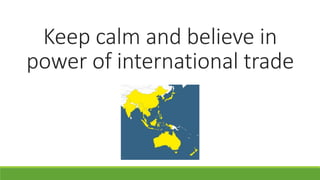
Keep calm and believe in
power of international trade

RCEP

  • 1.
    RCEP: Regional Comprehensive Economic Partnership HANXIAO (CHINA), ZHANG YI HAN (CHINA), LUCIE POLESOVSKA (CZECH REPUBLIC)
  • 2.
    • Introduction ofRCEP • Who are the members? • Historical background • ASEAN vs. non-ASEAN members • Guiding principles and objectives • Negotiations rounds • Current situation • Intellectual property -> draft´s leaks • RCEP vs. TPP • Chinese position
  • 5.
     Aimed atremoving intra-region trade barriers, creating and optimizing liberal investment climate and expanding trade of services  RCEP will cover fields like intellectual property rights protection and competition policies  have broader and deeper engagement with significant improvements over the existing FTAs between ASEAN and its partners while recognizing the individual and diverse circumstances of the participating countries.
  • 6.
    RCEP potentially includesmore than 3 billion people or 45% of the world's population, and a combined GDP of about $21.3 trillion, accounting for about 40 percent of world trade.The combined GDP of potential RCEP members surpassed the combined GDP of Trans-Pacific Partnership (TPP) members in 2007. Continued growth, particularly in China, India and Indonesia could see total GDP in RCEP grow to over $100 trillion by 2050, roughly double the project size of TPP economies.
  • 7.
    The RCEP conceptwas initially endorsed by ASEAN leaders in November 2011. In the latter half of 2012 to develop Guiding Principles and Objectives for Negotiating the RCEP. At the 7th East Asia Summit on 20 November 2012, officially launch the RCEP negotiations.
  • 8.
    8 basic guidingprinciples: • The RCEP will be consistent with the WTO, including GATT Article XXIV and GATS Article V. • … will include special and differential treatment, plus additional flexibility for the least-developed ASEAN states. • Any ASEAN FTA Partner that did not participate in the RCEP negotiations at the outset would be allowed to join the negotiations, subject to terms and conditions that would be agreed with all other participating countries. • The negotiations on trade in goods, trade in services, investment and other areas will be conducted in parallel to ensure a comprehensive and balanced outcome. • Etc.
  • 9.
    • Recognition ofASEAN centrality in the regional economic integration process and the interest of ASEAN’s FTA partners in broader and deeper engagement • Special and differential treatment (S&DT) - the Least Developed Countries (LDCs) in ASEAN namely Cambodia, Laos and Myanmar • The Basic Concept for Initial Offers (BCIO) proposed a 3-tiered approach
  • 10.
    • For the1st tier with ASEAN countries, all countries will do a 80% threshold. This would include 65% at entry into force (EIF) and 15% over 10 years. • For the 2nd tier between ASEAN FTA partners (AFP) with an existing FTA; all countries would do a 80% threshold while India would do a 65% threshold over a 10 year period -> Japan and ROK. • For the 3rd tier between AFPs with no existing FTAs; India would do a 42.5% threshold with China reciprocating with a 42.5% threshold, New Zealand doing a 62.5% threshold and Australia doing a 80% threshold over a 10 year period.
  • 11.
    • Eliminating tariffsamong members -> at least 95% of tariffs • Market opening which exceeds WTO requirements • Covers not just „traditional“ issues but also „New“ trade issues
  • 12.
    • Trade ingoods • Trade in services • Investment • Intellectual property • Competition • Dispute settlement • Rules of origin • Economic and technical cooperation • E-commerce (digital trade) and other issues
  • 13.
    • Since 2013till today 15 negotiation rounds + intersessional meetings • Negotiations in 2016: ◦ Round 11: February, Bandar Seri Begawan, Brunei ◦ Round 12: April, Perth, Australia ◦ Round 13: June, Auckland, New Zealand ◦ Third TNC Intersessional Meeting, July, Jakarta, Indonesia ◦ Round 14: August, Vietnam ◦ Fourth RCEP Ministerial Meeting, August, Vientiane, Lao PDR ◦ Round 15: October, Tianjin, China ◦ Second Intersessional RCEP Ministerial Meeting, November, Cebu, Philippines • Is coming-> Round 16: December 6th-10th, Indonesia
  • 14.
    • Negotiations inTianjin (October) focused on delineating market access on trade in goods, services, and investment, as well as on rules of origin, intellectual property, competition, and e-commerce + economic and technical cooperation. • TBD: negotiations in 2017 • The latest development during meeting in Philippines (November): “The ministers…underscored the urgency of a swift conclusion of the RCEP negotiations as a single undertaking, which will provide a much needed boost to confidence for the global economy.”
  • 15.
    • „Look East“policy • August (Laos): India is willing to drop the three-tiered approach on tariff liberalisation -> it would like to have a tariff schedule with "limited deviations" • Why? In order to negotiate better conditions on trade in services and investment
  • 16.
    TWO CAMPS Japan andKorea are developed countries with strong innovation ability, so they are trying to push ''super TRIPS'' of intellectual property protection rules. Developing countries such as India and Thailand disagree with ''super TRIPS'', they pay more attention to the protection of their own industries and safeguards of public health needs.
  • 17.
    The differences: TPP RCEP InitiatorThe United States ASEAN Goal dominate the trade in the Asia— Pacific region realize the economic and trade development in East Asia Style high—end business line economic power line Principle high standard and strict in principle populist route
  • 18.
    1. RCEP setup in line with China's opening up to the outside world 2. RCEP set up in line with China's implementation 3. RCEP the formation of a feasibility
  • 19.
    Keep calm andbelieve in power of international trade

Editor's Notes

  • #8 Without more background info
  • #10 Joint Declaration on the Launch of Negotiations for the Regional Comprehensive Economic Partnership signed in Cambodia 20th Nov 2012 The Least Developed Countries (LDC) is a list of the countries that, according to the United Nations, exhibit the lowest indicators of socioeconomic development, with the lowest Human Development Index ratings of all countries in the world. The Basic Concept for Initial Offers (BCIO) proposed a 3-tiered approach in terms of the quantum of tariff lines and RCEP import value on which customs duties would be eliminated. The 3 tiers in this approach would be one for ASEAN countries, the second for ASEAN FTA partners (AFPs) who have an FTA and the last tier is for the AFPs who do not have an existing FTA. Exapmple India For the 1st tier with ASEAN countries, all countries will do a 80% threshold. This would include 65% at entry into force (EIF) and 15% over 10 years. For the 2nd tier between ASEAN FTA partners (AFP) with an existing FTA; all countries would do a 80% threshold while India would do a 65% threshold over a 10 year period. India would have to do this for Japan and Korea. For the 3rd tier between AFPs with no existing FTAs; India would do a 42.5% threshold with China reciprocating with a 42.5% threshold, New Zealand doing a 62.5% threshold and Australia doing a 80% threshold over a 10 year period.
  • #13 „New“ issues like competititon policy, investment and e-commece
  • #14 Sixteenth Round of Negotiations – 2-10 December 2016, BSD City, Tangerang, Banten, Indonesia.
  • #15 The most recent negotiating round, held in Tianjin, China, from 17-21 October, focused on delineating market access on trade in goods, services, and investment, as well as on rules of origin, intellectual property, competition, and e-commerce. The chapter on economic and technical cooperation was concluded, which ministers said was a promising development that could inject additional momentum for talks and help address development gaps among RCEP members. New Delhi’s key demand to negotiate goods, services and investments together, for which there was no commitment in the last ministerial in August, was met in the just concluded meeting of trade ministers of the 16 countries including 10 members of Asean plus China, Japan, South Korea, Australia, New Zealand and India. “The ministers…underscored the urgency of a swift conclusion of the RCEP negotiations as a single undertaking, which will provide a much needed boost to confidence for the global economy,” said a joint statement from the talks held in the Philippines on November 3 and 4. This commitment reassures India that other members will not lose interest in its demands on liberalising services trade and easing investment norms once New Delhi accepts their demands for tariff concessions on goods. There has been concern that India has given away too much on the goods side in its other agreements without managing much on the services side where the country has a competitive edge.