NITHIN NATH, NEENA, SIVA,
VINEETH
INTERNATIONAL
BROADCASTING
GROUP NO. 6
International Broadcasting
International broadcasting is broadcasting that
is deliberately aimed at a foreign, rather than a
domestic, audience.
International broadcasting
Broadcasters in one country have several
reasons to reach out to an audience in other
countries
Reasons for international
broadcasting
IDEOLOGICAL OR PROPAGANDA REASONS
 Many government-owned stations portray their nation in a
positive, non-threatening way.
 This could be to encourage business investment and/or
tourism to the nation.
 Another reason is to combat a negative image produced by
other nations or internal dissidents, or insurgents
Eg: Radio RSA broadcast news and opinion programming, which was
often propaganda aimed at defending the apartheid regime and demonizing
its opponents, like the African National Congress
 A third reason is to promote the ideology of the broadcaster
Eg: A program on Radio Moscow from the 1960s to the 1980s was What
is Communism?
Reasons for international
broadcasting
FOREIGN POLICY INTERESTS AND AGENDA
To advance a nation's foreign policy interests and agenda by
disseminating its views on international affairs or on the
events in particular parts of the world
Eg: During the Cold War the American Radio Free Europe and Radio
Liberty broadcasted news from "behind the Iron Curtain" that was otherwise
being censored and promote dissent and occasionally, to
disseminate disinformation. Currently the US operates similar services
aimed at Cuba and the China.
Reasons for international
broadcasting
The BBC World Service, the Voice of America, All India
Radio and other western broadcasters have emphasized news
broadcasts, particularly to countries that are experiencing repression
or civil unrest and whose populations are unable to obtain news from
non-government sources. In the case of emergencies, a nation may
broadcast special programs overseas to inform listeners what is
occurring.
During Iraqi missile strikes on Israel during the 1991 Gulf War, Kol
Israel relayed its domestic service on its shortwave service.
Reasons for international
broadcasting
Many stations are run by
religious broadcasters and are
used to provide religious
education, religious music, or
worship service programs.
For example, Vatican Radio,
established in 1931, broadcasts
such programs.
Another station, such
as HCJB or Trans World
Radio will carry brokered
programming from evangelists.
PROVIDE RELIGIOUS EDUCATION
Reasons for international
broadcasting
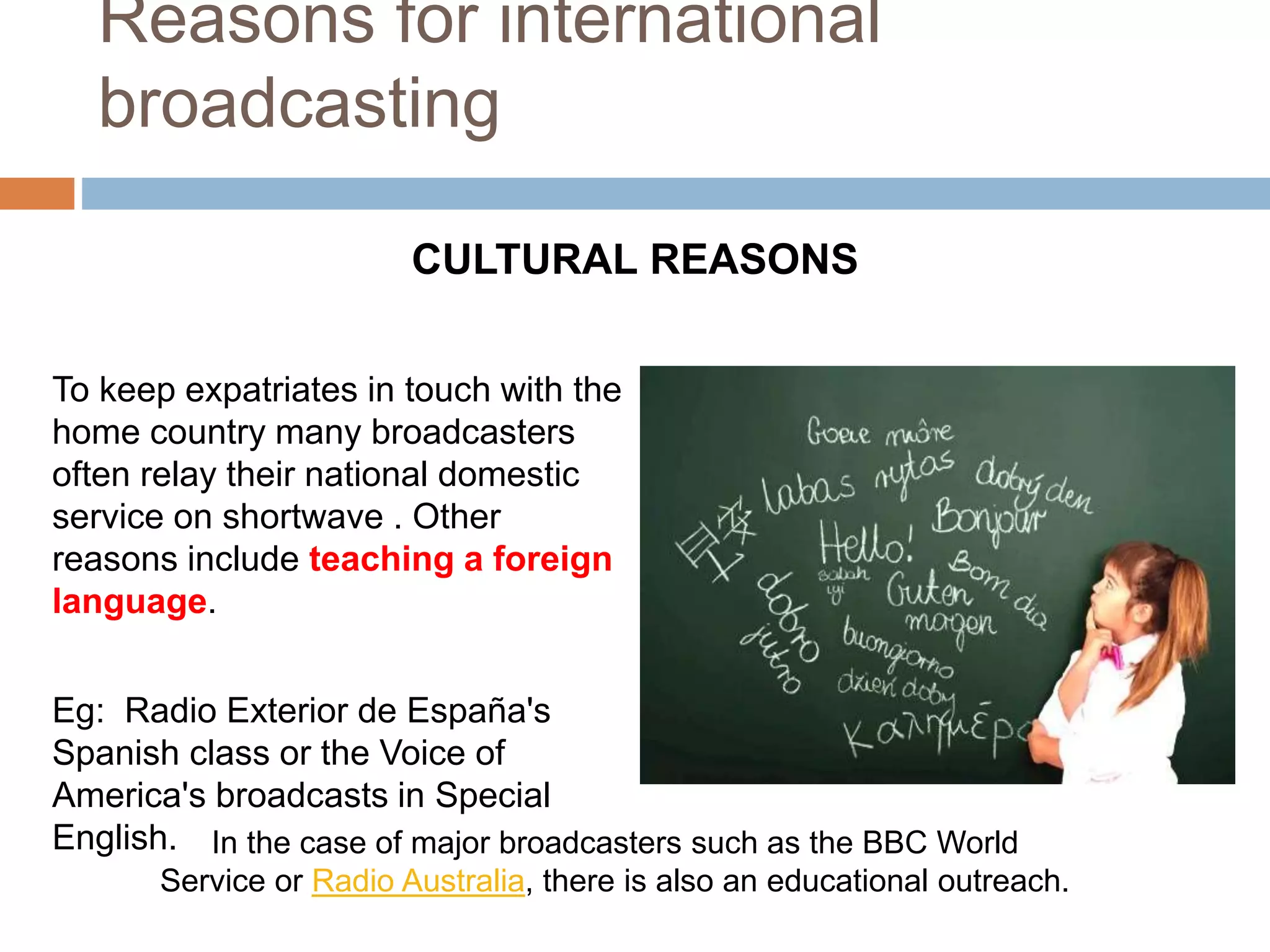
To keep expatriates in touch with the
home country many broadcasters
often relay their national domestic
service on shortwave . Other
reasons include teaching a foreign
language.
Eg: Radio Exterior de España's
Spanish class or the Voice of
America's broadcasts in Special
English.
CULTURAL REASONS
In the case of major broadcasters such as the BBC World
Service or Radio Australia, there is also an educational outreach.
Reasons for international
broadcasting
A number of international services such as the
original BBC Empire Service, Radio Netherlands,
France's Radio France International and others were
founded in part with the goal of helping draw overseas
empires closer to the mother country and provide closer
cultural and communication connections between the
home country and its colonies, a role that became
largely obsolete due to decolonization.
SAME NEWS….DIFFERENT
PERSPECTIVES
Let us see the different perspectives of three
various international news channels about the
capture and death of Muammar Gaddafi
CNN Report
BBC Report
Al Jazeera Report
Thank
you

INTERNATIONAL BROADCASTING

  • 1.
    NITHIN NATH, NEENA,SIVA, VINEETH INTERNATIONAL BROADCASTING GROUP NO. 6
  • 2.
    International Broadcasting International broadcastingis broadcasting that is deliberately aimed at a foreign, rather than a domestic, audience.
  • 3.
    International broadcasting Broadcasters inone country have several reasons to reach out to an audience in other countries
  • 4.
    Reasons for international broadcasting IDEOLOGICALOR PROPAGANDA REASONS  Many government-owned stations portray their nation in a positive, non-threatening way.  This could be to encourage business investment and/or tourism to the nation.  Another reason is to combat a negative image produced by other nations or internal dissidents, or insurgents Eg: Radio RSA broadcast news and opinion programming, which was often propaganda aimed at defending the apartheid regime and demonizing its opponents, like the African National Congress  A third reason is to promote the ideology of the broadcaster Eg: A program on Radio Moscow from the 1960s to the 1980s was What is Communism?
  • 5.
    Reasons for international broadcasting FOREIGNPOLICY INTERESTS AND AGENDA To advance a nation's foreign policy interests and agenda by disseminating its views on international affairs or on the events in particular parts of the world Eg: During the Cold War the American Radio Free Europe and Radio Liberty broadcasted news from "behind the Iron Curtain" that was otherwise being censored and promote dissent and occasionally, to disseminate disinformation. Currently the US operates similar services aimed at Cuba and the China.
  • 6.
    Reasons for international broadcasting TheBBC World Service, the Voice of America, All India Radio and other western broadcasters have emphasized news broadcasts, particularly to countries that are experiencing repression or civil unrest and whose populations are unable to obtain news from non-government sources. In the case of emergencies, a nation may broadcast special programs overseas to inform listeners what is occurring. During Iraqi missile strikes on Israel during the 1991 Gulf War, Kol Israel relayed its domestic service on its shortwave service.
  • 7.
    Reasons for international broadcasting Manystations are run by religious broadcasters and are used to provide religious education, religious music, or worship service programs. For example, Vatican Radio, established in 1931, broadcasts such programs. Another station, such as HCJB or Trans World Radio will carry brokered programming from evangelists. PROVIDE RELIGIOUS EDUCATION
  • 8.
    Reasons for international broadcasting Tokeep expatriates in touch with the home country many broadcasters often relay their national domestic service on shortwave . Other reasons include teaching a foreign language. Eg: Radio Exterior de España's Spanish class or the Voice of America's broadcasts in Special English. CULTURAL REASONS In the case of major broadcasters such as the BBC World Service or Radio Australia, there is also an educational outreach.
  • 9.
    Reasons for international broadcasting Anumber of international services such as the original BBC Empire Service, Radio Netherlands, France's Radio France International and others were founded in part with the goal of helping draw overseas empires closer to the mother country and provide closer cultural and communication connections between the home country and its colonies, a role that became largely obsolete due to decolonization.
  • 10.
    SAME NEWS….DIFFERENT PERSPECTIVES Let ussee the different perspectives of three various international news channels about the capture and death of Muammar Gaddafi
  • 11.
  • 12.
  • 13.
  • 14.