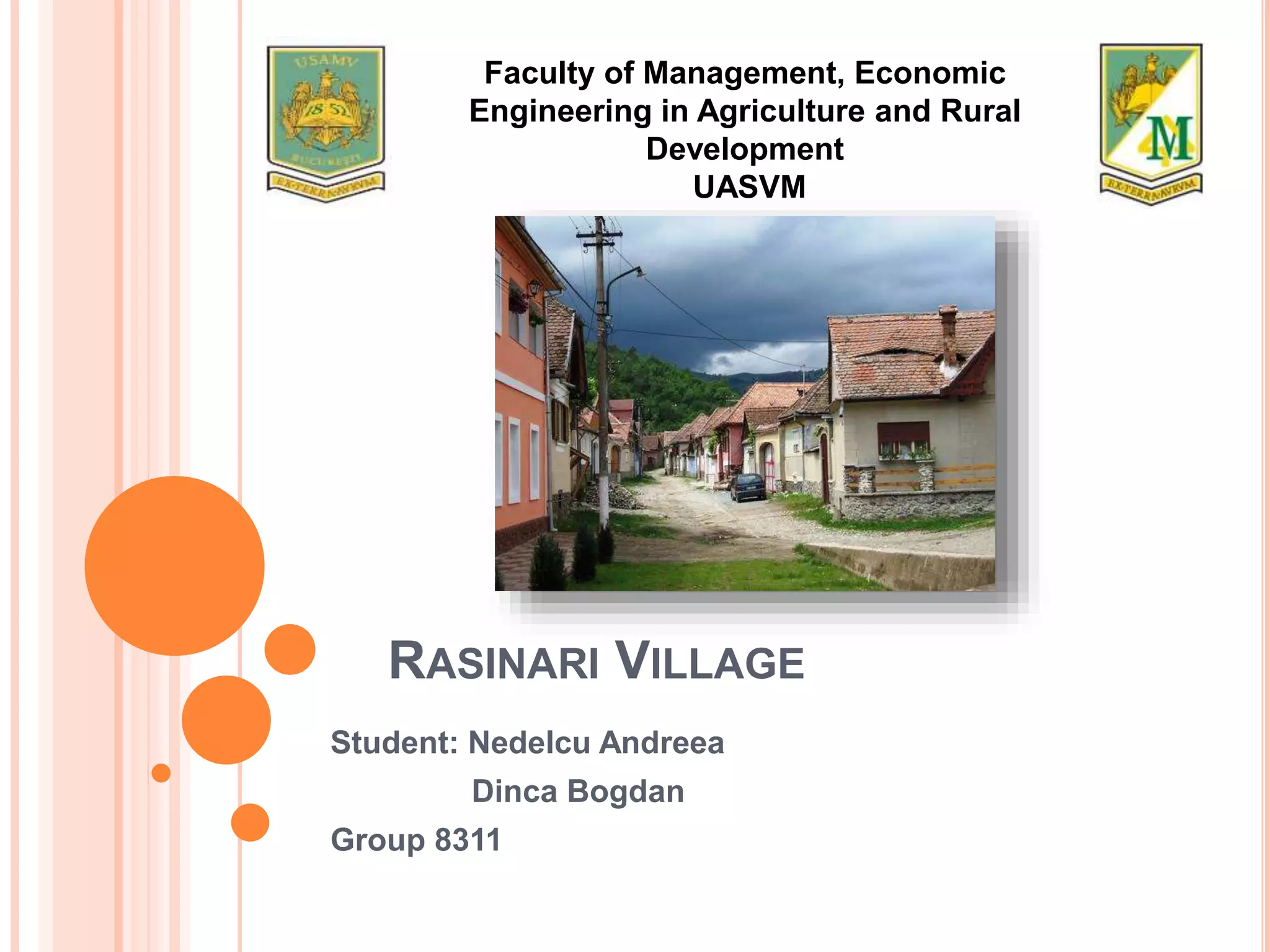
RASINARI VILLAGE
Student: Nedelcu Andreea
Dinca Bogdan
Group 8311
Faculty of Management, Economic
Engineering in Agriculture and Rural
Development
UASVM
HISTORY
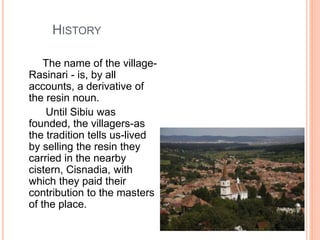
The name of the village-
Rasinari - is, by all
accounts, a derivative of
the resin noun.
Until Sibiu was
founded, the villagers-as
the tradition tells us-lived
by selling the resin they
carried in the nearby
cistern, Cisnadia, with
which they paid their
contribution to the masters
of the place.
ACCESS TO THE LOCALITY
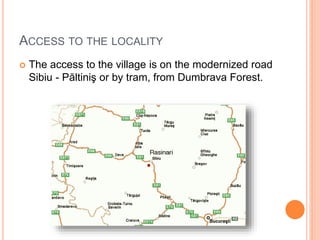
 The access to the village is on the modernized road
Sibiu - Păltiniş or by tram, from Dumbrava Forest.
CLIMATE
 The climate is moderate continental, with a central
European hue that is cooler and more humid, with
few sunny days. Rainfall is low in winter and more
abundant during summer (especially in June).
Winter starts in mid-November, but snow does not
last long.
 The lowest temperatures are recorded in January
and gradually increase until July when they begin to
decline.
MOUNTAINS
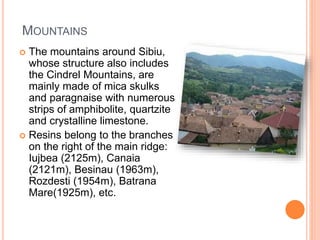
 The mountains around Sibiu,
whose structure also includes
the Cindrel Mountains, are
mainly made of mica skulks
and paragnaise with numerous
strips of amphibolite, quartzite
and crystalline limestone.
 Resins belong to the branches
on the right of the main ridge:
Iujbea (2125m), Canaia
(2121m), Besinau (1963m),
Rozdesti (1954m), Batrana
Mare(1925m), etc.
THE WATERS OF THE VILLAGE
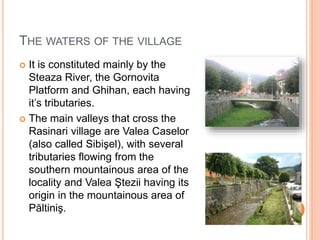
 It is constituted mainly by the
Steaza River, the Gornovita
Platform and Ghihan, each having
it’s tributaries.
 The main valleys that cross the
Rasinari village are Valea Caselor
(also called Sibişel), with several
tributaries flowing from the
southern mountainous area of the
locality and Valea Ştezii having its
origin in the mountainous area of
Păltiniş.
TOURIST ATTRACTIONS
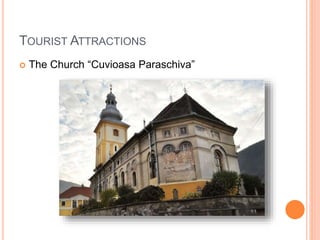
 The Church “Cuvioasa Paraschiva”
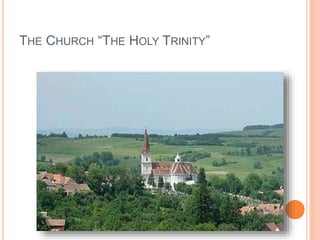
THE CHURCH “THE HOLY TRINITY”
OTHER ANTHROPIC AGRO-TOURISM
RESOURCES OF THE VILLAGE
 Episcopal House
 Ethnographic Museum
 The feudal citadel of the earth
 The Mausoleum of Metropolitan Andrei Saguna
 House of the philosopher Emil Cioran
 Memorial House Octavian Goga
 The natal home of the naturist, physician,
sociologist and ethnographer Ilarie Mitrea
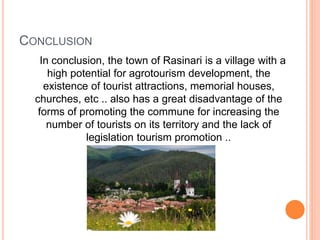
 The natural and scenic Rasinari settlements and
architectural monuments have always attracted
tourists from the country and abroad and eager to
know the locals.
 Today, rural tourism răşinărean highlights the
pastoral village of spiritual and cultural values. By
practicing this form of tourism, it is possible to learn
new horizons but also to earn money.
CONCLUSION
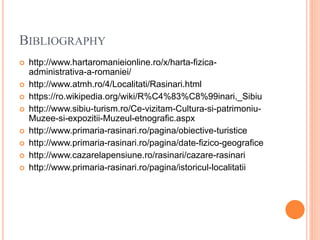
In conclusion, the town of Rasinari is a village with a
high potential for agrotourism development, the
existence of tourist attractions, memorial houses,
churches, etc .. also has a great disadvantage of the
forms of promoting the commune for increasing the
number of tourists on its territory and the lack of
legislation tourism promotion ..
BIBLIOGRAPHY
 http://www.hartaromanieionline.ro/x/harta-fizica-
administrativa-a-romaniei/
 http://www.atmh.ro/4/Localitati/Rasinari.html
 https://ro.wikipedia.org/wiki/R%C4%83%C8%99inari,_Sibiu
 http://www.sibiu-turism.ro/Ce-vizitam-Cultura-si-patrimoniu-
Muzee-si-expozitii-Muzeul-etnografic.aspx
 http://www.primaria-rasinari.ro/pagina/obiective-turistice
 http://www.primaria-rasinari.ro/pagina/date-fizico-geografice
 http://www.cazarelapensiune.ro/rasinari/cazare-rasinari
 http://www.primaria-rasinari.ro/pagina/istoricul-localitatii

Rasinari

  • 1.
    RASINARI VILLAGE Student: NedelcuAndreea Dinca Bogdan Group 8311 Faculty of Management, Economic Engineering in Agriculture and Rural Development UASVM
  • 2.
    HISTORY The name ofthe village- Rasinari - is, by all accounts, a derivative of the resin noun. Until Sibiu was founded, the villagers-as the tradition tells us-lived by selling the resin they carried in the nearby cistern, Cisnadia, with which they paid their contribution to the masters of the place.
  • 3.
    ACCESS TO THELOCALITY  The access to the village is on the modernized road Sibiu - Păltiniş or by tram, from Dumbrava Forest.
  • 4.
    CLIMATE  The climateis moderate continental, with a central European hue that is cooler and more humid, with few sunny days. Rainfall is low in winter and more abundant during summer (especially in June). Winter starts in mid-November, but snow does not last long.  The lowest temperatures are recorded in January and gradually increase until July when they begin to decline.
  • 5.
    MOUNTAINS  The mountainsaround Sibiu, whose structure also includes the Cindrel Mountains, are mainly made of mica skulks and paragnaise with numerous strips of amphibolite, quartzite and crystalline limestone.  Resins belong to the branches on the right of the main ridge: Iujbea (2125m), Canaia (2121m), Besinau (1963m), Rozdesti (1954m), Batrana Mare(1925m), etc.
  • 6.
    THE WATERS OFTHE VILLAGE  It is constituted mainly by the Steaza River, the Gornovita Platform and Ghihan, each having it’s tributaries.  The main valleys that cross the Rasinari village are Valea Caselor (also called Sibişel), with several tributaries flowing from the southern mountainous area of the locality and Valea Ştezii having its origin in the mountainous area of Păltiniş.
  • 7.
    TOURIST ATTRACTIONS  TheChurch “Cuvioasa Paraschiva”
  • 8.
    THE CHURCH “THEHOLY TRINITY”
  • 9.
    OTHER ANTHROPIC AGRO-TOURISM RESOURCESOF THE VILLAGE  Episcopal House  Ethnographic Museum  The feudal citadel of the earth  The Mausoleum of Metropolitan Andrei Saguna  House of the philosopher Emil Cioran  Memorial House Octavian Goga  The natal home of the naturist, physician, sociologist and ethnographer Ilarie Mitrea
  • 10.
     The naturaland scenic Rasinari settlements and architectural monuments have always attracted tourists from the country and abroad and eager to know the locals.  Today, rural tourism răşinărean highlights the pastoral village of spiritual and cultural values. By practicing this form of tourism, it is possible to learn new horizons but also to earn money.
  • 11.
    CONCLUSION In conclusion, thetown of Rasinari is a village with a high potential for agrotourism development, the existence of tourist attractions, memorial houses, churches, etc .. also has a great disadvantage of the forms of promoting the commune for increasing the number of tourists on its territory and the lack of legislation tourism promotion ..
  • 12.
    BIBLIOGRAPHY  http://www.hartaromanieionline.ro/x/harta-fizica- administrativa-a-romaniei/  http://www.atmh.ro/4/Localitati/Rasinari.html https://ro.wikipedia.org/wiki/R%C4%83%C8%99inari,_Sibiu  http://www.sibiu-turism.ro/Ce-vizitam-Cultura-si-patrimoniu- Muzee-si-expozitii-Muzeul-etnografic.aspx  http://www.primaria-rasinari.ro/pagina/obiective-turistice  http://www.primaria-rasinari.ro/pagina/date-fizico-geografice  http://www.cazarelapensiune.ro/rasinari/cazare-rasinari  http://www.primaria-rasinari.ro/pagina/istoricul-localitatii