Language and Communication Studies Ritva Ala-Louko Senior Lecturer, MA Head of Language Center
Language and Communication Studies at a University of Applied Sciences  Language and communication skills are part of the professional competence of a university of applied  sciences graduate. The studies prepare students for communication situations in working life. They reinforce the students’ familiarity with different cultures so that they can get along in an international work environment. The aim is to motivate students for continuously develop their language skills. The language and communication studies are stipulated by the universities of applied sciences decree 328/2003, §8 (language proficiency).
Language and Communication Studies at a University of Applied Sciences The scope of language studies varies by field and degree programme.  All the degree programmes include compulsory studies in English, Finnish and Communication and Swedish. International students study Finnish as a foreign language Students may start studying a new foreign language as a free-choice elective
Language and Communication Studies at a University of Applied Sciences Studies in Swedish for Finnish-speaking students and in Finnish for Swedish- speaking students are based on the language legislation in Finland, the Language Act. During the university studies the Finnish-speaking students must reach such a skills level in Swedish that is required of public officials working in a bilingual office.
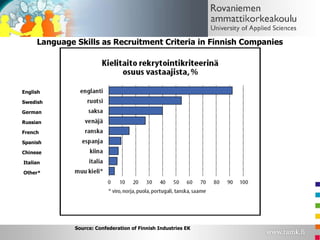
Language Skills as Recruitment Criteria in Finnish Companies English Swedish German Spanish French Russian Chinese Italian Other* Source: Confederation of Finnish Industries EK
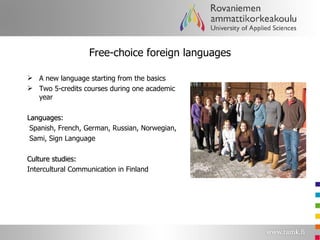
Free-choice foreign languages A new language starting from the basics Two 5-credits courses during one academic year Languages: Spanish, French, German, Russian, Norwegian, Sami, Sign Language Culture studies: Intercultural Communication in Finland
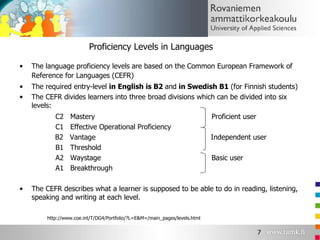
Proficiency Levels in Languages  The language proficiency levels are based on the  Common European Framework of Reference for Languages (CEFR)  The required entry-level  in English is B2  and   in Swedish B1  (for Finnish students) The CEFR divides learners into three broad divisions which can be divided into six levels: C2  Mastery  Proficient user  C1  Effective Operational Proficiency   B2  Vantage     Independent user B1  Threshold A2  Waystage   Basic user A1  Breakthrough The CEFR describes what a learner is supposed to be able to do in reading, listening, speaking and writing at each level.  http://www.coe.int/T/DG4/Portfolio/?L=E&M=/main_pages/levels.html
Language Centre at RAMK organises RAMK’s obligatory language and communication studies and the free-choice elective foreign language courses  provides tailored training in languages and communication for both RAMK’s personnel and local businesses and the public sector provides translation services  develops professional language and communication studies and teaching develops teacher’s professional competence cooperates with other universities of applied sciences
Development of Professional Language Teaching Web-based language teaching materials and methods Use of ICT and social media in language learning and teaching Integration of teaching professional subjects and languages  Thesis writing  guidance and academic writing materials
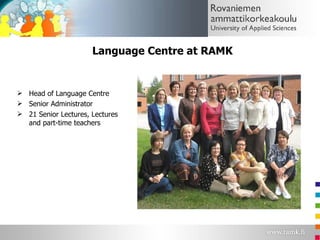
Language Centre at RAMK Head of Language Centre Senior Administrator 21 Senior Lectures, Lectures and part-time teachers
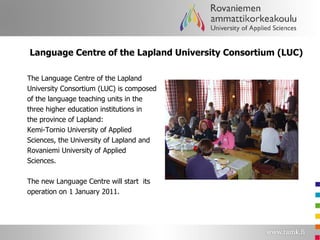
Language Centre of the Lapland University Consortium (LUC)  The Language Centre of the Lapland University Consortium (LUC) is composed  of the language teaching units in the  three higher education institutions in  the province of Lapland:  Kemi-Tornio University of Applied  Sciences, the University of Lapland and Rovaniemi University of Applied  Sciences. The new Language Centre will start  its operation on 1 January 2011.
Thank you for your attention!

Ramk language centre

  • 1.
    Language and CommunicationStudies Ritva Ala-Louko Senior Lecturer, MA Head of Language Center
  • 2.
    Language and CommunicationStudies at a University of Applied Sciences Language and communication skills are part of the professional competence of a university of applied sciences graduate. The studies prepare students for communication situations in working life. They reinforce the students’ familiarity with different cultures so that they can get along in an international work environment. The aim is to motivate students for continuously develop their language skills. The language and communication studies are stipulated by the universities of applied sciences decree 328/2003, §8 (language proficiency).
  • 3.
    Language and CommunicationStudies at a University of Applied Sciences The scope of language studies varies by field and degree programme. All the degree programmes include compulsory studies in English, Finnish and Communication and Swedish. International students study Finnish as a foreign language Students may start studying a new foreign language as a free-choice elective
  • 4.
    Language and CommunicationStudies at a University of Applied Sciences Studies in Swedish for Finnish-speaking students and in Finnish for Swedish- speaking students are based on the language legislation in Finland, the Language Act. During the university studies the Finnish-speaking students must reach such a skills level in Swedish that is required of public officials working in a bilingual office.
  • 5.
    Language Skills asRecruitment Criteria in Finnish Companies English Swedish German Spanish French Russian Chinese Italian Other* Source: Confederation of Finnish Industries EK
  • 6.
    Free-choice foreign languagesA new language starting from the basics Two 5-credits courses during one academic year Languages: Spanish, French, German, Russian, Norwegian, Sami, Sign Language Culture studies: Intercultural Communication in Finland
  • 7.
    Proficiency Levels inLanguages The language proficiency levels are based on the Common European Framework of Reference for Languages (CEFR) The required entry-level in English is B2 and in Swedish B1 (for Finnish students) The CEFR divides learners into three broad divisions which can be divided into six levels: C2 Mastery Proficient user C1 Effective Operational Proficiency B2 Vantage Independent user B1 Threshold A2 Waystage Basic user A1 Breakthrough The CEFR describes what a learner is supposed to be able to do in reading, listening, speaking and writing at each level. http://www.coe.int/T/DG4/Portfolio/?L=E&M=/main_pages/levels.html
  • 8.
    Language Centre atRAMK organises RAMK’s obligatory language and communication studies and the free-choice elective foreign language courses provides tailored training in languages and communication for both RAMK’s personnel and local businesses and the public sector provides translation services develops professional language and communication studies and teaching develops teacher’s professional competence cooperates with other universities of applied sciences
  • 9.
    Development of ProfessionalLanguage Teaching Web-based language teaching materials and methods Use of ICT and social media in language learning and teaching Integration of teaching professional subjects and languages Thesis writing guidance and academic writing materials
  • 10.
    Language Centre atRAMK Head of Language Centre Senior Administrator 21 Senior Lectures, Lectures and part-time teachers
  • 11.
    Language Centre ofthe Lapland University Consortium (LUC) The Language Centre of the Lapland University Consortium (LUC) is composed of the language teaching units in the three higher education institutions in the province of Lapland: Kemi-Tornio University of Applied Sciences, the University of Lapland and Rovaniemi University of Applied Sciences. The new Language Centre will start its operation on 1 January 2011.
  • 12.
    Thank you foryour attention!

Editor's Notes

  • #5 According to the Constitution, an individual has the right to use his or her own language, Finnish or Swedish, before authorities. The public authorities shall provide for the cultural and societal needs of the Finnish-speaking and Swedish-speaking populations of the country on an equal basis.   According to the Constitution, an individual has the right to use his or her own language, Finnish or Swedish, before authorities. The public authorities shall provide for the cultural and societal needs of the Finnish-speaking and Swedish-speaking populations of the country on an equal basis.