DIFFERENTIATION STRATEGIES AND
DIVERSIFICATION IN COCA COLA
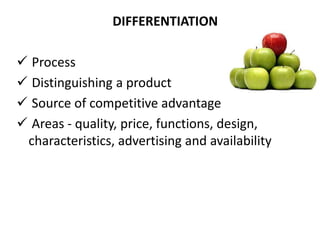
DIFFERENTIATION
 Process
 Distinguishing a product
 Source of competitive advantage
 Areas - quality, price, functions, design,
characteristics, advertising and availability
DIFFERENTIATION STRATEGIES
• Differentiated focus
• Cost leadership strategy
• Cost focus
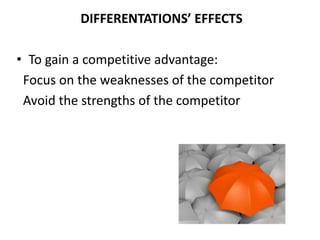
DIFFERENTATIONS’ EFFECTS
• To gain a competitive advantage:
Focus on the weaknesses of the competitor
Avoid the strengths of the competitor
DIVERSIFICATION
 Modification of a product or service
 A more expansive target market
 Not highlighting, it is create a new section
of the market
 Usually used by pre-existing brands
Failure or success is associated with original
brand
DIFFERENTIATION VERSUS
DIVERSIFICATION
 Less risky to differentiate
 Diversification - risk of too little interest or too
much interest
DIFFERENTIATION IN COCA COLA
• To raise brand loyalty and brand equity, using
innovation , communication and
differentiation
• Coca Cola Company spends 20% of total
advertisement budget for maintaining and
communicating on its differentiation strategy
• Coca Cola has created its differentiation by
utilizing soft sell approach
Coca Cola has successfully positioned itself on
the following standards:
• Corporate reputation for quality and
innovation: one of the best place to work
• Successful communication of perceived
strengths of the product: Integrated
marketing strategy
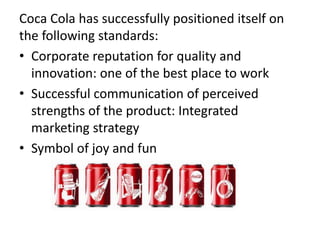
• Symbol of joy and fun
• Coca Cola has based its strategy on
diversification as its main brand is derived by
sub-products maintaining a strong affiliation
with Coca Cola: the Diet Coke Cola (Coca
Cola light, zero ...), Lemon Coke, Cherry Coke,
Vanilla Coke….
• Aware of its situation and context
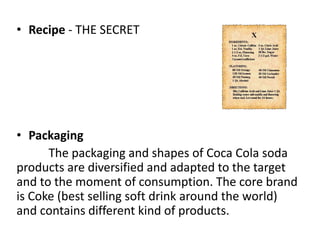
• Recipe - THE SECRET
• Packaging
The packaging and shapes of Coca Cola soda
products are diversified and adapted to the target
and to the moment of consumption. The core brand
is Coke (best selling soft drink around the world)
and contains different kind of products.
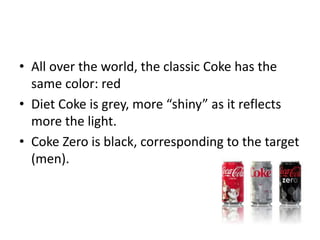
• All over the world, the classic Coke has the
same color: red
• Diet Coke is grey, more “shiny” as it reflects
more the light.
• Coke Zero is black, corresponding to the target
(men).
• The different shapes are:
- Glass bottle (0,25l; 0,5l; 1,5l)
- Plastic bottle (0,5 l; 1l; 1,5l, 2l)
- Cans (0,25l; 0,33l)
• Strict environmental guidelines - ensure
quality for the consumer and ensure the
packaging has as less as possible impact on
environment
DIVERSIFICATION IN COCA COLA
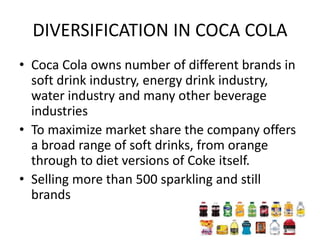
• Coca Cola owns number of different brands in
soft drink industry, energy drink industry,
water industry and many other beverage
industries
• To maximize market share the company offers
a broad range of soft drinks, from orange
through to diet versions of Coke itself.
• Selling more than 500 sparkling and still
brands
• Selling non-alcoholic beverages – sparkling
beverages, water, enhanced and flavored
water beverages, tea, coffee, juice, sports
beverages and energy drinks
• Diet Coke, Fanta, Sprite, Coca-Cola Zero,
Vitaminwater, Powerade, Minute Maid,
Simply, Georgia and Del Valle
• Diversification of bottling business to other
businesses like pharmaceuticals
• Columbia Pictures Entertainment Inc., the
movie and television studio that Coca-Cola
bought in 1982 and sold to the Sony
Corporation last year.
• A slightly profitable food subsidiary, the maker
of Minute Maid orange juice

Ramazan Macin - Coca Cola differentiation and diversification

  • 1.
  • 2.
    DIFFERENTIATION  Process  Distinguishinga product  Source of competitive advantage  Areas - quality, price, functions, design, characteristics, advertising and availability
  • 3.
    DIFFERENTIATION STRATEGIES • Differentiatedfocus • Cost leadership strategy • Cost focus
  • 4.
    DIFFERENTATIONS’ EFFECTS • Togain a competitive advantage: Focus on the weaknesses of the competitor Avoid the strengths of the competitor
  • 5.
    DIVERSIFICATION  Modification ofa product or service  A more expansive target market  Not highlighting, it is create a new section of the market  Usually used by pre-existing brands Failure or success is associated with original brand
  • 6.
    DIFFERENTIATION VERSUS DIVERSIFICATION  Lessrisky to differentiate  Diversification - risk of too little interest or too much interest
  • 7.
    DIFFERENTIATION IN COCACOLA • To raise brand loyalty and brand equity, using innovation , communication and differentiation • Coca Cola Company spends 20% of total advertisement budget for maintaining and communicating on its differentiation strategy • Coca Cola has created its differentiation by utilizing soft sell approach
  • 8.
    Coca Cola hassuccessfully positioned itself on the following standards: • Corporate reputation for quality and innovation: one of the best place to work • Successful communication of perceived strengths of the product: Integrated marketing strategy • Symbol of joy and fun
  • 9.
    • Coca Colahas based its strategy on diversification as its main brand is derived by sub-products maintaining a strong affiliation with Coca Cola: the Diet Coke Cola (Coca Cola light, zero ...), Lemon Coke, Cherry Coke, Vanilla Coke…. • Aware of its situation and context
  • 10.
    • Recipe -THE SECRET • Packaging The packaging and shapes of Coca Cola soda products are diversified and adapted to the target and to the moment of consumption. The core brand is Coke (best selling soft drink around the world) and contains different kind of products.
  • 11.
    • All overthe world, the classic Coke has the same color: red • Diet Coke is grey, more “shiny” as it reflects more the light. • Coke Zero is black, corresponding to the target (men).
  • 12.
    • The differentshapes are: - Glass bottle (0,25l; 0,5l; 1,5l) - Plastic bottle (0,5 l; 1l; 1,5l, 2l) - Cans (0,25l; 0,33l) • Strict environmental guidelines - ensure quality for the consumer and ensure the packaging has as less as possible impact on environment
  • 13.
    DIVERSIFICATION IN COCACOLA • Coca Cola owns number of different brands in soft drink industry, energy drink industry, water industry and many other beverage industries • To maximize market share the company offers a broad range of soft drinks, from orange through to diet versions of Coke itself. • Selling more than 500 sparkling and still brands
  • 14.
    • Selling non-alcoholicbeverages – sparkling beverages, water, enhanced and flavored water beverages, tea, coffee, juice, sports beverages and energy drinks • Diet Coke, Fanta, Sprite, Coca-Cola Zero, Vitaminwater, Powerade, Minute Maid, Simply, Georgia and Del Valle • Diversification of bottling business to other businesses like pharmaceuticals
  • 15.
    • Columbia PicturesEntertainment Inc., the movie and television studio that Coca-Cola bought in 1982 and sold to the Sony Corporation last year. • A slightly profitable food subsidiary, the maker of Minute Maid orange juice