KONGU
ENGINEERING
COLLEGE
Presented by:
MUTHU VENKATESH V (23MER022)
SANJAY PRAKASH D S(23MER038)
Date: 05/01/2024
Raman
Spectroscopy
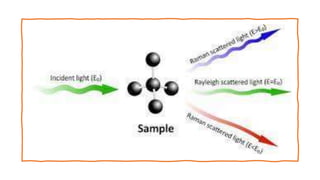
• According to Raman effect when a certain frequency of
monochromatic radiations incident on a sample, the incident light
is, the frequency of scattered light is different from that of the
incident light.
Raman Spectroscopy is a non-destructive analysis technique
that provides detailed information about atoms such as
chemical structure, polymorphy, crystallinity and molecular
interactions.
INSTRUMENTATION
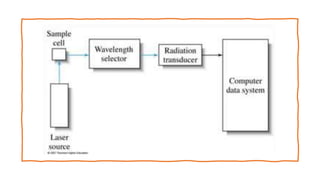
Wavelength Selector:
• Separates Raman scattered light from the laser light.
• Use special filters to pick desired wavelengths.
Transducer:
• The transducer captures the scattered light and converts it into an
electrical signal that can be further processed and analyzed.
• Commonly used transducers in Raman spectroscopy include
photomultiplier tubes (PMTs) and charge-coupled devices (CCDs).
Advantages
• Can be used on any state of matter.
• Non-destructive testing.
• Highly specified to a molecule.
• Only need of a small quantity of sample.
• It is a quick analysis.
Limitations
• Not suitable for metal alloy.
• Expensive process
• The sample may get heated when it is exposed to a laser too long.
• Fluorescence often contaminates the Raman signal.
Applications
• Investigating inorganic systems.
• To study microscopic biological samples.
• Used to detect explosives.
• Used in forensics to analyse gun residuals.
• distinguish healthy and unhealthy tissue.
Thank You

Raman Spectroscopy

  • 1.
    KONGU ENGINEERING COLLEGE Presented by: MUTHU VENKATESHV (23MER022) SANJAY PRAKASH D S(23MER038) Date: 05/01/2024
  • 2.
  • 3.
    • According toRaman effect when a certain frequency of monochromatic radiations incident on a sample, the incident light is, the frequency of scattered light is different from that of the incident light.
  • 5.
    Raman Spectroscopy isa non-destructive analysis technique that provides detailed information about atoms such as chemical structure, polymorphy, crystallinity and molecular interactions.
  • 6.
  • 9.
    Wavelength Selector: • SeparatesRaman scattered light from the laser light. • Use special filters to pick desired wavelengths. Transducer: • The transducer captures the scattered light and converts it into an electrical signal that can be further processed and analyzed. • Commonly used transducers in Raman spectroscopy include photomultiplier tubes (PMTs) and charge-coupled devices (CCDs).
  • 10.
    Advantages • Can beused on any state of matter. • Non-destructive testing. • Highly specified to a molecule. • Only need of a small quantity of sample. • It is a quick analysis.
  • 11.
    Limitations • Not suitablefor metal alloy. • Expensive process • The sample may get heated when it is exposed to a laser too long. • Fluorescence often contaminates the Raman signal.
  • 12.
    Applications • Investigating inorganicsystems. • To study microscopic biological samples. • Used to detect explosives. • Used in forensics to analyse gun residuals. • distinguish healthy and unhealthy tissue.
  • 13.