Design Fundamentals                                                                                  de
Beaufort

Radial Balance


Directions:
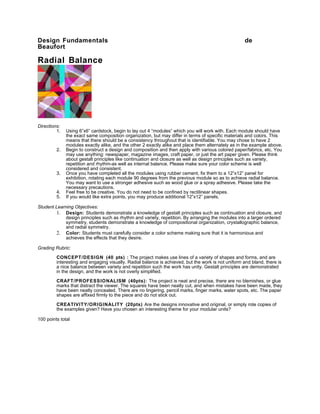
         1.   Using 6”x6” cardstock, begin to lay out 4 “modules” which you will work with. Each module should have
              the exact same composition organization, but may differ in terms of specific materials and colors. This
              means that there should be a consistency throughout that is identifiable. You may chose to have 2
              modules exactly alike, and the other 2 exactly alike and place them alternately as in the example above.
         2.   Begin to construct a design and composition and then apply with various colored paper/fabrics, etc. You
              may use anything: newspaper, magazine images, craft paper, or just the art paper given. Please think
              about gestalt principles like continuation and closure as well as design principles such as variety,
              repetition and rhythm-as well as internal balance. Please make sure your color scheme is well
              considered and consistent.
         3.   Once you have completed all the modules using rubber cement, fix them to a 12”x12” panel for
              exhibition, rotating each module 90 degrees from the previous module so as to achieve radial balance.
              You may want to use a stronger adhesive such as wood glue or a spray adhesive. Please take the
              necessary precautions.
         4.   Feel free to be creative. You do not need to be confined by rectilinear shapes.
         5.   If you would like extra points, you may produce additional 12”x12” panels.

Student Learning Objectives:
        1. Design: Students demonstrate a knowledge of gestalt principles such as continuation and closure, and
            design principles such as rhythm and variety, repetition. By arranging the modules into a larger ordered
            symmetry, students demonstrate a knowledge of compositional organization, crystallographic balance,
            and radial symmetry.
        2. Color: Students must carefully consider a color scheme making sure that it is harmonious and
            achieves the effects that they desire.

Grading Rubric:

         CONCEPT/DESIGN (40 pts) : The project makes use lines of a variety of shapes and forms, and are
         interesting and engaging visually. Radial balance is achieved, but the work is not uniform and bland, there is
         a nice balance between variety and repetition such the work has unity. Gestalt principles are demonstrated
         in the design, and the work is not overly simplified.

         CRAFT/PROFESSIONALISM (40pts): The project is neat and precise, there are no blemishes, or glue
         marks that distract the viewer. The squares have been neatly cut, and when mistakes have been made, they
         have been neatly concealed. There are no lingering, pencil marks, finger marks, water spots, etc. The paper
         shapes are affixed firmly to the piece and do not stick out.

         CREATIVITY/ORIGINALITY (20pts) Are the designs innovative and original, or simply rote copies of
         the examples given? Have you chosen an interesting theme for your modular units?

100 points total

Radial Balance

  • 1.
    Design Fundamentals de Beaufort Radial Balance Directions: 1. Using 6”x6” cardstock, begin to lay out 4 “modules” which you will work with. Each module should have the exact same composition organization, but may differ in terms of specific materials and colors. This means that there should be a consistency throughout that is identifiable. You may chose to have 2 modules exactly alike, and the other 2 exactly alike and place them alternately as in the example above. 2. Begin to construct a design and composition and then apply with various colored paper/fabrics, etc. You may use anything: newspaper, magazine images, craft paper, or just the art paper given. Please think about gestalt principles like continuation and closure as well as design principles such as variety, repetition and rhythm-as well as internal balance. Please make sure your color scheme is well considered and consistent. 3. Once you have completed all the modules using rubber cement, fix them to a 12”x12” panel for exhibition, rotating each module 90 degrees from the previous module so as to achieve radial balance. You may want to use a stronger adhesive such as wood glue or a spray adhesive. Please take the necessary precautions. 4. Feel free to be creative. You do not need to be confined by rectilinear shapes. 5. If you would like extra points, you may produce additional 12”x12” panels. Student Learning Objectives: 1. Design: Students demonstrate a knowledge of gestalt principles such as continuation and closure, and design principles such as rhythm and variety, repetition. By arranging the modules into a larger ordered symmetry, students demonstrate a knowledge of compositional organization, crystallographic balance, and radial symmetry. 2. Color: Students must carefully consider a color scheme making sure that it is harmonious and achieves the effects that they desire. Grading Rubric: CONCEPT/DESIGN (40 pts) : The project makes use lines of a variety of shapes and forms, and are interesting and engaging visually. Radial balance is achieved, but the work is not uniform and bland, there is a nice balance between variety and repetition such the work has unity. Gestalt principles are demonstrated in the design, and the work is not overly simplified. CRAFT/PROFESSIONALISM (40pts): The project is neat and precise, there are no blemishes, or glue marks that distract the viewer. The squares have been neatly cut, and when mistakes have been made, they have been neatly concealed. There are no lingering, pencil marks, finger marks, water spots, etc. The paper shapes are affixed firmly to the piece and do not stick out. CREATIVITY/ORIGINALITY (20pts) Are the designs innovative and original, or simply rote copies of the examples given? Have you chosen an interesting theme for your modular units? 100 points total