Joe Meadows M.S., DABMP Medical Physicist Lacks Cancer Center Dept Radiation Oncology Saint Mary’s Health Care Radiation Safety I-125 Prostate Seed Implants
Outline I-125 Prostate Seed implant procedure Nursing Policy Post-op Management Radiation Safety Quiz
I-125 Prostate Seed Implant Procedure Is the surgical implantation of radioactive Iodine-125 seeds into the prostate gland under ultrasound guidance. Each patiently will typically have between 60-120 seeds implanted depending on the gland size. These patients require post-operative care ranging from “Short-Stay” to overnight depending on the patient. Below is a radiograph showing the seeds inside the patients gland
Nursing Policy- 340/007 Most of the radiation is shielded by the prostate gland itself.  The very little radiation that escapes beyond the prostate gland is not considered a risk for most people.  Even though the exposure to radiation energy is low, certain precautions are to be followed. The Nursing Policy 340/007 consists of: A. Pre-Operative Management B. Intra-Operative Management C. Post Anesthesia Care Unit (PACU) Immediate Post-operative Management D. Nursing Unit Secondary Post-operative Management E. Radiation Safety This presentation will concentrate on items D and E
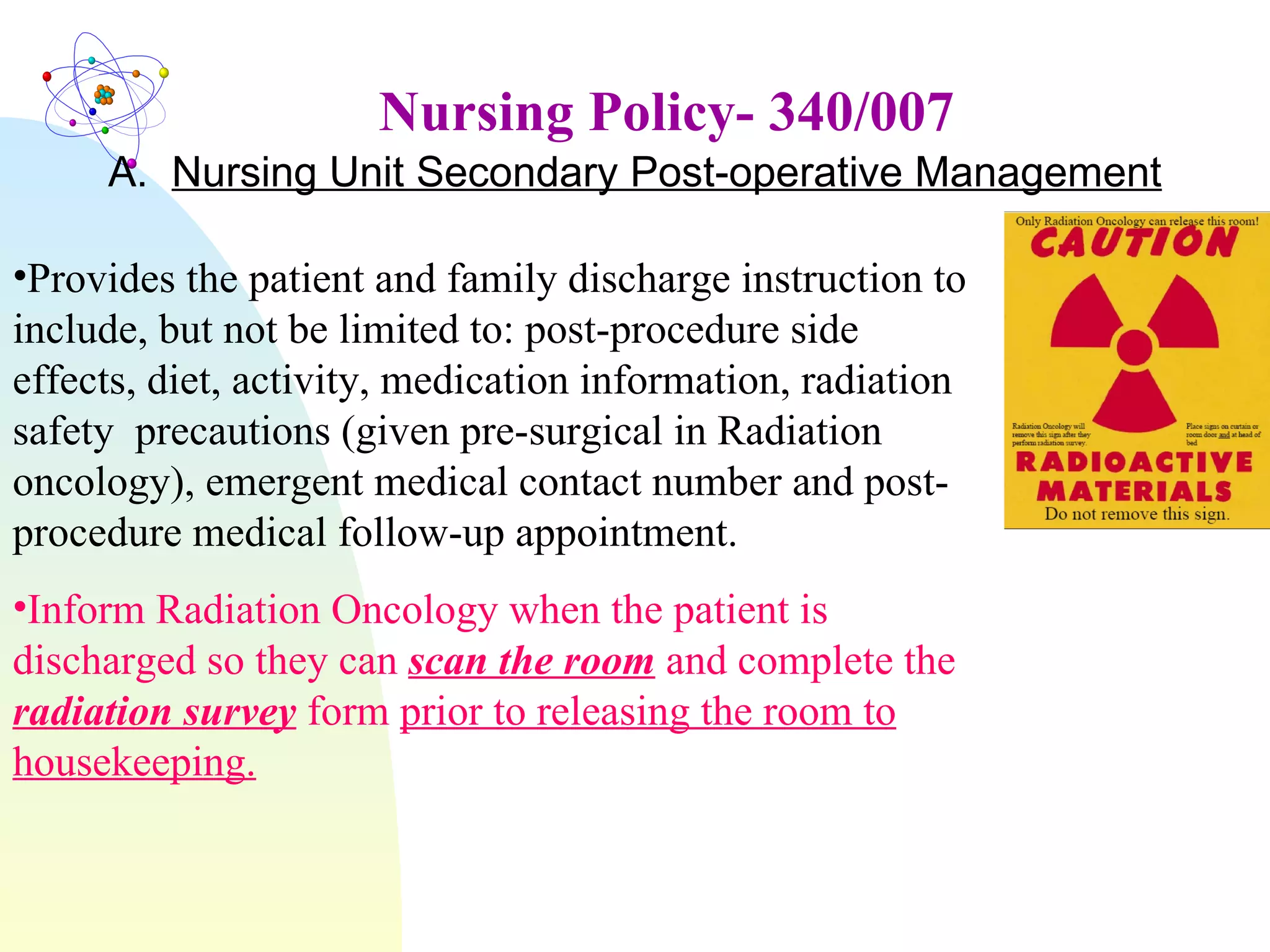
Nursing Policy- 340/007 Nursing Unit Secondary Post-operative Management Ensures patient is placed in a  private area  to maximize distance from other patients.  Ensures  Radiation sign  is posted at entrance to room. As the sign explains, it is VERY important the room is cleared by Radiation Oncology after patient is discharged. All trash, linens, foley, and urine filter are to remain to be surveyed by Physicist
Nursing Policy- 340/007 Nursing Unit Secondary Post-operative Management Reviews with patient and visitors that there is 3 foot distance requirement from the patient, for radiation safety precautions.  Visitors can hug or briefly greet patient and then move the safe distance away. Pregnant visitors  and  visitors under the age of 18  are  not allowed  without prior approval of the Radiation Safety Officer. Visually monitors the indwelling catheter collection bag and gurney/bed linens periodically for dislodged radioactive isotope seeds. (The seeds are metallic cylinders, 5mm long by 1mm in diameter).
Nursing Policy- 340/007 Nursing Unit Secondary Post-operative Management When the indwelling catheter is discontinued,  filter all urine  in the collection bag and discard indwelling catheter and collection bag into the patient’s cubicle/room trash receptacle.  Do not remove the catheter or any other trash from patient room until radiation survey is complete.  The patient should then void into a urinal and all urine should be strained prior to being flushed.  Does not  attempt to pick up the radioactive seed with hands. Uses a wet cotton swab to pick up and place the radioactive seed(s) into the lead container.  Notify Radiation Oncology of any seeds found
Nursing Policy- 340/007 Nursing Unit Secondary Post-operative Management Provides the patient and family discharge instruction to include, but not be limited to: post-procedure side effects, diet, activity, medication information, radiation safety  precautions (given pre-surgical in Radiation oncology), emergent medical contact number and post-procedure medical follow-up appointment.  Inform Radiation Oncology when the patient is discharged so they can  scan the room  and complete the  radiation survey  form  prior to releasing the room to housekeeping.
Nursing Policy- 340/007 Radiation Safety The Medical personnel should follow the *ALARA principle, meaning  As Low As Reasonably Achievable. This is used to limit your radiation exposure. There are three main components to limit your exposure:  Time, Distance, and Sheilding. If a seed is found, the nurse should immediately pick up seed using forceps or wet cotton swab and placed into a shielded container.  Under no circumstance should the nurse attempt to pick up the seed by hand.  The medical physicist, radiation safety officer, or radiation oncologist must be notified immediately.
Nursing Policy- 340/007 Radiation Safety The Nurse should be able to provide patient and family/visitor radiation safety education, to include, but not be limited to: Low radiation energy of seeds means that most radiation is contained within the prostate gland. Some radiation is given off to surrounding tissues, such as rectum and bladder. Objects that the patient touches/uses are  not  radioactive. Bodily wastes (urine and stool) are  not  radioactive.
Nursing Policy- 340/007 Radiation Safety Pregnant and possibly pregnant women should avoid prolonged personal contact (hugging, sitting on lap/next to patient) for the first two months. Children should not sit on your lap during the first two months. They can sit next to you, with no time limit. Recommend condom use during sexual intercourse for the first two weeks post-procedure.
Quiz- Please take and hand in results to Supervisor Radiation Safety -  I-125 Prostate Seed Implantation Procedure Multiple Choice/True False Identify the letter of the choice that best completes the statement or answers the question.
Quiz- Please take and hand in results to Supervisor Radiation Safety -  I-125 Prostate Seed Implantation Procedure
Quiz- Please take and hand in results to Supervisor Radiation Safety -  I-125 Prostate Seed Implantation Procedure This quiz documents your knowledge and training in radiation safety as it applies to I-125 Prostate Seed Implantation.  To document competency, you must score 80% or better.  This document should be forwarded to Dale Schippers (Radiation Safety Officer) in Radiology.

Rad Safety Inservice I 125 Prostate Seed Procedure

  • 1.
    Joe Meadows M.S.,DABMP Medical Physicist Lacks Cancer Center Dept Radiation Oncology Saint Mary’s Health Care Radiation Safety I-125 Prostate Seed Implants
  • 2.
    Outline I-125 ProstateSeed implant procedure Nursing Policy Post-op Management Radiation Safety Quiz
  • 3.
    I-125 Prostate SeedImplant Procedure Is the surgical implantation of radioactive Iodine-125 seeds into the prostate gland under ultrasound guidance. Each patiently will typically have between 60-120 seeds implanted depending on the gland size. These patients require post-operative care ranging from “Short-Stay” to overnight depending on the patient. Below is a radiograph showing the seeds inside the patients gland
  • 4.
    Nursing Policy- 340/007Most of the radiation is shielded by the prostate gland itself. The very little radiation that escapes beyond the prostate gland is not considered a risk for most people. Even though the exposure to radiation energy is low, certain precautions are to be followed. The Nursing Policy 340/007 consists of: A. Pre-Operative Management B. Intra-Operative Management C. Post Anesthesia Care Unit (PACU) Immediate Post-operative Management D. Nursing Unit Secondary Post-operative Management E. Radiation Safety This presentation will concentrate on items D and E
  • 5.
    Nursing Policy- 340/007Nursing Unit Secondary Post-operative Management Ensures patient is placed in a private area to maximize distance from other patients. Ensures Radiation sign is posted at entrance to room. As the sign explains, it is VERY important the room is cleared by Radiation Oncology after patient is discharged. All trash, linens, foley, and urine filter are to remain to be surveyed by Physicist
  • 6.
    Nursing Policy- 340/007Nursing Unit Secondary Post-operative Management Reviews with patient and visitors that there is 3 foot distance requirement from the patient, for radiation safety precautions. Visitors can hug or briefly greet patient and then move the safe distance away. Pregnant visitors and visitors under the age of 18 are not allowed without prior approval of the Radiation Safety Officer. Visually monitors the indwelling catheter collection bag and gurney/bed linens periodically for dislodged radioactive isotope seeds. (The seeds are metallic cylinders, 5mm long by 1mm in diameter).
  • 7.
    Nursing Policy- 340/007Nursing Unit Secondary Post-operative Management When the indwelling catheter is discontinued, filter all urine in the collection bag and discard indwelling catheter and collection bag into the patient’s cubicle/room trash receptacle. Do not remove the catheter or any other trash from patient room until radiation survey is complete. The patient should then void into a urinal and all urine should be strained prior to being flushed. Does not attempt to pick up the radioactive seed with hands. Uses a wet cotton swab to pick up and place the radioactive seed(s) into the lead container. Notify Radiation Oncology of any seeds found
  • 8.
    Nursing Policy- 340/007Nursing Unit Secondary Post-operative Management Provides the patient and family discharge instruction to include, but not be limited to: post-procedure side effects, diet, activity, medication information, radiation safety precautions (given pre-surgical in Radiation oncology), emergent medical contact number and post-procedure medical follow-up appointment. Inform Radiation Oncology when the patient is discharged so they can scan the room and complete the radiation survey form prior to releasing the room to housekeeping.
  • 9.
    Nursing Policy- 340/007Radiation Safety The Medical personnel should follow the *ALARA principle, meaning As Low As Reasonably Achievable. This is used to limit your radiation exposure. There are three main components to limit your exposure: Time, Distance, and Sheilding. If a seed is found, the nurse should immediately pick up seed using forceps or wet cotton swab and placed into a shielded container. Under no circumstance should the nurse attempt to pick up the seed by hand. The medical physicist, radiation safety officer, or radiation oncologist must be notified immediately.
  • 10.
    Nursing Policy- 340/007Radiation Safety The Nurse should be able to provide patient and family/visitor radiation safety education, to include, but not be limited to: Low radiation energy of seeds means that most radiation is contained within the prostate gland. Some radiation is given off to surrounding tissues, such as rectum and bladder. Objects that the patient touches/uses are not radioactive. Bodily wastes (urine and stool) are not radioactive.
  • 11.
    Nursing Policy- 340/007Radiation Safety Pregnant and possibly pregnant women should avoid prolonged personal contact (hugging, sitting on lap/next to patient) for the first two months. Children should not sit on your lap during the first two months. They can sit next to you, with no time limit. Recommend condom use during sexual intercourse for the first two weeks post-procedure.
  • 12.
    Quiz- Please takeand hand in results to Supervisor Radiation Safety - I-125 Prostate Seed Implantation Procedure Multiple Choice/True False Identify the letter of the choice that best completes the statement or answers the question.
  • 13.
    Quiz- Please takeand hand in results to Supervisor Radiation Safety - I-125 Prostate Seed Implantation Procedure
  • 14.
    Quiz- Please takeand hand in results to Supervisor Radiation Safety - I-125 Prostate Seed Implantation Procedure This quiz documents your knowledge and training in radiation safety as it applies to I-125 Prostate Seed Implantation. To document competency, you must score 80% or better. This document should be forwarded to Dale Schippers (Radiation Safety Officer) in Radiology.