Idiomatic RabbitMQ
Gavin M. Roy
VP of Architecture

AWeber Communications

Twitter: @Crad
To grok RabbitMQ is to know AMQP 0-9-1
Beginner Questions
How do I … 

What is a …
Next Level Questions
Why do / does / is …
RabbitMQ’s Identity
Capabilities and behaviors
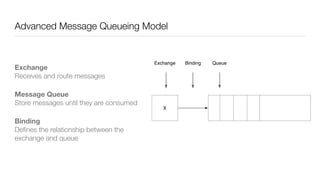
Advanced Message Queueing Model
Exchange

Receives and route messages
Message Queue

Store messages until they are consumed
Binding

Defines the relationship between the
exchange and queue
X
QueueBindingExchange
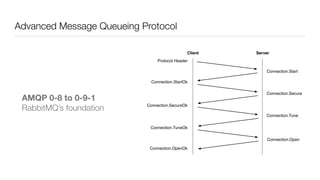
Advanced Message Queueing Protocol
Client Server
Protocol Header
Connection.Start
Connection.StartOk
Connection.Secure
Connection.SecureOk
Connection.Tune
Connection.TuneOk
Connection.Open
Connection.OpenOk
AMQP 0-8 to 0-9-1

RabbitMQ’s foundation
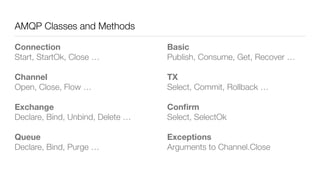
AMQP Classes and Methods
Connection

Start, StartOk, Close …
Channel

Open, Close, Flow …
Exchange

Declare, Bind, Unbind, Delete …
Queue

Declare, Bind, Purge …
Basic

Publish, Consume, Get, Recover …
TX

Select, Commit, Rollback …
Confirm

Select, SelectOk
Exceptions

Arguments to Channel.Close
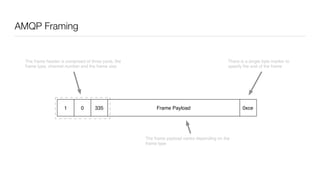
AMQP Framing
0 335 0xce1 Frame Payload
The frame header is comprised of three parts, the
frame type, channel number and the frame size
The frame payload varies depending on the
frame type
There is a single byte marker to
specify the end of the frame
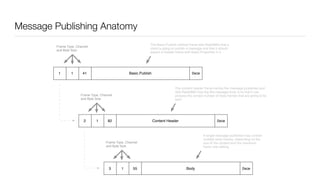
Message Publishing Anatomy
The Basic.Publish method frame tells RabbitMQ that a
client is going to publish a message and that it should
expect a Header frame with Basic.Properties in it
The content header frame carries the message properties and
tells RabbitMQ how big the message body is so that it can
process the correct number of body frames that are going to be
sent.
A single message published may contain
multiple body frames, depending on the
size of the content and the maximum
frame size setting
1 41 0xce1 Basic.Publish
1 82 0xce2 Content Header
1 55 0xce3 Body
Frame Type, Channel
and Byte Size
Frame Type, Channel
and Byte Size
Frame Type, Channel
and Byte Size
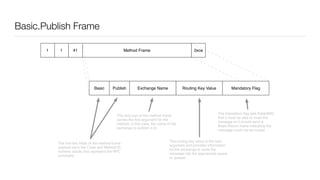
Basic.Publish Frame
The first two fields of the method frame
payload carry the Class and Method ID,
numeric values that represent the RPC
command.
The next part of the method frame
carries the first argument for the
method, in this case, the name of the
exchange to publish in to
The routing key value is the next
argument and provides information
for the exchange to route the
message into the appropriate queue
or queues.
Exchange Name Routing Key Value Mandatory Flag
The mandatory flag tells RabbitMQ
that it must be able to route the
message or it should send a
Basic.Return frame indicating the
message could not be routed.
Basic Publish
1 41 0xce1 Method Frame
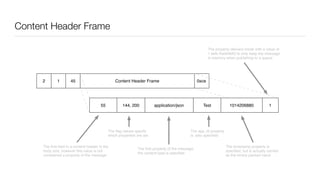
Content Header Frame
The first field in a content header is the
body size, however this value is not
considered a property of the message
The flag values specify
which properties are set
The first property of the message,
the content-type is specified
The app_id property
is also specified
55 application/json Test 1144, 200 1014206880
The timestamp property is
specified, but is actually carried
as the binary packed value
The property delivery-mode with a value of
1 tells RabbitMQ to only keep the message
in memory when publishing to a queue
1 45 0xce2 Content Header Frame
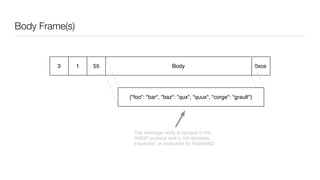
Body Frame(s)
1 55 0xce3 Body
{"foo": "bar", "baz": "qux", "quux", "corge": "grault"}
The message body is opaque to the
AMQP protocol and is not decoded,
inspected, or evaluated by RabbitMQ
Message Publishing
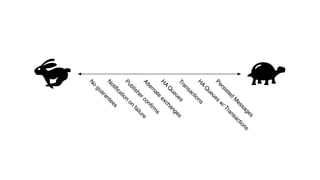
How do you answer publishing questions?
Persisted
M
essages
Transactions
H
A
Q
ueues
Publisherconfirm
s
N
o
guarantees
N
otification
on
failureAlternate
exchanges
H
A
Q
ueues
w
/Transactions
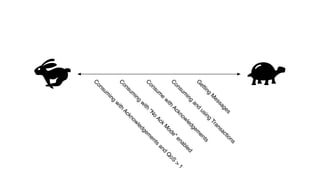
Receiving Messages
Questioning how messages are delivered
G
etting
M
essages
C
onsum
ing
and
using
Transactions
C
onsum
e
w
ith
Acknow
ledgem
ents
C
onsum
ing
w
ith
"N
o
Ack
M
ode"enabled
C
onsum
ing
w
ith
Acknow
ledgem
ents
and
Q
oS
>
1
How will you use RabbitMQ?
Leverage the AMQ Model or Do-It Yourself
Use RabbitMQ and DYI
Contract and content in the message body
Use the AMQ Model
Message Properties and Routing
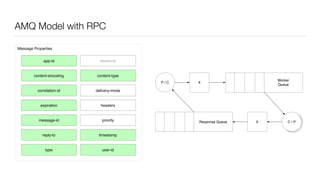
AMQ Model with RPC
C / PC / P
P / C
C / PResponse Queue
X
X
Worker
Queue
Message Properties
content-encoding
app-id
content-type
delivery-modecorrelation-id
expiration
message-id
headers
priority
user-id
reply-to
type
timestamp
cluster-id
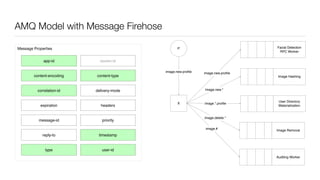
AMQ Model with Message Firehose
Message Properties
content-encoding
app-id
content-type
delivery-modecorrelation-id
expiration
message-id
headers
priority
user-id
reply-to
type
timestamp
cluster-id
X
Image Hashing
Facial Detection
RPC Worker
P
image.new.profile
User Directory
Materialization
image.new.*
Auditing Worker
image.*.profile
image.# Image Removal
image.delete.*
image.new.profile
Common User Problems
• Not understanding the bidirectional nature
of AMQP

• Heartbeats?

• Throttling Messages

• How to use channels?

• Slow performance due to poor choices
AMQP Problems
• Currently 30 items in the 0-9-1 errata
• Logic Errors
• Marshaling incompatibilities between 

0-9 && 0-9-1
• Behavior differences between 0-8 && 0-9-1
• Authentication Failure Notifications
• Client responsibilities
RabbitMQ Extensions
Building on top of the AMQ Model and Protocol
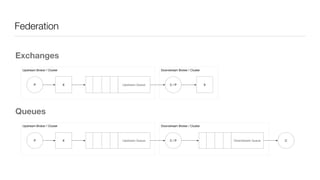
Federation
Exchanges
Queues
Downstream Broker / ClusterUpstream Broker / Cluster
P X Upstream Queue XC / P
Downstream Broker / ClusterUpstream Broker / Cluster
P X Upstream Queue C / P Downstream Queue C
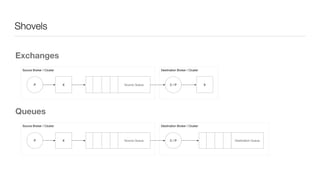
Shovels
Exchanges
Queues
Destination Broker / ClusterSource Broker / Cluster
P X Source Queue C / P Destination Queue
Destination Broker / ClusterSource Broker / Cluster
P X Source Queue XC / P
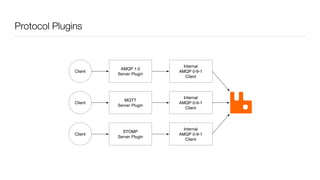
Protocol Plugins
Client
AMQP 1.0
Server Plugin
Client
MQTT
Server Plugin
Client
STOMP
Server Plugin
Internal
AMQP 0-9-1
Client
Internal
AMQP 0-9-1
Client
Internal
AMQP 0-9-1
Client
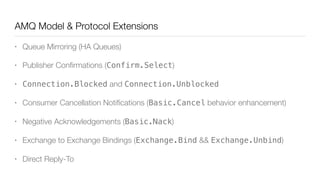
AMQ Model & Protocol Extensions
• Queue Mirroring (HA Queues)
• Publisher Confirmations (Confirm.Select)
• Connection.Blocked and Connection.Unblocked
• Consumer Cancellation Notifications (Basic.Cancel behavior enhancement)
• Negative Acknowledgements (Basic.Nack)
• Exchange to Exchange Bindings (Exchange.Bind && Exchange.Unbind)
• Direct Reply-To
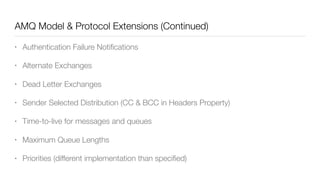
AMQ Model & Protocol Extensions (Continued)
• Authentication Failure Notifications
• Alternate Exchanges
• Dead Letter Exchanges
• Sender Selected Distribution (CC & BCC in Headers Property)
• Time-to-live for messages and queues
• Maximum Queue Lengths
• Priorities (different implementation than specified)
Architectural Impact of
Embracing AMQP
• Simplicity

• Extensibility

• Robustness

• Flexibility
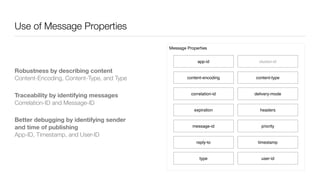
Use of Message Properties
Robustness by describing content

Content-Encoding, Content-Type, and Type
Traceability by identifying messages

Correlation-ID and Message-ID
Better debugging by identifying sender 

and time of publishing

App-ID, Timestamp, and User-ID
Message Properties
content-encoding
app-id
content-type
delivery-modecorrelation-id
expiration
message-id
headers
priority
user-id
reply-to
type
timestamp
cluster-id
Message Flexibility
Same message, multiple simple consumer types
Questions?
Follow me on Twitter: @Crad

Keynote: Idiomatic RabbitMQ - Gavin M Roy

  • 1.
    Idiomatic RabbitMQ Gavin M.Roy VP of Architecture AWeber Communications Twitter: @Crad
  • 2.
    To grok RabbitMQis to know AMQP 0-9-1
  • 3.
    Beginner Questions How doI … What is a …
  • 4.
    Next Level Questions Whydo / does / is …
  • 5.
  • 6.
    Advanced Message QueueingModel Exchange
 Receives and route messages Message Queue
 Store messages until they are consumed Binding
 Defines the relationship between the exchange and queue X QueueBindingExchange
  • 7.
    Advanced Message QueueingProtocol Client Server Protocol Header Connection.Start Connection.StartOk Connection.Secure Connection.SecureOk Connection.Tune Connection.TuneOk Connection.Open Connection.OpenOk AMQP 0-8 to 0-9-1
 RabbitMQ’s foundation
  • 8.
    AMQP Classes andMethods Connection
 Start, StartOk, Close … Channel
 Open, Close, Flow … Exchange
 Declare, Bind, Unbind, Delete … Queue
 Declare, Bind, Purge … Basic
 Publish, Consume, Get, Recover … TX
 Select, Commit, Rollback … Confirm
 Select, SelectOk Exceptions
 Arguments to Channel.Close
  • 9.
    AMQP Framing 0 3350xce1 Frame Payload The frame header is comprised of three parts, the frame type, channel number and the frame size The frame payload varies depending on the frame type There is a single byte marker to specify the end of the frame
  • 10.
    Message Publishing Anatomy TheBasic.Publish method frame tells RabbitMQ that a client is going to publish a message and that it should expect a Header frame with Basic.Properties in it The content header frame carries the message properties and tells RabbitMQ how big the message body is so that it can process the correct number of body frames that are going to be sent. A single message published may contain multiple body frames, depending on the size of the content and the maximum frame size setting 1 41 0xce1 Basic.Publish 1 82 0xce2 Content Header 1 55 0xce3 Body Frame Type, Channel and Byte Size Frame Type, Channel and Byte Size Frame Type, Channel and Byte Size
  • 11.
    Basic.Publish Frame The firsttwo fields of the method frame payload carry the Class and Method ID, numeric values that represent the RPC command. The next part of the method frame carries the first argument for the method, in this case, the name of the exchange to publish in to The routing key value is the next argument and provides information for the exchange to route the message into the appropriate queue or queues. Exchange Name Routing Key Value Mandatory Flag The mandatory flag tells RabbitMQ that it must be able to route the message or it should send a Basic.Return frame indicating the message could not be routed. Basic Publish 1 41 0xce1 Method Frame
  • 12.
    Content Header Frame Thefirst field in a content header is the body size, however this value is not considered a property of the message The flag values specify which properties are set The first property of the message, the content-type is specified The app_id property is also specified 55 application/json Test 1144, 200 1014206880 The timestamp property is specified, but is actually carried as the binary packed value The property delivery-mode with a value of 1 tells RabbitMQ to only keep the message in memory when publishing to a queue 1 45 0xce2 Content Header Frame
  • 13.
    Body Frame(s) 1 550xce3 Body {"foo": "bar", "baz": "qux", "quux", "corge": "grault"} The message body is opaque to the AMQP protocol and is not decoded, inspected, or evaluated by RabbitMQ
  • 14.
    Message Publishing How doyou answer publishing questions?
  • 15.
  • 16.
    Receiving Messages Questioning howmessages are delivered
  • 17.
  • 18.
    How will youuse RabbitMQ? Leverage the AMQ Model or Do-It Yourself
  • 19.
    Use RabbitMQ andDYI Contract and content in the message body
  • 20.
    Use the AMQModel Message Properties and Routing
  • 21.
    AMQ Model withRPC C / PC / P P / C C / PResponse Queue X X Worker Queue Message Properties content-encoding app-id content-type delivery-modecorrelation-id expiration message-id headers priority user-id reply-to type timestamp cluster-id
  • 22.
    AMQ Model withMessage Firehose Message Properties content-encoding app-id content-type delivery-modecorrelation-id expiration message-id headers priority user-id reply-to type timestamp cluster-id X Image Hashing Facial Detection RPC Worker P image.new.profile User Directory Materialization image.new.* Auditing Worker image.*.profile image.# Image Removal image.delete.* image.new.profile
  • 23.
    Common User Problems •Not understanding the bidirectional nature of AMQP • Heartbeats? • Throttling Messages • How to use channels? • Slow performance due to poor choices
  • 24.
    AMQP Problems • Currently30 items in the 0-9-1 errata • Logic Errors • Marshaling incompatibilities between 
 0-9 && 0-9-1 • Behavior differences between 0-8 && 0-9-1 • Authentication Failure Notifications • Client responsibilities
  • 25.
    RabbitMQ Extensions Building ontop of the AMQ Model and Protocol
  • 26.
    Federation Exchanges Queues Downstream Broker /ClusterUpstream Broker / Cluster P X Upstream Queue XC / P Downstream Broker / ClusterUpstream Broker / Cluster P X Upstream Queue C / P Downstream Queue C
  • 27.
    Shovels Exchanges Queues Destination Broker /ClusterSource Broker / Cluster P X Source Queue C / P Destination Queue Destination Broker / ClusterSource Broker / Cluster P X Source Queue XC / P
  • 28.
    Protocol Plugins Client AMQP 1.0 ServerPlugin Client MQTT Server Plugin Client STOMP Server Plugin Internal AMQP 0-9-1 Client Internal AMQP 0-9-1 Client Internal AMQP 0-9-1 Client
  • 29.
    AMQ Model &Protocol Extensions • Queue Mirroring (HA Queues) • Publisher Confirmations (Confirm.Select) • Connection.Blocked and Connection.Unblocked • Consumer Cancellation Notifications (Basic.Cancel behavior enhancement) • Negative Acknowledgements (Basic.Nack) • Exchange to Exchange Bindings (Exchange.Bind && Exchange.Unbind) • Direct Reply-To
  • 30.
    AMQ Model &Protocol Extensions (Continued) • Authentication Failure Notifications • Alternate Exchanges • Dead Letter Exchanges • Sender Selected Distribution (CC & BCC in Headers Property) • Time-to-live for messages and queues • Maximum Queue Lengths • Priorities (different implementation than specified)
  • 31.
    Architectural Impact of EmbracingAMQP • Simplicity • Extensibility • Robustness • Flexibility
  • 32.
    Use of MessageProperties Robustness by describing content
 Content-Encoding, Content-Type, and Type Traceability by identifying messages
 Correlation-ID and Message-ID Better debugging by identifying sender 
 and time of publishing
 App-ID, Timestamp, and User-ID Message Properties content-encoding app-id content-type delivery-modecorrelation-id expiration message-id headers priority user-id reply-to type timestamp cluster-id
  • 33.
    Message Flexibility Same message,multiple simple consumer types
  • 34.