148 © 2006 International Reading Association (pp. 148–156) doi:10.1598/RT.60.2.5
MICHELLE KELLEY
NICKI CLAUSEN-GRACE
R5
: The Sustained Silent Reading
makeover that transformed readers
This SSR adaptation can increase students’
wide reading, metacognitive awareness, and
comprehension.
A
t first glance, it looks as if all is well during
a Sustained Silent Reading (SSR) block.
The class is still and quiet. Students sit
calmly with open books, appearing to read intently.
But take a closer look and you’ll recognize a hand-
ful of disengaged readers doing anything but read-
ing. These students move from bookshelf to desk,
from desk to restroom, and then back to the book-
shelf to switch books. Others sit staring at and flip-
ping the pages of a book, maybe even reading
words, but neglecting to make meaning of what
they have read. These disengaged readers like to
share their progress with the teacher frequently, stat-
ing, “I’m on chapter 2 now,” then later, “I’m almost
to chapter 3.” Add to these students those who are
reading books well below their ability level, or
those stuck reading the same genre, book after
book, and you begin to get a clearer picture of what
is actually occurring during this silent reading time.
A cause for concern
Even a few disengaged readers in a classroom
is a cause for concern, especially given the research
that suggests a powerful link between time spent
reading and reading achievement (Cunningham &
Stanovich, 1997; Guthrie, Wigfield, Metsala, &
Cox, 1999). Furthermore, those who read by choice
report reading more than other students (Wigfield
& Guthrie, 1997), perform better on standardized
reading tests (Gottfried, 1990), and make higher
grades in school (Sweet, Guthrie, & Ng, 1998).
Our students as a whole seemed very far re-
moved from the engaged, enthusiastic, and self-
motivated students described by these researchers.
We were certainly aware of McQuillan’s (1998)
observation that students needed access to appeal-
ing, interesting text and time to silently read books
of their choice to attain high levels of literacy. And
although research suggests middle class families
such as those in our school have more access to
books (Feitelson & Goldstein, 1986), we found that
many of our students had outside interests com-
peting with time to read, and a handful of them,
when given the opportunity, didn’t actively engage
in reading at all.
Who we are
Our collaboration began in December of 2003.
The two of us, Michelle, a university instructor, and
Nicki, a third-grade teacher, wanted to examine
the metacognitive awareness or ability of third
graders to monitor and guide their thinking during
the reading process and to determine whether di-
rect instruction in metacognitive strategies would
benefit all learners.
Furthermore, Nicki was worried about the
growth of students in two groups she had identified
from guided reading: her advanced readers, those
who were performing well above grade level, and
her “fake” readers, those who read the words in a text
without attaching meaning, or literally pretended to
read. We hoped that in our quest to find out more
about third graders’ metacognitive awareness, we
would also discover how to engage our disengaged
readers and purposefully accelerate our highest read-
ers.
R5
: The Sustained Silent Reading makeover that transformed readers 149
How we gathered data
We chose to use the Developmental Reading
Assessment (DRA) designed for grades 4–8 to help
explore our action research questions. We chose the
DRA 4–8 for two major reasons. First, the DRA
4–8 provides data regarding engagement as well
as metacognitive awareness, both of which were
central to our research questions. Second, Nicki’s
students had already been assessed with the DRA
K–3 and some of them were reading beyond the
scope of its K–5 range. Because it has texts ranging
from level 20 (grade 2) to level 80 (grade 8), the
DRA 4–8 would allow those higher readers to con-
tinue to show growth, while providing a bridge for
the below- and on-grade-level readers.
The DRA 4–8 has three major components,
two of which were significant to this study: en-
gagement and comprehension. To determine each
student’s level of reading engagement, we admin-
istered the DRA Student Reading Survey to all stu-
dents. The survey has two sections, wide reading
and self-assessment/goal setting. The wide-reading
survey asks students to list what books they have
read recently, differentiating between what has
been read at school and at home, and what authors
and genres they enjoy reading and why. The self-
assessment survey asks students to identify their
strengths and weaknesses and develop a written
plan to improve areas of need. A rubric is used by
the teacher to determine whether the student’s writ-
ten response in each area is at one of four levels: in-
tervention, instructional, independent, or advanced.
The goal is to have each student be at least inde-
pendent in each area. Once a level is identified for
both wide reading and self-assessment/goal setting,
the scores are then totaled to obtain an overall en-
gagement score.
The next component of the DRA 4–8 that was
essential to our study was comprehension. Short
fiction and nonfiction texts are available for stu-
dents to read, ranging from reading levels 20–80
(second to eighth grade). After a text is selected by
the teacher or student, the student reads a few pages
orally for fluency evaluation. This determines if the
text level is appropriate for the student to continue
to read. Then, the student writes a prediction about
the book and develops questions he or she antici-
pates will be answered during the reading. The stu-
dent reads the remainder of the book silently and
then responds to several written prompts and ques-
tions. These assess the student’s ability to summa-
rize, answer literal and interpretive questions, and
reflect on the text, as well as his or her metacogni-
tive awareness while reading.As with engagement,
each area of comprehension is assessed using a
four-point rubric to determine whether the student
is at an intervention, instructional, independent, or
advanced level. Therefore, the teacher receives sep-
arate data on prediction, summarization, literal
comprehension, interpretation, reflection, and
metacognitive awareness for each student.
The scores are then totaled to determine an over-
all comprehension score. Scores on each component
(engagement, fluency, and comprehension) are com-
bined with the text level read to determine the stu-
dent’s overall reading level. These data provided us
with a comprehensive view of each student’s needs
as well as a measure of class trends and concerns.
What we found
The data on students’ engagement from the
Student Reading Survey confirmed our classroom
observations and teacher instinct. Our students
were reading only a narrow range of genres and
mostly nonchallenging texts. Many of them had a
poor view of reading and lacked strategies to mon-
itor comprehension. Although only 24% of the stu-
dents scored at the intervention and instructional
levels for wide reading, it was clear that their book
choices were limited by genre and series. When
we disaggregated their selections, 86% of the stu-
dents reported reading fantasy books and 52%
were reading realistic fiction. In contrast, only 10%
were reading nonfiction books and only 19% were
reading mysteries.
We needed to get these children interested and
engaged in other genres, especially nonfiction. We
also needed to introduce them to some new series,
authors, and age-appropriate books. The Magic
Tree House books and Junie B. Jones were the
most common books listed as recent reads.
The Student Reading Survey area of self-
assessment/goal setting demonstrated a more
startling need: 67% of our students were at the
intervention or instructional level. Our students had
a very limited view of the nature of reading, and
they often regurgitated “teacher lingo” without any
The Reading Teacher Vol. 60, No. 2 October 2006150
understanding of what it meant. For example, when
asked on the survey to list what he did well as a
reader, one student wrote, “I clarify, predict, and
ask questions.” This sounds very sophisticated but
these same words were printed on a poster in the
classroom and had been the focus of several guided
reading groups who used the reciprocal teaching
method. In addition, most of the plans to improve
reading were simplistic and showed that students
were not metacognitive or aware of the thinking
process as they read. For example, on one survey a
student wrote that his strengths were “connections,
retelling, comprehend reading the words.” When
asked in the survey what he needed to do to be-
come a better reader, he wrote, “connections,” and
his plan for improving was “connections, read
more, retelling, comprehend.” Like this student,
many others repeated what they did well as a read-
er in response to what they needed to do to become
a better reader. We knew we had a long way to go
in self-assessment/goal setting.
The comprehension data demonstrated that our
students would benefit from direct instruction in
comprehension strategies and in metacognitive
awareness, both related to our original action re-
search questions. In the areas of prediction and
summary, 61% of our students were at either the in-
tervention or instructional level, 39% scored at
these levels in literal comprehension, 56% in in-
terpretation, and 50% in reflection. In the area of
metacognitive awareness, 89% of our students
scored at the intervention and instructional levels.
What we concluded
Because our students lacked the strategies to
monitor comprehension we decided that we needed
to integrate metacognitive units across the literacy
block. The comprehension data led us to imple-
ment units of study in making connections, pre-
dicting, questioning, visualizing, and summarizing.
We determined that direct instruction in these
strategies would benefit all learners, potentially en-
hancing the achievement of our highest readers and
laying a foundation for our lowest readers.
Furthermore, by teaching a strategy throughout the
day and for a significant amount of time (some-
times more than a month), we hoped that students
would be more likely to acquire it and use it inde-
pendently.
The same data led us to redesign the SSR block
to be more purposeful and focused. Our students
had a very limited view of reading. We needed to
ensure that they were engaging in reading, and we
wanted to gradually release responsibility to them
as they learned each strategy (Pearson, 1985). We
felt that we needed to restructure SSR to achieve
these goals.
During the 1990s SSR; Drop Everything And
Read (DEAR); and Uninterrupted, Sustained Silent
Reading (USSR) were commonly used as the in-
dependent reading block in many schools. During
SSR, the teacher is expected to read and be a role
model for students. Students read materials of their
own choosing for a specified amount of time. In
SSR, there are no accountability measures and
there is no required follow-up activity (Pilgreen,
2000). The rationale for SSR was to have students
practice reading at their independent reading lev-
els to develop fluency, increase vocabulary, en-
hance comprehension, and improve wide reading
(Krashen, 1988; Pilgreen, 2000). We were well
aware of the strengths of SSR but equally aware of
possible weaknesses. Students often read inappro-
priate reading material (too hard or too easy), and
many students were fake reading during this time.
The lack of response or feedback left some students
without a purpose for reading.And in our situation,
many students were unable to engage in their texts
because they lacked strategies needed to monitor
comprehension. They viewed reading as decoding
words and answering questions when they were
finished (Beers, 2002; Wilhelm, 1997). Likewise,
the National Reading Panel (National Institute of
Child Health and Human Development, 2000) re-
ported that it was unable to locate many studies on
the efficacy of independent reading programs such
as SSR. Studies that did exist failed to convince
the panel that the programs increased the amount of
reading or improved fluency and overall reading
achievement.
Our data and the overwhelming evidence that
demonstrated the positive relationship between wide
reading, vocabulary acquisition, and a students’per-
formance on standardized tests (Anderson & Nagy,
1992; Krashen, 2004; National Assessment of
Educational Progress, 1988) solidified our belief
that a structured time for students to independently
practice reading was critical to engaging readers and
developing a literate culture—both predictors of
reading achievement (Allington, 2006; Davidson &
Koppenhaver, 1993). Because there is also evidence
that students who spend more time reading in school
perform as well or better on standardized tests of
reading comprehension than other students
(Krashen, 2004), we wanted to add to the total
amount of time students were reading. Therefore,
we set out to retool the SSR block. We wanted this
time to be purposeful, focused, metacognitive, and
pleasurable.
How we did it
We realized that our students were unaware of
the reading process, had some deficiencies in com-
prehension, and lacked the ability to self-assess and
set goals. In addition, we had a handful of fake
readers who went through the motions of reading
during SSR.
Michelle had experienced success with reading
workshop, so we decided to combine some of these
elements and add in those components that would
make the reading process more visible to our stu-
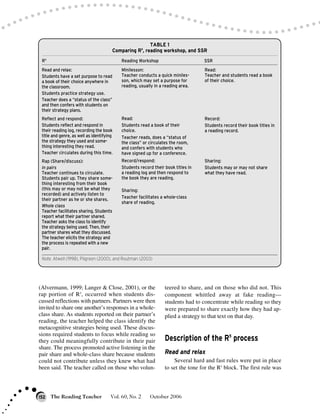
dents (see Table 1). We reviewed Pilgreen’s (2000)
research in which she analyzed successful SSR
programs and identified eight common factors.
These factors are access, appeal, conducive envi-
ronment, encouragement, staff training, nonac-
countability, follow-up activities, and distributed
time to read. Access and appeal were not an issue
for our students. The classroom library housed over
1,500 books across genres.A guided-reading group
had organized the library to make it more appeal-
ing. The physical environment was not a concern
either. We had couches, a chair, pillows, and even
lawn chairs available for students to use while they
read for a specified amount of time. Students re-
ported feeling safe and relaxed while they read.
We agreed with the assertion that teachers en-
hance motivation by serving as reading role models
(Gambrell, 1996), but felt Pilgreen’s model, which
promotes the practice of teachers reading silently
alongside students, limited the amount of support
a teacher could provide. Instead, Nicki modeled a
love for books through read-aloud, shared reading,
and book talks throughout the course of each day.
She shared her knowledge of books and worked
hard to match students to books that she thought
they would be interested in reading. This freed her
up to monitor and support students during the in-
dependent reading block while maintaining stu-
dents’ views of her as a reader. When asked, “Is
your teacher a reader?” 100% of the students re-
sponded “Yes.” When asked, “How do you know?”
they gave a number of convincing responses such
as, “She talks about all of the books she reads all
the time,” and “She reads to us all day.”
Staff training was ongoing as we read profes-
sional materials, implemented strategies, and reflect-
ed on the outcomes. Over time we built students’
reading stamina. We started out having them read
for 10 minutes and then increased the time gradual-
ly, based on their requests for more time reading.
While we agreed that a quota approach to ac-
countability, such as setting minimum pages read
or other book requirements for students, was coun-
terproductive, we wanted a way to monitor student
choices, provide encouragement, and support book
choices when they were reading for pleasure.
Therefore we needed to keep track of the books
students were reading and confer with students on
their strategy use. In addition, we wanted to have
students keep logs about their reading to help them
gather their thoughts for discussion. The logs were
never perceived, nor used, as evaluative tools for
individual students but they did provide us with a
great deal of insight on the group’s progress.
Next, we brainstormed a list of stumbling
blocks in traditional SSR drawn from our staff
training, professional reading, and our own expe-
riences. These included students choosing a new
chapter book every day, chronically reading books
well below their independent levels, getting stuck
in the same genre or series, fake reading, and gen-
eral avoidance behaviors.
Overview of the R5
process
We strategically designed several structures
and practices to help negate the obstacles of SSR.
The result was R5
(read, relax, reflect, respond, and
rap). Three days a week, students spend 10–25
minutes reading self-selected texts. After reading,
they reflect in writing on their use of metacognitive
practices taught during minilessons, guided read-
ing, and read-aloud. Conversations about books
R5
: The Sustained Silent Reading makeover that transformed readers 151
(Alvermann, 1999; Langer & Close, 2001), or the
rap portion of R5
, occurred when students dis-
cussed reflections with partners. Partners were then
invited to share one another’s responses in a whole-
class share. As students reported on their partner’s
reading, the teacher helped the class identify the
metacognitive strategies being used. These discus-
sions required students to focus while reading so
they could meaningfully contribute in their pair
share. The process promoted active listening in the
pair share and whole-class share because students
could not contribute unless they knew what had
been said. The teacher called on those who volun-
teered to share, and on those who did not. This
component whittled away at fake reading—
students had to concentrate while reading so they
were prepared to share exactly how they had ap-
plied a strategy to that text on that day.
Description of the R5
process
Read and relax
Several hard and fast rules were put in place
to set the tone for the R5
block. The first rule was
The Reading Teacher Vol. 60, No. 2 October 2006152
TABLE 1
Comparing R5
, reading workshop, and SSR
R5
Reading Workshop SSR
Note. Atwell (1998), Pilgreen (2000), and Routman (2003)
Read and relax:
Students have a set purpose to read
a book of their choice anywhere in
the classroom.
Students practice strategy use.
Teacher does a “status of the class”
and then confers with students on
their strategy plans.
Reflect and respond:
Students reflect and respond in
their reading log, recording the book
title and genre, as well as identifying
the strategy they used and some-
thing interesting they read.
Teacher circulates during this time.
Rap (Share/discuss):
In pairs
Teacher continues to circulate.
Students pair up. They share some-
thing interesting from their book
(this may or may not be what they
recorded) and actively listen to
their partner as he or she shares.
Whole class
Teacher facilitates sharing. Students
report what their partner shared.
Teacher asks the class to identify
the strategy being used. Then, their
partner shares what they discussed.
The teacher elicits the strategy and
the process is repeated with a new
pair.
Minilesson:
Teacher conducts a quick miniles-
son, which may set a purpose for
reading, usually in a reading area.
Read:
Students read a book of their
choice.
Teacher reads, does a “status of
the class” or circulates the room,
and confers with students who
have signed up for a conference.
Record/respond:
Students record their book titles in
a reading log and then respond to
the book they are reading.
Sharing:
Teacher facilitates a whole-class
share of reading.
Read:
Teacher and students read a book
of their choice.
Record:
Students record their book titles in
a reading record.
Sharing:
Students may or may not share
what they have read.
that students had to have self-selected reading ma-
terials in their desks prior to the start of the period.
If someone forgot or finished reading a book, we
gave them a new selection to read for the remainder
of the time. We were careful to ensure that this was
not perceived as a punishment, and we tried to
choose something the student would be able to read
and enjoy. The second rule was that no one could
get up during the block. Restroom and water breaks
were given before and after R5
.
These rules seemed to help all students relax
and settle into reading quickly and solidly. It made
a dramatic difference to most of those who had
spent time avoiding reading. Their only choice now
was to sit and pretend to read or to sit and read.
Only one or two made the former choice, and we
had a plan for them as well.
To help keep track of whether students were
making good selections and sticking with longer
books, the teacher logged the “status of the class”
each day (Atwell, 1990). The status sheet had cells
for the students’ names, the date, the title of each
student’s text, and the page they were on each day.
It took 5 to 10 minutes for the teacher to circulate
and record information. It was time well spent.
After a week, students realized that someone was
noticing what and how much they were reading. It
also offered us a chance to do on-the-spot minicon-
ferences with those students who might be making
poor choices or having trouble finding a book that
held their interest. It was a quiet, low-key, and sub-
tle way to provide some accountability and sup-
port right when it was needed.
After the status was taken, the teacher con-
ducted a one-on-one conference with one or two
students each day. Students shared their metacog-
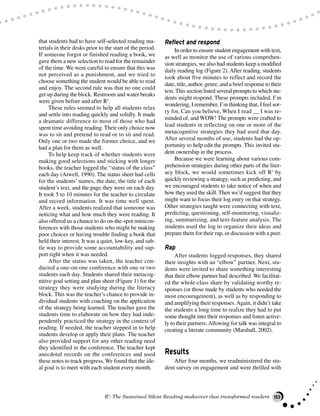
nitive goal setting and plan sheet (Figure 1) for the
strategy they were studying during the literacy
block. This was the teacher’s chance to provide in-
dividual students with coaching on the application
of the strategy being learned. The teacher gave the
students time to elaborate on how they had inde-
pendently practiced the strategy in the context of
reading. If needed, the teacher stepped in to help
students develop or apply their plans. The teacher
also provided support for any other reading need
they identified in the conference. The teacher kept
anecdotal records on the conferences and used
these notes to track progress. We found that the ide-
al goal is to meet with each student every month.
Reflect and respond
In order to ensure student engagement with text,
as well as monitor the use of various comprehen-
sion strategies, we also had students keep a modified
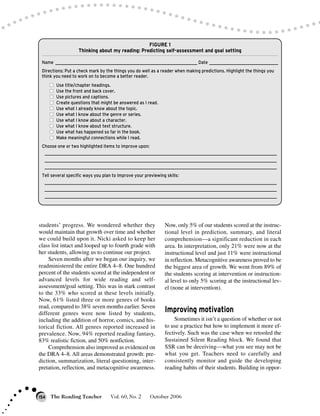
daily reading log (Figure 2). After reading, students
took about five minutes to reflect and record the
date, title, author, genre, and a brief response to their
text. This section listed several prompts to which stu-
dents might respond. These prompts included, I’m
wondering, I remember, I’m thinking that, I feel sor-
ry for, Can you believe, When I read __ I was re-
minded of, and WOW! The prompts were crafted to
lead students in reflecting on one or more of the
metacognitive strategies they had used that day.
After several months of use, students had the op-
portunity to help edit the prompts. This invited stu-
dent ownership in the process.
Because we were learning about various com-
prehension strategies during other parts of the liter-
acy block, we would sometimes kick off R5
by
quickly reviewing a strategy, such as predicting, and
we encouraged students to take notice of when and
how they used the skill. Then we’d suggest that they
might want to focus their log entry on that strategy.
Other strategies taught were connecting with text,
predicting, questioning, self-monitoring, visualiz-
ing, summarizing, and text-feature analysis. The
students used the log to organize their ideas and
prepare them for their rap, or discussion with a peer.
Rap
After students logged responses, they shared
their insights with an “elbow” partner. Next, stu-
dents were invited to share something interesting
that their elbow partner had described. We facilitat-
ed the whole-class share by validating worthy re-
sponses (or those made by students who needed the
most encouragement), as well as by responding to
and amplifying their responses.Again, it didn’t take
the students a long time to realize they had to put
some thought into their responses and listen active-
ly to their partners.Allowing for talk was integral to
creating a literate community (Marshall, 2002).
Results
After four months, we readministered the stu-
dent survey on engagement and were thrilled with
R5
: The Sustained Silent Reading makeover that transformed readers 153
students’ progress. We wondered whether they
would maintain that growth over time and whether
we could build upon it. Nicki asked to keep her
class list intact and looped up to fourth grade with
her students, allowing us to continue our project.
Seven months after we began our inquiry, we
readministered the entire DRA 4–8. One hundred
percent of the students scored at the independent or
advanced levels for wide reading and self-
assessment/goal setting. This was in stark contrast
to the 33% who scored at these levels initially.
Now, 61% listed three or more genres of books
read, compared to 38% seven months earlier. Seven
different genres were now listed by students,
including the addition of horror, comics, and his-
torical fiction. All genres reported increased in
prevalence. Now, 94% reported reading fantasy,
83% realistic fiction, and 50% nonfiction.
Comprehension also improved as evidenced on
the DRA 4–8. All areas demonstrated growth: pre-
diction, summarization, literal questioning, inter-
pretation, reflection, and metacognitive awareness.
Now, only 5% of our students scored at the instruc-
tional level in prediction, summary, and literal
comprehension—a significant reduction in each
area. In interpretation, only 21% were now at the
instructional level and just 11% were instructional
in reflection. Metacognitive awareness proved to be
the biggest area of growth. We went from 89% of
the students scoring at intervention or instruction-
al level to only 5% scoring at the instructional lev-
el (none at intervention).
Improving motivation
Sometimes it isn’t a question of whether or not
to use a practice but how to implement it more ef-
fectively. Such was the case when we retooled the
Sustained Silent Reading block. We found that
SSR can be deceiving—what you see may not be
what you get. Teachers need to carefully and
consistently monitor and guide the developing
reading habits of their students. Building in oppor-
The Reading Teacher Vol. 60, No. 2 October 2006154
FIGURE 1
Thinking about my reading: Predicting self-assessment and goal setting
Name __________________________________________________________________ Date ________________________________
Directions: Put a check mark by the things you do well as a reader when making predictions. Highlight the things you
think you need to work on to become a better reader.
■■ Use title/chapter headings.
■■ Use the front and back cover.
■■ Use pictures and captions.
■■ Create questions that might be answered as I read.
■■ Use what I already know about the topic.
■■ Use what I know about the genre or series.
■■ Use what I know about a character.
■■ Use what I know about text structure.
■■ Use what has happened so far in the book.
■■ Make meaningful connections while I read.
Choose one or two highlighted items to improve upon:
____________________________________________________________________________________________________________
____________________________________________________________________________________________________________
____________________________________________________________________________________________________________
Tell several specific ways you plan to improve your previewing skills:
____________________________________________________________________________________________________________
____________________________________________________________________________________________________________
____________________________________________________________________________________________________________
tunities for sharing ideas and discussions about text
can be a powerful motivation for engaging read-
ers.A thoughtful modification of SSR geared to the
needs of a class can result in significant gains on
formal assessments of wide reading, metacognitive
awareness, and comprehension.
The most striking outcome we observed in the
classroom was that students were sharing titles and
describing snippets of their books three times a
week during R5
. This proved in the end to be the
most motivating factor for our fake readers. A per-
vasive culture of avid readers was born, causing
even reluctant readers to compete for the first shot
at new books. Students began asking the teacher
to purchase specific titles for the classroom collec-
tion. They started coaxing their parents to purchase
new titles (which they actually read, rather than let-
ting them stack up) or to take them to the public li-
brary to get books. They also began clamoring for
more R5
time. The emphasis on metacognitive
awareness was a benefit for all learners. We saw
improved motivation in every child—from the
hard-core book addicts to the most reluctant read-
ers. Fake readers became engaged readers, and en-
gaged readers became fanatics.
Kelley teaches at the University of Central
Florida (PO Box 161250, Suite 322K, Orlando,
FL 32816-1250, USA). E-mail
mkelley@mail.ucf.edu. Clausen-Grace teaches
at Carillon Elementary in Oviedo, Florida. They
are the authors of Taking the Silence Out of
Reading, to be published by the International
Reading Association in 2007.
References
Allington, R.L. (2006). What really matters for struggling
readers: Designing research-based programs (2nd ed.).
Boston: Allyn & Bacon.
Alvermann, D. (1999). Adolescents’ perceptions and negoti-
ations of literacy practices in after-school read and talk
clubs. American Educational Research Journal, 36,
221–264.
Anderson, R.C., & Nagy, W.E. (1992). The vocabulary conun-
drum. American Educator, 16(4), 14–18, 44–47.
Atwell, N. (1990). Coming to know: Writing to learn in the in-
termediate grades. Portsmouth, NH: Heinemann.
R5
: The Sustained Silent Reading makeover that transformed readers 155
FIGURE 2
Independent reading log
Title and author Genre Response to what I read: I’m wondering.... I can see a clear
picture of.... I feel sorry for.... I really liked it when.... Can you
believe...? I made a connection to.... WOW! Today in my story....
Atwell, N. (1998). In the middle: New understandings about
writing, reading, and learning (2nd ed.). Portsmouth, NH:
Heinemann.
Beers, K.B. (2002). When kids can’t read: What teachers
can do. Portsmouth, NH: Heinemann.
Cunninghan, A.E., & Stanovich, K.E. (1997). Early reading
acquisition and its relation to reading experience and
ability 10 years later. Developmental Psychology, 33,
934–945.
Davidson, J., & Koppenhaver, D. (1993). Adolescent litera-
cy: What works and why. New York: Garland.
Feitelson, D., & Goldstein, Z. (1986). Patterns of book own-
ership and reading to young children in Israeli school-
oriented and nonschool-oriented families. The Reading
Teacher, 39, 924–930.
Gambrell, L.B. (1996). Creating classroom cultures that fos-
ter reading motivation. The Reading Teacher, 50, 14–25.
Gottfried, A.E. (1990). Academic intrinsic motivation in
young elementary school children. Journal of
Educational Psychology, 82, 525–538.
Guthrie, J.T., Wigfield, A., Metsala, J.L., & Cox, K.E. (1999).
Motivational and cognitive predictors of text compre-
hension and reading amount. Scientific Studies of
Reading, 3, 231–256.
Krashen, S. (1988). Do we learn to read by reading? The re-
lationship between free reading and reading ability. In
D. Tannen (Ed.), Linguistics in context: Connecting ob-
servation and understanding (pp. 269–298). Westport,
CT: Ablex.
Krashen, S. (2004). False claims about literacy develop-
ment. Educational Leadership, 61(6), 18–21.
Langer, J., & Close, E. (2001). Improving literary under-
standing through classroom conversation. Albany, NY:
Center on English Learning and Achievement.
Marshall, J.C. (2002). Are they really reading: Expanding
SSR in the middle grades. York, ME: Stenhouse.
McQuillan, J. (1998). The literacy crisis: False claims, real so-
lutions. Portsmouth, NH: Heinemann.
National Assessment of Educational Progress. (1988). NAEP
reading report card for the nation. Washington, DC:
Author.
National Institute of Child Health and Human Development.
(2000). Report of the National Reading Panel. Teaching
children to read: An evidence-based assessment of the
scientific research literature on reading and its implica-
tions for reading instruction (NIH Publication No, 00-
4769). Washington, DC: U.S. Government Printing Office.
Pearson, P.D. (1985). Changing the face of reading compre-
hension instruction. The Reading Teacher, 38, 724–738.
Pilgreen, J. (2000). The SSR handbook: How to organize and
manage a sustained silent reading program. Portsmouth,
NH: Heinemann.
Routman, R. (2003). Reading essentials: The specifics you
need to teach reading well. Portsmouth, NH: Heinemann.
Sweet, A., Guthrie, J.T., & Ng, M. (1998). Teachers’ percep-
tions and students’ reading motivations. Journal of
Educational Psychology, 90, 210–223.
Wigfield, A., & Guthrie, J.T. (1997). Relations of children’s
motivation for reading to the amount and breadth of
their reading. Journal of Educational Psychology, 89,
420–432.
Wilhelm, J. (1997). You gotta be the book: Teaching engaged
and reflective reading with adolescents. New York:
Teachers College Press.
The Reading Teacher Vol. 60, No. 2 October 2006156
R5 reading wrkshop

R5 reading wrkshop

  • 1.
    148 © 2006International Reading Association (pp. 148–156) doi:10.1598/RT.60.2.5 MICHELLE KELLEY NICKI CLAUSEN-GRACE R5 : The Sustained Silent Reading makeover that transformed readers This SSR adaptation can increase students’ wide reading, metacognitive awareness, and comprehension. A t first glance, it looks as if all is well during a Sustained Silent Reading (SSR) block. The class is still and quiet. Students sit calmly with open books, appearing to read intently. But take a closer look and you’ll recognize a hand- ful of disengaged readers doing anything but read- ing. These students move from bookshelf to desk, from desk to restroom, and then back to the book- shelf to switch books. Others sit staring at and flip- ping the pages of a book, maybe even reading words, but neglecting to make meaning of what they have read. These disengaged readers like to share their progress with the teacher frequently, stat- ing, “I’m on chapter 2 now,” then later, “I’m almost to chapter 3.” Add to these students those who are reading books well below their ability level, or those stuck reading the same genre, book after book, and you begin to get a clearer picture of what is actually occurring during this silent reading time. A cause for concern Even a few disengaged readers in a classroom is a cause for concern, especially given the research that suggests a powerful link between time spent reading and reading achievement (Cunningham & Stanovich, 1997; Guthrie, Wigfield, Metsala, & Cox, 1999). Furthermore, those who read by choice report reading more than other students (Wigfield & Guthrie, 1997), perform better on standardized reading tests (Gottfried, 1990), and make higher grades in school (Sweet, Guthrie, & Ng, 1998). Our students as a whole seemed very far re- moved from the engaged, enthusiastic, and self- motivated students described by these researchers. We were certainly aware of McQuillan’s (1998) observation that students needed access to appeal- ing, interesting text and time to silently read books of their choice to attain high levels of literacy. And although research suggests middle class families such as those in our school have more access to books (Feitelson & Goldstein, 1986), we found that many of our students had outside interests com- peting with time to read, and a handful of them, when given the opportunity, didn’t actively engage in reading at all. Who we are Our collaboration began in December of 2003. The two of us, Michelle, a university instructor, and Nicki, a third-grade teacher, wanted to examine the metacognitive awareness or ability of third graders to monitor and guide their thinking during the reading process and to determine whether di- rect instruction in metacognitive strategies would benefit all learners. Furthermore, Nicki was worried about the growth of students in two groups she had identified from guided reading: her advanced readers, those who were performing well above grade level, and her “fake” readers, those who read the words in a text without attaching meaning, or literally pretended to read. We hoped that in our quest to find out more about third graders’ metacognitive awareness, we would also discover how to engage our disengaged readers and purposefully accelerate our highest read- ers.
  • 2.
    R5 : The SustainedSilent Reading makeover that transformed readers 149 How we gathered data We chose to use the Developmental Reading Assessment (DRA) designed for grades 4–8 to help explore our action research questions. We chose the DRA 4–8 for two major reasons. First, the DRA 4–8 provides data regarding engagement as well as metacognitive awareness, both of which were central to our research questions. Second, Nicki’s students had already been assessed with the DRA K–3 and some of them were reading beyond the scope of its K–5 range. Because it has texts ranging from level 20 (grade 2) to level 80 (grade 8), the DRA 4–8 would allow those higher readers to con- tinue to show growth, while providing a bridge for the below- and on-grade-level readers. The DRA 4–8 has three major components, two of which were significant to this study: en- gagement and comprehension. To determine each student’s level of reading engagement, we admin- istered the DRA Student Reading Survey to all stu- dents. The survey has two sections, wide reading and self-assessment/goal setting. The wide-reading survey asks students to list what books they have read recently, differentiating between what has been read at school and at home, and what authors and genres they enjoy reading and why. The self- assessment survey asks students to identify their strengths and weaknesses and develop a written plan to improve areas of need. A rubric is used by the teacher to determine whether the student’s writ- ten response in each area is at one of four levels: in- tervention, instructional, independent, or advanced. The goal is to have each student be at least inde- pendent in each area. Once a level is identified for both wide reading and self-assessment/goal setting, the scores are then totaled to obtain an overall en- gagement score. The next component of the DRA 4–8 that was essential to our study was comprehension. Short fiction and nonfiction texts are available for stu- dents to read, ranging from reading levels 20–80 (second to eighth grade). After a text is selected by the teacher or student, the student reads a few pages orally for fluency evaluation. This determines if the text level is appropriate for the student to continue to read. Then, the student writes a prediction about the book and develops questions he or she antici- pates will be answered during the reading. The stu- dent reads the remainder of the book silently and then responds to several written prompts and ques- tions. These assess the student’s ability to summa- rize, answer literal and interpretive questions, and reflect on the text, as well as his or her metacogni- tive awareness while reading.As with engagement, each area of comprehension is assessed using a four-point rubric to determine whether the student is at an intervention, instructional, independent, or advanced level. Therefore, the teacher receives sep- arate data on prediction, summarization, literal comprehension, interpretation, reflection, and metacognitive awareness for each student. The scores are then totaled to determine an over- all comprehension score. Scores on each component (engagement, fluency, and comprehension) are com- bined with the text level read to determine the stu- dent’s overall reading level. These data provided us with a comprehensive view of each student’s needs as well as a measure of class trends and concerns. What we found The data on students’ engagement from the Student Reading Survey confirmed our classroom observations and teacher instinct. Our students were reading only a narrow range of genres and mostly nonchallenging texts. Many of them had a poor view of reading and lacked strategies to mon- itor comprehension. Although only 24% of the stu- dents scored at the intervention and instructional levels for wide reading, it was clear that their book choices were limited by genre and series. When we disaggregated their selections, 86% of the stu- dents reported reading fantasy books and 52% were reading realistic fiction. In contrast, only 10% were reading nonfiction books and only 19% were reading mysteries. We needed to get these children interested and engaged in other genres, especially nonfiction. We also needed to introduce them to some new series, authors, and age-appropriate books. The Magic Tree House books and Junie B. Jones were the most common books listed as recent reads. The Student Reading Survey area of self- assessment/goal setting demonstrated a more startling need: 67% of our students were at the intervention or instructional level. Our students had a very limited view of the nature of reading, and they often regurgitated “teacher lingo” without any
  • 3.
    The Reading TeacherVol. 60, No. 2 October 2006150 understanding of what it meant. For example, when asked on the survey to list what he did well as a reader, one student wrote, “I clarify, predict, and ask questions.” This sounds very sophisticated but these same words were printed on a poster in the classroom and had been the focus of several guided reading groups who used the reciprocal teaching method. In addition, most of the plans to improve reading were simplistic and showed that students were not metacognitive or aware of the thinking process as they read. For example, on one survey a student wrote that his strengths were “connections, retelling, comprehend reading the words.” When asked in the survey what he needed to do to be- come a better reader, he wrote, “connections,” and his plan for improving was “connections, read more, retelling, comprehend.” Like this student, many others repeated what they did well as a read- er in response to what they needed to do to become a better reader. We knew we had a long way to go in self-assessment/goal setting. The comprehension data demonstrated that our students would benefit from direct instruction in comprehension strategies and in metacognitive awareness, both related to our original action re- search questions. In the areas of prediction and summary, 61% of our students were at either the in- tervention or instructional level, 39% scored at these levels in literal comprehension, 56% in in- terpretation, and 50% in reflection. In the area of metacognitive awareness, 89% of our students scored at the intervention and instructional levels. What we concluded Because our students lacked the strategies to monitor comprehension we decided that we needed to integrate metacognitive units across the literacy block. The comprehension data led us to imple- ment units of study in making connections, pre- dicting, questioning, visualizing, and summarizing. We determined that direct instruction in these strategies would benefit all learners, potentially en- hancing the achievement of our highest readers and laying a foundation for our lowest readers. Furthermore, by teaching a strategy throughout the day and for a significant amount of time (some- times more than a month), we hoped that students would be more likely to acquire it and use it inde- pendently. The same data led us to redesign the SSR block to be more purposeful and focused. Our students had a very limited view of reading. We needed to ensure that they were engaging in reading, and we wanted to gradually release responsibility to them as they learned each strategy (Pearson, 1985). We felt that we needed to restructure SSR to achieve these goals. During the 1990s SSR; Drop Everything And Read (DEAR); and Uninterrupted, Sustained Silent Reading (USSR) were commonly used as the in- dependent reading block in many schools. During SSR, the teacher is expected to read and be a role model for students. Students read materials of their own choosing for a specified amount of time. In SSR, there are no accountability measures and there is no required follow-up activity (Pilgreen, 2000). The rationale for SSR was to have students practice reading at their independent reading lev- els to develop fluency, increase vocabulary, en- hance comprehension, and improve wide reading (Krashen, 1988; Pilgreen, 2000). We were well aware of the strengths of SSR but equally aware of possible weaknesses. Students often read inappro- priate reading material (too hard or too easy), and many students were fake reading during this time. The lack of response or feedback left some students without a purpose for reading.And in our situation, many students were unable to engage in their texts because they lacked strategies needed to monitor comprehension. They viewed reading as decoding words and answering questions when they were finished (Beers, 2002; Wilhelm, 1997). Likewise, the National Reading Panel (National Institute of Child Health and Human Development, 2000) re- ported that it was unable to locate many studies on the efficacy of independent reading programs such as SSR. Studies that did exist failed to convince the panel that the programs increased the amount of reading or improved fluency and overall reading achievement. Our data and the overwhelming evidence that demonstrated the positive relationship between wide reading, vocabulary acquisition, and a students’per- formance on standardized tests (Anderson & Nagy, 1992; Krashen, 2004; National Assessment of Educational Progress, 1988) solidified our belief that a structured time for students to independently
  • 4.
    practice reading wascritical to engaging readers and developing a literate culture—both predictors of reading achievement (Allington, 2006; Davidson & Koppenhaver, 1993). Because there is also evidence that students who spend more time reading in school perform as well or better on standardized tests of reading comprehension than other students (Krashen, 2004), we wanted to add to the total amount of time students were reading. Therefore, we set out to retool the SSR block. We wanted this time to be purposeful, focused, metacognitive, and pleasurable. How we did it We realized that our students were unaware of the reading process, had some deficiencies in com- prehension, and lacked the ability to self-assess and set goals. In addition, we had a handful of fake readers who went through the motions of reading during SSR. Michelle had experienced success with reading workshop, so we decided to combine some of these elements and add in those components that would make the reading process more visible to our stu- dents (see Table 1). We reviewed Pilgreen’s (2000) research in which she analyzed successful SSR programs and identified eight common factors. These factors are access, appeal, conducive envi- ronment, encouragement, staff training, nonac- countability, follow-up activities, and distributed time to read. Access and appeal were not an issue for our students. The classroom library housed over 1,500 books across genres.A guided-reading group had organized the library to make it more appeal- ing. The physical environment was not a concern either. We had couches, a chair, pillows, and even lawn chairs available for students to use while they read for a specified amount of time. Students re- ported feeling safe and relaxed while they read. We agreed with the assertion that teachers en- hance motivation by serving as reading role models (Gambrell, 1996), but felt Pilgreen’s model, which promotes the practice of teachers reading silently alongside students, limited the amount of support a teacher could provide. Instead, Nicki modeled a love for books through read-aloud, shared reading, and book talks throughout the course of each day. She shared her knowledge of books and worked hard to match students to books that she thought they would be interested in reading. This freed her up to monitor and support students during the in- dependent reading block while maintaining stu- dents’ views of her as a reader. When asked, “Is your teacher a reader?” 100% of the students re- sponded “Yes.” When asked, “How do you know?” they gave a number of convincing responses such as, “She talks about all of the books she reads all the time,” and “She reads to us all day.” Staff training was ongoing as we read profes- sional materials, implemented strategies, and reflect- ed on the outcomes. Over time we built students’ reading stamina. We started out having them read for 10 minutes and then increased the time gradual- ly, based on their requests for more time reading. While we agreed that a quota approach to ac- countability, such as setting minimum pages read or other book requirements for students, was coun- terproductive, we wanted a way to monitor student choices, provide encouragement, and support book choices when they were reading for pleasure. Therefore we needed to keep track of the books students were reading and confer with students on their strategy use. In addition, we wanted to have students keep logs about their reading to help them gather their thoughts for discussion. The logs were never perceived, nor used, as evaluative tools for individual students but they did provide us with a great deal of insight on the group’s progress. Next, we brainstormed a list of stumbling blocks in traditional SSR drawn from our staff training, professional reading, and our own expe- riences. These included students choosing a new chapter book every day, chronically reading books well below their independent levels, getting stuck in the same genre or series, fake reading, and gen- eral avoidance behaviors. Overview of the R5 process We strategically designed several structures and practices to help negate the obstacles of SSR. The result was R5 (read, relax, reflect, respond, and rap). Three days a week, students spend 10–25 minutes reading self-selected texts. After reading, they reflect in writing on their use of metacognitive practices taught during minilessons, guided read- ing, and read-aloud. Conversations about books R5 : The Sustained Silent Reading makeover that transformed readers 151
  • 5.
    (Alvermann, 1999; Langer& Close, 2001), or the rap portion of R5 , occurred when students dis- cussed reflections with partners. Partners were then invited to share one another’s responses in a whole- class share. As students reported on their partner’s reading, the teacher helped the class identify the metacognitive strategies being used. These discus- sions required students to focus while reading so they could meaningfully contribute in their pair share. The process promoted active listening in the pair share and whole-class share because students could not contribute unless they knew what had been said. The teacher called on those who volun- teered to share, and on those who did not. This component whittled away at fake reading— students had to concentrate while reading so they were prepared to share exactly how they had ap- plied a strategy to that text on that day. Description of the R5 process Read and relax Several hard and fast rules were put in place to set the tone for the R5 block. The first rule was The Reading Teacher Vol. 60, No. 2 October 2006152 TABLE 1 Comparing R5 , reading workshop, and SSR R5 Reading Workshop SSR Note. Atwell (1998), Pilgreen (2000), and Routman (2003) Read and relax: Students have a set purpose to read a book of their choice anywhere in the classroom. Students practice strategy use. Teacher does a “status of the class” and then confers with students on their strategy plans. Reflect and respond: Students reflect and respond in their reading log, recording the book title and genre, as well as identifying the strategy they used and some- thing interesting they read. Teacher circulates during this time. Rap (Share/discuss): In pairs Teacher continues to circulate. Students pair up. They share some- thing interesting from their book (this may or may not be what they recorded) and actively listen to their partner as he or she shares. Whole class Teacher facilitates sharing. Students report what their partner shared. Teacher asks the class to identify the strategy being used. Then, their partner shares what they discussed. The teacher elicits the strategy and the process is repeated with a new pair. Minilesson: Teacher conducts a quick miniles- son, which may set a purpose for reading, usually in a reading area. Read: Students read a book of their choice. Teacher reads, does a “status of the class” or circulates the room, and confers with students who have signed up for a conference. Record/respond: Students record their book titles in a reading log and then respond to the book they are reading. Sharing: Teacher facilitates a whole-class share of reading. Read: Teacher and students read a book of their choice. Record: Students record their book titles in a reading record. Sharing: Students may or may not share what they have read.
  • 6.
    that students hadto have self-selected reading ma- terials in their desks prior to the start of the period. If someone forgot or finished reading a book, we gave them a new selection to read for the remainder of the time. We were careful to ensure that this was not perceived as a punishment, and we tried to choose something the student would be able to read and enjoy. The second rule was that no one could get up during the block. Restroom and water breaks were given before and after R5 . These rules seemed to help all students relax and settle into reading quickly and solidly. It made a dramatic difference to most of those who had spent time avoiding reading. Their only choice now was to sit and pretend to read or to sit and read. Only one or two made the former choice, and we had a plan for them as well. To help keep track of whether students were making good selections and sticking with longer books, the teacher logged the “status of the class” each day (Atwell, 1990). The status sheet had cells for the students’ names, the date, the title of each student’s text, and the page they were on each day. It took 5 to 10 minutes for the teacher to circulate and record information. It was time well spent. After a week, students realized that someone was noticing what and how much they were reading. It also offered us a chance to do on-the-spot minicon- ferences with those students who might be making poor choices or having trouble finding a book that held their interest. It was a quiet, low-key, and sub- tle way to provide some accountability and sup- port right when it was needed. After the status was taken, the teacher con- ducted a one-on-one conference with one or two students each day. Students shared their metacog- nitive goal setting and plan sheet (Figure 1) for the strategy they were studying during the literacy block. This was the teacher’s chance to provide in- dividual students with coaching on the application of the strategy being learned. The teacher gave the students time to elaborate on how they had inde- pendently practiced the strategy in the context of reading. If needed, the teacher stepped in to help students develop or apply their plans. The teacher also provided support for any other reading need they identified in the conference. The teacher kept anecdotal records on the conferences and used these notes to track progress. We found that the ide- al goal is to meet with each student every month. Reflect and respond In order to ensure student engagement with text, as well as monitor the use of various comprehen- sion strategies, we also had students keep a modified daily reading log (Figure 2). After reading, students took about five minutes to reflect and record the date, title, author, genre, and a brief response to their text. This section listed several prompts to which stu- dents might respond. These prompts included, I’m wondering, I remember, I’m thinking that, I feel sor- ry for, Can you believe, When I read __ I was re- minded of, and WOW! The prompts were crafted to lead students in reflecting on one or more of the metacognitive strategies they had used that day. After several months of use, students had the op- portunity to help edit the prompts. This invited stu- dent ownership in the process. Because we were learning about various com- prehension strategies during other parts of the liter- acy block, we would sometimes kick off R5 by quickly reviewing a strategy, such as predicting, and we encouraged students to take notice of when and how they used the skill. Then we’d suggest that they might want to focus their log entry on that strategy. Other strategies taught were connecting with text, predicting, questioning, self-monitoring, visualiz- ing, summarizing, and text-feature analysis. The students used the log to organize their ideas and prepare them for their rap, or discussion with a peer. Rap After students logged responses, they shared their insights with an “elbow” partner. Next, stu- dents were invited to share something interesting that their elbow partner had described. We facilitat- ed the whole-class share by validating worthy re- sponses (or those made by students who needed the most encouragement), as well as by responding to and amplifying their responses.Again, it didn’t take the students a long time to realize they had to put some thought into their responses and listen active- ly to their partners.Allowing for talk was integral to creating a literate community (Marshall, 2002). Results After four months, we readministered the stu- dent survey on engagement and were thrilled with R5 : The Sustained Silent Reading makeover that transformed readers 153
  • 7.
    students’ progress. Wewondered whether they would maintain that growth over time and whether we could build upon it. Nicki asked to keep her class list intact and looped up to fourth grade with her students, allowing us to continue our project. Seven months after we began our inquiry, we readministered the entire DRA 4–8. One hundred percent of the students scored at the independent or advanced levels for wide reading and self- assessment/goal setting. This was in stark contrast to the 33% who scored at these levels initially. Now, 61% listed three or more genres of books read, compared to 38% seven months earlier. Seven different genres were now listed by students, including the addition of horror, comics, and his- torical fiction. All genres reported increased in prevalence. Now, 94% reported reading fantasy, 83% realistic fiction, and 50% nonfiction. Comprehension also improved as evidenced on the DRA 4–8. All areas demonstrated growth: pre- diction, summarization, literal questioning, inter- pretation, reflection, and metacognitive awareness. Now, only 5% of our students scored at the instruc- tional level in prediction, summary, and literal comprehension—a significant reduction in each area. In interpretation, only 21% were now at the instructional level and just 11% were instructional in reflection. Metacognitive awareness proved to be the biggest area of growth. We went from 89% of the students scoring at intervention or instruction- al level to only 5% scoring at the instructional lev- el (none at intervention). Improving motivation Sometimes it isn’t a question of whether or not to use a practice but how to implement it more ef- fectively. Such was the case when we retooled the Sustained Silent Reading block. We found that SSR can be deceiving—what you see may not be what you get. Teachers need to carefully and consistently monitor and guide the developing reading habits of their students. Building in oppor- The Reading Teacher Vol. 60, No. 2 October 2006154 FIGURE 1 Thinking about my reading: Predicting self-assessment and goal setting Name __________________________________________________________________ Date ________________________________ Directions: Put a check mark by the things you do well as a reader when making predictions. Highlight the things you think you need to work on to become a better reader. ■■ Use title/chapter headings. ■■ Use the front and back cover. ■■ Use pictures and captions. ■■ Create questions that might be answered as I read. ■■ Use what I already know about the topic. ■■ Use what I know about the genre or series. ■■ Use what I know about a character. ■■ Use what I know about text structure. ■■ Use what has happened so far in the book. ■■ Make meaningful connections while I read. Choose one or two highlighted items to improve upon: ____________________________________________________________________________________________________________ ____________________________________________________________________________________________________________ ____________________________________________________________________________________________________________ Tell several specific ways you plan to improve your previewing skills: ____________________________________________________________________________________________________________ ____________________________________________________________________________________________________________ ____________________________________________________________________________________________________________
  • 8.
    tunities for sharingideas and discussions about text can be a powerful motivation for engaging read- ers.A thoughtful modification of SSR geared to the needs of a class can result in significant gains on formal assessments of wide reading, metacognitive awareness, and comprehension. The most striking outcome we observed in the classroom was that students were sharing titles and describing snippets of their books three times a week during R5 . This proved in the end to be the most motivating factor for our fake readers. A per- vasive culture of avid readers was born, causing even reluctant readers to compete for the first shot at new books. Students began asking the teacher to purchase specific titles for the classroom collec- tion. They started coaxing their parents to purchase new titles (which they actually read, rather than let- ting them stack up) or to take them to the public li- brary to get books. They also began clamoring for more R5 time. The emphasis on metacognitive awareness was a benefit for all learners. We saw improved motivation in every child—from the hard-core book addicts to the most reluctant read- ers. Fake readers became engaged readers, and en- gaged readers became fanatics. Kelley teaches at the University of Central Florida (PO Box 161250, Suite 322K, Orlando, FL 32816-1250, USA). E-mail mkelley@mail.ucf.edu. Clausen-Grace teaches at Carillon Elementary in Oviedo, Florida. They are the authors of Taking the Silence Out of Reading, to be published by the International Reading Association in 2007. References Allington, R.L. (2006). What really matters for struggling readers: Designing research-based programs (2nd ed.). Boston: Allyn & Bacon. Alvermann, D. (1999). Adolescents’ perceptions and negoti- ations of literacy practices in after-school read and talk clubs. American Educational Research Journal, 36, 221–264. Anderson, R.C., & Nagy, W.E. (1992). The vocabulary conun- drum. American Educator, 16(4), 14–18, 44–47. Atwell, N. (1990). Coming to know: Writing to learn in the in- termediate grades. Portsmouth, NH: Heinemann. R5 : The Sustained Silent Reading makeover that transformed readers 155 FIGURE 2 Independent reading log Title and author Genre Response to what I read: I’m wondering.... I can see a clear picture of.... I feel sorry for.... I really liked it when.... Can you believe...? I made a connection to.... WOW! Today in my story....
  • 9.
    Atwell, N. (1998).In the middle: New understandings about writing, reading, and learning (2nd ed.). Portsmouth, NH: Heinemann. Beers, K.B. (2002). When kids can’t read: What teachers can do. Portsmouth, NH: Heinemann. Cunninghan, A.E., & Stanovich, K.E. (1997). Early reading acquisition and its relation to reading experience and ability 10 years later. Developmental Psychology, 33, 934–945. Davidson, J., & Koppenhaver, D. (1993). Adolescent litera- cy: What works and why. New York: Garland. Feitelson, D., & Goldstein, Z. (1986). Patterns of book own- ership and reading to young children in Israeli school- oriented and nonschool-oriented families. The Reading Teacher, 39, 924–930. Gambrell, L.B. (1996). Creating classroom cultures that fos- ter reading motivation. The Reading Teacher, 50, 14–25. Gottfried, A.E. (1990). Academic intrinsic motivation in young elementary school children. Journal of Educational Psychology, 82, 525–538. Guthrie, J.T., Wigfield, A., Metsala, J.L., & Cox, K.E. (1999). Motivational and cognitive predictors of text compre- hension and reading amount. Scientific Studies of Reading, 3, 231–256. Krashen, S. (1988). Do we learn to read by reading? The re- lationship between free reading and reading ability. In D. Tannen (Ed.), Linguistics in context: Connecting ob- servation and understanding (pp. 269–298). Westport, CT: Ablex. Krashen, S. (2004). False claims about literacy develop- ment. Educational Leadership, 61(6), 18–21. Langer, J., & Close, E. (2001). Improving literary under- standing through classroom conversation. Albany, NY: Center on English Learning and Achievement. Marshall, J.C. (2002). Are they really reading: Expanding SSR in the middle grades. York, ME: Stenhouse. McQuillan, J. (1998). The literacy crisis: False claims, real so- lutions. Portsmouth, NH: Heinemann. National Assessment of Educational Progress. (1988). NAEP reading report card for the nation. Washington, DC: Author. National Institute of Child Health and Human Development. (2000). Report of the National Reading Panel. Teaching children to read: An evidence-based assessment of the scientific research literature on reading and its implica- tions for reading instruction (NIH Publication No, 00- 4769). Washington, DC: U.S. Government Printing Office. Pearson, P.D. (1985). Changing the face of reading compre- hension instruction. The Reading Teacher, 38, 724–738. Pilgreen, J. (2000). The SSR handbook: How to organize and manage a sustained silent reading program. Portsmouth, NH: Heinemann. Routman, R. (2003). Reading essentials: The specifics you need to teach reading well. Portsmouth, NH: Heinemann. Sweet, A., Guthrie, J.T., & Ng, M. (1998). Teachers’ percep- tions and students’ reading motivations. Journal of Educational Psychology, 90, 210–223. Wigfield, A., & Guthrie, J.T. (1997). Relations of children’s motivation for reading to the amount and breadth of their reading. Journal of Educational Psychology, 89, 420–432. Wilhelm, J. (1997). You gotta be the book: Teaching engaged and reflective reading with adolescents. New York: Teachers College Press. The Reading Teacher Vol. 60, No. 2 October 2006156