R vs Python vs SAS
Oliver Frost
Wednesday, 18 January 2017
18/1/2017 Copyright Consolidata Ltd 2017 1
Today’s session:
• A (very quick) introduction to business intelligence and the big data
industry.
• The role of the analyst.
• What is R? What is Python? What is SAS?
• Why should I learn them?
• What can I use them for?
18/1/2017 Copyright Consolidata Ltd 2017 2
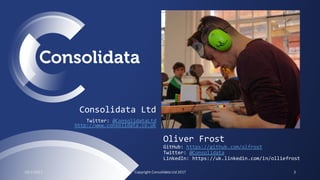
Oliver Frost
GitHub: https://github.com/olfrost
Twitter: @Consolidata
LinkedIn: https://uk.linkedin.com/in/olliefrost
Consolidata Ltd
Twitter: @ConsolidataLtd
http://www.consolidata.co.uk
18/1/2017 Copyright Consolidata Ltd 2017 3
Background
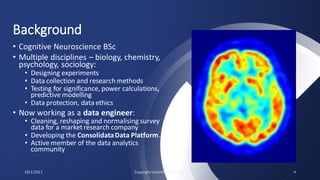
• Cognitive Neuroscience BSc
• Multiple disciplines – biology, chemistry,
psychology, sociology:
• Designing experiments
• Data collection and research methods
• Testing for significance, power calculations,
predictive modelling
• Data protection, data ethics
• Now working as a data engineer:
• Cleaning, reshaping and normalising survey
data for a marketresearch company
• Developing the ConsolidataData Platform.
• Active member of the data analytics
community
18/1/2017 Copyright Consolidata Ltd 2017 4
Working as an analyst
• You may be familiar with some tools already, depending
where you’ve come from:
• Excel and Office tools
• SPSS, MATLAB
• SQL
• BI and analytics are a bit of a continuous process:
• Cleaning data – missing values? Bad data?
• Reshape data – is the data in the right format?
• Loading – how much is there?
• Find patterns – do these patterns add value?
• Presentation – can you tell a story?
18/1/2017 Copyright Consolidata Ltd 2017 5
What is R?
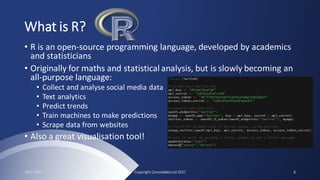
• R is an open-source programming language, developed by academics
and statisticians
• Originally for maths and statistical analysis, but is slowly becoming an
all-purpose language:
• Collect and analyse social media data
• Text analytics
• Predict trends
• Train machines to make predictions
• Scrape data from websites
• Also a great visualisation tool!
18/1/2017 Copyright Consolidata Ltd 2017 6
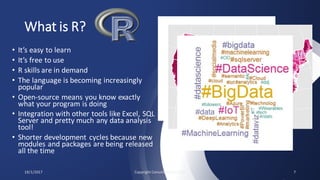
• It’s easy to learn
• It’s free to use
• R skills are in demand
• The language is becoming increasingly
popular
• Open-source means you know exactly
what your program is doing
• Integration with other tools like Excel, SQL
Server and pretty much any data analysis
tool!
• Shorter development cycles because new
modules and packages are being released
all the time
What is R?
18/1/2017 Copyright Consolidata Ltd 2017 7
What is Python?
• An all-purpose, general language that works on multiple platforms
• High level and easy to learn like R
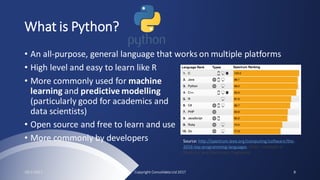
• More commonly used for machine
learning and predictive modelling
(particularly good for academics and
data scientists)
• Open source and free to learn and use
• More commonly by developers Source: http://spectrum.ieee.org/computing/software/the-
2016-top-programming-languages (IEEE - Institute of
Electrical and Electronics Engineers)
18/1/2017 Copyright Consolidata Ltd 2017 8
What is SAS?
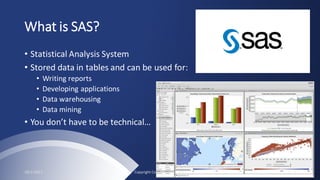
• Statistical Analysis System
• Stored data in tables and can be used for:
• Writing reports
• Developing applications
• Data warehousing
• Data mining
• You don’t have to be technical…
18/1/2017 Copyright Consolidata Ltd 2017 9
What do businesses use these tools for?
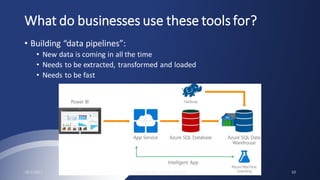
• Building “data pipelines”:
• New data is coming in all the time
• Needs to be extracted, transformed and loaded
• Needs to be fast
18/1/2017 Copyright Consolidata Ltd 2017 10
What do businesses use these tools for?
• Descriptive Analytics
• These skills are in demand.
• Businesses want to know about their
historical data.
• They also want to know what is happening
right now.
• New marketing opportunities? Save time
and money in current processes?
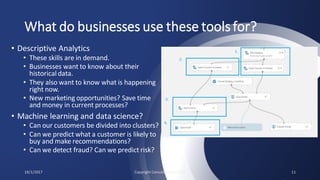
• Machine learning and data science?
• Can our customers be divided into clusters?
• Can we predict what a customer is likely to
buy and make recommendations?
• Can we detect fraud? Can we predict risk?
18/1/2017 Copyright Consolidata Ltd 2017 11
• Learning a language can be intimidating, especially from a
non-technical background.
• But from my experience, it was absolutely worth it.
• No need to pick one tool over the other, they are all great.
• I would recommend R, though…
Conclusions
18/1/2017 Copyright Consolidata Ltd 2017 12

R vs Python vs SAS

  • 1.
    R vs Pythonvs SAS Oliver Frost Wednesday, 18 January 2017 18/1/2017 Copyright Consolidata Ltd 2017 1
  • 2.
    Today’s session: • A(very quick) introduction to business intelligence and the big data industry. • The role of the analyst. • What is R? What is Python? What is SAS? • Why should I learn them? • What can I use them for? 18/1/2017 Copyright Consolidata Ltd 2017 2
  • 3.
    Oliver Frost GitHub: https://github.com/olfrost Twitter:@Consolidata LinkedIn: https://uk.linkedin.com/in/olliefrost Consolidata Ltd Twitter: @ConsolidataLtd http://www.consolidata.co.uk 18/1/2017 Copyright Consolidata Ltd 2017 3
  • 4.
    Background • Cognitive NeuroscienceBSc • Multiple disciplines – biology, chemistry, psychology, sociology: • Designing experiments • Data collection and research methods • Testing for significance, power calculations, predictive modelling • Data protection, data ethics • Now working as a data engineer: • Cleaning, reshaping and normalising survey data for a marketresearch company • Developing the ConsolidataData Platform. • Active member of the data analytics community 18/1/2017 Copyright Consolidata Ltd 2017 4
  • 5.
    Working as ananalyst • You may be familiar with some tools already, depending where you’ve come from: • Excel and Office tools • SPSS, MATLAB • SQL • BI and analytics are a bit of a continuous process: • Cleaning data – missing values? Bad data? • Reshape data – is the data in the right format? • Loading – how much is there? • Find patterns – do these patterns add value? • Presentation – can you tell a story? 18/1/2017 Copyright Consolidata Ltd 2017 5
  • 6.
    What is R? •R is an open-source programming language, developed by academics and statisticians • Originally for maths and statistical analysis, but is slowly becoming an all-purpose language: • Collect and analyse social media data • Text analytics • Predict trends • Train machines to make predictions • Scrape data from websites • Also a great visualisation tool! 18/1/2017 Copyright Consolidata Ltd 2017 6
  • 7.
    • It’s easyto learn • It’s free to use • R skills are in demand • The language is becoming increasingly popular • Open-source means you know exactly what your program is doing • Integration with other tools like Excel, SQL Server and pretty much any data analysis tool! • Shorter development cycles because new modules and packages are being released all the time What is R? 18/1/2017 Copyright Consolidata Ltd 2017 7
  • 8.
    What is Python? •An all-purpose, general language that works on multiple platforms • High level and easy to learn like R • More commonly used for machine learning and predictive modelling (particularly good for academics and data scientists) • Open source and free to learn and use • More commonly by developers Source: http://spectrum.ieee.org/computing/software/the- 2016-top-programming-languages (IEEE - Institute of Electrical and Electronics Engineers) 18/1/2017 Copyright Consolidata Ltd 2017 8
  • 9.
    What is SAS? •Statistical Analysis System • Stored data in tables and can be used for: • Writing reports • Developing applications • Data warehousing • Data mining • You don’t have to be technical… 18/1/2017 Copyright Consolidata Ltd 2017 9
  • 10.
    What do businessesuse these tools for? • Building “data pipelines”: • New data is coming in all the time • Needs to be extracted, transformed and loaded • Needs to be fast 18/1/2017 Copyright Consolidata Ltd 2017 10
  • 11.
    What do businessesuse these tools for? • Descriptive Analytics • These skills are in demand. • Businesses want to know about their historical data. • They also want to know what is happening right now. • New marketing opportunities? Save time and money in current processes? • Machine learning and data science? • Can our customers be divided into clusters? • Can we predict what a customer is likely to buy and make recommendations? • Can we detect fraud? Can we predict risk? 18/1/2017 Copyright Consolidata Ltd 2017 11
  • 12.
    • Learning alanguage can be intimidating, especially from a non-technical background. • But from my experience, it was absolutely worth it. • No need to pick one tool over the other, they are all great. • I would recommend R, though… Conclusions 18/1/2017 Copyright Consolidata Ltd 2017 12