Review
Links to prior Power Points
• Remember: CURRENT EVENT DUE
FRIDAY
• SlideShare
– http://www.slideshare.net/locmajiant827

• Blogger

– https://www.blogger.com/profile/035459846015576
– All posts are under “February” thus far, on the
right hand side
Review
• We’ll review today so that we can be all
prepared for the quiz on Friday (tomorrow)
The President
• The President is called the
– Commander-in-Chief

• The President is in charge of 3 things
– Military, Executing Laws, and the Nuclear
Arsenal

• In terms of bills the President can do three
things:
• Veto the bill, sign the bill, or take no action
(Not Sign It)
Legislative Branch
• Two parts of the Legislative branch are
called:
– The Senate and the House of
Representatives (the house)

• Each house has:
– 100 Senators and 435 Representatives

• This is called a bicameral legislature
(having two houses)
Brown vs Board of Education
• Supreme Court Case that allowed the
integration of schools across America
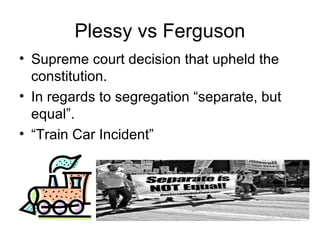
Plessy vs Ferguson
• Supreme court decision that upheld the
constitution.
• In regards to segregation “separate, but
equal”.
• “Train Car Incident”
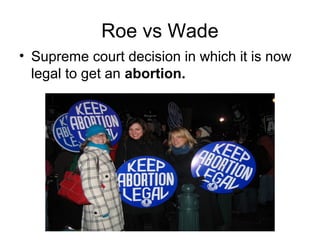
Roe vs Wade
• Supreme court decision in which it is now
legal to get an abortion.
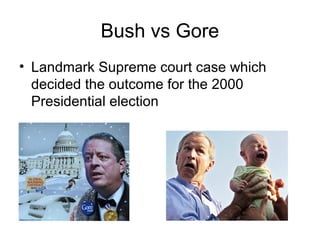
Bush vs Gore
• Landmark Supreme court case which
decided the outcome for the 2000
Presidential election
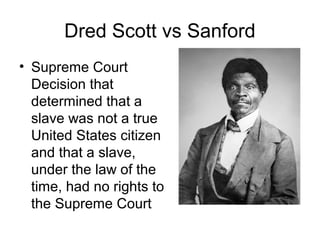
Dred Scott vs Sanford
• Supreme Court
Decision that
determined that a
slave was not a true
United States citizen
and that a slave,
under the law of the
time, had no rights to
the Supreme Court
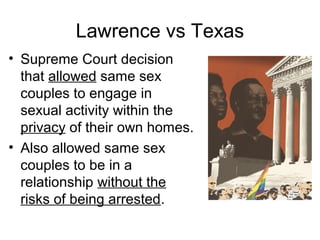
Lawrence vs Texas
• Supreme Court decision
that allowed same sex
couples to engage in
sexual activity within the
privacy of their own homes.
• Also allowed same sex
couples to be in a
relationship without the
risks of being arrested.
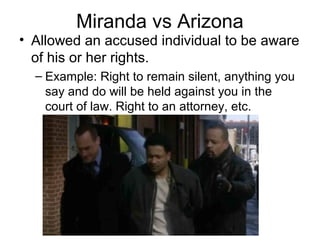
Miranda vs Arizona

• Allowed an accused individual to be aware
of his or her rights.
– Example: Right to remain silent, anything you
say and do will be held against you in the
court of law. Right to an attorney, etc.
Marbury vs Madison
• Supreme Court decision that lead to the
system of Judicial Review
– Supreme Court could step in and
check/balance officers in government
– Supreme Court could determine the legality or
“constitutionality” of a person/law(s)
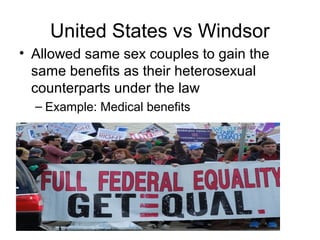
United States vs Windsor
• Allowed same sex couples to gain the
same benefits as their heterosexual
counterparts under the law
– Example: Medical benefits

Quiz review power point

  • 1.
  • 2.
    Links to priorPower Points • Remember: CURRENT EVENT DUE FRIDAY • SlideShare – http://www.slideshare.net/locmajiant827 • Blogger – https://www.blogger.com/profile/035459846015576 – All posts are under “February” thus far, on the right hand side
  • 3.
    Review • We’ll reviewtoday so that we can be all prepared for the quiz on Friday (tomorrow)
  • 4.
    The President • ThePresident is called the – Commander-in-Chief • The President is in charge of 3 things – Military, Executing Laws, and the Nuclear Arsenal • In terms of bills the President can do three things: • Veto the bill, sign the bill, or take no action (Not Sign It)
  • 5.
    Legislative Branch • Twoparts of the Legislative branch are called: – The Senate and the House of Representatives (the house) • Each house has: – 100 Senators and 435 Representatives • This is called a bicameral legislature (having two houses)
  • 6.
    Brown vs Boardof Education • Supreme Court Case that allowed the integration of schools across America
  • 7.
    Plessy vs Ferguson •Supreme court decision that upheld the constitution. • In regards to segregation “separate, but equal”. • “Train Car Incident”
  • 8.
    Roe vs Wade •Supreme court decision in which it is now legal to get an abortion.
  • 9.
    Bush vs Gore •Landmark Supreme court case which decided the outcome for the 2000 Presidential election
  • 10.
    Dred Scott vsSanford • Supreme Court Decision that determined that a slave was not a true United States citizen and that a slave, under the law of the time, had no rights to the Supreme Court
  • 11.
    Lawrence vs Texas •Supreme Court decision that allowed same sex couples to engage in sexual activity within the privacy of their own homes. • Also allowed same sex couples to be in a relationship without the risks of being arrested.
  • 12.
    Miranda vs Arizona •Allowed an accused individual to be aware of his or her rights. – Example: Right to remain silent, anything you say and do will be held against you in the court of law. Right to an attorney, etc.
  • 13.
    Marbury vs Madison •Supreme Court decision that lead to the system of Judicial Review – Supreme Court could step in and check/balance officers in government – Supreme Court could determine the legality or “constitutionality” of a person/law(s)
  • 14.
    United States vsWindsor • Allowed same sex couples to gain the same benefits as their heterosexual counterparts under the law – Example: Medical benefits