INTRODUCTION
• This presentationexplores the concept of queues, their definitions,
types, and practical applications, providing a comprehensive
understanding of how queues operate in different contexts.
3.
BASICS
DEFINITION OF QUEUE
•A queue is a data structure that follows the First In First Out (FIFO) principle, where the first
element added is the first one to be removed. It is commonly used to manage tasks in
programming, handle traffic in networking, and organize people or items in everyday
scenarios.
4.
TYPES OF QUEUES
Thereare several types of queues, including:
- Simple Queue: A straightforward arrangement where elements are added at the back
and removed from the front.
- Circular Queue: A fixed-size queue that wraps around when it reaches the end.
- Priority Queue: Elements are removed based on priority rather than order of arrival.
Understanding these types helps in choosing the right queue for specific use cases.
5.
APPLICATIONS OF QUEUES
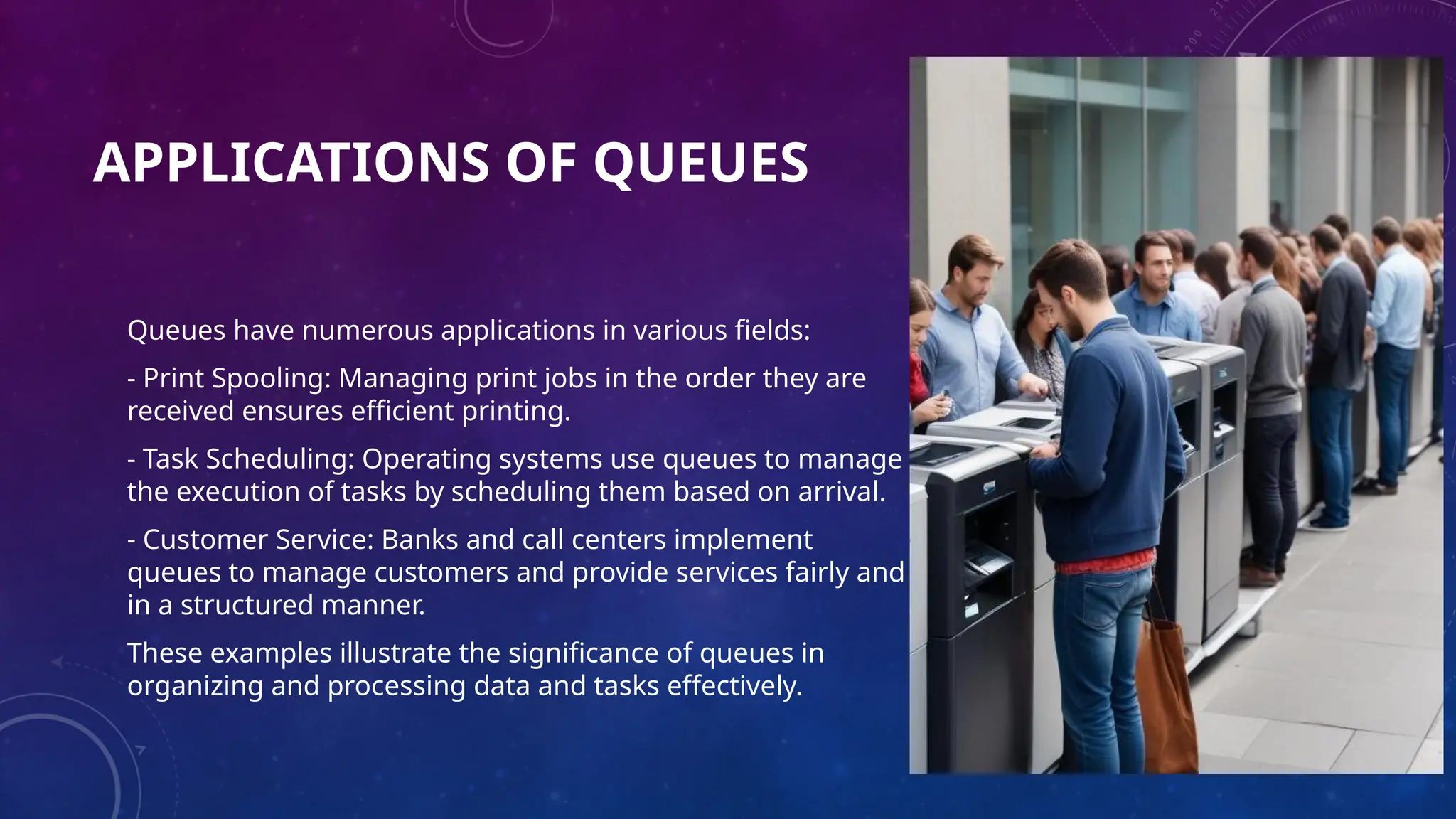
Queueshave numerous applications in various fields:
- Print Spooling: Managing print jobs in the order they are
received ensures efficient printing.
- Task Scheduling: Operating systems use queues to manage
the execution of tasks by scheduling them based on arrival.
- Customer Service: Banks and call centers implement
queues to manage customers and provide services fairly and
in a structured manner.
These examples illustrate the significance of queues in
organizing and processing data and tasks effectively.
6.
QUEUE OPERATIONS
ENQUEUE OPERATION
•The enqueue operation adds an element to the back of the queue. It is essential for
maintaining the FIFO order. In programming, an enqueue function typically involves
allocating space for the new element and updating the rear pointer of the queue. For
example, when a new print job is submitted, it gets added to the end of the printing
queue, ensuring that previously submitted tasks are completed first.
7.
DEQUEUE OPERATION
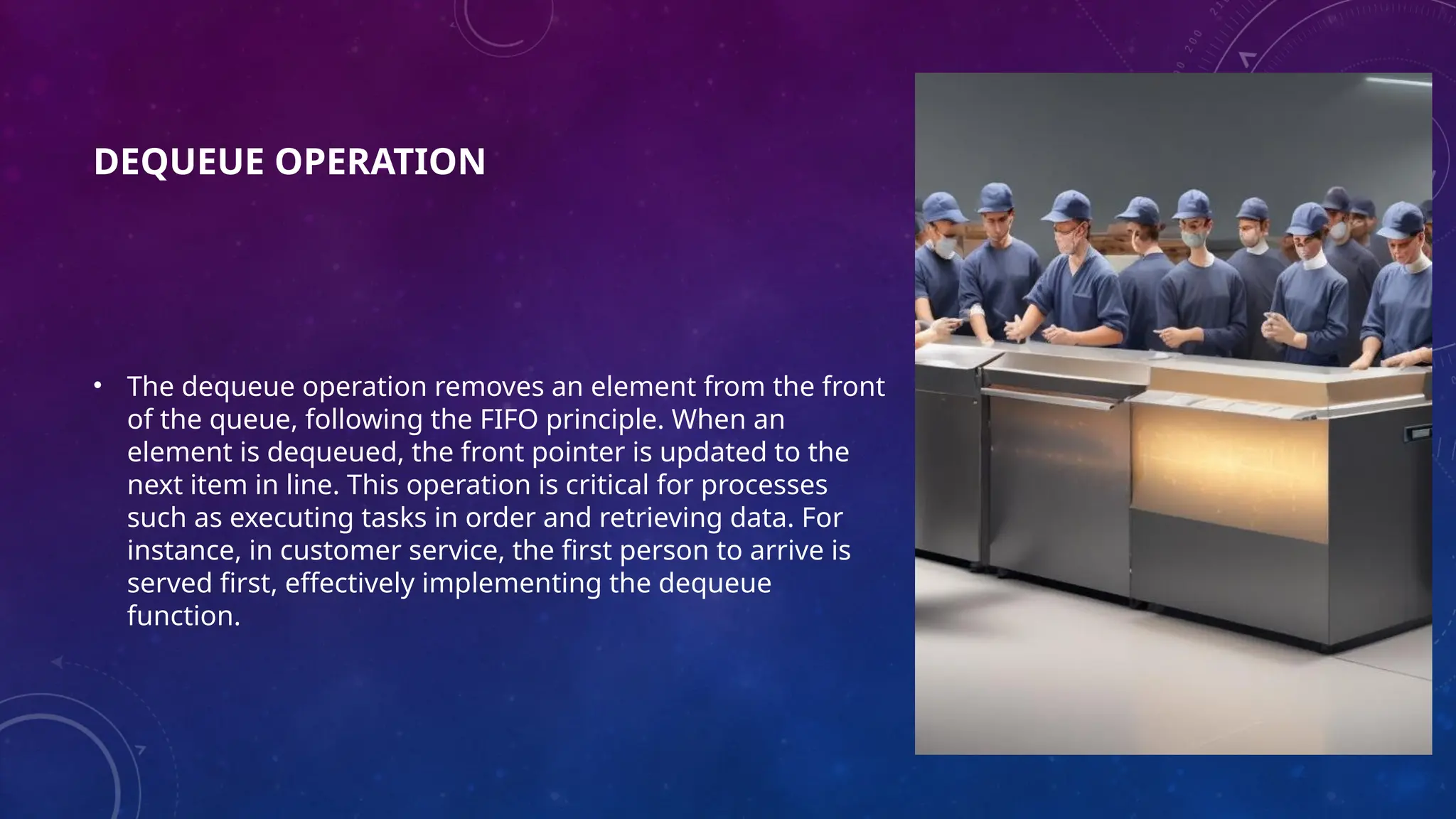
• Thedequeue operation removes an element from the front
of the queue, following the FIFO principle. When an
element is dequeued, the front pointer is updated to the
next item in line. This operation is critical for processes
such as executing tasks in order and retrieving data. For
instance, in customer service, the first person to arrive is
served first, effectively implementing the dequeue
function.
8.
PEEK OPERATION
• Thepeek operation allows the retrieval of the front element of the queue without
removing it. This is useful for checking which element will be dequeued next without
modifying the queue. For example, in a print queue, a user might want to see the next
print job in line before deciding to add another job. The peek function provides this
flexibility without changing the queue's state.
9.
CONCLUSIONS
• In summary,queues are fundamental data structures
that facilitate orderly processing and management of
tasks. Understanding their operations—enqueue,
dequeue, and peek—along with their practical
applications, enhances our ability to implement efficient
solutions across various domains.



![Data Structures - Lecture 6 [queues]](https://cdn.slidesharecdn.com/ss_thumbnails/lecture-6queues-150114114904-conversion-gate01-thumbnail.jpg?width=640&height=640&fit=bounds)


![[DSC Europe 25] Ivan Peric - Intelligence Swarm Logic and Techno-Functional M...](https://cdn.slidesharecdn.com/ss_thumbnails/7my7c97fsduiccadgavw-2-251212103249-5a03f7c6-thumbnail.jpg?width=640&height=640&fit=bounds)

![[DSC Europe 25] Nikolay Burlutskiy - Best Practices for Building Enterprise M...](https://cdn.slidesharecdn.com/ss_thumbnails/uirvaiuvq8y1w8hzd9tx-7-251212103249-2619edb4-thumbnail.jpg?width=640&height=640&fit=bounds)
![[DSC Europe 25] Miodrag Pesovic & Vladislav Radonjic - Federated Data Archite...](https://cdn.slidesharecdn.com/ss_thumbnails/gsbe3y5it5uhndi4e08e-1-251212103249-f1008e0c-thumbnail.jpg?width=640&height=640&fit=bounds)


![[DSC Europe 25] Hans Kleinsman - The Compliance Gearbox: How Tax Tech Mediate...](https://cdn.slidesharecdn.com/ss_thumbnails/dxdytie1toel0hr90bjs-2-251212103250-174fdbe7-thumbnail.jpg?width=640&height=640&fit=bounds)
![[DSC Europe 25] Branko Urosevic -Rethinking Financial Talent: Integrating Cod...](https://cdn.slidesharecdn.com/ss_thumbnails/8jjrus8ttko6qj64f58f-3-251212103250-642c6374-thumbnail.jpg?width=640&height=640&fit=bounds)
![[DSC Europe 25] Bassam Maharmeh - Artificial Intelligence: Opportunities and ...](https://cdn.slidesharecdn.com/ss_thumbnails/thhfmr2fqpawzj7hsjpg-5-251211083048-2c23204f-thumbnail.jpg?width=640&height=640&fit=bounds)
![[DSC Europe 25] Milan Sekuloski - Data, Defence, and Development: Cybersecuri...](https://cdn.slidesharecdn.com/ss_thumbnails/dfrkwwx4qly6atqpbl4z-4-251209104645-c3d4b0ca-thumbnail.jpg?width=640&height=640&fit=bounds)
![[DSC Europe 25] Dusan Nesic - Securing Tomorrow’s Infrastructure: Why Cyber-P...](https://cdn.slidesharecdn.com/ss_thumbnails/qikbszfftyowjm2q6duw-1-251211083848-8f2ead6b-thumbnail.jpg?width=640&height=640&fit=bounds)
