QUESTION 7:LOOKING BACK AT YOUR PRELIMINARY TASK,
WHAT DO YOU FEEL YOU HAVE LEARNT IN THE
PROGRESSION FROM IT TO THE FINAL PRODUCT?
WHAT TECHNICAL SKILLS DID YOU LEARN WHILE COMPLETING THE
PRELIMINARY TASK?
Whilst producing our preliminary task we learnt a variety of different technical skills that we were able to develop
and improve when producing our final production. Our preliminary task was very simplistic and the techniques we
used were straightforward, however this allowed us to gradually gain confidence when filming and to learn the
basics so we could then experiment with more extravagant techniques in our thriller.
When producing our preliminary task, we discovered that using shot reverse shot when editing the footage helped
to create a sense of conflict and separation between characters because from the audience’s perspective you are
constantly going back and forth between the two characters. In our preliminary task there is a continuous use of shot
reverse shot as the interrogation takes place, this was effective in creating the idea that the characters are having a
conversation but it did little to create any suspense. We advanced this method during our thriller by using shot
reverse shot when the femme fatale comes to aid our protagonist. This time the fast pace of the edit combined with
the use of shot reverse shot creates tension and makes the audience uneasy because it makes it clear that the
protagonist doesn’t trust her, and in turn that we shouldn’t either. We also improved our use of shot reverse shot by
making the shots more dynamic and intense. For example the close up of our protagonist’s eyes allows the audience
to clearly see the fear and confusion present in them. The wide shot of our femme fatale is also effective because the
combination of the shot type with the use of a back light makes it difficult for the audience to identify her, therefore
making her character mysterious and enigmatic. This was much more effective than the use of over-the-shoulder
shots in our preliminary task. Although these shots placed the audience in both the antagonist’s and protagonist’s
position, allowing them to understand the character’s decisions and actions, they did little to create suspense and
made it very slow paced.
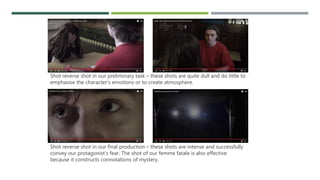
Shot reverse shot in our preliminary task – these shots are quite dull and do little to
emphasise the character’s emotions or to create atmosphere.
Shot reverse shot in our final production – these shots are intense and successfully
convey our protagonist’s fear. The shot of our femme fatale is also effective
because it constructs connotations of mystery.
WHAT TECHNICAL SKILLS DID YOU LEARN WHILE COMPLETING THE
PRELIMINARY TASK?
Our preliminary task lacked variety in terms of shot types and angles. For example, we only used wide shots
and mid shots for the majority of the film. This makes it repetitive and slightly dull, also the lack of close ups
makes it difficult for the audience to connect to the characters because it makes it harder to see the intensity
of their emotions. When producing our final production we tried to render this problem by including a wide
variety of shot types and angles. An example of this is during the garage scene in our thriller, we used
extreme close ups, mid shots and close ups as well as a wide shot. This made our thriller much more dynamic
and allowed the audience to experience the events from a range of different perspectives. Unlike in our
preliminary task, these shots give the audience insight and increase the tension in the scene. For example, we
included a close up of our protagonist’s tied up hands, this immediately tells the audience that he is being
held hostage and that the people holding him have motives that, as an viewer they are not yet aware of,
because the antagonists want to ensure that he doesn’t escape. However, it also implies that our protagonist
could be dangerous because the antagonists feel as though they need to restrain him. This is much more
effective than repetitively using mid shots the way we did in the preliminary task.
Final Production
These shots are much more
intense and help to build the
tension and suspense within our
thriller. The use of a range on
close ups of our protagonist also
allows the audience to connect to
him and experience his fear and
confusion about the events that
are occurring.
Preliminary Task
Although these shots effectively
convey the character’s journey and
conversation they do very little to
add to the atmosphere of our film
or to reveal anything about the
characters.
WHAT TECHNICAL SKILLS DID YOU LEARN WHILE COMPLETING THE
PRELIMINARY TASK?
Our preliminary task was very poorly lit and used light ineffectively. We only used the lights the ceiling lights
in the room, although these lit our shots adequately, this did little to create an atmosphere or to construct
connotations about our characters. We tried to improve our use of lighting during the production of our
thriller. For example during the alleyway scene, we took advantage of the afternoon sunlight coming through
the entrance of the alleyway. This was very effective as it cast the characters into darkness whilst the area
behind them was illuminated, essentially acting as a backlight. This helped to create a sense of mystery about
our characters because you can’t see their face, whilst also making them appear intimidating as its very
difficult for an audience to identify or connect with a character that they can’t see the eyes of.
We also used spotlights during the garage scene to create a harsh and bleak atmosphere, this was effective
because the light lacked any warmth, telling the audience that the protagonist is in a dangerous situation. It
also helped to create a sense of separation between scenes and to imply the events that have occurred in
between them. For example, the lighting in the alleyway scene is mysterious and foreboding whereas the
lighting in the garage scene is desolate and hopeless, implying that the protagonist is in serious danger and
needs to escape. This is very different to the lighting in our preliminary task as it remained the same for the
entire film, creating little variety and implying that nothing has changed.
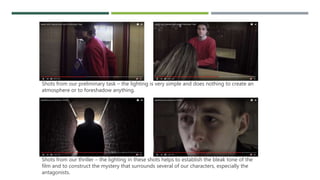
Shots from our preliminary task – the lighting is very simple and does nothing to create an
atmosphere or to foreshadow anything.
Shots from our thriller – the lighting in these shots helps to establish the bleak tone of the
film and to construct the mystery that surrounds several of our characters, especially the
antagonists.
WHAT TECHNICAL SKILLS DID YOU LEARN WHILE COMPLETING THE
PRELIMINARY TASK?
The sound in our preliminary task was very simplistic and the lack of an underscore meant that there was no
atmosphere created. Although silence or no underscore can be used effectively to create a bleak and hopeless
tone, this was not relevant to our film, instead that silence made it dull and slow paced. Another issue we had
was that the dialogue we had was difficult to hear at times due to the surrounding noises. We tried to render
this problem whilst producing our thriller by using a microphone and adding tense scores to accompany our
footage. For example, during the alleyway scene we used a suspenseful score that reached its peak as our
antagonist is seen properly for the first time. This emphasised how dangerous he is and foreshadows the pain
and dismay he is going to bring to our protagonist’s life. It could also be used to reflect our protagonist’s fear
as he realises he’s being followed. This was much more effective than our preliminary task because the score
helps to give the audience insight into the character’s emotions and in turn manipulates theirs.
WHAT HAVE YOU LEARNT ABOUT WORKING TO A SPECIFIC BRIEF?
Throughout the stages of producing both our preliminary task and our thriller having a specific brief has
been very useful as it has given us guidelines which have enabled us to narrow down our ideas. This was
helpful as it meant we didn’t spend too long coming up with a plot and instead we were able to flesh out
our idea and focus on specific details within it. Working to deadlines can become difficult when having
other priorities as well as completing our thriller, however our teamwork and good communication meant
that we were able to help each other and distribute the workload in a way that meant that nobody was ever
under too much pressure or stress. This meant that we were able to enjoy ourselves whilst completing our
work. During the production process of our films we learnt that planning was essential for a successful film;
by already having planned the shots we were going to film as well as having a script, we were able to film
effectively and efficiently for every shoot we did. This meant that we saved time which in turn meant that
we had extra time to experiment by filming shots that weren’t in the storyboard but could still be effective
in our thriller. This helped us to create an engaging narrative as it meant that our audience were able to
experience the thriller from a variety of perspectives instead of just one.

Question 7

  • 1.
    QUESTION 7:LOOKING BACKAT YOUR PRELIMINARY TASK, WHAT DO YOU FEEL YOU HAVE LEARNT IN THE PROGRESSION FROM IT TO THE FINAL PRODUCT?
  • 2.
    WHAT TECHNICAL SKILLSDID YOU LEARN WHILE COMPLETING THE PRELIMINARY TASK? Whilst producing our preliminary task we learnt a variety of different technical skills that we were able to develop and improve when producing our final production. Our preliminary task was very simplistic and the techniques we used were straightforward, however this allowed us to gradually gain confidence when filming and to learn the basics so we could then experiment with more extravagant techniques in our thriller. When producing our preliminary task, we discovered that using shot reverse shot when editing the footage helped to create a sense of conflict and separation between characters because from the audience’s perspective you are constantly going back and forth between the two characters. In our preliminary task there is a continuous use of shot reverse shot as the interrogation takes place, this was effective in creating the idea that the characters are having a conversation but it did little to create any suspense. We advanced this method during our thriller by using shot reverse shot when the femme fatale comes to aid our protagonist. This time the fast pace of the edit combined with the use of shot reverse shot creates tension and makes the audience uneasy because it makes it clear that the protagonist doesn’t trust her, and in turn that we shouldn’t either. We also improved our use of shot reverse shot by making the shots more dynamic and intense. For example the close up of our protagonist’s eyes allows the audience to clearly see the fear and confusion present in them. The wide shot of our femme fatale is also effective because the combination of the shot type with the use of a back light makes it difficult for the audience to identify her, therefore making her character mysterious and enigmatic. This was much more effective than the use of over-the-shoulder shots in our preliminary task. Although these shots placed the audience in both the antagonist’s and protagonist’s position, allowing them to understand the character’s decisions and actions, they did little to create suspense and made it very slow paced.
  • 3.
    Shot reverse shotin our preliminary task – these shots are quite dull and do little to emphasise the character’s emotions or to create atmosphere. Shot reverse shot in our final production – these shots are intense and successfully convey our protagonist’s fear. The shot of our femme fatale is also effective because it constructs connotations of mystery.
  • 4.
    WHAT TECHNICAL SKILLSDID YOU LEARN WHILE COMPLETING THE PRELIMINARY TASK? Our preliminary task lacked variety in terms of shot types and angles. For example, we only used wide shots and mid shots for the majority of the film. This makes it repetitive and slightly dull, also the lack of close ups makes it difficult for the audience to connect to the characters because it makes it harder to see the intensity of their emotions. When producing our final production we tried to render this problem by including a wide variety of shot types and angles. An example of this is during the garage scene in our thriller, we used extreme close ups, mid shots and close ups as well as a wide shot. This made our thriller much more dynamic and allowed the audience to experience the events from a range of different perspectives. Unlike in our preliminary task, these shots give the audience insight and increase the tension in the scene. For example, we included a close up of our protagonist’s tied up hands, this immediately tells the audience that he is being held hostage and that the people holding him have motives that, as an viewer they are not yet aware of, because the antagonists want to ensure that he doesn’t escape. However, it also implies that our protagonist could be dangerous because the antagonists feel as though they need to restrain him. This is much more effective than repetitively using mid shots the way we did in the preliminary task.
  • 5.
    Final Production These shotsare much more intense and help to build the tension and suspense within our thriller. The use of a range on close ups of our protagonist also allows the audience to connect to him and experience his fear and confusion about the events that are occurring. Preliminary Task Although these shots effectively convey the character’s journey and conversation they do very little to add to the atmosphere of our film or to reveal anything about the characters.
  • 6.
    WHAT TECHNICAL SKILLSDID YOU LEARN WHILE COMPLETING THE PRELIMINARY TASK? Our preliminary task was very poorly lit and used light ineffectively. We only used the lights the ceiling lights in the room, although these lit our shots adequately, this did little to create an atmosphere or to construct connotations about our characters. We tried to improve our use of lighting during the production of our thriller. For example during the alleyway scene, we took advantage of the afternoon sunlight coming through the entrance of the alleyway. This was very effective as it cast the characters into darkness whilst the area behind them was illuminated, essentially acting as a backlight. This helped to create a sense of mystery about our characters because you can’t see their face, whilst also making them appear intimidating as its very difficult for an audience to identify or connect with a character that they can’t see the eyes of. We also used spotlights during the garage scene to create a harsh and bleak atmosphere, this was effective because the light lacked any warmth, telling the audience that the protagonist is in a dangerous situation. It also helped to create a sense of separation between scenes and to imply the events that have occurred in between them. For example, the lighting in the alleyway scene is mysterious and foreboding whereas the lighting in the garage scene is desolate and hopeless, implying that the protagonist is in serious danger and needs to escape. This is very different to the lighting in our preliminary task as it remained the same for the entire film, creating little variety and implying that nothing has changed.
  • 7.
    Shots from ourpreliminary task – the lighting is very simple and does nothing to create an atmosphere or to foreshadow anything. Shots from our thriller – the lighting in these shots helps to establish the bleak tone of the film and to construct the mystery that surrounds several of our characters, especially the antagonists.
  • 8.
    WHAT TECHNICAL SKILLSDID YOU LEARN WHILE COMPLETING THE PRELIMINARY TASK? The sound in our preliminary task was very simplistic and the lack of an underscore meant that there was no atmosphere created. Although silence or no underscore can be used effectively to create a bleak and hopeless tone, this was not relevant to our film, instead that silence made it dull and slow paced. Another issue we had was that the dialogue we had was difficult to hear at times due to the surrounding noises. We tried to render this problem whilst producing our thriller by using a microphone and adding tense scores to accompany our footage. For example, during the alleyway scene we used a suspenseful score that reached its peak as our antagonist is seen properly for the first time. This emphasised how dangerous he is and foreshadows the pain and dismay he is going to bring to our protagonist’s life. It could also be used to reflect our protagonist’s fear as he realises he’s being followed. This was much more effective than our preliminary task because the score helps to give the audience insight into the character’s emotions and in turn manipulates theirs.
  • 9.
    WHAT HAVE YOULEARNT ABOUT WORKING TO A SPECIFIC BRIEF? Throughout the stages of producing both our preliminary task and our thriller having a specific brief has been very useful as it has given us guidelines which have enabled us to narrow down our ideas. This was helpful as it meant we didn’t spend too long coming up with a plot and instead we were able to flesh out our idea and focus on specific details within it. Working to deadlines can become difficult when having other priorities as well as completing our thriller, however our teamwork and good communication meant that we were able to help each other and distribute the workload in a way that meant that nobody was ever under too much pressure or stress. This meant that we were able to enjoy ourselves whilst completing our work. During the production process of our films we learnt that planning was essential for a successful film; by already having planned the shots we were going to film as well as having a script, we were able to film effectively and efficiently for every shoot we did. This meant that we saved time which in turn meant that we had extra time to experiment by filming shots that weren’t in the storyboard but could still be effective in our thriller. This helped us to create an engaging narrative as it meant that our audience were able to experience the thriller from a variety of perspectives instead of just one.