IN WHAT WAYS DOES YOUR
MEDIA PRODUCT USE, DEVELOP
OR CHALLENGE FORMS AND
CONVENTIONS OF REAL MEDIA
PRODUCTS?
INTRODUCTION
There are many forms and conventions within media
products, which are inspired by other music videos, films
and artwork. It was important that I had a balance of using,
developing and challenging forms and conventions of real
media products, so that I could improve my own music video
and print productions. My track, Tonight I Let You Go, was
inspired by many films and music videos, such as Bob
Dylan’s ‘Subterranean Homesick Blues’ and the films
‘Apocalypse Now’ and ‘Shallow Grave’. Not only does this
allow the audience to relate my music video to other pieces
of work, it also strengthens my music video overall.
MUSIC VIDEO
LOCATION
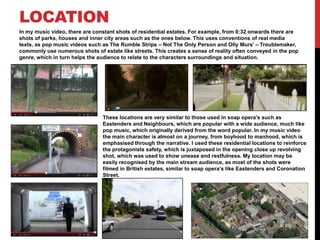
In my music video, there are constant shots of residential estates. For example, from 0:32 onwards there are
shots of parks, houses and inner city areas such as the ones below. This uses conventions of real media
texts, as pop music videos such as The Rumble Strips – Not The Only Person and Olly Murs’ – Troublemaker,
commonly use numerous shots of estate like streets. This creates a sense of reality often conveyed in the pop
genre, which in turn helps the audience to relate to the characters surroundings and situation.


                                These locations are very similar to those used in soap opera’s such as
                                Eastenders and Neighbours, which are popular with a wide audience, much like
                                pop music, which originally derived from the word popular. In my music video
                                the main character is almost on a journey, from boyhood to manhood, which is
                                emphasised through the narrative. I used these residential locations to reinforce
                                the protagonists safety, which is juxtaposed in the opening close up revolving
                                shot, which was used to show unease and restfulness. My location may be
                                easily recognised by the main stream audience, as most of the shots were
                                filmed in British estates, similar to soap opera’s like Eastenders and Coronation
                                Street.
NARRATIVE STRUCTURE
I used conventions of narrative structure within my music video, by basing the
story around love and its ups and downs. This structure appears commonly in
pop music videos such as ‘What Makes You Beautiful’ by One Direction, which is
about loving a girl for herself, her inner beauty, not just her external features.
Adele’s ‘Someone Like You’ also focusses on love and is based on letting
someone dear to herself go, regrettably. My band’s song ‘Tonight I Let You Go’
revolves around the main character who doesn’t treats his girlfriend seriously, to
the extent to which she leaves him for another guy.

Links:

‘Someone Like You’ - http://www.youtube.com/watch?v=hLQl3WQQoQ0
‘What Makes You Beautiful’ - http://www.youtube.com/watch?v=QJO3ROT-A4E

The narrative in my music video is linear. It clearly shows the progression of the
main character, from his mistakes to his regrets, like a journey from boyhood to
manhood. Again this is similar to the narrative of TV soap operas, such as
Eastenders. Each characters storyline progresses gradually, as more goes on
around them. The main difference between the narratives of my music video and
soap operas, is that I use flashbacks, strengthening the feeling of regret and
remorse. Flashbacks will be explained further in slide 9: Camera Angles and
Transitions.
LIGHTING, SOUND AND VISUALS
When filming my music video, I did not challenge conventions of lighting, as most shots were filmed outside in
natural light. Generic conventions of lighting such as ambient, non-ambient and chiaroscuro lighting, which can be
found in thriller films, were not addressed during the shoot of my music video. Because the majority of the shots
were filmed outside, it would’ve been incredibly hard to get the right light levels. Because of the location and its
similarities with soap opera’s, light levels were kept naturally, to cohere and provide resemblances to soap opera’s
like Eastenders, increasing the sense of realism.


I conformed to Andrew Goodwin’s reference point number two – ‘There is a relationship between lyrics and visuals’ –
by using a lyric card shot, within my music video. As the track progresses, the main character swaps lyric cards,
containing important words of the verse. This concept was inspired by Bob Dylan’s ‘Subterranean Homesick Blues’
music video (below). This concept has also inspired many music videos such as INXS’ ‘Mediate’ and Evidence’s ‘The
Far Left’


     My music video                 Subterranean                 INXS - Mediate             Evidence – The Far Left
                                   Homesick Blues

Like lighting, I did not develop or challenge conventions of sound, such as diegetic and non diegetic sound. I found
that when overlaying natural sound over the track, it didn’t sound right nor worked. An good example of diegetic
sound is the chase scene in the thriller, The Third Man. The audience hears the sound of rushing water and the
footsteps of the policeman chasing after Harry Lime the protagonist. This allows the audience to delve into the
moment, to almost be a part of the chase, establishing a relationship between the audience and characters.

    The Third Man Chase Scene - http://www.youtube.com/watch?v=bvnjHevRceQ
COSTUME AND PERFORMERS
My music video used costume conventions shown within the pop genre. For example, the main character is
dressed in a suit jacket, along with tight chinos. This is similar to pop bands such as The Jonas Brothers
and One Direction, who tend to wear more modern styles, with a suit jacket, jeans or chinos combination.


Similar costume to one used, can be found in high street stores such as NEXT and Topman, which
reinforces the sense of reality within my music video, which corresponds with the realistic location.

                By using not voyeuristic costume on the ex girlfriend, I have potentially developed the pop
                convention. For example, pop music videos such as Olly Murs’ Troublemaker, contain
                voyeuristic imagery of the females during Flo Rida’s verse (shot below).


                                                        Despite this the girl is
                                                        wearing a red jumper, which
                                                        signifies love as well as
                                                        danger, which is commonly
                                                        associated with the Femme
                                                        Fatale look, which is used in
                                                        films such as Skyfall (shot
                                                        below).
CAMERA ANGLES AND TRANSITIONS
I have both used and not used conventions of the pop genre and music videos in
general. For example, music videos are known for their quick cuts, despite some
exceptions such as Sinead O’Connor’s Nothing Compares 2 U’, which retains the
same camera angle and position throughout the music video. During my music video,
many shots last more than 10 seconds, which significantly reduces the tempo of the
music video, thus not conforming to the specific convention.
On the other hand, I have used conventions of the pop genre, such as the primary
focus on the artist. For example, in my music video, the majority of the shots contain
imagery of the main character, in one way or another, through use of over the
shoulder shots or flashbacks. These shots are similar to music videos such as The
Rumble Strips ‘Not The Only Person’ and Olly Murs’ Troublemaker’, where focus on
the main character is vital though use of close ups also (shots below). This conforms
to Andrew Goodwin’s Theory point 5 – ‘There is frequent nothing of looking’. This is
shown through use of close ups as well as multiple shots focussing on the artist.
CAMERA ANGLES AND TRANSITIONS
 CONTINUED…
In terms of the use of flashbacks, I have potentially developed conventions of music
videos. The use of flashbacks, reinforces the audiences knowledge of the situation,
which allows the audience to understand the main characters actions, thus allowing
them to relate more to him. To indicate these flashbacks I have used the colour filter
black and white, which features in pop music videos such as Michael Jackson’s
‘Scream’ and Cher’s ‘Walking in Memphis’ (shots below).
I have not challenged music video conventions, but an example of a music video that
has, is Frankie Goes Hollywood’s ‘Two Tribes’ where it shows a wrestling match
between former US president Ronald Reagen and former soviet leader Konstantin
Chernenko. This challenges the image of boy bands. Like boy bands in the present day,
they are shown all together in a party style atmosphere, like One Directions ‘Live While
We’re Young’. ‘Two Tribes’ put a complete spin on this, by showing limited shots of the
band members together, instead showing a more violent side, through means of
wrestling.


   Walking in Memphis                    Scream                        Two Tribes
REPRESENTATION OF GENRE
   - MEDIA THEORY
Theorist Gunter Kress defines genre as ‘a kind of text that derives its form from the
structure of social occasion with its characteristics and their purposes’. As said in
slide 6: Narrative Structure, my music video is based on a love story between a male
and female. According to Gunther Kress’ theory, I may have potentially used
conventions of the genre pop. For example, the love story could be seen as a social
occasion, something that happens frequently in society, thus allowing the audience to
relate to the situation, due to its realism. This in turn gives the audience a sense of
belonging to a specific group (in this case ‘being in love’) which allows them to
develop their own collective identity, through means of relation.


On the other hand, theorist Stuart Hall would suggest that the producer encodes,
whilst the audience decodes. For example, when creating a music video the audience
could potentially determine the genre, with specific reference to age, gender and
ethnicity, developing a relationship between the text and audience. Audiences are then
able to recognise codes implemented by other producers, linking them back to the
original. This would then suggest that genre, is almost the gatekeeper of exhibition, in
other words the audience determines the genre.
PRINT PRODUCTIONS

(DIGIPAK AND MAGAZINE ADVERT)
LAYOUT
For my digipak, I used the standard 4 panel layout, used on most digipak’s of
similar pop artists. For example, Olly Murs’ ‘Heart Skips A Beat’ album (below)
uses 4 panels.


The four panel layout is a simple design,
that easily conveys the artist, without
complicating the digipak with too many
panels. I decided not to develop forms of
digipaks, after looking at some digipak’s
with 6 or more panels on Google. I found
that some were too over the top and
realised that most panels were relatively
the same shot and very repetitive. For
example, Myth’s album to the right, used
the same image on panel 2 as panel 5.
PANEL 1

The first panel of a digipak, most
commonly displays the title of the band. I
used this convention, as shown bottom
left. I added the title into the white area,
which contrasts well with the red text.
The title on panel 1 often links to either
the band or the name of the album. In
some cases panel 1 contains just the
album name not the band name. An
example of challenging this convention
is by using the band title as the title of
the album, for example, The Wanted’s US
debut album ‘The Wanted’. This leaves
the audience free to judge what the
album is about, to try and identify any
patterns with the album tracks.
PANEL 2
Panel 2 is often a pull out which may contain information about the
band, or maybe the lyrics to the songs within the digipak. I did not
use this convention, as The Colours, only have one song, therefore
it would be pointless filling in a pull out with just one set of lyrics
inside. Instead I decided to use another
image for my music video, to
strengthen the connection between the
music video and digipak. This is
explained further in question 2.
PANEL 3
The 3rd panel in a 4 panel digipak, is most commonly the cd
cover. I did not use this convention, instead I creating a panel
which covered the whole area, as well as the cd. When the cd
is taken out it takes out a part of the panel, which makes up
the image (example below).
PANEL 4
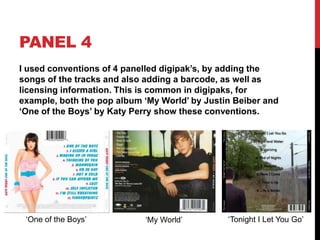
I used conventions of 4 panelled digipak’s, by adding the
songs of the tracks and also adding a barcode, as well as
licensing information. This is common in digipaks, for
example, both the pop album ‘My World’ by Justin Beiber and
‘One of the Boys’ by Katy Perry show these conventions.


 ‘One of the Boys’          ‘My World’         ‘Tonight I Let You Go’
MAGAZINE ADVERT

My magazine advert use the
convention of the focus on the artist,
used in magazine adverts by Olly
Murs and Plan B (on slide 19). Unlike
Olly Murs’ magazine advert, I have
not used the convention of listing
tour dates on the advert. The Colours
do have tour dates on their website,
but all are for 2010. I also decided
that if I were to list the tour dates, I
would have to place them on the post
box, which would not have been
possible, due to the lyric card
covering it.
CONCLUSION
To conclude, I have both used and developed various
conventions from pop and general music videos and print
productions. Although I have not challenge many of the
conventions, I have successfully used them, which is
reinforced in question 3 of my evaluation. Overall my music
video creates a sense of realism, through use of common
estate streets, realistic and modern costume as well as a
linear narrative similar to those of soap operas. My print
productions has mostly conformed to many of the
conventions used such as a 4 panel digipak. But on the other
hand, I have both taken influences from other media texts, to
further strengthen my productions.

Question 1 Evaluation Rough

  • 1.
    IN WHAT WAYSDOES YOUR MEDIA PRODUCT USE, DEVELOP OR CHALLENGE FORMS AND CONVENTIONS OF REAL MEDIA PRODUCTS?
  • 2.
  • 3.
    There are manyforms and conventions within media products, which are inspired by other music videos, films and artwork. It was important that I had a balance of using, developing and challenging forms and conventions of real media products, so that I could improve my own music video and print productions. My track, Tonight I Let You Go, was inspired by many films and music videos, such as Bob Dylan’s ‘Subterranean Homesick Blues’ and the films ‘Apocalypse Now’ and ‘Shallow Grave’. Not only does this allow the audience to relate my music video to other pieces of work, it also strengthens my music video overall.
  • 4.
  • 5.
    LOCATION In my musicvideo, there are constant shots of residential estates. For example, from 0:32 onwards there are shots of parks, houses and inner city areas such as the ones below. This uses conventions of real media texts, as pop music videos such as The Rumble Strips – Not The Only Person and Olly Murs’ – Troublemaker, commonly use numerous shots of estate like streets. This creates a sense of reality often conveyed in the pop genre, which in turn helps the audience to relate to the characters surroundings and situation. These locations are very similar to those used in soap opera’s such as Eastenders and Neighbours, which are popular with a wide audience, much like pop music, which originally derived from the word popular. In my music video the main character is almost on a journey, from boyhood to manhood, which is emphasised through the narrative. I used these residential locations to reinforce the protagonists safety, which is juxtaposed in the opening close up revolving shot, which was used to show unease and restfulness. My location may be easily recognised by the main stream audience, as most of the shots were filmed in British estates, similar to soap opera’s like Eastenders and Coronation Street.
  • 6.
    NARRATIVE STRUCTURE I usedconventions of narrative structure within my music video, by basing the story around love and its ups and downs. This structure appears commonly in pop music videos such as ‘What Makes You Beautiful’ by One Direction, which is about loving a girl for herself, her inner beauty, not just her external features. Adele’s ‘Someone Like You’ also focusses on love and is based on letting someone dear to herself go, regrettably. My band’s song ‘Tonight I Let You Go’ revolves around the main character who doesn’t treats his girlfriend seriously, to the extent to which she leaves him for another guy. Links: ‘Someone Like You’ - http://www.youtube.com/watch?v=hLQl3WQQoQ0 ‘What Makes You Beautiful’ - http://www.youtube.com/watch?v=QJO3ROT-A4E The narrative in my music video is linear. It clearly shows the progression of the main character, from his mistakes to his regrets, like a journey from boyhood to manhood. Again this is similar to the narrative of TV soap operas, such as Eastenders. Each characters storyline progresses gradually, as more goes on around them. The main difference between the narratives of my music video and soap operas, is that I use flashbacks, strengthening the feeling of regret and remorse. Flashbacks will be explained further in slide 9: Camera Angles and Transitions.
  • 7.
    LIGHTING, SOUND ANDVISUALS When filming my music video, I did not challenge conventions of lighting, as most shots were filmed outside in natural light. Generic conventions of lighting such as ambient, non-ambient and chiaroscuro lighting, which can be found in thriller films, were not addressed during the shoot of my music video. Because the majority of the shots were filmed outside, it would’ve been incredibly hard to get the right light levels. Because of the location and its similarities with soap opera’s, light levels were kept naturally, to cohere and provide resemblances to soap opera’s like Eastenders, increasing the sense of realism. I conformed to Andrew Goodwin’s reference point number two – ‘There is a relationship between lyrics and visuals’ – by using a lyric card shot, within my music video. As the track progresses, the main character swaps lyric cards, containing important words of the verse. This concept was inspired by Bob Dylan’s ‘Subterranean Homesick Blues’ music video (below). This concept has also inspired many music videos such as INXS’ ‘Mediate’ and Evidence’s ‘The Far Left’ My music video Subterranean INXS - Mediate Evidence – The Far Left Homesick Blues Like lighting, I did not develop or challenge conventions of sound, such as diegetic and non diegetic sound. I found that when overlaying natural sound over the track, it didn’t sound right nor worked. An good example of diegetic sound is the chase scene in the thriller, The Third Man. The audience hears the sound of rushing water and the footsteps of the policeman chasing after Harry Lime the protagonist. This allows the audience to delve into the moment, to almost be a part of the chase, establishing a relationship between the audience and characters. The Third Man Chase Scene - http://www.youtube.com/watch?v=bvnjHevRceQ
  • 8.
    COSTUME AND PERFORMERS Mymusic video used costume conventions shown within the pop genre. For example, the main character is dressed in a suit jacket, along with tight chinos. This is similar to pop bands such as The Jonas Brothers and One Direction, who tend to wear more modern styles, with a suit jacket, jeans or chinos combination. Similar costume to one used, can be found in high street stores such as NEXT and Topman, which reinforces the sense of reality within my music video, which corresponds with the realistic location. By using not voyeuristic costume on the ex girlfriend, I have potentially developed the pop convention. For example, pop music videos such as Olly Murs’ Troublemaker, contain voyeuristic imagery of the females during Flo Rida’s verse (shot below). Despite this the girl is wearing a red jumper, which signifies love as well as danger, which is commonly associated with the Femme Fatale look, which is used in films such as Skyfall (shot below).
  • 9.
    CAMERA ANGLES ANDTRANSITIONS I have both used and not used conventions of the pop genre and music videos in general. For example, music videos are known for their quick cuts, despite some exceptions such as Sinead O’Connor’s Nothing Compares 2 U’, which retains the same camera angle and position throughout the music video. During my music video, many shots last more than 10 seconds, which significantly reduces the tempo of the music video, thus not conforming to the specific convention. On the other hand, I have used conventions of the pop genre, such as the primary focus on the artist. For example, in my music video, the majority of the shots contain imagery of the main character, in one way or another, through use of over the shoulder shots or flashbacks. These shots are similar to music videos such as The Rumble Strips ‘Not The Only Person’ and Olly Murs’ Troublemaker’, where focus on the main character is vital though use of close ups also (shots below). This conforms to Andrew Goodwin’s Theory point 5 – ‘There is frequent nothing of looking’. This is shown through use of close ups as well as multiple shots focussing on the artist.
  • 10.
    CAMERA ANGLES ANDTRANSITIONS CONTINUED… In terms of the use of flashbacks, I have potentially developed conventions of music videos. The use of flashbacks, reinforces the audiences knowledge of the situation, which allows the audience to understand the main characters actions, thus allowing them to relate more to him. To indicate these flashbacks I have used the colour filter black and white, which features in pop music videos such as Michael Jackson’s ‘Scream’ and Cher’s ‘Walking in Memphis’ (shots below). I have not challenged music video conventions, but an example of a music video that has, is Frankie Goes Hollywood’s ‘Two Tribes’ where it shows a wrestling match between former US president Ronald Reagen and former soviet leader Konstantin Chernenko. This challenges the image of boy bands. Like boy bands in the present day, they are shown all together in a party style atmosphere, like One Directions ‘Live While We’re Young’. ‘Two Tribes’ put a complete spin on this, by showing limited shots of the band members together, instead showing a more violent side, through means of wrestling. Walking in Memphis Scream Two Tribes
  • 11.
    REPRESENTATION OF GENRE - MEDIA THEORY Theorist Gunter Kress defines genre as ‘a kind of text that derives its form from the structure of social occasion with its characteristics and their purposes’. As said in slide 6: Narrative Structure, my music video is based on a love story between a male and female. According to Gunther Kress’ theory, I may have potentially used conventions of the genre pop. For example, the love story could be seen as a social occasion, something that happens frequently in society, thus allowing the audience to relate to the situation, due to its realism. This in turn gives the audience a sense of belonging to a specific group (in this case ‘being in love’) which allows them to develop their own collective identity, through means of relation. On the other hand, theorist Stuart Hall would suggest that the producer encodes, whilst the audience decodes. For example, when creating a music video the audience could potentially determine the genre, with specific reference to age, gender and ethnicity, developing a relationship between the text and audience. Audiences are then able to recognise codes implemented by other producers, linking them back to the original. This would then suggest that genre, is almost the gatekeeper of exhibition, in other words the audience determines the genre.
  • 12.
  • 13.
    LAYOUT For my digipak,I used the standard 4 panel layout, used on most digipak’s of similar pop artists. For example, Olly Murs’ ‘Heart Skips A Beat’ album (below) uses 4 panels. The four panel layout is a simple design, that easily conveys the artist, without complicating the digipak with too many panels. I decided not to develop forms of digipaks, after looking at some digipak’s with 6 or more panels on Google. I found that some were too over the top and realised that most panels were relatively the same shot and very repetitive. For example, Myth’s album to the right, used the same image on panel 2 as panel 5.
  • 14.
    PANEL 1 The firstpanel of a digipak, most commonly displays the title of the band. I used this convention, as shown bottom left. I added the title into the white area, which contrasts well with the red text. The title on panel 1 often links to either the band or the name of the album. In some cases panel 1 contains just the album name not the band name. An example of challenging this convention is by using the band title as the title of the album, for example, The Wanted’s US debut album ‘The Wanted’. This leaves the audience free to judge what the album is about, to try and identify any patterns with the album tracks.
  • 15.
    PANEL 2 Panel 2is often a pull out which may contain information about the band, or maybe the lyrics to the songs within the digipak. I did not use this convention, as The Colours, only have one song, therefore it would be pointless filling in a pull out with just one set of lyrics inside. Instead I decided to use another image for my music video, to strengthen the connection between the music video and digipak. This is explained further in question 2.
  • 16.
    PANEL 3 The 3rdpanel in a 4 panel digipak, is most commonly the cd cover. I did not use this convention, instead I creating a panel which covered the whole area, as well as the cd. When the cd is taken out it takes out a part of the panel, which makes up the image (example below).
  • 17.
    PANEL 4 I usedconventions of 4 panelled digipak’s, by adding the songs of the tracks and also adding a barcode, as well as licensing information. This is common in digipaks, for example, both the pop album ‘My World’ by Justin Beiber and ‘One of the Boys’ by Katy Perry show these conventions. ‘One of the Boys’ ‘My World’ ‘Tonight I Let You Go’
  • 18.
    MAGAZINE ADVERT My magazineadvert use the convention of the focus on the artist, used in magazine adverts by Olly Murs and Plan B (on slide 19). Unlike Olly Murs’ magazine advert, I have not used the convention of listing tour dates on the advert. The Colours do have tour dates on their website, but all are for 2010. I also decided that if I were to list the tour dates, I would have to place them on the post box, which would not have been possible, due to the lyric card covering it.
  • 20.
  • 21.
    To conclude, Ihave both used and developed various conventions from pop and general music videos and print productions. Although I have not challenge many of the conventions, I have successfully used them, which is reinforced in question 3 of my evaluation. Overall my music video creates a sense of realism, through use of common estate streets, realistic and modern costume as well as a linear narrative similar to those of soap operas. My print productions has mostly conformed to many of the conventions used such as a 4 panel digipak. But on the other hand, I have both taken influences from other media texts, to further strengthen my productions.