Evaluation
Question 1 - In what ways does
your media product use, develop or
challenge forms and conventions of real
media products?
Question 1 - Section 1:
In what ways does your music video use, develop
or challenge forms and conventions of real media
products?
Track: Gather & Run
Artist: Natasha North
Genre: Indie folk
Section 1 - Music Video: Conventions of the medium
How the video conforms and shows conventions of music videos:
● Length of song
● Promotional piece
Music videos are about advertising the artist that has made the song. Keeping this in mind as I
made and edited my video I used different conventions that allows my video to fit those of the
medium.
I used the conventions of the medium by
editing my music video to the length of the
track. Apart from the diegetic sound of the
sea after the song finishes. I used this is
connote the way memory is often aroused
by sound.
I had to cut the track for both the ease of my editing; which may reduce the promotional
aspect as the track isn’t how the artist intended, but by having my track’s length to be 2 ½
minutes long it helps to engage the audience's attention, without becoming tedious and
thus causes the loss of engagement.
There’s also a relationship shown between the lyrics and
the visuals (Goodwin). For example,For example in the
song’s chorus (which is repeated several times) are the
lyrics “to the forest”, this parallels with the visuals which
show the two young girls running around in a forest. A
less explicit example is another set of lyrics that is
repeated throughout the track; “we are only young”. This
is seen and corresponds with my video’s visuals through
the young actors who were chosen to play the main roles
(both aging from 17-18).
Section 1 - Music Video: Conventions of the medium
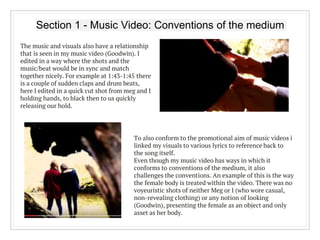
The music and visuals also have a relationship
that is seen in my music video (Goodwin). I
edited in a way where the shots and the
music/beat would be in sync and match
together nicely. For example at 1:43-1:45 there
is a couple of sudden claps and drum beats,
here I edited in a quick cut shot from meg and I
holding hands, to black then to us quickly
releasing our hold.
To also conform to the promotional aim of music videos i
linked my visuals to various lyrics to reference back to
the song itself.
Even though my music video has ways in which it
conforms to conventions of the medium, it also
challenges the conventions. An example of this is the way
the female body is treated within the video. There was no
voyeuristic shots of neither Meg or I (who wore casual,
non-revealing clothing) or any notion of looking
(Goodwin), presenting the female as an object and only
asset as her body.
Section 1 - Music Video: Conventions of Genre
My music video attains another one of Goodwin’s theories where he believes that music videos
should present some form of genre characteristics. Gather and Run’s genre is indie-folk, so
before filming my group and I looked at other indie folk music artists and their music videos for
inspiration, this included artists like ‘Florence and the machine’, ‘First Aid Kit’ and ‘Birdy’. From
this we were clearly able to identify common conventions of this genre with reference to the
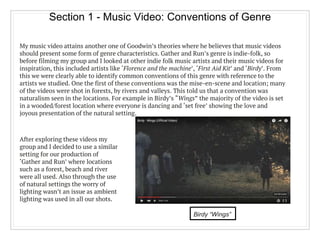
artists we studied. One the first of these conventions was the mise-en-scene and location; many
of the videos were shot in forests, by rivers and valleys. This told us that a convention was
naturalism seen in the locations. For example in Birdy’s “Wings” the majority of the video is set
in a wooded/forest location where everyone is dancing and ‘set free’ showing the love and
joyous presentation of the natural setting.
Birdy “Wings”
After exploring these videos my
group and I decided to use a similar
setting for our production of
‘Gather and Run’ where locations
such as a forest, beach and river
were all used. Also through the use
of natural settings the worry of
lighting wasn’t an issue as ambient
lighting was used in all our shots.
Section 1 - Music video: Conventions of Genre
As previously mentioned many other indie-folk artists use natural locations and
therefore natural lighting, while incorporating shot techniques like lenses flares. We
used this in my production as a pan up to the sun which shone into the camera creating
a fully white shot which then panned down from the sky to an entirely new shot. Also
using different saturations and the use of colour I created the sense of flashbacks, from
happy and sad memories to present time. Higher saturation and colour was used in the
happy shots to present a positive image, while the melancholy shots had low saturation
and were in black and white. This aided us to create a backstory and binary opposition
(Strauss), which helped to engage the audience in emotion and to feel sad and depressed
when the relationship fails.
Section 1 - Music video: Narrative conventions
In post production I used the convention of colour alteration to indicate a flashback to an earlier
point in the story line which is a crucial part of the back story, I used full colour for the flash backs
to indicate nostalgia while real time is black and white to avoid the viewer to be confused.
The use of colour and black and white isn’t
particularly normal in this genre; indie-folk. Indie-
folk is a rather traditional style of music which is
possibly why many videos tend to be in full colour.
Few videos in this genre use both colour and black
and white in one video, indie music tends to be
upbeat so the normal use of colour connotes to this
playful soundtrack.
Goodwin suggests that music videos should either be
performance based or narrative based, as a group we decided
to make our video narrative based, particularly because
performance would require an appearance from the artist
who we didn’t have access to.
I conformed to the conventions of narratives in my video
through the use of a circular narrative; it begins with me on
the bench looking into the distance remembering my past
relationship. It then ends with the memory coming to an
end with me on the bench again. This is seen in other media
productions like Quentin Tarintino’s Pulp Fiction.
Because the artist (Natasha North) was not present in my
video I am challenging generic music video narratives. This
is because it isn’t obvious that I’m promoting the artist; a
convention of the medium suggested by Goodwin.
Pulp Fiction
I used a storyline as a narrative, this is
a good way to maintain attention as it
creates a story that the audience can
follow and see the outcome for the
characters. The story is poetic and
injected with the notion that reality is
constantly influenced by memory.
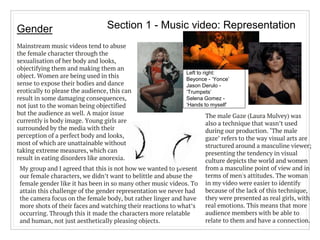
Section 1 - Music video: RepresentationGender
Mainstream music videos tend to abuse
the female character through the
sexualisation of her body and looks,
objectifying them and making them an
object. Women are being used in this
sense to expose their bodies and dance
erotically to please the audience, this can
result in some damaging consequences,
not just to the woman being objectified
but the audience as well. A major issue
currently is body image. Young girls are
surrounded by the media with their
perception of a perfect body and looks,
most of which are unattainable without
taking extreme measures, which can
result in eating disorders like anorexia.
Left to right:
Beyonce - ‘Yonce’
Jason Derulo -
‘Trumpets’
Selena Gomez -
‘Hands to myself’
The male Gaze (Laura Mulvey) was
also a technique that wasn’t used
during our production. ‘The male
gaze’ refers to the way visual arts are
structured around a masculine viewer;
presenting the tendency in visual
culture depicts the world and women
from a masculine point of view and in
terms of men's attitudes. The woman
in my video were easier to identify
because of the lack of this technique,
they were presented as real girls, with
real emotions. This means that more
audience members with be able to
relate to them and have a connection.
My group and I agreed that this is not how we wanted to present
our female characters, we didn’t want to belittle and abuse the
female gender like it has been in so many other music videos. To
attain this challenge of the gender representation we never had
the camera focus on the female body, but rather linger and have
more shots of their faces and watching their reactions to what’s
occurring. Through this it made the characters more relatable
and human, not just aesthetically pleasing objects.
Section 1 - Music video: Representation
Age
British youths and youth culture in society are represented very negatively by the media. Different
mediums such as films, the internet and newspapers seem to all represent British youths to be
troublesome, dangerous, and a threat to society and the wellbeing of others. Recent events like the
London riots (2011) have proved that youths are frustrated and are challenging cultural hegemony,
thus creating violence, trouble and moral panic (Stanley Cohen). It can be argued that youths have
always been and behaved in this manner, but to label youths as a whole as being violent can be seen as
very inaccurate.
I challenged this view of age in my production
through the girl’s behaviour and attitude, they did
not swear, were rude or violent in any way. When
there was a snippet of conflict the girls resorted to
arguing verbally with no use of physical violence.
In comparison to another music video like ‘Ill
Manors’ by Plan B, youth are represented to be
very violent, attacking each other, damaging
property and disturbing the peace of the
community.
Through the focus of two British youths who are
rather naïve, travel through the emotions and
memories of their past relationship it makes the
characters much more relatable, thus the audience
will identify and feel emotion for their hardships.
Plan B - ‘Ill Manors’
London Riots
Gather & Run
Section 1 - Music video: Representation
Sexuality
In my music video I challenged the negative representations of the LGBTQ+ community;
particularly lesbians. Homosexuals are under portrayed in the media, especially female
homosexuals; this means that there is a serious lack of any representation of the LGBT
community, so the audience that would identify with that are unable to do so (Jacques Lacan).
The focus of my production was not concentrating on the girl’s sexuality and their exploration of
it, but rather just a normal relationship between two people and how for any kind of couple there
will be ups and downs, this way the audience can focus on identifying with the characters and
their representation as normal people.
Another way how I challenged the representation of lesbian characters and representation is
through their appearance and behaviour. A typical representation is that of a “butch” woman,
with short hair and jeans. The girls in my production were not represented like this, but instead
both wore similar outfits; consisting of coats, jeans and long brown hair. This presents them to
still have an attachment to their femininity and neither represented as the ‘male’ in their
relationship.
Comparison of representation in ‘Gather & Run’ to stereotypical ‘butch lesbian’.
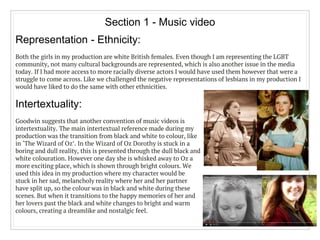
Section 1 - Music video
Intertextuality:
Goodwin suggests that another convention of music videos is
intertextuality. The main intertextual reference made during my
production was the transition from black and white to colour, like
in ‘The Wizard of Oz’. In the Wizard of Oz Dorothy is stuck in a
boring and dull reality, this is presented through the dull black and
white colouration. However one day she is whisked away to Oz a
more exciting place, which is shown through bright colours. We
used this idea in my production where my character would be
stuck in her sad, melancholy reality where her and her partner
have split up, so the colour was in black and white during these
scenes. But when it transitions to the happy memories of her and
her lovers past the black and white changes to bright and warm
colours, creating a dreamlike and nostalgic feel.
Representation - Ethnicity:
Both the girls in my production are white British females. Even though I am representing the LGBT
community, not many cultural backgrounds are represented, which is also another issue in the media
today. If I had more access to more racially diverse actors I would have used them however that were a
struggle to come across. Like we challenged the negative representations of lesbians in my production I
would have liked to do the same with other ethnicities.
Question 1 - Section 2:
In what ways does your print productions use,
develop or challenge forms and conventions of
real media products?
Track: Gather & Run
Artist: Natasha North
Genre: Indie folk
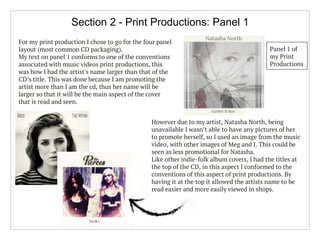
Section 2 - Print Productions: Panel 1
For my print production I chose to go for the four panel
layout (most common CD packaging).
My text on panel 1 conforms to one of the conventions
associated with music videos print productions, this
was how I had the artist's name larger than that of the
CD’s title. This was done because I am promoting the
artist more than I am the cd, thus her name will be
larger so that it will be the main aspect of the cover
that is read and seen.
However due to my artist, Natasha North, being
unavailable I wasn’t able to have any pictures of her
to promote herself, so I used an image from the music
video, with other images of Meg and I. This could be
seen as less promotional for Natasha.
Like other indie-folk album covers, I had the titles at
the top of the CD, in this aspect I conformed to the
conventions of this aspect of print productions. By
having it at the top it allowed the artists name to be
read easier and more easily viewed in shops.
Panel 1 of
my Print
Productions
Panel 2 & 3
of my Print
Productions
Section 2 - Print Productions: Panel 2 & 3
My panels 2 & 3 were two individual pictures on each panel, but together make a larger continuous
image. On panel 2 we see me; one of the actors from the music video, looking sad remembering the
happy times I once had with Meg. On panel 3 we can see Meg, who is doing the same, but looking, in
my direction. Over both the images is a large crack, connoting that our bond has been broken and our
memories are shattering.
No additional information was added onto the CD design, like companies, artist details or extras like a
lyric sheet. So I challenged that convention to do with the design as it is normally featured on CDs to
increase the promotion of the artist and label.
A CD cover convention can be that the main design (the front panel) is bright and eye catching to the
audience, when the inside panels are more dull and simple so that the front cover can have all the
attention. I challenged this by keeping a consistent colour scheme throughout my panels. Each panel
is dull and dark, some with a hint of colour. The dull, faded colours in the interior panels work with
front and back panels creating consistency, however there is a hint of red from Meg’s coat on the
front and back cover.
Panel 4 of my Print Productions
Section 2 - Print Productions: Panel 4
One of the first conventions of a panel 4
for CD case designs is having a list of what
tracks are on the CD and in what order.
This is done so that the audience know
what to expect from what they are buying
and so that they know what tracks are
attached to this particular CD. Also it is
often that panel 1 fonts correspond with
panel 4. I had this written in the same font
I used for panel 1 titles; “Lora”. This way I
kept the continuity throughout like I was
doing with the colouration.
The tracks are normally placed on one side of the panel and not normally in the
middle, this way it allows for a picture to be present, also for the audience to be
able to read it with ease. This is a convention that I used.
Lastly I used the convention of having a barcode present and the company. This
is important as it helps promotion wise for the artist, giving further information
of who they are and who they work wish. This is often placed at the bottom of
the CD panel; again not to get in the way and so it is easier for the audience to
read.
Magazine advert of my Print
Productions
Section 2 - Print Productions: Magazine Advert
Like the front of my digipak, one panel 1, I had the
artists name at the top in the biggest size. This is a
convention of magazine adverts as they are
advertisements, promoting and attempting to catch the
audience’s eye and attention to make them aware of
the artist. This is seen in my ad where Natasha’s name
is at the top in the largest size with the album's name
smaller (still reasonably large) below it to present the
album that is on sale.
I included text in my advert to provide information
about the album like its release date and ratings it has
been given. All of this is above an image I have below,
which is the same image used in my digipak but slightly
different, creating continuity so the audience know it’s
the same product. I made the sky have a purple tint,
with the colours of the whole picture remaining,
however slightly dimmed. This way it’ll attract
attention but not stray too far from the design of the
CD case.
Similar to my CD case I was unable to use any pictures
of Natasha, so I used images from my music video, this
challenges the conventions of magazines adverts as
they tend to advertise and show the artist, therefore
not as much impact is made as the audience don’t
know who Natasha is and what she looks like.
Section 2 - Print Productions: Intertextual
References
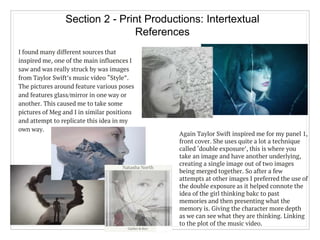
I found many different sources that
inspired me, one of the main influences I
saw and was really struck by was images
from Taylor Swift’s music video “Style”.
The pictures around feature various poses
and features glass/mirror in one way or
another. This caused me to take some
pictures of Meg and I in similar positions
and attempt to replicate this idea in my
own way.
Again Taylor Swift inspired me for my panel 1,
front cover. She uses quite a lot a technique
called ‘double exposure’, this is where you
take an image and have another underlying,
creating a single image out of two images
being merged together. So after a few
attempts at other images I preferred the use of
the double exposure as it helped connote the
idea of the girl thinking bakc to past
memories and then presenting what the
memory is. Giving the character more depth
as we can see what they are thinking. Linking
to the plot of the music video.

Evaluation Q1

  • 1.
    Evaluation Question 1 -In what ways does your media product use, develop or challenge forms and conventions of real media products?
  • 2.
    Question 1 -Section 1: In what ways does your music video use, develop or challenge forms and conventions of real media products? Track: Gather & Run Artist: Natasha North Genre: Indie folk
  • 3.
    Section 1 -Music Video: Conventions of the medium How the video conforms and shows conventions of music videos: ● Length of song ● Promotional piece Music videos are about advertising the artist that has made the song. Keeping this in mind as I made and edited my video I used different conventions that allows my video to fit those of the medium. I used the conventions of the medium by editing my music video to the length of the track. Apart from the diegetic sound of the sea after the song finishes. I used this is connote the way memory is often aroused by sound. I had to cut the track for both the ease of my editing; which may reduce the promotional aspect as the track isn’t how the artist intended, but by having my track’s length to be 2 ½ minutes long it helps to engage the audience's attention, without becoming tedious and thus causes the loss of engagement. There’s also a relationship shown between the lyrics and the visuals (Goodwin). For example,For example in the song’s chorus (which is repeated several times) are the lyrics “to the forest”, this parallels with the visuals which show the two young girls running around in a forest. A less explicit example is another set of lyrics that is repeated throughout the track; “we are only young”. This is seen and corresponds with my video’s visuals through the young actors who were chosen to play the main roles (both aging from 17-18).
  • 4.
    Section 1 -Music Video: Conventions of the medium The music and visuals also have a relationship that is seen in my music video (Goodwin). I edited in a way where the shots and the music/beat would be in sync and match together nicely. For example at 1:43-1:45 there is a couple of sudden claps and drum beats, here I edited in a quick cut shot from meg and I holding hands, to black then to us quickly releasing our hold. To also conform to the promotional aim of music videos i linked my visuals to various lyrics to reference back to the song itself. Even though my music video has ways in which it conforms to conventions of the medium, it also challenges the conventions. An example of this is the way the female body is treated within the video. There was no voyeuristic shots of neither Meg or I (who wore casual, non-revealing clothing) or any notion of looking (Goodwin), presenting the female as an object and only asset as her body.
  • 5.
    Section 1 -Music Video: Conventions of Genre My music video attains another one of Goodwin’s theories where he believes that music videos should present some form of genre characteristics. Gather and Run’s genre is indie-folk, so before filming my group and I looked at other indie folk music artists and their music videos for inspiration, this included artists like ‘Florence and the machine’, ‘First Aid Kit’ and ‘Birdy’. From this we were clearly able to identify common conventions of this genre with reference to the artists we studied. One the first of these conventions was the mise-en-scene and location; many of the videos were shot in forests, by rivers and valleys. This told us that a convention was naturalism seen in the locations. For example in Birdy’s “Wings” the majority of the video is set in a wooded/forest location where everyone is dancing and ‘set free’ showing the love and joyous presentation of the natural setting. Birdy “Wings” After exploring these videos my group and I decided to use a similar setting for our production of ‘Gather and Run’ where locations such as a forest, beach and river were all used. Also through the use of natural settings the worry of lighting wasn’t an issue as ambient lighting was used in all our shots.
  • 6.
    Section 1 -Music video: Conventions of Genre As previously mentioned many other indie-folk artists use natural locations and therefore natural lighting, while incorporating shot techniques like lenses flares. We used this in my production as a pan up to the sun which shone into the camera creating a fully white shot which then panned down from the sky to an entirely new shot. Also using different saturations and the use of colour I created the sense of flashbacks, from happy and sad memories to present time. Higher saturation and colour was used in the happy shots to present a positive image, while the melancholy shots had low saturation and were in black and white. This aided us to create a backstory and binary opposition (Strauss), which helped to engage the audience in emotion and to feel sad and depressed when the relationship fails.
  • 7.
    Section 1 -Music video: Narrative conventions In post production I used the convention of colour alteration to indicate a flashback to an earlier point in the story line which is a crucial part of the back story, I used full colour for the flash backs to indicate nostalgia while real time is black and white to avoid the viewer to be confused. The use of colour and black and white isn’t particularly normal in this genre; indie-folk. Indie- folk is a rather traditional style of music which is possibly why many videos tend to be in full colour. Few videos in this genre use both colour and black and white in one video, indie music tends to be upbeat so the normal use of colour connotes to this playful soundtrack. Goodwin suggests that music videos should either be performance based or narrative based, as a group we decided to make our video narrative based, particularly because performance would require an appearance from the artist who we didn’t have access to. I conformed to the conventions of narratives in my video through the use of a circular narrative; it begins with me on the bench looking into the distance remembering my past relationship. It then ends with the memory coming to an end with me on the bench again. This is seen in other media productions like Quentin Tarintino’s Pulp Fiction. Because the artist (Natasha North) was not present in my video I am challenging generic music video narratives. This is because it isn’t obvious that I’m promoting the artist; a convention of the medium suggested by Goodwin. Pulp Fiction I used a storyline as a narrative, this is a good way to maintain attention as it creates a story that the audience can follow and see the outcome for the characters. The story is poetic and injected with the notion that reality is constantly influenced by memory.
  • 8.
    Section 1 -Music video: RepresentationGender Mainstream music videos tend to abuse the female character through the sexualisation of her body and looks, objectifying them and making them an object. Women are being used in this sense to expose their bodies and dance erotically to please the audience, this can result in some damaging consequences, not just to the woman being objectified but the audience as well. A major issue currently is body image. Young girls are surrounded by the media with their perception of a perfect body and looks, most of which are unattainable without taking extreme measures, which can result in eating disorders like anorexia. Left to right: Beyonce - ‘Yonce’ Jason Derulo - ‘Trumpets’ Selena Gomez - ‘Hands to myself’ The male Gaze (Laura Mulvey) was also a technique that wasn’t used during our production. ‘The male gaze’ refers to the way visual arts are structured around a masculine viewer; presenting the tendency in visual culture depicts the world and women from a masculine point of view and in terms of men's attitudes. The woman in my video were easier to identify because of the lack of this technique, they were presented as real girls, with real emotions. This means that more audience members with be able to relate to them and have a connection. My group and I agreed that this is not how we wanted to present our female characters, we didn’t want to belittle and abuse the female gender like it has been in so many other music videos. To attain this challenge of the gender representation we never had the camera focus on the female body, but rather linger and have more shots of their faces and watching their reactions to what’s occurring. Through this it made the characters more relatable and human, not just aesthetically pleasing objects.
  • 9.
    Section 1 -Music video: Representation Age British youths and youth culture in society are represented very negatively by the media. Different mediums such as films, the internet and newspapers seem to all represent British youths to be troublesome, dangerous, and a threat to society and the wellbeing of others. Recent events like the London riots (2011) have proved that youths are frustrated and are challenging cultural hegemony, thus creating violence, trouble and moral panic (Stanley Cohen). It can be argued that youths have always been and behaved in this manner, but to label youths as a whole as being violent can be seen as very inaccurate. I challenged this view of age in my production through the girl’s behaviour and attitude, they did not swear, were rude or violent in any way. When there was a snippet of conflict the girls resorted to arguing verbally with no use of physical violence. In comparison to another music video like ‘Ill Manors’ by Plan B, youth are represented to be very violent, attacking each other, damaging property and disturbing the peace of the community. Through the focus of two British youths who are rather naïve, travel through the emotions and memories of their past relationship it makes the characters much more relatable, thus the audience will identify and feel emotion for their hardships. Plan B - ‘Ill Manors’ London Riots Gather & Run
  • 10.
    Section 1 -Music video: Representation Sexuality In my music video I challenged the negative representations of the LGBTQ+ community; particularly lesbians. Homosexuals are under portrayed in the media, especially female homosexuals; this means that there is a serious lack of any representation of the LGBT community, so the audience that would identify with that are unable to do so (Jacques Lacan). The focus of my production was not concentrating on the girl’s sexuality and their exploration of it, but rather just a normal relationship between two people and how for any kind of couple there will be ups and downs, this way the audience can focus on identifying with the characters and their representation as normal people. Another way how I challenged the representation of lesbian characters and representation is through their appearance and behaviour. A typical representation is that of a “butch” woman, with short hair and jeans. The girls in my production were not represented like this, but instead both wore similar outfits; consisting of coats, jeans and long brown hair. This presents them to still have an attachment to their femininity and neither represented as the ‘male’ in their relationship. Comparison of representation in ‘Gather & Run’ to stereotypical ‘butch lesbian’.
  • 11.
    Section 1 -Music video Intertextuality: Goodwin suggests that another convention of music videos is intertextuality. The main intertextual reference made during my production was the transition from black and white to colour, like in ‘The Wizard of Oz’. In the Wizard of Oz Dorothy is stuck in a boring and dull reality, this is presented through the dull black and white colouration. However one day she is whisked away to Oz a more exciting place, which is shown through bright colours. We used this idea in my production where my character would be stuck in her sad, melancholy reality where her and her partner have split up, so the colour was in black and white during these scenes. But when it transitions to the happy memories of her and her lovers past the black and white changes to bright and warm colours, creating a dreamlike and nostalgic feel. Representation - Ethnicity: Both the girls in my production are white British females. Even though I am representing the LGBT community, not many cultural backgrounds are represented, which is also another issue in the media today. If I had more access to more racially diverse actors I would have used them however that were a struggle to come across. Like we challenged the negative representations of lesbians in my production I would have liked to do the same with other ethnicities.
  • 12.
    Question 1 -Section 2: In what ways does your print productions use, develop or challenge forms and conventions of real media products? Track: Gather & Run Artist: Natasha North Genre: Indie folk
  • 13.
    Section 2 -Print Productions: Panel 1 For my print production I chose to go for the four panel layout (most common CD packaging). My text on panel 1 conforms to one of the conventions associated with music videos print productions, this was how I had the artist's name larger than that of the CD’s title. This was done because I am promoting the artist more than I am the cd, thus her name will be larger so that it will be the main aspect of the cover that is read and seen. However due to my artist, Natasha North, being unavailable I wasn’t able to have any pictures of her to promote herself, so I used an image from the music video, with other images of Meg and I. This could be seen as less promotional for Natasha. Like other indie-folk album covers, I had the titles at the top of the CD, in this aspect I conformed to the conventions of this aspect of print productions. By having it at the top it allowed the artists name to be read easier and more easily viewed in shops. Panel 1 of my Print Productions
  • 14.
    Panel 2 &3 of my Print Productions Section 2 - Print Productions: Panel 2 & 3 My panels 2 & 3 were two individual pictures on each panel, but together make a larger continuous image. On panel 2 we see me; one of the actors from the music video, looking sad remembering the happy times I once had with Meg. On panel 3 we can see Meg, who is doing the same, but looking, in my direction. Over both the images is a large crack, connoting that our bond has been broken and our memories are shattering. No additional information was added onto the CD design, like companies, artist details or extras like a lyric sheet. So I challenged that convention to do with the design as it is normally featured on CDs to increase the promotion of the artist and label. A CD cover convention can be that the main design (the front panel) is bright and eye catching to the audience, when the inside panels are more dull and simple so that the front cover can have all the attention. I challenged this by keeping a consistent colour scheme throughout my panels. Each panel is dull and dark, some with a hint of colour. The dull, faded colours in the interior panels work with front and back panels creating consistency, however there is a hint of red from Meg’s coat on the front and back cover.
  • 15.
    Panel 4 ofmy Print Productions Section 2 - Print Productions: Panel 4 One of the first conventions of a panel 4 for CD case designs is having a list of what tracks are on the CD and in what order. This is done so that the audience know what to expect from what they are buying and so that they know what tracks are attached to this particular CD. Also it is often that panel 1 fonts correspond with panel 4. I had this written in the same font I used for panel 1 titles; “Lora”. This way I kept the continuity throughout like I was doing with the colouration. The tracks are normally placed on one side of the panel and not normally in the middle, this way it allows for a picture to be present, also for the audience to be able to read it with ease. This is a convention that I used. Lastly I used the convention of having a barcode present and the company. This is important as it helps promotion wise for the artist, giving further information of who they are and who they work wish. This is often placed at the bottom of the CD panel; again not to get in the way and so it is easier for the audience to read.
  • 16.
    Magazine advert ofmy Print Productions Section 2 - Print Productions: Magazine Advert Like the front of my digipak, one panel 1, I had the artists name at the top in the biggest size. This is a convention of magazine adverts as they are advertisements, promoting and attempting to catch the audience’s eye and attention to make them aware of the artist. This is seen in my ad where Natasha’s name is at the top in the largest size with the album's name smaller (still reasonably large) below it to present the album that is on sale. I included text in my advert to provide information about the album like its release date and ratings it has been given. All of this is above an image I have below, which is the same image used in my digipak but slightly different, creating continuity so the audience know it’s the same product. I made the sky have a purple tint, with the colours of the whole picture remaining, however slightly dimmed. This way it’ll attract attention but not stray too far from the design of the CD case. Similar to my CD case I was unable to use any pictures of Natasha, so I used images from my music video, this challenges the conventions of magazines adverts as they tend to advertise and show the artist, therefore not as much impact is made as the audience don’t know who Natasha is and what she looks like.
  • 17.
    Section 2 -Print Productions: Intertextual References I found many different sources that inspired me, one of the main influences I saw and was really struck by was images from Taylor Swift’s music video “Style”. The pictures around feature various poses and features glass/mirror in one way or another. This caused me to take some pictures of Meg and I in similar positions and attempt to replicate this idea in my own way. Again Taylor Swift inspired me for my panel 1, front cover. She uses quite a lot a technique called ‘double exposure’, this is where you take an image and have another underlying, creating a single image out of two images being merged together. So after a few attempts at other images I preferred the use of the double exposure as it helped connote the idea of the girl thinking bakc to past memories and then presenting what the memory is. Giving the character more depth as we can see what they are thinking. Linking to the plot of the music video.