Question 1: In What Ways Does Your
Media Product Use, Develop Or
Challenge Forms And Conventions Of
Real Media Products?
By Carlie Cokell-Smith
What Is A Music Video?
A short film which is made to accompany a song. A music video is a platform for promotional purposes to not
only promote an artists album/work and entertain their fan base, but their star image as well.
In my advanced portfolio, I was required to follow 4 stages in the making of my music video:
Research
Planning
Production
Evaluation
During this process, I was required to choose any genre to create my music video. Me and my group decided to
choose a niche genre of Alternative R&B which was researched by myself and my group in more depth to be
able to be accurate with the conventions of this genre. To do this, I watched existing music videos from this
genre to get a taste of what kind of visuals, edits and other elements of mise en scene was used in which ways.
When my research was complete (including theorists associated with music videos such as Hebdige and
Goodwin, music videos and conventions), I moved onto the planning stage of the process to making my music
video. This was a lot easier after my researching stage as I had much more knowledge on music videos and the
music industry. This consisted of me planning the look and theme of my ancillary products which would also
have to be associated with my music video. During this process I was planning the narrative, micro elements,
artists and characters in depth to make sure that everything is in place and makes sense in our music video.
We planned our music video thoroughly and made sure everything was in place properly.
The forms and conventions of all my
media products
All my products USE conventions due to artist representation, the dark colours throughout, the eerie locations
and the use of dyers star theory and adorno’s popular culture theory.
All my products DEVELOP conventions by how the artists presents a niche and mainstream representation for
audiences, the locations were developed due to making them accurate and suitable to the scene, and dyers
star image theory was used to be put in detail, making an accurate image for the artist.
All my products CHALLENGE conventions as we avoid using Mulvey’s theory and intertextual reference (as it
wasn’t needed) and iconography being used in significant ways to the narrative, for example, the belt was used
to represent the hanging of the male character, tarot cards are unusual cards which not many people would
use and mysterious marbles.
Music Video Influences
Sia – Elastic Heart
Chris Brown – Fine By Me
Lady Gaga – Judas
Justin Bieber – The Feeling
There was some
music videos and
artists which
influenced our idea
in the music video
we decided to
create. This helped
me and my group
gain new and
interesting ideas and
visions to develop,
use and challenge
the conventions. We
have four main
music videos which
influenced our music
video:
This video massively influences the
second fight in the video, due to the
style of dance called ‘krumping’
being used by them. We used this
because we saw it was very effect in
this video and created emotion.
The ‘fighting through dancing’
representation in this video is
exactly what we wanted to do within
our work, the way they are fighting
adds interest to the video.
The dancing in the video is unique and
represents Sia’s mind which I found very
unique and inspiring. This is because
she shows her true self within her work,
which we wanted to do.
The quirky movements that Lady GaGa
makes with her facial expression and
body language is what inspired me from
this. This is because she shows her
personality through her work, which we
wanted to do.
Cinematography – Shot Sizes
What I discovered as I was watching the existing music videos for guidance was that there was a lot
of star image shown through close ups, especially in Lady Gaga’s music video ‘Judas’ as well as long
shots. This allowed the audience to connect with the artist which also illustrated her use of lip
syncing. This enhances her star image/importance in the music video. Long shots represented how
talented she is in performing all round (dancing and acting). This allows the audience to relate to
her in a more personal way, which is through her movements and music.
This influenced me and my group to do the same in order to enhance our artists star image. This
also reflects Goodwin’s theory as Goodwin states that an artist should perform in their music video
to make it conventional. This made me understand that capturing the artist through different shots
is extremely important as it helps represent the artists as a 'star' (Dyers Theory).
Cinematography – Camera Angles

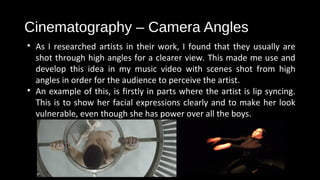
As I researched artists in their work, I found that they usually are
shot through high angles for a clearer view. This made me use and
develop this idea in my music video with scenes shot from high
angles in order for the audience to perceive the artist.

An example of this, is firstly in parts where the artist is lip syncing.
This is to show her facial expressions clearly and to make her look
vulnerable, even though she has power over all the boys.
Cinematography – movement and
positioning
• Throughout the process of filming, the majority of the time we hand held the
camera as we believe in scenes such as the fights, the shaky cam will look
effect and cause panic and tension in the scene for the audience. The
camera moves in different angles and sizes quite a lot in these scenes. This
consists of high/low angles and even zooms to particular body movements
in characters.
• Also, as we filmed the scenes where the artist is in a dark room, the focus of
attention was always on her. This is because we wanted the audience to
feel a deep connection with her and to feel her quirky personality through
her visuals and movement.
Mise En Scene – Lighting And Colour

In the genre of alternative R&B, colours such as red, black and blue supported by low
key lighting makes the difference between this genre and the original R&B. Chris
Brown's Video to 'Fine By Me' uses these dark colours with connote gloom and danger
in the scene due to the violent fighting, also creating an urban look. We develop the
lighting byediting the colour and brightness through Final Cut Pro.
Mise En Scene - Setting
I found unique locations through my research stage which would best suit my genre
(Alternative R&B). Locations included a drama room which would be a safer way to
represent a deserted, dark room. This made me make the decision of using and
developing this idea with ensuring the locations were urban and dark which suited my
narrative. The artist was filmed in the dark drama room to portray her unpredictable
nature and how niche her work is compared to other artists, and the fight scenes were
at a grimy subway. I also challenged conventions with using normal locations like a
library.
Mise En Scene - Iconography
Alternative R&B music videos usually have unique iconography which
compliments the narrative, which also gives off the creepy, abnormal
effect. Even though we used iconography, a lot of the focus was on the
performance of the characters. Conventions were challenged as I used
tarot cards, marbles, candles, a glass plate and other pieces of iconography
to compliment the artists characteristics of a tarot reader. The iconography
is also significant as the cards control the characters.
Mise En Scene – Facial Expressions And
Body Language
My artist had a straight/emotionless facial expression due to the weird and quirky
representation that I want her to have to make the audience feel uncomfortable. This
will evoke suspense and urge to find deeper emotion within the artist, building a
connection with the audience. We decided I should be the artist as I can dance and my
body language can be quite flexible to show off unique movements, abilities and skills.
This is shown in ‘Sia – Elastic Heart’ as the girl dancing uses her whole body to move
around in the large cage.
Mise En Scene – Costume, Hair And
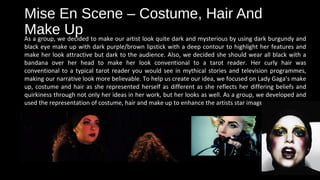
Make UpAs a group, we decided to make our artist look quite dark and mysterious by using dark burgundy and
black eye make up with dark purple/brown lipstick with a deep contour to highlight her features and
make her look attractive but dark to the audience. Also, we decided she should wear all black with a
bandana over her head to make her look conventional to a tarot reader. Her curly hair was
conventional to a typical tarot reader you would see in mythical stories and television programmes,
making our narrative look more believable. To help us create our idea, we focused on Lady Gaga’s make
up, costume and hair as she represented herself as different as she reflects her differing beliefs and
quirkiness through not only her ideas in her work, but her looks as well. As a group, we developed and
used the representation of costume, hair and make up to enhance the artists star image.
Editing
Goodwin’s theory made me understand that the editing of the music should reflective the pace
of the song. For example, if the song is slow, the editing should be slow. ‘Power of Love’ by
Gabrielle Aplin is an extremely slow, calming song and is complimented with slow edits of the
scenery and her by the piano. The song has slow, mysterious parts to the accompaniment so I
edited at a slow pace to create a daunting, mysterious atmosphere. However, when the fight
scenes occurred the music was at its climax, which I decided to edit quickly with so then the
audience can feel tension whilst watching the violent scenes. Also, a flashing effect was used to
show the artist is magical and powerful over the boys. We did follow the theory overall as it
makes sense to do slow edits to a slow piece of music and vice versa.
Have You Followed Sound Conventions
Of Your Genre And How?
Sound Conventions were followed due to a strong relationships between the
visuals and the music and the lyrics to the visuals. This shows we had a great
understanding with the music and the narrative and focused massively on the
relationship between each area. My group looked into existing music videos to see
how other editors used the relationship between the lyrics and visuals, and the
music and visuals, so then we could use and develop the techniques they
demonstrated.
Andrew Goodwin’s eight characteristics draw upon the use of sound and
conventions. Although there was difficulties in the process, we overcome then and
used the theory to do so. I promoted love and fighting for love by editing it within
the lyrics and the music, adding interest to the editing techniques and flow.
Does My Product Develop Or Challenge
Forms And Conventions Of Real Media
Products?
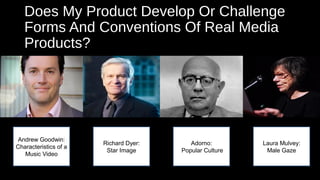
Andrew Goodwin:
Characteristics of a
Music Video
Richard Dyer:
Star Image
Adorno:
Popular Culture
Laura Mulvey:
Male Gaze
Goodwin: Using, Developing And
Challenging Conventions
1. Notion of looking – Particularly voyeuristic
treatment of the female body (women that are
seen as a sexual object.)
2. Intertextual Reference – In many music videos
you will find there are often links to other films,
TV programmes, celebrity’s lives, other music
videos, etc.
3. Performance, Narrative or Concept-Based –
Performance: Solidly focused on the artist/band.
Narrative: Story attached to video. Concept:
Obscure/surreal for the audience and doesn’t
really make sense.
4. Technical elements – Micro elements compliment
the genre (Cinematography, Editing, Mise en
scene, Sound).
1. Genre Characteristics – that music videos often
reflect their genre through the use of specific
characteristics which makes them conventional.
2. Relationship between lyrics and visuals –
Illustrative: Explaining the lyrics visually.
Amplifying: Exaggeration of the lyrics linking to
the video.
3. Relationship between music and visuals – Visuals
show a clear connection to the actual music.
4. Star Image Motifs – The music video mainly
focuses on the artists with many close up shots,
demanded by the record label so they can
become more popular and identifiable in the
industry.
Goodwin: Using, Developing And
Challenging Conventions (Continued).
Genre Characteristics
Relationship between lyrics and visuals
Performance and Narrative
Star Image Motifs
‘Pacify our love,
our love, love’
Using, Developing And Challenging
Conventions: Adorno
Adorno said that popular music usually promotes particular mainstream values and lifestyles.
This is because it will appeal to mass audiences and create lots of success for the artist.
I was interested in using this idea but I found it challenging at the same time due to the idea of
niche ideas that were created and the song that was chosen. I believe the fight scenes were a
piece of the video that I believe audiences will relate to as its physical contact in which people
know of on a daily basis. I developed his theory in the representation of the male actors of my
music video as they were seen from the audience as ordinary/normal men. Their own
environments represented their hobbies which many different audiences will relate to. Also,
their different races will also draw different racial audience to my music video, increasing the
audience mass.
On the other hand, I challenged this idea due to the need of a unique/uncomfortable feeling to
come from the artists actions, appearance and behaviour throughout. This clearly represents her
real life beliefs, causing interest. Artists such as Lady Gaga and Grimes are similar to this, which
attracts audiences.
Using And Developing Conventions: Dyer
As a group, we decided that we should aim to appeal to a larger audience, including sub cultures
(Hebdige’s theory) in order to gain success from the artist. We done this through promoting her
ideologies and cultural views through her movement and music. This would allow both genders
to possibly relate to her in a personal manner. I made her as an artist more appealing to the
audience by showing her distinctive beliefs. This was enhanced by her body language, facial
expressions and the use of low key lighting.
Even though the artist is singing a song from a rare genre of alternative R&B, she can still be
seen as a well established artist and also a star, due to her high level of performance and great
representation of herself as a unique character.
Dyer’s theory set for representations that a music artist would represent in their work:
Stars and constructions (artificial image), Ideology and culture (cultural values to share),
Character and Personality (audience feel closer to their lifestyle) and Industry and Audience
(making money).
Challenging Conventions: Mulvey
Our narrative is clearly about chasing love
and facing challenges over someone you
love so we decided as a group that ‘the
male gaze’ is no necessary in our music
video. We believed that it could distract the
audience from the real meaning and
understanding of what our narrative is
trying to portray. We also believed that it
would throw off how quirky and different our
music video is. This challenged the mal
gaze as we avoided using this theory within
the music video.
Overall..
Overall, the process of finalising the video was used., developed and challenged
conventions which was crucial is making a successful video. Using and developing
conventions was important for the music video, for it to look effective but unique as
it made us have sensible decisions based on our research. We identified our artist
and narrative, which was distinctive rather than cliché. We challenged conventions
throughout, as we avoided theories such as; Mulvey’s ‘Male Gaze’. This didn’t put
our music video at a disadvantage or unconventional for an audience, it just made
our music video more unique compared to others, making more success within the
process. Despite using conventions and also developing on them, we also felt that
it was important that we made our music video similar to its genre (which is seen
in the music industry). Whilst creating the ancillary products, we used and
developed conventions, making them more conventional to our research of digipak
and adverts from the past. We also made our digipak and advert similar to others
from the alternative R&B genre, so it can relate to fan bases of the genre
effectively.

Question 1 Evaluation

  • 1.
    Question 1: InWhat Ways Does Your Media Product Use, Develop Or Challenge Forms And Conventions Of Real Media Products? By Carlie Cokell-Smith
  • 2.
    What Is AMusic Video? A short film which is made to accompany a song. A music video is a platform for promotional purposes to not only promote an artists album/work and entertain their fan base, but their star image as well. In my advanced portfolio, I was required to follow 4 stages in the making of my music video: Research Planning Production Evaluation During this process, I was required to choose any genre to create my music video. Me and my group decided to choose a niche genre of Alternative R&B which was researched by myself and my group in more depth to be able to be accurate with the conventions of this genre. To do this, I watched existing music videos from this genre to get a taste of what kind of visuals, edits and other elements of mise en scene was used in which ways. When my research was complete (including theorists associated with music videos such as Hebdige and Goodwin, music videos and conventions), I moved onto the planning stage of the process to making my music video. This was a lot easier after my researching stage as I had much more knowledge on music videos and the music industry. This consisted of me planning the look and theme of my ancillary products which would also have to be associated with my music video. During this process I was planning the narrative, micro elements, artists and characters in depth to make sure that everything is in place and makes sense in our music video. We planned our music video thoroughly and made sure everything was in place properly.
  • 3.
    The forms andconventions of all my media products All my products USE conventions due to artist representation, the dark colours throughout, the eerie locations and the use of dyers star theory and adorno’s popular culture theory. All my products DEVELOP conventions by how the artists presents a niche and mainstream representation for audiences, the locations were developed due to making them accurate and suitable to the scene, and dyers star image theory was used to be put in detail, making an accurate image for the artist. All my products CHALLENGE conventions as we avoid using Mulvey’s theory and intertextual reference (as it wasn’t needed) and iconography being used in significant ways to the narrative, for example, the belt was used to represent the hanging of the male character, tarot cards are unusual cards which not many people would use and mysterious marbles.
  • 4.
    Music Video Influences Sia– Elastic Heart Chris Brown – Fine By Me Lady Gaga – Judas Justin Bieber – The Feeling There was some music videos and artists which influenced our idea in the music video we decided to create. This helped me and my group gain new and interesting ideas and visions to develop, use and challenge the conventions. We have four main music videos which influenced our music video: This video massively influences the second fight in the video, due to the style of dance called ‘krumping’ being used by them. We used this because we saw it was very effect in this video and created emotion. The ‘fighting through dancing’ representation in this video is exactly what we wanted to do within our work, the way they are fighting adds interest to the video. The dancing in the video is unique and represents Sia’s mind which I found very unique and inspiring. This is because she shows her true self within her work, which we wanted to do. The quirky movements that Lady GaGa makes with her facial expression and body language is what inspired me from this. This is because she shows her personality through her work, which we wanted to do.
  • 5.
    Cinematography – ShotSizes What I discovered as I was watching the existing music videos for guidance was that there was a lot of star image shown through close ups, especially in Lady Gaga’s music video ‘Judas’ as well as long shots. This allowed the audience to connect with the artist which also illustrated her use of lip syncing. This enhances her star image/importance in the music video. Long shots represented how talented she is in performing all round (dancing and acting). This allows the audience to relate to her in a more personal way, which is through her movements and music. This influenced me and my group to do the same in order to enhance our artists star image. This also reflects Goodwin’s theory as Goodwin states that an artist should perform in their music video to make it conventional. This made me understand that capturing the artist through different shots is extremely important as it helps represent the artists as a 'star' (Dyers Theory).
  • 6.
    Cinematography – CameraAngles  As I researched artists in their work, I found that they usually are shot through high angles for a clearer view. This made me use and develop this idea in my music video with scenes shot from high angles in order for the audience to perceive the artist.  An example of this, is firstly in parts where the artist is lip syncing. This is to show her facial expressions clearly and to make her look vulnerable, even though she has power over all the boys.
  • 7.
    Cinematography – movementand positioning • Throughout the process of filming, the majority of the time we hand held the camera as we believe in scenes such as the fights, the shaky cam will look effect and cause panic and tension in the scene for the audience. The camera moves in different angles and sizes quite a lot in these scenes. This consists of high/low angles and even zooms to particular body movements in characters. • Also, as we filmed the scenes where the artist is in a dark room, the focus of attention was always on her. This is because we wanted the audience to feel a deep connection with her and to feel her quirky personality through her visuals and movement.
  • 8.
    Mise En Scene– Lighting And Colour  In the genre of alternative R&B, colours such as red, black and blue supported by low key lighting makes the difference between this genre and the original R&B. Chris Brown's Video to 'Fine By Me' uses these dark colours with connote gloom and danger in the scene due to the violent fighting, also creating an urban look. We develop the lighting byediting the colour and brightness through Final Cut Pro.
  • 9.
    Mise En Scene- Setting I found unique locations through my research stage which would best suit my genre (Alternative R&B). Locations included a drama room which would be a safer way to represent a deserted, dark room. This made me make the decision of using and developing this idea with ensuring the locations were urban and dark which suited my narrative. The artist was filmed in the dark drama room to portray her unpredictable nature and how niche her work is compared to other artists, and the fight scenes were at a grimy subway. I also challenged conventions with using normal locations like a library.
  • 10.
    Mise En Scene- Iconography Alternative R&B music videos usually have unique iconography which compliments the narrative, which also gives off the creepy, abnormal effect. Even though we used iconography, a lot of the focus was on the performance of the characters. Conventions were challenged as I used tarot cards, marbles, candles, a glass plate and other pieces of iconography to compliment the artists characteristics of a tarot reader. The iconography is also significant as the cards control the characters.
  • 11.
    Mise En Scene– Facial Expressions And Body Language My artist had a straight/emotionless facial expression due to the weird and quirky representation that I want her to have to make the audience feel uncomfortable. This will evoke suspense and urge to find deeper emotion within the artist, building a connection with the audience. We decided I should be the artist as I can dance and my body language can be quite flexible to show off unique movements, abilities and skills. This is shown in ‘Sia – Elastic Heart’ as the girl dancing uses her whole body to move around in the large cage.
  • 12.
    Mise En Scene– Costume, Hair And Make UpAs a group, we decided to make our artist look quite dark and mysterious by using dark burgundy and black eye make up with dark purple/brown lipstick with a deep contour to highlight her features and make her look attractive but dark to the audience. Also, we decided she should wear all black with a bandana over her head to make her look conventional to a tarot reader. Her curly hair was conventional to a typical tarot reader you would see in mythical stories and television programmes, making our narrative look more believable. To help us create our idea, we focused on Lady Gaga’s make up, costume and hair as she represented herself as different as she reflects her differing beliefs and quirkiness through not only her ideas in her work, but her looks as well. As a group, we developed and used the representation of costume, hair and make up to enhance the artists star image.
  • 13.
    Editing Goodwin’s theory mademe understand that the editing of the music should reflective the pace of the song. For example, if the song is slow, the editing should be slow. ‘Power of Love’ by Gabrielle Aplin is an extremely slow, calming song and is complimented with slow edits of the scenery and her by the piano. The song has slow, mysterious parts to the accompaniment so I edited at a slow pace to create a daunting, mysterious atmosphere. However, when the fight scenes occurred the music was at its climax, which I decided to edit quickly with so then the audience can feel tension whilst watching the violent scenes. Also, a flashing effect was used to show the artist is magical and powerful over the boys. We did follow the theory overall as it makes sense to do slow edits to a slow piece of music and vice versa.
  • 14.
    Have You FollowedSound Conventions Of Your Genre And How? Sound Conventions were followed due to a strong relationships between the visuals and the music and the lyrics to the visuals. This shows we had a great understanding with the music and the narrative and focused massively on the relationship between each area. My group looked into existing music videos to see how other editors used the relationship between the lyrics and visuals, and the music and visuals, so then we could use and develop the techniques they demonstrated. Andrew Goodwin’s eight characteristics draw upon the use of sound and conventions. Although there was difficulties in the process, we overcome then and used the theory to do so. I promoted love and fighting for love by editing it within the lyrics and the music, adding interest to the editing techniques and flow.
  • 15.
    Does My ProductDevelop Or Challenge Forms And Conventions Of Real Media Products? Andrew Goodwin: Characteristics of a Music Video Richard Dyer: Star Image Adorno: Popular Culture Laura Mulvey: Male Gaze
  • 16.
    Goodwin: Using, DevelopingAnd Challenging Conventions 1. Notion of looking – Particularly voyeuristic treatment of the female body (women that are seen as a sexual object.) 2. Intertextual Reference – In many music videos you will find there are often links to other films, TV programmes, celebrity’s lives, other music videos, etc. 3. Performance, Narrative or Concept-Based – Performance: Solidly focused on the artist/band. Narrative: Story attached to video. Concept: Obscure/surreal for the audience and doesn’t really make sense. 4. Technical elements – Micro elements compliment the genre (Cinematography, Editing, Mise en scene, Sound). 1. Genre Characteristics – that music videos often reflect their genre through the use of specific characteristics which makes them conventional. 2. Relationship between lyrics and visuals – Illustrative: Explaining the lyrics visually. Amplifying: Exaggeration of the lyrics linking to the video. 3. Relationship between music and visuals – Visuals show a clear connection to the actual music. 4. Star Image Motifs – The music video mainly focuses on the artists with many close up shots, demanded by the record label so they can become more popular and identifiable in the industry.
  • 17.
    Goodwin: Using, DevelopingAnd Challenging Conventions (Continued). Genre Characteristics Relationship between lyrics and visuals Performance and Narrative Star Image Motifs ‘Pacify our love, our love, love’
  • 18.
    Using, Developing AndChallenging Conventions: Adorno Adorno said that popular music usually promotes particular mainstream values and lifestyles. This is because it will appeal to mass audiences and create lots of success for the artist. I was interested in using this idea but I found it challenging at the same time due to the idea of niche ideas that were created and the song that was chosen. I believe the fight scenes were a piece of the video that I believe audiences will relate to as its physical contact in which people know of on a daily basis. I developed his theory in the representation of the male actors of my music video as they were seen from the audience as ordinary/normal men. Their own environments represented their hobbies which many different audiences will relate to. Also, their different races will also draw different racial audience to my music video, increasing the audience mass. On the other hand, I challenged this idea due to the need of a unique/uncomfortable feeling to come from the artists actions, appearance and behaviour throughout. This clearly represents her real life beliefs, causing interest. Artists such as Lady Gaga and Grimes are similar to this, which attracts audiences.
  • 19.
    Using And DevelopingConventions: Dyer As a group, we decided that we should aim to appeal to a larger audience, including sub cultures (Hebdige’s theory) in order to gain success from the artist. We done this through promoting her ideologies and cultural views through her movement and music. This would allow both genders to possibly relate to her in a personal manner. I made her as an artist more appealing to the audience by showing her distinctive beliefs. This was enhanced by her body language, facial expressions and the use of low key lighting. Even though the artist is singing a song from a rare genre of alternative R&B, she can still be seen as a well established artist and also a star, due to her high level of performance and great representation of herself as a unique character. Dyer’s theory set for representations that a music artist would represent in their work: Stars and constructions (artificial image), Ideology and culture (cultural values to share), Character and Personality (audience feel closer to their lifestyle) and Industry and Audience (making money).
  • 20.
    Challenging Conventions: Mulvey Ournarrative is clearly about chasing love and facing challenges over someone you love so we decided as a group that ‘the male gaze’ is no necessary in our music video. We believed that it could distract the audience from the real meaning and understanding of what our narrative is trying to portray. We also believed that it would throw off how quirky and different our music video is. This challenged the mal gaze as we avoided using this theory within the music video.
  • 21.
    Overall.. Overall, the processof finalising the video was used., developed and challenged conventions which was crucial is making a successful video. Using and developing conventions was important for the music video, for it to look effective but unique as it made us have sensible decisions based on our research. We identified our artist and narrative, which was distinctive rather than cliché. We challenged conventions throughout, as we avoided theories such as; Mulvey’s ‘Male Gaze’. This didn’t put our music video at a disadvantage or unconventional for an audience, it just made our music video more unique compared to others, making more success within the process. Despite using conventions and also developing on them, we also felt that it was important that we made our music video similar to its genre (which is seen in the music industry). Whilst creating the ancillary products, we used and developed conventions, making them more conventional to our research of digipak and adverts from the past. We also made our digipak and advert similar to others from the alternative R&B genre, so it can relate to fan bases of the genre effectively.