In what ways does your media product use,
develop, or challenge forms and conventions
of real media products?
Lucas Murrain
Character
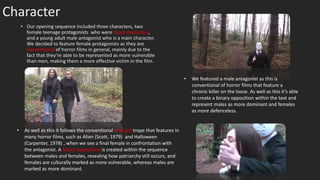
• Our opening sequence included three characters, two
female teenage protagonists who were stock characters,
and a young adult male antagonist who is a main character.
We decided to feature female protagonists as they are
conventional of horror films in general, mainly due to the
fact that they’re able to be represented as more vulnerable
than men, making them a more effective victim in the film.
• As well as this it follows the conventional final girl trope that features in
many horror films, such as Alien (Scott, 1979) and Halloween
(Carpenter, 1978) , when we see a final female in confrontation with
the antagonist. A binary opposition is created within the sequence
between males and females, revealing how patriarchy still occurs, and
females are culturally marked as more vulnerable, whereas males are
marked as more dominant.
• We featured a male antagonist as this is
conventional of horror films that feature a
chronic killer on the loose. As well as this it’s able
to create a binary opposition within the text and
represent males as more dominant and females
as more defenceless.
Plot & Location
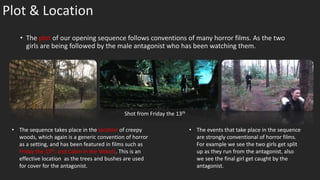
• The plot of our opening sequence follows conventions of many horror films. As the two
girls are being followed by the male antagonist who has been watching them.
• The events that take place in the sequence
are strongly conventional of horror films.
For example we see the two girls get split
up as they run from the antagonist, also
we see the final girl get caught by the
antagonist.
• The sequence takes place in the location of creepy
woods, which again is a generic convention of horror
as a setting, and has been featured in films such as
Friday the 13th, and Cabin in the Woods. This is an
effective location as the trees and bushes are used
for cover for the antagonist.
Shot from Friday the 13th
Mise-en-scene
• Several aspects of the mise-en-scene in our sequence are conventional,
and used as key iconography, for example the props that appear in the
film are weapons, used by the antagonist, which you see in all horror
films that feature a killer.
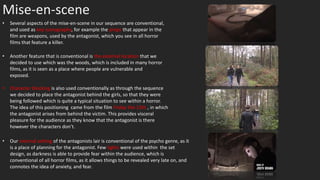
• Character blocking is also used conventionally as through the sequence
we decided to place the antagonist behind the girls, so that they were
being followed which is quite a typical situation to see within a horror.
The idea of this positioning came from the film Friday the 13th , in which
the antagonist arises from behind the victim. This provides visceral
pleasure for the audience as they know that the antagonist is there
however the characters don’t.
• Another feature that is conventional is the external location that we
decided to use which was the woods, which is included in many horror
films, as it is seen as a place where people are vulnerable and
exposed.
• Our internal setting of the antagonists lair is conventional of the psycho genre, as it
is a place of planning for the antagonist. Few lights were used within the set
design, as darkness is able to provide fear within the audience, which is
conventional of all horror films, as it allows things to be revealed very late on, and
connotes the idea of anxiety, and fear.
Mise-en-scene
• One aspect of the mise-en-scene that
may be considered as unconventional
to the genre, is the costume used for
the antagonist. He is dressed in a suit &
tie, which juxtaposes the location of
the woods that he is in. However we
decided to use this as it reinforces the
idea that our antagonist is a
psychopath, so therefore he dresses
inappropriately for the situation, as if
it’s his occupation.
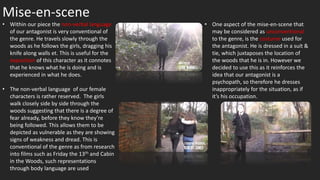
• Within our piece the non-verbal language
of our antagonist is very conventional of
the genre. He travels slowly through the
woods as he follows the girls, dragging his
knife along walls et. This is useful for the
exposition of this character as it connotes
that he knows what he is doing and is
experienced in what he does.
• The non-verbal language of our female
characters is rather reserved. The girls
walk closely side by side through the
woods suggesting that there is a degree of
fear already, before they know they’re
being followed. This allows them to be
depicted as vulnerable as they are showing
signs of weakness and dread. This is
conventional of the genre as from research
into films such as Friday the 13th and Cabin
in the Woods, such representations
through body language are used
Sound
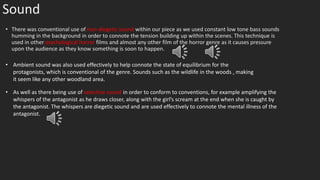
• There was conventional use of non-diegetic sound within our piece as we used constant low tone bass sounds
humming in the background in order to connote the tension building up within the scenes. This technique is
used in other psychological horror films and almost any other film of the horror genre as it causes pressure
upon the audience as they know something is soon to happen.
• As well as there being use of selective sound in order to conform to conventions, for example amplifying the
whispers of the antagonist as he draws closer, along with the girl’s scream at the end when she is caught by
the antagonist. The whispers are diegetic sound and are used effectively to connote the mental illness of the
antagonist.
• Ambient sound was also used effectively to help connote the state of equilibrium for the
protagonists, which is conventional of the genre. Sounds such as the wildlife in the woods , making
it seem like any other woodland area.
Editing
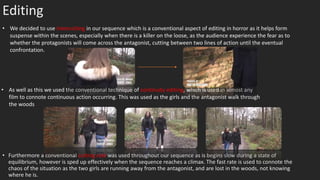
• Furthermore a conventional cutting rate was used throughout our sequence as is begins slow during a state of
equilibrium, however is sped up effectively when the sequence reaches a climax. The fast rate is used to connote the
chaos of the situation as the two girls are running away from the antagonist, and are lost in the woods, not knowing
where he is.
• We decided to use intercutting in our sequence which is a conventional aspect of editing in horror as it helps form
suspense within the scenes, especially when there is a killer on the loose, as the audience experience the fear as to
whether the protagonists will come across the antagonist, cutting between two lines of action until the eventual
confrontation.
• As well as this we used the conventional technique of continuity editing, which is used in almost any
film to connote continuous action occurring. This was used as the girls and the antagonist walk through
the woods
Typography
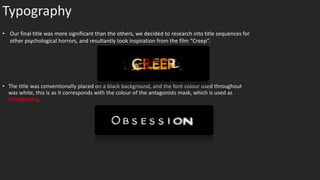
• The title was conventionally placed on a black background, and the font colour used throughout
was white, this is as it corresponds with the colour of the antagonists mask, which is used as
iconography.
• Our final title was more significant than the others, we decided to research into title sequences for
other psychological horrors, and resultantly took inspiration from the film “Creep”.

Question 1

  • 1.
    In what waysdoes your media product use, develop, or challenge forms and conventions of real media products? Lucas Murrain
  • 2.
    Character • Our openingsequence included three characters, two female teenage protagonists who were stock characters, and a young adult male antagonist who is a main character. We decided to feature female protagonists as they are conventional of horror films in general, mainly due to the fact that they’re able to be represented as more vulnerable than men, making them a more effective victim in the film. • As well as this it follows the conventional final girl trope that features in many horror films, such as Alien (Scott, 1979) and Halloween (Carpenter, 1978) , when we see a final female in confrontation with the antagonist. A binary opposition is created within the sequence between males and females, revealing how patriarchy still occurs, and females are culturally marked as more vulnerable, whereas males are marked as more dominant. • We featured a male antagonist as this is conventional of horror films that feature a chronic killer on the loose. As well as this it’s able to create a binary opposition within the text and represent males as more dominant and females as more defenceless.
  • 3.
    Plot & Location •The plot of our opening sequence follows conventions of many horror films. As the two girls are being followed by the male antagonist who has been watching them. • The events that take place in the sequence are strongly conventional of horror films. For example we see the two girls get split up as they run from the antagonist, also we see the final girl get caught by the antagonist. • The sequence takes place in the location of creepy woods, which again is a generic convention of horror as a setting, and has been featured in films such as Friday the 13th, and Cabin in the Woods. This is an effective location as the trees and bushes are used for cover for the antagonist. Shot from Friday the 13th
  • 4.
    Mise-en-scene • Several aspectsof the mise-en-scene in our sequence are conventional, and used as key iconography, for example the props that appear in the film are weapons, used by the antagonist, which you see in all horror films that feature a killer. • Character blocking is also used conventionally as through the sequence we decided to place the antagonist behind the girls, so that they were being followed which is quite a typical situation to see within a horror. The idea of this positioning came from the film Friday the 13th , in which the antagonist arises from behind the victim. This provides visceral pleasure for the audience as they know that the antagonist is there however the characters don’t. • Another feature that is conventional is the external location that we decided to use which was the woods, which is included in many horror films, as it is seen as a place where people are vulnerable and exposed. • Our internal setting of the antagonists lair is conventional of the psycho genre, as it is a place of planning for the antagonist. Few lights were used within the set design, as darkness is able to provide fear within the audience, which is conventional of all horror films, as it allows things to be revealed very late on, and connotes the idea of anxiety, and fear.
  • 5.
    Mise-en-scene • One aspectof the mise-en-scene that may be considered as unconventional to the genre, is the costume used for the antagonist. He is dressed in a suit & tie, which juxtaposes the location of the woods that he is in. However we decided to use this as it reinforces the idea that our antagonist is a psychopath, so therefore he dresses inappropriately for the situation, as if it’s his occupation. • Within our piece the non-verbal language of our antagonist is very conventional of the genre. He travels slowly through the woods as he follows the girls, dragging his knife along walls et. This is useful for the exposition of this character as it connotes that he knows what he is doing and is experienced in what he does. • The non-verbal language of our female characters is rather reserved. The girls walk closely side by side through the woods suggesting that there is a degree of fear already, before they know they’re being followed. This allows them to be depicted as vulnerable as they are showing signs of weakness and dread. This is conventional of the genre as from research into films such as Friday the 13th and Cabin in the Woods, such representations through body language are used
  • 6.
    Sound • There wasconventional use of non-diegetic sound within our piece as we used constant low tone bass sounds humming in the background in order to connote the tension building up within the scenes. This technique is used in other psychological horror films and almost any other film of the horror genre as it causes pressure upon the audience as they know something is soon to happen. • As well as there being use of selective sound in order to conform to conventions, for example amplifying the whispers of the antagonist as he draws closer, along with the girl’s scream at the end when she is caught by the antagonist. The whispers are diegetic sound and are used effectively to connote the mental illness of the antagonist. • Ambient sound was also used effectively to help connote the state of equilibrium for the protagonists, which is conventional of the genre. Sounds such as the wildlife in the woods , making it seem like any other woodland area.
  • 7.
    Editing • Furthermore aconventional cutting rate was used throughout our sequence as is begins slow during a state of equilibrium, however is sped up effectively when the sequence reaches a climax. The fast rate is used to connote the chaos of the situation as the two girls are running away from the antagonist, and are lost in the woods, not knowing where he is. • We decided to use intercutting in our sequence which is a conventional aspect of editing in horror as it helps form suspense within the scenes, especially when there is a killer on the loose, as the audience experience the fear as to whether the protagonists will come across the antagonist, cutting between two lines of action until the eventual confrontation. • As well as this we used the conventional technique of continuity editing, which is used in almost any film to connote continuous action occurring. This was used as the girls and the antagonist walk through the woods
  • 8.
    Typography • The titlewas conventionally placed on a black background, and the font colour used throughout was white, this is as it corresponds with the colour of the antagonists mask, which is used as iconography. • Our final title was more significant than the others, we decided to research into title sequences for other psychological horrors, and resultantly took inspiration from the film “Creep”.