In what ways does your media product
use, develop or challenge forms and
conventions of real media products?
QUESTION 1:
• Thrillers are a broad genre of literature, film, gaming and television. It includes
numerous, often overlapping sub-genres. Some example of sub-genres are:
Disaster, Erotic, Legal, Supernatural, Action.
• The most common ingredients are: fast paced, frequent action, and resourceful
heroes who must thwart the plans of more powerful and better equipped villains.
• Thriller conventions include: protagonist V antagonist, binary opposites (light and
dark), cheap surprises, false endings, making it personal and theatre of the mind.
• A good thriller builds up tension and anticipation of things to come, usually the
protagonist character will encounter dangerous situations. To gain an
understanding of these conventions I looked into existing thrillers by completing
numerous textual analysis on horror thrillers. There are 4 main codes and
conventions which are shown in the opening of thrillers, to make the audience ask
questions and add mystery:
• Editing
• Sound
• Camera
• Mise en scene
CONVENTIONS
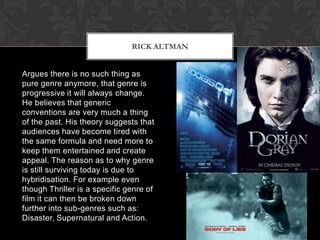
Argues there is no such thing as
pure genre anymore, that genre is
progressive it will always change.
He believes that generic
conventions are very much a thing
of the past. His theory suggests that
audiences have become tired with
the same formula and need more to
keep them entertained and create
appeal. The reason as to why genre
is still surviving today is due to
hybridisation. For example even
though Thriller is a specific genre of
film it can then be broken down
further into sub-genres such as:
Disaster, Supernatural and Action.
RICK ALTMAN
Research into sound from existing thrillers taught me that tension
can be built up in many ways. In our thriller we used a number of
non-diegetic and incidental music to do this. We wanted to include
the diegetic sounds that the audience would expect to see, for
example, because it was outside we wanted to put the sounds of
wind and footsteps into it to make the thriller seem more real and
believable. However we also wanted to make it sound eerie therefore
we incorporated incidental music over the diegetic sounds. To do so
we used Mix craft which was easily accessible due to the fact that it
was already on the school system. Furthermore non diegetic sounds
were also used like a heartbeat rhythm in the background, sounds
like theses add a disturbing effect to a thriller.
SOUND
I noticed that a key convention in horror thrillers during editing is
usually fast paced. The editing in our thriller went against this
convention as we decided to include aspects of slow motion. I
thought this made it more effective as it puts the audience on the
edge of their seat by making them think someone or something is
suddenly going to pop up and give them a fright. I believe this fit well
with a horror thriller yet it still broke the common conventions
associated with thrillers. Furthermore by doing this it makes our
thriller stand out compared to others and makes it more
recognisable.
EDITING
Point of view shots are common in thrillers as it gives the audience a
sense of what the character is feelings/experiencing. We followed this
convention by using go pro when the protagonist character is running
away and falls down.
Low angle and high angle shots are also used within thriller films, this
convention was shown throughout our thriller especially when the
protagonist falls down. Using a low angle shows that the protagonist is
vulnerable and in danger while the antagonist character standing over
him is portrayed as dangerous and powerful.
CAMERA
You will often see dark colours, black and red, in thrillers due to the
fact that they portray evil, blood and danger. We stuck to this
convention through the use of costumes, the antagonists wore black
while the protagonist wore red. I addition to this common objects
include weapons and masks of which we also used within our
thriller.
Lighting conventions are usually non natural as low key lighting is
used to gain shadows, in our product we used all natural lighting so
again we went against the conventions used in thrillers.
MISE EN SCENE
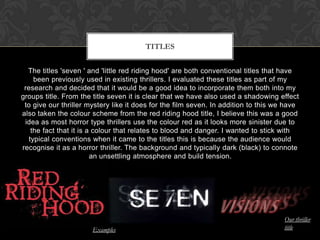
The titles 'seven ' and 'little red riding hood' are both conventional titles that have
been previously used in existing thrillers. I evaluated these titles as part of my
research and decided that it would be a good idea to incorporate them both into my
groups title. From the title seven it is clear that we have also used a shadowing effect
to give our thriller mystery like it does for the film seven. In addition to this we have
also taken the colour scheme from the red riding hood title, I believe this was a good
idea as most horror type thrillers use the colour red as it looks more sinister due to
the fact that it is a colour that relates to blood and danger. I wanted to stick with
typical conventions when it came to the titles this is because the audience would
recognise it as a horror thriller. The background and typically dark (black) to connote
an unsettling atmosphere and build tension.
TITLES
Our thriller
titleExamples
Levi Strauss came up with the theory of binary opposites, he believes that thrillers
use opposites to move the story along. It is common for binary opposites to be in
thrillers, for example the most common would be good v evil or light v dark.
In my thriller my group focused on the aspect of good v evil as we chose to do a
horror thriller.
Horror thriller also often include the binary opposite of human v supernatural which
we have also tried to bring into our thriller by putting the antagonist characters in
masks to add mystery and make the audience wonder if they really are human.
In addition to this we further incorporated feminine v masculine, usually the female is
portrayed as being the victim while the male is seen to be the killer. We went against
this stereotypical role and put the female character as the killer.
BINARY OPPOSITES
Todorov suggested that conventional narratives are structured in five stages:
• A state of equilibrium (when everything is as it should be, an equal balance
between powers of any kind)
• Disruption (equilibrium becomes destroyed)
• Recognition (protagonist has to recognise the problem for their to be a solution)
• Attempt to repair the damage
• Reinstatement of the equilibrium (when the equilibrium from the start is restored).
This applies to my groups thriller, at the start there is a state of equilibrium when the
protagonist character is walking his dog, this soon becomes disrupted when the
antagonist character is shown coming out from the bushes and following him.
Recognition is established when he starts to run away as he realises he is in
danger, which then leads to an attempt to repair the damage. When he wakes up in
bed we know that the equilibrium has been reinstated.
EQUILIBRIUM THEORY

Question1

  • 1.
    In what waysdoes your media product use, develop or challenge forms and conventions of real media products? QUESTION 1:
  • 2.
    • Thrillers area broad genre of literature, film, gaming and television. It includes numerous, often overlapping sub-genres. Some example of sub-genres are: Disaster, Erotic, Legal, Supernatural, Action. • The most common ingredients are: fast paced, frequent action, and resourceful heroes who must thwart the plans of more powerful and better equipped villains. • Thriller conventions include: protagonist V antagonist, binary opposites (light and dark), cheap surprises, false endings, making it personal and theatre of the mind. • A good thriller builds up tension and anticipation of things to come, usually the protagonist character will encounter dangerous situations. To gain an understanding of these conventions I looked into existing thrillers by completing numerous textual analysis on horror thrillers. There are 4 main codes and conventions which are shown in the opening of thrillers, to make the audience ask questions and add mystery: • Editing • Sound • Camera • Mise en scene CONVENTIONS
  • 3.
    Argues there isno such thing as pure genre anymore, that genre is progressive it will always change. He believes that generic conventions are very much a thing of the past. His theory suggests that audiences have become tired with the same formula and need more to keep them entertained and create appeal. The reason as to why genre is still surviving today is due to hybridisation. For example even though Thriller is a specific genre of film it can then be broken down further into sub-genres such as: Disaster, Supernatural and Action. RICK ALTMAN
  • 4.
    Research into soundfrom existing thrillers taught me that tension can be built up in many ways. In our thriller we used a number of non-diegetic and incidental music to do this. We wanted to include the diegetic sounds that the audience would expect to see, for example, because it was outside we wanted to put the sounds of wind and footsteps into it to make the thriller seem more real and believable. However we also wanted to make it sound eerie therefore we incorporated incidental music over the diegetic sounds. To do so we used Mix craft which was easily accessible due to the fact that it was already on the school system. Furthermore non diegetic sounds were also used like a heartbeat rhythm in the background, sounds like theses add a disturbing effect to a thriller. SOUND
  • 5.
    I noticed thata key convention in horror thrillers during editing is usually fast paced. The editing in our thriller went against this convention as we decided to include aspects of slow motion. I thought this made it more effective as it puts the audience on the edge of their seat by making them think someone or something is suddenly going to pop up and give them a fright. I believe this fit well with a horror thriller yet it still broke the common conventions associated with thrillers. Furthermore by doing this it makes our thriller stand out compared to others and makes it more recognisable. EDITING
  • 6.
    Point of viewshots are common in thrillers as it gives the audience a sense of what the character is feelings/experiencing. We followed this convention by using go pro when the protagonist character is running away and falls down. Low angle and high angle shots are also used within thriller films, this convention was shown throughout our thriller especially when the protagonist falls down. Using a low angle shows that the protagonist is vulnerable and in danger while the antagonist character standing over him is portrayed as dangerous and powerful. CAMERA
  • 7.
    You will oftensee dark colours, black and red, in thrillers due to the fact that they portray evil, blood and danger. We stuck to this convention through the use of costumes, the antagonists wore black while the protagonist wore red. I addition to this common objects include weapons and masks of which we also used within our thriller. Lighting conventions are usually non natural as low key lighting is used to gain shadows, in our product we used all natural lighting so again we went against the conventions used in thrillers. MISE EN SCENE
  • 8.
    The titles 'seven' and 'little red riding hood' are both conventional titles that have been previously used in existing thrillers. I evaluated these titles as part of my research and decided that it would be a good idea to incorporate them both into my groups title. From the title seven it is clear that we have also used a shadowing effect to give our thriller mystery like it does for the film seven. In addition to this we have also taken the colour scheme from the red riding hood title, I believe this was a good idea as most horror type thrillers use the colour red as it looks more sinister due to the fact that it is a colour that relates to blood and danger. I wanted to stick with typical conventions when it came to the titles this is because the audience would recognise it as a horror thriller. The background and typically dark (black) to connote an unsettling atmosphere and build tension. TITLES Our thriller titleExamples
  • 9.
    Levi Strauss cameup with the theory of binary opposites, he believes that thrillers use opposites to move the story along. It is common for binary opposites to be in thrillers, for example the most common would be good v evil or light v dark. In my thriller my group focused on the aspect of good v evil as we chose to do a horror thriller. Horror thriller also often include the binary opposite of human v supernatural which we have also tried to bring into our thriller by putting the antagonist characters in masks to add mystery and make the audience wonder if they really are human. In addition to this we further incorporated feminine v masculine, usually the female is portrayed as being the victim while the male is seen to be the killer. We went against this stereotypical role and put the female character as the killer. BINARY OPPOSITES
  • 10.
    Todorov suggested thatconventional narratives are structured in five stages: • A state of equilibrium (when everything is as it should be, an equal balance between powers of any kind) • Disruption (equilibrium becomes destroyed) • Recognition (protagonist has to recognise the problem for their to be a solution) • Attempt to repair the damage • Reinstatement of the equilibrium (when the equilibrium from the start is restored). This applies to my groups thriller, at the start there is a state of equilibrium when the protagonist character is walking his dog, this soon becomes disrupted when the antagonist character is shown coming out from the bushes and following him. Recognition is established when he starts to run away as he realises he is in danger, which then leads to an attempt to repair the damage. When he wakes up in bed we know that the equilibrium has been reinstated. EQUILIBRIUM THEORY