Querying datasets on the Web 
with high availability 
Ruben Verborgh, Olaf Hartig, Ben De Meester, Gerald Haesendonck, 
Laurens De Vocht, Miel Vander Sande, Richard Cyganiak, Pieter Colpaert, 
Erik Mannens, and Rik Van de Walle
Somebody comes to you 
with a high-quality 
Linked Open Data set: 
“How can people query 
my Linked Data on the Web?”
“A public SPARQL endpoint 
gives live querying, but it’s costly 
and has availability issues.” 
“Offer a data dump. 
but it’s not really Web querying: 
users need to set up an endpoint” 
“Publish Linked Data documents. 
But querying is very slow…”
Querying Linked Data 
on the Web 
always involves trade-offs. 
But have we looked 
at all possible trade-offs?
Querying Linked Data 
live on the Web 
becomes affordable 
by building simpler servers 
and more intelligent clients.
We formalized and evaluated 
client-side SPARQL querying 
through a triple-pattern interface. 
The trade-offs are different: 
low-cost, high-availability servers, 
more bandwidth and slower queries.
Querying datasets on the Web 
with high availability 
Trade-offs for the Semantic Web 
Triple pattern fragment querying 
Evaluating the trade-offs
Querying datasets on the Web 
with high availability 
Trade-offs for the Semantic Web 
Triple pattern fragment querying 
Evaluating the trade-offs
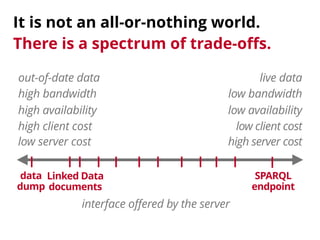
It is not an all-or-nothing world. 
There is a spectrum of trade-offs. 
out-of-date data live data 
high bandwidth low bandwidth 
high availability low availability 
high client cost low client cost 
low server cost high server cost 
data 
dump 
SPARQL 
endpoint 
Linked Data 
documents 
interface offered by the server
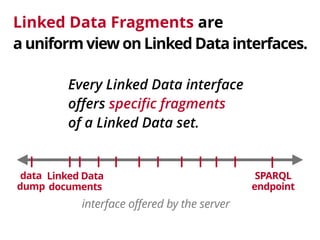
Linked Data Fragments are 
a uniform view on Linked Data interfaces. 
data 
dump 
SPARQL 
endpoint 
Every Linked Data interface 
offers specific fragments 
of a Linked Data set. 
Linked Data 
documents 
interface offered by the server
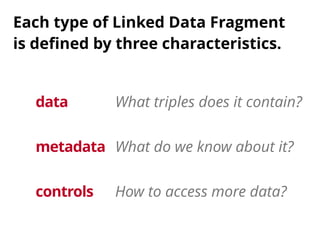
Each type of Linked Data Fragment 
is defined by three characteristics. 
data 
metadata 
controls 
What triples does it contain? 
What do we know about it? 
How to access more data?
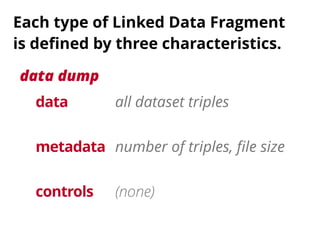
Each type of Linked Data Fragment 
is defined by three characteristics. 
all dataset triples 
(none) 
data dump 
number of triples, file size 
data 
metadata 
controls
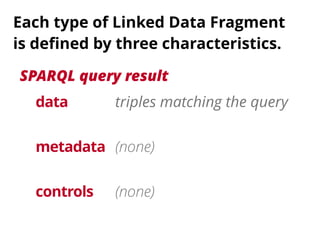
Each type of Linked Data Fragment 
is defined by three characteristics. 
SPARQL query result 
data 
triples matching the query 
(none) 
(none) 
metadata 
controls
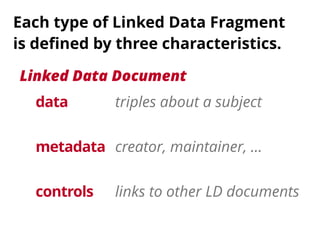
Each type of Linked Data Fragment 
is defined by three characteristics. 
Linked Data Document 
data 
triples about a subject 
creator, maintainer, … 
links to other LD documents 
metadata 
controls
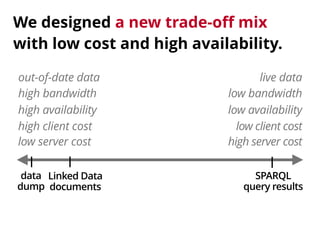
We designed a new trade-off mix 
with low cost and high availability. 
out-of-date data live data 
high bandwidth low bandwidth 
high availability low availability 
high client cost low client cost 
low server cost high server cost 
data 
dump 
SPARQL 
query results 
Linked Data 
documents
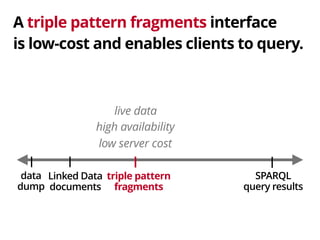
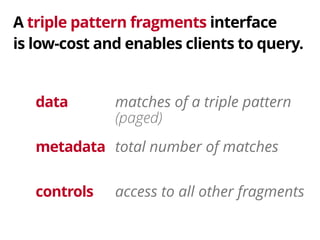
A triple pattern fragments interface 
is low-cost and enables clients to query. 
live data 
low server cost 
data 
dump 
SPARQL 
query results 
high availability 
Linked Data 
documents 
triple pattern 
fragments
A triple pattern fragments interface 
is low-cost and enables clients to query. 
matches of a triple pattern 
total number of matches 
access to all other fragments 
data 
metadata 
controls 
(paged)
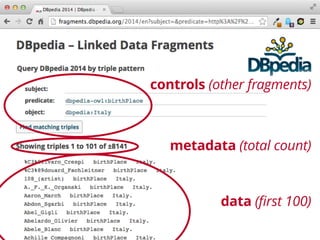
controls (other fragments) 
metadata (total count) 
data (first 100)
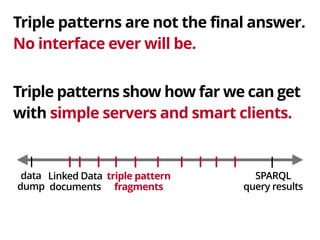
Triple patterns are not the final answer. 
No interface ever will be. 
Triple patterns show how far we can get 
with simple servers and smart clients. 
data 
dump 
SPARQL 
query results 
Linked Data 
documents 
triple pattern 
fragments
Querying datasets on the Web 
with high availability 
Trade-offs for the Semantic Web 
Triple pattern fragment querying 
Evaluating the trade-offs
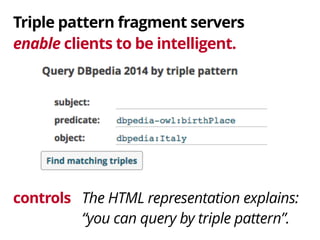
Triple pattern fragment servers 
enable clients to be intelligent. 
The HTML representation explains: 
“you can query by triple pattern”. 
controls
Triple pattern fragment servers 
enable clients to be intelligent. 
<http://fragments.dbpedia.org/2014/en#dataset> hydra:search [ 
hydra:template "http://fragments.dbpedia.org/2014/en 
controls 
{?subject,predicate,object}"; 
hydra:mapping 
[ hydra:variable "subject"; hydra:property rdf:subject ], 
[ hydra:variable "predicate"; hydra:property rdf:predicate ], 
[ hydra:variable "object"; hydra:property rdf:object ] 
]. 
The RDF representation explains: 
“you can query by triple pattern”.
Triple pattern fragment servers 
enable clients to be intelligent. 
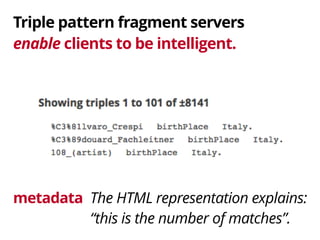
The HTML representation explains: 
“this is the number of matches”. 
metadata
Triple pattern fragment servers 
enable clients to be intelligent. 
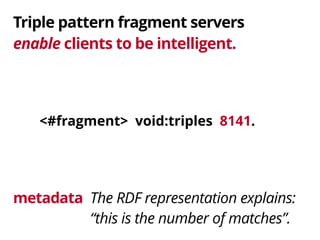
<#fragment> void:triples 8141. 
The RDF representation explains: 
“this is the number of matches”. 
metadata
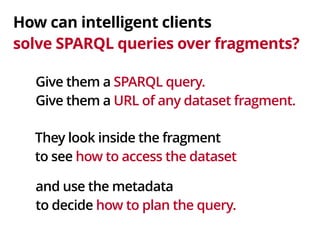
How can intelligent clients 
solve SPARQL queries over fragments? 
Give them a SPARQL query. 
Give them a URL of any dataset fragment. 
They look inside the fragment 
to see how to access the dataset 
and use the metadata 
to decide how to plan the query.
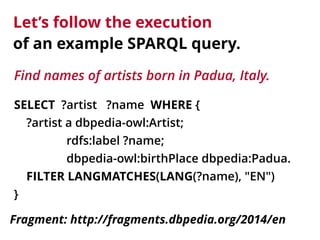
Let’s follow the execution 
of an example SPARQL query. 
Find names of artists born in Padua, Italy. 
SELECT ?artist ?name WHERE { 
?artist a dbpedia-owl:Artist; 
rdfs:label ?name; 
dbpedia-owl:birthPlace dbpedia:Padua. 
FILTER LANGMATCHES(LANG(?name), "EN") 
} 
Fragment: http://fragments.dbpedia.org/2014/en
The client looks inside the fragment 
to see how to access the dataset. 
Fragment: http://fragments.dbpedia.org/2014/en 
<http://fragments.dbpedia.org/2014/en#dataset> hydra:search [ 
hydra:template "http://fragments.dbpedia.org/2014/en 
{?subject,predicate,object}"; 
hydra:mapping 
[ hydra:variable "subject"; hydra:property rdf:subject ], 
[ hydra:variable "predicate"; hydra:property rdf:predicate ], 
[ hydra:variable "object"; hydra:property rdf:object ] 
]. 
“I can query the dataset by triple pattern.”
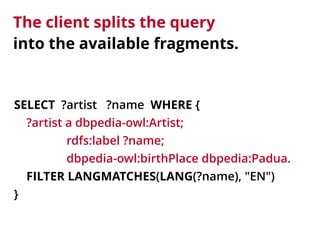
The client splits the query 
into the available fragments. 
SELECT ?artist ?name WHERE { 
?artist a dbpedia-owl:Artist; 
rdfs:label ?name; 
dbpedia-owl:birthPlace dbpedia:Padua. 
FILTER LANGMATCHES(LANG(?name), "EN") 
}
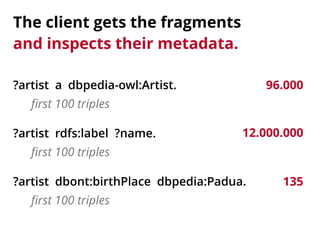
The client gets the fragments 
and inspects their metadata. 
?artist a dbpedia-owl:Artist. 
first 100 triples 
96.000 
?artist rdfs:label ?name. 
first 100 triples 
12.000.000 
?artist dbont:birthPlace dbpedia:Padua. 
first 100 triples 
135
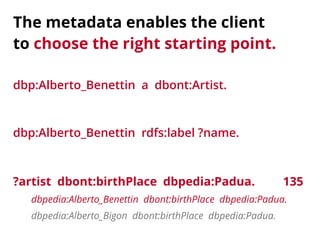
The metadata enables the client 
to choose the right starting point. 
?dbp:artist Alberto_a dbpedia-Benettin owl:a Artist. dbont:Artist. 
96.000 
?artist rdfs:label ?name. 12.000.000 
dbp:Alberto_Benettin rdfs:label ?name. 
?artist dbont:birthPlace dbpedia:Padua. 
135 
dbpedia:Alberto_Benettin dbont:birthPlace dbpedia:Padua. 
dbpedia:Alberto_Bigon dbont:birthPlace dbpedia:Padua.
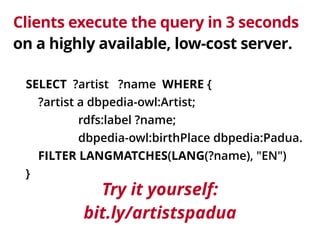
Clients execute the query in 3 seconds 
on a highly available, low-cost server. 
SELECT ?artist ?name WHERE { 
?artist a dbpedia-owl:Artist; 
rdfs:label ?name; 
dbpedia-owl:birthPlace dbpedia:Padua. 
FILTER LANGMATCHES(LANG(?name), "EN") 
} 
Try it yourself: 
bit.ly/artistspadua
Querying datasets on the Web 
with high availability 
Trade-offs for the Semantic Web 
Triple pattern fragment querying 
Evaluating the trade-offs
We evaluated triple pattern fragments 
for server cost and availability. 
Berlin SPARQL benchmark 
on Amazon EC2 machines 
100 million triples 
high query diversity 
BGP, UNION, FILTER, …
We evaluated triple pattern fragments 
for server cost and availability. 
Berlin SPARQL benchmark 
on Amazon EC2 machines 
1 server 
1 cache 
1–240 simultaneous clients
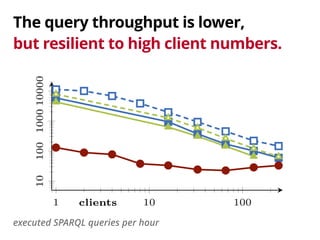
The query throughput is lower, 
but resilient to high client numbers. 
Querying Datasets on 1 10 100 10 100 1000 10000 clients 
throughput (q/hr) 
Virtuoso 6 Fuseki–tdb triple pattern Fig. 3.1: Server performance (log-log plot) 
200 
executed SPARQL queries per hour 
timeouts
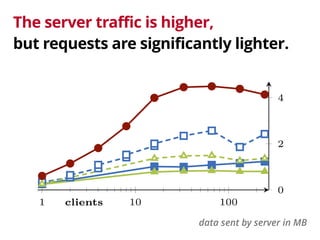
The server traffic is higher, 
but requests are significantly lighter. 
Datasets on the Web with High Availability 13 
Virtuoso 6 Virtuoso 7 
Fuseki–tdb Fuseki–hdt 
pattern fragments 
1 10 100 
4 
2 
0 
clients 
data sent (mb) 
Fig. 3.2: Server network traffic 
data sent by server in MB
2 
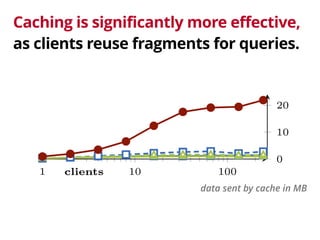
Caching is significantly more effective, 
as clients reuse fragments for queries. 
1 10 100 
0 
clients 
sent (mb) 
Fig. 3.2: Server network traffic 
1 10 100 
20 
10 
0 
clients 
sent (mb) 
Fig. 3.4: Cache network traffic 
ram use data sent by cache in MB 
8 
6 
4
150 
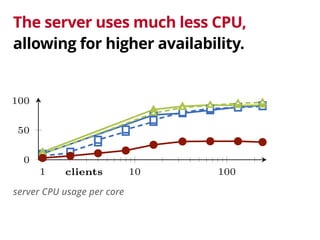
The server uses much less CPU, 
allowing for higher availability. 
clients 
1 10 100 
1 1 10 100 
100 
50 
0 
100 
50 
1 50 
server CPU usage per core 
#timeouts 
Fig. 3.3: Query timeouts 
0 
clients 
cpu use (%) 
Fig. 3.5: Server processor usage per core 
100 
use (%)
150 
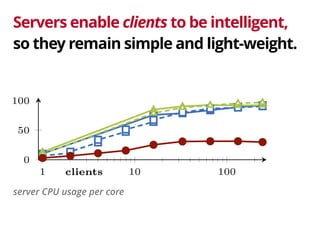
Servers enable clients to be intelligent, 
so they remain simple and light-weight. 
1 10 100 
1 1 10 100 
100 
50 
0 
clients 
#timeouts 
Fig. 3.3: Query timeouts 
100 
50 
0 
clients 
cpu use (%) 
1 Fig. 3.5: Server processor usage per core 
50 
100 
use (%) 
server CPU usage per core
Querying datasets on the Web 
with high availability 
Trade-offs for the Semantic Web 
Triple pattern fragment querying 
Evaluating the trade-offs
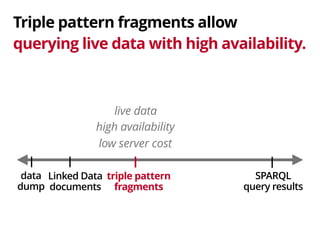
Triple pattern fragments allow 
querying live data with high availability. 
live data 
low server cost 
data 
dump 
SPARQL 
query results 
high availability 
Linked Data 
documents 
triple pattern 
fragments
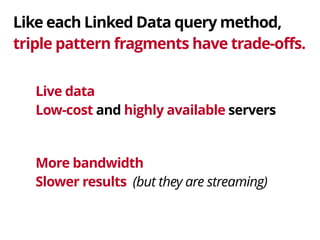
Like each Linked Data query method, 
triple pattern fragments have trade-offs. 
Live data 
Low-cost and highly available servers 
More bandwidth 
Slower results (but they are streaming)
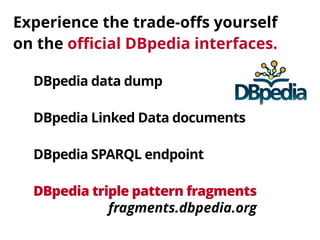
Experience the trade-offs yourself 
on the official DBpedia interfaces. 
DBpedia data dump 
DBpedia Linked Data documents 
DBpedia SPARQL endpoint 
DBpedia triple pattern fragments 
fragments.dbpedia.org
Triple pattern fragments are easy: 
all software is available as open source. 
Software 
github.com/LinkedDataFragments 
Documentation and specification 
linkeddatafragments.org
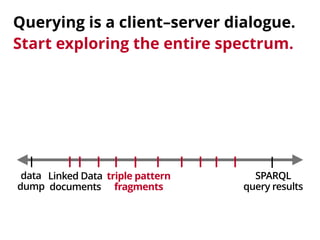
Querying is a client–server dialogue. 
Start exploring the entire spectrum. 
data 
dump 
SPARQL 
query results 
Linked Data 
documents 
triple pattern 
fragments
Querying datasets on the Web 
with high availability 
linkeddatafragments.org 
@LDFragments

Querying datasets on the Web with high availability

  • 1.
    Querying datasets onthe Web with high availability Ruben Verborgh, Olaf Hartig, Ben De Meester, Gerald Haesendonck, Laurens De Vocht, Miel Vander Sande, Richard Cyganiak, Pieter Colpaert, Erik Mannens, and Rik Van de Walle
  • 2.
    Somebody comes toyou with a high-quality Linked Open Data set: “How can people query my Linked Data on the Web?”
  • 3.
    “A public SPARQLendpoint gives live querying, but it’s costly and has availability issues.” “Offer a data dump. but it’s not really Web querying: users need to set up an endpoint” “Publish Linked Data documents. But querying is very slow…”
  • 4.
    Querying Linked Data on the Web always involves trade-offs. But have we looked at all possible trade-offs?
  • 5.
    Querying Linked Data live on the Web becomes affordable by building simpler servers and more intelligent clients.
  • 6.
    We formalized andevaluated client-side SPARQL querying through a triple-pattern interface. The trade-offs are different: low-cost, high-availability servers, more bandwidth and slower queries.
  • 7.
    Querying datasets onthe Web with high availability Trade-offs for the Semantic Web Triple pattern fragment querying Evaluating the trade-offs
  • 8.
    Querying datasets onthe Web with high availability Trade-offs for the Semantic Web Triple pattern fragment querying Evaluating the trade-offs
  • 9.
    It is notan all-or-nothing world. There is a spectrum of trade-offs. out-of-date data live data high bandwidth low bandwidth high availability low availability high client cost low client cost low server cost high server cost data dump SPARQL endpoint Linked Data documents interface offered by the server
  • 10.
    Linked Data Fragmentsare a uniform view on Linked Data interfaces. data dump SPARQL endpoint Every Linked Data interface offers specific fragments of a Linked Data set. Linked Data documents interface offered by the server
  • 11.
    Each type ofLinked Data Fragment is defined by three characteristics. data metadata controls What triples does it contain? What do we know about it? How to access more data?
  • 12.
    Each type ofLinked Data Fragment is defined by three characteristics. all dataset triples (none) data dump number of triples, file size data metadata controls
  • 13.
    Each type ofLinked Data Fragment is defined by three characteristics. SPARQL query result data triples matching the query (none) (none) metadata controls
  • 14.
    Each type ofLinked Data Fragment is defined by three characteristics. Linked Data Document data triples about a subject creator, maintainer, … links to other LD documents metadata controls
  • 15.
    We designed anew trade-off mix with low cost and high availability. out-of-date data live data high bandwidth low bandwidth high availability low availability high client cost low client cost low server cost high server cost data dump SPARQL query results Linked Data documents
  • 16.
    A triple patternfragments interface is low-cost and enables clients to query. live data low server cost data dump SPARQL query results high availability Linked Data documents triple pattern fragments
  • 17.
    A triple patternfragments interface is low-cost and enables clients to query. matches of a triple pattern total number of matches access to all other fragments data metadata controls (paged)
  • 18.
    controls (other fragments) metadata (total count) data (first 100)
  • 19.
    Triple patterns arenot the final answer. No interface ever will be. Triple patterns show how far we can get with simple servers and smart clients. data dump SPARQL query results Linked Data documents triple pattern fragments
  • 20.
    Querying datasets onthe Web with high availability Trade-offs for the Semantic Web Triple pattern fragment querying Evaluating the trade-offs
  • 21.
    Triple pattern fragmentservers enable clients to be intelligent. The HTML representation explains: “you can query by triple pattern”. controls
  • 22.
    Triple pattern fragmentservers enable clients to be intelligent. <http://fragments.dbpedia.org/2014/en#dataset> hydra:search [ hydra:template "http://fragments.dbpedia.org/2014/en controls {?subject,predicate,object}"; hydra:mapping [ hydra:variable "subject"; hydra:property rdf:subject ], [ hydra:variable "predicate"; hydra:property rdf:predicate ], [ hydra:variable "object"; hydra:property rdf:object ] ]. The RDF representation explains: “you can query by triple pattern”.
  • 23.
    Triple pattern fragmentservers enable clients to be intelligent. The HTML representation explains: “this is the number of matches”. metadata
  • 24.
    Triple pattern fragmentservers enable clients to be intelligent. <#fragment> void:triples 8141. The RDF representation explains: “this is the number of matches”. metadata
  • 25.
    How can intelligentclients solve SPARQL queries over fragments? Give them a SPARQL query. Give them a URL of any dataset fragment. They look inside the fragment to see how to access the dataset and use the metadata to decide how to plan the query.
  • 26.
    Let’s follow theexecution of an example SPARQL query. Find names of artists born in Padua, Italy. SELECT ?artist ?name WHERE { ?artist a dbpedia-owl:Artist; rdfs:label ?name; dbpedia-owl:birthPlace dbpedia:Padua. FILTER LANGMATCHES(LANG(?name), "EN") } Fragment: http://fragments.dbpedia.org/2014/en
  • 27.
    The client looksinside the fragment to see how to access the dataset. Fragment: http://fragments.dbpedia.org/2014/en <http://fragments.dbpedia.org/2014/en#dataset> hydra:search [ hydra:template "http://fragments.dbpedia.org/2014/en {?subject,predicate,object}"; hydra:mapping [ hydra:variable "subject"; hydra:property rdf:subject ], [ hydra:variable "predicate"; hydra:property rdf:predicate ], [ hydra:variable "object"; hydra:property rdf:object ] ]. “I can query the dataset by triple pattern.”
  • 28.
    The client splitsthe query into the available fragments. SELECT ?artist ?name WHERE { ?artist a dbpedia-owl:Artist; rdfs:label ?name; dbpedia-owl:birthPlace dbpedia:Padua. FILTER LANGMATCHES(LANG(?name), "EN") }
  • 29.
    The client getsthe fragments and inspects their metadata. ?artist a dbpedia-owl:Artist. first 100 triples 96.000 ?artist rdfs:label ?name. first 100 triples 12.000.000 ?artist dbont:birthPlace dbpedia:Padua. first 100 triples 135
  • 30.
    The metadata enablesthe client to choose the right starting point. ?dbp:artist Alberto_a dbpedia-Benettin owl:a Artist. dbont:Artist. 96.000 ?artist rdfs:label ?name. 12.000.000 dbp:Alberto_Benettin rdfs:label ?name. ?artist dbont:birthPlace dbpedia:Padua. 135 dbpedia:Alberto_Benettin dbont:birthPlace dbpedia:Padua. dbpedia:Alberto_Bigon dbont:birthPlace dbpedia:Padua.
  • 31.
    Clients execute thequery in 3 seconds on a highly available, low-cost server. SELECT ?artist ?name WHERE { ?artist a dbpedia-owl:Artist; rdfs:label ?name; dbpedia-owl:birthPlace dbpedia:Padua. FILTER LANGMATCHES(LANG(?name), "EN") } Try it yourself: bit.ly/artistspadua
  • 32.
    Querying datasets onthe Web with high availability Trade-offs for the Semantic Web Triple pattern fragment querying Evaluating the trade-offs
  • 33.
    We evaluated triplepattern fragments for server cost and availability. Berlin SPARQL benchmark on Amazon EC2 machines 100 million triples high query diversity BGP, UNION, FILTER, …
  • 34.
    We evaluated triplepattern fragments for server cost and availability. Berlin SPARQL benchmark on Amazon EC2 machines 1 server 1 cache 1–240 simultaneous clients
  • 35.
    The query throughputis lower, but resilient to high client numbers. Querying Datasets on 1 10 100 10 100 1000 10000 clients throughput (q/hr) Virtuoso 6 Fuseki–tdb triple pattern Fig. 3.1: Server performance (log-log plot) 200 executed SPARQL queries per hour timeouts
  • 36.
    The server trafficis higher, but requests are significantly lighter. Datasets on the Web with High Availability 13 Virtuoso 6 Virtuoso 7 Fuseki–tdb Fuseki–hdt pattern fragments 1 10 100 4 2 0 clients data sent (mb) Fig. 3.2: Server network traffic data sent by server in MB
  • 37.
    2 Caching issignificantly more effective, as clients reuse fragments for queries. 1 10 100 0 clients sent (mb) Fig. 3.2: Server network traffic 1 10 100 20 10 0 clients sent (mb) Fig. 3.4: Cache network traffic ram use data sent by cache in MB 8 6 4
  • 38.
    150 The serveruses much less CPU, allowing for higher availability. clients 1 10 100 1 1 10 100 100 50 0 100 50 1 50 server CPU usage per core #timeouts Fig. 3.3: Query timeouts 0 clients cpu use (%) Fig. 3.5: Server processor usage per core 100 use (%)
  • 39.
    150 Servers enableclients to be intelligent, so they remain simple and light-weight. 1 10 100 1 1 10 100 100 50 0 clients #timeouts Fig. 3.3: Query timeouts 100 50 0 clients cpu use (%) 1 Fig. 3.5: Server processor usage per core 50 100 use (%) server CPU usage per core
  • 40.
    Querying datasets onthe Web with high availability Trade-offs for the Semantic Web Triple pattern fragment querying Evaluating the trade-offs
  • 41.
    Triple pattern fragmentsallow querying live data with high availability. live data low server cost data dump SPARQL query results high availability Linked Data documents triple pattern fragments
  • 42.
    Like each LinkedData query method, triple pattern fragments have trade-offs. Live data Low-cost and highly available servers More bandwidth Slower results (but they are streaming)
  • 43.
    Experience the trade-offsyourself on the official DBpedia interfaces. DBpedia data dump DBpedia Linked Data documents DBpedia SPARQL endpoint DBpedia triple pattern fragments fragments.dbpedia.org
  • 44.
    Triple pattern fragmentsare easy: all software is available as open source. Software github.com/LinkedDataFragments Documentation and specification linkeddatafragments.org
  • 45.
    Querying is aclient–server dialogue. Start exploring the entire spectrum. data dump SPARQL query results Linked Data documents triple pattern fragments
  • 46.
    Querying datasets onthe Web with high availability linkeddatafragments.org @LDFragments