Corporate Presentation
September 2020
OTCQB:QUBT
Leading the Industry with Quantum-Ready
Applications
OTCQB:QUBT
Important Cautions Regarding Forward-Looking Statements
2
This presentation contains forward-looking statements as defined within Section 27A of the Securities Act of 1933, as amended, and Section 21E of the Securities Exchange
Act of 1934, as amended. By their nature, forward-looking statements and forecasts involve risks and uncertainties because they relate to events and depend on
circumstances that will occur in the near future. Those statements include statements regarding the intent, belief or current expectations of Quantum Computing Inc.
(“Company”), and members of its management as well as the assumptions on which such statements are based. Prospective investors are cautioned that any such forward-
looking statements are not guarantees of future performance and involve risks and uncertainties, and that actual results may differ materially from those contemplated by
such forward-looking statements.
The Company undertakes no obligation to update or revise forward-looking statements to reflect changed conditions. Statements in this presentation that are not
descriptions of historical facts are forward-looking statements relating to future events, and as such all forward-looking statements are made pursuant to the Securities
Litigation Reform Act of 1995.
Statements may contain certain forward-looking statements pertaining to future anticipated or projected plans, performance and developments, as well as other
statements relating to future operations and results. Any statements in this presentation that are not statements of historical fact may be considered to be forward-looking
statements. Words such as "may," "will," "expect," "believe," "anticipate," "estimate," "intends," "goal," "objective," "seek," "attempt," “aim to”, or variations of these or
similar words, identify forward-looking statements. These risks and uncertainties include, but are not limited to, those described in Item 1A in the Company’s Annual Report
on Form 10-K, which is expressly incorporated herein by reference, and other factors as may periodically be described in the Company’s filings with the SEC.
Mukai™, QCI qbsolv™ and QuOIR™ are trademarks of Quantum Computing Inc.
Intel® is a trademark of Intel Corporation. 083120b
OTCQB:QUBT
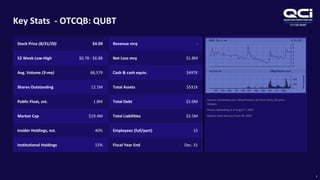
Stock Price (8/31/20) $4.09 Revenue mrq -
52 Week Low-High $0.78 - $6.88 Net Loss mrq $1.8M
Avg. Volume (3-mo) 68,579 Cash & cash equiv. $497K
Shares Outstanding 12.1M Total Assets $531K
Public Float, est. 1.8M Total Debt $2.0M
Market Cap $19.4M Total Liabilities $3.5M
Insider Holdings, est. 40% Employees (full/part) 15
Institutional Holdings 15% Fiscal Year End Dec. 31
Key Stats - OTCQB: QUBT
3
Sources: otcmarkets.com, Yahoo!Finance, QCI Form 10-Q, QCI press
releases.
Shares outstanding as of August 7, 2020.
Balance sheet data as of June 30, 2020.
OTCQB:QUBT
Who We Are
4
• Emerging technology leader in Quantum Computing (QC) software and
applications
• QCI is to the first QCs as Microsoft was to the first PCs.
• We solve the most difficult enterprise-level logistical problems with unmatched
speed and quality of results1
• Partnered with Splunk (NASDAQ: SPLK), a $30 billion big data analytics company
with 17,500 customers worldwide, including 92 of the Fortune 100.
• Cloud-based SaaS recurring revenue model.
• Highly-experienced software development team from Cray, Silicon Graphics, D-
Wave, and other major IT firms.
• Recently entered commercial phase as the only public pure-play in the high-
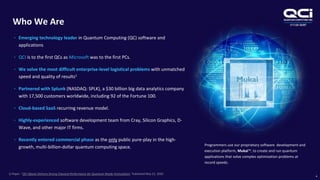
growth, multi-billion-dollar quantum computing space. Programmers use our proprietary software development and
execution platform, Mukai™, to create and run quantum
applications that solve complex optimization problems at
record speeds.
1) Paper: “QCI Qbsolv Delivers Strong Classical Performance for Quantum-Ready Formulation,’ Published May 22, 2020
OTCQB:QUBT
What is Quantum Computing?
Quantum Computing involves controlling and
manipulating nature's smallest objects —
single atoms and photons, rather than
electronic circuits — to create on/off states
that process information.
The technology is base upon on two key
concepts of Quantum Physics, Superposition &
Entanglement:
Superposition Entanglement
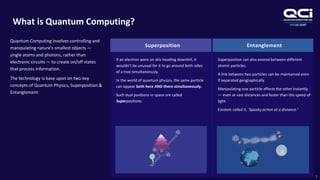
If an electron were on skis heading downhill, it
wouldn’t be unusual for it to go around both sides
of a tree simultaneously.
In the world of quantum physics, the same particle
can appear both here AND there simultaneously.
Such dual positions in space are called
Superpositions.
Superposition can also extend between different
atomic particles.
A link between two particles can be maintained even
if separated geographically.
Manipulating one particle affects the other instantly
— even at vast distances and faster than the speed of
light.
Einstein called it, ‘Spooky action at a distance.’
5
OTCQB:QUBT
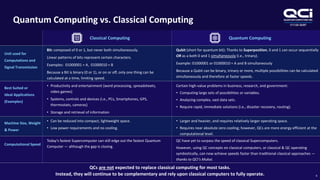
Classical Computing Quantum Computing
Unit used for
Computations and
Signal Transmission
Bit: composed of 0 or 1, but never both simultaneously.
Linear patterns of bits represent certain characters.
Examples: 01000001 = A, 01000010 = B
Because a Bit is binary (0 or 1), or on or off, only one thing can be
calculated at a time, limiting speed.
Qubit (short for quantum bit): Thanks to Superposition, 0 and 1 can occur sequentially
OR as a both 0 and 1 simultaneously (i.e., trinary).
Example: 01000001 or 01000010 = A and B simultaneously
Because a Qubit can be binary, trinary or more, multiple possibilities can be calculated
simultaneously and therefore at faster speeds.
Best Suited or
Ideal Applications
(Examples)
• Productivity and entertainment (word processing, spreadsheets,
video games)
• Systems, controls and devices (i.e., PCs, Smartphones, GPS,
thermostats, cameras)
• Storage and retrieval of information
Certain high-value problems in business, research, and government:
• Computing large sets of possibilities or variables.
• Analyzing complex, vast data sets.
• Require rapid, immediate solutions (i.e., disaster recovery, routing).
Machine Size, Weight
& Power
• Can be reduced into compact, lightweight space.
• Low power requirements and no cooling.
• Larger and heavier, and requires relatively larger operating space.
• Requires near absolute zero cooling; however, QCs are more energy efficient at the
computational level.
Computational Speed
Today’s fastest Supercomputer can still edge out the fastest Quantum
Computer — although the gap is closing.
QC have yet to surpass the speed of classical Supercomputers.
However, using QC concepts on classical computers, or classical & QC operating
symbiotically, can now achieve speeds faster than traditional classical approaches —
thanks to QCI’s Mukai.
QCs are not expected to replace classical computing for most tasks.
Instead, they will continue to be complementary and rely upon classical computers to fully operate.
Quantum Computing vs. Classical Computing
6
OTCQB:QUBT
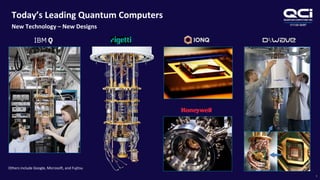
Today’s Leading Quantum Computers
New Technology – New Designs
7
Others include Google, Microsoft, and Fujitsu
OTCQB:QUBT
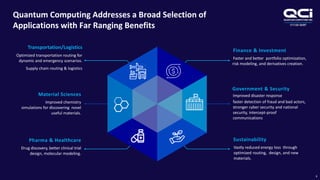
Sustainability
Vastly reduced energy loss through
optimized routing, design, and new
materials.
Government & Security
Improved disaster response
faster detection of fraud and bad actors,
stronger cyber security and national
security, intercept-proof
communications
Transportation/Logistics
Optimized transportation routing for
dynamic and emergency scenarios.
Supply chain routing & logistics
Finance & Investment
Faster and better portfolio optimization,
risk modeling, and derivatives creation.
Material Sciences
Improved chemistry
simulations for discovering novel
useful materials.
Pharma & Healthcare
Drug discovery, better clinical trial
design, molecular modeling.
Quantum Computing Addresses a Broad Selection of
Applications with Far Ranging Benefits
8
OTCQB:QUBT
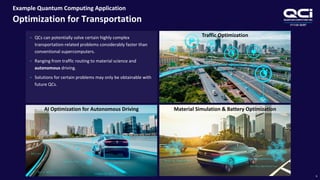
Example Quantum Computing Application
Optimization for Transportation
9
• QCs can potentially solve certain highly complex
transportation-related problems considerably faster than
conventional supercomputers.
• Ranging from traffic routing to material science and
autonomous driving.
• Solutions for certain problems may only be obtainable with
future QCs.
Traffic Optimization
Material Simulation & Battery Optimization
AI Optimization for Autonomous Driving
OTCQB:QUBT
The Quantum Landscape
10
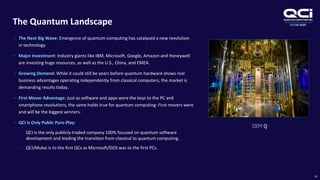
• The Next Big Wave: Emergence of quantum computing has catalyzed a new revolution
in technology.
• Major Investment: Industry giants like IBM, Microsoft, Google, Amazon and Honeywell
are investing huge resources, as well as the U.S., China, and EMEA.
• Growing Demand: While it could still be years before quantum hardware shows real
business advantages operating independently from classical computers, the market is
demanding results today.
• First Mover Advantage: Just as software and apps were the keys to the PC and
smartphone revolutions, the same holds true for quantum computing: First movers were
and will be the biggest winners.
• QCI is Only Public Pure-Play:
• QCI is the only publicly-traded company 100% focused on quantum software
development and leading the transition from classical to quantum computing.
• QCI/Mukai is to the first QCs as Microsoft/DOS was to the first PCs.
OTCQB:QUBT
Quantum Opportunity by the Numbers
11
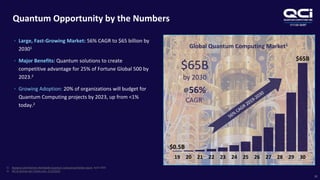
• Large, Fast-Growing Market: 56% CAGR to $65 billion by
20301
• Major Benefits: Quantum solutions to create
competitive advantage for 25% of Fortune Global 500 by
2023.2
• Growing Adoption: 20% of organizations will budget for
Quantum Computing projects by 2023, up from <1%
today.2
$0.5B
$65B
19 20 21 22 23 24 25 26 27 28 29 30
Global Quantum Computing Market1
1) Research and Markets Worldwide Quantum Computing Market report, April 2020
2) IDC & Gartner per Forbes.com 2/13/2020
$65B
by 2030
@56%
CAGR1
OTCQB:QUBT
Industry Driver
Major Gov’t, Commercial & Academia Investment
12
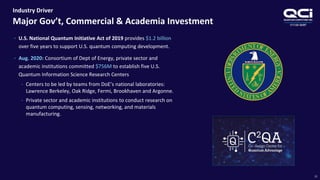
• U.S. National Quantum Initiative Act of 2019 provides $1.2 billion
over five years to support U.S. quantum computing development.
• Aug. 2020: Consortium of Dept of Energy, private sector and
academic institutions committed $756M to establish five U.S.
Quantum Information Science Research Centers
• Centers to be led by teams from DoE’s national laboratories:
Lawrence Berkeley, Oak Ridge, Fermi, Brookhaven and Argonne.
• Private sector and academic institutions to conduct research on
quantum computing, sensing, networking, and materials
manufacturing.
OTCQB:QUBT
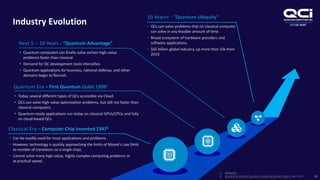
Quantum Era – First Quantum Qubit 19981
• Today, several different types of QCs accessible via Cloud.
• QCs can solve high value optimization problems, but still not faster than
classical computers.
• Quantum-ready applications run today on classical GPUs/CPUs and fully
on cloud-based QCs.
Classical Era – Computer Chip Invented 19471
• Can be readily used for most applications and problems.
• However, technology is quickly approaching the limits of Moore’s Law (limit
to number of transistors on a single chip).
• Cannot solve many high-value, highly complex computing problems or
at practical speed.
Industry Evolution
13
Next 5 – 10 Years - “Quantum Advantage”
• Quantum computers can finally solve certain high-value
problems faster than classical.
• Demand for QC development tools intensifies.
• Quantum applications for business, national defense, and other
domains begin to flourish.
10 Years+ - “Quantum Ubiquity”
• QCs can solve problems that no classical computer
can solve in any feasible amount of time.
• Broad ecosystem of hardware providers and
software applications.
• $65 billion global industry, up more than 10x from
2019.
1) Wikipedia
2) Research & Markets Quantum Computing Market Report, April 2020
OTCQB:QUBT
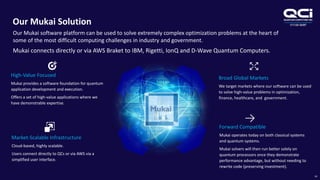
High-Value Focused
Mukai provides a software foundation for quantum
application development and execution.
Offers a set of high-value applications where we
have demonstrable expertise.
Forward Compatible
Mukai operates today on both classical systems
and quantum systems.
Mukai solvers will then run better solely on
quantum processors once they demonstrate
performance advantage, but without needing to
rewrite code (preserving investment).
Our Mukai Solution
14
Market-Scalable Infrastructure
Cloud-based, highly scalable.
Users connect directly to QCs or via AWS via a
simplified user interface.
Broad Global Markets
We target markets where our software can be used
to solve high-value problems in optimization,
finance, healthcare, and government.
Our Mukai software platform can be used to solve extremely complex optimization problems at the heart of
some of the most difficult computing challenges in industry and government.
Mukai connects directly or via AWS Braket to IBM, Rigetti, IonQ and D-Wave Quantum Computers.
OTCQB:QUBT
Proven Best-in-Class Performance
15
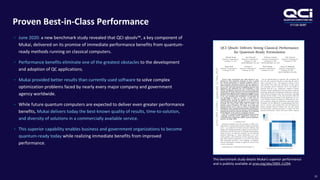
• June 2020: a new benchmark study revealed that QCI qbsolv™, a key component of
Mukai, delivered on its promise of immediate performance benefits from quantum-
ready methods running on classical computers.
• Performance benefits eliminate one of the greatest obstacles to the development
and adoption of QC applications.
• Mukai provided better results than currently used software to solve complex
optimization problems faced by nearly every major company and government
agency worldwide.
• While future quantum computers are expected to deliver even greater performance
benefits, Mukai delivers today the best-known quality of results, time-to-solution,
and diversity of solutions in a commercially available service.
• This superior capability enables business and government organizations to become
quantum-ready today while realizing immediate benefits from improved
performance.
This benchmark study details Mukai’s superior performance
and is publicly available at arxiv.org/abs/2005.11294.
OTCQB:QUBT
Example of Mukai Quantum-Ready Application
Quantum Asset Allocator (QAA) Application
16
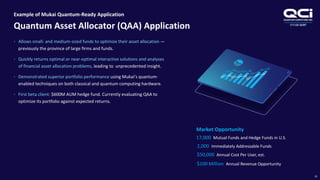
• Allows small- and medium-sized funds to optimize their asset allocation —
previously the province of large firms and funds.
• Quickly returns optimal or near-optimal interactive solutions and analyses
of financial asset allocation problems, leading to unprecedented insight.
• Demonstrated superior portfolio performance using Mukai’s quantum-
enabled techniques on both classical and quantum computing hardware.
• First beta client: $600M AUM hedge fund. Currently evaluating QAA to
optimize its portfolio against expected returns.
Market Opportunity
17,000 Mutual Funds and Hedge Funds in U.S.
2,000 Immediately Addressable Funds
$50,000 Annual Cost Per User, est.
$100 Million Annual Revenue Opportunity
OTCQB:QUBT
Example of Mukai Quantum-Ready Application
Community Detection Application
17
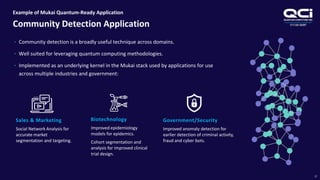
• Community detection is a broadly useful technique across domains.
• Well suited for leveraging quantum computing methodologies.
• Implemented as an underlying kernel in the Mukai stack used by applications for use
across multiple industries and government:
Sales & Marketing
Social Network Analysis for
accurate market
segmentation and targeting.
Biotechnology
Improved epidemiology
models for epidemics.
Cohort segmentation and
analysis for improved clinical
trial design.
Government/Security
Improved anomaly detection for
earlier detection of criminal activity,
fraud and cyber bots.
OTCQB:QUBT
Example of a Quantum-Ready Application
Retail: In-Warehouse Grocery Order Fulfillment
18
The Challenge:
• Online grocers compete on quality, price, selection, and delivery speed in a market
with notoriously thin margins.
• Ability to fill online orders quickly and accurately is essential, especially with many
perishable items that must remain cold.
The Potential Solution:
• Automated warehouse with robotic vehicles that collect items from bins and place
them in the appropriate shipping containers.
• The more vehicles that can move about without colliding, the more efficiently the
warehouse can operate.
• Requires logistics and path optimization with has a vast number of variables and
data points. Such “constrained-optimization problems” is one area where quantum
computing solvers can excel.
• With Mukai, developers can specify the constraints and how to measure the cost of a
solution explicitly. Mukai then finds excellent answers quickly.
• Problems that could not be solved fast enough, or solved in their full complexity, can
now be quickly solved with the new power of Mukai.
Case Study: Ocado1
• World's largest online-only grocery retailer
• $1.4 billion in annual sales, based in U.K.
• 1.7 million items processed daily
Previous Problem: 50,000 product types, three
temperature regimes. Many product must be
segregated or have short expirations dates.
Solution: AI/Machine Learning calculates all aspects
of operations when controlling robotic vehicles.
New Problem: According to CTO, Paul Clarke: “We're
bumping up against Moore's Law.” Hence, he plans to
eventually use a QC to power algorithms.
1) Forbes Magazine
Ocado’s Robotic Order Fulfillment Warehouse
Shipping Bins
OTCQB:QUBT
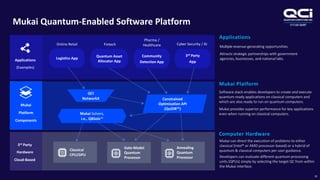
Applications
Multiplerevenue-generating opportunities.
Attracts strategic partnerships with government
agencies, businesses, and national labs.
Mukai Platform
Software stack enables developers to create and execute
quantum-ready applications on classical computers and
which are also ready to run on quantum computers.
Mukai provides superior performance for key applications
even when running on classical computers.
Computer Hardware
Mukai can direct the execution of problems to either
classical (Intel® or AMD processor-based) or a hybrid of
quantum & classical computers per user guidance.
Developers can evaluate different quantum processing
units (QPUs) simply by selecting the target QC from within
the Mukai interface.
Mukai Quantum-Enabled Software Platform
19
Applications
(Examples)
3rd Party
Hardware
Cloud-Based
Mukai Solvers,
i.e., QBSolv™
Quantum Asset
Allocator App
3rd Party
App
Community
Detection App
Mukai
Platform
Components
Fintech
Pharma /
Healthcare Cyber Security / AI
Classical
CPU/GPU
Annealing
Quantum
Processor
Constrained
Optimization API
(QuOIR™)
Gate-Model
Quantum
Processor
Logistics App
Online Retail
QCI
NetworkX
OTCQB:QUBT
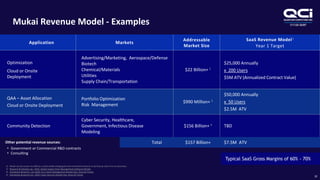
Mukai Revenue Model - Examples
20
Application Markets
Addressable
Market Size
SaaS Revenue Model1
Year 1 Target
Optimization
Cloud or Onsite
Deployment
Advertising/Marketing, Aerospace/Defense
Biotech
Chemical/Materials
Utilities
Supply Chain/Transportation
$22 Billion+ 2
$25,000 Annually
x 200 Users
$5M ATV (Annualized Contract Value)
QAA – Asset Allocation
Cloud or Onsite Deployment
Portfolio Optimization
Risk Management
$990 Million+ 3
$50,000 Annually
x 50 Users
$2.5M ATV
Community Detection
Cyber Security, Healthcare,
Government, Infectious Disease
Modeling
$156 Billion+ 4 TBD
Total $157 Billion+ $7.5M ATV
Typical SaaS Gross Margins of 60% - 70%
Other potential revenue sources:
• Government or Commercial R&D contracts
• Consulting
1) Mukai can be access via AWS as a SaaS model charging by time increments (hours) or by license cost if run on premises.
2) Research & Markets Jan. 2020: Global Supply Chain Management Software Market
3) Grandview Research July 2020: AI In Asset Management Market Size, Share & Trends
4) Grandview Research Jan. 2020: Cyber Security Market Size, Share & Trends.
OTCQB:QUBT
Key Partnerships – Industry & Academia
21
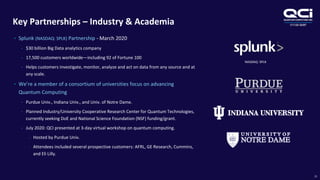
• Splunk (NASDAQ: SPLK) Partnership - March 2020
• $30 billion Big Data analytics company
• 17,500 customers worldwide—including 92 of Fortune 100
• Helps customers investigate, monitor, analyze and act on data from any source and at
any scale.
• We’re a member of a consortium of universities focus on advancing
Quantum Computing
• Purdue Univ., Indiana Univ., and Univ. of Notre Dame.
• Planned Industry/University Cooperative Research Center for Quantum Technologies,
currently seeking DoE and National Science Foundation (NSF) funding/grant.
• July 2020: QCI presented at 3-day virtual workshop on quantum computing.
• Hosted by Purdue Univ.
• Attendees included several prospective customers: AFRL, GE Research, Cummins,
and Eli Lilly.
NASDAQ: SPLK
OTCQB:QUBT
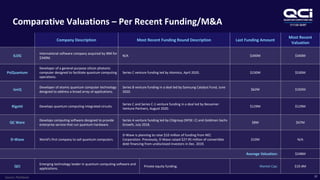
Company Description Most Recent Funding Round Description Last Funding Amount
Most Recent
Valuation
ILOG
International software company acquired by IBM for
$340M.
N/A $340M $340M
PsiQuantum
Developer of a general-purpose silicon photonic
computer designed to facilitate quantum computing
operations.
Series C venture funding led by Atomico, April 2020. $230M $530M
ionQ
Developer of atomic quantum computer technology
designed to address a broad array of applications.
Series B venture funding in a deal led by Samsung Catalyst Fund, June
2020.
$62M $192M
Rigetti Develops quantum computing integrated circuits.
Series C and Series C-1 venture funding in a deal led by Bessemer
Venture Partners, August 2020.
$129M $129M
QC Ware
Develops computing software designed to provide
enterprise service that run quantum hardware.
Series A venture funding led by Citigroup (NYSE: C) and Goldman Sachs
Growth, July 2018.
$8M $47M
D-Wave World's first company to sell quantum computers.
D-Wave is planning to raise $10 million of funding from NEC
Corporation. Previously, D-Wave raised $27.95 million of convertible
debt financing from undisclosed investors in Dec. 2019.
$10M N/A
Average Valuation: $248M
QCI
Emerging technology leader in quantum computing software and
applications.
Private equity funding. Market Cap: $19.4M
Comparative Valuations – Per Recent Funding/M&A
22
Source: Pitchbook
OTCQB:QUBT
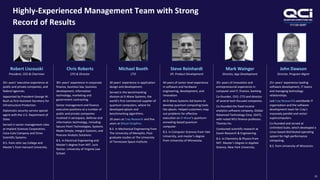
Highly-Experienced Management Team with Strong
Record of Results
Robert Liscouski
President, CEO & Chairman
35+ years’ executive experience at
public and private companies, and
federal agencies.
Appointed by President George W.
Bush as first Assistant Secretary for
Infrastructure Protection.
Diplomatic security service special
agent with the U.S. Department of
State.
Served in senior management roles
at Implant Sciences Corporation,
Coca-Cola Company and Orion
Scientific Systems.
B.S. from John Jay College and
Master’s from Harvard University.
Chris Roberts
CFO & Director
30+ years’ experience in corporate
finance, business law, business
development, information
technology, marketing and
government contracting.
Senior management and finance
executive positions at a number of
public and private companies
involved in aerospace, defense and
information technology, including
Secure Point Technologies, Systems
Made Simple, Integral Systems, and
Pearson Analytic Solutions.
B.S. in Electrical Engineering and
Master’s degree from MIT. Juris
Doctor, University of Virginia Law
School.
Michael Booth
CTO
30 years’ experience in application
design and development.
Served in the benchmarking
division at D-Wave Systems, the
world’s first commercial supplier of
quantum computers, where he
developed qbsolv and
benchmarking algorithms.
20 years at Cray Research and five
years at Silicon Graphics.
B.S. in Mechanical Engineering from
The University of Memphis. Post-
graduate studies at The University
of Tennessee Space Institute.
Steve Reinhardt
VP, Product Development
40 years of senior level experience
in software and hardware
engineering, development, and
innovation.
At D-Wave Systems led teams to
develop quantum computing tools
like qbsolv. Helped customers map
out problems for effective
execution on D-Wave’s quantum-
annealing-based quantum
computer.
B.S. in Computer Sciences from Yale
University, and master’s degree
from University of Minnesota.
Mark Wainger
Director, App Development
35+ years of innovation and
entrepreneurial experience in
computer and IT, finance, banking.
Co-founder, CEO, CTO and director
of several tech-focused companies.
Co-founded the fixed income
analytics software company, Global
Advanced Technology Corp. (GAT),
with noted NYU finance professor,
Thomas Ho.
Conducted scientific research at
Exxon Research & Engineering.
B.S. in Chemistry & Physics from
MIT. Master’s Degree in Applied
Science, New York University.
John Dawson
Director, Program Mgmt
25+ years’ experience leading
software development, IT teams
and managing technology
relationships.
Led Cray Research’s worldwide IT
organization and the software
development team for Cray’s
massively parallel and vector
supercomputers.
Co-founded and served at
Unlimited Scale, which developed a
Linux-based distributed operating
system for high performance
computing.
B.S. from University of Wisconsin.
23
OTCQB:QUBT
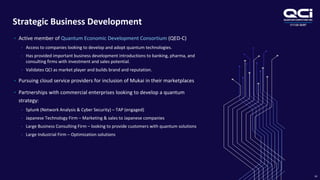
Strategic Business Development
24
• Active member of Quantum Economic Development Consortium (QED-C)
• Access to companies looking to develop and adopt quantum technologies.
• Has provided important business development introductions to banking, pharma, and
consulting firms with investment and sales potential.
• Validates QCI as market player and builds brand and reputation.
• Pursuing cloud service providers for inclusion of Mukai in their marketplaces
• Partnerships with commercial enterprises looking to develop a quantum
strategy:
• Splunk (Network Analysis & Cyber Security) – TAP (engaged)
• Japanese Technology Firm – Marketing & sales to Japanese companies
• Large Business Consulting Firm – looking to provide customers with quantum solutions
• Large Industrial Firm – Optimization solutions
OTCQB:QUBT
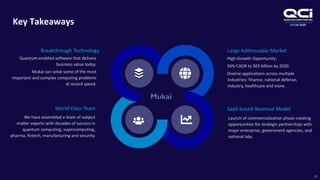
Breakthrough Technology
Quantum-enabled software that delivers
business value today.
Mukai can solve some of the most
important and complex computing problems
at record speed.
SaaS-based Revenue Model
Launch of commercialization phase creating
opportunities for strategic partnerships with
major enterprise, government agencies, and
national labs.
Large Addressable Market
High-Growth Opportunity:
56% CAGR to $65 billion by 2030.
Diverse applications across multiple
industries: finance, national defense,
industry, healthcare and more.
World Class Team
We have assembled a team of subject
matter experts with decades of success in
quantum computing, supercomputing,
pharma, fintech, manufacturing and security.
Key Takeaways
25
Robert Liscouski | President &CEO
rlisk@quantumcomputinginc.com
Chris Roberts | CFO
croberts@quantumcomputinginc.com
Investor & Media Relations Contact
Ron Both or Grant Stude
CMA Investor Relations
Tel (949) 432-7566
QUBT@cma.team
26

QUBT Corporate Presentation Sept 2020.pdf

  • 1.
    Corporate Presentation September 2020 OTCQB:QUBT Leadingthe Industry with Quantum-Ready Applications
  • 2.
    OTCQB:QUBT Important Cautions RegardingForward-Looking Statements 2 This presentation contains forward-looking statements as defined within Section 27A of the Securities Act of 1933, as amended, and Section 21E of the Securities Exchange Act of 1934, as amended. By their nature, forward-looking statements and forecasts involve risks and uncertainties because they relate to events and depend on circumstances that will occur in the near future. Those statements include statements regarding the intent, belief or current expectations of Quantum Computing Inc. (“Company”), and members of its management as well as the assumptions on which such statements are based. Prospective investors are cautioned that any such forward- looking statements are not guarantees of future performance and involve risks and uncertainties, and that actual results may differ materially from those contemplated by such forward-looking statements. The Company undertakes no obligation to update or revise forward-looking statements to reflect changed conditions. Statements in this presentation that are not descriptions of historical facts are forward-looking statements relating to future events, and as such all forward-looking statements are made pursuant to the Securities Litigation Reform Act of 1995. Statements may contain certain forward-looking statements pertaining to future anticipated or projected plans, performance and developments, as well as other statements relating to future operations and results. Any statements in this presentation that are not statements of historical fact may be considered to be forward-looking statements. Words such as "may," "will," "expect," "believe," "anticipate," "estimate," "intends," "goal," "objective," "seek," "attempt," “aim to”, or variations of these or similar words, identify forward-looking statements. These risks and uncertainties include, but are not limited to, those described in Item 1A in the Company’s Annual Report on Form 10-K, which is expressly incorporated herein by reference, and other factors as may periodically be described in the Company’s filings with the SEC. Mukai™, QCI qbsolv™ and QuOIR™ are trademarks of Quantum Computing Inc. Intel® is a trademark of Intel Corporation. 083120b
  • 3.
    OTCQB:QUBT Stock Price (8/31/20)$4.09 Revenue mrq - 52 Week Low-High $0.78 - $6.88 Net Loss mrq $1.8M Avg. Volume (3-mo) 68,579 Cash & cash equiv. $497K Shares Outstanding 12.1M Total Assets $531K Public Float, est. 1.8M Total Debt $2.0M Market Cap $19.4M Total Liabilities $3.5M Insider Holdings, est. 40% Employees (full/part) 15 Institutional Holdings 15% Fiscal Year End Dec. 31 Key Stats - OTCQB: QUBT 3 Sources: otcmarkets.com, Yahoo!Finance, QCI Form 10-Q, QCI press releases. Shares outstanding as of August 7, 2020. Balance sheet data as of June 30, 2020.
  • 4.
    OTCQB:QUBT Who We Are 4 •Emerging technology leader in Quantum Computing (QC) software and applications • QCI is to the first QCs as Microsoft was to the first PCs. • We solve the most difficult enterprise-level logistical problems with unmatched speed and quality of results1 • Partnered with Splunk (NASDAQ: SPLK), a $30 billion big data analytics company with 17,500 customers worldwide, including 92 of the Fortune 100. • Cloud-based SaaS recurring revenue model. • Highly-experienced software development team from Cray, Silicon Graphics, D- Wave, and other major IT firms. • Recently entered commercial phase as the only public pure-play in the high- growth, multi-billion-dollar quantum computing space. Programmers use our proprietary software development and execution platform, Mukai™, to create and run quantum applications that solve complex optimization problems at record speeds. 1) Paper: “QCI Qbsolv Delivers Strong Classical Performance for Quantum-Ready Formulation,’ Published May 22, 2020
  • 5.
    OTCQB:QUBT What is QuantumComputing? Quantum Computing involves controlling and manipulating nature's smallest objects — single atoms and photons, rather than electronic circuits — to create on/off states that process information. The technology is base upon on two key concepts of Quantum Physics, Superposition & Entanglement: Superposition Entanglement If an electron were on skis heading downhill, it wouldn’t be unusual for it to go around both sides of a tree simultaneously. In the world of quantum physics, the same particle can appear both here AND there simultaneously. Such dual positions in space are called Superpositions. Superposition can also extend between different atomic particles. A link between two particles can be maintained even if separated geographically. Manipulating one particle affects the other instantly — even at vast distances and faster than the speed of light. Einstein called it, ‘Spooky action at a distance.’ 5
  • 6.
    OTCQB:QUBT Classical Computing QuantumComputing Unit used for Computations and Signal Transmission Bit: composed of 0 or 1, but never both simultaneously. Linear patterns of bits represent certain characters. Examples: 01000001 = A, 01000010 = B Because a Bit is binary (0 or 1), or on or off, only one thing can be calculated at a time, limiting speed. Qubit (short for quantum bit): Thanks to Superposition, 0 and 1 can occur sequentially OR as a both 0 and 1 simultaneously (i.e., trinary). Example: 01000001 or 01000010 = A and B simultaneously Because a Qubit can be binary, trinary or more, multiple possibilities can be calculated simultaneously and therefore at faster speeds. Best Suited or Ideal Applications (Examples) • Productivity and entertainment (word processing, spreadsheets, video games) • Systems, controls and devices (i.e., PCs, Smartphones, GPS, thermostats, cameras) • Storage and retrieval of information Certain high-value problems in business, research, and government: • Computing large sets of possibilities or variables. • Analyzing complex, vast data sets. • Require rapid, immediate solutions (i.e., disaster recovery, routing). Machine Size, Weight & Power • Can be reduced into compact, lightweight space. • Low power requirements and no cooling. • Larger and heavier, and requires relatively larger operating space. • Requires near absolute zero cooling; however, QCs are more energy efficient at the computational level. Computational Speed Today’s fastest Supercomputer can still edge out the fastest Quantum Computer — although the gap is closing. QC have yet to surpass the speed of classical Supercomputers. However, using QC concepts on classical computers, or classical & QC operating symbiotically, can now achieve speeds faster than traditional classical approaches — thanks to QCI’s Mukai. QCs are not expected to replace classical computing for most tasks. Instead, they will continue to be complementary and rely upon classical computers to fully operate. Quantum Computing vs. Classical Computing 6
  • 7.
    OTCQB:QUBT Today’s Leading QuantumComputers New Technology – New Designs 7 Others include Google, Microsoft, and Fujitsu
  • 8.
    OTCQB:QUBT Sustainability Vastly reduced energyloss through optimized routing, design, and new materials. Government & Security Improved disaster response faster detection of fraud and bad actors, stronger cyber security and national security, intercept-proof communications Transportation/Logistics Optimized transportation routing for dynamic and emergency scenarios. Supply chain routing & logistics Finance & Investment Faster and better portfolio optimization, risk modeling, and derivatives creation. Material Sciences Improved chemistry simulations for discovering novel useful materials. Pharma & Healthcare Drug discovery, better clinical trial design, molecular modeling. Quantum Computing Addresses a Broad Selection of Applications with Far Ranging Benefits 8
  • 9.
    OTCQB:QUBT Example Quantum ComputingApplication Optimization for Transportation 9 • QCs can potentially solve certain highly complex transportation-related problems considerably faster than conventional supercomputers. • Ranging from traffic routing to material science and autonomous driving. • Solutions for certain problems may only be obtainable with future QCs. Traffic Optimization Material Simulation & Battery Optimization AI Optimization for Autonomous Driving
  • 10.
    OTCQB:QUBT The Quantum Landscape 10 •The Next Big Wave: Emergence of quantum computing has catalyzed a new revolution in technology. • Major Investment: Industry giants like IBM, Microsoft, Google, Amazon and Honeywell are investing huge resources, as well as the U.S., China, and EMEA. • Growing Demand: While it could still be years before quantum hardware shows real business advantages operating independently from classical computers, the market is demanding results today. • First Mover Advantage: Just as software and apps were the keys to the PC and smartphone revolutions, the same holds true for quantum computing: First movers were and will be the biggest winners. • QCI is Only Public Pure-Play: • QCI is the only publicly-traded company 100% focused on quantum software development and leading the transition from classical to quantum computing. • QCI/Mukai is to the first QCs as Microsoft/DOS was to the first PCs.
  • 11.
    OTCQB:QUBT Quantum Opportunity bythe Numbers 11 • Large, Fast-Growing Market: 56% CAGR to $65 billion by 20301 • Major Benefits: Quantum solutions to create competitive advantage for 25% of Fortune Global 500 by 2023.2 • Growing Adoption: 20% of organizations will budget for Quantum Computing projects by 2023, up from <1% today.2 $0.5B $65B 19 20 21 22 23 24 25 26 27 28 29 30 Global Quantum Computing Market1 1) Research and Markets Worldwide Quantum Computing Market report, April 2020 2) IDC & Gartner per Forbes.com 2/13/2020 $65B by 2030 @56% CAGR1
  • 12.
    OTCQB:QUBT Industry Driver Major Gov’t,Commercial & Academia Investment 12 • U.S. National Quantum Initiative Act of 2019 provides $1.2 billion over five years to support U.S. quantum computing development. • Aug. 2020: Consortium of Dept of Energy, private sector and academic institutions committed $756M to establish five U.S. Quantum Information Science Research Centers • Centers to be led by teams from DoE’s national laboratories: Lawrence Berkeley, Oak Ridge, Fermi, Brookhaven and Argonne. • Private sector and academic institutions to conduct research on quantum computing, sensing, networking, and materials manufacturing.
  • 13.
    OTCQB:QUBT Quantum Era –First Quantum Qubit 19981 • Today, several different types of QCs accessible via Cloud. • QCs can solve high value optimization problems, but still not faster than classical computers. • Quantum-ready applications run today on classical GPUs/CPUs and fully on cloud-based QCs. Classical Era – Computer Chip Invented 19471 • Can be readily used for most applications and problems. • However, technology is quickly approaching the limits of Moore’s Law (limit to number of transistors on a single chip). • Cannot solve many high-value, highly complex computing problems or at practical speed. Industry Evolution 13 Next 5 – 10 Years - “Quantum Advantage” • Quantum computers can finally solve certain high-value problems faster than classical. • Demand for QC development tools intensifies. • Quantum applications for business, national defense, and other domains begin to flourish. 10 Years+ - “Quantum Ubiquity” • QCs can solve problems that no classical computer can solve in any feasible amount of time. • Broad ecosystem of hardware providers and software applications. • $65 billion global industry, up more than 10x from 2019. 1) Wikipedia 2) Research & Markets Quantum Computing Market Report, April 2020
  • 14.
    OTCQB:QUBT High-Value Focused Mukai providesa software foundation for quantum application development and execution. Offers a set of high-value applications where we have demonstrable expertise. Forward Compatible Mukai operates today on both classical systems and quantum systems. Mukai solvers will then run better solely on quantum processors once they demonstrate performance advantage, but without needing to rewrite code (preserving investment). Our Mukai Solution 14 Market-Scalable Infrastructure Cloud-based, highly scalable. Users connect directly to QCs or via AWS via a simplified user interface. Broad Global Markets We target markets where our software can be used to solve high-value problems in optimization, finance, healthcare, and government. Our Mukai software platform can be used to solve extremely complex optimization problems at the heart of some of the most difficult computing challenges in industry and government. Mukai connects directly or via AWS Braket to IBM, Rigetti, IonQ and D-Wave Quantum Computers.
  • 15.
    OTCQB:QUBT Proven Best-in-Class Performance 15 •June 2020: a new benchmark study revealed that QCI qbsolv™, a key component of Mukai, delivered on its promise of immediate performance benefits from quantum- ready methods running on classical computers. • Performance benefits eliminate one of the greatest obstacles to the development and adoption of QC applications. • Mukai provided better results than currently used software to solve complex optimization problems faced by nearly every major company and government agency worldwide. • While future quantum computers are expected to deliver even greater performance benefits, Mukai delivers today the best-known quality of results, time-to-solution, and diversity of solutions in a commercially available service. • This superior capability enables business and government organizations to become quantum-ready today while realizing immediate benefits from improved performance. This benchmark study details Mukai’s superior performance and is publicly available at arxiv.org/abs/2005.11294.
  • 16.
    OTCQB:QUBT Example of MukaiQuantum-Ready Application Quantum Asset Allocator (QAA) Application 16 • Allows small- and medium-sized funds to optimize their asset allocation — previously the province of large firms and funds. • Quickly returns optimal or near-optimal interactive solutions and analyses of financial asset allocation problems, leading to unprecedented insight. • Demonstrated superior portfolio performance using Mukai’s quantum- enabled techniques on both classical and quantum computing hardware. • First beta client: $600M AUM hedge fund. Currently evaluating QAA to optimize its portfolio against expected returns. Market Opportunity 17,000 Mutual Funds and Hedge Funds in U.S. 2,000 Immediately Addressable Funds $50,000 Annual Cost Per User, est. $100 Million Annual Revenue Opportunity
  • 17.
    OTCQB:QUBT Example of MukaiQuantum-Ready Application Community Detection Application 17 • Community detection is a broadly useful technique across domains. • Well suited for leveraging quantum computing methodologies. • Implemented as an underlying kernel in the Mukai stack used by applications for use across multiple industries and government: Sales & Marketing Social Network Analysis for accurate market segmentation and targeting. Biotechnology Improved epidemiology models for epidemics. Cohort segmentation and analysis for improved clinical trial design. Government/Security Improved anomaly detection for earlier detection of criminal activity, fraud and cyber bots.
  • 18.
    OTCQB:QUBT Example of aQuantum-Ready Application Retail: In-Warehouse Grocery Order Fulfillment 18 The Challenge: • Online grocers compete on quality, price, selection, and delivery speed in a market with notoriously thin margins. • Ability to fill online orders quickly and accurately is essential, especially with many perishable items that must remain cold. The Potential Solution: • Automated warehouse with robotic vehicles that collect items from bins and place them in the appropriate shipping containers. • The more vehicles that can move about without colliding, the more efficiently the warehouse can operate. • Requires logistics and path optimization with has a vast number of variables and data points. Such “constrained-optimization problems” is one area where quantum computing solvers can excel. • With Mukai, developers can specify the constraints and how to measure the cost of a solution explicitly. Mukai then finds excellent answers quickly. • Problems that could not be solved fast enough, or solved in their full complexity, can now be quickly solved with the new power of Mukai. Case Study: Ocado1 • World's largest online-only grocery retailer • $1.4 billion in annual sales, based in U.K. • 1.7 million items processed daily Previous Problem: 50,000 product types, three temperature regimes. Many product must be segregated or have short expirations dates. Solution: AI/Machine Learning calculates all aspects of operations when controlling robotic vehicles. New Problem: According to CTO, Paul Clarke: “We're bumping up against Moore's Law.” Hence, he plans to eventually use a QC to power algorithms. 1) Forbes Magazine Ocado’s Robotic Order Fulfillment Warehouse Shipping Bins
  • 19.
    OTCQB:QUBT Applications Multiplerevenue-generating opportunities. Attracts strategicpartnerships with government agencies, businesses, and national labs. Mukai Platform Software stack enables developers to create and execute quantum-ready applications on classical computers and which are also ready to run on quantum computers. Mukai provides superior performance for key applications even when running on classical computers. Computer Hardware Mukai can direct the execution of problems to either classical (Intel® or AMD processor-based) or a hybrid of quantum & classical computers per user guidance. Developers can evaluate different quantum processing units (QPUs) simply by selecting the target QC from within the Mukai interface. Mukai Quantum-Enabled Software Platform 19 Applications (Examples) 3rd Party Hardware Cloud-Based Mukai Solvers, i.e., QBSolv™ Quantum Asset Allocator App 3rd Party App Community Detection App Mukai Platform Components Fintech Pharma / Healthcare Cyber Security / AI Classical CPU/GPU Annealing Quantum Processor Constrained Optimization API (QuOIR™) Gate-Model Quantum Processor Logistics App Online Retail QCI NetworkX
  • 20.
    OTCQB:QUBT Mukai Revenue Model- Examples 20 Application Markets Addressable Market Size SaaS Revenue Model1 Year 1 Target Optimization Cloud or Onsite Deployment Advertising/Marketing, Aerospace/Defense Biotech Chemical/Materials Utilities Supply Chain/Transportation $22 Billion+ 2 $25,000 Annually x 200 Users $5M ATV (Annualized Contract Value) QAA – Asset Allocation Cloud or Onsite Deployment Portfolio Optimization Risk Management $990 Million+ 3 $50,000 Annually x 50 Users $2.5M ATV Community Detection Cyber Security, Healthcare, Government, Infectious Disease Modeling $156 Billion+ 4 TBD Total $157 Billion+ $7.5M ATV Typical SaaS Gross Margins of 60% - 70% Other potential revenue sources: • Government or Commercial R&D contracts • Consulting 1) Mukai can be access via AWS as a SaaS model charging by time increments (hours) or by license cost if run on premises. 2) Research & Markets Jan. 2020: Global Supply Chain Management Software Market 3) Grandview Research July 2020: AI In Asset Management Market Size, Share & Trends 4) Grandview Research Jan. 2020: Cyber Security Market Size, Share & Trends.
  • 21.
    OTCQB:QUBT Key Partnerships –Industry & Academia 21 • Splunk (NASDAQ: SPLK) Partnership - March 2020 • $30 billion Big Data analytics company • 17,500 customers worldwide—including 92 of Fortune 100 • Helps customers investigate, monitor, analyze and act on data from any source and at any scale. • We’re a member of a consortium of universities focus on advancing Quantum Computing • Purdue Univ., Indiana Univ., and Univ. of Notre Dame. • Planned Industry/University Cooperative Research Center for Quantum Technologies, currently seeking DoE and National Science Foundation (NSF) funding/grant. • July 2020: QCI presented at 3-day virtual workshop on quantum computing. • Hosted by Purdue Univ. • Attendees included several prospective customers: AFRL, GE Research, Cummins, and Eli Lilly. NASDAQ: SPLK
  • 22.
    OTCQB:QUBT Company Description MostRecent Funding Round Description Last Funding Amount Most Recent Valuation ILOG International software company acquired by IBM for $340M. N/A $340M $340M PsiQuantum Developer of a general-purpose silicon photonic computer designed to facilitate quantum computing operations. Series C venture funding led by Atomico, April 2020. $230M $530M ionQ Developer of atomic quantum computer technology designed to address a broad array of applications. Series B venture funding in a deal led by Samsung Catalyst Fund, June 2020. $62M $192M Rigetti Develops quantum computing integrated circuits. Series C and Series C-1 venture funding in a deal led by Bessemer Venture Partners, August 2020. $129M $129M QC Ware Develops computing software designed to provide enterprise service that run quantum hardware. Series A venture funding led by Citigroup (NYSE: C) and Goldman Sachs Growth, July 2018. $8M $47M D-Wave World's first company to sell quantum computers. D-Wave is planning to raise $10 million of funding from NEC Corporation. Previously, D-Wave raised $27.95 million of convertible debt financing from undisclosed investors in Dec. 2019. $10M N/A Average Valuation: $248M QCI Emerging technology leader in quantum computing software and applications. Private equity funding. Market Cap: $19.4M Comparative Valuations – Per Recent Funding/M&A 22 Source: Pitchbook
  • 23.
    OTCQB:QUBT Highly-Experienced Management Teamwith Strong Record of Results Robert Liscouski President, CEO & Chairman 35+ years’ executive experience at public and private companies, and federal agencies. Appointed by President George W. Bush as first Assistant Secretary for Infrastructure Protection. Diplomatic security service special agent with the U.S. Department of State. Served in senior management roles at Implant Sciences Corporation, Coca-Cola Company and Orion Scientific Systems. B.S. from John Jay College and Master’s from Harvard University. Chris Roberts CFO & Director 30+ years’ experience in corporate finance, business law, business development, information technology, marketing and government contracting. Senior management and finance executive positions at a number of public and private companies involved in aerospace, defense and information technology, including Secure Point Technologies, Systems Made Simple, Integral Systems, and Pearson Analytic Solutions. B.S. in Electrical Engineering and Master’s degree from MIT. Juris Doctor, University of Virginia Law School. Michael Booth CTO 30 years’ experience in application design and development. Served in the benchmarking division at D-Wave Systems, the world’s first commercial supplier of quantum computers, where he developed qbsolv and benchmarking algorithms. 20 years at Cray Research and five years at Silicon Graphics. B.S. in Mechanical Engineering from The University of Memphis. Post- graduate studies at The University of Tennessee Space Institute. Steve Reinhardt VP, Product Development 40 years of senior level experience in software and hardware engineering, development, and innovation. At D-Wave Systems led teams to develop quantum computing tools like qbsolv. Helped customers map out problems for effective execution on D-Wave’s quantum- annealing-based quantum computer. B.S. in Computer Sciences from Yale University, and master’s degree from University of Minnesota. Mark Wainger Director, App Development 35+ years of innovation and entrepreneurial experience in computer and IT, finance, banking. Co-founder, CEO, CTO and director of several tech-focused companies. Co-founded the fixed income analytics software company, Global Advanced Technology Corp. (GAT), with noted NYU finance professor, Thomas Ho. Conducted scientific research at Exxon Research & Engineering. B.S. in Chemistry & Physics from MIT. Master’s Degree in Applied Science, New York University. John Dawson Director, Program Mgmt 25+ years’ experience leading software development, IT teams and managing technology relationships. Led Cray Research’s worldwide IT organization and the software development team for Cray’s massively parallel and vector supercomputers. Co-founded and served at Unlimited Scale, which developed a Linux-based distributed operating system for high performance computing. B.S. from University of Wisconsin. 23
  • 24.
    OTCQB:QUBT Strategic Business Development 24 •Active member of Quantum Economic Development Consortium (QED-C) • Access to companies looking to develop and adopt quantum technologies. • Has provided important business development introductions to banking, pharma, and consulting firms with investment and sales potential. • Validates QCI as market player and builds brand and reputation. • Pursuing cloud service providers for inclusion of Mukai in their marketplaces • Partnerships with commercial enterprises looking to develop a quantum strategy: • Splunk (Network Analysis & Cyber Security) – TAP (engaged) • Japanese Technology Firm – Marketing & sales to Japanese companies • Large Business Consulting Firm – looking to provide customers with quantum solutions • Large Industrial Firm – Optimization solutions
  • 25.
    OTCQB:QUBT Breakthrough Technology Quantum-enabled softwarethat delivers business value today. Mukai can solve some of the most important and complex computing problems at record speed. SaaS-based Revenue Model Launch of commercialization phase creating opportunities for strategic partnerships with major enterprise, government agencies, and national labs. Large Addressable Market High-Growth Opportunity: 56% CAGR to $65 billion by 2030. Diverse applications across multiple industries: finance, national defense, industry, healthcare and more. World Class Team We have assembled a team of subject matter experts with decades of success in quantum computing, supercomputing, pharma, fintech, manufacturing and security. Key Takeaways 25
  • 26.
    Robert Liscouski |President &CEO rlisk@quantumcomputinginc.com Chris Roberts | CFO croberts@quantumcomputinginc.com Investor & Media Relations Contact Ron Both or Grant Stude CMA Investor Relations Tel (949) 432-7566 QUBT@cma.team 26