Quasi-Authoritarianism
and Its Implications to Ukraine
           Yuriy Matsiyevsky
   Ostroh Academy National University
                 2011
Objective
• To challenge the view that Ukraine’s
  regime has become authoritarian under
  Yanukovych
Primary questions
• What type of regime is Ukraine?
• Why did Yanukovych succeeded in
  concentrating power (more than had
  Kuchma?)
• How long he could stay in power and
• What implications his presidency would
  have for Ukraine?
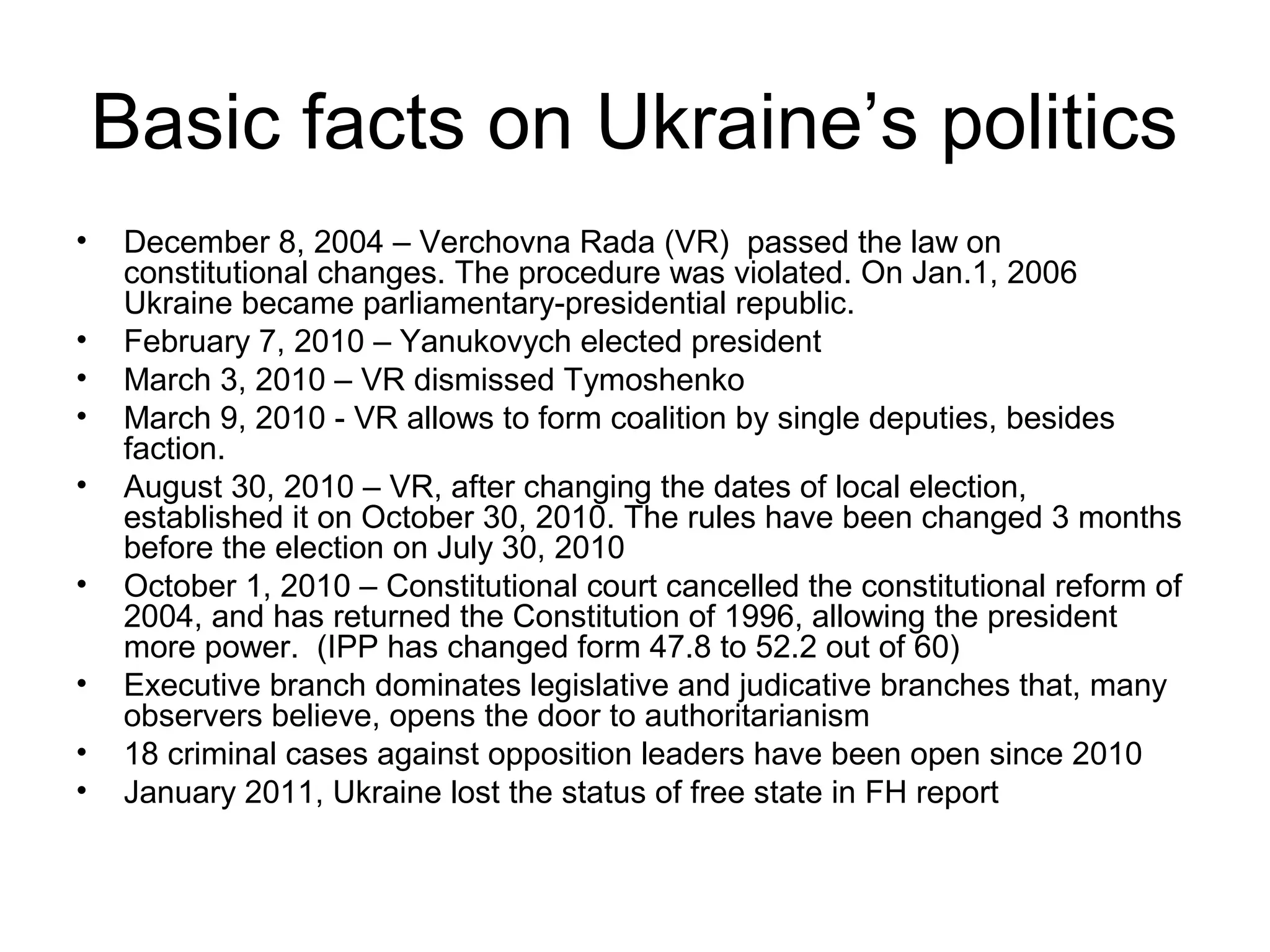
Basic facts on Ukraine’s politics
•    December 8, 2004 – Verchovna Rada (VR) passed the law on
     constitutional changes. The procedure was violated. On Jan.1, 2006
     Ukraine became parliamentary-presidential republic.
•    February 7, 2010 – Yanukovych elected president
•    March 3, 2010 – VR dismissed Tymoshenko
•    March 9, 2010 - VR allows to form coalition by single deputies, besides
     faction.
•    August 30, 2010 – VR, after changing the dates of local election,
     established it on October 30, 2010. The rules have been changed 3 months
     before the election on July 30, 2010
•    October 1, 2010 – Constitutional court cancelled the constitutional reform of
     2004, and has returned the Constitution of 1996, allowing the president
     more power. (IPP has changed form 47.8 to 52.2 out of 60)
•    Executive branch dominates legislative and judicative branches that, many
     observers believe, opens the door to authoritarianism
•    18 criminal cases against opposition leaders have been open since 2010
•    January 2011, Ukraine lost the status of free state in FH report
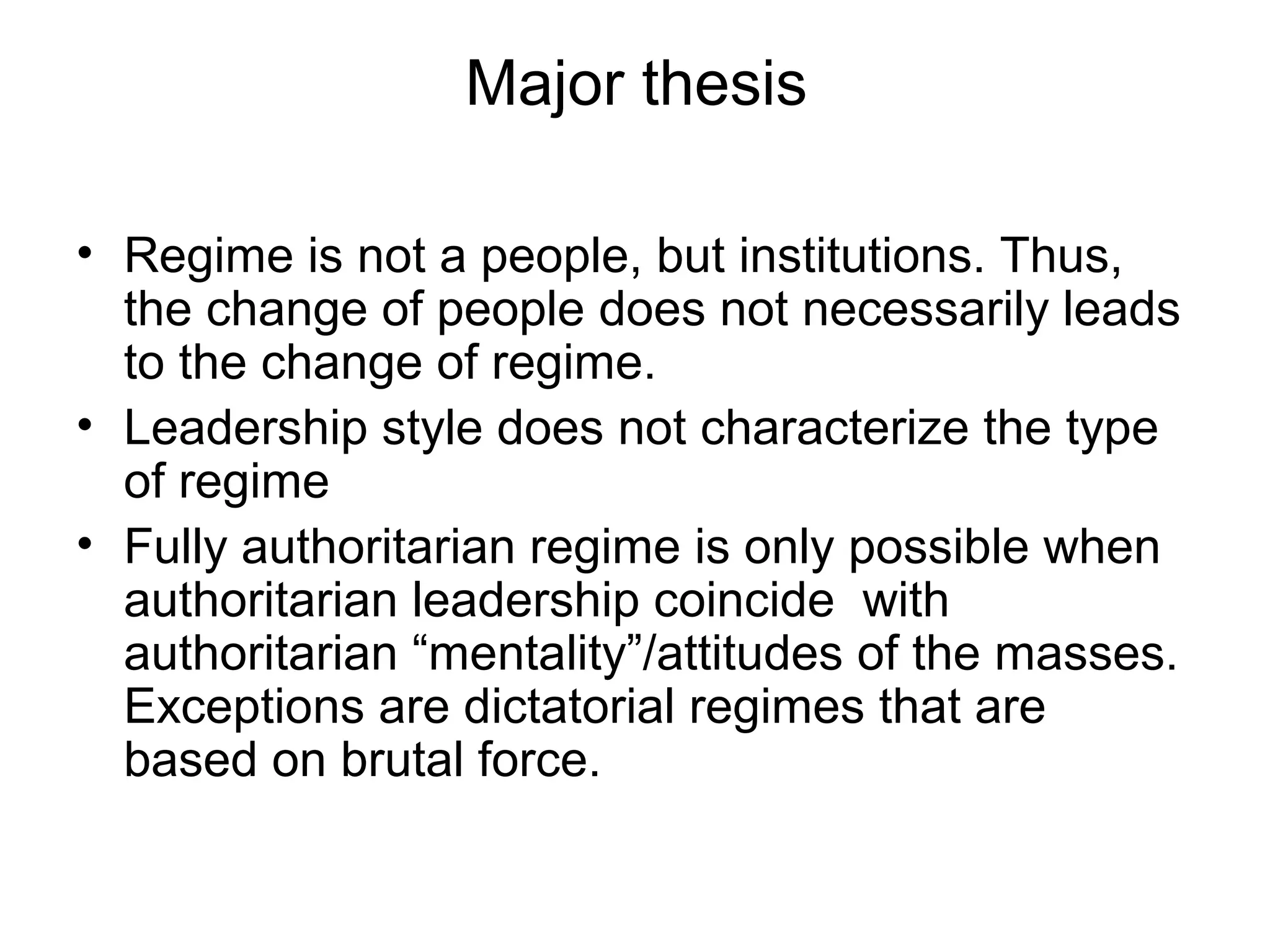
Major thesis

• Regime is not a people, but institutions. Thus,
  the change of people does not necessarily leads
  to the change of regime.
• Leadership style does not characterize the type
  of regime
• Fully authoritarian regime is only possible when
  authoritarian leadership coincide with
  authoritarian “mentality”/attitudes of the masses.
  Exceptions are dictatorial regimes that are
  based on brutal force.
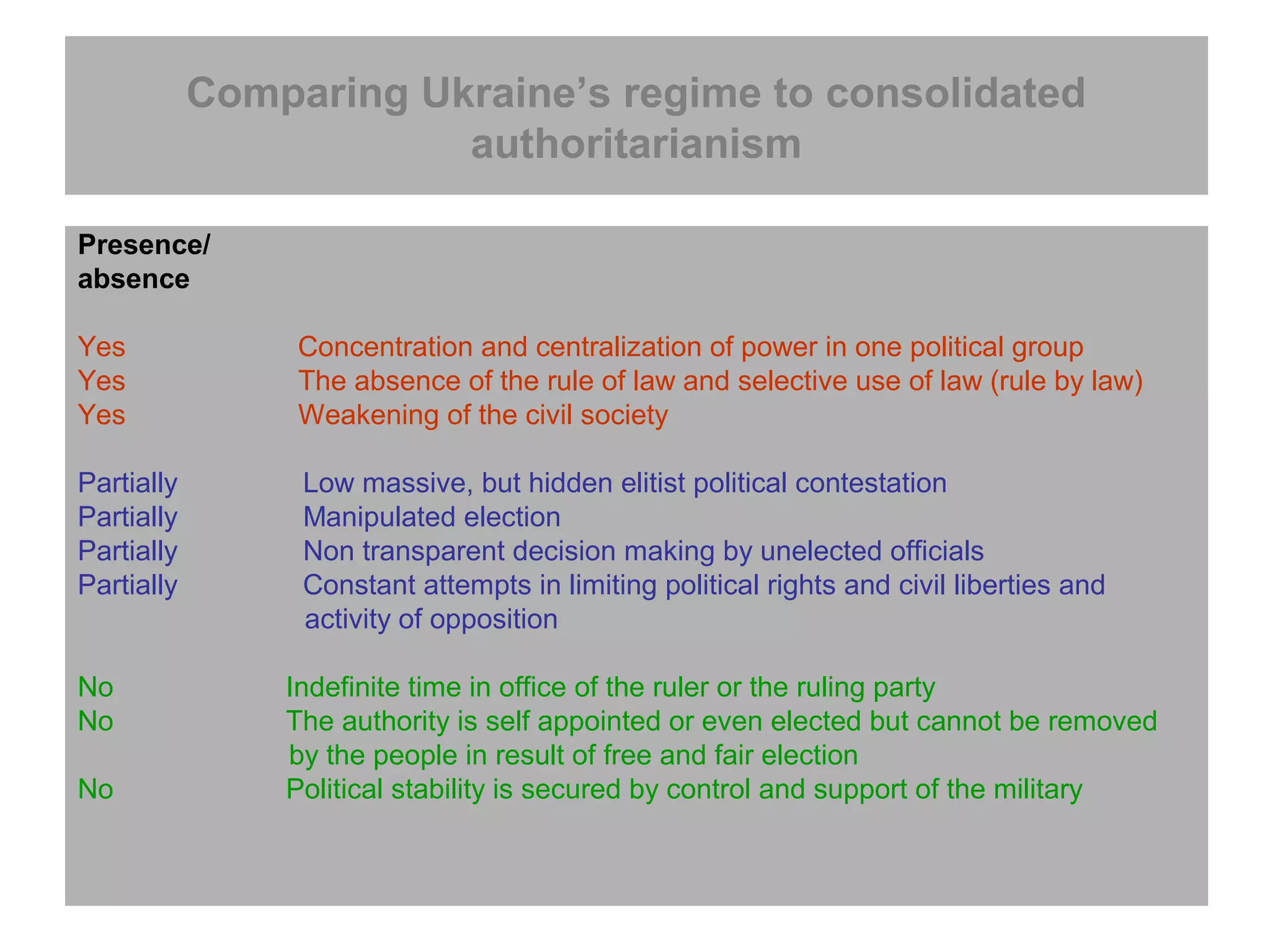
Comparing Ukraine’s regime to consolidated
                        authoritarianism

Presence/
absence

Yes              Concentration and centralization of power in one political group
Yes              The absence of the rule of law and selective use of law (rule by law)
Yes              Weakening of the civil society

Partially        Low massive, but hidden elitist political contestation
Partially        Manipulated election
Partially        Non transparent decision making by unelected officials
Partially        Constant attempts in limiting political rights and civil liberties and
                 activity of opposition

No              Indefinite time in office of the ruler or the ruling party
No              The authority is self appointed or even elected but cannot be removed
                by the people in result of free and fair election
No              Political stability is secured by control and support of the military
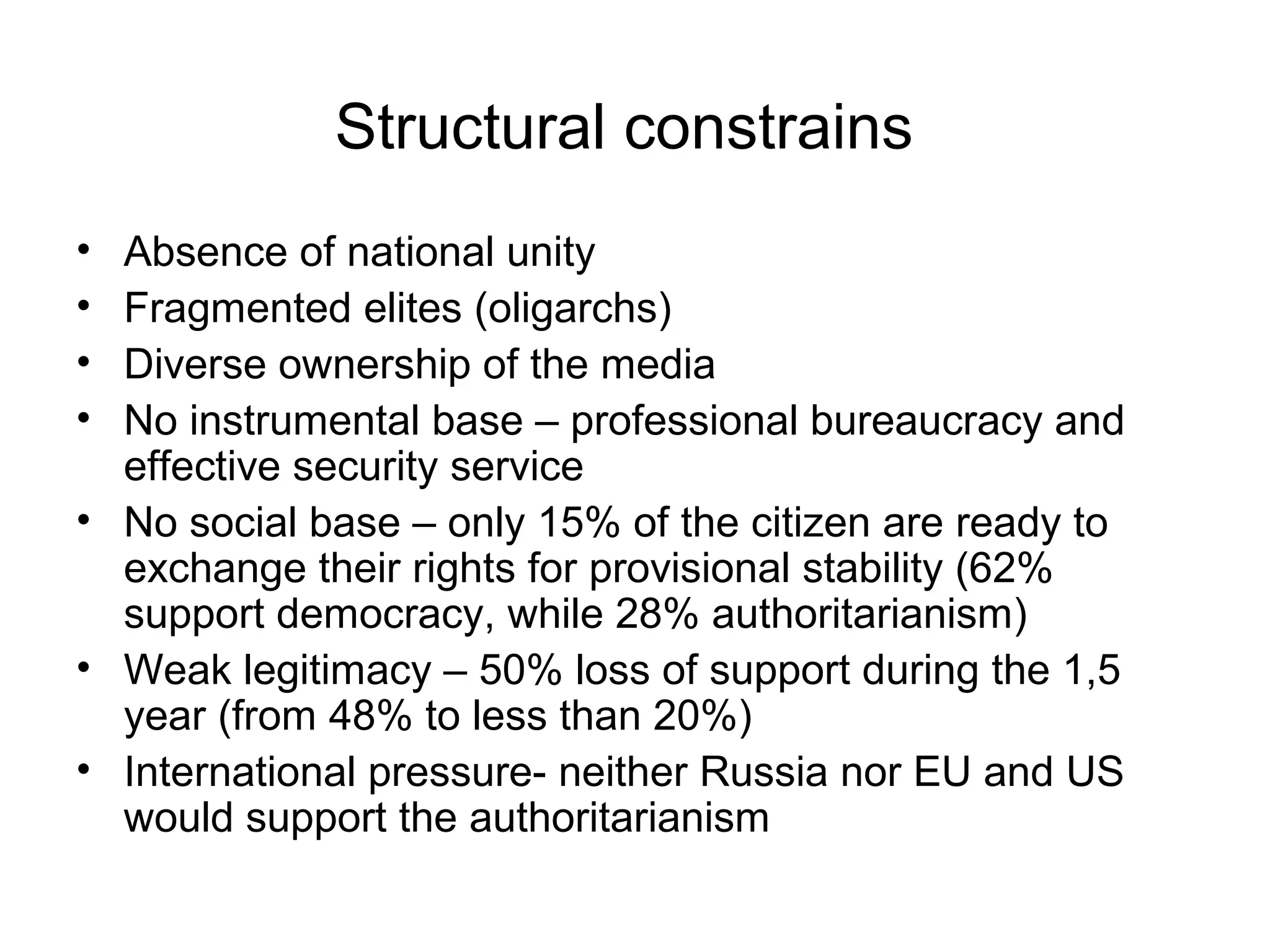
Structural constrains
• Absence of national unity
• Fragmented elites (oligarchs)
• Diverse ownership of the media
• No instrumental base – professional bureaucracy and
  effective security service
• No social base – only 15% of the citizen are ready to
  exchange their rights for provisional stability (62%
  support democracy, while 28% authoritarianism)
• Weak legitimacy – 50% loss of support during the 1,5
  year (from 48% to less than 20%)
• International pressure- neither Russia nor EU and US
  would support the authoritarianism
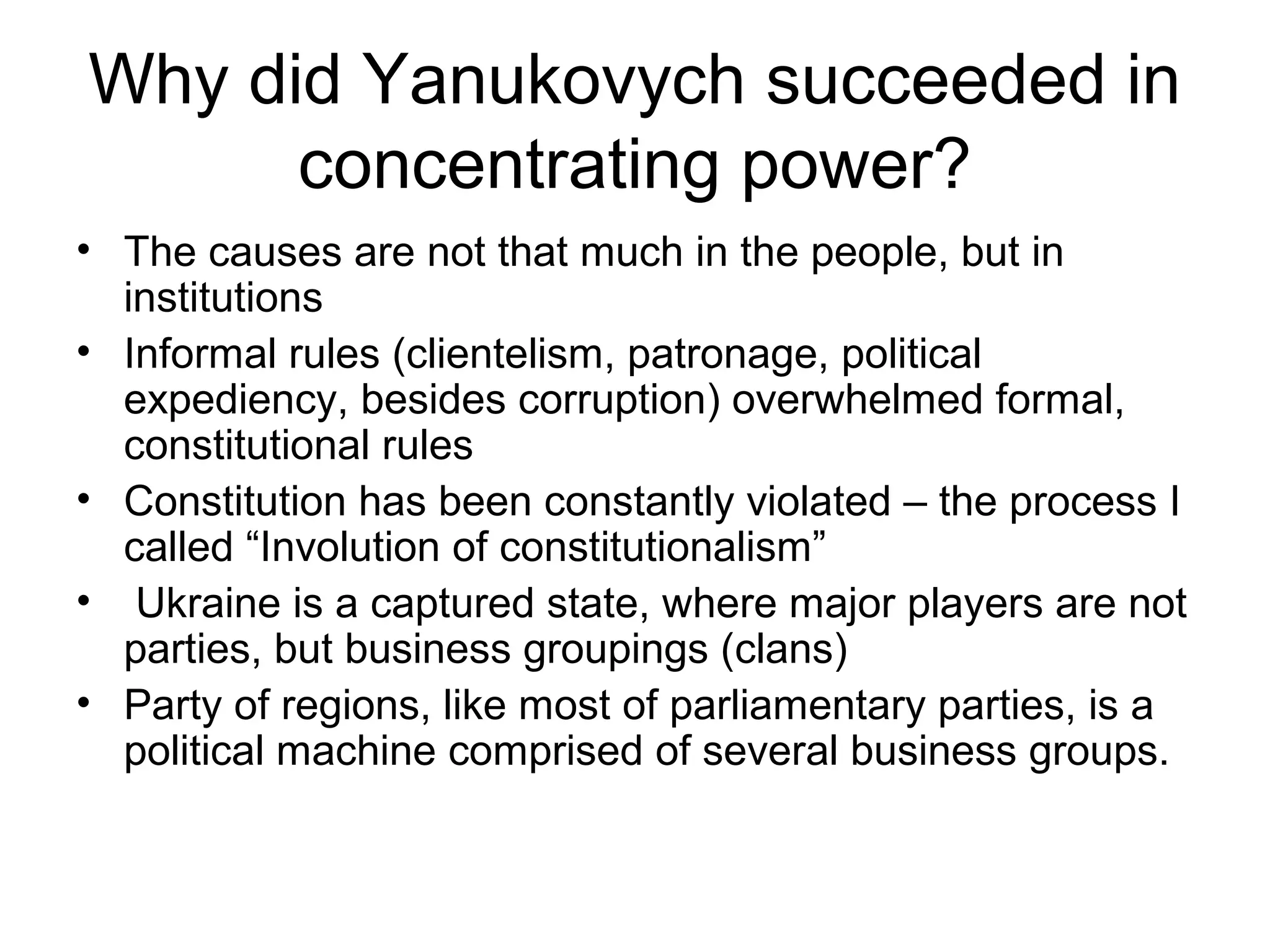
Why did Yanukovych succeeded in
      concentrating power?
• The causes are not that much in the people, but in
  institutions
• Informal rules (clientelism, patronage, political
  expediency, besides corruption) overwhelmed formal,
  constitutional rules
• Constitution has been constantly violated – the process I
  called “Involution of constitutionalism”
• Ukraine is a captured state, where major players are not
  parties, but business groupings (clans)
• Party of regions, like most of parliamentary parties, is a
  political machine comprised of several business groups.
Is the regime stable?
 Will Yanukovych survive the next
          electoral cycle?
• According to H.Linz, stability is a sum of
  legitimacy, efficacy, and effectiveness
• Measuring stability:
• Legitimacy is public support
• Efficacy reflects the public attitudes
  towards the current situation in the country
• Effectiveness reflects the attitudes
  towards the policies being implemented
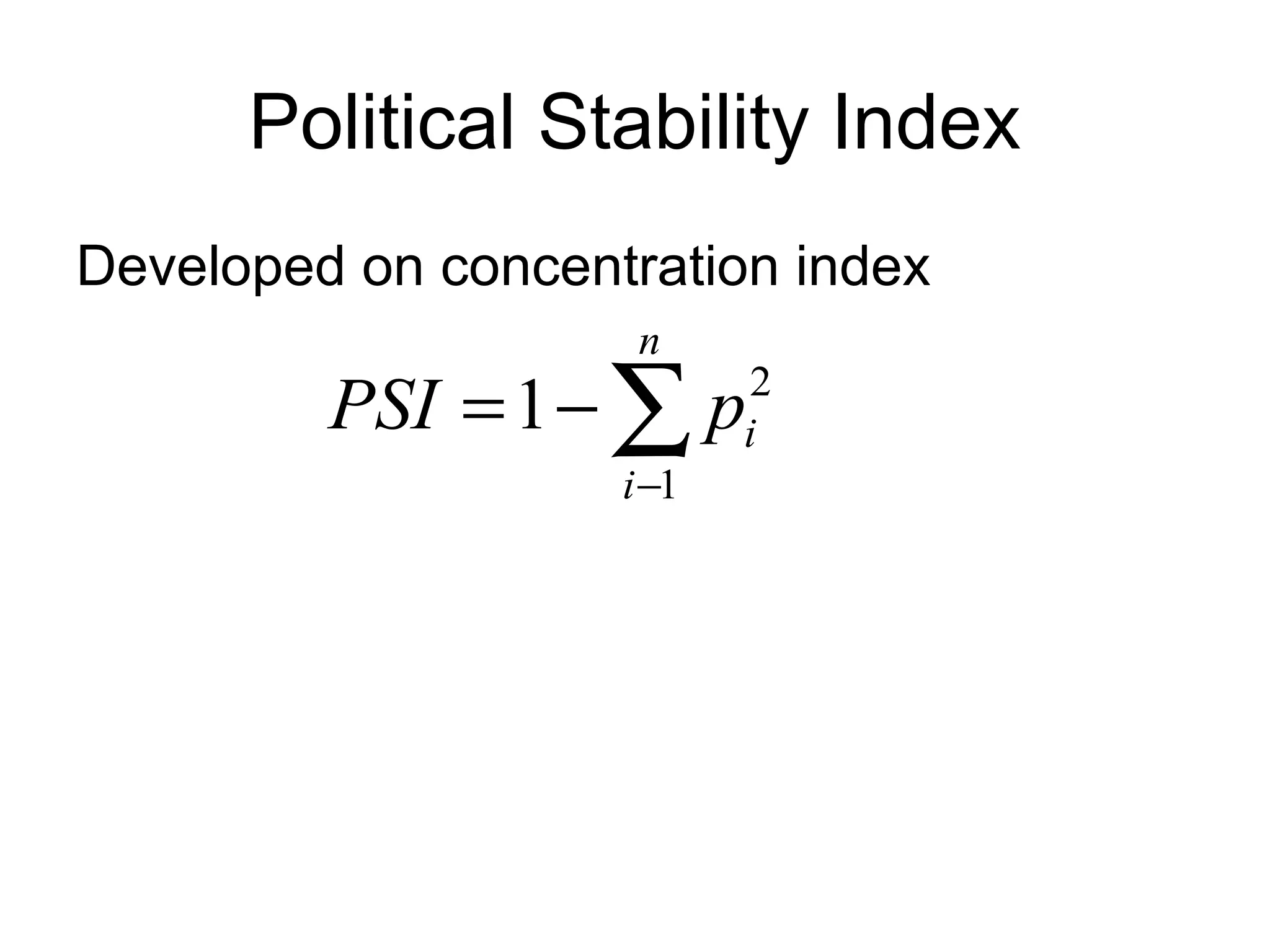
Political Stability Index
Developed on concentration index
                     n
         PSI = 1 − ∑ p     2
                           i
                    i −1
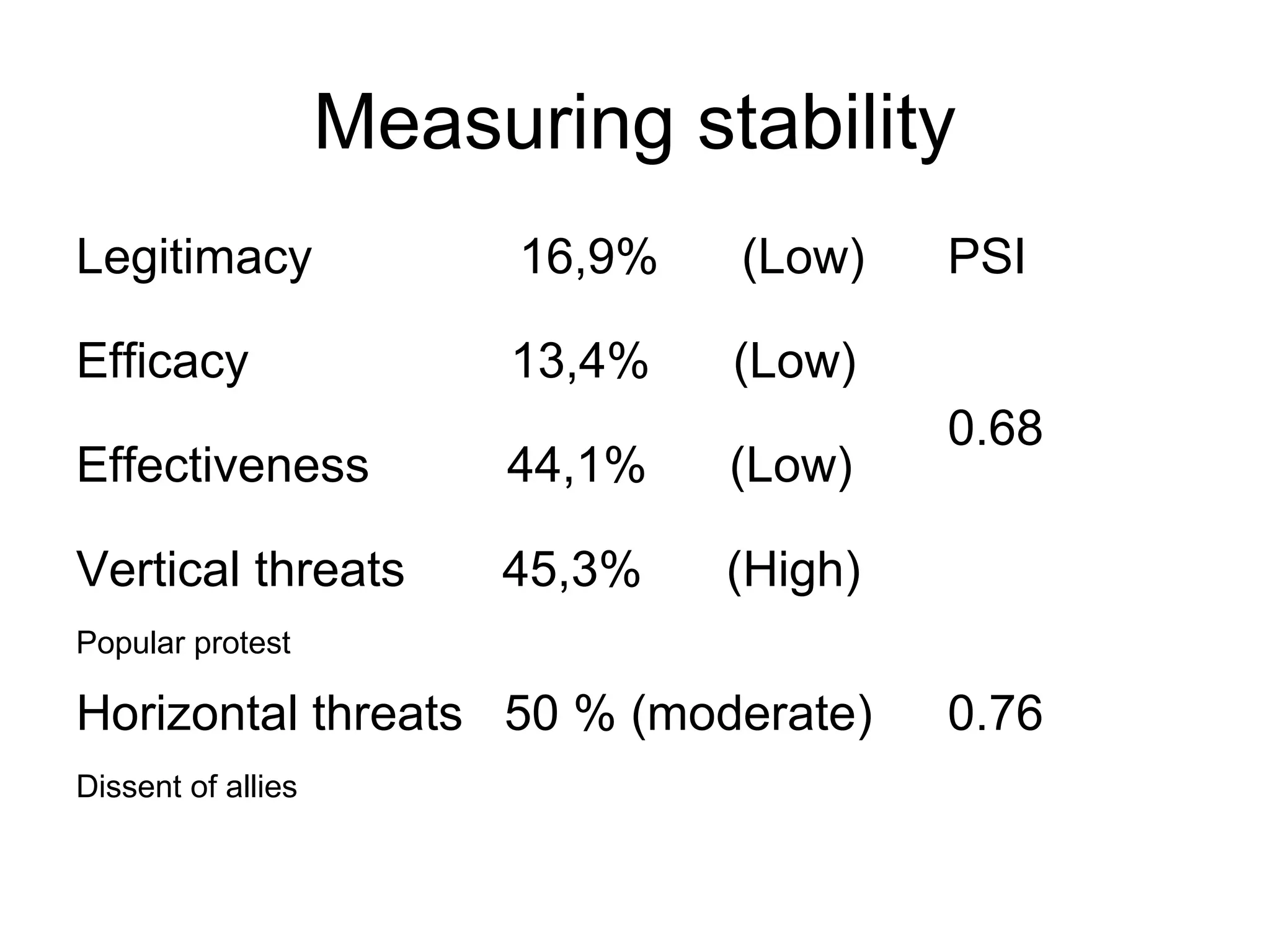
Measuring stability
Legitimacy                16,9%   (Low)    PSI

Efficacy                 13,4%    (Low)
                                           0.68
Effectiveness            44,1%    (Low)

Vertical threats         45,3%    (High)
Popular protest

Horizontal threats 50 % (moderate)         0.76
Dissent of allies
Strategies of survival
• Two scenarios:
• democracy in exchange for stability
• Regression to dictatorship
• Alternative scenarios:
• Change of power in result of election,
or in result of popular protest.
democracy in exchange for stability
• This is a conservative scenario that aims to secure
  societal consent on remaining in power.
• Necessary condition:
• To win next (2012) parliamentary election
• Positive effects of 21 reforms, proclaimed by the
  government
• Tighten control over the courts and parliament,
  opposition, civil society
• Contain dissent and mass protest
• Risks:
• The growth of instability as a result of low legitimacy,
  efficacy and effectiveness
• Failure to contain dissent
• Intervening variables (new sickle of economic crisis,
  collapse of national currency, external pressure)
Regression to dictatorship
• This is a less probable scenario, because the
  risks and structural constrains are too high, but
  resources and external support are limited
• The signs of choosing this scenario would be
  introducing martial law, abolishing elections,
  dissolution of opposition parties, manual
  steering of economy.
• Risks:
• Internal dissent
• Popular protest
• International isolation and the fate of Mubarak or
  Kaddafi
Implications
• In case of developing events by the conservative
  scenario, Yanukovych will stay in power after
  2015, and Ukraine will remain quasi-
  authoritarian state under the bigger control of
  Russia.
• In case Yanukovych will choose to stay in power
  by all means, the radical (populist) opponents
  could try to mobilize people for the fight against
  a dictator.
• This may bring unpredictable outcomes

Quasi-Authoritarianism

  • 1.
    Quasi-Authoritarianism and Its Implicationsto Ukraine Yuriy Matsiyevsky Ostroh Academy National University 2011
  • 2.
    Objective • To challengethe view that Ukraine’s regime has become authoritarian under Yanukovych
  • 3.
    Primary questions • Whattype of regime is Ukraine? • Why did Yanukovych succeeded in concentrating power (more than had Kuchma?) • How long he could stay in power and • What implications his presidency would have for Ukraine?
  • 4.
    Basic facts onUkraine’s politics • December 8, 2004 – Verchovna Rada (VR) passed the law on constitutional changes. The procedure was violated. On Jan.1, 2006 Ukraine became parliamentary-presidential republic. • February 7, 2010 – Yanukovych elected president • March 3, 2010 – VR dismissed Tymoshenko • March 9, 2010 - VR allows to form coalition by single deputies, besides faction. • August 30, 2010 – VR, after changing the dates of local election, established it on October 30, 2010. The rules have been changed 3 months before the election on July 30, 2010 • October 1, 2010 – Constitutional court cancelled the constitutional reform of 2004, and has returned the Constitution of 1996, allowing the president more power. (IPP has changed form 47.8 to 52.2 out of 60) • Executive branch dominates legislative and judicative branches that, many observers believe, opens the door to authoritarianism • 18 criminal cases against opposition leaders have been open since 2010 • January 2011, Ukraine lost the status of free state in FH report
  • 5.
    Major thesis • Regimeis not a people, but institutions. Thus, the change of people does not necessarily leads to the change of regime. • Leadership style does not characterize the type of regime • Fully authoritarian regime is only possible when authoritarian leadership coincide with authoritarian “mentality”/attitudes of the masses. Exceptions are dictatorial regimes that are based on brutal force.
  • 6.
    Comparing Ukraine’s regimeto consolidated authoritarianism Presence/ absence Yes Concentration and centralization of power in one political group Yes The absence of the rule of law and selective use of law (rule by law) Yes Weakening of the civil society Partially Low massive, but hidden elitist political contestation Partially Manipulated election Partially Non transparent decision making by unelected officials Partially Constant attempts in limiting political rights and civil liberties and activity of opposition No Indefinite time in office of the ruler or the ruling party No The authority is self appointed or even elected but cannot be removed by the people in result of free and fair election No Political stability is secured by control and support of the military
  • 7.
    Structural constrains • Absenceof national unity • Fragmented elites (oligarchs) • Diverse ownership of the media • No instrumental base – professional bureaucracy and effective security service • No social base – only 15% of the citizen are ready to exchange their rights for provisional stability (62% support democracy, while 28% authoritarianism) • Weak legitimacy – 50% loss of support during the 1,5 year (from 48% to less than 20%) • International pressure- neither Russia nor EU and US would support the authoritarianism
  • 8.
    Why did Yanukovychsucceeded in concentrating power? • The causes are not that much in the people, but in institutions • Informal rules (clientelism, patronage, political expediency, besides corruption) overwhelmed formal, constitutional rules • Constitution has been constantly violated – the process I called “Involution of constitutionalism” • Ukraine is a captured state, where major players are not parties, but business groupings (clans) • Party of regions, like most of parliamentary parties, is a political machine comprised of several business groups.
  • 9.
    Is the regimestable? Will Yanukovych survive the next electoral cycle? • According to H.Linz, stability is a sum of legitimacy, efficacy, and effectiveness • Measuring stability: • Legitimacy is public support • Efficacy reflects the public attitudes towards the current situation in the country • Effectiveness reflects the attitudes towards the policies being implemented
  • 10.
    Political Stability Index Developedon concentration index n PSI = 1 − ∑ p 2 i i −1
  • 11.
    Measuring stability Legitimacy 16,9% (Low) PSI Efficacy 13,4% (Low) 0.68 Effectiveness 44,1% (Low) Vertical threats 45,3% (High) Popular protest Horizontal threats 50 % (moderate) 0.76 Dissent of allies
  • 12.
    Strategies of survival •Two scenarios: • democracy in exchange for stability • Regression to dictatorship • Alternative scenarios: • Change of power in result of election, or in result of popular protest.
  • 13.
    democracy in exchangefor stability • This is a conservative scenario that aims to secure societal consent on remaining in power. • Necessary condition: • To win next (2012) parliamentary election • Positive effects of 21 reforms, proclaimed by the government • Tighten control over the courts and parliament, opposition, civil society • Contain dissent and mass protest • Risks: • The growth of instability as a result of low legitimacy, efficacy and effectiveness • Failure to contain dissent • Intervening variables (new sickle of economic crisis, collapse of national currency, external pressure)
  • 14.
    Regression to dictatorship •This is a less probable scenario, because the risks and structural constrains are too high, but resources and external support are limited • The signs of choosing this scenario would be introducing martial law, abolishing elections, dissolution of opposition parties, manual steering of economy. • Risks: • Internal dissent • Popular protest • International isolation and the fate of Mubarak or Kaddafi
  • 15.
    Implications • In caseof developing events by the conservative scenario, Yanukovych will stay in power after 2015, and Ukraine will remain quasi- authoritarian state under the bigger control of Russia. • In case Yanukovych will choose to stay in power by all means, the radical (populist) opponents could try to mobilize people for the fight against a dictator. • This may bring unpredictable outcomes

Editor's Notes

  • #4 Has it changed since the Yushchenko presidency? Whether it is a regime in transition, hybrid or the one that failed to democratize?
  • #5 Л.Йохансен О. Норгаард
  • #6 The term “Regime” here refers to the set of formal and informal institutions, determining horizontal and vertical limitations on the ways of exercising power, by power holders as they interact with one another and the rest of society.
  • #8 Thus, instead of constructing a Russian style “managed democracy”, Yanukovych created hyper-centralized executive branch, without instrumental and social grounds. This is nothing more than inherently unstable quasi regime.
  • #9 In such a system it is easy to get power, but it is hard to win public support. Ukraine has returned to the system of “patronal presidentialism” in terms of H.Hale, and very close to what S.Fish calls “superpresidency”
  • #10 Legitimacy is a belief that existing government is least harmful of all possible. Efficacy is the ability to find solution to important problems Effectiveness is the ability to implement policies with desired ends
  • #11 0- would mean complete stability 1- complete instability
  • #12 Regime is unstable. The claim that stability was attained is false. Instability will increase as horizontal threats arise
  • #13 Both of them are negative, and both will have negative implications to Ukraine. Theoretically, there could be alternative (positive) scenarios, in case the elections will be free a fair and government will act in the interests of the people, but this is less probable. Both scenarios were developed based on the logic of rational calculations of elites – maximum power for the maximum term.
  • #14 The biggest challenge is the loss of legitimacy. Yanukovych has lost more than 50% of support during his 1,5 presidency (from 48% to less than 20% by march 2011) In order to win election the government will probably tries to “buy” people by rising up salaries and pensions, at it was done in 2004, before the presidential elections.
  • #16 Both scenarios describe the collapse of the post communism in Ukraine. If my assumptions are correct Yanukovych has all chances to became the last president of post-communist Ukraine. Any way, the most dramatic events will played out in Ukraine between 2012 and 2015. Depending on the scenarios chosen it will be more clear weather Ukraine remain hybrid, regress to authoritarianism or get back to democratic track.