The Indian Contract Act,1872
Chapter V
Certain relations resembling those created by
contract: Quasi contracts
Section 68-72
Submitted by:
1) Kunika Kanodia- 04551103815
2) Mohd Asad Saeed- 05151103815
3) Mohd Shahkar- 05251103815
4) Shikha Srivastava- 07851103815
5) Abhilash Bhardwaj-00351103815
6) Uday Sharma- 09651103815
Indian Contract Act, 1872
Chapter V
Certain relations resembling those created by contract:
Quasi contracts
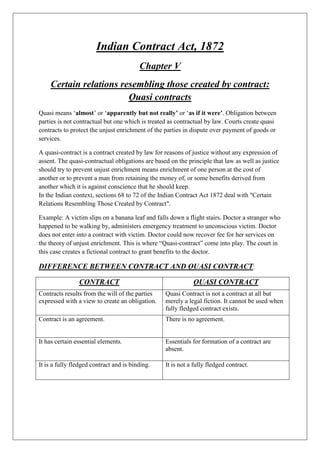
Quasi means ‘almost’ or ‘apparently but not really’ or ‘as if it were’. Obligation between
parties is not contractual but one which is treated as contractual by law. Courts create quasi
contracts to protect the unjust enrichment of the parties in dispute over payment of goods or
services.
A quasi-contract is a contract created by law for reasons of justice without any expression of
assent. The quasi-contractual obligations are based on the principle that law as well as justice
should try to prevent unjust enrichment means enrichment of one person at the cost of
another or to prevent a man from retaining the money of, or some benefits derived from
another which it is against conscience that he should keep.
In the Indian context, sections 68 to 72 of the Indian Contract Act 1872 deal with "Certain
Relations Resembling Those Created by Contract".
Example: A victim slips on a banana leaf and falls down a flight stairs. Doctor a stranger who
happened to be walking by, administers emergency treatment to unconscious victim. Doctor
does not enter into a contract with victim. Doctor could now recover fee for her services on
the theory of unjust enrichment. This is where “Quasi-contract” come into play. The court in
this case creates a fictional contract to grant benefits to the doctor.
DIFFERENCE BETWEEN CONTRACT AND QUASI CONTRACT:
CONTRACT QUASI CONTRACT
Contracts results from the will of the parties
expressed with a view to create an obligation.
Quasi Contract is not a contract at all but
merely a legal fiction. It cannot be used when
fully fledged contract exists.
Contract is an agreement. There is no agreement.
It has certain essential elements. Essentials for formation of a contract are
absent.
It is a fully fledged contract and is binding. It is not a fully fledged contract.
Nature of quasi-contractual obligations – under English and Indian
laws
The English Law identified quasi-contractual obligations; the framers of the Indian Contract
Act modified it and placed it in the Act as- “Certain Relations Resembling Those Created By
Contracts”. Therefore the elements that are present in the English Quasi-contract are also
found in that of the Indian Contract Act.
1] Payments to the defendant’s use
Two principles govern this liability:
· payment should have been made under pressure and not voluntarily;
· the defendant should have been bound to pay and has been relieved of his liability by
the payment made by the plaintiff.
The kind of pressure that the law recognizes for the purposes of this remedy is clearly
understood by the case of Exall v. Partridge, where, the plaintiff had left his carriage upon the
premises which the defendant was leaving as a tenant. The landlord lawfully seized all the
goods on the premises including the carriage for non-payment of rent and would have sold
them in execution of his claim. The plaintiff paid the outstanding rent to get back his carriage
and then sued the defendant for the amount. He was held entitled to it.
2] Voluntary payments
Payments made under the mistake of fact can be recovered provided that the party paying
would have been liable to pay if the mistake of fact were true. In this respect one must look at
the case of Kelly v. Solary, where the money was paid under a life insurance policy which to
the knowledge of the company had lapsed. But, the fact of lapse having been forgotten at the
moment, the company was held entitled to recover back the money. One of the essential
conditions of this action is that the mistake must be of fact and must make the person liable to
pay the money.
3] Quantum Meriut
Quantum meruit is a Latin phrase meaning "what one has earned". In the context of contract
law, it means something along the lines of "reasonable value of services". There are situations
wherein a party does the performance of a contract and further performance is made useless
by the other party. In such cases the former can recover reasonable compensation from latter.
Where a party has in the performance of his contract done some work or rendered some
service and the further performance has been made useless by the other party, he may recover
reasonable compensation for the work or service.
The case of Plinche vs Colburn(1831) is an authority for this principle.
In this case:-
FACTS: The plaintiff was the author of several dramatic entertainments. He was engaged by
the defendants, who were the publishers of a work called “ The Juvenile Library”. The
defendants asked the plaintiff to write an article to illustrate the history of armour and
costumes from the earliest times ,for which he was to be paid 100 guineas. The plaintiff made
various drawings and prepared a considerable portion of the manuscript when the defendants
discontinued the library.
ISSUE: Whether the plaintiff was entitled to a compensation or not.
JUDGEMENT: It was held, the plaintiff that is the author was held entitled to a sum of 50
guineas, for the part which he had prepared and the trouble that he had taken in business.
In Quantum Meruit, also a similar recovery is allowed where a person has rendered
services under a supposed contract which turns out to be nullity.
The case of Craven-Ellis vs Canons ltd (1936) is an authority for this.
In this case:-
FACTS: The plaintiff was appointed the managing director of a company. The appointment
was made by the other directors who were disqualified by reason of having not taken their
qualification shares. The plaintiff also did not take his qualification shares. But he continued
to act as managing director and sued the company for his agreed remuneration.
ISSUE: Whether the plaintiff was entitled to a compensation or not.
JUDGEMENT: The court of appeal rejected the claim for the agreed remuneration, the
contract of appointment was held void, but allowed the plaintiff to recover a compensatory
sum on the basis of quantum meruit.
GREEH LJ emphasised that a claim of this kind does not depend upon implied contract
arising by virtue of the services having been accepted or upon inference of law, but upon a
rule of law.
Section 68: Claim for necessaries supplied to person
incapable of contracting, or on his account.
“If a person incapable of entering into contract (A), or anyone whom he is legally bound to
support (B),
Is supplied by another person with necessaries(C) suited to his condition in life,
The person who has furnished such supplies is entitled to be reimbursed from the property of
such incapable person.’’
(A)Who all are incapable of entering into contract – section 11 of the Indian contract act
tells us who all are competent to contract .It says “Every person is competent to contract, who
is of the age of majority according to the law to which he is subject and who is of sound mind
and is not is not disqualified from contracting by any law to which he is subject.”
This means that anyone who is –
i) A minor –
ii) Of unsound mind
iii) Disqualified by law to which he is subject
Are incapable of entering into a contract.
Illustration -
(Bare Act) A supplies B, a lunatic, with necessaries suitable to his condition in life. A is
entitled to be reimbursed from B’s property.
Sound mind for contract under Indian contract act –defined in section 12 as follows “A
person is said to be of sound mind for the purpose of making a contract, if, at the time when
he makes it, he is capable of understanding it and of forming a rational judgment as to its
effect upon his interests. —A person is said to be of sound mind for the purpose of making a
contract, if, at the time when he makes it, he is capable of understanding it and of forming a
rational judgment as to its effect upon his interests." A person, who is usually of unsound
mind, but occasionally of sound mind, may make a contract when he is of sound mind. A
person, who is usually of sound mind, but occasionally of unsound mind, may not make a
contract when he is of unsound mind.
Illustrations-
(a) A patient in a lunatic asylum, who is, at intervals, of sound mind, may contract during
those intervals. (a) A patient in a lunatic asylum, who is, at intervals, of sound mind, may
contract during those intervals."
(b) A sane man, who is delirious from fever, or who is so drunk that he cannot understand the
terms of a contract, or form a rational judgment as to its effect on his interests, cannot
contract whilst such delirium or drunkenness lasts. (b) A sane man, who is delirious from
fever, or who is so drunk that he cannot understand the terms of a contract, or form a rational
judgment as to its effect on his interests, cannot contract whilst such delirium or drunkenness
lasts."
Views of English law – in English law a person of unsound mind is competent to contract
and the contract is voidable if he proves in the court that he was incapable of understanding
the contract and the other party knew it. It becomes binding on him only if he affirms it. Lord
Esher said in the case of Imperial loan vs. Stone 1892 that “when a person enters into a
contract and afterwards alleges that he was so insane at the time that he did not know what he
was doing ,and proves the allegation, the contract is as binding on him in every respect
,whether it is executor or executed, as if he had been sane when he made it, unless he can
prove further that the person with whom he contracted knew him to be so insane as not to be
capable of understanding what it was about. ”
(B) Whom he is legally bound to support – this is well illustrated in illustration “B” of the
bare acts it covers the case of husband and wife. i.e., A supplied the wife and children of B ,
a lunatic, with necessaries suitable to their condition in life. A is entitled to be reimbursed
from B’s property.
(C) Is supplied by another person with necessaries suited to his condition in life – the Indian
contract act provides no definition of the term necessities .but a illustrative definition of
necessities is provided in the case of Chapple vs. Cooper 1844, (in this case A young widow
entered into contract for the funeral expenses for her late husband, and later refused for
making the payment claiming her incapacity to make contract, a suit was filed against her
and she was held liable to pay the expenses, as these services were regarded as necessaries. )
“Things necessary are those without which an individual cannot reasonably exist. In the first
place, food, raiment, lodging and the like. About these there is no doubt. Again, as the proper
cultivation of mind is as expedient as the support of the body, instruction in art or trade, or
intellectual, moral and religious education may be necessary also…. Then the classes being
established, the subject and extent of the contract may vary according to the state and
condition of the infant himself. His clothes may be fine or coarse …..But in all these cases it
must be first be made out that the class itself is one in which the things furnished are essential
to the existence and of reasonable advantage and comfort of the infant contractor. Thus
articles of mere luxury are always excluded, though luxurious articles of utility are in some
cases allowed. ” as in the case of peters vs. Fleming 1840 , where an undergraduate at a
collage should have a watch and consequently a watch chain; and that therefore it was a
question of fact whether the watch chain supplied on credit was such as necessary to support
himself properly in his degree. Parke B says: “All such articles as are purely ornamental are
to be rejected, as they cannot be requisite for anyone.”
Thus “what is necessary” is a relative fact and is to be determined on the Prima Facie of the
facts and circumstances of the case, what is necessary for one might not be necessary for
another.
It is to be observed that the minors property is liable for the necessaries, and no
personal liability is incurred by him as was held in the case of - Mohori Bibi v. Dharmodas
Ghosh 1903 in this case, agent of defendant advanced money to plaintiff, an infant, fully
knowing his incompetency to contract, against mortgage of property belonging to latter.
Plaintiff commenced this action to get the mortgage declared as void u/s 2, 10 and 11 of ICA
and repossession of property there under conveyed to defendant. The Court held that unless
the parties are competent to contract as u/s 11, no agreement is contract as u/s 10 and hence,
is not enforceable by law u/s 2(h) and is void u/s 2(g). Since minor is not competent to
contract u/s 11, hence every such agreement entered into by a minor is void ab initio (void
from the very inception). Even u/s 68, a minor is deemed as incompetent to contract and is
not to be personally liable for any necessaries supplied to him, albeit a statutory claim is
created against his property.
To render an infant’s state liable there are two conditions to be satisfied –
i) The contract must be for goods reasonably necessary to support in his station in
life.
ii) He must not already have a sufficient supply of these necessaries which happened
in the case of Nash vs. Inman 1908 where an undergraduate student in the
Cambridge University, who was amply supplied with proper clothes according to
his position, was supplied by the plaintiff with a number of dresses (fancy
dresses). The price was held to be irrecoverable.
Section 69 -"Reimbursement of person paying money due
by another, in payment of which he is interested"
Section 69 of Indian Contract Act, 1872 states that “A person who is interested in the
payment of money which another is bound by law to pay, and who therefore pays it is entitled
to reimbursement by the other."
In other words when a person shows his interest in making payment of money, and also pays
for it, while another person is bound and liable to same, but fails to pay, the person so making
the payment is entitled and can recover the money by the person who is bound to pay.
Illustration:-
B holds land in Bengal, on a lease granted by A, the Zamindar. The revenue payable by A to
Government being in arrear, his land is advertised for sale by the government. Under the
revenue law, the consequent annulment of his own lease pays to the Government the sum due
from A. A is bound to make good to B the amount so paid.
Conditions of liability
The conditions of liability under this section may now be stated.
1. Payer must be interested:- Firstly, the person, who has paid the money but not bound to
pay should be interested in making the payment. The interest which the person seeks to
protect must be legally recognizable. His honest belief that he has an interest to protect is
enough.
For explaining that where the interest can be seen here I am giving an example of a case:
GOVINDRAM GORSHANDAS SEKSARIA V/S STATE OF GONDAL,
AIR 1950
Facts: - In this case there was defendant who had sold certain mills to the plaintiff. After
purchasing the mills plaintiff founds that the mills are already in some overdue municipal
taxes. The property is now going to be sold on execution, in order to save the property from
being sold in execution; the plaintiff paid all the taxes and sues the defendant for the recovery
of the money paid by him as the municipal tax.
Issue: - Whether the plaintiff should be reimbursed or not.
Judgment: - In this case it was held that the plaintiff should be reimbursed because all the
condition of liability for being reimbursed under this section can be seen, the interest which is
a very important condition can be seen when the plaintiff agrees to buy the property and pays
all the overdue taxes in order to save his own interest.
2. But should not be bound to pay: - Secondly, it is very necessary that the person who has
paid the money should not be bound to pay. He should only be interested in making the
payment in order to protect his own interest. Where a person is jointly liable with others to
pay, a payment by him of the other’s share would not give him a right of recovery under this
section.
For the better understanding of the condition there I am giving an example of a case again:
PORT OF THE TRUST, MADRAS V/S BOMBAY CO (P) LTD., AIR 1967
Facts: - In this case there was a port authority the plaintiff who was doing a construction and
during the construction a workman was injured due to the negligence of the contractor and
for the medical treatment of the injured the plaintiff paid some money to the workman. Now,
the plaintiff sued the defendant for the recovery of the money spent by the plaintiff.
Issue: - Whether the plaintiff should be reimbursement by the defendant or not.
Judgment: - In this case it was held that the defendant is not liable to reimburse the plaintiff
because, in this case the plaintiff is not only interested in making the payment but also under
a statutory liability to pay an injured workman which was held because of the negligence of
the contractor.
3. Defendant should be under legal compulsion to pay: - Thirdly, the person who was
failed to pay, should have been "bound by law" to pay the money. The words "bound by law"
have been held, after some hesitation, to mean bound by law or by contract. It is not
necessary that the liability should be only statutory. It is enough that "the defendant at the suit
of any person might be compelled to pay".
Explaining this by the already given example case by me named "Govindram Gordhandas
Seksaria vs State of Gondal"
In this case, we have studied that the defendant is under legal compulsion to pay when the
property is being sold in execution by government and in order to save the property the
payment of taxes is compulsory, and the defendant was bound to pay this money in the sense
that he made a legally enforceable contract with the plaintiff to pay it.
4. Payment should be by one to another: - Lastly, the plaintiff should have made the
payment to another person and not to himself.
SECRETARY OF STATE FOR INDIA V/S FERNANDES
Facts: - In this case the Government as plaintiff was the tenant of a land and the landlord the
defendant has not paid any land revenue to the Government, now the Government paid to
itself out of the rent due to the Landlord the arrear of land revenue due to itself and also sued
the plaintiff for the recovery of money paid by him as the land revenue.
Issue: - Whether the defendant should be reimbursed by the plaintiff or not
Judgment: - In this case it was held that, the government could not recover the money from
the landlord. It was a transfer of money by one head to another within the Government and
not 'payment to another' and though it was done to save the land from being sold in
execution, it did not come within the principle of the section.
Section 70: Obligation of person enjoying benefit of non-
gratuitous act
According to the Indian contract act ,1872, where a person lawfully does anything for another
person, or delivers anything to him,not intending to do so gratuitously ,and suchother person
enjoys the the benefit thereof,the latter is bound to make compensation to the former in
respect of, or to restore, the thing so done or delivered.
Illustrations:
*A, a tradesman, leaves goods at B’s house by mistake .B treats the good as his own. He is
bound to pay A for them.
* A saves B’s property from fire .A is not entitled to compensation from B, if the
circumstances show that he intended to do so gratuitously.
Where a claim for compensation is made under section 70,by one person against another, it is
not on the basis of any subsisting contract between the parties.
Case laws:
1. V.R Subramanyam v. B.Thayappa, (1961) 3 SCR 663: (1961) 2 SCJ 191
FACTS:
In addition to the construction work as stipulated under the contract, plaintiff did some more
construction work as requested by an officer of State of W.B. Government though started
using the constructed warehouse, yet on account of the work not being recorded in form of
contract as provided under Article 299 of Constitution, denied any liability to pay for it.
ISSUES:
1. Whether there was any contract between the State of W.B. and plaintiff?
2. Whether the rule of Promissory Estoppel can be evoked?
3. Whether plaintiff can claim under S.70 of Indian Contract Act (ICA)?
HELD:
Since the officers making such requests were unauthorized by the government to do so,
hence, there was neither any agreement between the parties nor the rule of Promissory
Estoppel could be invoked (See Motilal Padampat Sugar Mills)
Three conditions must be satisfied before S.70 could be invoked: First, person should
lawfully do something for another person or deliver something to him; Second, in doing so,
he must not intend to act gratuitously; Third, other person for whom something is done or to
whom something is delivered must ‘voluntarily’ enjoy the benefit thereof. Such other person
must have the option not to accept the thing and to return it. It is only when he voluntary
accepts the thing or enjoys the work done, that the liability u/s 70 arises. The person must not
be incompetent to exercise his volition u/s 11.
S.70 does not deal with rights and liberties arising from contracts rather from relations
which resemble those created by contracts. Therefore, person offering benefit to another
could not compel for specific performance thereof nor could ask for any damages for breach
for there was never a contract between the persons. But if the other person voluntarily enjoys
the benefit there from, former may claim eithercompensation or restoration u/s 70; though
such a claim for compensation is in no way to be treated as borne contractually.
Further, “lawfully” u/s 70 must be read in accordance with S.23 of ICA. In alternative “it
indicates that after something is done or delivered by one person to other who enjoys the
benefit there from, a lawful relation is borne which u/s 70 gives rise to a claim for
compensation”.
A MINOR cannot be sued for compensation u/s 70 of ICA: Incidentally, minor is excluded
from S.70 for his case is specifically dealt with u/s 68 in same chapter; Secondly, voluntary
acceptance of benefit of work done or thing delivered which is the foundation for any claim
u/s 70 will not be present for he is incompetent to exercise his volition u/s 11.
After the plaintiff constructed the warehouse it was open to the State of W.B. to have the
benefit of it or to demolish it and instruct the plaintiff to take the materials used therein. The
government, by voluntarily enjoying the benefit accruing from the constructed warehouses,
became liable u/s 70. However, it is urged by the defendant that allowing this cause of action
would amount to enforcing a contract in infringement of mandatory provisions of A.299 of
the constitution, rendering it invalid. But, the contention is not well founded for the plaintiff
did not allege any contract at all while claiming u/s 70. The cause of action u/s 70 is
independent of any contract; the cause of action is based not upon the delivery of the thing
or doing of the work as such but upon the acceptance and enjoyment of the said goods or
the said work. A.299 may forbid a government to take work under a contract rendered invalid
on account of its not being in compliance with its terms, but does not make it unlawful for the
government to take the benefit of work done for it under no contract at all. Request made by
the officers not authorized on behalf of government was not a request at all and did amount to
nothing.
Section 71: Responsibility of finder of goods
Section 71 of the Indian Contract Act, 1872 tells us about the responsibility of the finder of
the goods.
Section 71 states that-
“A person who finds goods belonging to another, and takes them into his custody, is subject
to the same responsibility as a bailee.
Coming to the concept of the bail.
Section 148 of the Indian contract act, 1872 describes the concept of BAIL.
It states that-
“A bailment is the delivery of the good by one person to another for some purpose, upon a
contract that they shall, when the purpose is accomplished, be returned or otherwise disposed
of according to the directions of the person delivering them. The person delivering the goods
is called the bailor. The person to whom they are delivered is called the bailee.
Duties, liabilities, and rights of a bailee-
Duties-
 To take prudent man’s care. [s.151]
 Not to make wrongful use of goods. [s.152]
 Not to mix up bailed goods with his own. [s.156,157]
 To return bailed goods. [s.159,160]
Section 72:“Liabilities of a person to whom money is paid or
thing delivered by mistake or under coercion”
Section 72 of Indian Contract Act, 1872 states that “A person to whom money has been paid,
or anything delivered by mistake or under coercion, must repay or return it.”
In simple words, if one party under a mistake pays to other party money which is not due by
contract or otherwise, that money must be repaid. It is the liability of the person, to whom
money is paid or things are delivered by mistake or under coercion, to repay back the money
or return back the goods to the true owner.
Illustration:
1. A and B jointly owe Rs.100 to C. A alone pays the amount. B not knowing it also
pays to C. C is bound to repay the amount to B.
2. A railway co. refuses to deliver certain goods to the consignee, except upon the
payment of illegal charge for carriage. The consignee pays the sum charged in order
to obtain the goods. He is entitled to receive the excessive amount as paid by him.
Mistake is a misconception or error. Mistake means erroneous belief or wrong motion
concerning something. Section 20 of the Indian Contract act 1872, defines Mistake as
follows: “Where both parties to an agreement are under a mistake as to a matter of fact
essential to the agreement, the agreement is void.”
Thus it means that parties entering into the contract should not be under any error and they
must agree on the same thing in the same sense (Consensus Ad Idem)
However, Sec. 72 does not draw any distinction between a mistake of fact and mistake of
law.
Money paid under mistake is recoverable irrespective of the fact that whether the mistake is
of fact or of law. The controversy between the High Court Decisions as to whether money
paid under mistake of law could be recovered was set at rest by the Privy Council in Sri Sri
Shiba Prasad Singh v. Maharaja Srish Chandra Nanadi it was made clear that money
paid under mistake is recoverable whether the mistake is of fact or of law. If a mistake either
of law or of fact is established, the individual is entitled to recover the money and the party
receiving it is bound to return it irrespective of any other consideration.
K paid sales tax on his forward transactions of bullion. Subsequently this tax was declared
ultra vires. Held, K could recover the amount of sales tax and that sec. 72 is wide enough to
cover not only mistake of fact but also mistake of law. {Sales Tax Officer, Benares v.
Kanhaiya Lal Mukand Lal Saraf, 1959 S.C.J. 53}.
Sales Tax Officer, Banaras and Ors. vs. Kanhaiya Lal Mukundlal SarafAIR 1959 SC
135
FACTS
Plaintiff claimed refund under section 72 of the sales tax levied by the defendant for the
forward transactions entered into by the former, after the impugned collection of tax on such
transactions was declared illegal, alleging that such levy was done under a mistake of law.
ISSUE: Whether S.72 includes within its scope mistake as to law.
HELD:
Section 72 of the Indian Contract Act, which does not deal with the contractual relations
between the parties but the relations which resemble those of contracts (quasi contractual), is
not in conflict with the provisions of Section 21 of the Act (which renders contract made in
mistake as to law as valid) which operates at the stage of formation of contract.
If mistake of law has led to the formation of a contract, S.21 enacts that contract is not for
that reason voidable. If money is paid under that contract, it cannot be said that that
money was paid under “mistake of law” for it was paid under a valid contract, and had it
not been paid it could have been enforced. Payment, “by mistake” in S.72 refers to a
payment which wasn’t legally due and which couldn’t have been enforced; mistake is in
thinking that money paid was due when in fact it was not due.
In the present case, plaintiff committed mistake in thinking that the monies paid were due
while in fact they were not due and that mistake on being established, entitled plaintiff to
recover the same from the state under Section 72.
COERCION:-
Coercion under Sec.72: Money must be paid voluntarily without compulsion, extortion,
undue influence, or even fraud and with full knowledge of facts. The word “coercion” used in
this section is used in the general sense and not as defined in section 15. Thus the money paid
under pressure of circumstances, such as prevention of the execution of a decree on a
property in which the party paying is interested, may be recovered even though “coercion” as
defined in sections 15 is not established.
THEORY OF UNJUST ENRICHMENT:-
The retention of a benefit conferred by another, that is not intended as a gift and is not legally
justifiable, without offering compensation, in circumstances where compensation is
reasonably expected.
Under this section the principle of unjust enrichment cannot be extended to give a right to the
state to recover or realise vend fee after the concerned statute for realisation of vend fee has
been struck down; (Somaiya Organics (India) Ltd vs State Of Uttar Pradesh, AIR 2001
SC 1725).
GLOSSARY
1. REIMBURSEMENT- The act of compensating someone for an expense.
2. LUNATIC- One who has had an understanding, but who, by disease, grief, or other
accident, has lost the use of his reason. A lunatic is properly one who has had lucid
intervals, sometimes enjoying his senses, and sometimes not.
3. MINOR- Refers to a person who is under 18 years of age.
4. VOID AB INITIO- Latin, void from the beginning. Never legitimate or valid.
5. ARREARAGE- Money remaining unpaid after it becomes due as rent unpaid
interest remaining due; a sum of money remaining in the hands of an accountant.
Also may revert to overdue alimony or child support payments, all of which are
usually not able to be discharged in bankruptcy or retroactively canceled by the
court.
6. GRATUITOUS-(A) An act that is lacking in good reason or is unwarranted. (B)
Something given or done that is voluntary or free of charge.
7. BAILEE- One to whom the goods are bailed.
8. MISTAKE- An error committed in relation to some matter of fact affecting the
rights of one of the parties to a contract.
9. COERCION- Force to compel a person to do something, or to abstain from doing
something.
10. UNJUST ENRICHMENT- A legal doctrine to remedy the situation where one
party to a contract or agreement unjustifiably benefits from the property or action
of another and without compensation. The law provides an obligation of restitution
to be made by the enriched party.

Quasi contracts- Certain Relations Resembling those created by Contract

  • 1.
    The Indian ContractAct,1872 Chapter V Certain relations resembling those created by contract: Quasi contracts Section 68-72 Submitted by: 1) Kunika Kanodia- 04551103815 2) Mohd Asad Saeed- 05151103815 3) Mohd Shahkar- 05251103815 4) Shikha Srivastava- 07851103815 5) Abhilash Bhardwaj-00351103815 6) Uday Sharma- 09651103815
  • 2.
    Indian Contract Act,1872 Chapter V Certain relations resembling those created by contract: Quasi contracts Quasi means ‘almost’ or ‘apparently but not really’ or ‘as if it were’. Obligation between parties is not contractual but one which is treated as contractual by law. Courts create quasi contracts to protect the unjust enrichment of the parties in dispute over payment of goods or services. A quasi-contract is a contract created by law for reasons of justice without any expression of assent. The quasi-contractual obligations are based on the principle that law as well as justice should try to prevent unjust enrichment means enrichment of one person at the cost of another or to prevent a man from retaining the money of, or some benefits derived from another which it is against conscience that he should keep. In the Indian context, sections 68 to 72 of the Indian Contract Act 1872 deal with "Certain Relations Resembling Those Created by Contract". Example: A victim slips on a banana leaf and falls down a flight stairs. Doctor a stranger who happened to be walking by, administers emergency treatment to unconscious victim. Doctor does not enter into a contract with victim. Doctor could now recover fee for her services on the theory of unjust enrichment. This is where “Quasi-contract” come into play. The court in this case creates a fictional contract to grant benefits to the doctor. DIFFERENCE BETWEEN CONTRACT AND QUASI CONTRACT: CONTRACT QUASI CONTRACT Contracts results from the will of the parties expressed with a view to create an obligation. Quasi Contract is not a contract at all but merely a legal fiction. It cannot be used when fully fledged contract exists. Contract is an agreement. There is no agreement. It has certain essential elements. Essentials for formation of a contract are absent. It is a fully fledged contract and is binding. It is not a fully fledged contract.
  • 3.
    Nature of quasi-contractualobligations – under English and Indian laws The English Law identified quasi-contractual obligations; the framers of the Indian Contract Act modified it and placed it in the Act as- “Certain Relations Resembling Those Created By Contracts”. Therefore the elements that are present in the English Quasi-contract are also found in that of the Indian Contract Act. 1] Payments to the defendant’s use Two principles govern this liability: · payment should have been made under pressure and not voluntarily; · the defendant should have been bound to pay and has been relieved of his liability by the payment made by the plaintiff. The kind of pressure that the law recognizes for the purposes of this remedy is clearly understood by the case of Exall v. Partridge, where, the plaintiff had left his carriage upon the premises which the defendant was leaving as a tenant. The landlord lawfully seized all the goods on the premises including the carriage for non-payment of rent and would have sold them in execution of his claim. The plaintiff paid the outstanding rent to get back his carriage and then sued the defendant for the amount. He was held entitled to it. 2] Voluntary payments Payments made under the mistake of fact can be recovered provided that the party paying would have been liable to pay if the mistake of fact were true. In this respect one must look at the case of Kelly v. Solary, where the money was paid under a life insurance policy which to the knowledge of the company had lapsed. But, the fact of lapse having been forgotten at the moment, the company was held entitled to recover back the money. One of the essential conditions of this action is that the mistake must be of fact and must make the person liable to pay the money. 3] Quantum Meriut Quantum meruit is a Latin phrase meaning "what one has earned". In the context of contract law, it means something along the lines of "reasonable value of services". There are situations wherein a party does the performance of a contract and further performance is made useless by the other party. In such cases the former can recover reasonable compensation from latter. Where a party has in the performance of his contract done some work or rendered some service and the further performance has been made useless by the other party, he may recover reasonable compensation for the work or service. The case of Plinche vs Colburn(1831) is an authority for this principle. In this case:-
  • 4.
    FACTS: The plaintiffwas the author of several dramatic entertainments. He was engaged by the defendants, who were the publishers of a work called “ The Juvenile Library”. The defendants asked the plaintiff to write an article to illustrate the history of armour and costumes from the earliest times ,for which he was to be paid 100 guineas. The plaintiff made various drawings and prepared a considerable portion of the manuscript when the defendants discontinued the library. ISSUE: Whether the plaintiff was entitled to a compensation or not. JUDGEMENT: It was held, the plaintiff that is the author was held entitled to a sum of 50 guineas, for the part which he had prepared and the trouble that he had taken in business. In Quantum Meruit, also a similar recovery is allowed where a person has rendered services under a supposed contract which turns out to be nullity. The case of Craven-Ellis vs Canons ltd (1936) is an authority for this. In this case:- FACTS: The plaintiff was appointed the managing director of a company. The appointment was made by the other directors who were disqualified by reason of having not taken their qualification shares. The plaintiff also did not take his qualification shares. But he continued to act as managing director and sued the company for his agreed remuneration. ISSUE: Whether the plaintiff was entitled to a compensation or not. JUDGEMENT: The court of appeal rejected the claim for the agreed remuneration, the contract of appointment was held void, but allowed the plaintiff to recover a compensatory sum on the basis of quantum meruit. GREEH LJ emphasised that a claim of this kind does not depend upon implied contract arising by virtue of the services having been accepted or upon inference of law, but upon a rule of law.
  • 5.
    Section 68: Claimfor necessaries supplied to person incapable of contracting, or on his account. “If a person incapable of entering into contract (A), or anyone whom he is legally bound to support (B), Is supplied by another person with necessaries(C) suited to his condition in life, The person who has furnished such supplies is entitled to be reimbursed from the property of such incapable person.’’ (A)Who all are incapable of entering into contract – section 11 of the Indian contract act tells us who all are competent to contract .It says “Every person is competent to contract, who is of the age of majority according to the law to which he is subject and who is of sound mind and is not is not disqualified from contracting by any law to which he is subject.” This means that anyone who is – i) A minor – ii) Of unsound mind iii) Disqualified by law to which he is subject Are incapable of entering into a contract. Illustration - (Bare Act) A supplies B, a lunatic, with necessaries suitable to his condition in life. A is entitled to be reimbursed from B’s property. Sound mind for contract under Indian contract act –defined in section 12 as follows “A person is said to be of sound mind for the purpose of making a contract, if, at the time when he makes it, he is capable of understanding it and of forming a rational judgment as to its effect upon his interests. —A person is said to be of sound mind for the purpose of making a contract, if, at the time when he makes it, he is capable of understanding it and of forming a rational judgment as to its effect upon his interests." A person, who is usually of unsound mind, but occasionally of sound mind, may make a contract when he is of sound mind. A person, who is usually of sound mind, but occasionally of unsound mind, may not make a contract when he is of unsound mind. Illustrations- (a) A patient in a lunatic asylum, who is, at intervals, of sound mind, may contract during those intervals. (a) A patient in a lunatic asylum, who is, at intervals, of sound mind, may contract during those intervals." (b) A sane man, who is delirious from fever, or who is so drunk that he cannot understand the terms of a contract, or form a rational judgment as to its effect on his interests, cannot contract whilst such delirium or drunkenness lasts. (b) A sane man, who is delirious from
  • 6.
    fever, or whois so drunk that he cannot understand the terms of a contract, or form a rational judgment as to its effect on his interests, cannot contract whilst such delirium or drunkenness lasts." Views of English law – in English law a person of unsound mind is competent to contract and the contract is voidable if he proves in the court that he was incapable of understanding the contract and the other party knew it. It becomes binding on him only if he affirms it. Lord Esher said in the case of Imperial loan vs. Stone 1892 that “when a person enters into a contract and afterwards alleges that he was so insane at the time that he did not know what he was doing ,and proves the allegation, the contract is as binding on him in every respect ,whether it is executor or executed, as if he had been sane when he made it, unless he can prove further that the person with whom he contracted knew him to be so insane as not to be capable of understanding what it was about. ” (B) Whom he is legally bound to support – this is well illustrated in illustration “B” of the bare acts it covers the case of husband and wife. i.e., A supplied the wife and children of B , a lunatic, with necessaries suitable to their condition in life. A is entitled to be reimbursed from B’s property. (C) Is supplied by another person with necessaries suited to his condition in life – the Indian contract act provides no definition of the term necessities .but a illustrative definition of necessities is provided in the case of Chapple vs. Cooper 1844, (in this case A young widow entered into contract for the funeral expenses for her late husband, and later refused for making the payment claiming her incapacity to make contract, a suit was filed against her and she was held liable to pay the expenses, as these services were regarded as necessaries. ) “Things necessary are those without which an individual cannot reasonably exist. In the first place, food, raiment, lodging and the like. About these there is no doubt. Again, as the proper cultivation of mind is as expedient as the support of the body, instruction in art or trade, or intellectual, moral and religious education may be necessary also…. Then the classes being established, the subject and extent of the contract may vary according to the state and condition of the infant himself. His clothes may be fine or coarse …..But in all these cases it must be first be made out that the class itself is one in which the things furnished are essential to the existence and of reasonable advantage and comfort of the infant contractor. Thus articles of mere luxury are always excluded, though luxurious articles of utility are in some cases allowed. ” as in the case of peters vs. Fleming 1840 , where an undergraduate at a collage should have a watch and consequently a watch chain; and that therefore it was a question of fact whether the watch chain supplied on credit was such as necessary to support himself properly in his degree. Parke B says: “All such articles as are purely ornamental are to be rejected, as they cannot be requisite for anyone.” Thus “what is necessary” is a relative fact and is to be determined on the Prima Facie of the facts and circumstances of the case, what is necessary for one might not be necessary for another.
  • 7.
    It is tobe observed that the minors property is liable for the necessaries, and no personal liability is incurred by him as was held in the case of - Mohori Bibi v. Dharmodas Ghosh 1903 in this case, agent of defendant advanced money to plaintiff, an infant, fully knowing his incompetency to contract, against mortgage of property belonging to latter. Plaintiff commenced this action to get the mortgage declared as void u/s 2, 10 and 11 of ICA and repossession of property there under conveyed to defendant. The Court held that unless the parties are competent to contract as u/s 11, no agreement is contract as u/s 10 and hence, is not enforceable by law u/s 2(h) and is void u/s 2(g). Since minor is not competent to contract u/s 11, hence every such agreement entered into by a minor is void ab initio (void from the very inception). Even u/s 68, a minor is deemed as incompetent to contract and is not to be personally liable for any necessaries supplied to him, albeit a statutory claim is created against his property. To render an infant’s state liable there are two conditions to be satisfied – i) The contract must be for goods reasonably necessary to support in his station in life. ii) He must not already have a sufficient supply of these necessaries which happened in the case of Nash vs. Inman 1908 where an undergraduate student in the Cambridge University, who was amply supplied with proper clothes according to his position, was supplied by the plaintiff with a number of dresses (fancy dresses). The price was held to be irrecoverable.
  • 8.
    Section 69 -"Reimbursementof person paying money due by another, in payment of which he is interested" Section 69 of Indian Contract Act, 1872 states that “A person who is interested in the payment of money which another is bound by law to pay, and who therefore pays it is entitled to reimbursement by the other." In other words when a person shows his interest in making payment of money, and also pays for it, while another person is bound and liable to same, but fails to pay, the person so making the payment is entitled and can recover the money by the person who is bound to pay. Illustration:- B holds land in Bengal, on a lease granted by A, the Zamindar. The revenue payable by A to Government being in arrear, his land is advertised for sale by the government. Under the revenue law, the consequent annulment of his own lease pays to the Government the sum due from A. A is bound to make good to B the amount so paid. Conditions of liability The conditions of liability under this section may now be stated. 1. Payer must be interested:- Firstly, the person, who has paid the money but not bound to pay should be interested in making the payment. The interest which the person seeks to protect must be legally recognizable. His honest belief that he has an interest to protect is enough. For explaining that where the interest can be seen here I am giving an example of a case: GOVINDRAM GORSHANDAS SEKSARIA V/S STATE OF GONDAL, AIR 1950 Facts: - In this case there was defendant who had sold certain mills to the plaintiff. After purchasing the mills plaintiff founds that the mills are already in some overdue municipal taxes. The property is now going to be sold on execution, in order to save the property from being sold in execution; the plaintiff paid all the taxes and sues the defendant for the recovery of the money paid by him as the municipal tax. Issue: - Whether the plaintiff should be reimbursed or not. Judgment: - In this case it was held that the plaintiff should be reimbursed because all the condition of liability for being reimbursed under this section can be seen, the interest which is a very important condition can be seen when the plaintiff agrees to buy the property and pays all the overdue taxes in order to save his own interest. 2. But should not be bound to pay: - Secondly, it is very necessary that the person who has paid the money should not be bound to pay. He should only be interested in making the payment in order to protect his own interest. Where a person is jointly liable with others to
  • 9.
    pay, a paymentby him of the other’s share would not give him a right of recovery under this section. For the better understanding of the condition there I am giving an example of a case again: PORT OF THE TRUST, MADRAS V/S BOMBAY CO (P) LTD., AIR 1967 Facts: - In this case there was a port authority the plaintiff who was doing a construction and during the construction a workman was injured due to the negligence of the contractor and for the medical treatment of the injured the plaintiff paid some money to the workman. Now, the plaintiff sued the defendant for the recovery of the money spent by the plaintiff. Issue: - Whether the plaintiff should be reimbursement by the defendant or not. Judgment: - In this case it was held that the defendant is not liable to reimburse the plaintiff because, in this case the plaintiff is not only interested in making the payment but also under a statutory liability to pay an injured workman which was held because of the negligence of the contractor. 3. Defendant should be under legal compulsion to pay: - Thirdly, the person who was failed to pay, should have been "bound by law" to pay the money. The words "bound by law" have been held, after some hesitation, to mean bound by law or by contract. It is not necessary that the liability should be only statutory. It is enough that "the defendant at the suit of any person might be compelled to pay". Explaining this by the already given example case by me named "Govindram Gordhandas Seksaria vs State of Gondal" In this case, we have studied that the defendant is under legal compulsion to pay when the property is being sold in execution by government and in order to save the property the payment of taxes is compulsory, and the defendant was bound to pay this money in the sense that he made a legally enforceable contract with the plaintiff to pay it. 4. Payment should be by one to another: - Lastly, the plaintiff should have made the payment to another person and not to himself. SECRETARY OF STATE FOR INDIA V/S FERNANDES Facts: - In this case the Government as plaintiff was the tenant of a land and the landlord the defendant has not paid any land revenue to the Government, now the Government paid to itself out of the rent due to the Landlord the arrear of land revenue due to itself and also sued the plaintiff for the recovery of money paid by him as the land revenue. Issue: - Whether the defendant should be reimbursed by the plaintiff or not Judgment: - In this case it was held that, the government could not recover the money from the landlord. It was a transfer of money by one head to another within the Government and not 'payment to another' and though it was done to save the land from being sold in execution, it did not come within the principle of the section.
  • 10.
    Section 70: Obligationof person enjoying benefit of non- gratuitous act According to the Indian contract act ,1872, where a person lawfully does anything for another person, or delivers anything to him,not intending to do so gratuitously ,and suchother person enjoys the the benefit thereof,the latter is bound to make compensation to the former in respect of, or to restore, the thing so done or delivered. Illustrations: *A, a tradesman, leaves goods at B’s house by mistake .B treats the good as his own. He is bound to pay A for them. * A saves B’s property from fire .A is not entitled to compensation from B, if the circumstances show that he intended to do so gratuitously. Where a claim for compensation is made under section 70,by one person against another, it is not on the basis of any subsisting contract between the parties. Case laws: 1. V.R Subramanyam v. B.Thayappa, (1961) 3 SCR 663: (1961) 2 SCJ 191 FACTS: In addition to the construction work as stipulated under the contract, plaintiff did some more construction work as requested by an officer of State of W.B. Government though started using the constructed warehouse, yet on account of the work not being recorded in form of contract as provided under Article 299 of Constitution, denied any liability to pay for it. ISSUES: 1. Whether there was any contract between the State of W.B. and plaintiff? 2. Whether the rule of Promissory Estoppel can be evoked? 3. Whether plaintiff can claim under S.70 of Indian Contract Act (ICA)? HELD: Since the officers making such requests were unauthorized by the government to do so, hence, there was neither any agreement between the parties nor the rule of Promissory Estoppel could be invoked (See Motilal Padampat Sugar Mills) Three conditions must be satisfied before S.70 could be invoked: First, person should lawfully do something for another person or deliver something to him; Second, in doing so, he must not intend to act gratuitously; Third, other person for whom something is done or to
  • 11.
    whom something isdelivered must ‘voluntarily’ enjoy the benefit thereof. Such other person must have the option not to accept the thing and to return it. It is only when he voluntary accepts the thing or enjoys the work done, that the liability u/s 70 arises. The person must not be incompetent to exercise his volition u/s 11. S.70 does not deal with rights and liberties arising from contracts rather from relations which resemble those created by contracts. Therefore, person offering benefit to another could not compel for specific performance thereof nor could ask for any damages for breach for there was never a contract between the persons. But if the other person voluntarily enjoys the benefit there from, former may claim eithercompensation or restoration u/s 70; though such a claim for compensation is in no way to be treated as borne contractually. Further, “lawfully” u/s 70 must be read in accordance with S.23 of ICA. In alternative “it indicates that after something is done or delivered by one person to other who enjoys the benefit there from, a lawful relation is borne which u/s 70 gives rise to a claim for compensation”. A MINOR cannot be sued for compensation u/s 70 of ICA: Incidentally, minor is excluded from S.70 for his case is specifically dealt with u/s 68 in same chapter; Secondly, voluntary acceptance of benefit of work done or thing delivered which is the foundation for any claim u/s 70 will not be present for he is incompetent to exercise his volition u/s 11. After the plaintiff constructed the warehouse it was open to the State of W.B. to have the benefit of it or to demolish it and instruct the plaintiff to take the materials used therein. The government, by voluntarily enjoying the benefit accruing from the constructed warehouses, became liable u/s 70. However, it is urged by the defendant that allowing this cause of action would amount to enforcing a contract in infringement of mandatory provisions of A.299 of the constitution, rendering it invalid. But, the contention is not well founded for the plaintiff did not allege any contract at all while claiming u/s 70. The cause of action u/s 70 is independent of any contract; the cause of action is based not upon the delivery of the thing or doing of the work as such but upon the acceptance and enjoyment of the said goods or the said work. A.299 may forbid a government to take work under a contract rendered invalid on account of its not being in compliance with its terms, but does not make it unlawful for the government to take the benefit of work done for it under no contract at all. Request made by the officers not authorized on behalf of government was not a request at all and did amount to nothing.
  • 12.
    Section 71: Responsibilityof finder of goods Section 71 of the Indian Contract Act, 1872 tells us about the responsibility of the finder of the goods. Section 71 states that- “A person who finds goods belonging to another, and takes them into his custody, is subject to the same responsibility as a bailee. Coming to the concept of the bail. Section 148 of the Indian contract act, 1872 describes the concept of BAIL. It states that- “A bailment is the delivery of the good by one person to another for some purpose, upon a contract that they shall, when the purpose is accomplished, be returned or otherwise disposed of according to the directions of the person delivering them. The person delivering the goods is called the bailor. The person to whom they are delivered is called the bailee. Duties, liabilities, and rights of a bailee- Duties-  To take prudent man’s care. [s.151]  Not to make wrongful use of goods. [s.152]  Not to mix up bailed goods with his own. [s.156,157]  To return bailed goods. [s.159,160]
  • 13.
    Section 72:“Liabilities ofa person to whom money is paid or thing delivered by mistake or under coercion” Section 72 of Indian Contract Act, 1872 states that “A person to whom money has been paid, or anything delivered by mistake or under coercion, must repay or return it.” In simple words, if one party under a mistake pays to other party money which is not due by contract or otherwise, that money must be repaid. It is the liability of the person, to whom money is paid or things are delivered by mistake or under coercion, to repay back the money or return back the goods to the true owner. Illustration: 1. A and B jointly owe Rs.100 to C. A alone pays the amount. B not knowing it also pays to C. C is bound to repay the amount to B. 2. A railway co. refuses to deliver certain goods to the consignee, except upon the payment of illegal charge for carriage. The consignee pays the sum charged in order to obtain the goods. He is entitled to receive the excessive amount as paid by him. Mistake is a misconception or error. Mistake means erroneous belief or wrong motion concerning something. Section 20 of the Indian Contract act 1872, defines Mistake as follows: “Where both parties to an agreement are under a mistake as to a matter of fact essential to the agreement, the agreement is void.” Thus it means that parties entering into the contract should not be under any error and they must agree on the same thing in the same sense (Consensus Ad Idem) However, Sec. 72 does not draw any distinction between a mistake of fact and mistake of law. Money paid under mistake is recoverable irrespective of the fact that whether the mistake is of fact or of law. The controversy between the High Court Decisions as to whether money paid under mistake of law could be recovered was set at rest by the Privy Council in Sri Sri Shiba Prasad Singh v. Maharaja Srish Chandra Nanadi it was made clear that money paid under mistake is recoverable whether the mistake is of fact or of law. If a mistake either of law or of fact is established, the individual is entitled to recover the money and the party receiving it is bound to return it irrespective of any other consideration. K paid sales tax on his forward transactions of bullion. Subsequently this tax was declared ultra vires. Held, K could recover the amount of sales tax and that sec. 72 is wide enough to cover not only mistake of fact but also mistake of law. {Sales Tax Officer, Benares v. Kanhaiya Lal Mukand Lal Saraf, 1959 S.C.J. 53}.
  • 14.
    Sales Tax Officer,Banaras and Ors. vs. Kanhaiya Lal Mukundlal SarafAIR 1959 SC 135 FACTS Plaintiff claimed refund under section 72 of the sales tax levied by the defendant for the forward transactions entered into by the former, after the impugned collection of tax on such transactions was declared illegal, alleging that such levy was done under a mistake of law. ISSUE: Whether S.72 includes within its scope mistake as to law. HELD: Section 72 of the Indian Contract Act, which does not deal with the contractual relations between the parties but the relations which resemble those of contracts (quasi contractual), is not in conflict with the provisions of Section 21 of the Act (which renders contract made in mistake as to law as valid) which operates at the stage of formation of contract. If mistake of law has led to the formation of a contract, S.21 enacts that contract is not for that reason voidable. If money is paid under that contract, it cannot be said that that money was paid under “mistake of law” for it was paid under a valid contract, and had it not been paid it could have been enforced. Payment, “by mistake” in S.72 refers to a payment which wasn’t legally due and which couldn’t have been enforced; mistake is in thinking that money paid was due when in fact it was not due. In the present case, plaintiff committed mistake in thinking that the monies paid were due while in fact they were not due and that mistake on being established, entitled plaintiff to recover the same from the state under Section 72. COERCION:- Coercion under Sec.72: Money must be paid voluntarily without compulsion, extortion, undue influence, or even fraud and with full knowledge of facts. The word “coercion” used in this section is used in the general sense and not as defined in section 15. Thus the money paid under pressure of circumstances, such as prevention of the execution of a decree on a property in which the party paying is interested, may be recovered even though “coercion” as defined in sections 15 is not established. THEORY OF UNJUST ENRICHMENT:- The retention of a benefit conferred by another, that is not intended as a gift and is not legally justifiable, without offering compensation, in circumstances where compensation is reasonably expected. Under this section the principle of unjust enrichment cannot be extended to give a right to the state to recover or realise vend fee after the concerned statute for realisation of vend fee has been struck down; (Somaiya Organics (India) Ltd vs State Of Uttar Pradesh, AIR 2001 SC 1725).
  • 15.
    GLOSSARY 1. REIMBURSEMENT- Theact of compensating someone for an expense. 2. LUNATIC- One who has had an understanding, but who, by disease, grief, or other accident, has lost the use of his reason. A lunatic is properly one who has had lucid intervals, sometimes enjoying his senses, and sometimes not. 3. MINOR- Refers to a person who is under 18 years of age. 4. VOID AB INITIO- Latin, void from the beginning. Never legitimate or valid. 5. ARREARAGE- Money remaining unpaid after it becomes due as rent unpaid interest remaining due; a sum of money remaining in the hands of an accountant. Also may revert to overdue alimony or child support payments, all of which are usually not able to be discharged in bankruptcy or retroactively canceled by the court. 6. GRATUITOUS-(A) An act that is lacking in good reason or is unwarranted. (B) Something given or done that is voluntary or free of charge. 7. BAILEE- One to whom the goods are bailed. 8. MISTAKE- An error committed in relation to some matter of fact affecting the rights of one of the parties to a contract. 9. COERCION- Force to compel a person to do something, or to abstain from doing something. 10. UNJUST ENRICHMENT- A legal doctrine to remedy the situation where one party to a contract or agreement unjustifiably benefits from the property or action of another and without compensation. The law provides an obligation of restitution to be made by the enriched party.