- Grade 8 -
GOOD MORNING!
recap
What did we discuss in our previous meeting?
ObjectIVE
S:
a. define grammatical signals;
b. identify the different patterns of ideas development;
c. distinguish appropriate grammatical signals to each
pattern of idea development; and
d. point out the grammatical signals and pattern of idea
development used in a paragraph
let’s
warm
what am I?
• I will give clues for each items to be guessed.
• You have 10 seconds to think of an answer.
• Raise your hand if you want to answer.
EXAMPLE:
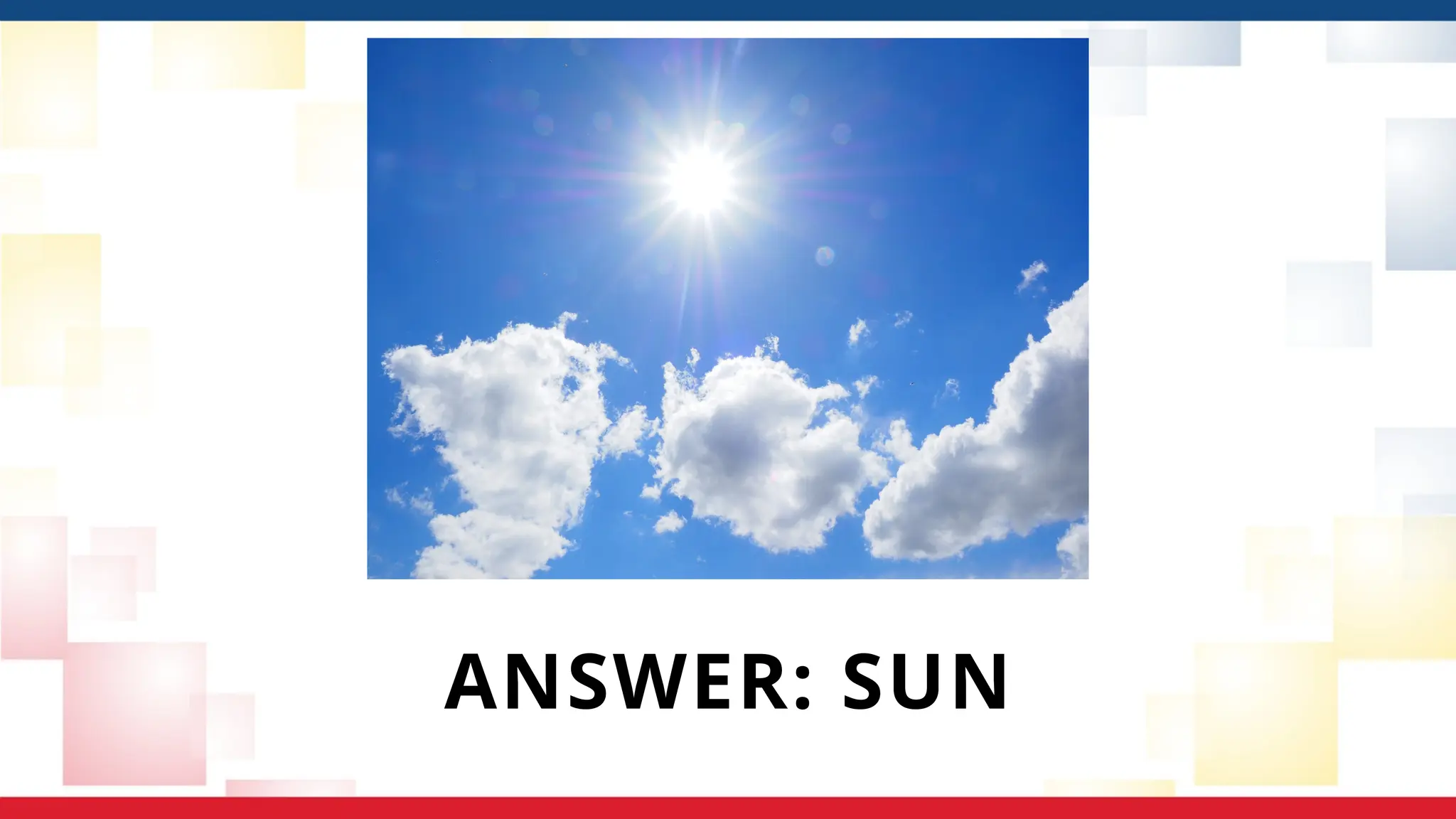
• I disappear at night
• I give light to the earth.
• I’m hot even in a far distance.
• I can give you vitamin D for your skin.
ANSWER:
what am I?
ANSWER: SUN
• You can only see me after the rain.
• I have a multicolored arc.
• I am in the stratosphere.
• I am believed to have a gold at the end of my line.
ANSWER:
what am I?
ANSWER: RAINBOW
• I am a man’s best friend.
• I wag my tail every time I see you.
• I can protect my human in danger.
• I can run very fast.
ANSWER:
what am I?
ANSWER: DOG
1. How were you able to guess the hidden items?
POINTS TO
PONDER:
1. How were you able to guess the hidden items?
2. What can you notice about the sets of clues?
POINTS TO
PONDER:
1. How were you able to guess the hidden items?
2. What can you notice about the sets of clues?
3. Do the clues share the same idea?
POINTS TO
PONDER:
Idea development is essential in writing.
This is done by organizing ideas in a
logical and clear manner that suits the
writer’s purpose.
IDEA
DEVELOPMENT
are writing devices such as transitional devices,
connectors, determiners, and repetitions that are
used to maintain text coherence.
Coherence establishes a logical connection
between ideas in sentences and paragraphs.
GRAMMATICAL
SIGNALS
refers to the structure of writing on how the ideas
are being presented.
PATTERN OF IDEA
DEVELOPMENT
- general to particular - problem-solution
- cause and effect
- claim-counterclaim
- persuasion
It starts with the general idea stated in the topic
sentence. Then, it is elaborated and explained
through specific details and examples.
1. GENERAL TO
PARTICULAR
GRAMMATICAL SIGNALS:
also, for example, as an example, in addition, in addition to,
for instance, examples of these, first, second, third, next, on
one hand, and on the other hand.
It explains the causes or the effects of something.
2. CAUSE AND EFFECT
GRAMMATICAL SIGNALS:
Cause: if, for, since, due to, because, owing to, because of,
one cause, and resulting from
Effect: so, thus, hence, then, therefore, as a result, in effect,
as consequence, consequently, leads to, one of the effects is,
and that is why
A claim is the writer’s stand on a topic supported by
evidences and logical reasoning. Also, the writer
presents the counterclaim or the opposite stand of an
issue to disprove it through evidences and logical
reasoning
3. CLAIM AND
COUNTERCLAIM
GRAMMATICAL SIGNALS:
however, nevertheless, on one hand, on the other hand,
admittedly, some people say, some may say, of course,
nevertheless, and but not only that.
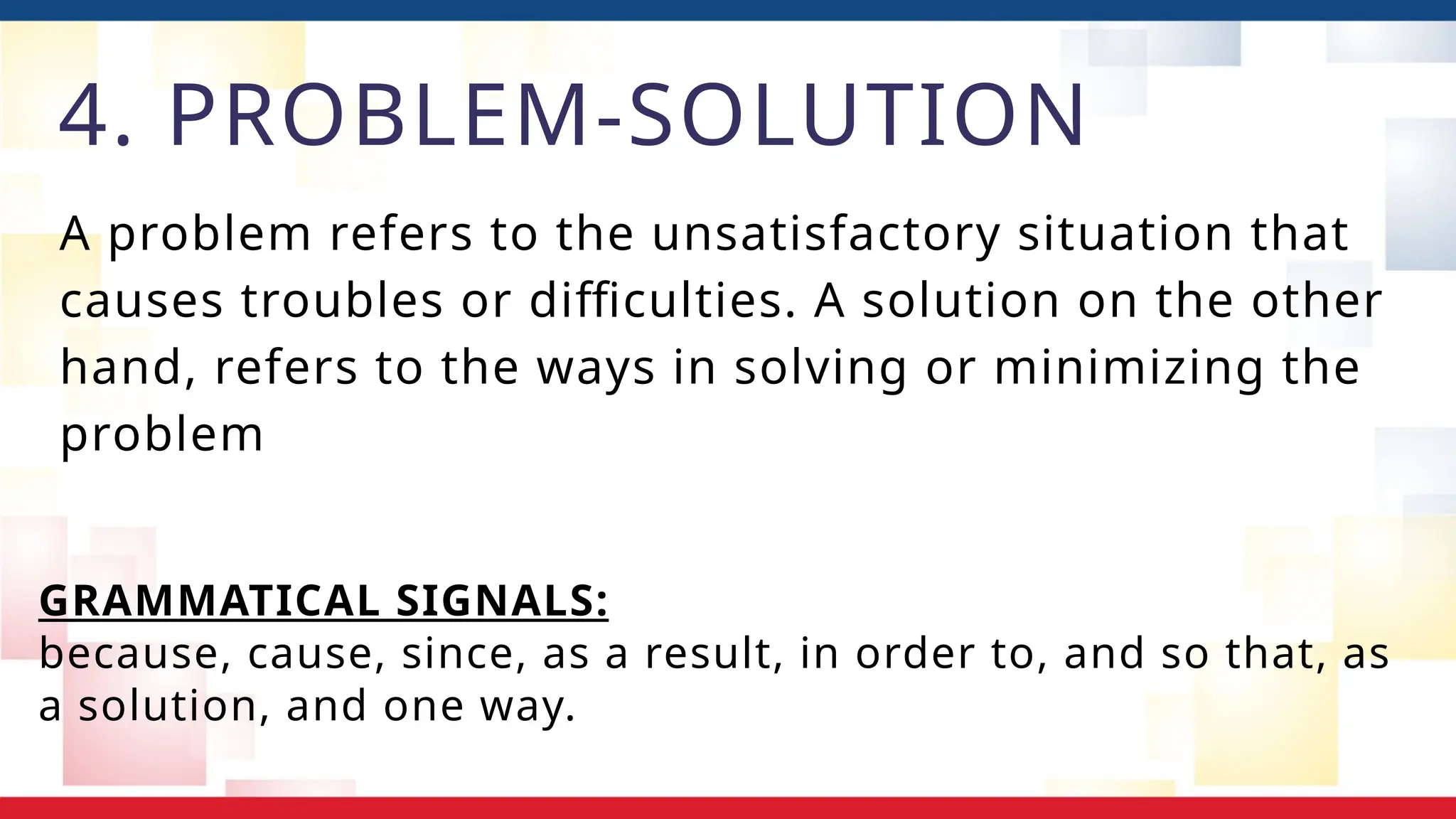
A problem refers to the unsatisfactory situation that
causes troubles or difficulties. A solution on the other
hand, refers to the ways in solving or minimizing the
problem
4. PROBLEM-SOLUTION
GRAMMATICAL SIGNALS:
because, cause, since, as a result, in order to, and so that, as
a solution, and one way.
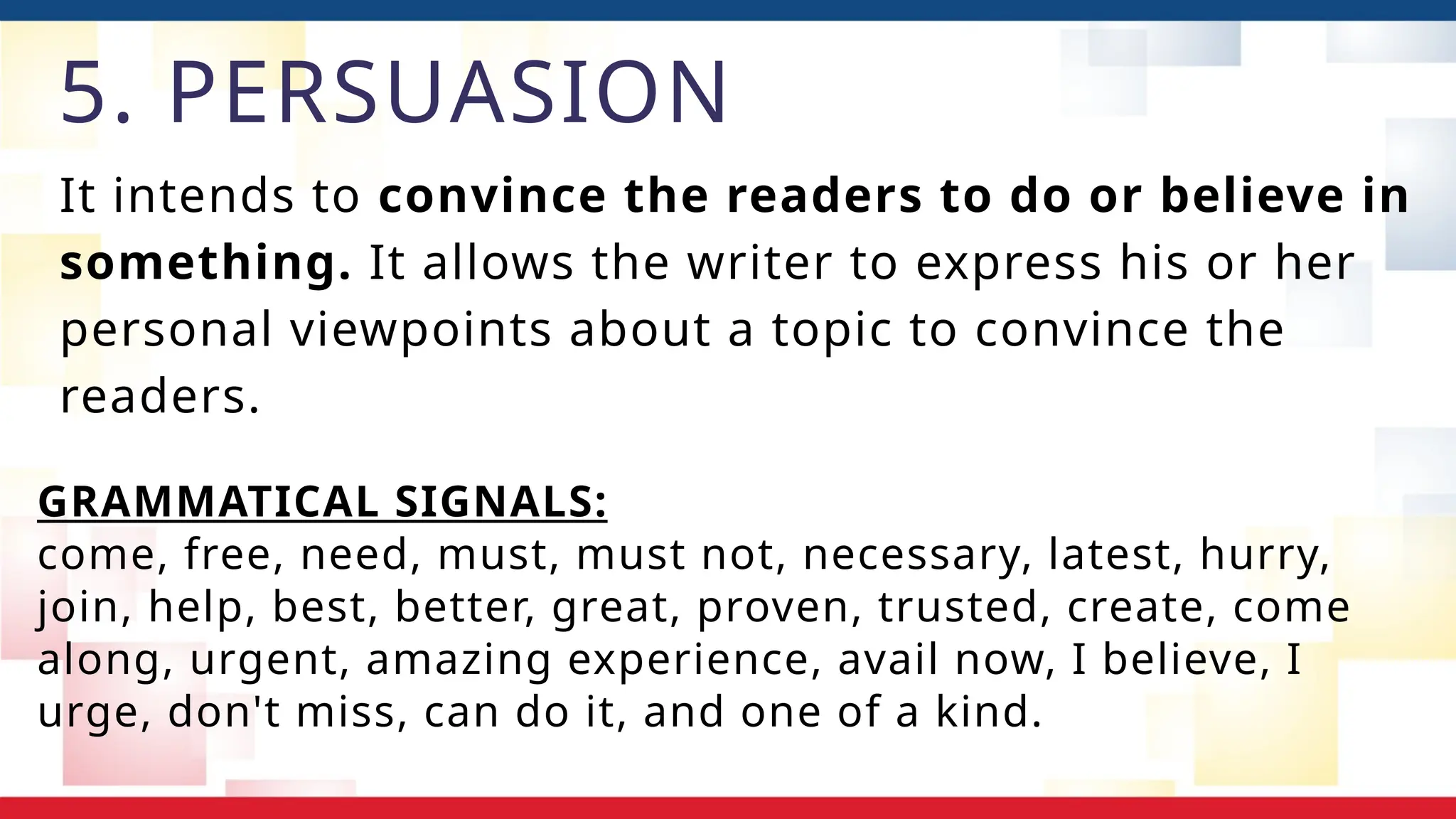
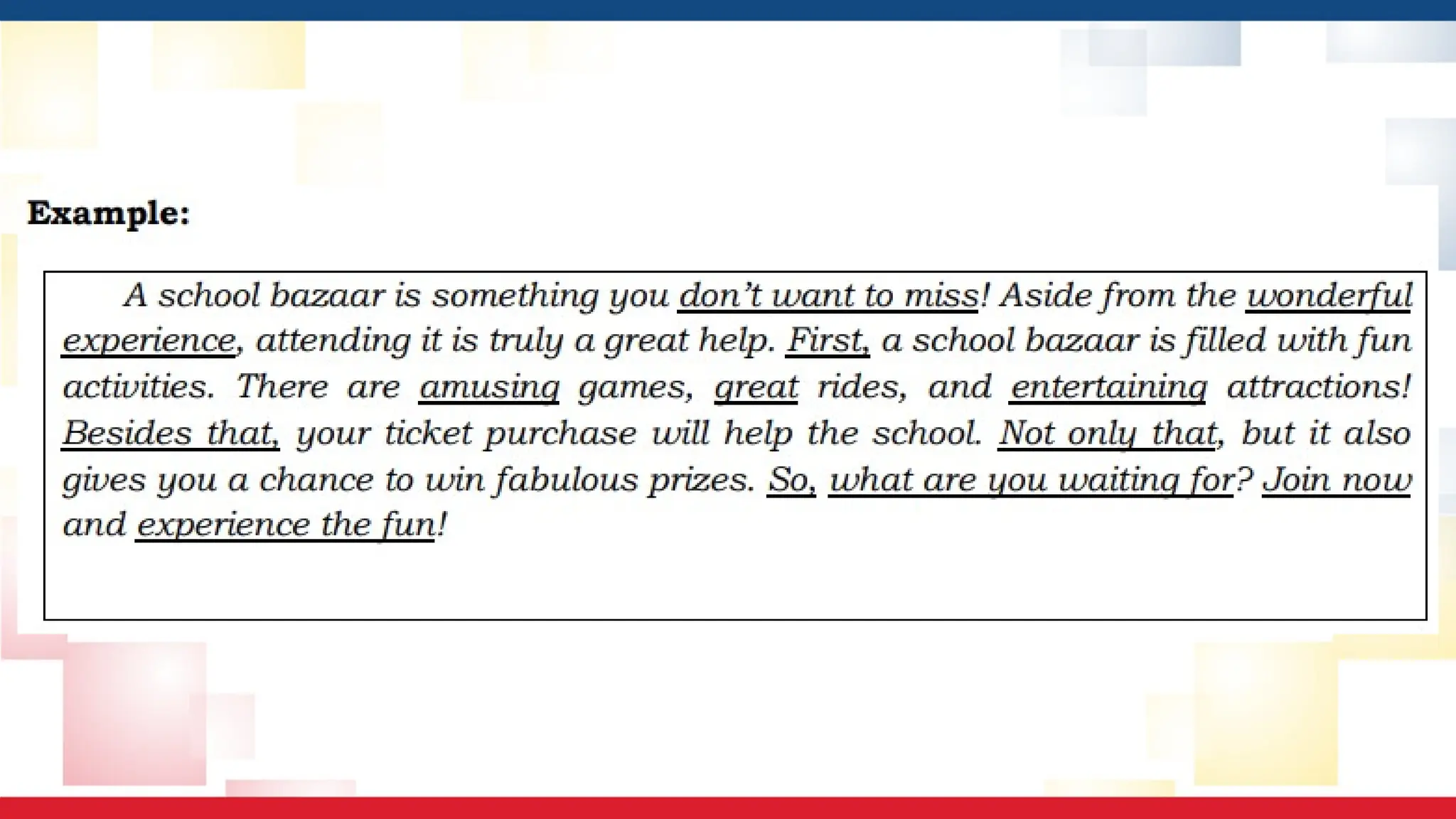
It intends to convince the readers to do or believe in
something. It allows the writer to express his or her
personal viewpoints about a topic to convince the
readers.
5. PERSUASION
GRAMMATICAL SIGNALS:
come, free, need, must, must not, necessary, latest, hurry,
join, help, best, better, great, proven, trusted, create, come
along, urgent, amazing experience, avail now, I believe, I
urge, don't miss, can do it, and one of a kind.
Read the paragraphs presented and identify the pattern of
idea development used.
LET’S PRACTICE!
"One significant issue in modern education is the decreasing
engagement of students in the classroom. Many students
struggle to stay focused and interested in the material, often
due to outdated teaching methods or lack of interactivity. To
address this, educators can incorporate more hands-on
learning experiences, use technology to create interactive
lessons, and encourage student-led discussions, which have
been shown to increase participation and retention of
information."
PROBLEM AND SOLUTION
"Chronic stress can have a negative impact on both mental and
physical health. When a person experiences prolonged stress,
the body produces increased levels of cortisol, a hormone that
can affect heart health and immune function. For instance,
long-term stress has been linked to high blood pressure,
increased risk of heart disease, and weakened immune
response, which makes individuals more susceptible to
illnesses."
CAUSE AND EFFECT
"Recycling is one of the easiest and most effective ways to protect
our planet. By recycling materials like plastic, paper, and glass, we
reduce the amount of waste that ends up in landfills, which helps
decrease pollution and conserves natural resources. Imagine a
world where fewer trees are cut down for paper, and less plastic is
dumped into our oceans. Recycling is not just a simple task; it is a
responsibility we all share to ensure a healthier environment for
future generations. We must act now before the damage becomes
irreversible."
PERSUASION
"Many educators argue that the integration of technology in the
classroom enhances learning by making lessons more interactive
and accessible. Students can use educational apps, access
resources online, and collaborate with peers across the globe.
However, some critics claim that technology can be distracting and
that students spend too much time on screens, which can hinder
social interaction. While these concerns are valid, the key is
balance—technology should be used purposefully to complement
traditional learning methods rather than replace them."
CLAIM-COUNTERCLAIM
"Reading books is essential for personal growth and learning.
It expands our knowledge, improves cognitive abilities, and
enhances vocabulary. For example, research shows that
individuals who read regularly have a better understanding of
various subjects, from history to science. In addition, reading
fiction can improve empathy and emotional intelligence by
allowing readers to step into the shoes of diverse characters
and understand their perspectives."
GENERAL TO PARTICULAR
ACTIVITY
ACTIVITY
ACTIVITY
ACTIVITY
ACTIVITY
ACTIVITY
Instructions: You will be divided into 5 groups.
Each group will identify the pattern of idea
development of paragraph assigned to them, and
will underline the statements that will support
their answer and the grammatical signals used.
Then 2 representatives of each group will read
the group’s answer in the class.
Criteria Excellent(5) Average(3) Poor(1)
Identification of
Pattern of Idea
Development
Clearly identifies the pattern of
idea development presented in
the paragraph and provides
insightful analysis of its nature,
evidence, and clues.
Identifies the pattern of idea
development presented in the
paragraph but provides limited
analysis of its nature, evidence, and
clues.
Fails to clearly identify the pattern of
idea development presented in the
paragraph or provides insufficient
analysis of its nature, evidence, and
clues.
Grammatical Signals
Provides a detailed examination
and identification of the
grammatical signals used in the
paragraph.
Provides a basic examination and
identification of the grammatical
signals used in the paragraph.
Provides an incomplete or superficial
examination and identification of the
grammatical signals used in the
paragraph.
Explanation
Proposes a well-thought-out
explanation of how patterns of
idea development and
grammatical signals are
identified.
Proposes a basic explanation of
how patterns of idea development
and grammatical signals are
identified.
Proposes an incomplete or superficial
explanation of how patterns of idea
development and grammatical signals
are identified.
RUBRICS
Directions: Read the questions below carefully and write
your answers in your portfolio notebook.
1. Which concept below refers to the organizing of ideas in
a logical and clear manner to suit the writer’s purpose?
A. Coherence
B. Grammatical signals
C. Idea development
D. Pattern of idea development
PRACTICE EXERCISE:
2. It is an idea that usually expresses the main point or
main idea of a piece of writing. It usually presents the
topic of a paragraph.
A. General Idea
B. General Information
C. Particular Information
D. Specific Information
3. It is a pattern of development that begins with a
general idea or statement and it is followed by specific
details to support and explain.
A. General Idea
B. General Information
C. General to Specific
D. Specific Information
4. It is a statement that presents an arguable position that
reflects one’s interpretation, belief or opinion.
A. Claim
B. Counterclaim
C. Evidence
D. Idea
5. It is a pattern of development that refers to the
structure of an argument where there is more than one
side to debate.
A. Cause and effect
B. Claim and counterclaim
C. General to specific
D. Problem-Solution
6. It is a pattern of development that describes or
discusses an event/action that is caused by another action.
A. Cause and effect
B. Claim and counterclaim
C. General to specific
D. Problem-Solution
7. It is a pattern of development that presents a significant
problem and explains it in detail then a possible solution
is suggested.
A. Cause and effect
B. Claim and Counterclaim
C. General to Particular
D. Problem-Solution
8. Which among the grammatical signals below is
appropriate for the problem-solution pattern of idea
development?
A. one way
B. as a result
C. specifically
D. with these reasons
9. Germs can be classified into several types.
Suitable Pattern: ______________________________________
10. Global warming is the biggest enemy that the
humankind is facing today, but there are many ways to
combat this problem.
Suitable Pattern: ______________________________________

Quarter 2 Grade 8 GRAMMATICAL SIGNALS.pptx

  • 1.
    - Grade 8- GOOD MORNING!
  • 2.
    recap What did wediscuss in our previous meeting?
  • 3.
    ObjectIVE S: a. define grammaticalsignals; b. identify the different patterns of ideas development; c. distinguish appropriate grammatical signals to each pattern of idea development; and d. point out the grammatical signals and pattern of idea development used in a paragraph
  • 4.
  • 5.
    what am I? •I will give clues for each items to be guessed. • You have 10 seconds to think of an answer. • Raise your hand if you want to answer.
  • 6.
    EXAMPLE: • I disappearat night • I give light to the earth. • I’m hot even in a far distance. • I can give you vitamin D for your skin. ANSWER: what am I?
  • 7.
  • 8.
    • You canonly see me after the rain. • I have a multicolored arc. • I am in the stratosphere. • I am believed to have a gold at the end of my line. ANSWER: what am I?
  • 9.
  • 10.
    • I ama man’s best friend. • I wag my tail every time I see you. • I can protect my human in danger. • I can run very fast. ANSWER: what am I?
  • 11.
  • 12.
    1. How wereyou able to guess the hidden items? POINTS TO PONDER:
  • 13.
    1. How wereyou able to guess the hidden items? 2. What can you notice about the sets of clues? POINTS TO PONDER:
  • 14.
    1. How wereyou able to guess the hidden items? 2. What can you notice about the sets of clues? 3. Do the clues share the same idea? POINTS TO PONDER:
  • 15.
    Idea development isessential in writing. This is done by organizing ideas in a logical and clear manner that suits the writer’s purpose. IDEA DEVELOPMENT
  • 16.
    are writing devicessuch as transitional devices, connectors, determiners, and repetitions that are used to maintain text coherence. Coherence establishes a logical connection between ideas in sentences and paragraphs. GRAMMATICAL SIGNALS
  • 17.
    refers to thestructure of writing on how the ideas are being presented. PATTERN OF IDEA DEVELOPMENT - general to particular - problem-solution - cause and effect - claim-counterclaim - persuasion
  • 18.
    It starts withthe general idea stated in the topic sentence. Then, it is elaborated and explained through specific details and examples. 1. GENERAL TO PARTICULAR GRAMMATICAL SIGNALS: also, for example, as an example, in addition, in addition to, for instance, examples of these, first, second, third, next, on one hand, and on the other hand.
  • 20.
    It explains thecauses or the effects of something. 2. CAUSE AND EFFECT GRAMMATICAL SIGNALS: Cause: if, for, since, due to, because, owing to, because of, one cause, and resulting from Effect: so, thus, hence, then, therefore, as a result, in effect, as consequence, consequently, leads to, one of the effects is, and that is why
  • 22.
    A claim isthe writer’s stand on a topic supported by evidences and logical reasoning. Also, the writer presents the counterclaim or the opposite stand of an issue to disprove it through evidences and logical reasoning 3. CLAIM AND COUNTERCLAIM GRAMMATICAL SIGNALS: however, nevertheless, on one hand, on the other hand, admittedly, some people say, some may say, of course, nevertheless, and but not only that.
  • 24.
    A problem refersto the unsatisfactory situation that causes troubles or difficulties. A solution on the other hand, refers to the ways in solving or minimizing the problem 4. PROBLEM-SOLUTION GRAMMATICAL SIGNALS: because, cause, since, as a result, in order to, and so that, as a solution, and one way.
  • 26.
    It intends toconvince the readers to do or believe in something. It allows the writer to express his or her personal viewpoints about a topic to convince the readers. 5. PERSUASION GRAMMATICAL SIGNALS: come, free, need, must, must not, necessary, latest, hurry, join, help, best, better, great, proven, trusted, create, come along, urgent, amazing experience, avail now, I believe, I urge, don't miss, can do it, and one of a kind.
  • 28.
    Read the paragraphspresented and identify the pattern of idea development used. LET’S PRACTICE!
  • 29.
    "One significant issuein modern education is the decreasing engagement of students in the classroom. Many students struggle to stay focused and interested in the material, often due to outdated teaching methods or lack of interactivity. To address this, educators can incorporate more hands-on learning experiences, use technology to create interactive lessons, and encourage student-led discussions, which have been shown to increase participation and retention of information." PROBLEM AND SOLUTION
  • 30.
    "Chronic stress canhave a negative impact on both mental and physical health. When a person experiences prolonged stress, the body produces increased levels of cortisol, a hormone that can affect heart health and immune function. For instance, long-term stress has been linked to high blood pressure, increased risk of heart disease, and weakened immune response, which makes individuals more susceptible to illnesses." CAUSE AND EFFECT
  • 31.
    "Recycling is oneof the easiest and most effective ways to protect our planet. By recycling materials like plastic, paper, and glass, we reduce the amount of waste that ends up in landfills, which helps decrease pollution and conserves natural resources. Imagine a world where fewer trees are cut down for paper, and less plastic is dumped into our oceans. Recycling is not just a simple task; it is a responsibility we all share to ensure a healthier environment for future generations. We must act now before the damage becomes irreversible." PERSUASION
  • 32.
    "Many educators arguethat the integration of technology in the classroom enhances learning by making lessons more interactive and accessible. Students can use educational apps, access resources online, and collaborate with peers across the globe. However, some critics claim that technology can be distracting and that students spend too much time on screens, which can hinder social interaction. While these concerns are valid, the key is balance—technology should be used purposefully to complement traditional learning methods rather than replace them." CLAIM-COUNTERCLAIM
  • 33.
    "Reading books isessential for personal growth and learning. It expands our knowledge, improves cognitive abilities, and enhances vocabulary. For example, research shows that individuals who read regularly have a better understanding of various subjects, from history to science. In addition, reading fiction can improve empathy and emotional intelligence by allowing readers to step into the shoes of diverse characters and understand their perspectives." GENERAL TO PARTICULAR
  • 34.
  • 38.
  • 39.
    Instructions: You willbe divided into 5 groups. Each group will identify the pattern of idea development of paragraph assigned to them, and will underline the statements that will support their answer and the grammatical signals used. Then 2 representatives of each group will read the group’s answer in the class.
  • 40.
    Criteria Excellent(5) Average(3)Poor(1) Identification of Pattern of Idea Development Clearly identifies the pattern of idea development presented in the paragraph and provides insightful analysis of its nature, evidence, and clues. Identifies the pattern of idea development presented in the paragraph but provides limited analysis of its nature, evidence, and clues. Fails to clearly identify the pattern of idea development presented in the paragraph or provides insufficient analysis of its nature, evidence, and clues. Grammatical Signals Provides a detailed examination and identification of the grammatical signals used in the paragraph. Provides a basic examination and identification of the grammatical signals used in the paragraph. Provides an incomplete or superficial examination and identification of the grammatical signals used in the paragraph. Explanation Proposes a well-thought-out explanation of how patterns of idea development and grammatical signals are identified. Proposes a basic explanation of how patterns of idea development and grammatical signals are identified. Proposes an incomplete or superficial explanation of how patterns of idea development and grammatical signals are identified. RUBRICS
  • 41.
    Directions: Read thequestions below carefully and write your answers in your portfolio notebook. 1. Which concept below refers to the organizing of ideas in a logical and clear manner to suit the writer’s purpose? A. Coherence B. Grammatical signals C. Idea development D. Pattern of idea development PRACTICE EXERCISE:
  • 42.
    2. It isan idea that usually expresses the main point or main idea of a piece of writing. It usually presents the topic of a paragraph. A. General Idea B. General Information C. Particular Information D. Specific Information
  • 43.
    3. It isa pattern of development that begins with a general idea or statement and it is followed by specific details to support and explain. A. General Idea B. General Information C. General to Specific D. Specific Information
  • 44.
    4. It isa statement that presents an arguable position that reflects one’s interpretation, belief or opinion. A. Claim B. Counterclaim C. Evidence D. Idea
  • 45.
    5. It isa pattern of development that refers to the structure of an argument where there is more than one side to debate. A. Cause and effect B. Claim and counterclaim C. General to specific D. Problem-Solution
  • 46.
    6. It isa pattern of development that describes or discusses an event/action that is caused by another action. A. Cause and effect B. Claim and counterclaim C. General to specific D. Problem-Solution
  • 47.
    7. It isa pattern of development that presents a significant problem and explains it in detail then a possible solution is suggested. A. Cause and effect B. Claim and Counterclaim C. General to Particular D. Problem-Solution
  • 48.
    8. Which amongthe grammatical signals below is appropriate for the problem-solution pattern of idea development? A. one way B. as a result C. specifically D. with these reasons
  • 49.
    9. Germs canbe classified into several types. Suitable Pattern: ______________________________________ 10. Global warming is the biggest enemy that the humankind is facing today, but there are many ways to combat this problem. Suitable Pattern: ______________________________________