A Quality Framework for Plant Breeding
GCP 2011 General Research Meeting
21–25 September 2011
Hyderabad, India David Galsworthy
Derek Tomlinson
Julian Smith
International Development
julian.smith@fera.gsi.gov.uk
1-Quality@GCP – a feasibility
analysis
 Asked to review the opportunity for
positioning a quality system „about‟ the GCP
 Agreed to map out some of the top tier
process that describe a generic plant
breeding pipeline and to see what controls
might be appropriate
 To identify some „low hanging‟ and/or „high
impact‟ opportunities
The message of this talk
 Why
 What
 How
 [The Why and What could be reversed, but to
capture attention it has to be this way]
The why – a justification for
quality assured ways
Some high level benefits of a
QA system
 Increased competitiveness within the market
 Succession of knowledge within the institute
over time
 Improved institutional resource management
and net increase in efficiency
 Reduced vulnerability to customer disputes
 Improved basis for outsourcing and
partnerships for deliverables requested by an
external party – strengths the „community‟
IBS Workshop feedback
 Quality systems need
upfront inputs to put in place
 And cost extra to maintain
 The first is true, but the latter
is a debatable point
 Especially in developing
countries: staff vs
consumables costs reversed
Do we recognise this scenario
 Plant breeders are a community, but are
competitive, which is good
 Projects won on institutional reputation for
research excellence and project management
 The better scientists are attracted to the elite
institutes
 Funds follow previous funding
 A status quo is reached
Is this an optimal model
 For innovation
 For motivating
 For developing emerging institutions,
especially amongst the national programmes
 Quality systems can demonstrate
equivalence or comparative advantage
between institutions
The what (in brief)
Quality Assurance
“all those planned and systematic actions
necessary to provide adequate confidence
that a product or service will satisfy given
requirements for quality.....”
And meet the expectation of the customer
Quality = meets expectation
About demonstrated competence
Those applicable to plant
breeding
 ISO 9001 - is a generic quality standard application in
all situations and is designed to help organisations
ensure they meet the needs of customers and other
stakeholders. The standard has the potential for
superior operational performance by driving through
better practices and efficacy improvements.
 ISO 17025 - is the main quality standard used by
testing laboratories.
The how
Examples to draw from
Crop pesticide production
 Comparable stages to plant breeding
– Idea formation and iteration
– Resource inventorying
– Bioactive generation
– Screening, stages
– Field trials
– Registration and release
– Post release monitoring
Crop pesticides production and
QA
 Health and environmental concerns are high and this
has motivated legislation
 In Europe production has to comply with REACH
(Registration, Evaluation, Authorisation and restriction
on Chemicals) that sets standards
 Regulation is recognised in the UK by ORETO that
provides for „officially recognised testing facilities‟
 FERA is a registered with ORETO so that it can win
business in this area
 UK hand book on pesticide development and meeting
EU regulatory norms (Expectations) is over substantial
Plant germplasms and freeness
from pests
Plant germplasms and freeness
from pests
 International Potato Centre is accredited to ISO
17025 for named pests of quarantine concern and
associated with in vitro production. Involved:
– Document control systems
– Training and training records
– Equipment records
– Validation of data for test methods
– Evidence of operation of the quality control system
 Crop Genebank Knowledge Base. A well intended
website for best practices, but not a quality system.
No measure of adoption or use
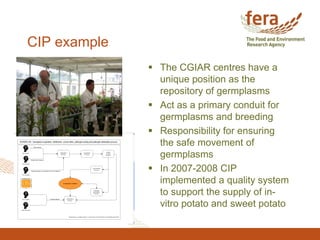
CIP example
 The CGIAR centres have a
unique position as the
repository of germplasms
 Act as a primary conduit for
germplasms and breeding
 Responsibility for ensuring
the safe movement of
germplasms
 In 2007-2008 CIP
implemented a quality system
to support the supply of in-
vitro potato and sweet potato
CIP and motivation for adopting
QA
 CIP employed a seed systems specialist (from
FERA) that was familiar with quality systems and
how they could leverage change and raise
standards
 There was concern that the TC germplasm was
not tested to be free of pests; infection with a
quarantine organism was been reported by US
causing „embarrassment‟
 A combination of „institutional hurt‟ and individual
knowledge or culture for QA brought about
change
Proficiency Testing Schemes
 Widely used in many
commercial sectors
 A metric of
competence
 Accreditation for DNA
extraction
 Basis for support and
learning
 PT Scheme for CBSV
Adoption
The major imperative to
adoption
 For QA to be adopted there has to be
incentives and consequences for success
and failure
 Currently these are not sufficiently in place
Who is most likely to champion
a plant breeding quality frame?
Expectations and driver strength
Stakeholder Incentive Driver
strength
Researcher  Improved quality of research
 Science publication
 Esteem
Low
Research institute  Increased efficacy of direct costs and staff time
 Higher success rate in winning project funding through
demonstration of competitive advantage over competitors
Moderate /
High
Variety registering
body
 Greater acceptance of data provided by variety developers
 Greater comparability of data on variety performance over
time and between regulatory bodies
 Reduced time and cost for variety performance assessment
and recommendation
Moderate
Commercial
partner
 Cost saving due to improved efficiency over pipeline and in
time required to have varieties registered for commercial sale
High
Donor  Greater likelihood in success of projects funded
 Defendable choice of partners selected for funding
 Quality of data increases scope for sharing data between
projects, realising synergy of data and securing legacy of data
High
Setting the expectation along a
pipeline
 Critical questions about:
– Idea validation
– Minimum resourcing: natural, human, infrastructure
– Experimental design and compliance checks
– Data management for traceability
– Partnerships brokering
Idea validation,
collection of resources
Progeny
generation
1st 2nd 3rd
germplasm
screening
Approval
and release
Field trials
(Biosafety
trials if GMO)
Owner of these expectations
 GCP
 CGIAR
 CRP
 Alliance of CGIAR
 Donors
 Other!
A quality frame for plant
breeding
Meeting the expectation
 At the researcher and institute level:
– Document control systems
– Training and training records
– Equipment records
– Data management tools and services
– Validation of data for test methods
– Evidence of operation of the quality control
system
Approach for implementation of
ISO 17025
 Mainly the below generic stages will fit for the
majority of needs, but the detail for each will
be institute specific
– Stage 1: Design and process setting
– Stage 2: Developing the system
documentation
– Stage 3: Training in System Requirements
– Stage 4: Evidence of implementation
– Stage 5: Internal Auditing
•
Inputs and outcomes
The special case of
development
 In times of emergency response we need
solutions before the full validation is
undertaken
 Work with partners of diverse capabilities and
access to recourses, to raise that capacity
 These factors needs to be „understood‟ and
built into the deliverables
Situations to consider
Cassava Brown Streak Disease
 Two species (CBSV
an UCBSV)
 Both present in Ke,
Tz and Ug
 Only UCBSV in Br,
Rw and DRC
(currently)
 Disparate lab
capacities
 Breeding and field
trials ongoing
Nucleic acid data – ICRISAT
example
 World class
genomic capacity
 Internal research
 Outsourcing
services
 Would the
outsourcing win
more business if
accreditated?
Summary
 What will make me want to move from here to there?
 Currently a absence of consequence about non-
compliance
 No natural owner of a quality system
 GCP has capital in a Community of Partners
 GCP has a wealth of Best Practice tools; their use
will contribute to a quality assured system
 But be caution of opportunistic adages of systems
designed for other reasons
 Not everything available will fit the expectation when
that is set
Thank you
julian.smith@fera.gsi.gov.uk
First name Last name Institution
Jeffrey Ehlers UC-R ; University of California Riverside
Pooran Gaur ICRISAT - International Crops Research
Institute for the Semi-Arid Tropics
Marie Noelle Ndjiondjop WARDA - Africa Rice Center
Emmanuel Okogbenin National Root Crops Research Institute
Chunlin He GCP
Breeding services Manger
Arvind Kumar IRRI
Richard Trethowan Sydney University

GRM 2011: A quality management framework for integrated plant breeding

  • 1.
    A Quality Frameworkfor Plant Breeding GCP 2011 General Research Meeting 21–25 September 2011 Hyderabad, India David Galsworthy Derek Tomlinson Julian Smith International Development julian.smith@fera.gsi.gov.uk
  • 2.
    1-Quality@GCP – afeasibility analysis  Asked to review the opportunity for positioning a quality system „about‟ the GCP  Agreed to map out some of the top tier process that describe a generic plant breeding pipeline and to see what controls might be appropriate  To identify some „low hanging‟ and/or „high impact‟ opportunities
  • 3.
    The message ofthis talk  Why  What  How  [The Why and What could be reversed, but to capture attention it has to be this way]
  • 4.
    The why –a justification for quality assured ways
  • 5.
    Some high levelbenefits of a QA system  Increased competitiveness within the market  Succession of knowledge within the institute over time  Improved institutional resource management and net increase in efficiency  Reduced vulnerability to customer disputes  Improved basis for outsourcing and partnerships for deliverables requested by an external party – strengths the „community‟
  • 6.
    IBS Workshop feedback Quality systems need upfront inputs to put in place  And cost extra to maintain  The first is true, but the latter is a debatable point  Especially in developing countries: staff vs consumables costs reversed
  • 7.
    Do we recognisethis scenario  Plant breeders are a community, but are competitive, which is good  Projects won on institutional reputation for research excellence and project management  The better scientists are attracted to the elite institutes  Funds follow previous funding  A status quo is reached
  • 8.
    Is this anoptimal model  For innovation  For motivating  For developing emerging institutions, especially amongst the national programmes  Quality systems can demonstrate equivalence or comparative advantage between institutions
  • 9.
  • 10.
    Quality Assurance “all thoseplanned and systematic actions necessary to provide adequate confidence that a product or service will satisfy given requirements for quality.....” And meet the expectation of the customer Quality = meets expectation About demonstrated competence
  • 11.
    Those applicable toplant breeding  ISO 9001 - is a generic quality standard application in all situations and is designed to help organisations ensure they meet the needs of customers and other stakeholders. The standard has the potential for superior operational performance by driving through better practices and efficacy improvements.  ISO 17025 - is the main quality standard used by testing laboratories.
  • 12.
  • 13.
  • 14.
  • 15.
    Crop pesticide production Comparable stages to plant breeding – Idea formation and iteration – Resource inventorying – Bioactive generation – Screening, stages – Field trials – Registration and release – Post release monitoring
  • 16.
    Crop pesticides productionand QA  Health and environmental concerns are high and this has motivated legislation  In Europe production has to comply with REACH (Registration, Evaluation, Authorisation and restriction on Chemicals) that sets standards  Regulation is recognised in the UK by ORETO that provides for „officially recognised testing facilities‟  FERA is a registered with ORETO so that it can win business in this area  UK hand book on pesticide development and meeting EU regulatory norms (Expectations) is over substantial
  • 17.
    Plant germplasms andfreeness from pests
  • 18.
    Plant germplasms andfreeness from pests  International Potato Centre is accredited to ISO 17025 for named pests of quarantine concern and associated with in vitro production. Involved: – Document control systems – Training and training records – Equipment records – Validation of data for test methods – Evidence of operation of the quality control system  Crop Genebank Knowledge Base. A well intended website for best practices, but not a quality system. No measure of adoption or use
  • 19.
    CIP example  TheCGIAR centres have a unique position as the repository of germplasms  Act as a primary conduit for germplasms and breeding  Responsibility for ensuring the safe movement of germplasms  In 2007-2008 CIP implemented a quality system to support the supply of in- vitro potato and sweet potato
  • 20.
    CIP and motivationfor adopting QA  CIP employed a seed systems specialist (from FERA) that was familiar with quality systems and how they could leverage change and raise standards  There was concern that the TC germplasm was not tested to be free of pests; infection with a quarantine organism was been reported by US causing „embarrassment‟  A combination of „institutional hurt‟ and individual knowledge or culture for QA brought about change
  • 21.
    Proficiency Testing Schemes Widely used in many commercial sectors  A metric of competence  Accreditation for DNA extraction  Basis for support and learning  PT Scheme for CBSV
  • 22.
  • 23.
    The major imperativeto adoption  For QA to be adopted there has to be incentives and consequences for success and failure  Currently these are not sufficiently in place
  • 24.
    Who is mostlikely to champion a plant breeding quality frame?
  • 25.
    Expectations and driverstrength Stakeholder Incentive Driver strength Researcher  Improved quality of research  Science publication  Esteem Low Research institute  Increased efficacy of direct costs and staff time  Higher success rate in winning project funding through demonstration of competitive advantage over competitors Moderate / High Variety registering body  Greater acceptance of data provided by variety developers  Greater comparability of data on variety performance over time and between regulatory bodies  Reduced time and cost for variety performance assessment and recommendation Moderate Commercial partner  Cost saving due to improved efficiency over pipeline and in time required to have varieties registered for commercial sale High Donor  Greater likelihood in success of projects funded  Defendable choice of partners selected for funding  Quality of data increases scope for sharing data between projects, realising synergy of data and securing legacy of data High
  • 26.
    Setting the expectationalong a pipeline  Critical questions about: – Idea validation – Minimum resourcing: natural, human, infrastructure – Experimental design and compliance checks – Data management for traceability – Partnerships brokering Idea validation, collection of resources Progeny generation 1st 2nd 3rd germplasm screening Approval and release Field trials (Biosafety trials if GMO)
  • 27.
    Owner of theseexpectations  GCP  CGIAR  CRP  Alliance of CGIAR  Donors  Other!
  • 28.
    A quality framefor plant breeding
  • 29.
    Meeting the expectation At the researcher and institute level: – Document control systems – Training and training records – Equipment records – Data management tools and services – Validation of data for test methods – Evidence of operation of the quality control system
  • 30.
    Approach for implementationof ISO 17025  Mainly the below generic stages will fit for the majority of needs, but the detail for each will be institute specific – Stage 1: Design and process setting – Stage 2: Developing the system documentation – Stage 3: Training in System Requirements – Stage 4: Evidence of implementation – Stage 5: Internal Auditing •
  • 31.
  • 32.
    The special caseof development  In times of emergency response we need solutions before the full validation is undertaken  Work with partners of diverse capabilities and access to recourses, to raise that capacity  These factors needs to be „understood‟ and built into the deliverables
  • 33.
  • 34.
    Cassava Brown StreakDisease  Two species (CBSV an UCBSV)  Both present in Ke, Tz and Ug  Only UCBSV in Br, Rw and DRC (currently)  Disparate lab capacities  Breeding and field trials ongoing
  • 35.
    Nucleic acid data– ICRISAT example  World class genomic capacity  Internal research  Outsourcing services  Would the outsourcing win more business if accreditated?
  • 36.
    Summary  What willmake me want to move from here to there?  Currently a absence of consequence about non- compliance  No natural owner of a quality system  GCP has capital in a Community of Partners  GCP has a wealth of Best Practice tools; their use will contribute to a quality assured system  But be caution of opportunistic adages of systems designed for other reasons  Not everything available will fit the expectation when that is set
  • 37.
    Thank you julian.smith@fera.gsi.gov.uk First nameLast name Institution Jeffrey Ehlers UC-R ; University of California Riverside Pooran Gaur ICRISAT - International Crops Research Institute for the Semi-Arid Tropics Marie Noelle Ndjiondjop WARDA - Africa Rice Center Emmanuel Okogbenin National Root Crops Research Institute Chunlin He GCP Breeding services Manger Arvind Kumar IRRI Richard Trethowan Sydney University