Gathering Data
Qualitatively and
Quantitatively
NOEL P. MUNDA
Teacher
Research for Grade 7 Learners
Quarter 3
Gathering Data Qualitatively and
Quantitatively
After going through this lesson, the learners are expected
to:
1. Define quantitative and qualitative data,
2. Differentiate quantitative from qualitative data; and
3. Classify the examples according to the type of data.
Gathering Data Qualitatively and
Quantitatively
Quantitative data is generated by
measuring or counting certain entities, or by
performing calculations, while Qualitative
data is gathered through interviews,
surveys, and observations [4].
Gathering Data Qualitatively and
Quantitatively
Research provides the best solution to some of the
world problems and also enhance the knowledge of the
researchers. It can give explanations to certain
questions stated in the research problem. Through the
explanations, it serves as a tool for building knowledge
and for facilitating new learning.
Gathering Data Qualitatively and
Quantitatively
Quantitative Data Qualitative Data
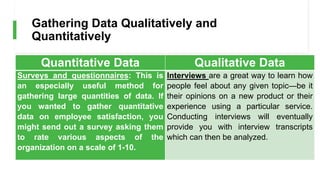
Surveys and questionnaires: This is
an especially useful method for
gathering large quantities of data. If
you wanted to gather quantitative
data on employee satisfaction, you
might send out a survey asking them
to rate various aspects of the
organization on a scale of 1-10.
Interviews are a great way to learn how
people feel about any given topic—be it
their opinions on a new product or their
experience using a particular service.
Conducting interviews will eventually
provide you with interview transcripts
which can then be analyzed.
Gathering Data Qualitatively and
Quantitatively
Quantitative Data Qualitative Data
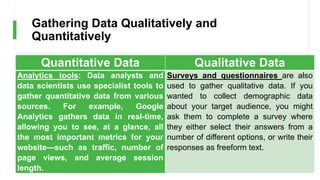
Analytics tools: Data analysts and
data scientists use specialist tools to
gather quantitative data from various
sources. For example, Google
Analytics gathers data in real-time,
allowing you to see, at a glance, all
the most important metrics for your
website—such as traffic, number of
page views, and average session
length.
Surveys and questionnaires are also
used to gather qualitative data. If you
wanted to collect demographic data
about your target audience, you might
ask them to complete a survey where
they either select their answers from a
number of different options, or write their
responses as freeform text.
Gathering Data Qualitatively and
Quantitatively
Quantitative Data Qualitative Data
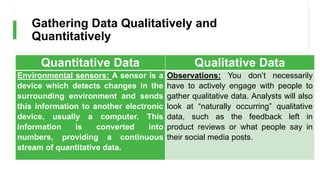
Environmental sensors: A sensor is a
device which detects changes in the
surrounding environment and sends
this information to another electronic
device, usually a computer. This
information is converted into
numbers, providing a continuous
stream of quantitative data.
Observations: You don’t necessarily
have to actively engage with people to
gather qualitative data. Analysts will also
look at “naturally occurring” qualitative
data, such as the feedback left in
product reviews or what people say in
their social media posts.
Gathering Data Qualitatively and
Quantitatively
Quantitative Data Qualitative Data
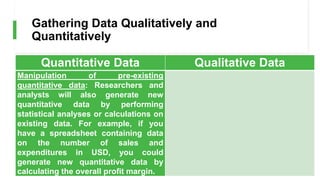
Manipulation of pre-existing
quantitative data: Researchers and
analysts will also generate new
quantitative data by performing
statistical analyses or calculations on
existing data. For example, if you
have a spreadsheet containing data
on the number of sales and
expenditures in USD, you could
generate new quantitative data by
calculating the overall profit margin.
Differentiating Qualitative and Quantitative
Data
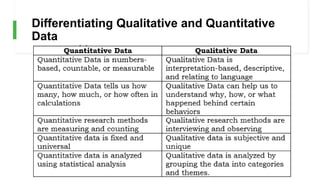
What is the difference between Qualitative and
Quantitative Data? [5]
Differentiating Qualitative and Quantitative
Data
What are the examples of Qualitative and
Quantitative Data? [5]
QUIZ
Prepare ¼ sheet of paper
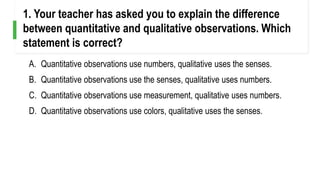
A. Quantitative observations use numbers, qualitative uses the senses.
B. Quantitative observations use the senses, qualitative uses numbers.
C. Quantitative observations use measurement, qualitative uses numbers.
D. Quantitative observations use colors, qualitative uses the senses.
1. Your teacher has asked you to explain the difference
between quantitative and qualitative observations. Which
statement is correct?
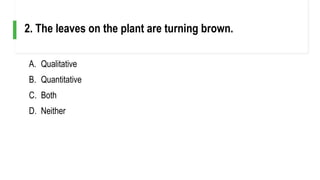
A. Qualitative
B. Quantitative
C. Both
D. Neither
2. The leaves on the plant are turning brown.
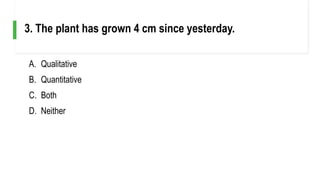
A. Qualitative
B. Quantitative
C. Both
D. Neither
3. The plant has grown 4 cm since yesterday.
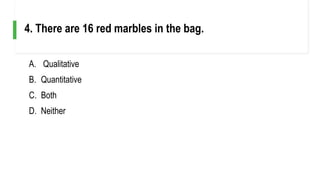
A. Qualitative
B. Quantitative
C. Both
D. Neither
4. There are 16 red marbles in the bag.
A. Qualitative
B. Quantitative
C. Both
D. Neither
6. The speed of the car was 45 mph.
A. Qualitative
B. Quantitative
7. There are nine dolphins in this pod.
A. Qualitative
B. Quantitative
8. Dolphin colors range from gray to white.
A. Qualitative
B. Quantitative
9. Dolphins eat the equivalent of 4 - 5% of their body mass
each day.
A. Qualitative
B. Quantitative [6]
10. Dolphins have smooth skin.
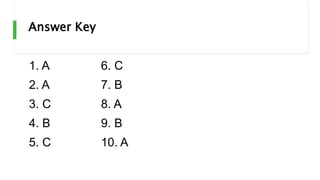
1. A 6. C
2. A 7. B
3. C 8. A
4. B 9. B
5. C 10. A
Answer Key
References
[4] Stevens, E. (2022, November 30). Quantitative vs qualitative data: What’s the
difference? Career Foundry. https://careerfoundry.com/en/blog/data-
analytics/difference-between-quantitative-and-qualitative-data
[5] Qualitative vs. quantitative data: what's the difference? (2021, October 6).
Fullstory. https://www.fullstory.com/blog/qualitative-vs-quantitative-data/
[6] https://quizizz.com/admin/quiz/63f0145b8407ad001eb4610c/qualitative-vs-
quantitative

Topic2- Gathering Data Qualitatively and Quantitatively.pptx

  • 1.
    Gathering Data Qualitatively and Quantitatively NOELP. MUNDA Teacher Research for Grade 7 Learners Quarter 3
  • 2.
    Gathering Data Qualitativelyand Quantitatively After going through this lesson, the learners are expected to: 1. Define quantitative and qualitative data, 2. Differentiate quantitative from qualitative data; and 3. Classify the examples according to the type of data.
  • 3.
    Gathering Data Qualitativelyand Quantitatively Quantitative data is generated by measuring or counting certain entities, or by performing calculations, while Qualitative data is gathered through interviews, surveys, and observations [4].
  • 4.
    Gathering Data Qualitativelyand Quantitatively Research provides the best solution to some of the world problems and also enhance the knowledge of the researchers. It can give explanations to certain questions stated in the research problem. Through the explanations, it serves as a tool for building knowledge and for facilitating new learning.
  • 5.
    Gathering Data Qualitativelyand Quantitatively Quantitative Data Qualitative Data Surveys and questionnaires: This is an especially useful method for gathering large quantities of data. If you wanted to gather quantitative data on employee satisfaction, you might send out a survey asking them to rate various aspects of the organization on a scale of 1-10. Interviews are a great way to learn how people feel about any given topic—be it their opinions on a new product or their experience using a particular service. Conducting interviews will eventually provide you with interview transcripts which can then be analyzed.
  • 6.
    Gathering Data Qualitativelyand Quantitatively Quantitative Data Qualitative Data Analytics tools: Data analysts and data scientists use specialist tools to gather quantitative data from various sources. For example, Google Analytics gathers data in real-time, allowing you to see, at a glance, all the most important metrics for your website—such as traffic, number of page views, and average session length. Surveys and questionnaires are also used to gather qualitative data. If you wanted to collect demographic data about your target audience, you might ask them to complete a survey where they either select their answers from a number of different options, or write their responses as freeform text.
  • 7.
    Gathering Data Qualitativelyand Quantitatively Quantitative Data Qualitative Data Environmental sensors: A sensor is a device which detects changes in the surrounding environment and sends this information to another electronic device, usually a computer. This information is converted into numbers, providing a continuous stream of quantitative data. Observations: You don’t necessarily have to actively engage with people to gather qualitative data. Analysts will also look at “naturally occurring” qualitative data, such as the feedback left in product reviews or what people say in their social media posts.
  • 8.
    Gathering Data Qualitativelyand Quantitatively Quantitative Data Qualitative Data Manipulation of pre-existing quantitative data: Researchers and analysts will also generate new quantitative data by performing statistical analyses or calculations on existing data. For example, if you have a spreadsheet containing data on the number of sales and expenditures in USD, you could generate new quantitative data by calculating the overall profit margin.
  • 9.
    Differentiating Qualitative andQuantitative Data What is the difference between Qualitative and Quantitative Data? [5]
  • 10.
  • 11.
    What are theexamples of Qualitative and Quantitative Data? [5]
  • 12.
  • 13.
    A. Quantitative observationsuse numbers, qualitative uses the senses. B. Quantitative observations use the senses, qualitative uses numbers. C. Quantitative observations use measurement, qualitative uses numbers. D. Quantitative observations use colors, qualitative uses the senses. 1. Your teacher has asked you to explain the difference between quantitative and qualitative observations. Which statement is correct?
  • 14.
    A. Qualitative B. Quantitative C.Both D. Neither 2. The leaves on the plant are turning brown.
  • 15.
    A. Qualitative B. Quantitative C.Both D. Neither 3. The plant has grown 4 cm since yesterday.
  • 16.
    A. Qualitative B. Quantitative C.Both D. Neither 4. There are 16 red marbles in the bag.
  • 17.
    A. Qualitative B. Quantitative C.Both D. Neither 6. The speed of the car was 45 mph.
  • 18.
    A. Qualitative B. Quantitative 7.There are nine dolphins in this pod.
  • 19.
    A. Qualitative B. Quantitative 8.Dolphin colors range from gray to white.
  • 20.
    A. Qualitative B. Quantitative 9.Dolphins eat the equivalent of 4 - 5% of their body mass each day.
  • 21.
    A. Qualitative B. Quantitative[6] 10. Dolphins have smooth skin.
  • 22.
    1. A 6.C 2. A 7. B 3. C 8. A 4. B 9. B 5. C 10. A Answer Key
  • 23.
    References [4] Stevens, E.(2022, November 30). Quantitative vs qualitative data: What’s the difference? Career Foundry. https://careerfoundry.com/en/blog/data- analytics/difference-between-quantitative-and-qualitative-data [5] Qualitative vs. quantitative data: what's the difference? (2021, October 6). Fullstory. https://www.fullstory.com/blog/qualitative-vs-quantitative-data/ [6] https://quizizz.com/admin/quiz/63f0145b8407ad001eb4610c/qualitative-vs- quantitative