QUALIFICATION
OF COMPOSITE
MATERIALS FOR
STRUCTURAL USE
Guidelines of the Italian High Council of Public Works
E-book by CertiMaC
Authorized official laboratory
for the qualification tests
and the issue of certificates
Protocol No. 2107 - 28/02/2020
E-book|QualificationOfCompositeMaterialsForStructuralUse
[founded and participated by]
+
+
+
+
+
+
+
+
+
+
+
+
+
+
+
+
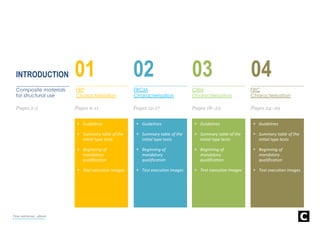
FRP
Characterisation
FRCM
Characterisation
CRM
Characterisation
FRC
Characterisation
01 02 03 04INTRODUCTION
Pages 24–29Pages 18–23Pages 12-17Pages 6-11Pages 2-5
Composite materials
for structural use
Fiber-reinforced - eBook
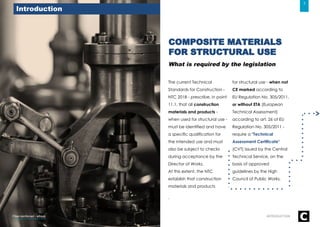
The current Technical
Standards for Construction -
NTC 2018 - prescribe, in point
11.1, that all construction
materials and products -
when used for structural use -
must be identified and have
a specific qualification for
the intended use and must
also be subject to checks
during acceptance by the
Director of Works.
At this extent, the NTC
establish that construction
materials and products
.
COMPOSITE MATERIALS
FOR STRUCTURAL USE
What is required by the legislation
Introduction
for structural use - when not
CE marked according to
EU Regulation No. 305/2011,
or without ETA (European
Technical Assessment)
according to art. 26 of EU
Regulation No. 305/2011 -
require a "Technical
Assessment Certificate"
(CVT) issued by the Central
Technical Service, on the
basis of approved
guidelines by the High
Council of Public Works.
Fiber-reinforced - eBook
3
INTRODUCTION
Beginning of mandatory
QUALIFICATION
The Guidelines relating to the
qualification of the four main
types of composite materials for
structural use - FRP, FRCM, CRM
and FRC - were approved in
2019.
Between 2020 and 2021, the
obligation to be in possession of
the CVT - Technical Assessment
Certificate - will begin for all
Manufacturers, in order
to market their products in Italy.
The release of the CVT is
subordinate to the execution of
qualification tests by an
Authorized Official Laboratory
that can issue a certificate with
the results of the tests performed.
The global composites
market is projected to reach
USD 131.6 billion by 2025,
at a CAGR of 7.7% during the
forecast period.
54
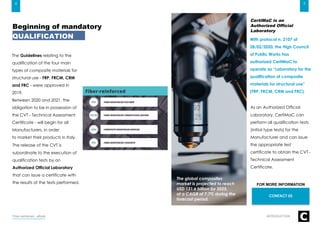
With protocol n. 2107 of
28/02/2020, the High Council
of Public Works has
authorized CertiMaC to
operate as “Laboratory for the
qualification of composite
materials for structural use”
(FRP, FRCM, CRM and FRC).
As an Authorized Official
Laboratory, CertiMaC can
perform all qualification tests
(initial type tests) for the
Manufacturer and can issue
the appropriate test
certificate to obtain the CVT -
Technical Assessment
Certificate.
CertiMaC is an
Authorized Official
Laboratory
Fiber-reinforced - eBook INTRODUCTION
CONTACT US
FOR MORE INFORMATION
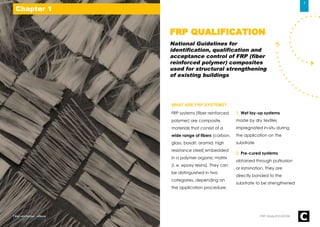
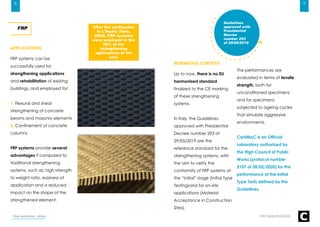
WHAT ARE FRP SYSTEMS?
FRP systems (fiber reinforced
polymer) are composite
materials that consist of a
wide range of fibers (carbon,
glass, basalt, aramid, high
resistance steel) embedded
in a polymer organic matrix
(i. e. epoxy resins). They can
be distinguished in two
categories, depending on
the application procedure:
1. Wet lay-up systems
made by dry textiles
impregnated in-situ during
the application on the
substrate
2. Pre-cured systems
obtained through pultrusion
or lamination. They are
directly bonded to the
substrate to be strengthened
FRP QUALIFICATION
National Guidelines for
identification, qualification and
acceptance control of FRP (fiber
reinforced polymer) composites
used for structural strengthening
of existing buildings
Chapter 1
7
FRP QUALIFICATIONFiber-reinforced - eBook
NORMATIVE CONTEXT
Up to now, there is no EU
harmonised standard
finalized to the CE marking
of these strengthening
systems.
In Italy, the Guidelines
approved with Presidential
Decree number 293 of
29/05/2019 are the
reference standard for the
strengthening systems, with
the aim to verify the
conformity of FRP systems at
the “Initial” stage (Initial Type
Testing)and for on-site
applications (Material
Acceptance in Construction
Sites).
9
FRP QUALIFICATION
APPLICATIONS
FRP systems can be
successfully used for
strengthening applications
and rehabilitation of existing
buildings, and employed for:
1. Flexural and shear
strengthening of concrete
beams and masonry elements
2. Confinement of concrete
columns
FRP systems provide several
advantages if compared to
traditional strengthening
systems, such as: high strength
to weight ratio, easiness of
application and a reduced
impact on the shape of the
strengthened element.
FRP
Fiber-reinforced - eBook
Guidelines
approved with
Presidential
Decree
number 293
of 29/05/2019
The performances are
evaluated in terms of tensile
strength, both for
unconditioned specimens
and for specimens
subjected to ageing cycles
that simulate aggressive
environments.
CertiMaC is an Official
Laboratory authorized by
the High Council of Public
Works (protocol number
2107 of 28/02/2020) for the
performance of the Initial
Type Tests defined by the
Guidelines.
After the earthquake
in L'Aquila (Italy,
2009), FRP systems
were employed in the
58% of the
strengthening
applications of the
area
8
Product Test Type Parameter
Number of
specimens
Number of
production lots
Resin
Glass Transition
Temperature
Tg 3 (1 for each lot) 1
FRP System
Mechanical
Resistance
Elastic Modulus and
Tensile Strength
15 (5 for each lot) 3
Mechanical
Resistance after
freeze and thawing
cycles
Elastic Modulus and
Tensile Strength
3 subjected to
ageing cycles and 3
unconditioned
3
Mechanical
Resistance after
exposure to humidity
Elastic Modulus and
Tensile Strength
3 subjected to
ageing cycles and 3
unconditioned
3
Mechanical
Resistance after
exposure to saltwater
Elastic Modulus and
Tensile Strength
3 subjected to
ageing cycles and 3
unconditioned
3
Mechanical
Resistance after
exposure to alkaline
environment
Elastic Modulus and
Tensile Strength
3 subjected to
ageing cycles and 3
unconditioned
3
Summary Table of the
Initial Type Tests
FRP
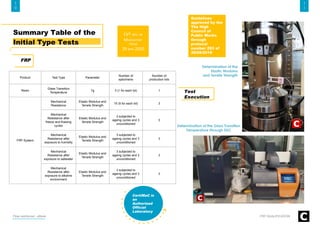
Test
Execution
CertiMaC is
an
Authorized
Official
Laboratory
Determination of the
Elastic Modulus
and Tensile Strength
Determination of the Glass Transition
Temperature through DSC
Fiber-reinforced - eBook FRP QUALIFICATION
Guidelines
approved by the
The High
Council of
Public Works
through
protocol
number 293 of
29/05/2019
1
1
1
0
Chapter 2
1
3
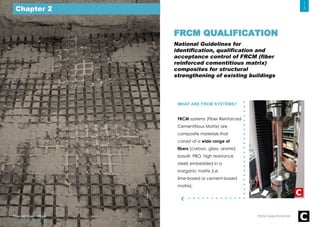
WHAT ARE FRCM SYSTEMS?
FRCM systems (Fiber Reinforced
Cementitious Matrix) are
composite materials that
consist of a wide range of
fibers (carbon, glass, aramid,
basalt, PBO, high resistance
steel) embedded in a
inorganic matrix (i.e.
lime-based or cement-based
matrix).
FRCM QUALIFICATION
National Guidelines for
identification, qualification and
acceptance control of FRCM (fiber
reinforced cementitious matrix)
composites for structural
strengthening of existing buildings
FRCM QUALIFICATIONFiber-reinforced - eBook
NORMATIVE CONTEXT
Up to now, there is no EU
harmonised standard
finalized to the CE marking
of these strengthening
systems.
In Italy, the Guidelines
approved with Presidential
Decree number 1 of
08/01/2019 are the
reference standard for
these strengthening
systems, with the aim to
verify the conformity of FRP
systems at the “Initial” stage
(Initial Type Testing)and for
on-site applications
(Material Acceptance in
Construction Sites)
1
5
FRCM QUALIFICATION
81
4
APPLICATIONS
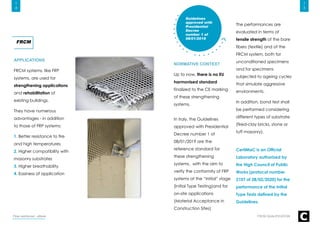
FRCM systems, like FRP
systems, are used for
strengthening applications
and rehabilitation of
existing buildings.
They have numerous
advantages - in addition
to those of FRP systems:
1. Better resistance to fire
and high temperatures
2. Higher compatibility with
masonry substrates
3. Higher breathability
4. Easiness of application
FRCM
Fiber-reinforced - eBook
Guidelines
approved with
Presidential
Decree
number 1 of
08/01/2019
The performances are
evaluated in terms of
tensile strength of the bare
fibers (textile) and of the
FRCM system, both for
unconditioned specimens
and for specimens
subjected to ageing cycles
that simulate aggressive
environments.
In addition, bond test shall
be performed considering
different types of substrate
(fired-clay bricks, stone or
tuff masonry).
CertiMaC is an Official
Laboratory authorized by
the High Council of Public
Works (protocol number
2107 of 28/02/2020) for the
performance of the Initial
Type Tests defined by the
Guidelines.
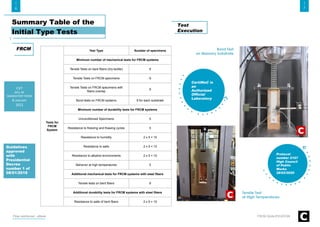
Summary Table of the
Initial Type Tests
FRCM
Test
Execution
1
6
1
7
CertiMaC is
an
Authorized
Official
Laboratory
Bond Test
on Masonry Substrate
Tensile Test
at High Temperatures
FRCM QUALIFICATION
Protocol
number 2107
High Council
of Public
Works
28/02/2020
Guidelines
approved
with
Presidential
Decree
number 1 of
08/01/2019
Tests for
FRCM
System
Test Type Number of specimens
Minimum number of mechanical tests for FRCM systems
Tensile Tests on bare fibers (dry textile) 9
Tensile Tests on FRCM specimens 9
Tensile Tests on FRCM specimens with
fibers overlap
9
Bond tests on FRCM systems 9 for each substrate
Minimum number of durability tests for FRCM systems
Unconditioned Specimens 5
Resistance to freezing and thawing cycles 5
Resistance to humidity 2 x 5 = 10
Resistance to salts 2 x 5 = 10
Resistance to alkaline environments 2 x 5 = 10
Behavior at high temperatures 5
Additional mechanical tests for FRCM systems with steel fibers
Tensile tests on bent fibers 9
Additional durability tests for FRCM systems with steel fibers
Resistance to salts of bent fibers 2 x 5 = 10
Fiber-reinforced - eBook
Chapter 3
1
9
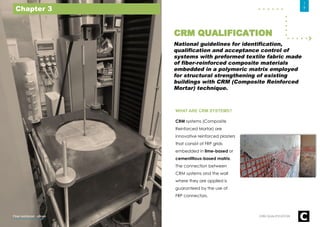
National guidelines for identification,
qualification and acceptance control of
systems with preformed textile fabric made
of fiber-reinforced composite materials
embedded in a polymeric matrix employed
for structural strengthening of existing
buildings with CRM (Composite Reinforced
Mortar) technique.
CRM QUALIFICATION
CRM QUALIFICATIONFiber-reinforced - eBook
WHAT ARE CRM SYSTEMS?
CRM systems (Composite
Reinforced Mortar) are
innovative reinforced plasters
that consist of FRP grids
embedded in lime-based or
cementitious-based matrix.
The connection between
CRM systems and the wall
where they are applied is
guaranteed by the use of
FRP connectors.
NORMATIVE CONTEXT
Up to now, there is no EU
harmonised standard finalized
to the CE marking of these
strengthening systems.
In Italy, the Guidelines
approved with Presidential
Decree number 292 of
29/05/2019 are the reference
standard for these
strengthening systems, with the
aim to verify the conformity of
CRM systems at the “Initial”
stage (Initial Type Testing) and
for on-site applications
(Material Acceptance in
Construction Sites).
The performances are
evaluated in terms of tensile
strength of the FRP grid and of
the connectors of the CRM
system, both for unconditioned
specimens and for specimens
subjected to ageing cycles
that simulate aggressive
environments.
2
1
CRM QUALIFICATION
82
0
APPLICATIONS
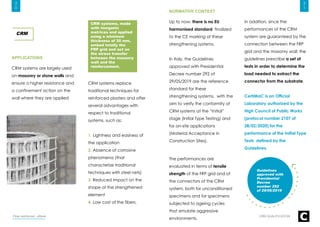
CRM systems are largely used
on masonry or stone walls and
ensure a higher resistance and
a confinement action on the
wall where they are applied
Guidelines
approved with
Presidential
Decree
number 292
of 29/05/2019
In addition, since the
performances of the CRM
system are guaranteed by the
connection between the FRP
grid and the masonry wall, the
guidelines prescribe a set of
tests in order to determine the
load needed to extract the
connector from the substrate.
CertiMaC is an Official
Laboratory authorized by the
High Council of Public Works
(protocol number 2107 of
28/02/2020) for the
performance of the Initial Type
Tests defined by the
Guidelines.
CRM
CRM systems replace
traditional techniques for
reinforced plasters and offer
several advantages with
respect to traditional
systems, such as:
1. Lightness and easiness of
the application
2. Absence of corrosive
phenomena (that
characterize traditional
techniques with steel nets)
3. Reduced impact on the
shape of the strengthened
element
4. Low cost of the fibers.
CRM systems, made
with inorganic
matrices and applied
using a minimum
thickness of 30 mm,
embed totally the
FRP grid and act on
the stress transfer
between the masonry
wall and the
reinforcement.
Fiber-reinforced - eBook
2
2
2
3
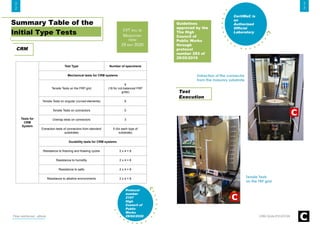
Summary Table of the
Initial Type Tests
CRM
CertiMaC is
an
Authorized
Official
Laboratory
Protocol
number
2107
High
Council of
Public
Works
28/02/2020
Test
Execution
Extraction of the connector
from the masonry substrate
Tensile Tests
on the FRP grid
CRM QUALIFICATION
Guidelines
approved by the
The High
Council of
Public Works
through
protocol
number 293 of
29/05/2019
Tests for
CRM
System
Test Type Number of specimens
Mechanical tests for CRM systems
Tensile Tests on the FRP grid
9
(18 for not-balanced FRP
grids)
Tensile Tests on angular (curved elements) 9
Tensile Tests on connectors 5
Overlap tests on connectors 3
Extraction tests of connectors from standard
substrates
5 (for each type of
substrate)
Durability tests for CRM systems
Resistance to freezing and thawing cycles 2 x 4 = 8
Resistance to humidity 2 x 4 = 8
Resistance to salts 2 x 4 = 8
Resistance to alkaline environments 2 x 4 = 8
Fiber-reinforced - eBook
FRC QUALIFICATION
National Guidelines for identification,
qualification, technical certification
and acceptance control of FRC (Fiber
Reinforced Concrete) systems.
Chapter 4
2
5
FRC QUALIFICATIONFiber-reinforced - eBook
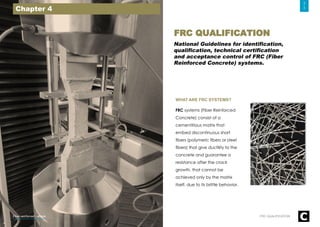
WHAT ARE FRC SYSTEMS?
FRC systems (Fiber Reinforced
Concrete) consist of a
cementitious matrix that
embed discontinuous short
fibers (polymeric fibers or steel
fibers) that give ductility to the
concrete and guarantee a
resistance after the crack
growth, that cannot be
achieved only by the matrix
itself, due to its brittle behavior.
NORMATIVE CONTEXT
Up to now, there is no EU
harmonised standard
finalized to the CE marking
of these strengthening
systems.
In Italy, the Guidelines
approved with Presidential
Decree number 208 of
09/04/2019 are the
reference standard for these
strengthening systems, with
the aim to verify the
conformity of FRC systems at
the “Initial” stage (Initial Type
Testing)and for on-site
applications (Material
Acceptance in Construction
Sites).
2
7
FRC QUALIFICATION
APPLICATIONS
FRC (Fiber Reinforced
Concrete) systems are
employed for the
strengthening of structural
elements, i.e. jackets for
columns and beams or for
the extrados strengthening
of slabs. With FRC systems it is
possible to obtain structural
slabs without the needed of
welded steel wire meshes.
Another advantage of FRC
systems is the high ductility,
that allows to guarantee
high performances in terms
of tensile strength, also after
the crack growth.
Fiber-reinforced - eBook
Guidelines
approved with
Presidential
Decree
number 208
of 09/04/2019
The performances are
evaluated in terms of tensile
and flexural strength of the
fiber reinforced concrete
both for unconditioned
specimens and for
specimens subjected to
ageing cycles that simulate
aggressive environments.
CertiMaC is an Official
Laboratory authorized by the
High Council of Public Works
(protocol number 2107 of
28/02/2020) for the
performance of the Initial
Type Tests defined by the
Guidelines.
FRC
2
6
2
8
2
9
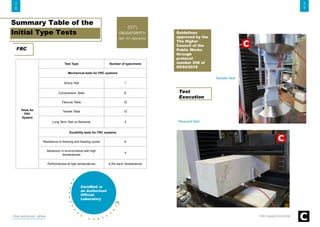
Summary Table of the
Initial Type Tests
FRC
Test
Execution
Tensile Test
Flexural Test
FRC QUALIFICATION
Guidelines
approved by the
The Higher
Council of the
Public Works
through
protocol
number 208 of
09/04/2019
Fiber-reinforced - eBook
Tests for
FRC
System
Test Type Number of specimens
Mechanical tests for FRC systems
Slump Test 1
Compression Tests 6
Flexural Tests 12
Tensile Tests 12
Long Term Test on filaments 3
Durability tests for FRC systems
Resistance to freezing and thawing cycles 6
Behaviour in environments with high
temperatures
4
Performances at high temperatures 4 (for each Temperature)
CertiMaC is
an Authorized
Official
Laboratory
CertiMaC is a Research Body
founded and participated by ENEA
and CNR.
CertiMaC promotes innovation in the
energy and materials sector by
offering laboratory analysis, industrial
research and specialist consultancy
services.
CertiMaC experts in materials
science and thermophysics support
companies in every design phase,
from the need analysis to the release
of test reports, certifications and
technical-scientific reports.
Advanced equipment, specialist
skills, rigorous quality parameters are
the value we offer to companies
that choose us for their innovation
and certification projects.
CertiMaC
at a glance
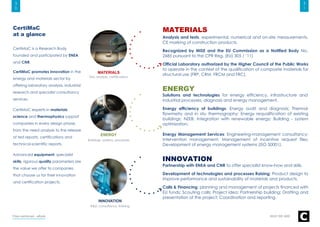
MATERIALS
Test, analysis, certifications
ENERGY
Buildings, systems, processes
INNOVATION
R&D, consultancy, training
WHO WE ARE
3
1
3
0
Analysis and tests, experimental, numerical and on-site measurements,
CE marking of construction products.
Recognized by MISE and the EU Commission as a Notified Body No.
2685 pursuant to the CPR Reg. (EU) 305 / ’11)
Official Laboratory authorized by the Higher Council of the Public Works
to operate in the context of the qualification of composite materials for
structural use (FRP, CRM, FRCM and FRC).
Solutions and technologies for energy efficiency, infrastructure and
industrial processes, diagnosis and energy management.
Energy efficiency of buildings: Energy audit and diagnosis; Thermal
flowmetry and in situ thermography; Energy requalification of existing
buildings; NZEB; Integration with renewable energy; Building - system
optimization.
Energy Management Services: Engineering-management consultancy;
Intervention management; Management of incentive request files;
Development of energy management systems (ISO 50001).
Partnership with ENEA and CNR to offer specialist know-how and skills.
Development of technologies and processes Raising; Product design to
improve performance and sustainability of materials and products.
Calls & Financing: planning and management of projects financed with
EU funds; Scouting calls; Project idea; Partnership building; Drafting and
presentation of the project; Coordination and reporting.
MATERIALS
ENERGY
INNOVATION
Fiber-reinforced - eBook
3
2
CONTACTS
www.certimac.it
info@certimac.it
+39 0546 678548
Our specialists are at your disposal
 
Technical Director Eng. Luca Laghi – l.laghi@certimac.it / (+ 39) 328 3058166
Materials Department| materiali@certimac.it
Energy Department| energia@certimac.it
Innovation Department| innovazione@certimac.it
Organismo Notificato N. 2685
Regolamento Prodotti da Costruzione
CPR (EU) 305/2011
www.certimac.it

Qualification of composite materials for structural use_CertiMaC

  • 1.
    QUALIFICATION OF COMPOSITE MATERIALS FOR STRUCTURALUSE Guidelines of the Italian High Council of Public Works E-book by CertiMaC Authorized official laboratory for the qualification tests and the issue of certificates Protocol No. 2107 - 28/02/2020 E-book|QualificationOfCompositeMaterialsForStructuralUse [founded and participated by]
  • 2.
    + + + + + + + + + + + + + + + + FRP Characterisation FRCM Characterisation CRM Characterisation FRC Characterisation 01 02 0304INTRODUCTION Pages 24–29Pages 18–23Pages 12-17Pages 6-11Pages 2-5 Composite materials for structural use Fiber-reinforced - eBook
  • 3.
    The current Technical Standardsfor Construction - NTC 2018 - prescribe, in point 11.1, that all construction materials and products - when used for structural use - must be identified and have a specific qualification for the intended use and must also be subject to checks during acceptance by the Director of Works. At this extent, the NTC establish that construction materials and products . COMPOSITE MATERIALS FOR STRUCTURAL USE What is required by the legislation Introduction for structural use - when not CE marked according to EU Regulation No. 305/2011, or without ETA (European Technical Assessment) according to art. 26 of EU Regulation No. 305/2011 - require a "Technical Assessment Certificate" (CVT) issued by the Central Technical Service, on the basis of approved guidelines by the High Council of Public Works. Fiber-reinforced - eBook 3 INTRODUCTION
  • 4.
    Beginning of mandatory QUALIFICATION TheGuidelines relating to the qualification of the four main types of composite materials for structural use - FRP, FRCM, CRM and FRC - were approved in 2019. Between 2020 and 2021, the obligation to be in possession of the CVT - Technical Assessment Certificate - will begin for all Manufacturers, in order to market their products in Italy. The release of the CVT is subordinate to the execution of qualification tests by an Authorized Official Laboratory that can issue a certificate with the results of the tests performed. The global composites market is projected to reach USD 131.6 billion by 2025, at a CAGR of 7.7% during the forecast period. 54 With protocol n. 2107 of 28/02/2020, the High Council of Public Works has authorized CertiMaC to operate as “Laboratory for the qualification of composite materials for structural use” (FRP, FRCM, CRM and FRC). As an Authorized Official Laboratory, CertiMaC can perform all qualification tests (initial type tests) for the Manufacturer and can issue the appropriate test certificate to obtain the CVT - Technical Assessment Certificate. CertiMaC is an Authorized Official Laboratory Fiber-reinforced - eBook INTRODUCTION CONTACT US FOR MORE INFORMATION
  • 5.
    WHAT ARE FRPSYSTEMS? FRP systems (fiber reinforced polymer) are composite materials that consist of a wide range of fibers (carbon, glass, basalt, aramid, high resistance steel) embedded in a polymer organic matrix (i. e. epoxy resins). They can be distinguished in two categories, depending on the application procedure: 1. Wet lay-up systems made by dry textiles impregnated in-situ during the application on the substrate 2. Pre-cured systems obtained through pultrusion or lamination. They are directly bonded to the substrate to be strengthened FRP QUALIFICATION National Guidelines for identification, qualification and acceptance control of FRP (fiber reinforced polymer) composites used for structural strengthening of existing buildings Chapter 1 7 FRP QUALIFICATIONFiber-reinforced - eBook
  • 6.
    NORMATIVE CONTEXT Up tonow, there is no EU harmonised standard finalized to the CE marking of these strengthening systems. In Italy, the Guidelines approved with Presidential Decree number 293 of 29/05/2019 are the reference standard for the strengthening systems, with the aim to verify the conformity of FRP systems at the “Initial” stage (Initial Type Testing)and for on-site applications (Material Acceptance in Construction Sites). 9 FRP QUALIFICATION APPLICATIONS FRP systems can be successfully used for strengthening applications and rehabilitation of existing buildings, and employed for: 1. Flexural and shear strengthening of concrete beams and masonry elements 2. Confinement of concrete columns FRP systems provide several advantages if compared to traditional strengthening systems, such as: high strength to weight ratio, easiness of application and a reduced impact on the shape of the strengthened element. FRP Fiber-reinforced - eBook Guidelines approved with Presidential Decree number 293 of 29/05/2019 The performances are evaluated in terms of tensile strength, both for unconditioned specimens and for specimens subjected to ageing cycles that simulate aggressive environments. CertiMaC is an Official Laboratory authorized by the High Council of Public Works (protocol number 2107 of 28/02/2020) for the performance of the Initial Type Tests defined by the Guidelines. After the earthquake in L'Aquila (Italy, 2009), FRP systems were employed in the 58% of the strengthening applications of the area 8
  • 7.
    Product Test TypeParameter Number of specimens Number of production lots Resin Glass Transition Temperature Tg 3 (1 for each lot) 1 FRP System Mechanical Resistance Elastic Modulus and Tensile Strength 15 (5 for each lot) 3 Mechanical Resistance after freeze and thawing cycles Elastic Modulus and Tensile Strength 3 subjected to ageing cycles and 3 unconditioned 3 Mechanical Resistance after exposure to humidity Elastic Modulus and Tensile Strength 3 subjected to ageing cycles and 3 unconditioned 3 Mechanical Resistance after exposure to saltwater Elastic Modulus and Tensile Strength 3 subjected to ageing cycles and 3 unconditioned 3 Mechanical Resistance after exposure to alkaline environment Elastic Modulus and Tensile Strength 3 subjected to ageing cycles and 3 unconditioned 3 Summary Table of the Initial Type Tests FRP Test Execution CertiMaC is an Authorized Official Laboratory Determination of the Elastic Modulus and Tensile Strength Determination of the Glass Transition Temperature through DSC Fiber-reinforced - eBook FRP QUALIFICATION Guidelines approved by the The High Council of Public Works through protocol number 293 of 29/05/2019 1 1 1 0
  • 8.
    Chapter 2 1 3 WHAT AREFRCM SYSTEMS? FRCM systems (Fiber Reinforced Cementitious Matrix) are composite materials that consist of a wide range of fibers (carbon, glass, aramid, basalt, PBO, high resistance steel) embedded in a inorganic matrix (i.e. lime-based or cement-based matrix). FRCM QUALIFICATION National Guidelines for identification, qualification and acceptance control of FRCM (fiber reinforced cementitious matrix) composites for structural strengthening of existing buildings FRCM QUALIFICATIONFiber-reinforced - eBook
  • 9.
    NORMATIVE CONTEXT Up tonow, there is no EU harmonised standard finalized to the CE marking of these strengthening systems. In Italy, the Guidelines approved with Presidential Decree number 1 of 08/01/2019 are the reference standard for these strengthening systems, with the aim to verify the conformity of FRP systems at the “Initial” stage (Initial Type Testing)and for on-site applications (Material Acceptance in Construction Sites) 1 5 FRCM QUALIFICATION 81 4 APPLICATIONS FRCM systems, like FRP systems, are used for strengthening applications and rehabilitation of existing buildings. They have numerous advantages - in addition to those of FRP systems: 1. Better resistance to fire and high temperatures 2. Higher compatibility with masonry substrates 3. Higher breathability 4. Easiness of application FRCM Fiber-reinforced - eBook Guidelines approved with Presidential Decree number 1 of 08/01/2019 The performances are evaluated in terms of tensile strength of the bare fibers (textile) and of the FRCM system, both for unconditioned specimens and for specimens subjected to ageing cycles that simulate aggressive environments. In addition, bond test shall be performed considering different types of substrate (fired-clay bricks, stone or tuff masonry). CertiMaC is an Official Laboratory authorized by the High Council of Public Works (protocol number 2107 of 28/02/2020) for the performance of the Initial Type Tests defined by the Guidelines.
  • 10.
    Summary Table ofthe Initial Type Tests FRCM Test Execution 1 6 1 7 CertiMaC is an Authorized Official Laboratory Bond Test on Masonry Substrate Tensile Test at High Temperatures FRCM QUALIFICATION Protocol number 2107 High Council of Public Works 28/02/2020 Guidelines approved with Presidential Decree number 1 of 08/01/2019 Tests for FRCM System Test Type Number of specimens Minimum number of mechanical tests for FRCM systems Tensile Tests on bare fibers (dry textile) 9 Tensile Tests on FRCM specimens 9 Tensile Tests on FRCM specimens with fibers overlap 9 Bond tests on FRCM systems 9 for each substrate Minimum number of durability tests for FRCM systems Unconditioned Specimens 5 Resistance to freezing and thawing cycles 5 Resistance to humidity 2 x 5 = 10 Resistance to salts 2 x 5 = 10 Resistance to alkaline environments 2 x 5 = 10 Behavior at high temperatures 5 Additional mechanical tests for FRCM systems with steel fibers Tensile tests on bent fibers 9 Additional durability tests for FRCM systems with steel fibers Resistance to salts of bent fibers 2 x 5 = 10 Fiber-reinforced - eBook
  • 11.
    Chapter 3 1 9 National guidelinesfor identification, qualification and acceptance control of systems with preformed textile fabric made of fiber-reinforced composite materials embedded in a polymeric matrix employed for structural strengthening of existing buildings with CRM (Composite Reinforced Mortar) technique. CRM QUALIFICATION CRM QUALIFICATIONFiber-reinforced - eBook WHAT ARE CRM SYSTEMS? CRM systems (Composite Reinforced Mortar) are innovative reinforced plasters that consist of FRP grids embedded in lime-based or cementitious-based matrix. The connection between CRM systems and the wall where they are applied is guaranteed by the use of FRP connectors.
  • 12.
    NORMATIVE CONTEXT Up tonow, there is no EU harmonised standard finalized to the CE marking of these strengthening systems. In Italy, the Guidelines approved with Presidential Decree number 292 of 29/05/2019 are the reference standard for these strengthening systems, with the aim to verify the conformity of CRM systems at the “Initial” stage (Initial Type Testing) and for on-site applications (Material Acceptance in Construction Sites). The performances are evaluated in terms of tensile strength of the FRP grid and of the connectors of the CRM system, both for unconditioned specimens and for specimens subjected to ageing cycles that simulate aggressive environments. 2 1 CRM QUALIFICATION 82 0 APPLICATIONS CRM systems are largely used on masonry or stone walls and ensure a higher resistance and a confinement action on the wall where they are applied Guidelines approved with Presidential Decree number 292 of 29/05/2019 In addition, since the performances of the CRM system are guaranteed by the connection between the FRP grid and the masonry wall, the guidelines prescribe a set of tests in order to determine the load needed to extract the connector from the substrate. CertiMaC is an Official Laboratory authorized by the High Council of Public Works (protocol number 2107 of 28/02/2020) for the performance of the Initial Type Tests defined by the Guidelines. CRM CRM systems replace traditional techniques for reinforced plasters and offer several advantages with respect to traditional systems, such as: 1. Lightness and easiness of the application 2. Absence of corrosive phenomena (that characterize traditional techniques with steel nets) 3. Reduced impact on the shape of the strengthened element 4. Low cost of the fibers. CRM systems, made with inorganic matrices and applied using a minimum thickness of 30 mm, embed totally the FRP grid and act on the stress transfer between the masonry wall and the reinforcement. Fiber-reinforced - eBook
  • 13.
    2 2 2 3 Summary Table ofthe Initial Type Tests CRM CertiMaC is an Authorized Official Laboratory Protocol number 2107 High Council of Public Works 28/02/2020 Test Execution Extraction of the connector from the masonry substrate Tensile Tests on the FRP grid CRM QUALIFICATION Guidelines approved by the The High Council of Public Works through protocol number 293 of 29/05/2019 Tests for CRM System Test Type Number of specimens Mechanical tests for CRM systems Tensile Tests on the FRP grid 9 (18 for not-balanced FRP grids) Tensile Tests on angular (curved elements) 9 Tensile Tests on connectors 5 Overlap tests on connectors 3 Extraction tests of connectors from standard substrates 5 (for each type of substrate) Durability tests for CRM systems Resistance to freezing and thawing cycles 2 x 4 = 8 Resistance to humidity 2 x 4 = 8 Resistance to salts 2 x 4 = 8 Resistance to alkaline environments 2 x 4 = 8 Fiber-reinforced - eBook
  • 14.
    FRC QUALIFICATION National Guidelinesfor identification, qualification, technical certification and acceptance control of FRC (Fiber Reinforced Concrete) systems. Chapter 4 2 5 FRC QUALIFICATIONFiber-reinforced - eBook WHAT ARE FRC SYSTEMS? FRC systems (Fiber Reinforced Concrete) consist of a cementitious matrix that embed discontinuous short fibers (polymeric fibers or steel fibers) that give ductility to the concrete and guarantee a resistance after the crack growth, that cannot be achieved only by the matrix itself, due to its brittle behavior.
  • 15.
    NORMATIVE CONTEXT Up tonow, there is no EU harmonised standard finalized to the CE marking of these strengthening systems. In Italy, the Guidelines approved with Presidential Decree number 208 of 09/04/2019 are the reference standard for these strengthening systems, with the aim to verify the conformity of FRC systems at the “Initial” stage (Initial Type Testing)and for on-site applications (Material Acceptance in Construction Sites). 2 7 FRC QUALIFICATION APPLICATIONS FRC (Fiber Reinforced Concrete) systems are employed for the strengthening of structural elements, i.e. jackets for columns and beams or for the extrados strengthening of slabs. With FRC systems it is possible to obtain structural slabs without the needed of welded steel wire meshes. Another advantage of FRC systems is the high ductility, that allows to guarantee high performances in terms of tensile strength, also after the crack growth. Fiber-reinforced - eBook Guidelines approved with Presidential Decree number 208 of 09/04/2019 The performances are evaluated in terms of tensile and flexural strength of the fiber reinforced concrete both for unconditioned specimens and for specimens subjected to ageing cycles that simulate aggressive environments. CertiMaC is an Official Laboratory authorized by the High Council of Public Works (protocol number 2107 of 28/02/2020) for the performance of the Initial Type Tests defined by the Guidelines. FRC 2 6
  • 16.
    2 8 2 9 Summary Table ofthe Initial Type Tests FRC Test Execution Tensile Test Flexural Test FRC QUALIFICATION Guidelines approved by the The Higher Council of the Public Works through protocol number 208 of 09/04/2019 Fiber-reinforced - eBook Tests for FRC System Test Type Number of specimens Mechanical tests for FRC systems Slump Test 1 Compression Tests 6 Flexural Tests 12 Tensile Tests 12 Long Term Test on filaments 3 Durability tests for FRC systems Resistance to freezing and thawing cycles 6 Behaviour in environments with high temperatures 4 Performances at high temperatures 4 (for each Temperature) CertiMaC is an Authorized Official Laboratory
  • 17.
    CertiMaC is aResearch Body founded and participated by ENEA and CNR. CertiMaC promotes innovation in the energy and materials sector by offering laboratory analysis, industrial research and specialist consultancy services. CertiMaC experts in materials science and thermophysics support companies in every design phase, from the need analysis to the release of test reports, certifications and technical-scientific reports. Advanced equipment, specialist skills, rigorous quality parameters are the value we offer to companies that choose us for their innovation and certification projects. CertiMaC at a glance MATERIALS Test, analysis, certifications ENERGY Buildings, systems, processes INNOVATION R&D, consultancy, training WHO WE ARE 3 1 3 0 Analysis and tests, experimental, numerical and on-site measurements, CE marking of construction products. Recognized by MISE and the EU Commission as a Notified Body No. 2685 pursuant to the CPR Reg. (EU) 305 / ’11) Official Laboratory authorized by the Higher Council of the Public Works to operate in the context of the qualification of composite materials for structural use (FRP, CRM, FRCM and FRC). Solutions and technologies for energy efficiency, infrastructure and industrial processes, diagnosis and energy management. Energy efficiency of buildings: Energy audit and diagnosis; Thermal flowmetry and in situ thermography; Energy requalification of existing buildings; NZEB; Integration with renewable energy; Building - system optimization. Energy Management Services: Engineering-management consultancy; Intervention management; Management of incentive request files; Development of energy management systems (ISO 50001). Partnership with ENEA and CNR to offer specialist know-how and skills. Development of technologies and processes Raising; Product design to improve performance and sustainability of materials and products. Calls & Financing: planning and management of projects financed with EU funds; Scouting calls; Project idea; Partnership building; Drafting and presentation of the project; Coordination and reporting. MATERIALS ENERGY INNOVATION Fiber-reinforced - eBook
  • 18.
    3 2 CONTACTS www.certimac.it info@certimac.it +39 0546 678548 Ourspecialists are at your disposal   Technical Director Eng. Luca Laghi – l.laghi@certimac.it / (+ 39) 328 3058166 Materials Department| materiali@certimac.it Energy Department| energia@certimac.it Innovation Department| innovazione@certimac.it Organismo Notificato N. 2685 Regolamento Prodotti da Costruzione CPR (EU) 305/2011
  • 19.