By
Jk Study Materials(YouTube Channel)
Textual Question &
Answers
Textual Question &
Answers
12th English
12th English
/jkStudymaterials
1. Flamingo
2. vistas
1. Flamingo
2. vistas
2.
NCERT Solutions forClass 12 English
Flamingo Chapter 1
The Last Lesson Class 12
Chapter 1 The Last Lesson Exercise Answers & Summary
Exercise : Solutions of Questions on Page Number : 2
Q1 :
Notice these expressions in the text. Infer their meanings from the context.
Answer :
in great dread of - fearful in anticipation of something
counted on - to rely or trust on somebody/something
thumbed at the edges - worn or soiled edges caused by frequent handling
in unison - something happening or being done at the same time
a great bustle - an excited (and often noisy) activity or a rapid, active commotion
reproach ourselves with - to express disapproval, criticism, or disappointment
Think as you read : Solutions of Questions on Page Number : 7
Q1 :
What was Franz expected to be prepared with for school that day?
Answer :
That day, Franz was expected to be prepared with the lesson on participles.
Q2 :
What did Franz notice that was unusual about the school that day?
Answer :
JK STUDY MATERIALS - Whatsp Group for More Notes (6006356890)
Click Here
For Notes, Pyqs etc
3.
That day, Franznoticed the absence of the routine commotion caused by the opening
and closing of desks, repeating of lessons in unison and rapping of the teacher's ruler
on the table. The usual hustle-bustle was replaced by a strange stillness that was the
characteristic of a school on a "Sunday morning."
Q3 :
What had been put up on the bulletin-board?
Answer :
The bulletin-board notified the general public about an order from Berlin. It stated that
only German was to be taught to students in the schools of Alsace and Lorraine.
Q4 :
What changes did the order from Berlin cause in school that day?
Answer :
The order from Berlin brought all the routine hustle-bustle of the school life to a stand-
still. The teacher, M. Hamel, became more sympathetic to his students and taught his
lessons with more patience. The students became more attentive in their classes. The
villagers, who were sitting at the usually empty back benches and had come to show
their respect and gratitude to M. Hamel, regretted not going to school more than they
did. The order also brought about a great change in the feelings of the people towards
their country and their native language. There was a general sadness about not being
able to utilise the opportunities of learning French when it was easily accessible.
Q5 :
How did Franz's feelings about M. Hamel and school change?
Answer :
Franz was shocked when M. Hamel told the students about the order from Berlin and
that it was their last French lesson. He forgot about his teacher's ruler and crankiness.
He developed a fondness for M. Hamel at the troubling idea of being separated from
him forever. He understood the pain and agony his teacher was undergoing. And, he
became more sympathetic towards his teacher.
JK STUDY MATERIALS - Whatsp Group for More Notes (6006356890)
4.
His school too,now, carried a different meaning. His books and lessons seemed old
friends whom he couldn't give up. He realised with pain how much French meant to him
and regretted not being attentive in his classes earlier. Suddenly, he felt that the 'difficult
concepts' had never actually been difficult.
Understanding the texttalking about the textworkin : Solutions of Questions on Page Number
: 9
Q1 :
The people in this story suddenly realize how precious their language is to them.
What shows you this? Why does this happen?
Answer :
The crowd surrounding the bulletin-board, the presence of the villagers in the class, the
silence in place of the routine hustle and bustle of the school, the emotions that gripped
M. Hamel and Franz, representing that of the teacher and the student community
respectively, were all indicators of the realisation of the importance of their language to
them.
In the story, M. Hamel says that people realise the importance of somebody or
something in their lives very often when it is lost to them. Similarly, it was the order from
Berlin that made people realise the importance of their language for them.
Q2 :
"When a people are enslaved, as long as they hold fast to their language it is as if
they had the key to their prison."
Can you think of examples in history where a conquered people had their
language taken away from them or had a language imposed on them?
Answer :
Some examples of the native language taken away from its people and/or imposition of
the language of the conqueror are:
(a) Portuguese becoming the lingua franca of Angola.
(b) English imposed on the various Celtic peoples.
(c) Spanish imposed on the Basques and the Catalans.
(d) Turkish imposed on the Kurds.
JK STUDY MATERIALS - Whatsp Group for More Notes (6006356890)
5.
(A few exampleshave been provided for students' reference. It is strongly
recommended that students develop the answer on their own.)
Q3 :
English is a language that contains words from many other languages. This
inclusiveness is one of the reasons it is now a world language, for example:
petite - French
kindergarten - German
capital - Latin
democracy - Greek
bazaar - Hindi
Find out the origin of the following words.
Tycoon, tulip, logo, bandicoot, barbecue, veranda, robot, zero, ski, trek
Answer :
tycoon - Japanese
tulip - French
logo - Greek
bandicoot - Telugu
barbecue - Spanish
veranda - Hindi
robot - Czech
zero - Italian
ski - Norwegian
trek - Dutch
Q4 :
Franz thinks, "Will they make them sing in German, even the pigeons?" What
could this mean?
(There could be more than one answer.)
JK STUDY MATERIALS - Whatsp Group for More Notes (6006356890)
6.
Answer :
Language isinherent to culture and identity. The authority of human beings is restricted
only to false boundaries that can be controlled. Nature and other things cannot be
governed by some superficial laws of the wilful people. By taking the reference of
making the pigeons learn German, the author is pointing to this very constraint.
(or)
This sentence could possibly mean that however hard the authorities try to embed
German language in the culture of Alsace and Lorraine, the natural status of French, for
them, will remain unchanged. French flows in the air and the entire place is imbued with
its effect. Even though they train students in German, the basic mode of communication
would remain unchanged like the cooing of the pigeons.
(Two model answers have been provided for students' reference. It is strongly
recommended that students prepare the answer on their own.)
Q5 :
What happens to a linguistic minority in a state? How do you think they can keep
their language alive? For example:
Punjabis in Bangalore
Tamilians in Mumbai
Kannadigas in Delhi
Gujaratis in Kolkata
Answer :
A linguistic minority in a state does not have as much liberty to exercise linguistic skills
as the natives of the state. They initially try to learn the jargons in order to cope with the
day-to-day life activities and finally begin to understand the native language with regular
interaction. At the workplace and educational organisations, English or the link language
helps a lot to cope up with the work and learning process. But, when it comes to
understanding the basic norms of the society, in order to socialize, one does face a sort
of linguistic barrier during communication.
To keep their language alive, the linguistic minorities can form small communities where
they can celebrate their festivals as per their traditions. Moreover, they can continue to
speak their native language at their homes in order to make their children learn the
language. People must, even, try to visit their native places at regular intervals in order
to stay close to their roots.
JK STUDY MATERIALS - Whatsp Group for More Notes (6006356890)
7.
(A model answerhas been provided for students' reference. It is strongly recommended
that students prepare the answer on their own.)
Q6 :
Is it possible to carry pride in one's language too far?
Do you know what 'linguistic chauvinism' means?
Answer :
Yes, it is possible to carry pride in one's language too far if one is fond of one's own
language at the cost of others. Indifference towards other languages is not healthy for
any democracy like India.
When the sense of belonging to one's own language crosses the thin line between
'pride' and 'proud', it becomes linguistic chauvinism. If people feel good about their
languages and traditions, they must have tolerance for other languages too. Everybody
has the right to follow the religion as well as speak the language as per his/her desire.
In fact, it is disparaging to distort the names of communities, for example, Bongs for
Bengalis, Gujju for Gujratis, etc.
(This question is to be answered on the basis of students' own understanding and
experience. However, a model answer has been provided for students' reference)
Working with wordsnoticing form : Solutions of Questions on Page Number : 10
Q1 :
Read this sentence.
M. Hamel had said that he would question us on participles.
In the sentence above, the verb form “had said” in the first part is used to
indicate an “earlier past.” The whole story is narrated in the past. M. Hamel's
“saying” happened earlier than the events in this story. This form of the verb is
called the past perfect.
Pick out five sentences from the story with this form of verb and say why this
form has been used.
Answer :
JK STUDY MATERIALS - Whatsp Group for More Notes (6006356890)
8.
In the followingsentences, two activities of past, occurring at two different points of time
in the past, are indicated. The one that happens earlier takes the “had” + past form of
verb (V3), while the one that follows it takes the simple past form of verb (V2).
Sentences in past perfect form Reason/ Explanation
I had counted on the commotion to get to my desk witho
ut being seen; but, of course, that day everything had to b
e as quiet as Sunday morning.
The protagonist decided to depend on the commotion to s
neak into the classroom before he encountered the quietn
ess at the school.
Not till then, when I had got a little over my fright, did I se
e that our teacher had on his beautiful green coat ... prize
days.
Getting over the fright happened before he noticed his tea
cher's green coat.
...Hauser had brought an old primer, thumbed at the edg
e, and he held it open on his knees with his great spectacl
es lying across the pages.
Of the two actions, Hauser's bringing of the old primer hap
pened before he held it open on his knees.
It was because they were sorry, too, that they had not go
ne to school more.
The feeling of regret comes after they realise they did not
go to school more than what they did.
My books, that had seemed such a nuisance ... were old f
riends now that I couldn't give up.
The books were a nuisance earlier. It is only later that the
protagonist talked about them in a different light.
(A model answer has been provided for students' reference. It is strongly recommended
that students prepare the answer on their own.)
Q2 :
Notice the underlined words in these sentences and tick the option that best
explains their meanings.
(a) “What a thunderclap these words were to me!”
The words were ___________________
(i) loud and clear.
(ii) startling and unexpected.
(iii) pleasant and welcome.
(b) “When a people are enslaved, as long as they hold fast to their language it is
as if they had the key to their prison.”
It is as if they have the key to the prison as long as they _______________
(i) do not lose their language.
JK STUDY MATERIALS - Whatsp Group for More Notes (6006356890)
9.
(ii) are attachedto their language.
(iii) quickly learn the conqueror's language.
(c) Don't go so fast, you will get to your school in plenty of time.
You will get to your school _______________
(i) very late.
(ii) too early.
(iii) early enough.
(d) I never saw him look so tall.
M. Hamel _____________________
(a) had grown physically taller.
(b) seemed very confident.
(c) stood on the chair.
Answer :
(a) (ii) startling and unexpected.
(b) (ii) are attached to their language.
(c) (iii) early enough.
(d) (b) seemed very confident.
Things to dowriting : Solutions of Questions on Page Number : 11
Q1 :
Find out about the following (You may go to the internet, interview people,
consult reference books or visit a library.)
(a) Linguistic human rights
(b) Constitutional guarantees for linguistic minorities in India
Answer :
(This question is to be answered on the basis of students' own understanding and the
research done by them. It is strongly recommended that students prepare the answer
on their own.)
JK STUDY MATERIALS - Whatsp Group for More Notes (6006356890)
10.
Q2 :
Write anotice for your school bulletin board. Your notice could be an
announcement of a forthcoming event, or a requirement to be fulfilled, or a rule to
be followed.
Answer :
FUTURE VISION PUBLIC SCHOOL, Delhi
NOTICE
July 25, 2012
SPORTS DAY
The school has decided to celebrate its Annual Sports Day on 25 July 2012. All those interested to participate in the
various sports activities are requested to give their names to their respective class teachers latest by 6 July 2012 in t
he following format.
Name:
Class & Section:
Activity 1:
Activity 2:
Activity 3:
A copy of the list of sports activities has been sent to your class teacher. Please note that no student is allowed to pa
rticipate in more than three sports activities.
Rahul Sinha
Head Boy
(A model answer has been provided for students' reference. It is strongly recommended
that students prepare the answer on their own.)
Q3 :
Given below is a survey form. Talk to at least five of your classmates and fill in
the information you get in the form.
S.No.
Languages you
know
Home langua
ge
Neighbourhood lang
uage
City/Town lan
guage
School langua
ge
JK STUDY MATERIALS - Whatsp Group for More Notes (6006356890)
11.
Answer :
(This questionis to be answered on the basis of students' own understanding and
experience. It is strongly recommended that students prepare the answer on their own.)
Q4 :
Write a paragraph of about 100 words arguing for or against having to study three
languages at school.
Answer :
For
Knowledge of additional language gives an edge - makes a person more competitive in
today's fast paced world - better employment opportunities with fluency in a foreign
language - multi-national companies send professionals for on-site projects to other
countries - delegates from other countries coming to interact with people of our country -
can work as translators, interpreters or tourist guides, etc. - preservation of culture and
tradition through native language.
Against
Students are already burdened with two languages - no need for a third language - no
natural inclination for foreign language - foreign language not of much use in daily life
and gradually gets forgotten - should not be forced on people who do not need it - can
be taught only to those who demand for it - time and effort should not be wasted on
something of no clear use.
(Pointers have been provided for students' reference. It is strongly recommended that
students prepare the answer on their own.)
JK STUDY MATERIALS - Whatsp Group for More Notes (6006356890)
12.
Q5 :
Have youever changed your opinion about someone or something that you had
earlier liked or disliked? Narrate what led you to change your mind.
Answer :
Directions: Think about something that you hated earlier but hate no more. It may be
anything - eating a particular vegetable, studying a subject, going to a particular place.
Or, you may think about a person whom you did not like earlier but your opinion about
that person has changed now. It might be because of some misunderstanding or so.
After you make your choice, recollect the reason for your dislike. Recollect what
happened that made you change your opinion about the thing or person. Think about
how it helped you look at things or events or people in different perspective. Write about
it in a paragraph form. You may end it by talking about the learning experience or how it
enriched your perspective or broadened your scope of thinking.
(Directions have been provided for students' benefit. It is strongly recommended that
students prepare the answer on their own.)
JK STUDY MATERIALS - Whatsp Group for More Notes (6006356890)
13.
NCERT Solutions forClass 12 English
Flamingo Chapter 2
Lost Spring Class 12
Chapter 2 Lost Spring Exercise Answers & Summary
Exercise : Solutions of Questions on Page Number : 13
Q1 :
Notice these expressions in the text. Infer their meaning from the context.
Answer :
looking for -try to locate or discover
slog their daylight hours -struggle persistently during the daytime
roof over his head -a place to live
perpetual state of poverty -endless impoverishment
dark hutments -encampment of huts devoid of any light
imposed the baggage on the child - force the profession on the child
Think as you read : Solutions of Questions on Page Number : 17
Q1 :
What is Saheb looking for in the garbage dumps? Where is he and where has he
come from?
Answer :
Saheb is looking for coins, rupee notes and any other useful objects in the garbage
dumps.
Saheb and his family have migrated to Seemapuri, a slum area on the outskirts of Delhi,
looking for a source of living after they were uprooted from their native village in Dhaka,
Bangladesh.
Q2 :
What explanations does the author offer for the children not wearing footwear?
JK STUDY MATERIALS - Whatsp Group for More Notes (6006356890)
14.
Answer :
The authorcomes across many shoeless rag-picker children in her neighbourhood.
According to her, one explanation of this habit of remaining barefoot is that it is a
tradition among the poor children of this country. However, the author quickly mentions
that calling it a tradition could be just a means of justification of the utter destitution.
Q3 :
Is Saheb happy working at the tea-stall? Explain.
Answer :
Saheb is not really happy working at the tea-stall because working for a master meant
sacrificing his freedom and his "carefree look". Even though the job at the tea-stall pays
him 800 rupees and all his meals, he seems less contented than before. The weight of
his master's steel canister seems heavier than his rag-picking plastic bag.
Understanding the texttalking about the textthink : Solutions of Questions on Page Number
: 20
Q1 :
How, in your opinion, can Mukesh realise his dream?
Answer :
Mukesh was different from the others of his community. By daring to dream, he has
already taken the first step towards a big change. He wants to become a motor
mechanic and drive a car. He can realise this dream with determination and hard work.
There might be many obstacles on his way but a strong willpower will help him move
towards the way to success. The fact that he is willing to walk a long distance in order to
learn the vocation, underlines his firm resolve. The only thing left for him to do is to
make that first journey to that garage and request the owner to take him in and guide
and direct him on his journey as a mechanic.
(A model answer has been provided for students' reference. It is strongly recommended
that students prepare the answer based on their own experience and understanding.)
Q2 :
What makes the city of Firozabad famous?
JK STUDY MATERIALS - Whatsp Group for More Notes (6006356890)
15.
Answer :
Firozabad isfamous for its glass bangles. The place is the centre of India's glass-
blowing industry.
Q3 :
What could be some of the reasons for the migration of people from villages to
cities?
Answer :
There are many factors that cause migration of people from villages to cities. Some
villagers voluntarily move to the cities in search for jobs and better civic and health
facilities, etc. Others are forced to migrate when natural disasters like flood, storm,
drought, famine, etc. destroy their houses and properties. History has records of large
scale migrations caused by wars. Also, many villagers who are better off than others
manage to send their children to study in the cities.
In the lesson 'Lost Spring', Saheb and his family migrates to Seemapuri from Dhaka
after their houses were destroyed in the storms.
(A model answer has been provided for students' reference. It is strongly recommended
that students prepare the answer based on their own experience and understanding.)
Q4 :
Would you agree that promises made to poor children are rarely kept? Why do
you think this happens in the incidents narrated in the text?
Answer :
Yes, the promises made to poor children are seldom kept. Often, they are not taken
seriously or have been made on the pretext of retaining a child's fancy for something.
This keeps the child hoping for a better possibility till he/she realises the truth. It is
difficult for people to shatter the children's dreams; while it is also painful to see these
children thrive of false hopes given to them.
Once, while interacting with Saheb, the narrator ends up encouraging him to study and
jokingly talks about opening a school herself. At that time she fails to realise that
unknowingly she has sown a seed of hope in Saheb's heart. She becomes conscious of
her mistake when, after a few days, Saheb approaches her, enquiring about her school.
Her hollow promise leaves her embarrassed.
JK STUDY MATERIALS - Whatsp Group for More Notes (6006356890)
16.
(A model answerhas been provided for students' reference. It is strongly recommended
that students prepare the answer based on their own experience and understanding.)
Q5 :
Mention the hazards of working in the glass bangles industry.
Answer :
The impoverished workers in the glass bangles industry toil in potentially hazardous
working conditions while welding. The furnaces they work in have extremely high
temperature and lack proper ventilation. Persistently working in low light conditions,
without any protective eye gear, leaves them blind. Even burns and cuts are quite
common. The workers are quite prone to ailments such as lung cancer.
(A model answer has been provided for students' reference. It is strongly recommended
that students prepare the answer based on their own experience and understanding.)
Q6 :
Mention the hazards of working in the glass bangles industry.
Answer :
The impoverished workers in the glass bangles industry toil in potentially hazardous
working conditions while welding. The furnaces they work in have extremely high
temperature and lack proper ventilation. Persistently working in low light conditions,
without any protective eye gear, leaves them blind. Even burns and cuts are quite
common. The workers are quite prone to ailments such as lung cancer.
(A model answer has been provided for students' reference. It is strongly recommended
that students prepare the answer based on their own experience and understanding.)
Q7 :
What forces conspire to keep the workers in the bangle industry of Firozabad in
poverty?
Answer :
The unfavourable social and legal systems, the deceptive middlemen, and their own
sad destinies keep the workers in the bangle industry of Firozabad in perpetual poverty.
JK STUDY MATERIALS - Whatsp Group for More Notes (6006356890)
17.
Q8 :
Why shouldchild labour be eliminated and how?
Answer :
Child labour should be eliminated because it takes away from the child his childhood
and the prospect of elementary education. Moreover, since the child labourers are
cheap, and consequently engaged in hazardous and dangerous employment, they are
often vulnerable to mental and physical illness. In order to curb this problem, it is
important to make education easily accessible. Apart from that, the parents must be
made aware of the consequences of working in harmful environments. It is also
important to make the public aware of the fact that child labour is a criminal offence and
is punishable under law. The government must ensure stricter child labour laws and that
the offenders are punished.
(A model answer has been provided for students' reference. It is strongly recommended
that students prepare the answer based on their own experience and understanding.)
Q9 :
How is Mukesh's attitude to his situation different from that of his family?
Answer :
Mukesh belongs to a family of glass bangle makers in Firozabad. Even though the
children of such families usually carry on their family profession, Mukesh wants to be a
motor mechanic and drive a car. Unlike his family members, and others of his
community, he has dared to dream. His grandmother's words about the unbreakable
lineage represent the attitude they have towards their situation in life. They believe that
it is their destiny to toil as bangle makers. But Mukesh dreams of a better and safer
career. The resolute boy is willing to walk a long distance from his home to learn to be a
mechanic, exemplifying the saying, 'where there is a will, there is a way'.
Thinking about language : Solutions of Questions on Page Number : 21
Q1 :
Although this text speaks of factual events and situations of misery it transforms
these situations with an almost poetical prose into a literary experience. How
does it do so? Here are some literary devices:
• Hyperbole is a way of speaking or writing that makes something sound better or
more exciting than it really is. For example: Garbage to them is gold.
JK STUDY MATERIALS - Whatsp Group for More Notes (6006356890)
18.
• A Metaphor,as you may know, compares two things or ideas that are not very
similar. A metaphor describes a thing in terms of a single quality or feature of
some other thing; we can say that a metaphor "transfers" a quality of one thing to
another. For example: The road was a ribbon of light.
• Simile is a word or phrase that compares one thing with another using the
words "like" or "as". For example: As white as snow.
Carefully read the following phrases and sentences taken from the text. Can you
identify the literary device in each example?
1. Saheb-e-Alam which means the lord of the universe is directly in contrast to
what Saheb is in reality.
2. Drowned in an air of desolation.
3. Seemapuri, a place on the periphery of Delhi yet miles away from it,
metaphorically.
4. For the children it is wrapped in wonder; for the elders it is a means of survival.
5. As her hands move mechanically like the tongs of a machine, I wonder if she
knows the sanctity of the bangles she helps make.
6. She still has bangles on her wrist, but not light in her eyes.
7. Few airplanes fly over Firozabad.
8. Web of poverty.
9. Scrounging for gold.
10. And survival in Seemapuri means rag-picking. Through the years, it has
acquired the proportions of a fine art.
11. The steel canister seems heavier than the plastic bag he would carry so lightly
over his shoulde
Answer :
1. Irony
2. Metaphor
3. Antithesis
4. Antithesis
5. Simile
6. Pun
7. Pun
8. Metaphor
JK STUDY MATERIALS - Whatsp Group for More Notes (6006356890)
19.
9. Metaphor
10. Hyberbole
11.Paradox
Things to do : Solutions of Questions on Page Number : 22
Q1 :
The beauty of the glass bangles of Firozabad contrasts with the misery of people
who produce them.
This paradox is also found in some other situations, for example, those who work
in gold and diamond mines, or carpet weaving factories, and the products of their
labour, the lives of construction workers, and the buildings they build.
Look around and find examples of such paradoxes.
Write a paragraph of about 200 to 250 words on any one of them. You can start by
making notes.
Here is an example of how one such paragraph may begin:
You never see the poor in this town. By day they toil, working cranes and
earthmovers, squirreling deep into the hot sand to lay the foundations of chrome.
By night they are banished to bleak labour camps at the outskirts of the city...
Answer :
You never see the poor in this town. By day they toil, working cranes and earthmovers,
squirreling deep into the hot sand to lay the foundations of chrome. By night they are
banished to bleak labour camps at the outskirts of the city. Such is the life of the poor
construction workers in this city, Delhi. It is the capital of India, with beautifully
constructed buildings everywhere around the city. How often do we reflect on the poor
labourers who toil so hard working day in and day out constructing these structures?
These labourers who construct these buildings, ironically, often lead a nomadic life
living in temporary settlements in slums or construction areas. They are denied the very
fruit of their hard work. It is absurd that bricklayers are forced to live in tents of plastic
and rubber sheets. They live in penury; the job is underpaid to such an extent that they
fail to manage a proper house of their own.
The paradox is even more deplorable when one finds such labourers working in
construction sites for schools and hospitals. These people are illiterate and often do not
send their children to schools for the lack of resources. Again, these people often work
and live in hazardous and unhealthy conditions without any health benefits. Why are
such things overlooked by the society and the government? It is high time the
JK STUDY MATERIALS - Whatsp Group for More Notes (6006356890)
20.
government and therich work together for providing these construction site workers with
the basic necessities along with education for their children.
JK STUDY MATERIALS - Whatsp Group for More Notes (6006356890)
21.
NCERT Solutions forClass 12 English
Flamingo Chapter 3
Deep Water Class 12
Chapter 3 Deep Water Exercise Answers & Summary
Exercise : Solutions of Questions on Page Number : 23
Q1 :
Notice these words and expressions in the text. Infer their meaning from the
context.
Answer :
treacherous - unpredictable danger; not dependable or trustworthy
subdued my pride - to lower or restrain the intensity of self-respect and confidence
flailed at the surface - to strike or lash out vigorously at the surface of the water in trying to
come out
fishing for landlocked salmon - to go fishing for a specific variety of salmon available in
certain lakes
misadventure - an incident that turns out to be a disaster
bob to the surface like a cork - to float or show the characteristics of buoyancy as a cork in
water
curtain of life fell - to indicate that life has ended or a near-death experience
back and forth across the pool - to swim across the swimming pool from one side to the
other
Think as you read : Solutions of Questions on Page Number : 27
Q1 :
What is the "misadventure" that William Douglas speaks about?
Answer :
Douglas refers to the incident at the Y.M.C.A. swimming pool where he almost drowned
as a "misadventure." The author was about ten or eleven years old at the time and had
barely begun to learn swimming, primarily by aping others. As he was thrown suddenly
into the water by someone and he couldn't swim, he started drowning. The struggle to
come to surface and to avoid getting drowned left him with a deep fear of water which
deprived him from enjoying water-related activities for many years.
JK STUDY MATERIALS - Whatsp Group for More Notes (6006356890)
22.
Q2 :
What werethe series of emotions and fears that Douglas experienced when he
was thrown into the pool? What plans did he make to come to the surface?
Answer :
The sudden realization of being thrown into the pool did not make him lose his wits
immediately. Although frightened, he thought of a trick to come up to the surface but
couldn't execute it successfully. He panicked and felt suffocated by the water. His
sense-perceptions gave way, his heart pounded loudly, his limbs became paralyzed
with fear, his mind became dizzy and his lungs ached as he gulped water while making
desperate attempts to come out of the water. Finally, he lost all his strength and
willingness to keep struggling and blacked out.
Douglas planned to allow himself to go down till his feet hit the bottom so that could
make a big jump to come back to the surface like a cork. Then, he would lie flat on the
surface of water and paddle to the edge of the pool.
Q3 :
How did this experience affect him?
Answer :
The near death experience of drowning had a very strong impact on his psychology. He
was deeply perturbed and shaken by the whole experience. A haunting fear of water
took control of his physical strength and emotional balance for many years. As he
couldn't bear being surrounded by water, he was deprived of enjoying any water-related
activity.
Understanding the textthink as you read : Solutions of Questions on Page Number : 29
Q1 :
How does Douglas make clear to the reader the sense of panic that gripped him
as he almost drowned? Describe the details that have made the description vivid.
Answer :
Douglas takes us through his near death experience at the Y.M.C.A. pool by detailing
every little aspect associated to it. He details minutes of his emotional, mental and
JK STUDY MATERIALS - Whatsp Group for More Notes (6006356890)
23.
physical struggle withthe paralyzing fear of being drowned in the water. The first person
narration of the incident also helps us to associate with his experience more deeply.
Though he did not lose his wits initially, he panicked when his strategy didn't work. His
feeling of suffocation, fear and losing hold on sense perceptions make the readers
experience what he does. His eyes couldn't see beyond the dirty yellow water. His voice
did not assist him. His nose and mouth could only manage to take water to the
lungs. His limbs became paralyzed with fear and his mind dizzy. His desperation to
save himself kept him struggling until he went down the third time and blacked out. All
these details make the description vivid.
Q2 :
Why was Douglas determined to get over his fear of water?
Answer :
Douglas regretted being deprived of enjoying water activities like canoeing, boating,
swimming, fishing, etc. The wish to enjoy them and the craving to regain his lost
confidence, while being in water, made him try every possible way to get rid of his fear.
He was finally able to overcome this mental handicap by getting himself a swimming
instructor and further ensuring that no residual fear was left.
Q3 :
How did Douglas overcome his fear of water?
Answer :
At first, he tried to overcome his fear of water on his own. But when this failed, he got
an instructor for himself who worked on Douglas' fear very methodically. With his help,
Douglas began by learning to be at ease in water. After this, he practiced exhaling-
inhaling in water to eliminate the fear of putting his head inside the water. Then, he
moved on to master individual steps of swimming which were, finally, integrated into a
complete experience of swimming, by his instructor. After about six months, Douglas
could not only swim well but was, also, free of his fear to a great extent.
At this stage, Douglas' journey of truly overcoming his fear to its tiniest vestiges began.
He swam alone in the pool. He went to Lake Wentworth to dive. He tried every possible
stroke he learnt. Finally, in his diving expedition, in the Warm Lake, he conquered his
fear completely.
Q4 :
JK STUDY MATERIALS - Whatsp Group for More Notes (6006356890)
24.
How did theinstructor "build a swimmer" out of Douglas?
Answer :
The instructor worked gradually on Douglas' psychology, moved on to his physical
movements and then integrated each part to build a swimmer out of him.
Initially, he made Douglas swim back and forth across the swimming pool so that he
could get used to it. He used an elaborate mechanism with a rope, belt, pulley and an
overhead cable to help them stay connected while Douglas was in the pool. Then, one-
by-one, he made Douglas master the individual techniques of swimming, like putting his
head in the water, exhaling and inhaling while in water, movements of his hands, body,
legs, etc. Finally, he integrated these perfected steps into a whole experience of
swimming for Douglas.
Q5 :
Why does Douglas as an adult recount a childhood experience of terror and his
conquering of it? What larger meaning does he draw from his experience?
Answer :
Douglas recounts his childhood experience at the Y.M.C.A. pool to enable the readers
to understand the exact nature and intensity of the terror. The fear of being surrounded
by the water, the fear of putting his head in the water, the fear of choking and the fear of
his limbs going numb couldn't have been explained to a reader unacquainted with
Douglas' childhood experience. In that case, the elaborate strategy adopted by the
author (and his instructor) and the time-taken by him to learn or master even simple
things, though put in the perspective of his fear of water, couldn't have been understood
properly.
By quoting Roosevelt, "All we have to fear is fear itself," Douglas indicates the larger
meaning that he draws from his experience. For him, the importance of life became
evident when he encountered death or rather its proximity threatening his life.
Q6 :
How did Douglas make sure that he conquered the old terror?
Answer :
Even after the swimming training was over, Douglas wasn't confident about his
swimming or that he had overcome the fear. He was determined to completely get rid of
it forever. He swam alone in the pool. He went to Lake Wentworth to dive. There, he
tried every possible stroke he had learnt. He fought back the tiny vestiges of terror that
JK STUDY MATERIALS - Whatsp Group for More Notes (6006356890)
25.
gripped him inmiddle of the lake. Finally, in his diving expedition in the Warm Lake, he
realised that he had truly conquered his old terror.
Thinking about languagetalking about the textthing : Solutions of Questions on Page
Number : 30
Q1 :
If someone else had narrated Douglas' experience, how would it have differed
from this account? Write out a sample paragraph or paragraphs from this text
from the point of view of a third person or observer to find out which style of
narration would you consider to be more effective? Why?
Answer :
If a third person had narrated Douglas' experience, the impact of the story would have
lost the reader's deep connection with the main protagonist and his fear of water. The
narrator then would be passively telling the story from the perspective of an observer.
The incident of drowning in water could never have successfully communicated the
feeling of the "stark terror" that Douglas underwent.
In third person narrative, the 8th
and 9th
paragraph of the story would be as follows:
"He flailed at the surface of the water, swallowed and choked. He tried to bring his legs
up but they hung as dead weights, paralyzed and rigid. A great force was pulling him
under. He screamed, but only the water heard him. He had started on the long journey
back to the bottom of the pool."
"He struck at the water as he went down; expending his strength as one in a nightmare,
fights an irresistible force. He had lost all his breath. His lungs ached. His head
throbbed. He was getting dizzy. But he remembered the strategy - he would spring from
the bottom of the pool and come like a cork to the surface. He would lie flat on the
water, strike out with his arms, and thrash with his legs. Then he would get to the edge
of the pool and be safe."
So, it is only the first person narrative that keeps the reader gripped to the story. It
makes the experience more relevant and tangible for the reader. It engages him by
making him go through the experience along with the protagonist. The desperation and
helplessness of being in water, which has almost become fatal, the mental and physical
agony of trying to survive the crisis, the long struggle of overcoming the fear bit-by-bit
and the jubilation of conquering it at the end; all make the reader feel part of the
experience. The first person narrative makes the story a fast-paced and urgent reading
for the readers. All this would have been lost had it been a third person narrative or from
the point of view of an observer.
JK STUDY MATERIALS - Whatsp Group for More Notes (6006356890)
26.
Q2 :
"All wehave to fear is fear itself". Have you ever had a fear that you have now
overcome? Share your experience with your partner.
Answer :
Directions: Everyone has some or other fear that has been overcome. Think about one
such experience from your life. It may be anything associated to activities that you now
engage in with ease but were scared earlier. Driving, skating, public-speaking,
participating in a competition or overcoming stage fear are some examples.
After you have found one such example from your life, recollect the reason it bothered
or frightened you. Recollect the efforts you and/or other people put in to help you get rid
of it. Discuss the detailed experience with your partner in the class. Also, discuss your
feelings when you realised that you have overcome the fear entirely.
(Guidelines/directions have been provided for students' reference. It is strongly
recommended that students prepare the answer on their own.)
Q3 :
Are there any water sports in India? Find out about the areas or places which are
known for water sports.
Answer :
WATER SPORT
S
PLACES
River Rafting Zanskar river in Ladakh, Rishikesh, River Teesta
Water Skiing Asan Barrage, Goa, Dal & Nagin Lake, Manasbal Lake, Andaman and Nicobar
Islands and Lakshadweep.
Canoeing and Kay
aking
Mumbai, Dal Lake, Nagin Lake, Wular Lake, Rishikesh, Teesta River, Goa
Scuba Diving Lakshadweep Islands, Andaman Islands, Dugong Reef, Havelock Island, Goa
Snorkelling Andaman and Nicobar Islands and Lakshadweep.
Angling and Fishi
ng
Tirthan Valley, Beas Ghat (Uttaranchal), Ranikor- Meghalaya, Mahakali (Uttar
anchal), Jia Bhoroli (Assam)
(The list is only indicative. It is strongly recommended that students prepare the answer
on their own.)
Q4 :
JK STUDY MATERIALS - Whatsp Group for More Notes (6006356890)
27.
Doing well inany activity, for example a sport, music, dance or painting, riding a
motorcycle or a car, involves a great deal of struggle. Most of us are very nervous
to begin with until gradually we overcome our fears and perform well.
Write an essay of about five paragraphs recounting such an experience. Try to
recollect minute details of what caused the fear, your feelings, the
encouragement you got from others or the criticism.
You could begin with the last sentence of the essay you have just read - "At last I
felt released - free to walk the trails and climb the peaks and to brush aside fear."
Answer :
Directions: You may follow the given steps for the essay:
Paragraph 1: Begin with "At last I felt released - free to walk the trails and climb the
peaks and to brush aside fear. Fear, when conquered, becomes victory. And a victory,
emerging from the bitterness of failures and hardships of enduring them for a long
period of time, has its own meaning and charm. When I look back, it appears to be a
long and arduous journey that has now successfully culminated in its destination."
Paragraph 2: Talk about the beginning of the incident that was the root cause for your
fear. Try to pen down what you saw, what you felt and what you thought. Recollect and
write the details of the surrounding environment, people and things.
Paragraph 3: Here, you can continue talking about how the incident progressed in terms
of the subsequent events or happenings. Detail the exact proceedings in the logical
order of their happening. You may talk about what you think went wrong and how the
incident could have ended differently.
Paragraph 4: In this paragraph, you may write how the fear proved a handicap or how it
affected other activities of your life. And then write about when you decided that you will
get rid of it. Talk about your plans, strategies and things that you may have considered
to ensure that you succeed in your attempt.
Paragraph 5: In the last paragraph, you can detail all your efforts (and that of others)
and end with an analysis of why you won over your fear.
(Guidelines/directions have been provided for students' reference. It is strongly
recommended that students prepare the answer on their own.)
Q5 :
Find and narrate other stories about conquest of fear and what people have said
about courage. For example, you can recall Nelson Mandela's struggle for
freedom, his perseverance to achieve his mission, to liberate the oppressed and
the oppressor as depicted in his autobiography. The story We're Not Afraid to
Die, which you have read in Class IX, is an apt example of how courage and
optimism helped a family survive under the direst stress.
JK STUDY MATERIALS - Whatsp Group for More Notes (6006356890)
28.
Answer :
Hrithik Roshan- one of the highest paid and greatly admired actor suffered from
stammering - used to bunk school during oral exams - was skinny - couldn't dance well -
decided to establish well in his career and get rid of negatives - took speech therapy
every day - worked as assistant director - training at the gym for hours - practiced
dancing - after years of patience and perseverance, he is now one of the most admired
actor and dancer.
(Pointers have been provided for students' reference. It is strongly recommended that
students prepare the answer on their own.)
Q6 :
Write a short letter to someone you know about your having learnt to do
something new.
Answer :
Examination Hall
New Delhi
July 1, 20xx
Dear Garima,
I hope this letter finds you in good health and spirits. I've something interesting to share
this time. I have learnt skating, this summer. Being able to skate is a wonderful feeling
and it fills me with loads of confidence. There is an odd sense of power in knowing that
every technique and skill required to master has been learnt. With a little more practice,
I would feel my spirits flying high.
Initially, I was very scared of even wearing my skates. But all the bruises, injuries,
frustrations and pessimistic ideas that gripped me during some of the initial training
sessions now seem nothing in front of what I feel. It gives me immense satisfaction to
see myself almost flying in the air. Skating also helps me stay fit. Even my parents are
happy to see me investing my time constructively.
Do let me know about your hobby classes. Convey my kind regards to uncle and aunt.
Yours affectionately,
Nishtha
(A model answer has been provided for students' reference. It is strongly recommended
that students prepare the answer on their own.)
JK STUDY MATERIALS - Whatsp Group for More Notes (6006356890)
29.
NCERT Solutions forClass 12 English
Flamingo Chapter 4
The Rattrap Class 12
Chapter 4 The Rattrap Exercise Answers & Summary
Exercise : Solutions of Questions on Page Number : 32
Q1 :
Notice these expressions in the text. Infer their meanings from the context.
Answer :
keep body and soul together - to manage to keep alive; to survive
hunger gleamed in his eyes - feeling so hungry that the expression shows on one's face
plods along the road - moving along the road slowly but deliberately, to walk with a heavy
feet
unwonted joy - unusual pleasure or happiness
impenetrable prison - impassable confinement
nodded a haughty consent - indifferent agreement
eased his way - moved himself slowly and carefully
fallen into a line of thought - agreement of thoughts
things have gone downhill - to decline or grow worse and worse
Think as you read : Solutions of Questions on Page Number : 34
Q1 :
From where did the peddler get the idea of the world being a rattrap?
Answer :
During one of his usual plodding, the peddler thought on the subject of rattraps. It
presented him with the idea of the world being a rattrap and he grew fond of thinking
this way.
Q2 :
Why was he amused by this idea?
JK STUDY MATERIALS - Whatsp Group for More Notes (6006356890)
30.
Answer :
The peddlerwas amused by the idea of the world being a giant rattrap because he was
never treated kindly by the world. Therefore, he harboured hard feelings for it and loved
'to think ill of it' by comparing it with a giant rattrap.
Q3 :
Did the peddler expect the kind of hospitality that he received from the crofter?
Answer :
No, the peddler did not expect the kind of hospitality that he received from the crofter.
This was because usually he was greeted by 'sour' and unfriendly faces whenever he
knocked on doors and requested for shelter.
Q4 :
Why was the crofter so talkative and friendly with the peddler?
Answer :
The crofter was a lonely fellow who lived on his own in a little gray cottage by the
roadside. He had no wife or children, and craved company and friends. So, one day
when the peddler turned up at his doorstep, he was happy to find someone to talk to, to
be relieved of his boredom and monotony. This is the reason he was so talkative and
friendly with the peddler.
Q5 :
Why did he show the thirty kroner to the peddler?
Answer :
The crofter was a naive and trusting man who craved company more than anything
else. He wanted to share his joy of earning the money with someone. He got his chance
when the peddler came along. Moreover, he thought that the peddler did not believe
him, so he showed the peddler the thirty kronor bills that he kept in a leather pouch.
Q6 :
JK STUDY MATERIALS - Whatsp Group for More Notes (6006356890)
31.
Did the peddlerrespect the confidence reposed in him by the crofter?
Answer :
No, the peddler did not respect the confidence reposed in him by the crofter. In fact, he
betrayed his trust by robbing the thirty kronors from him.
However, later in the story, his conscience was awakened by his stay with the
Willmanssons and he decided to return the money.
Q7 :
What made the peddler think that he had indeed fallen into a rattrap?
Answer :
After stealing the money, the peddler tried to escape through the forest but soon got
lost. Left in despair, he recollected his own thoughts on the world being a giant rattrap.
A sudden realisation came to him that he had finally got himself caught in the rattrap
because he allowed himself to be tempted by the bait, the thirty kronor bills. Similarly,
on his way to the ironmaster's home, he felt himself caught in the trap.
He was again haunted by such thoughts when the ironmaster, on realising the truth
about the peddler, threatened to get him arrested. The rattrap seller expressed himself
strongly realising that the worldly bait had, once more, tempted and trapped him.
Q8 :
Why did the ironmaster speak kindly to the peddler and invite him home?
Answer :
The ironmaster of the Ramsjö Ironworks spoke kindly to the peddler because he
had mistaken him for an old regimental comrade, Captain von Stahle.
The ironmaster wanted to help the peddler, not only in regaining his health but also in
taking up a new vocation. Moreover, the ironmaster was a lonely fellow who lived with
his oldest daughter after the death of his wife and the departure of his sons. As he
longed for some company on the Christmas Eve, he invited the peddler to his home.
Q9 :
Why did the peddler decline the invitation?
JK STUDY MATERIALS - Whatsp Group for More Notes (6006356890)
32.
Answer :
The peddlerwas alarmed at the idea of spending the night at the manor of the
ironmaster, of the Ramsjö Ironworks, who was an ex-army man. He had not made
an attempt to correct the ironmaster when he was mistaken for an old acquaintance.
Moreover, he was anxious about the fact that he had the stolen thirty kronor bills with
him, and accepting the invitation "would be like throwing himself voluntarily into the
lion's den". Therefore, the peddler thought it better to decline the invitation.
Q10 :
What made the peddler accept Edla Willmansson's invitation?
Answer :
By his frightened look, Edla guessed that the peddler had either stolen something or
has escaped prison. So she hinted an assurance that he would be free to leave
whenever he wanted. Reassured, he accepted the invitation.
Q11 :
What doubts did Edla have about the peddler?
Answer :
When Edla went to the iron mill to fetch the peddler, she noticed that he was frightened.
She had doubts that the peddler had stolen something or had escaped prison. His
appearance and behaviour also left her in doubts whether he was actually an educated
man, as claimed by her father.
Q12 :
When did the ironmaster realise his mistake?
Answer :
The ironmaster realised his mistake the next day when the peddler turned up at
breakfast. The valet had bathed the peddler, cut his hair, shaved him and given him
clothes. The ironmaster realised that he had been deceived in recognising the person
because of the reflection of the furnace, the previous night.
JK STUDY MATERIALS - Whatsp Group for More Notes (6006356890)
33.
Q13 :
What didthe peddler say in his defence when it was clear that he was not the
person the ironmaster had thought he was?
Answer :
To defend himself, the peddler argued that he had never said that he was a captain or
the old comrade of the ironmaster. In fact, he had repeatedly declined the invitation to
spend the Christmas at the manor.
Q14 :
Why did Edla still entertain the peddler even after she knew the truth about him?
Answer :
Edla had a kind and sympathetic heart that was pained by the plight of the poor peddler.
She requested her father to allow him to spend one day with them in peace as a respite
from the struggle he had to endure round the year. Her principles did not allow her to
throw this man out of her house on the Christmas Eve especially when they had already
promised him a “Christmas cheer”. Moreover, she had been in high spirits that morning
thinking of the ways in which she could help the tramp. Therefore, even after knowing
the truth, Edla wanted to entertain the peddler.
Q15 :
Why was Edla happy to see the gift left by the peddler?
Answer :
Edla showed great trust in him by letting him stay at their manor on the Christmas Eve.
But the news about the robbery had left her dejected. So she was overjoyed when she
reached home to find the package and the letter left by the peddler. This gesture of
appreciation from the peddler made her happy.
Q16 :
Why did the peddler sign himself as Captain von Stahle?
Answer :
Throughout his life, the peddler had never known respect. He was always treated coldly
by the world. For the first time in his life, he was honoured and respected as if he were a
JK STUDY MATERIALS - Whatsp Group for More Notes (6006356890)
34.
captain. Even afterthe truth was exposed, the daughter continued to treat him in a
similar way. The way he was treated encouraged him to behave in a like manner. He
signed the letter as Captain von Stahle so as to underline the impact of Edla's goodness
on him.
Understanding the texttalking about the textworkin : Solutions of Questions on Page Number
: 43
Q1 :
How does the peddler interpret the acts of kindness and hospitality shown by the
crofter, the ironmaster and his daughter?
Answer :
The different ways in which the peddler repaid the three people corresponds to the way
he interpreted the kindness of the three people. The peddler realised that for the crofter
it was his craving for company that led him to offer his hospitality. The ironmaster's
hospitality apparently is limited to his acquaintances. It was only the daughter who
genuinely offered warmth and goodness to the peddler. He was touched by Edla's
kindness and it made him want to act differently. He repaid her good treatment with a
gesture of true gratitude.
Q2 :
Discuss the following in groups of four. Each group can deal with one topic.
Present the views of your group to the whole class.
The reader's sympathy is with the peddler right from the beginning of the story.
Why is this so? Is the sympathy justified?
Answer :
From the beginning, the rattrap seller is shown as a victim of his situation and not a
downright evil character. The peddler had to resort to beggary and stealing because his
business is not profitable enough to make both ends meet. His condition of penury does
not allow him to be fully righteous. Moreover, we find that he lacks friends and guide to
steer him in the right path. The sympathy is justified because in the end we find out that
the peddler is capable of appreciating genuine goodness and hospitality. When he is
treated with respect and kindness, he reciprocates the same in the best way he can.
Q3 :
JK STUDY MATERIALS - Whatsp Group for More Notes (6006356890)
35.
The man sellingrattraps is referred to by many terms such as "peddler, stranger"
etc. Pick out all such references to him. What does each of these labels indicate
of the context or the attitude of the people around him?
Answer :
Labels Contexts
1 Peddler As he peddles or sells the rattraps
2 Vagabond Used to describe his nomadic lifestyle
3 Stranger
Used to refer to the peddler when he was at the crofter's place, possi
bly to emphasise the fact that the crofter was compassionate to an un
known man
4 Guest
He is treated with compassion, especially at the ironmaster's house
where he was invited to spend the Christmas
5 Intruder When the peddler trespasses and enters the iron mill
6 Tramp
When the peddler asks for lodgings at the iron mill; also when the ir
onmaster, mistaking him for his old regimental comrade plans of hel
ping him drop his tramp ways and begin a new vocation
7 Ragamuffin
When the ironmaster first notices him wrapped in rags and in the sta
te to utter destitution
8
Old regimental comra
de
The ironmaster mistakes him for his old friend when he first meets t
he peddler at his iron mill
9 Poor hungry wretch
Used only once when the author mentions the fact that Edla was exc
ited about the prospect of getting a chance to help an unfortunate fell
ow on Christmas
10 Rat
The peddler calls himself a rat and thanks Edla for helping him esca
pe the rattrap with her kindness and compassion
This list may not be an exhaustive one. The students are strongly recommended to read
the chapters and find other such terms and phrases on their own.
Q4 :
What are the instances in the story that show that the character of the ironmaster
is different from that of his daughter in many ways?
Answer :
Edla and her father had different natures. She had more convincing power than the
father and was able to persuade the peddler to accept the invitation. We also find that
JK STUDY MATERIALS - Whatsp Group for More Notes (6006356890)
36.
the ironmaster's hospitabilitywas limited to his old comrade. But, the daughter was
pained by the plight of the peddler and continued to treat him well even after the truth
about his identity was revealed. Again, after finding about the robbery of the crofter's
money, while the ironmaster was more concerned with the possibility of the peddler
robbing them as well, the daughter is more pained by the betrayal of her trust. We also
find that while the father was impulsive and reckless in nature, the daughter's behaviour
was more mature and controlled.
Q5 :
The story also focuses on human loneliness and the need to bond with others.
Answer :
The Rattrap deals with the issues of human loneliness and the need to bond with
others. Not only the peddler but also other characters like the crofter, the ironmaster
and Edla emphasise this fact.
The peddler's conscience had left him because he had been lonely in his predicament,
for a long time. But Edla's kindness and hospitality changed him. The crofter, on the
other hand, is a lonely fellow whose craving for company leads him to give shelter to a
vagabond, and he ends up getting robbed. Even, the ironmaster and his daughter suffer
from loneliness. They crave company on Christmas Eve and are excited when they get
the opportunity to serve a guest.
Q6 :
You came across the words, plod, trudge, stagger in the story. These words
indicate movement accompanied by weariness. Find five other such words with a
similar meaning.
Answer :
Other words are lurch, stumble, slog, hike, clump, traipse and stomp.
Q7 :
The story has many instances of unexpected reactions from the characters to
others' behaviour. Pick out instances of these surprises.
Answer :
JK STUDY MATERIALS - Whatsp Group for More Notes (6006356890)
37.
The first instanceis that of the crofter's hospitality to the peddler. The rattrap peddler,
used to being shooed away, was surprised at the friendly behaviour of the crofter. The
peddlar was also surprised at the sudden invitation given by the ironmaster, who was
himself shocked to realise his mistake in recognising the peddler, the next day. Another
unexpected reaction, for both the peddler and the ironmaster, is Edla's intervention to
seek peddler's presence for Christmas. However, the most unexpected reaction is from
the peddler when he leaves the package and the letter for Edla, showing gratitude to the
girl's hospitality and respect for him.
Q8 :
Have you known/heard of an episode where a good deed or an act of kindness
has changed a person's view of the world?
Answer :
Directions: Think of any incident or a story where your perspective changes due to
some act of kindness from someone. Or, think about someone whose perspective
changes because of a good deed by someone else. Discussing this with the group will
help. After finalising the incident, write about the reason the person had a negative
perspective towards life. Then describe the episode where someone bestowed kindness
on him. Finally, explain what effect it had on the person on whom it was bestowed and
how his perspective of the world changed.
(Directions have been provided for a student's benefit. It is strongly recommended that
students prepare the answer on their own.)
Q9 :
What made the peddler finally change his ways?
Answer :
The experience of the peddler at the manor of the Willmanssons made the peddler
change his ways. Earlier he had never known a true sympathiser or well-wisher. He had
no friend to steer him on the right path. Though the crofter was hospitable to him and
even the ironmaster had almost offered him help, they failed to leave any impact on
him. It was Edla who, through her genuine care and understanding, was finally able to
change the peddler for the better.
Q10 :
The story is both entertaining and philosophical.
JK STUDY MATERIALS - Whatsp Group for More Notes (6006356890)
38.
Answer :
The storyis told in the form of a fairy tale with a happy ending. The narrative is
interesting with many surprises and attention-grabbing dialogues. The twists and the
unexpected reactions of the characters often astonish the reader making the story
entertaining.
However, the author has carefully managed to weave philosophical elements into the
storyline. The rattrap peddler's comparison of the whole world with a giant rattrap makes
this an interesting commentary on how such people end up getting trapped in the giant
chasm. The story also makes an observation on the inherent goodness of people. It
also showcases how goodness and kindness shown by some people can change
others' perspective.
Q11 :
How does the metaphor of the rattrap serve to highlight the human predicament?
Answer :
The metaphor of the rattrap signifies that the world exists only to trap people by setting
baits for them. Whenever someone is tempted by the luxuries, he ends up being caught
in a dangerous trap. The author, thus, makes a much deeper comment on the woeful
plight of those in pursuit of the worldly pleasures, which often lead them to unfortunate
situations. The story helps in realising the importance of general goodness and
kindness. The peddler is saved from the snare of the huge rattrap called world only
when he appreciates the kindness to him by Edla.
Q12 :
The peddler comes out as a person with a subtle sense of humour. How does this
serve in lightening the seriousness of the theme of the story and also endear him
to us?
Answer :
The peddler doesn't come across as a humorous person, although one can locate a
subtle sense of humour in the way he thinks about the world as being a giant rattrap. He
is singularly pleased by this thought of his because it provides him with the opportunity
of thinking 'ill' of the world that is not kind to him. It is clearly visible that whenever he
gets caught unaware, in the web of deceit spun by his scheming mind, he hides behind
the thought that the world is a rattrap and he merely a prey. Thus, he lightens the mood
and theme of the story and makes us endear him.
JK STUDY MATERIALS - Whatsp Group for More Notes (6006356890)
39.
Thinking about languagenoticingform : Solutions of Questions on Page Number : 44
Q1 :
Notice the words in bold in the following sentence.
"The fire boy shovelled charcoal into the maw of the furnace with a great deal of
clatter". This is a phrase that is used in the specific context of an iron plant.
Pick out other such phrases and words from the story that are peculiar to the
terminology of ironworks.
Answer :
Other such phrases could be as follows:
1. 'a hard regular thumping'
2. 'hammer strokes'
3. 'a large plant with smelter, rolling mill and forge'
4. 'pig iron'
5. 'coal dust'
6. 'put on the anvil'
Q2 :
1. He made them himself at odd moments.
2. He raised himself.
3. He had let himself be fooled by a bait and had been caught.
4. … a day may come when you yourself may want to get a big piece of pork.
Notice the way in which these reflexive pronouns have been used (pronoun +
self)
In 1 and 4 the reflexive pronouns "himself" and "yourself" are used to convey
emphasis.
In 2 and 3 the reflexive pronoun is used in place of personal pronoun to signal
that it refers to the same subject in the sentence.
Pick out other examples of the use of reflexive pronouns from the story and
notice how they are used.
JK STUDY MATERIALS - Whatsp Group for More Notes (6006356890)
40.
Answer :
Examples Usage
“...wouldbe like throwing himself v
oluntarily into the lion's den”
used in place of personal pronoun to signal that it refers t
o the same subject in the sentence
“...except my oldest daughter and my
self”
used in place of personal pronoun to signal that it refers t
o the same subject in the sentence
“...he laughed to himself.” used in place of personal pronoun to signal that it refers t
o the same subject in the sentence
“...better powers of persuasion than h
ehimself”
used to convey emphasis
“stretched himself out on the floor” used in place of personal pronoun to signal that it refers t
o the same subject in the sentence
“He could not bring himself to oppos
e her.”
used to convey emphasis
Q3 :
Mjolis is a card game of Sweden.
Name a few indoor games played in your region. 'Chopar' could be an example.
Answer :
Some indoor games are chess, ludo, table tennis, playing cards, billiards, etc.
Q4 :
A crofter is a person who rents or owns a small farm especially in Scotland. Think
of other uncommon terms for 'a small farmer' including those in your language.
Answer :
Some other terms are peasant, plower, cultivator, krishak, kisan etc
JK STUDY MATERIALS - Whatsp Group for More Notes (6006356890)
NCERT Solutions forClass 12 English
Flamingo Chapter 5
Indigo Class 12
Chapter 5 Indigo Exercise Answers & Summary
S : Solutions of Questions on Page Number : 46
Q1 :
Notice these expressions in the text. Infer their meanings from the context.
Answer :
urge the departure -insist on the going away of the British from India
conflict of duties -clash of obligation or responsibility
harbor a man like me -give shelter to an advocate of home-rule
seek a prop -try to find support or assistance
Think as you read : Solutions of Questions on Page Number : 47
Q1 :
1. Strike out what is not true in the following.
a. Rajkumar Shukla was
(i) a sharecropper.
(ii) a politician.
(iii) a delegate.
(iv) a landlord.
Answer :
(i) a sharecropper.
(ii) a politician.
(iii) a delegate.
(iv) a landlord.
JK STUDY MATERIALS - Whatsp Group for More Notes (6006356890)
43.
Q2 :
1. Strikeout what is not true in the following.
b. Rajkumar Shukla was
(i) poor.
(ii) physically strong.
(iii) illiterate.
Answer :
(i) poor.
(ii) physically strong.
(iii) illiterate.
Q3 :
Why is Rajkumar Shukla described as being 'resolute'?
Answer :
Rajkumar Shukla is described as being 'resolute' because even after being told about
the prior engagements of Gandhi at Cawnpore and other parts across the county, he
does not quit. He continues to accompany Gandhi everywhere. Furthermore, he
persistently asks Gandhi to fix a date for his visit to his native district of Champaran. His
resolution and determination finally impresses Gandhi and the latter complies with his
request.
Q4 :
Why do you think the servants thought Gandhi to be another peasant?
Answer :
Gandhi was a simple and humble man dressed in a plain 'dhoti' (loincloth). To the
servants, he must have looked like just another poor farmer in this country. Moreover,
he was accompanied by Rajkumar Shukla whom they knew to be a poor indigo
sharecropper. Thus, when the servants saw them both together, they mistook Gandhi to
be another peasant.
JK STUDY MATERIALS - Whatsp Group for More Notes (6006356890)
44.
Q5 :
List theplaces that Gandhi visited between his first meeting with Shukla and his
arrival at Champaran.
Answer :
After his first meeting with Shukla, Gandhi visited Cawnpore, his ashram near
Ahmedabad, Calcutta, Patna and Muzzafarpur before he reached Champaran.
Q6 :
What did the peasants pay the British landlords as rent? What did the British now
want instead and why? What would be the impact of synthetic indigo on the
prices of natural indigo?
Answer :
According to the long-term contract, the peasants were forced to plant fifteen percent of
their holdings with indigo and pay the entire harvest as rent.
Now, with the development of synthetic indigo in Germany, the British landlords did not
want indigo from these plantations. Hence, the shrewd landlords decided to release the
peasants of Champaran from the fifteen percent arrangement on the payment of a
compensation.
Development of synthetic indigo would lead to an increase in the price of natural indigo.
Q7 :
The events in this part of the text illustrate Gandhi's method of working. Can you
identify some instances of this method and link them to his ideas
of satyagraha and non-violence?
Answer :
There are many instances in the narrative that can be linked to Gandhi's idea of non-
cooperation and satyagraha. One such instance is Gandhi's refusal to obey the court
order asking him to leave Champaran immediately. Besides that, Gandhi's protest
against the delay of the court proceedings is also an instance of his belief in civil
disobedience.
Furthermore, Gandhi does not falter to plead guilty in front of the court. He accepts his
guilt but presents a rational case as to what made him disobey the law. For him, truth is
JK STUDY MATERIALS - Whatsp Group for More Notes (6006356890)
45.
above everything and,thus, he decides to follow the voice of conscience and obey the
"higher law of our being".
Q8 :
Why did Gandhi agree to a settlement of 25 per cent refund to the farmers?
Answer :
For Gandhi, it was not the money but the principles that were of utmost importance. He
believed that the very fact that the British landlords surrendered was of more
significance than the percentage of refund. He wanted the poor farmers to realise that
they too had rights and that they need not really live in fear of the British landlords.
Therefore, although he had initially quoted a 50 percent refund, he later agreed to a
settlement of 25 percent refund to the farmers. Besides, Gandhi was interested in long-
term solutions rather than immediate benefits. His decision was proved right when,
years later, the British landlords decided to leave their estates, putting an end to the
sharecropping arrangement.
Q9 :
How did the episode change the plight of the peasants?
Answer :
The episode of Champaran brought more than one change in the plight of the peasants
of that district. These peasants gained confidence which was evident in their
spontaneous demonstration on the morning of Gandhi's trial. After the successful refund
of the compensation, the peasants, for the first time, realised their own rights and were
liberated from the fear that had plagued them.
This episode brought an end to the fifteen percent arrangement of sharecropping.
However, the most radical change that the episode brought about was in their social
and cultural standard. Gandhi opened schools in six villages. His wife took pains to
make the peasants aware of the importance of general sanitation and personal hygiene.
He even appointed a doctor.
Understanding the text : Solutions of Questions on Page Number : 54
Q1 :
Why do you think Gandhi considered the Champaran episode to be a turning-
point in his life?
JK STUDY MATERIALS - Whatsp Group for More Notes (6006356890)
46.
Answer :
Gandhi consideredthe Champaran episode to be a turning point in his life because he
realised that civil disobedience, which had triumphed for the first time, could go a long
way in the freedom struggle. Moreover, he had succeeded in making the peasants
aware of their rights and becoming confident. This success, thus, proved the
effectiveness of Gandhi's method of non-violence and non-cooperation.
Q2 :
How was Gandhi able to influence lawyers? Give instances.
Answer :
Gandhi was able to influence the lawyers through his conviction, earnestness and
pertinent questioning. Gandhi reproached the lawyers of Muzzafarpur for charging a
large sum of money as fee from the peasants. Later, the lawyers from Bihar opined that
they would return to their own places in the event of his imprisonment. But, Gandhi
made them realise that it would be impudent for them, being lawyers from a
neighbouring place, to return when a stranger was ready to get himself imprisoned for
the peasants. So, they agreed to follow him to jail. Gandhi also convinced the lawyers
not to seek support from an Englishman and be self-reliant.
Q3 :
What was the attitude of the average Indian in smaller localities towards
advocates of 'home rule'?
Answer :
During those times, the average Indian in smaller localities lived in fear of the British.
They were afraid of the dire consequences of helping the advocates of "home-rule".
Hence, though they were supportive of people like Gandhi, they were afraid of showing
it explicitly and only a few could actually dare to come out openly. In the story, we find
people, like Professor Malkani, who had the courage to give shelter to Gandhi on the
latter's visit to Muzzafarpur.
Q4 :
How do we know that ordinary people too contributed to the freedom movement?
Answer :
JK STUDY MATERIALS - Whatsp Group for More Notes (6006356890)
47.
In the chapter'Indigo' Louis Fischer writes of how a small farmer Rajkumar Shukla from
a small district, Champaran, helps bring about a very prominent change. Likewise,
many other peasants from the villages fought courageously and contributed in their own
way to the movement. Their cumulative effort eventually resulted in their winning the
battle of Champaran and to finally free themselves of the sharecropping arrangement.
Thinking about languagetalking about the textworki : Solutions of Questions on Page
Number : 55
Q1 :
Notice the sentences in the text which are in 'direct speech'.
Why does the author use quotations in his narration?
Answer :
Below are some sentences in the text which are in 'direct speech':
“I will tell you how it happened that I decided to urge the departure of the British. It was in 1917.”
'I am Rajkumar Shukla. I am from Champaran, and I want you to come to my district'!''
“Speak to Gandhi.”
“Fix a date,”
''I have to be in Calcutta on such-and-such a date. Come and meet me and take me from there.”
''It was an extraordinary thing ... for a government professor to harbour a man like me”.
''The commissioner ... to bully me and advised me forthwith to leave Tirhut.''
“conflict of duties”
“humanitarian and national service”
“not for want of respect for lawful authority, but in obedience to the higher law of our being, the voice of consci
“But how much must we pay?”
''Look, there is no box or cupboard here for clothes. The sari I am wearing is the only one I have.”
''What I did,” he explained, “was a very ordinary thing. I declared that the British could not order me about in m
''He had read our minds correctly,'' Rajendra Prasad comments, “and we had no reply... Gandhi in this way taugh
eliance''.
The author uses quotations to indicate the actual words of a speaker. Usually a
quotation is used when a particular passage or sentence is well-written or memorable or
is especially relevant in the context under discussion. In 'Indigo,' the author uses
quotations when he mentions important commentary or observation, or any pertinent
utterance by Gandhi, or for that matter, by any other character.
JK STUDY MATERIALS - Whatsp Group for More Notes (6006356890)
48.
Q2 :
Discuss thefollowing.
1. "Freedom from fear is more important than legal justice for the poor."
Do you think that the poor of India are free from fear after Independence?
2. The qualities of a good leader.
Answer :
1. In the story, Gandhi makes it possible for the sharecroppers of Champaran to shed
their fear of the British landlords. According to Gandhi, freedom from fear is the first step
towards self-reliance. However, it is unfortunate that the poor of the country are not free
from fear, even decades after the independence. Their actions, work, etc. are still under
pressure; they are under the mercy of the bureaucratic system. Furthermore, the poor
live in a continual fear of the police, who instead of taking care, often end up maltreating
them. The already poor farmers are becoming poorer, because of globalisation and the
craze for the foreign products. This leaves them in the fear of further destitution.
2. A leader is someone who leads the minds of others and convinces them into
following his set of ideas and beliefs. As such, there are some qualities inherent in the
persona of the leader that sets him apart from the rest. One of these qualities includes
dedication to one's work. His enthusiasm is evident in his work and life, and this inspires
others to follow him. A good leader is courageous in the face of adversity and is never a
quitter. He motivates and encourages others, bringing out the best in them. He
appreciates the efforts of others and is not biased or impartial.
(The above answer is only a sample provided for students' reference. It is strongly
recommended that students prepare the answer on their own.)
Q3 :
• List the words used in the text that are related to legal procedures.
For example: deposition
• List other words that you know that fall into this category.
Answer :
Deposition Notice Summon Lawyer
Court Cases Fee Agreement
Compensation Order Courthouse Judge
Prosecutor Statement Guilty Trial
JK STUDY MATERIALS - Whatsp Group for More Notes (6006356890)
49.
Penalty Law MagistrateSentence
Bail Judgement Inquiry Evidence
Documents Imprison Appeal Rights
Investigation Reconvene Appear Pleading
Witness Accused Proceedings Adjourn
Verdict Decree Accusation Defense
Impeachment Charge Affidavit Indictment
Opposition Prosecution Offence Crime
Q4 :
Choose an issue that has provoked a controversy like the Bhopal Gas Tragedy or
the Narmada Dam Project in which the lives of the poor have been affected.
Answer :
Fukushima I nuclear accidents in Japan are regarded as one of the largest nuclear
disasters in the recent years.
(The above answer is only a sample provided for students' reference. It is strongly
recommended that students prepare the answer on their own.)
Q5 :
Notice the use or non-use of the comma in the following sentences.
a. When I first visited Gandhi in 1942 at his ashram in Sevagram, he told me what
happened in Champaran.
b. He had not proceeded far when the police superintendent's messenger overtook him.
c. When the court reconvened, the judge said he would not deliver the judgment for
several days.
Answer :
JK STUDY MATERIALS - Whatsp Group for More Notes (6006356890)
50.
a. In thissentence, the comma is used after a long introductory phrase.
b. Essential clauses do not require commas. In this sentence, the clause 'when the police
superintendent's messenger overtook him' is an essential clause because it provides
essential information. Hence, a comma is not required in this sentence.
c. In this sentence again we have an introductory clause which provides extra information. The
second half of the sentence can stand alone and, therefore, is separated from the
introductory clause with a comma.
Q6 :
Find out the facts of the case.
Answer :
On 11 March 2011, the TÃ…Âhoku earthquake and tsunami occurred disabling the
power supply and cooling of three Fukushima Daiichi reactors. The three cores largely
melted in the first three days. This accident, which is rated 7 on the INES scale, led to
the release of high radioactive substances, including contaminated water leaking from
the three units. Although there were no immediate deaths, over 100000 residents were
evacuated from their homes.
(The above answer is only a sample provided for students' reference. It is strongly
recommended that students prepare the answer on their own.)
Q7 :
Present your arguments.
Answer :
The contaminated sea water from such disasters is a potential threat across
boundaries. The investigations into the Fukushima disaster have proved some faults in
the design of the reactors. Lack of adequate safety measures and response actions in
the plant have led to a higher risk.
(The above answer is only a sample provided for students' reference. It is strongly
recommended that students prepare the answer on their own.)
Q8 :
Suggest a possible settlement.
Answer :
JK STUDY MATERIALS - Whatsp Group for More Notes (6006356890)
51.
A possible wayto avert such disasters is by constructing such plants away from
residential areas. It is imperative to improve safety measures and take other possible
steps to eliminate the release of harmful materials.
(The above answer is only a sample provided for students' reference. It is strongly
recommended that students prepare the answer on their own.)
JK STUDY MATERIALS - Whatsp Group for More Notes (6006356890)
52.
Poets and Pancakes
PageNo 57:
Question 1:
Notice these words and expressions in the text. Infer their meanings from the context.
Answer:
● blew over – give a long, angry speech of criticism or accusation
● was struck dumb – render speechless, as by surprise or shock
● catapulted into –to shoot forth or launch
● a coat of mail –an armoured coat made of chain mail, interlinked rings, or
overlapping metal plates
● played into their hands –to act or behave so as to give an advantage to (an
opponent).
● the favourite haunt –a frequently visited place
● heard a bell ringing –stirring an often indistinct memory
Page No 59:
Question 1:
What does the writer mean by ‘the fiery misery’ of those subjected to make-up’?
Answer:
The make-up room of Gemini Studios looked like a hair cutting salon. It had around half
a dozen mirrors with incandescent lights at all angles around them. The artists would
feel the heat emanating from these lights. Thus, the writer uses the term ‘fiery misery’ to
denote the uncomfortable situation of those subjected to make-up.
Page No 59:
Question 2:
JK STUDY MATERIALS - Whatsp Group for More Notes (6006356890)
53.
What is theexample of national integration that the author refers to?
Answer:
The make-up division of the Gemini Studios was an example of national integration.
According to the author, this is so because people from different regions and religious
groups worked together in the same department. The department was headed by a
Bengali who was succeeded by a Maharashtrian. The other helpers included a Dharwar
Kannadiga, an Andhra, a Madras Indian Christian, an Anglo-Burmese and the local
Tamils.
Page No 59:
Question 3:
What work did the ‘office boy’ do in the Gemini Studios? Why did he join the studio?
Why was he disappointed?
Answer:
The ‘office boy’ was responsible for the make-up of the people who formed part of crowd
in the films. He used to mix his paint in a giant vessel and slapped the paint on the faces
of the players.
He had joined the Gemini Studios years ago, aspiring to become an actor, or a
scriptwriter, or a director, or a lyricist. He was disappointed with the studio that failed to
recognise his talent. He called it a “department fit only for barbers and perverts”.
Page No 59:
Question 4:
Why did the author appear to be doing nothing at the studios?
Answer:
JK STUDY MATERIALS - Whatsp Group for More Notes (6006356890)
54.
The job ofthe author was to cut newspaper clippings and file them. For the other
employees, all he seemed to be doing is tearing newspapers, which according to them
did not qualify as work.
Page No 61:
Question 1:
Why was the office boy frustrated? Who did he show his anger on?
Answer:
The office boy had joined the studio years ago in the hope of becoming an actor or a
screenwriter, or a director, or a lyricist. The fact that he ended up becoming none of
these left him frustrated. According to him, “great literary talent was being allowed to go
waste in a department fit only for barbers and perverts”. He used to direct his anger at
the author even though it was meant for Kothamangalam Subbu.
Page No 61:
Question 2:
Who was Subbu’s principal?
Answer:
The Boss, who was also the founder of Gemini Studios, was Subbu’s principal.
Page No 61:
Question 3:
Subbu is described as a many-sided genius. List four of his special abilities.
Answer:
Subbu was a multi-disciplinarian. He was could provide solutions to problems, could
remain cheerful all the time and was an actor, a poet and a novelist.
JK STUDY MATERIALS - Whatsp Group for More Notes (6006356890)
55.
Page No 61:
Question4:
Why was the legal adviser referred to as the opposite by others?
Answer:
A lawyer used to be a part of the story department at the Gemini studios. Though, a legal
adviser was supposed to be involved in legal matters, his cagey yet stupid idea led to the
end of an actress’s career. Due to this, he was referred to as the opposite of a legal
advisor, by the people.
Page No 61:
Question 5:
What made the lawyer stand out from the others at Gemini Studios?
Answer:
The lawyer wore pants and a tie and sometimes a coat whereas everyone else in the
Story Department wore similar khadi dhoti with a slightly oversized and clumsily tailored
white khadi shirt. Thus, the lawyer stood out from others at Gemini Studios as if he is a
dispassionate man who did not take sides. Moreover, he was a logical man with no
emotional attachment whatsoever.
Page No 64:
Question 1:
Did the people at Gemini Studios have any particular political affiliations?
Answer:
The people at Gemini Studios did not have any particular political affiliations. The
common political notions of the day managed to influence them but that was limited to
wearing khadi and admiring the Gandhian philosophy. They were averse to the term
‘Communism’ but had only an erroneous understanding of the concept.
JK STUDY MATERIALS - Whatsp Group for More Notes (6006356890)
56.
Page No 64:
Question2:
Why was the Moral Re-Armament army welcomed at the studio?
Answer:
Frank Buchman’s Moral Re-Armament army was welcomed at the studio mainly because
of their political association. The people at the Gemini Studios were averse to
Communism, and hence, were ready to play host to the MRA.
Apart from that, the studio people hardly had any occupation and suffered from
boredom. The MRA came as a welcome change to their monotonous days at the studio.
Page No 64:
Question 3:
Name one example to show that Gemini Studios was influenced by the plays staged by
MRA.
Answer:
Madras and Tamil drama community included scenes of ‘sunset and sunrise in the
manner of Jotham Valley’ in almost all of their plays. This shows how the plays, staged
by MRA, influenced Gemini Studios.
Page No 64:
Question 4:
Who was The Boss of Gemini Studios?
Answer:
Mr. S.S. Vasan was The Boss of Gemini Studios.
Page No 64:
Question 5:
JK STUDY MATERIALS - Whatsp Group for More Notes (6006356890)
57.
What caused thelack of communication between the Englishman and the people at
Gemini Studios?
Answer:
The accent of Stephen Spender, the Englishman, was the main cause of the lack of
communication between him and the people at Gemini Studios. Apart from that, the
people did not have any idea about what he was talking.
Page No 64:
Question 6:
Why is the Englishman’s visit referred to as unexplained mystery?
Answer:
The Englishman’s visit to the Gemini Studios is referred to as an unexplained mystery
because no one could decipher his identity, whether he was a poet or an editor. Besides,
when he spoke no one at the studio understood what he intended to say as his accent
was beyond their comprehension.
Page No 65:
Question 1:
Who was the English visitor to the studio?
Answer:
The English visitor to the Gemini Studios was Stephen Spender. He was the editor of The
Encounter, a British Periodical, and a famous English poet, essayist and novelist of the
twentieth century.
Page No 65:
Question 2:
How did the author discover who the English visitor to the studios was?
JK STUDY MATERIALS - Whatsp Group for More Notes (6006356890)
58.
Answer:
Before investing moneyin participating in a short story contest organised by an English
periodical The Encounter, the author did a research on the magazine. He went to the
British Council Library where, while going through an issue of that periodical, he
discovered that its editor was Stephen Spender, the poet that had once visited the
studio.
Page No 65:
Question 3:
What does The God that Failed refer to?
Answer:
The God That Failed was a compilation of six essays written by six eminent writers,
namely, Andre Gide, Richard Wright, Ignazio Silone, Arthur Koestler, Louis Fischer and
Stephen Spender. In each of the essays, the respective writers described “their journeys
into Communism and their disillusioned return”.
Page No 66:
Question 1:
Discuss in small groups taking off from points in the text.
1. Film-production today has come a long way from the early days of the
Gemini Studios.
2. Poetry and films.
3. Humour and criticism
Answer:
1. Film production is more technical nowadays. While earlier only five per cent of the
shooting was done outdoors, nowadays outdoor shooting is no more limited to such a
JK STUDY MATERIALS - Whatsp Group for More Notes (6006356890)
59.
negligible percentage. Thecameras and other equipments are more advanced allowing
for more varied and accurate presentation.
The quality of make-up has improved many folds from the days of the Gemini Studios
where only pancake was used. The people involved in various departments are experts
in their specialised work, be it the director, producer, scriptwriter, lyricist or the actors.
The overall quality of the films is more striking and lively.
2. In India poetry and films are intricately linked. The people at Gemini Studios, all
claimed to have the talents of a poet. The main reason behind it was their monotonous
and leisurely life at the studios. However, these people were not knowledgeable or
educated enough to be poets. Unlike poetry, films can be enjoyed by people with little
resources who cannot afford to cultivate taste for poetry and literature.
3. The story is interspersed with instances dipped in subtle humour. The humorous
instances, however, make interesting and relevant comments on the behaviour of
general people. A humorous story has more readers, a humorous film more viewers. This
is because they provide entertainment and a respite from the tedious existence.
Criticism by means of humour is more effective, hence writers and film-makers often use
humorous elements in their works and make sarcastic comments and criticism.
(The above answer is only a sample provided for students’ reference. It is strongly
recommended that students prepare the answer on their own.)
Page No 66:
Question 2:
Why was Kothamangalam Subbu considered No. 2 in Gemini Studios?
Answer:
Kothamangalam Subbu succeeded in securing the place closest to The Boss by means
of flattery. He was not brilliant but a rather cheerful person and exceedingly loyal to The
Boss. He offered solutions whenever The Boss was in a fix. Thus, the other employees
considered him No.2 in Gemini Studios.
JK STUDY MATERIALS - Whatsp Group for More Notes (6006356890)
60.
Page No 66:
Question3:
How does the author describe the incongruity of an English poet addressing the
audience at Gemini Studios?
Answer:
The audience at the Gemini studios was not knowledgeable enough to understand the
thrills and travails of an English poet, of which the visitor poet-editor talked about, in his
speech. The studio made films for simple people whose limited resources did not
provide them with an opportunity to develop a taste in English poetry. The audience
failed to understand anything the poet said, all the more, because of the latter’s accent.
The poet-editor, in turn, looked baffled realising the utter inappropriateness of his speech
being directed to such an audience.
Page No 66:
Question 4:
What do you understand about the author’s literary inclinations from the account?
Answer:
Though the author had a very tedious and unchallenging job at the studios, his interest in
literature and writing is apparent in his willingness to participate in the short story
contest organised by the British periodical, The Encounter. Moreover, the author appears
to be a keen reader visiting libraries and buying books on wide-ranging topics whenever
he could afford them. Besides, the narrative also establishes the fact that the author was
one of the most knowledgeable persons in Gemini Studios. His idea about how prose
writing was not meant for geniuses but for those with patience and perseverance,
highlight his reflective and deep thoughts on literature and creative writing.
JK STUDY MATERIALS - Whatsp Group for More Notes (6006356890)
61.
The Interview
Page No69:
Question 1:
What are some of the positive views on interviews?
Answer:
Interview, in the 130 years of its existence, has become an inherent part of journalism. It
is a useful means of communication that is, at times, considered to be an art, serving as
a source of truth. Denis Brian has stated that in today’s world we get to know “our
contemporaries” through their interviews.
Page No 69:
Question 2:
Why do most celebrity writers despise being interviewed?
Answer:
Celebrity writers believe that interviews unduly interfere in their private lives. They regard
themselves as victims of interviews. They claim that the interview in some way
‘diminishes’ them, just like some ancient cultures believed that a portrait of a person
takes away his soul. Certain celebrities like V.S Naipaul have claimed that interviews
leave them wounded, while others like Rudyard Kipling have referred to it as a crime and
an immoral act.
Page No 69:
Question 3:
What is the belief in some primitive cultures about being photographed?
Answer:
JK STUDY MATERIALS - Whatsp Group for More Notes (6006356890)
62.
Some primitive culturesbelieved that getting oneself photographed would rob them of
their souls.
Page No 69:
Question 4:
What do you understand by the expression “thumbprints on his windpipe”?
Answer:
“Thumbprints on his windpipe” means to choke or suffocate somebody by applying
pressure on his throat. Saul Bellow uses this expression to refer to the pressure and
discomfort felt by a celebrity while giving an interview.
Page No 69:
Question 5:
Who, in today’s world, is our chief source of information about personalities?
Answer:
Interviews help us know our contemporaries and their opinions. They serve as a means
of communication between the celebrities and the audience. In this case, the interviewer
is endowed with a very special power and he becomes our chief source of information
about personalities.
Page No 73:
Question 1:
Do you think Umberto Eco likes being interviewed? Give reasons for your opinion.
Answer:
Yes, Umberto Eco, in all possibilities, likes being interviewed. He readily answers every
question asked by Mukund Padmanabhan in an energetic and lively manner. He does not
seem apprehensive about sharing his secrets, experiences and opinions with the
JK STUDY MATERIALS - Whatsp Group for More Notes (6006356890)
63.
interviewer, and consequently,the world. There is no indication throughout the interview
that he dislikes being interviewed.
Page No 73:
Question 2:
How does Eco find the time to write so much?
Answer:
During the interview, Mukund Padmanabhan reiterates David Lodge’s astonishment on
Umberto Eco’s large amount of works and how he manages to write them all. Eco replies
that just like the universe has empty spaces, our lives too, have a lot of empty spaces or
‘interstices’, as he calls them. Whenever he has a few moments to spare in between two
different tasks, instead of wasting them, he uses the time to write. He even gives an
example of his working technique. He says that while waiting for someone to come up
the elevator he keeps himself busy.
Page No 73:
Question 3:
What was distinctive about Eco’s academic writing style?
Answer:
Eco’s writing style is strikingly different from that of the standard academic mode. The
academicians first make a thorough research, then move on to prove their hypotheses,
and finally, give their conclusion on that subject. The final outcome, therefore, comes out
as tedious. Eco, on the other hand, tells the story of his research, including his “trials and
errors”. While the scholars usually use a very depersonalised and dull manner, Eco’s style
is personalised and playful, and in the form of a narrative.
Page No 73:
Question 4:
Did Umberto Eco consider himself a novelist first or an academic scholar?
JK STUDY MATERIALS - Whatsp Group for More Notes (6006356890)
64.
Answer:
Umberto Eco consideredhimself an academic scholar first and then a novelist. He wrote
more scholarly articles as compared to novels; and, he attended academic conferences
and not meetings of Pen Clubs and writers. According to him, he was a university
professor who wrote novels on Sundays. “I started writing novels by accident”, he said.
Page No 73:
Question 5:
What is the reason for the huge success of the novel, The Name of the Rose?
Answer:
Umberto Eco has rightly pointed out that the success behind The Name of the Rose is a
mystery. It is not possible to know the exact reason behind a book’s success or failure;
one can only make wild guesses. Perhaps the time in history when it was written has
proved favourable for its success. According to Mukund, the novel’s setting in the
medieval past might have contributed to its success. But many novels written about the
medieval past have failed to get as much success.
Page No 74:
Question 1:
Discuss in pairs or small groups.
1. Talk about any interview that you have watched on television or read in a newspaper.
How did it add to your understanding of the celebrity, the interviewer and the field of
the celebrity?
2. The medium you like best for an interview, print, radio, or television.
3. Every famous person has a right to his or her privacy. Interviewers sometimes
embarrass celebrities with very personal questions.
Answer:
JK STUDY MATERIALS - Whatsp Group for More Notes (6006356890)
65.
1. Directions: Thestudents can watch or read an interview of a politician or a bollywood
actor. Some of the issues that can be discussed are:
● The celebrity and his/her life
● His/her work and the career
● The interviewer, his questions and his mood
● The way the celebrity answers the questions- his language, mood, gestures,
body language
● The views and opinions of both the interviewer and the interviewee
2. Each medium has positives and negatives – yet, television is the best medium – more
enjoyable and attractive – visual medium allows us to observe the celebrity, his gestures,
expressions and body language – helps connect better with the interview
3. Everyone has a right to maintain his/her privacy – wrong to ask private and
humiliating questions about his/her past – wrong to consider the private life of public
figures as public – once their privacy is breached, it may be difficult for them to recover
– may affect their personal relationships even
(Directions/pointers have been provided for students’ benefit. It is strongly recommended
that students prepare the answer on their own.)
Page No 75:
Question 1:
If the interviewer Mukund Padmanabhan had not got the space in the newspaper to
reproduce the interview verbatim, he may have been asked to produce a short report of
the interview with the salient points.
Write this report for him.
[The teacher should be able to help the pupils in what to include and what can be
omitted. We could also provide a short report of an interview as a sample.]
JK STUDY MATERIALS - Whatsp Group for More Notes (6006356890)
66.
Answer:
A CHAT WITHUMBERTO ECO
By Mukund Padmanabhan
Delhi, 6 September
Umberto Eco, the renowned scholar and writer, in a short interview with The Hindu
claimed to be an academician first and a novelist later. He is a professor at the University
of Bologna in Italy. His works range from semiotics to literary interpretation, medieval
aesthetics and finally to novels and children’s books. When asked about his
wide-ranging works, he clarified his position saying “I am a professor who writes novels
on Sundays”.
One is amazed by his ability to manage time. He revealed his secret theory of empty
spaces or ‘interstices’, as he calls them. Eco explained his way of utilising every second,
even the free ones between two different tasks.
All of Eco’s works including his academic publications have a personal touch to them.
This is Eco’s unique style of writing which, he declared, began at the age of 22 when he
was a research scholar. His inclination towards creative writing led him to novel-writing
in his later years.
His detective novel The Name of the Rose has sold 10 million copies, but its success
apparently did not surprise him. He stated that the success of the book proves that there
are people who read difficult texts.
All in all, Eco turned out to be a dynamic personality who loves his work. His enthusiasm
is apparent in the way he gave the replies to all the questions, without any apprehension
or qualms.
Page No 76:
JK STUDY MATERIALS - Whatsp Group for More Notes (6006356890)
67.
Question 1:
Interview aperson whom you admire either in school or your neighbourhood and record
it in writing.
Answer:
Directions: Think of a person whom you admire. He or she may be one of your teachers,
your relatives, your role model or any elderly person in the family. Consider his or her
profession or work and based on that prepare a questionnaire. Before the actual
interview, remember to ask for permission and accordingly fix a date for the interview.
During the interview, follow the questionnaire but you may ask any relevant questions
that crop up during the course of the interview. Try to note down the important points.
(Directions have been provided for students’ benefit. It is strongly recommended that
students prepare the answer on their own.)
JK STUDY MATERIALS - Whatsp Group for More Notes (6006356890)
68.
NCERT Solutions forClass 12 English
Flamingo Chapter 6
Going Places Class 12
Chapter 6 Going Places Exercise Answers & Summary
Exercise : Solutions of Questions on Page Number : 77
Q1 :
Notice these expressions in the text. Infer their meanings from the context.
Answer :
incongruity - quality of being unsuitable
prodigy - a young person endowed with exceptional qualities
chuffed - very pleased
solitary elm - a secluded tall tree
arcade - a passage or a walkway with shops and stalls on either side
amber glow - orange-yellow light of the lamp
wharf - a place beside the water bodies for loading or unloading of the ships
pangs of doubt - a sudden realization of uncertainty about something
Think as you read : Solutions of Questions on Page Number : 79
Q1 :
Where was it most likely that the two girls would find work after school?
Answer :
The two girls, Sophie and Jansie, were already destined for a job in the biscuit factory
and it was likely that they would work there after school.
Q2 :
What were the options that Sophie was dreaming of? Why does Jansie
discourage her to have such dreams?
Answer :
JK STUDY MATERIALS - Whatsp Group for More Notes (6006356890)
69.
Sophie dreamt ofopening a boutique or becoming an actress or a fashion designer.
She thought that she would be offered the position of a manager and that she would
work there till the time she saves enough money for her boutique.
Keeping in mind their lower middle class family background, Jansie discourages Sophie
to have such dreams. Jansie is more realistic and practical in life, and hence, knows
that big ambitions cost heavy investments, something their working-class status could
not afford.
Q3 :
Why did Sophie wriggle when Geoff told her father that she had met Danny
Casey?
Answer :
She wriggled when Geoff told her father that she had met Danny Casey because she
was well aware of her father's short-tempered nature. She knew that he would scold her
for spreading wild stories. Moreover, she was aware that no one would believe her. It is
also possible that she did not expect Geoff to share her secrets with others, even family
members.
Q4 :
Did Geoff believe what Sophie says about her meeting with Danny Casey?
Answer :
No, Geoff does not believe what Sophie says about her meeting. He calls it "the
unlikeliest thing [he] ever heard".
Q5 :
Does her father believe her story?
Answer :
Sophie's father does not believe her story and he warns her that her "wild stories" might
land her into trouble.
Q6 :
JK STUDY MATERIALS - Whatsp Group for More Notes (6006356890)
70.
How does Sophieinclude her brother Geoff in her fantasy of future?
Answer :
Sophie was jealous of the fact that her brother had access to the world outside. She
fantasises about going to these places with him some day in the future wearing a yellow
dress. She fantasises that the world would rise to greet them.
Q7 :
Which country did Danny Casey play for?
Answer :
Danny Casey played football for Ireland.
Understanding the texttalking about the textthink : Solutions of Questions on Page Number
: 85
Q1 :
Sophie and Jansie were class-mates and friends. What were the differences
between them that show up in the story?
Answer :
Sophie and Jansie were different from each other. Sophie was a dreamer who enjoyed
creating her own fantasy world using her imagination. She showed an urge to transcend
her working-class status and attain sophistication by pursuing the ambition of a fashion
designer or an actress. Jansie, on the other hand, was more practical and realistic than
Sophie. She tried to pull Sophie back to reality, but all in vain. Jansie's sensibility and
maturity are evident in her attempt to remind her friend that they were earmarked for the
biscuit factory, and expensive dreams were inappropriate to their financial status.
Q2 :
Discuss in pairs
1. Sophie's dreams and disappointments are all in her mind.
2. It is natural for teenagers to have unrealistic dreams. What would you say are
the benefits and disadvantages of such fantasising?
JK STUDY MATERIALS - Whatsp Group for More Notes (6006356890)
71.
Answer :
1. Sophiewas a dreamer who often made up stories for herself and for others. One
possibility might be that she wanted to escape the squalor of daily life with the help of
her fantasies. Her encounter with Danny Casey was a made-up story for the sake of
catching her brother's attention. Eventually, she gets so much engrossed in it that she
starts to live the fantasy. When Danny Casey does not arrive for the second 'date', she
experiences disappointment. However painful and disappointing her fantasy might be,
she was not willing to accept reality. Her dreams and disappointments are figments of
her imagination.
2. Teenage is the phase of life which constitutes of major changes in the life of an
individual. During this phase, a person learns many things, sets his career goals, and
deals with peer pressure and the pressure of adults' expectations. Hence, it is natural
for teenagers to fantasise and to have unrealistic dreams.
Advantages: Fantasising, based on realistic goals or the world around, provides a
means to reach higher ambitions and dreams. Aspiring for higher career goals and
working hard may ensure successful career prospects. Thus, it instills confidence and a
spirit to achieve one's desire. In difficult situations of life, it helps instill positivity and
optimism. It is a talent in those known as creative.
Disadvantages: Fantasising builds a gap between fantasy and reality. The realisation of
the disparity between one's goals and capabilities may be painful. Non achievement
may also lead to disappointment, depression or suicidal tendencies. Moreover, it is a
sheer wastage of time for many.
(Sample answers have been provided for students' benefit. It is strongly recommended
that students prepare the answers on their own.)
Q3 :
Why didn't Sophie want Jansie to know about her story with Danny?
Answer :
Sophie didn't want Jansie to know about her encounter with Danny because she feared
that Jansie would spread her story to the whole neighbourhood.
Q4 :
How would you describe the character and temperament of Sophie's father?
Answer :
JK STUDY MATERIALS - Whatsp Group for More Notes (6006356890)
72.
Sophie's father isan archetype of the lower middle class father who has worked hard in
uncompromising conditions in order to earn livelihood for his family. After his day's work,
he watched the television instead of spending time with his family or sharing family
responsibilities with his wife. He expects Sophie to buy them a new house instead of
engaging in her expensive dream ambitions, if she gets a chance to earn money. His
impoverished financial condition does not, however, stop him from watching the football
match, or later, going to the pub for celebration. He is shown as a practical, but a self-
centered and short-tempered person.
Q5 :
Did Sophie really meet Danny Casey?
Answer :
Sophie did not meet Danny Casey in reality. She made up the story of her encounter
with Danny Casey only to seek the attention her brother, Geoff.
Q6 :
Why did Sophie like her brother Geoff more than any other person? From her
perspective, what did he symbolise?
Answer :
Sophie liked her brother, Geoff, more than anybody else because he was not in the
habit of talking much and remained lost in his own thoughts. She envied his silence and
thought that he had access to an unknown world. She wanted to be a part of that world
and she fancied herself wearing glamorous clothes and being welcomed by everyone.
For Sophie, Geoff symbolised liberty from the monotonous life they had been living.
Q7 :
Which was the only occasion when she got to see Danny Casey in person?
Answer :
Sophie went to see the football match of the United team with her father and her two
brothers. This was the only instance where she got a chance to see Danny Casey.
Q8 :
JK STUDY MATERIALS - Whatsp Group for More Notes (6006356890)
73.
What socio-economic backgrounddoes Sophie belong to? What are the
indicators of her family's financial status?
Answer :
Sophie belongs to a lower middle class socio-economic background. She lives in a
small house with her parents and two brothers, Derek and Geoff. When she returns
home after school, she feels choked with the steam of the stove and is disgusted with
the dirty dishes piled in a corner. Her mother's back has become stooped and bent by
handling all the household chores and responsibilities on her own. Her father is a hard
labourer and her elder brother, Geoff, works as an apprentice mechanic in a garage
situated far away from his house. Her family wants Sophie to join work immediately after
her school. These are some of the indicators of Sophie's family's financial status.
Working with wordsnoticing form : Solutions of Questions on Page Number : 86
Q1 :
Notice the following expressions. The highlighted words are not used in a literal
sense. Explain what they mean.
1. Words had to be prized out of him like stones out of a ground.
2. Sophie felt a tightening in her throat.
3. If he keeps his head on his shoulders.
4. On Saturday they made their weekly pilgrimage to the United.
5. She saw… him ghost past the lumbering defenders.
Answer :
1. These words are spoken by Sophie to Geoff. In this line, Sophie compares the words
uttered by Geoff to the precious stones that have to be dug out from the earth, both
being laborious activities.
2. After returning from her school, Sophie notices her father sitting on the dining table.
In this line, she is expressing her fear of her father's wrath.
3. In this line, Sophie's father compliments Danny's skills at playing football, but, he
feels that he could only achieve long term success if he keeps himself well grounded.
4. In the given line, the author points at the habitual visit of Sophie's family to watch the
football match every week. The word 'pilgrimage' emphasises the theme of hero
worship in the story.
5. In this line, the author describes Sophie's recollection of Danny Casey who leaves
behind all other players and speeds towards the goal.
JK STUDY MATERIALS - Whatsp Group for More Notes (6006356890)
74.
Q2 :
Notice thehighlighted words in the following sentences.
1. "When I leave,' Sophie said, coming home from school, "I'm going to have a
boutique."
2. Jansie, linking arms with her along the street, looked doubtful.
3. "I'll find it," Sophie said, staring far down the street.
4. Jansie, knowing they were both earmarked for the biscuit factory, became
melancholy.
5. And she turned in through the open street door leaving Jansie standing in the
rain.
- When we add "ing" to a verb we get the present participle form. The present
participle form is generally used along with forms of "be', (is, was, are, were, am)
to indicate the continuous tense as in "Sophie was cominghome from school."
- We can use the present participle by itself without the helping verb, when we
wish to indicate that an action is happening at the same time as another.
- In example 1, Sophie "said" something. "Said", here, is the main action.
- What Sophie was doing while she was "saying" is indicated by "coming home
from school". So we get the information of two actions happening at the same
time. We convey the information in one sentence instead of two.
I. Analyse the other examples in the same way.
II. Pick out five other sentences from the story in which present participles are
used in this sense.
Answer :
I. The explanations are as follows:
2. Here, the main verb is 'looked'. Therefore, 'linking' is the present participle form of the
verb 'link' and is not used in continuous tense. The two actions indicated are 'linking
arms' and 'looked doubtful.'
3. The main verb is 'said'. Therefore, 'staring' is the present participle form of the verb
'stare' and is not used in continuous tense. The two actions indicated are 'said' and
'staring'.
4. The main verb is 'became'. Therefore, 'knowing' is the present participle form of the
verb 'know' and is not used in continuous tense. The two actions indicated are 'knowing'
and 'became melancholy.'
5. In this sentence, the main verb is 'turned'. Therefore, 'leaving' and 'standing' are the
present participle form of the verb 'leave' and 'stand' respectively, that are not used in
continuous tense.
JK STUDY MATERIALS - Whatsp Group for More Notes (6006356890)
75.
II. Examples ofsimilar sentences are as follows:
1. He was kneeling on the floor in the next room tinkering with a part of his motorcycle
over some newspaper spread on the carpet.
2. She watched along the canal, seeing him come out of the shadows, imagining her
own consequent excitement.
3. Jansie frowned, sensing she was covering.
4. I feel the pangs of doubt stirring inside me.
5. But all the same, it makes me despondent, this knowing I'll never be able to show
them they're wrong to doubt me.
<< Previous Chapter 5 : IndigoNext Chapter 7 : My Mother at Sixty-six >>
Thinking about languagethings to dowriting : Solutions of Questions on Page Number : 87
Q1 :
Notice these words in the story.
• "chuffed", meaning delighted or very pleased
• "nosey", meaning inquisitive
• "gawky", meaning awkward, ungainly
These are words that are used in an informal way in colloquial speech.
Make a list of ten other words of this kind.
Answer :
List of the words used by the characters in their colloquial speech is given below:
1. “Airhead”, meaning a stupid person
2. “Boo boo”, meaning to make mistakes
3. “Glitzy”, meaning fashionable
4. “Airy-fairy”, meaning to be overly idealistic
5. “Tight-arse”, meaning a person who doesn't like to spend money on others
6. “Thick”, meaning to be not very intelligent
7. “Nerd”, meaning a person with lesser social skills
8. “Gnarly”, meaning extreme
9. “Bonkers”, meaning crazy
10. “Eggy”, meaning stressed
JK STUDY MATERIALS - Whatsp Group for More Notes (6006356890)
76.
Q2 :
Look forstories or movies where this theme of hero worship and fantasising
about film or sports icons finds a place.
Answer :
The movie Chain Kulli Ki Main Kulli revolves around the life of a thirteen year-old orphan
boy, Karan. He has been brought up in an impoverished orphanage, hearing from his
caretaker stories about India's victory in the 1983 Cricket World Cup under the
captainship of Kapil Dev.
One day, he finds an old bat with the year '1983' engraved on it. Karan fantasises that
the bat found by him is the same bat which Kapil Dev had used during the 1983 Cricket
World Cup matches. He believes it to be his lucky bat. On one fortunate occasion, the
coach of the Indian cricket team spots Karan playing. He is highly impressed with
Karan's batting skills and selects him as a member of the Indian cricket team.
Karan's bond and belief with his lucky bat grows stronger and it becomes his magic bat
for him. Everyone congratulates Karan for his good performance in the cricket match
except his orphanage mate, Raghu. He feels jealous of Karan's newly achieved
success. To hinder his success, he breaks Karan's lucky bat during the India-Pakistan
innings. Consequently, the incident becomes a huge setback for Karan and he refuses
to play without his magic bat. This is the time when he is made to realise that the magic
was not in his bat, but inside him. Thereafter, Karan plays well and his team wins the
match. At last, Karan develops confidence in his own capabilities rather than depending
on his magic bat.
(A sample answer has been provided for students' benefit. It is strongly recommended
that students prepare the answer on their own.)
Q3 :
Think of a person who you would like to have as a role model.
Write down the points to be discussed or questions to be asked, if you were asked to
interview that person on a television show.
Answer :
Directions: Think of a person whom you admire and consider as your role model. He or
she may be one of your teachers, or any famous personality who inspire you. Think of
the questions you would like to ask that person, if given an opportunity to interview him
or her. The questions should be prepared keeping in mind the profession of the person
concerned.
Some of the questions that could be put to him or her during the interview are:
JK STUDY MATERIALS - Whatsp Group for More Notes (6006356890)
77.
Why andwhen did you decide to choose your present field as your prospective career?
What is your idea of stress relief?
What do you like doing apart from your work?
What is your favorite holiday destination?
What does success mean to you?
Where do you wish to see yourself five years down the line?
What are your future plans?
If you wish to change one thing on the planet, what would it be?
(Directions and pointers have been provided for students' benefit. It is strongly
recommended that students prepare the answer on their own.)
JK STUDY MATERIALS - Whatsp Group for More Notes (6006356890)
78.
NCERT Solutions forClass 12 English
Flamingo Chapter 7
My Mother at Sixty-six Class 12
Chapter 7 My Mother at Sixty-six Exercise Answers & Summary
Before you read : Solutions of Questions on Page Number : 90
Q1 :
Ageing is a natural process; have you ever thought what our elderly parents
expect from us?
Answer :
Aged people usually undergo pangs of loneliness and need companionship. The
pessimistic approach they develop towards life can be shunned only if we provide them
with abundant love, care, importance and empathy. They expect their children to sit
calmly and talk to them about the happenings of their lives and to take their suggestions
for making significant decisions. Their lost vitality can thus be easily rejuvenated. This
happiness will encourage them to live life enthusiastically.
(A model answer has been provided for students' reference. It is strongly recommended
that students prepare the answer on their own.)
Think it out : Solutions of Questions on Page Number : 91
Q1 :
What is the kind of pain and ache that the poet feels?
Answer :
The poet, while leaving her parent's home, observes her mother's pallid face. For the
poet, the 'ashen' face of her mother, lost of all vitality and colour, bears resemblance to
a corpse. She realises, with pain, that her mother has grown old and is nearing her
death. Such thoughts make her recollect her childhood fear and anxiety of losing her
mother. The idea of getting separated from her mother distresses her. Even her smiles
are an expression of her helplessness at the face of what is inevitable.
JK STUDY MATERIALS - Whatsp Group for More Notes (6006356890)
79.
Q2 :
Why arethe young trees described as 'sprinting'?
Answer :
While driving to the airport, in an effort to distract herself from the thoughts of her ageing
mother, the poet looks at the young trees 'sprinting'. The trees seem to be running past
the moving car. The sprinting of the trees symbolises the rapidly passing years of
human's life from childhood to old age. This image, which shows activity and strength, is
contrasted with that of her old and weak mother who seems dormant, sleeping in the
car. The 'young' trees represent life in contrast to her mother's approaching death.
Q3 :
Why has the poet brought in the image of the merry children 'spilling out of their
homes'?
Answer :
In the poem, the poet has shown contrasting images of life and death. She has
incorporated the image of the merry children, running out of their houses to play, in
order to signify liveliness, vigor, health, beauty and happiness. This image is a sharp
contrast to that of her mother who is nearing her death and has become old, inactive,
weak and withered. The poet has juxtaposed the two images to indicate the contrasts
between them. Childhood marks the beginning of life whereas old age marks its end.
Q4 :
Why has the mother been compared to the 'late winter's moon'?
Answer :
With the growing age, the poet's mother has started losing all her vitality and radiance.
The poet uses the simile of 'late winter's moon' for her mother to indicate her
approaching death.
Winter, being the last season of the year, is synonymous with lifelessness and
dormancy. And, a winter's moon is also pale-white in colour bearing close resemblance
with her mother who, having lost all her strength and beauty, looks 'wan' and 'pale' to
the poet. Her mother, too, is in the last phase of her life.
JK STUDY MATERIALS - Whatsp Group for More Notes (6006356890)
80.
Q5 :
What dothe parting words of the poet and her smile signify?
Answer :
The poet's parting words, "see you soon, Amma," signify both her farewell to her mother
and an effort to leave her with optimism and cheer. They also enable the poet to
empathise with the sense of isolation faced by her mother in the old age.
Her smiles signify her helplessness at the face of her mother's inevitable death. They
express her love and concern for her mother along with the underlying pain and struggle
that she undergoes in coming to terms with this bitter realisation.
JK STUDY MATERIALS - Whatsp Group for More Notes (6006356890)
81.
NCERT Solutions forClass 12 English
Flamingo Chapter 9
Keeping Quiet Class 12
Chapter 9 Keeping Quiet Exercise Answers & Summary
Before you read : Solutions of Questions on Page Number : 95
Q1 :
What does the title of the poem suggests to you? What do you think the poem is
about?
Answer :
The title of the poem suggests the importance of silence.
The poem is about the importance of self-examination and introspection. It is also an
appeal for universal harmony.
(A model answer has been provided for students' reference. It is strongly recommended
that students themselves prepare the answer based on their own experience.)
Think it out : Solutions of Questions on Page Number : 96
Q1 :
What will counting up to twelve and keeping still help us achieve?
Answer :
According to the poet, taking a break from our monotonous routine by 'counting up to
twelve' and 'keeping still' will help us understand ourselves and those around us better.
The quietness will aid our understanding of the significance of peace and tranquility in
this age of futile activities. Thus, they will help us in introspection and self-analysis.
Q2 :
JK STUDY MATERIALS - Whatsp Group for More Notes (6006356890)
82.
Do you thinkthe poet advocates total inactivity and death?
Answer :
Although the poet believes that silences assist in introspection and help in taking a
break from the world of frenzy activity, he does not advocate total inactivity and death.
Rather, he believes that observing stillness once in a while helps people to spring back
in action, rejuvenated.
Q3 :
What is the 'sadness' that the poet refers to in the poem?
Answer :
The poet refers to the 'sadness' of failing to understand oneself in the monotonous
every day existence. He also finds it sad that the humanity is moving towards its own
ruin owing to its unanalyzed actions. He regrets the rush of outdoing others that has
made us forget the values of humanity.
Q4 :
What symbol from Nature does the poet invoke to say that there can be life under
apparent stillness?
Answer :
The poet uses the symbol of the earth to illustrate the point that there can be life under
apparent stillness.
Try this out : Solutions of Questions on Page Number : 97
Q1 :
Choose a quiet corner and keep still physically and mentally for about five
minutes. Do you feel any change in your state of mind?
Answer :
JK STUDY MATERIALS - Whatsp Group for More Notes (6006356890)
83.
Yes, I felta strange stillness engulf me initially. But soon, I started thinking about my
day and the activities that I was engaged in. My mind, of its own accord, moved to
thoughts or actions that preoccupied my mind. As my thoughts became organized, the
skewed priorities, of their own accord, became apparent. It also gave me opportunity to
reprioritise and energy to work with a new zeal. All worries seemed unnecessary and I
felt relieved of stress. It became easier for me to focus on more important things in life
and empty my mind of petty issues that I dwelt on without reason. Thus, these five
minutes of silence and introspection brought a huge change in my perspectives. I've
now decided to continue this for the rest of my life.
(A model answer has been provided for students' reference. It is strongly recommended
that students themselves prepare the answer based on their own experience.)
JK STUDY MATERIALS - Whatsp Group for More Notes (6006356890)
84.
NCERT Solutions forClass 12 English Flamingo
Chapter 10
A Thing of Beauty Class 12
Chapter 10 A Thing of Beauty Exercise Answers & Summary
Before you read : Solutions of Questions on Page Number : 98
Q1 :
What pleasure does a beautiful thing give us? Are beautiful things worth treasuring?
Answer :
The world is filled with negative elements which make our life dull, sad, depressing and bereft of
hope. In such moments, a beautiful thing gives us everlasting joy and helps us forget our
sorrows.
Yes, a beautiful thing is worth treasuring because even its memory soothes our nerves and
inspires us to overcome the challenges of life.
(A model answer has been provided for students' reference. It is strongly recommended that
students themselves prepare the answer based on their own experience.)
Think it out : Solutions of Questions on Page Number : 99
Q1 :
List the things of beauty mentioned in the poem.
Answer :
According to the poet, there are numerous things of beauty that help us forget our sorrows. These
are the sun, the moon, old and young trees that provide shade to 'simple sheep', daffodils, clear
streams of rivers, musk-roses in the forest and the lovely tales of mighty men.
Q2 :
JK STUDY MATERIALS - Whatsp Group for More Notes (6006356890)
85.
List the thingsthat cause suffering and pain.
Answer :
The poet lists a number of things that cause suffering and pain, such as despondency, depression,
unhealthy and wrong ways taken up by humans to acquire their desired goals, etc. The poet also
feels that there is a real dearth of noble souls in this world.
Q3 :
What does the line, 'Therefore are we wreathing a flowery band to bind us to earth' suggest
to you?
Answer :
This line suggests that things of beauty bind us to the earth with a beautiful connection.
According to the poet, even if the world is not worth living because of the innumerable reasons
that ultimately result in gloom and depression, the zeal to live a happy and content life can be
derived from the sight of the beautiful bounties of nature around us.
Q4 :
What makes human beings love life in spite of troubles and sufferings?
Answer :
Human beings love life in spite of troubles and sufferings because of the existence of several
natural and beautiful things around them. These things of beauty never fade. They give joy and
optimism to human mind, and thus, help in overcoming or bearing the troubles and sufferings.
Q5 :
Why is 'grandeur' associated with the 'mighty dead'?
Answer :
The 'grandeur' of the 'mighty dead' lies in their noble deeds. They have left behind the beautiful
legacy of their brave acts. Their selfless sacrifice for their nation and deeds for the welfare of
mankind still continue to inspire us.
JK STUDY MATERIALS - Whatsp Group for More Notes (6006356890)
86.
Q6 :
Do weexperience things of beauty only for short moments or do they make a lasting
impression on us?
Answer :
The poet believes that when we encounter a beautiful thing, even for a small moment, the
pleasure remains with us forever. It leaves a lasting impression that inspires us to live life with
hope and optimism.
Q7 :
What image does the poet use to describe the beautiful bounty of the earth?
Answer :
The poet uses the image of 'an endless fountain of immortal drink' to describe the
beautiful bounty of the earth. The earth, like a fountain, pours unto us numerous
beautiful sights like the sun, the moon, flowers, rivers and greenery.
JK STUDY MATERIALS - Whatsp Group for More Notes (6006356890)
87.
The RoadSide Stand
Beforeyou Read
Have you ever stopped at a roadside stand? What have you observed
there?
Answer
The poet believes that when we encounter a beautiful thing, even for a
small moment, the pleasure remains with us forever. It leaves a lasting
impression that inspires us to live life with hope and optimism.
Page No: 102
Think about it
1. The city folk who drove through the countryside hardly paid any heed
to the roadside stand or to the people who ran it. If at all they did, it was
to complain. Which lines bring this out? What was their complaint about?
Answer
“The polished traffic passed with a mind ahead,
Or if ever aside a moment, then out of sorts
At having the landscape marred with the artless paint
Of signs that with N turned wrong and S turned wrong”
According to the city folk, these stalls with inartistic signboards blemish
the scenic beauty of the landscape.
JK STUDY MATERIALS - Whatsp Group for More Notes (6006356890)
88.
2. What wasthe plea of the folk who had put up the roadside stand?
Answer
The rural folks pleaded pathetically for some customers to stop by and
buy some of their goods. City folks used to pass by on this road and
hence the rural folk set up the roadside stand to attract their attention
and sell their goods.
3. The government and other social service agencies appear to help the
poor rural people, but actually do them no good. Pick out the words and
phrases that the poet uses to show their double standards.
Answer
The poet criticizes the double standards of the government and other
social service agencies who promise to improve the standard of living of
the poor farmers and show them the rosy side of life. Yet, when the time
comes to deliver their promise, they either forget them or fulfill them
keeping in view their own benefits. The poet calls them “greedy
good-doers” and “beneficent beasts of prey”, who “swarm over their
lives”. The poet says that these greedy people make calculated and well
thought-out shrewd moves, to which the innocent, unaware farmers fall
prey. These humble and simple farmers are robbed of their peace of
mind by these clever people. The poet says, “…..enforcing benefits
That are calculated to soothe them out of their wits,
And by teaching them how to sleep they sleep all day,
Destroy their sleeping at night the ancient way.”
JK STUDY MATERIALS - Whatsp Group for More Notes (6006356890)
89.
4. What isthe ‘childish longing’ that the poet refers to? Why is it ‘vain’?
Answer
The poet thinks that the persons who are running the roadside stand,
suffer from a childish longing. They are always expecting customers and
waiting for their prospective customers. They keep their windows open
to attract them. They become sad when no one turns up. They are
always waiting to hear the squeal of brakes, the sound of a stopping car.
But all their efforts go in vain.
5. Which lines tell us about the insufferable pain that the poet feels at the
thought of the plight of the rural poor?
Answer
Filled with empathy, the poet is unable to bear the plight of the
unassuming and innocent rural people. The lines below show his
insufferable pain: “Sometimes I feel myself I can hardly bear
The thought of so much childish longing in vain,
The sadness that lurks near the open window there,
That waits all day in almost open prayer”
JK STUDY MATERIALS - Whatsp Group for More Notes (6006356890)
90.
NCERT Solutions forClass 12 English
Flamingo Chapter 11
Aunt Jennifer's Tigers Class 12
Chapter 11 Aunt Jennifer's Tigers Exercise Answers & Summary
Before you read : Solutions of Questions on Page Number : 103
Q1 :
What does the title of the poem suggest to you? Are you reminded of other
poems on tigers?
Answer :
The title, "Aunt Jennifer's Tigers", suggests that the poem is about Aunt Jennifer's
knitted tigers that, with their chivalric, ferocious, bright and carefree attitude, become an
alternate world of her creation. The tigers are the only means of free expression in her
life, which is otherwise burdened by fear and struggles of the married life.
There are many other poems written about tigers, some of which are given below.
"The Tiger" by William Blake
"Tiger" by Alec Derwent Hope
"Tiger Drinking at Forest Pool" by Ruth Padel
(A model answer has been provided for students' reference. It is strongly recommended
that students prepare the answer on their own.)
Think it out : Solutions of Questions on Page Number : 104
Q1 :
How do 'denizens' and 'chivalric' add to our understanding of the tiger's
attitudes?
Answer :
Animals naturalised in a region or the inhabitants of a particular region are called
denizens. Since the natural habitat of the tigers is forest, the poet has correctly defined
JK STUDY MATERIALS - Whatsp Group for More Notes (6006356890)
91.
it as 'denizensof a world of green'. Tigers are characteristically masters of their own
domain.
The poet also refers to the tiger as being 'chivalric'. The exceptional heroic courage
when facing danger is termed as chivalry. To explain this, the poet goes on to say that
the tigers were not afraid of the men standing under a tree and went on prancing with
'certainty'. Since tigers are brave, ferocious and gallant creatures, the poet has used the
term 'chivalric'.
Q2 :
Why do you think Aunt Jennifer's hands are 'fluttering through her wool' in the
second stanza? Why is she finding the needle so hard to pull?
Answer :
Aunt Jennifer's hands are 'fluttering through her wool' because she is an old lady on
whom age has taken its toll. The fluttering of Aunt Jennifer's fingers also signifies her
oppressed mental condition which makes it difficult for her to even pull an ivory needle
while embroidering.
Q3 :
What is suggested by the image 'massive weight of Uncle's wedding band'?
Answer :
The 'wedding band' that the poet talks about was the wedding ring worn by Aunt
Jennifer. The image 'massive weight of Uncle's wedding band' suggests that she was
overburdened with duties and responsibilities, post her marriage.
Q4 :
Of what or of whom is Aunt Jennifer terrified with in the third stanza?
Answer :
Aunt Jennifer is, probably, terrified of the oppression of her chauvinist husband. She
lives her life under constant pressure of duties and responsibilities of a married lady.
The image of the wedding ring, even after her death, suggests that there is no escape
whatsoever from the conventions of her marriage and that she had to succumb to them.
JK STUDY MATERIALS - Whatsp Group for More Notes (6006356890)
92.
Q5 :
What arethe 'ordeals' Aunt Jennifer is surrounded by? Why is it significant that
the poet uses the word 'ringed'? What are the meanings of the word 'ringed' in the
poem?
Answer :
Aunt Jennifer has been living her life in accordance with the rules laid down by her
husband. Her life lacks expression and is overburdened by the demands and duties of
her married life. Although old and weak, she still has to face oppression by her
husband. These are the ordeals that the poet talks about.
The use of word 'ringed', in the poem, is significant and appropriate because it correctly
represents the vicious circle from which Aunt Jennifer is unable to free herself. The
word 'ringed' not only indicates that she is wearing her wedding ring but also that she is
bound by the responsibilities, fear and oppression of her marriage for entire life and,
probably, after it too.
Q6 :
Why do you think Aunt Jennifer created animals that are so different from her
own character? What might the poet be suggesting, through this difference?
Answer :
In creating animals that are different from her own character, Aunt Jennifer found a
means of living an alternate life that is denied to her: a life that is proud, free, fearless
and sure of itself. The tigers denote her yearning for power, freedom and fearless living.
Through this difference, the poet may be indicating the prejudices of the patriarchal
society that is unfair to females, especially the married ones.
(A model answer has been provided for students' reference. It is strongly recommended
that students prepare the answer on their own.)
Q7 :
Interpret the symbols found in this poem.
Answer :
JK STUDY MATERIALS - Whatsp Group for More Notes (6006356890)
93.
The poet hasexpressed his views and concerns in the poem through a number of
symbols. These include tigers, the men, a screen and, the most importantly, a ring. Aunt
Jennifer has created tigers on a screen. These tigers symbolise Aunt Jennifer's silent
yearning for a life of freedom and power. The screen on which she knitted the tigers
may represent the world in general. The men beneath the tree may represent people
like her husband. She makes her tigers fearless, proud and free to prance about the
screen or the world. The symbol of the heavy wedding ring she wore on her finger
represents the ordeals and burdens of her married life which caged her in a vicious
circle that, the poet indicates, will continue even in her death just as in her life.
(A model answer has been provided for students' reference. It is strongly recommended
that students prepare the answer on their own.)
Q8 :
Do you sympathise with Aunt Jennifer? What is the attitude of the speaker
towards Aunt Jennifer?
Answer :
Yes, the character of Aunt Jennifer wins our sympathy as a reader. Her ordeals and
sufferings move the reader. Even the speaker in the poem shows sympathy and pity
towards her. The speaker says that even after Aunt Jennifer's death, she will be
terrified of her husband and the ordeals of her marriage.
JK STUDY MATERIALS - Whatsp Group for More Notes (6006356890)
94.
Ch 1 TheThird Level
Page No:7
Read and Find Out
1. What does the third level refer to?
Answer
The third level refers to the subway of the Grand Central Station that
takes passengers to Galesburg, Illinois. The third level on the station was
a medium of escape for Charley, the narrator from the harsh realities of
modern life. It provided him a base where he could interweave fantasy
and reality.
Page No:7
2. Would Charley ever go back to the ticket-counter on the third level to
buy tickets to Galesburg for himself and his wife?
Answer
No, Charley would never go back to the ticket-counter on the third level
to buy tickets to Galesburg for himself and his wife because third level
was his imagination.
JK STUDY MATERIALS - Whatsp Group for More Notes (6006356890)
95.
Page No: 7
Readingwith Insight
1.Do you think that the third level was a medium of escape for Charley?
Why?
Answer
Yes, I think that the third level was a medium of escape for Charley. Life
in modern world is full of insecurity, fear, war, worries and stress. Man
has to confront them all the times. The harsh realities of life make living
quite unpleasant and even unbearable. So he wants to escape into a
wishful world. Charley talks to his psychiatrist friend about the third level
at the Grand Central Station. His friend calls it “a walking-dream wish
fulfillment”. Charley possesses an escapist tendency. Even his stamp
collecting is a ‘temporary refuge from reality’.
2. What do you infer from Sam’s letter to Charley?
Answer
The way Charley came across Sam’s letter was surrounded in mystery.
Among his oldest first-day covers, he found an envelope. The envelope
containing the letter bore the address of his grandfather. It was written
on July 18, 1894. The postmark showed the Picture of President
Garfield. Generally the first day covers have blank papers in them, but
this one contained a letter. The letter was addressed to Charley. In the
JK STUDY MATERIALS - Whatsp Group for More Notes (6006356890)
96.
letter Sam hadinformed Charley that he was living on the third level. He
had also told Charley and his wife to keep looking for the third level.
Clearly, the letter was a product of Charley’s imagination.
3. ‘The modern world is full of insecurity, fear, war, worry and stress.’
What are the ways in which we attempt to overcome them?
Answer
We can overcome the anxieties and insecurities bred by our inevitable
existence in the modern world by getting involved in some practical and
beneficial activities. Cultivating hobbies, spending time with family and
friends, going on trips and excursions, pursuing meditation and exercises
help us live a balanced and healthy life. Reading good books is
equivalent to having good friends with great insight. They not only
enrich us with the vast store of knowledge but also help us to learn from
other’s experience and stay rooted to some basic qualities of humanity.
Joining hobby classes or gym, attending social events like birthdays and
weddings, going for outdoor games, interacting meaningfully through
social-networking sites and writing diaries etc can also help us relieve
our worries and stay focussed and disciplined in life. Simple activities like
listening to music, playing with pets, an occasional dinner out, watching
cinema or plays or going to places like parks etc can go a long way in
helping us get rid of stress, boredom and insecurities.
4. Do you see an intersection of time and space in the story?
Answer
Yes, there are certain instances in the story that show an intersection of
JK STUDY MATERIALS - Whatsp Group for More Notes (6006356890)
97.
time and space.Firstly, the first two levels of Grand Central Station were
located in the present time while the third level existed in the 1890s.
Secondly, Charley and his wife, Louisa, live in the present time yet he
rushes to get old currency to buy two tickets to go to the Galesburg of
1894. Further, the old architecture of the platform at the third level is
different from the modern platforms of the first two levels. Besides, the
archaic manner of dressing by the people, and the newspaper, The
World, dated June 11, 1984 also overlaps with Charley’s real time world
and existence. Lastly, the letter that was mailed to Charley’s grandfather
on 18th July, 1894 highlights the intersection of time and space as the
sender (Charley’s friend Sam) and receiver (Charley himself) belong to
the present time.
5. Apparent illogicality sometimes turns out to be a futuristic projection?
Discuss.
Answer
It is true that apparent illogicality sometimes turns out to be a futuristic
projection. Before the Wright Brothers invented the first aeroplane,
nobody could have dared to believe that man could fly. Before
Alexander Graham Bell invented the telephone, it would have been
impossible to believe in long-distance talks happening in the real-time
interface. Moreover, there are examples of inventions, like that of
inventing a modern-day sewing machine with a needle that has hole on
its wrong end, which were conceived in dreams but now are part of our
everyday reality.
All this emphasises that fantasies of one point of time that seem illogical
may turn out to be revolutionary things that change the future of the
mankind. Similarly, it would not be far-fetched to think about railway
JK STUDY MATERIALS - Whatsp Group for More Notes (6006356890)
98.
stations fitted withtime-machine devices that would make travel from
one era to another just a matter of time.
6. Philately helps keep the past alive. Discuss other ways in which this is
done. What do you think of the human tendency to constantly move
between the past, the present and the future?
Answer
Besides philately, there are numerous other ways to help keep the past
alive. Collecting historical artefacts, paintings and inscriptions in a
museum, collecting and reading books (including autobiographies, bio-
sketches, letters and diary entries) written in different eras, collecting
and viewing documentaries and other videos are all a few ways of
revisiting history. Besides, we can keep our culture and traditions alive
when we follow the rituals in ceremonies, treasure memories in the
form of videos, photographs and audio collections. Also, reviving old
monuments, buildings and other artefacts may prove a huge learning
opportunity to those visiting such places, and promote tourism at the
same time.
The capacity to oscillate between the past, present and future is a great
intellectual gift. This human tendency enables him to plan for the future
in the present by reaping benefits from the past. Consider a very simple
example of adopting a study technique for board exams. Considering the
past result (of class test or half yearly exams) a student makes a strategy
plan to address the weak areas more and score better in the future.
Thus, such a tendency helps in ensuring acceptance of the impact of
important decisions taken at any point of time and learning from them.
JK STUDY MATERIALS - Whatsp Group for More Notes (6006356890)
99.
7. You haveread ‘Adventure’ by Jayant Narlikar in Hornbill Class XI.
Compare the interweaving of fantasy and reality in the two stories.
Answer
In 'Adventure' Jayant Narlikar expressed that many world exist
simultaneously though they appear to be separated by time. He
expressed that the other world also existed and prospered with the
world we are aware of. On the other hand, In the third level, Charley a
young new york commuter wandering Grand Central Station by accident
finds a gateway that leads to a real past of 1894Seizing the oppurtunity
Charley attempts to escape the rat race by buying a one way ticket to his
childhood town of Galesburg. Not having proper currency for that
period, he forced to postpone his plan to escape to the past.
JK STUDY MATERIALS - Whatsp Group for More Notes (6006356890)
100.
Chapter 2 :The Tiger King
Page No: 8
Read and Find Out
JK STUDY MATERIALS - Whatsp Group for More Notes (6006356890)
101.
1. Who isthe Tiger King? Why does he get that name?
Answer
Jilani Jung Jung Bahadur, the king of Pratibandapuram, is known as the
Tiger King. At the time of his birth the astrologers declared that the
prince would have to die one day. The ten-day-old prince asked the
astrologers to reveal the manner of his death. The wise men were
baffled at this miracle. The chief astrologer said that his death would
come from the tiger. The young prince growled and uttered terrifying
words: 'Let tigers beware!' He decided to kill one hundred tigers. He
thus got the name 'Tiger King'.
Page No: 10
1. What did the royal infant grow up to be?
Answer
The royal infant grew up to be the king of Pratibandapuram who was
obsessed with the idea of killing one hundred tigers. He wanted to do so
to disprove the prophecy which said that his death would come from the
hundredth tiger. This made him kill all tigers of Pratibandapuram. He
even married for the sake of this ambition. He came to be known as the
Tiger King.
Page No: 13
1. What will the Maharaja do to find the required number of tigers to
kill?
JK STUDY MATERIALS - Whatsp Group for More Notes (6006356890)
102.
Answer
To get therequired number of tigers to kill, the Maharaja asked his
dewan to find a suitable girl for him to marry. A suitable girl for
matrimonial alliance would be one who would not only come from a
royal family but also belong to a state with a large tiger population. As
Pratibandapuram had no more tigers left, a province that belonged to
his father-in-law would certainly provide him with an opportunity to kill
more tigers and reach his aim of killing one hundred tigers.
Page No: 14
1. How will the Maharaja prepare himself for the hundredth tiger which
was supposed to decide his fate?
Answer
The Maharaja wanted to be extremely careful while dealing with the
hundredth tiger which was supposed to be the reason for his death. On
encountering the hundredth one, he took a careful aim at the tiger and
shot it. When it fell in a crumpled heap, he was overcome with joy and
left the place hastily.
Page No: 15
1. What will now happen to the astrologer? Do you think the prophecy
was indisputably disproved?
JK STUDY MATERIALS - Whatsp Group for More Notes (6006356890)
103.
Answer
The astrologer diesbefore the king of Pratibandapuram gets an
opportunity to kill one hundred tigers. Disproving his prophecy seems to
be the sole reason for the king's existence. Except for killing hundred
tigers, everything else takes a back-seat for the king.
The prophecy cannot to be indisputably disproved as the king was
ultimately killed by a tiger, though neither by a real one nor by the
hundredth one. Looking at the weak, old and almost lifeless tiger that
was the hundredth one, no one would have thought that it would
escape the king’s bullet by fainting at the shock of the bullet whizzing
past. It was the “tiny little wooden tiger” from the toy shop that caused
the death of Tiger King.
Page No: 17
Reading with Insight
1. The story is a satire on the conceit of those in power. How does the
author employ the literary device of dramatic irony in the story?
Answer
The story "The Tiger King" is a supreme example of dramatic irony. The
character acts in a way grossly inappropriate to the actual circumstances
or expects the opposite of what fate holds in store for him'. Kalki has
used a very dexterous use of dramatic irony in the story. After killing the
first tiger the King flaunts its dead body before astrologer to show that
he is more powerful than the tiger. However, the astrologer warns the
king that he should be "careful with the hundredth tiger". The king
JK STUDY MATERIALS - Whatsp Group for More Notes (6006356890)
104.
chooses to provethe astrologer wrong once again and makes frantic
efforts to kill hundred tigers. Thus, having shot at the old tiger, the Tiger
king believes he has killed the hundredth tiger. But the reader as well as
the king's officers and minions soon come to know that the emaciated
tiger does not get killed but only faints. The king gets happy of killing the
tiger but in actual ignorant of this ironical fate the prediction proves to
be right and mere sliver on wooden tiger's body causes his dramatic
death. Quite ironically the hundredth tiger kills the king instead and
astrologer's predictions stands vindicated.
2. What is the author’s indirect comment on subjecting innocent animals
to the willfulness of human beings?
Answer
Through this satirical story the author has rightly portrayed how human
beings have subjected innocent animals to untold torture and death,
merely to fulfill their own whims and fancies. The maharaja’s
indiscriminate killing of tigers led to their extinction in some states, but
the maharaja was oblivious to the grave consequences his action was
leading to. In order to prove an astrologer wrong the maharaja went on
a killing spree proving his dominance over the hapless animals.
3. How would you describe the behaviour of the Maharaja’s minions
towards him? Do you find them truly sincere towards him or are they
driven by fear when they obey him? Do we find a similarity in today’s
political order?
Answer
JK STUDY MATERIALS - Whatsp Group for More Notes (6006356890)
105.
Maharaja’s minions weresubservient and sycophantic. Most of them
were scared of Maharaja and tried to keep him in good humour by
obeying his orders. They did not dare to disobey him as his displeasure
could mean loss of their job or even loss of their lives.
The astrologer was afraid of predicting his death , till Maharaja told him
to “ speak without fear”. Dewan who should have advised the king not
to kill the tigers did not dare to go against his wishes and aided his
marriage to a princess whose father’s kingdom possessed a large
number of tigers. Being afraid of losing his job, he presented an old tiger
to satisfy the whims of his Maharaja. Likewise , the hunters chose not to
inform him of the survival of the 100th tiger and instead killed it
themselves fearing that they might lose their jobs. Even the shopkeeper,
who sold the king a cheap wooden toy tiger, quoted a higher price lest
he should be punished under the rules of emergency.
So ,it is evident that the king’s minions were driven by fear rather than
any feelings of sincerity towards their ruler.
Today’s political order is no different. We know too well that many of
the people in power are not there because of their ability but because of
their influence and power. Moreover, others pander to them for their
own vested interests rather than for the good of the country.
4. Can you relate instances of game-hunting among the rich and the
powerful in the present times that illustrate the callousness of human
beings towards wildlife?
Answer
JK STUDY MATERIALS - Whatsp Group for More Notes (6006356890)
106.
There have beensome instances of game hunting in the present times.
Even the affluent have been involved in instances that illustrate the
callousness of human beings towards wildlife.
Salman Khan – Black Buck poaching case.
Nawab Mansoor Ali Khan Pataudi - Antelope case.
JK STUDY MATERIALS - Whatsp Group for More Notes (6006356890)
107.
Chapter 4 Journeyto the end of the Earth
Page No: 19
Read and Find Out
How do geological phenomena help us to know about the history of
humankind?
Answer
The geological phenomenon of separating various continents and water
bodies from one compact landmass tells us about the age of existence of
human race on the earth. Six hundred and fifty million years ago, no
human race existed on the earth because the environment was not
favourable. After the time when the dinosaurs were wiped out, the
Mammals started existing and after the separation of landmass, the
human race started flourishing on the earth.
Page No: 20
1. What are the indications for the future of humankind?
JK STUDY MATERIALS - Whatsp Group for More Notes (6006356890)
108.
Answer
The future ofthe humankind can get in danger if the emission of carbon-
dioxide and other poisonous gases go on in the same manner. These
gases deplete the ozone layer and allow the ultra-violet rays of the sun
to enter the earth’s environment. This causes the rise in temperature of
the earth and giving rise to the phenomenon called global warming.
Increased temperature can melt the ice of the Antarctica, and cause
other environmental problems, thus jeopardizing the future of human
kind.
Page No: 23
Reading with Insight
1. ‘The world’s geological history is trapped in Antarctica.’ How is the
study of this region useful to us?
Answer
The study of this region of Antarctica gives us insight into the world’s
geological history. It gives an idea, how the earth was like, before it
drifted into continents and countries. It shows how slight changes in the
climate can change the shape of the region. It gives the explanation how
the climatic conditions of the earth were not favourable for life before
and how slowly rising temperature made earth a place to sustain life. All
secrets are embedded in the layers of ice in the form of half million year
old carbon records.
JK STUDY MATERIALS - Whatsp Group for More Notes (6006356890)
109.
2. What areGeoff Green’s reasons for including high school students in
the Students on Ice expedition?
Answer
Geoff Green took the high school students to one end of the world, to
provide them the opportunity to develop the respect and understanding
for the earth. He wanted to make the future policy-makers to
experience how difficult it would have been for the earth to sustain life
by rising its temperature. He wanted them to understand that any
interference in nature can cause drastic mishappenings in the future
when the students see the ice shelves melting and collapsing, they can
estimate the kind of environmental troubles ahead in their future.
3. ‘Take care of the small things and the big things will take care of
themselves.’ What is the relevance of this statement in the context of
the Antarctic environment?
Answer
This statement has great relevance in the context of the Antarctic
environment. A small change in the environment can give rise to drastic
developments. Antarctica has a small biodiversity. The example of small
grass called phytoplankton can be studied in this context. These
microscopic grasses undergo the process of photosynthesis and serve as
food for number of marine birds and animals. The author says if there is
further depletion of the ozone layer, it will affect the phytoplanktons
and the carbon cycle on the globe. This whole process can jeopardize
the existence of all the marine birds and animals. So if we take care that
JK STUDY MATERIALS - Whatsp Group for More Notes (6006356890)
110.
processes carried overby these small grasses are carried out properly,
the bigger animals and birds will fall into the place on their own.
4. Why is Antarctica the place to go to, to understand the earth’s
present, past and future?
Answer
Antarctica gives us an idea, how the earth would have been like millions
of years ago and how it got divided into various earth masses. The
melting and colliding ice masses also give us an insight into how our
future is going to be, if we continue with interference in the working of
the nature. Moreover, Antarctica holds into the depths of its ice half-
million year old carbon records, which are helpful in understanding the
past, present and future of the earth. Therefore, Antarctica is the place
which reveals our past, shows our present and visualizes our future.
JK STUDY MATERIALS - Whatsp Group for More Notes (6006356890)
111.
Chapter 3 :The Enemy
Page No: 24
Read and Find Out
1. Who was Dr Sadao? Where was his house?
Answer
Dr Sadao Hoki was an eminent Japanese surgeon and scientist. He had
spent eight valuable years of his youth in America to learn all that could
be learnt of surgery and medicine there. He was perfecting a discovery
which would· render wounds entirely clean. Dr Sadao's house was built
on rocks well above a narrow beach that was outlined with bent pines. It
was on a spot of the Japanese coast.
JK STUDY MATERIALS - Whatsp Group for More Notes (6006356890)
112.
Page No: 27
1.Will Dr Sadao be arrested on the charge of harbouring an enemy?
Answer
Dr Sadao knew that they would be arrested if they sheltered a white
man in their house. The wounded man was a prisoner of war who had
escaped with a bullet on his back. Since Japan was at war with America,
harbouring an enemy meant being a traitor to Japan. Dr Sadao could be
arrested if anyone complained against him and accused him of
harbouring an enemy.
Page No: 31
1. Will Hana help the wounded man and wash him herself?
Answer
The wounded American was in a very bad state and needed to be
washed before being operated on. Hana did not want Dr Sadao to clean
the dirty and unconscious prisoner, and so asked their servant, Yumi, to
do so. However, Yumi defied her master’s order and opted out of it. As a
result, Hana had no other option but to wash him herself. Although this
act was impulsive and dipped in a sense of superiority over her servant,
Yumi, she did it with sincerity.
Page No: 35
1. What will Dr Sadao and his wife do with the man?
JK STUDY MATERIALS - Whatsp Group for More Notes (6006356890)
113.
Answer
Dr Sadao andHana found an unconscious wounded war prisoner who
posed a huge threat to their own safety. However, Dr Sadao decided to
go with his gut feeling and operate on him. He saved his life even though
it was for the time being. Though half heartedly, both took good care of
the patient’s health and other needs. Hana even washed and fed him
with her own hands. Although they knew that they would have to hand
him over to the army sooner or later, they did their best to help the
injured man.
Page No: 39
1. Will Dr Sadao be arrested on the charge of harbouring an enemy?
Answer
Dr Sadao, on humanitarian grounds as well as professional grounds,
tended a wounded war prisoner which was officially a serious crime.
However, he did not get punished for this offence as it was never
revealed to anyone, except his wife, loyal but timid servants, and a
General who was too self-obsessed with his own treatment that he
would never let the doctor leave him.
Page No: 43
1. What will Dr Sadao do to get rid of the man?
JK STUDY MATERIALS - Whatsp Group for More Notes (6006356890)
114.
Answer
With the injuredAmerican's health gradually improving, Dr Sadao and
Hana were in a fix as to what should be done with him. Their loyal
servants had left them and keeping him in their house could pose a
threat to their lives. As Hana’s impatience and distress grew, Dr Sadao
revealed the matter to the General who decided to send assassins to kill
the young American in his sleep. Keen on getting rid of the escaped war
prisoner, Dr Sadao agreed. However, the matter could not be resolved
because the assassins never came.
Dr Sadao then planned another way to get rid of him which was
overpowered with sympathy and a distant gratitude towards the people
he had been linked to in America. He decided to save his patient one
more time. He secretly sent him to an isolated island with food, bottled
water, clothes, blanket and his own flashlight on a boat from where he
boarded a Korean ship to freedom and safety.
Page No: 47
Reading with Insight
1. There are moments in life when we have to make hard choices
between our roles as private individuals and as citizens with a sense of
national loyalty. Discuss with reference to the story you have just read.
Answer
Dr. Sadao encounters with the dilemma-to live as private individual
whose moral and ethical responsibility is to save the soldier & second is
a Japanese to make the soldier arrest.
JK STUDY MATERIALS - Whatsp Group for More Notes (6006356890)
115.
So as adoctor and as an individual his first job is to save man-takes
ethical responsibility, he risks his life, fame and social status- takes him
to his house and makes efforts to save him.
But his other side-sense of patriotism as well as nationalism also involves
a report to police, takes the general in confidence and plans to make
him killed but later on again helps the soldier in escaping off. Thus Dr.
Sadao personality is displayed.
2. Dr Sadao was compelled by duty as a doctor to help the enemy
soldier. What made Hana, his wife, sympathetic to him in the face of
open defiance from the domestic staff?
Answer
Dr Sadao and Hana knew that their decision to save the enemy soldier
would be questioned by everyone. However, they firmly followed their
sense of duty. For Dr Sadao this sense of duty came from the profession
he was in; but for Hana, the duty was purely humanitarian. From bearing
the unrest in her domestic staff to being forced to do all the chores of
house-hold herself, she does all with grace and dignity. Hana’s loving,
considerate and sympathetic nature shines out. She washed and fed the
soldier although it was not her job. Her care helped recuperate the
soldier fast. It is also apparent from the story that she respected her
husband, and as a sense of duty towards him, did the needful. This
explains why she, even after feeling sick, comes back to the room and
readily does whatever is told by her husband during the operation.
JK STUDY MATERIALS - Whatsp Group for More Notes (6006356890)
116.
3. How wouldyou explain the reluctance of the soldier to leave the
shelter of the doctor’s home even when he knew he couldn’t stay there
without risk to the doctor and himself ?
Answer
JK STUDY MATERIALS - Whatsp Group for More Notes (6006356890)
117.
When the Americanwar prisoner came to consciousness and realized
that he was saved by a Japanese family, he feared that he will be soon
handed over to the army. However, as he noticed the amount of
concern and care given to him by the family, he understood that he was
in safe hands. He knew that although he was a threat to the doctor’s
family, his own life might be saved there. Burdened with gratitude
towards the family, he ultimately decides to comply with what the
doctor planned for him - the escape.
4. What explains the attitude of the General in the matter of the enemy
soldier? Was it human consideration, lack of national loyalty, dereliction
of duty or simply self absorption?
Answer
The General was totally governed by self absorption. He was a patient of
Dr Sadao and did not trust anyone except him when it came to his
health. He could not take the risk of living unprotected if the doctor was
executed for treachery. He had personal assassins whom he promised to
use for killing the injured soldier. But ironically, he ‘forgot’ his promise to
help the doctor. Human consideration was not his cup of tea.
5. While hatred against a member of the enemy race is justifiable,
especially during war time, what makes a human being rise above
narrow prejudices?
Answer
News of war is fast becoming a way of life. The moment one picks up a
newspaper, one is bombarded with news of wars between different
JK STUDY MATERIALS - Whatsp Group for More Notes (6006356890)
118.
countries, directly orindirectly. It is obvious that the countries at war are
enemies and hatred is a part of this enmity. However the success of
humanity comes when we rise above this enmity and show our love
towards the civilization as a whole. Dr Sadao did the same. He did
whatever he could to save the life of a man whom he knew was a war
prisoner. The instant he saw the injured man, he was filled with concern.
Ignoring the fact that he was the enemy of his country and must have
killed so many Japanese and may kill even more, if alive, he saved him.
6. Do you think the doctor’s final solution to the problem was the best
possible one in the circumstances?
Answer
The doctor tried his best to save the injured soldier as a part of his duty.
But the ultimate question was what to do next. It cannot be said that he
betrayed his country as he told the truth to the General. However when
he noticed that the soldier was to be killed not for the benefit of the
country but only to save the doctor’s life, he decided to help him flee. In
such a situation, the doctor's final solution to the problem was the best
possible one.
7. Does the story remind you of ‘Birth’ by A. J. Cronin that you read in
Snapshots last year? What are the similarities?
Answer
The story definitely reminds one of “Birth’ by A. J. Cronin. There is a
striking similarity between both the stories. Both revolve around doctors
who try their level best to save the lives of nearly dead human beings. In
JK STUDY MATERIALS - Whatsp Group for More Notes (6006356890)
119.
the story ‘Birth’,Dr Andrew saves the life of an almost still born baby
boy with lot of effort, while ‘The Enemy’ deals with the story of Dr Sadao
who saves an American soldier from the enemy troops during the times
of war. Both the stories deal with humanity, love, affection, selflessness
and a strong sense of duty.
8. Is there any film you have seen or novel you have read with a similar
theme?
Answer
The story ‘The Enemy’ is built on the pillars of selflessness, sense of
duty, kindness and generosity. There have been many films and novels
based on this theme. One such example is the film ‘My Name is Khan’,
where the protagonist, with a sense of duty and generosity, goes to the
flooded Georgia to save the lives of his friends, Mama Jenny, Joel and
other natives. He selflessly works to save the town without thinking
twice about the possible dangers to his own life.
JK STUDY MATERIALS - Whatsp Group for More Notes (6006356890)
120.
Ch 6 OnThe Face Of It
Page No: 56
Read and Find Out
JK STUDY MATERIALS - Whatsp Group for More Notes (6006356890)
121.
1. Who isMr. Lamb? How does Derry get into his garden?
Answer
Mr Lamb is an old man with a tin leg. His real leg was blown off years
ago during the war. He lives all alone in his house. There is a garden near
the house. It has ripe crab apples looking orange and golden in colour.
Mr Lamb is sitting in his garden when Derry climbs over the garden wall
to get into his garden. Though the gate is open, the boy does not use it.
Page No: 62
1. Do you think all this will change Derry’s attitude towards Mr. Lamb?
Answer
Derry’s burnt face made him the center of ridicule. Although people
sympathized with him, it was never a heartfelt one. This resulted in his
pessimistic approach towards life. He thought that everyone detested
and despised him. On the contrary, Mr. Lamb did not show any pity
towards him. He considered Derry to be his equal and welcomed him in
his garden. He helped the boy to love and live life happily without any
contempt for his own self. Derry had initially considered the old man to
be like others, but he gradually started respecting and liking him for
what he said.
Page No: 69
Reading with Insight
JK STUDY MATERIALS - Whatsp Group for More Notes (6006356890)
122.
1. What isit that draws Derry towards Mr. Lamb in spite of himself?
Answer
Derry finds Mr. Lamb different from others. Mr. Lamb shows no shock or
fear on seeing Derry’s burned face. Rather he talks to him in a loving
manner. He welcomes him to his garden. He offers to pluck apples and
make jelly for him. He calls him his friend. He says that things look
outwardly different, but inwardly they are all the same. He gives the
example of flowers, trees, herbs and weeds. They look different, but
they are all growing living things. Similarly, people can have different
looks, but inwardly they are all the same. Derry says that he hates some
people. At this, Mr. Lamb says that it can do him more harm than any
bottle of acid. Acid burns only the face, but hatred burns one away
inside. He tells Derry never to think of his burned face. He has two arms,
two legs, eyes ears, tongue and a brain. And if he has a firm mind, he
can do better than others. It is by such words of encouragement that
Mr. Lamb draws Derry to himself.
2. In which section of the play does Mr. Lamb display signs of loneliness
and disappointment? What are the ways in which Mr. Lamb tries to
overcome these feelings?
Answer
Although the loneliness of Derry dominates the play, there are evident
traces of Mr. Lamb’s loneliness throughout the first scene of the play.
The old man says that having heard the bees for a “long time” he knows
that they “sing”, not buzz. It not only depicts how his perception was
JK STUDY MATERIALS - Whatsp Group for More Notes (6006356890)
123.
different from othersbut also illustrates that he was lonely and that he
did not have any one to be with.
Another evidence of his loneliness is the fact that whole day he sat in
the sun and read books. This proves that books were his only true
friends. He says that his “empty house” is full of books, underlining the
way in which the void of his empty life was filled in by books.
By the end of this scene, it becomes even clearer that he is lonely and
sad when he mutters to himself that no one comes back to him after the
first meeting. Likewise, he did not expect Derry to return. He was so sure
that Derry would never return that he climbed the ladder to collect all
the apples himself, although Derry had offered to help him after
informing his mother. Ironically, the old man would have died unnoticed
if Derry had not returned to fill the emptiness of his own life.
3. The actual pain or inconvenience caused by a physical impairment is
often much less than the sense of alienation felt by the person with
disabilities. What is the kind of behaviour that the person expects from
others?
Answer
A person with any physical impairment can live life with respect and
honour, if he is not ridiculed and punished with heartless pity. He
expects empathy rather than sympathy. If everyone looks down at him
with a pessimistic approach, he may never be able to come out of his
sorrow, and consequently, recline to his own secluded world. He is
already in tremendous mental and emotional pressure. So, he expects
others to be understanding rather than remind him of his disability.
In the play, Derry and Mr. Lamb, both are caught in a similar situation.
Mr. Lamb, as an adult, is able to cope with such problems, but Derry,
JK STUDY MATERIALS - Whatsp Group for More Notes (6006356890)
124.
being a child,is not able to untangle this web alone. He develops a
strong liking for this old man because he spoke the words a person, with
such problem, would want to hear.
4. Will Derry get back to his old seclusion or will Mr. Lamb’s brief
association effect a change in the kind of life he will lead in the future?
Answer
The brief association of Derry with Mr. Lamb boosted his self-confidence
and helped him to respect his own self. The manner in which the old
man made Derry realize the importance of his being self-dependent, of
respecting himself and of holding on to hope helped Derry undergo a
remarkable change. The new found self-esteem makes him tell his
mother that his looks are not important.
It is not likely that the death of Mr. Lamb would take him back to his
secluded life. This big change is definitely here to stay and would not be
undone due to setbacks.
JK STUDY MATERIALS - Whatsp Group for More Notes (6006356890)
125.
Chapter 8 :Memories of Childhood
Page No: 100
Reading with Insight
JK STUDY MATERIALS - Whatsp Group for More Notes (6006356890)
126.
1. The twoaccounts that you read above are based in two distant
cultures. What is the commonality of theme found in both of them?
Answer
The autobiographical accounts included in the “Memories of Childhood”
are by two women from socially marginalized sections in two distant
cultures of the world. One highlights the evil practice of racial prejudice
while the other talks about the hierarchical Indian caste system and
untouchability. The first part traces how the author, a Native American,
was victimized at the hands of the European staff of her boarding
school. The second account gives a picture of the hardships and
humiliations faced by the Indian ‘Dalits’ from the eyes of a third
standard student.
Although they are set in different cultures, both the stories share a
similar theme. They show the sufferings and oppression faced by their
respective communities. The practice of social stratification is rebuked
by both the authors. Zitkala-Sa’s hair was “shingled” at the behest of
Europeans who considered themselves superior to the Native American.
On the other hand, Bama witnessed untouchability being practiced
openly where people from ‘lower castes’ were considered impious and
were not even allowed to touch the people from the upper castes. From
a very young age, both Zitkala-Sa and Bama start protesting and resisting
in their own ways.
2. It may take a long time for oppression to be resisted, but the seeds of
rebellion are sowed early in life. Do you agree that injustice in any form
cannot escape being noticed even by children?
JK STUDY MATERIALS - Whatsp Group for More Notes (6006356890)
127.
Answer
The world hasbeen gripped in the web of stratification, oppression and
discrimination at many levels. While the adults have grown used to this,
the innocence of childhood does not understand hatred and prejudice.
However, their keen observant eye is capable enough to notice any form
of injustice and discrimination. When subjected to such evil practices,
their sensitive minds and hearts are deeply affected. Perplexed, they
often resist in their own simple ways.
In the lesson, the two girls describe their encounters with inequality.
Zitkala-Sa, in the very first line reports that her first day in school was
“bitter-cold”. For her, it not only describes the weather, but also
represents the atmosphere of the boarding school. The overly
disciplined students of the school and the European staff were
unfriendly or “cold” towards her, and the vain struggle against her hair
being shingled was a “bitter” experience for her. On the other hand,
Bama walked on her brother's footsteps to protest against the practice
of untouchability through education. She studied wholeheartedly to
reach a position where people would forget her “caste” and feel proud
to befriend her.
3. Bama’s experience is that of a victim of the caste system. What kind
of discrimination does Zitkala-Sa’s experience depict? What are their
responses to their respective situations?
Answer
While Bama was subjected to caste discrimination and untouchability,
Zitkala-Sa was a victim of racial prejudice. Zitkala-Sa was packed off to a
European missionary school where, being a local tribal, she was looked
JK STUDY MATERIALS - Whatsp Group for More Notes (6006356890)
128.
down upon. Herprecious, long and heavy hair, which was her pride, was
shingled. She tried to resist with all her might but, ultimately, she was
forced to give up her struggle. On the contrary, Bama, who witnessed
the malpractice of untouchability, decided to blur the difference of
castes with the light of education. Under the guidance and supervision
of her elder brother, she judiciously utilized her anger and sense of
rebellion to study hard and outwit any form of prejudice. She
understood that a social change would be possible only if these so-called
lower castes make an effort to study and, thus, make progress.
It can easily be noticed that though both the protagonists tried to
protest against the injustice they faced, the paths they chose are
remarkably different. Through this journey of rebellion, Zitkala-Sa is
forced to give in; on the contrary, Bama successfully implemented her
brother’s advice to finally top in her class. While Zitkala-Sa continued to
rebel by criticizing the evils of racial prejudice through her works, Bama
opted for a more subtle way to carry forth her silent yet effective
remonstration.
JK STUDY MATERIALS - Whatsp Group for More Notes (6006356890)

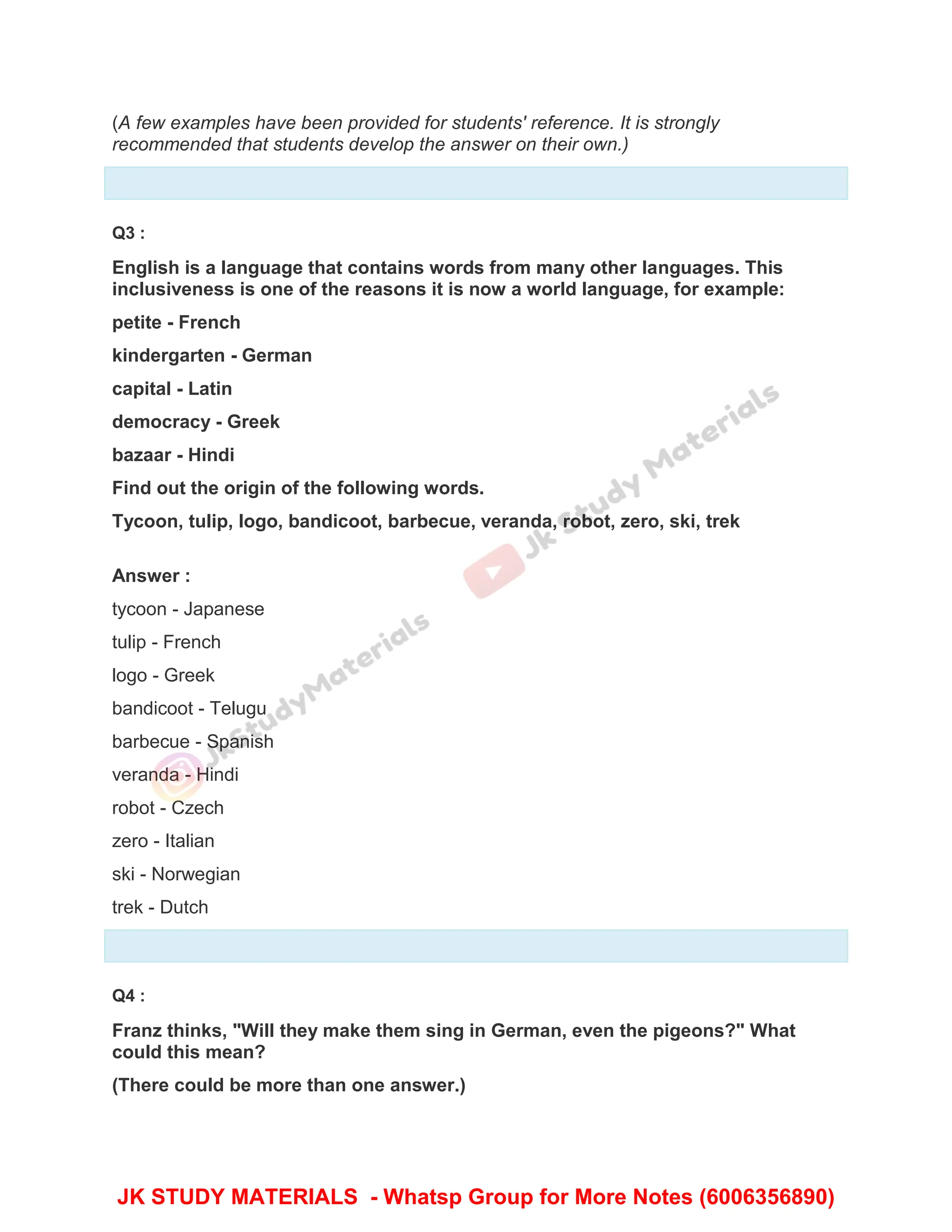
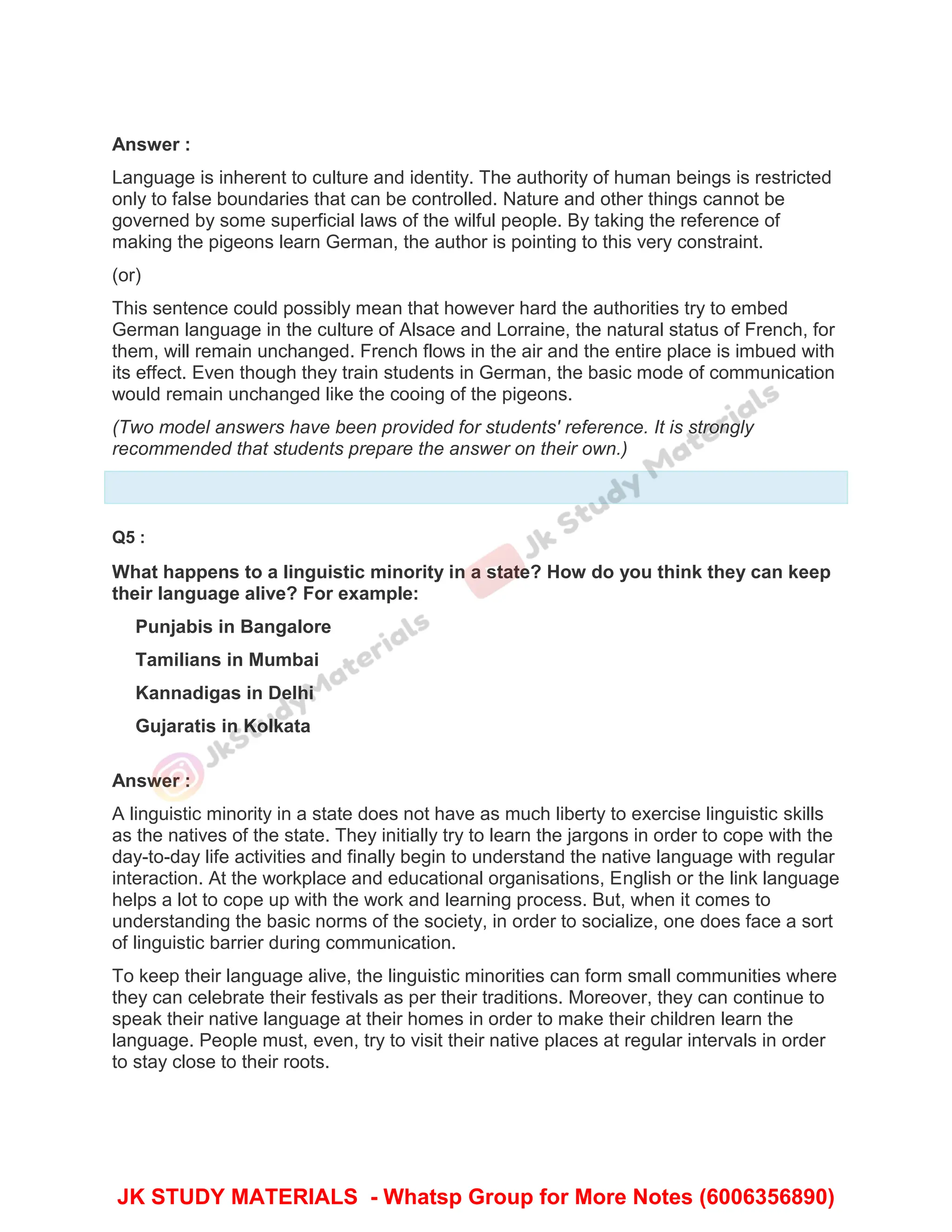
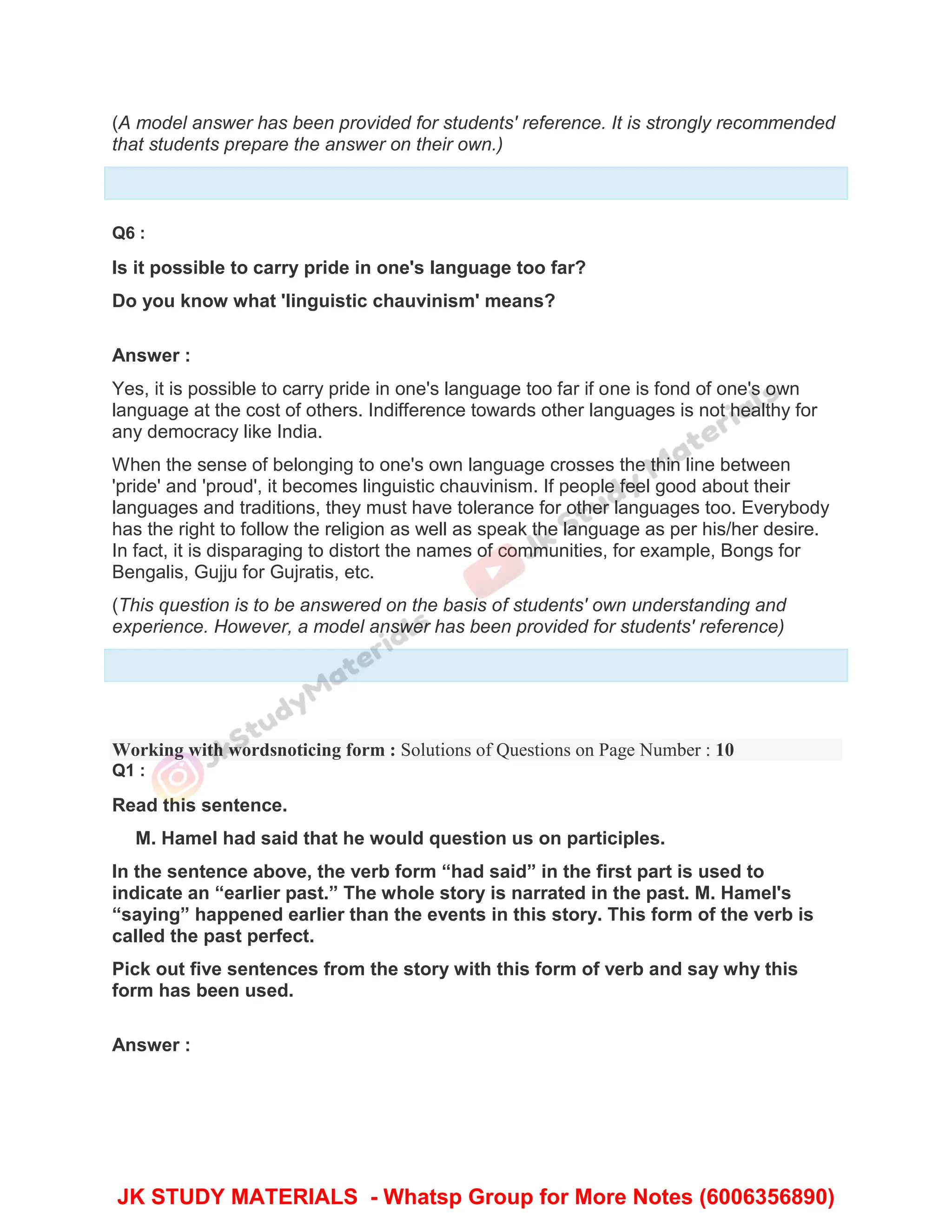
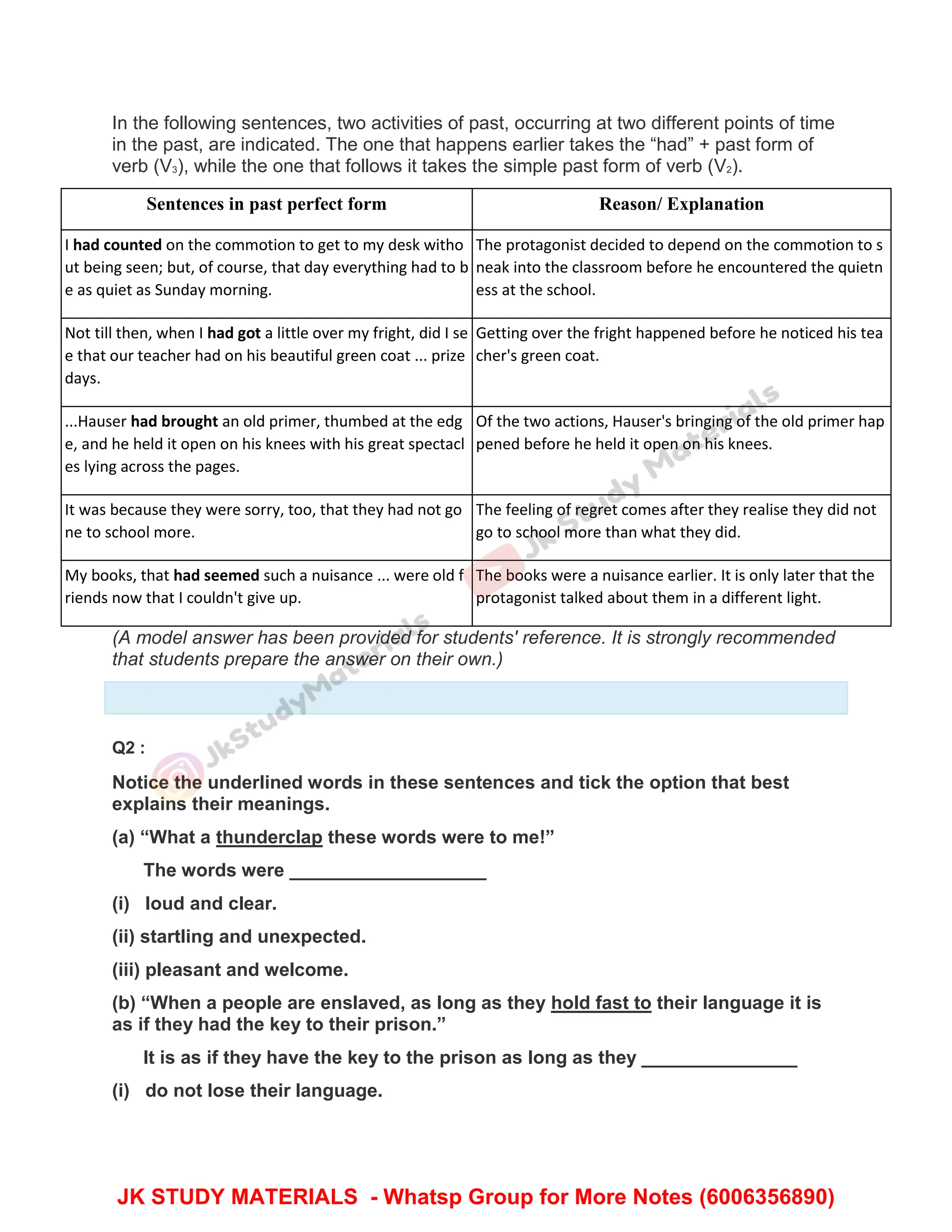





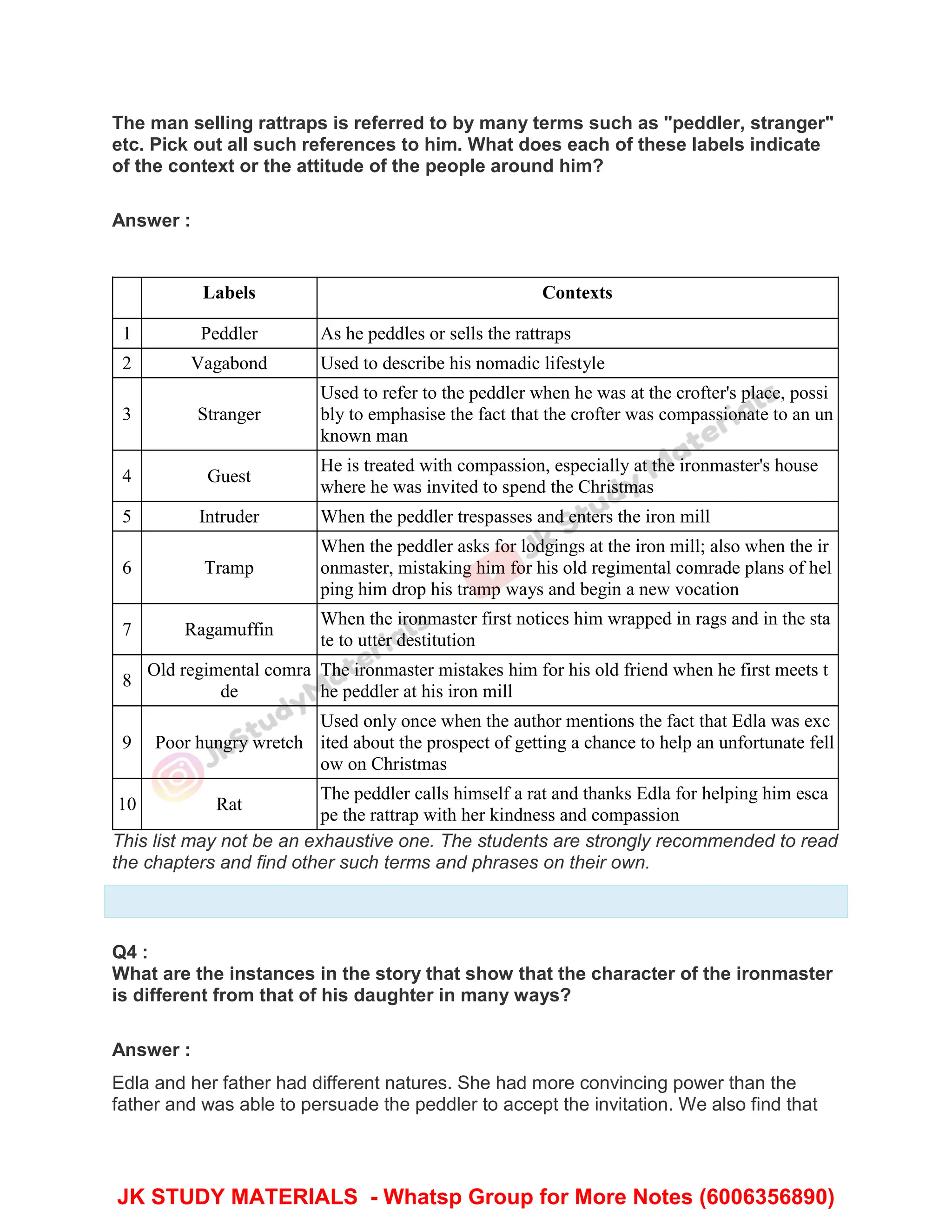
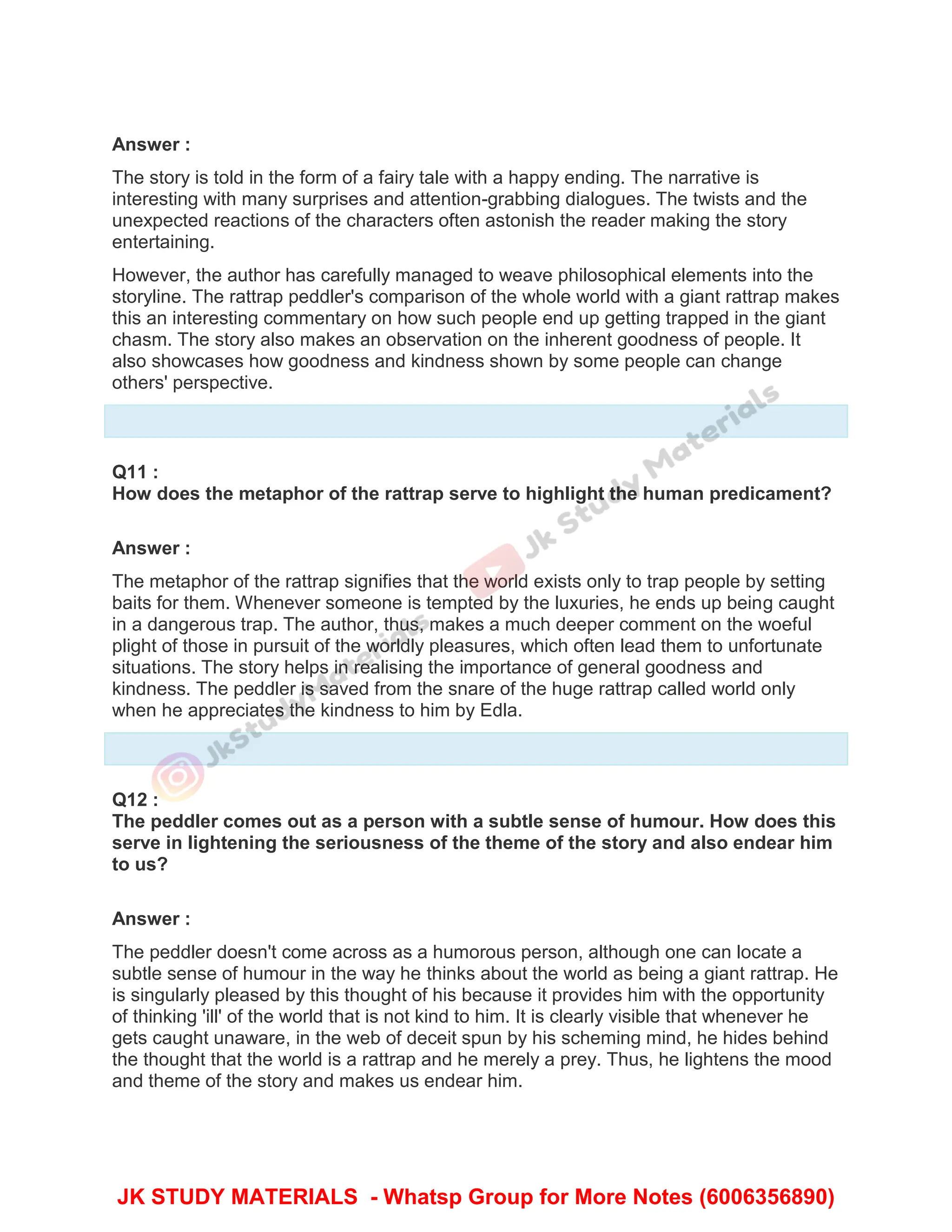
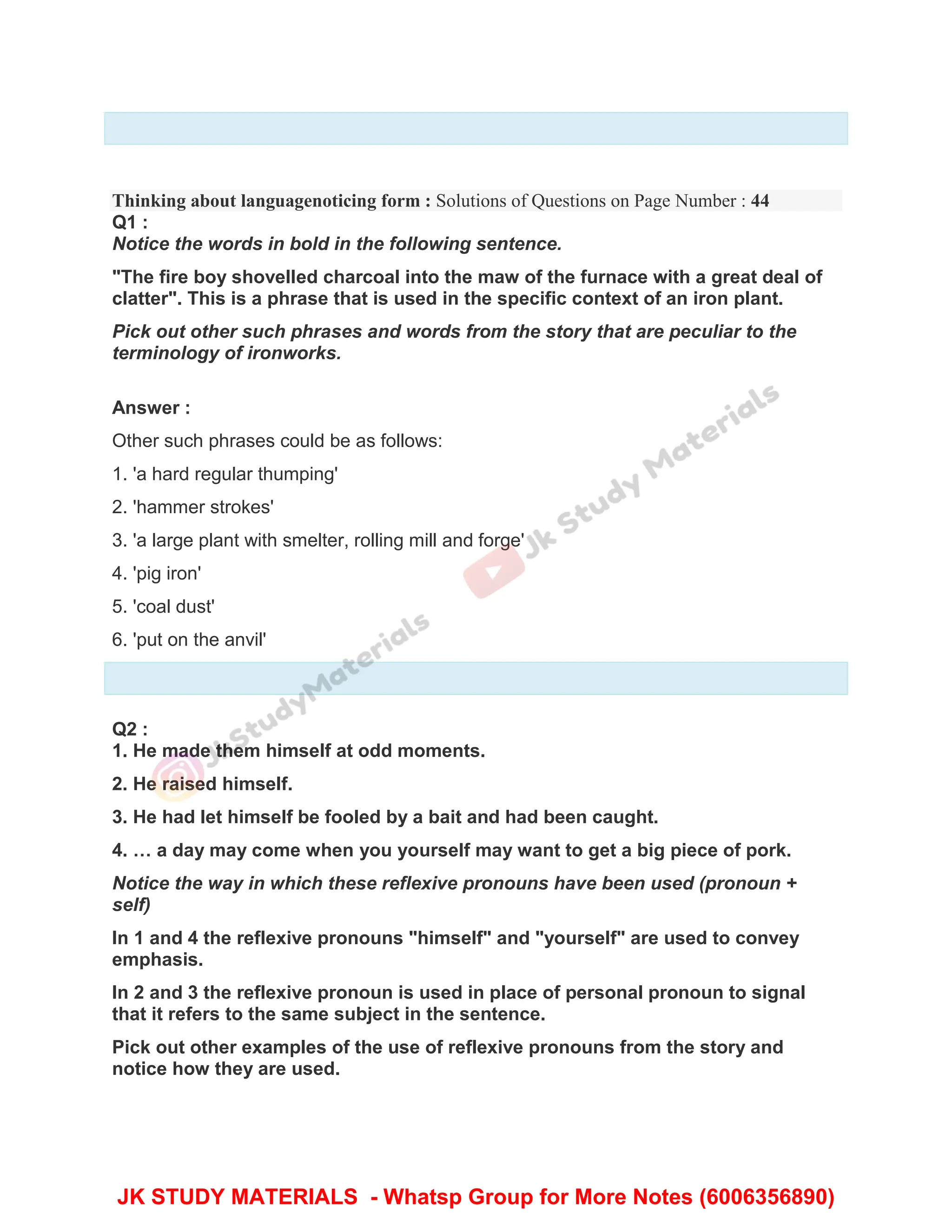
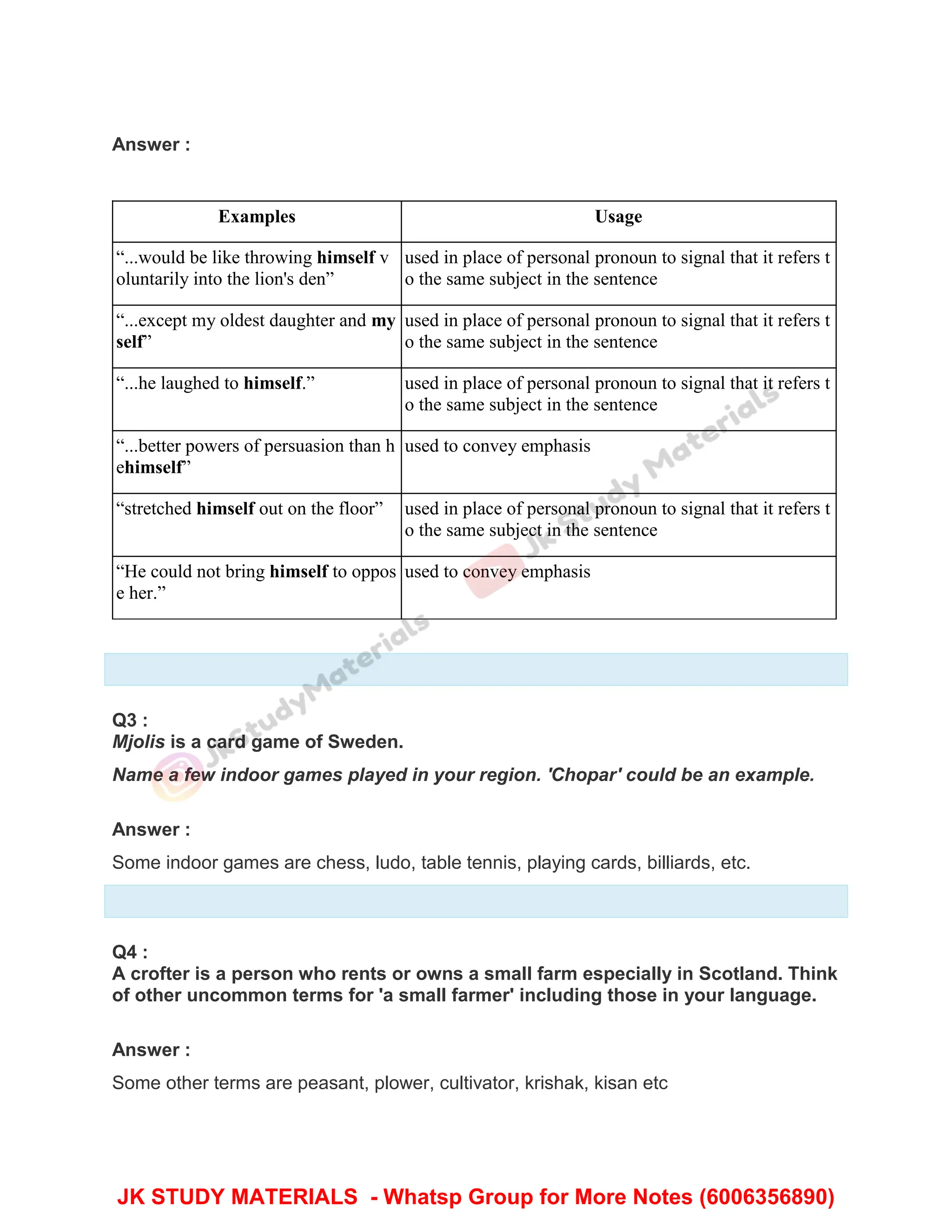

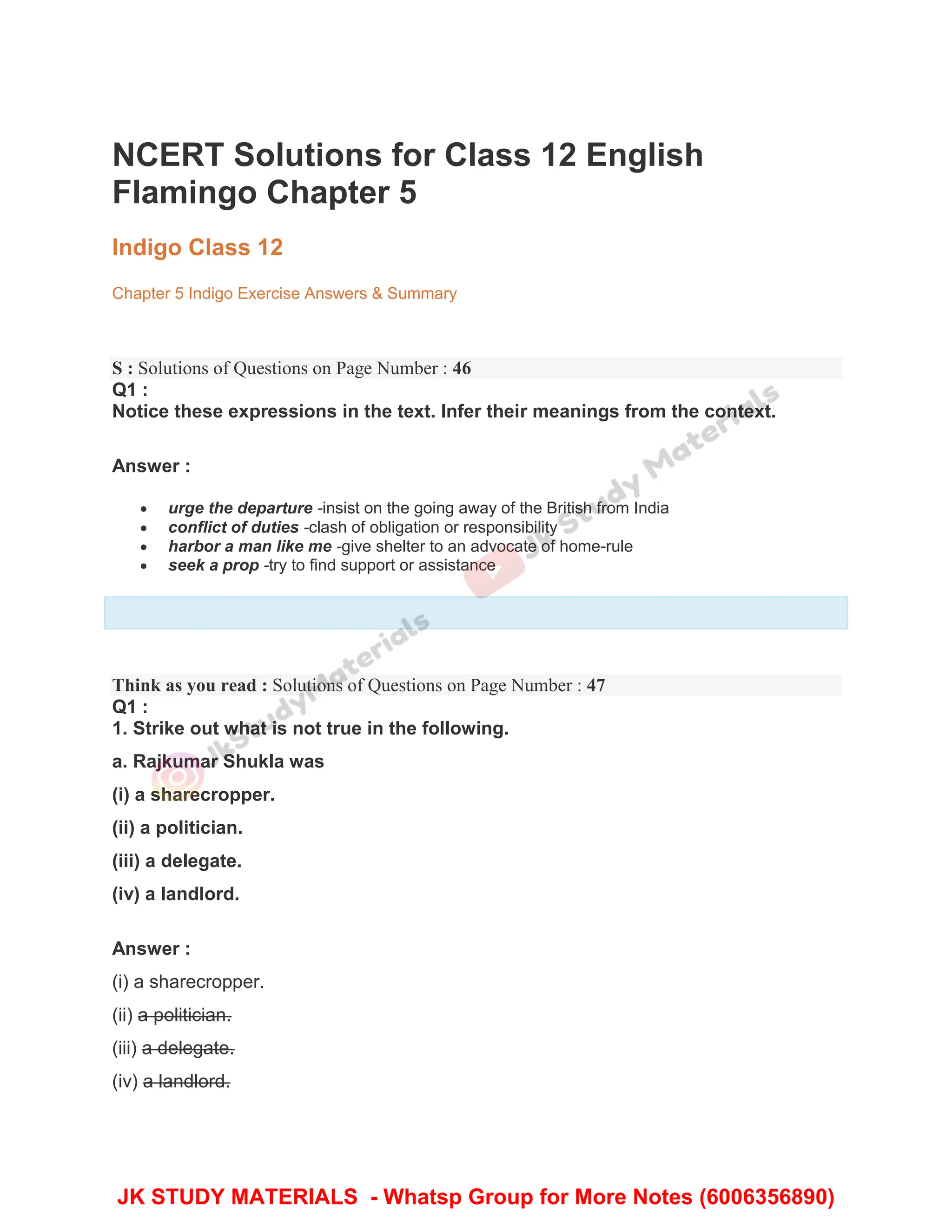
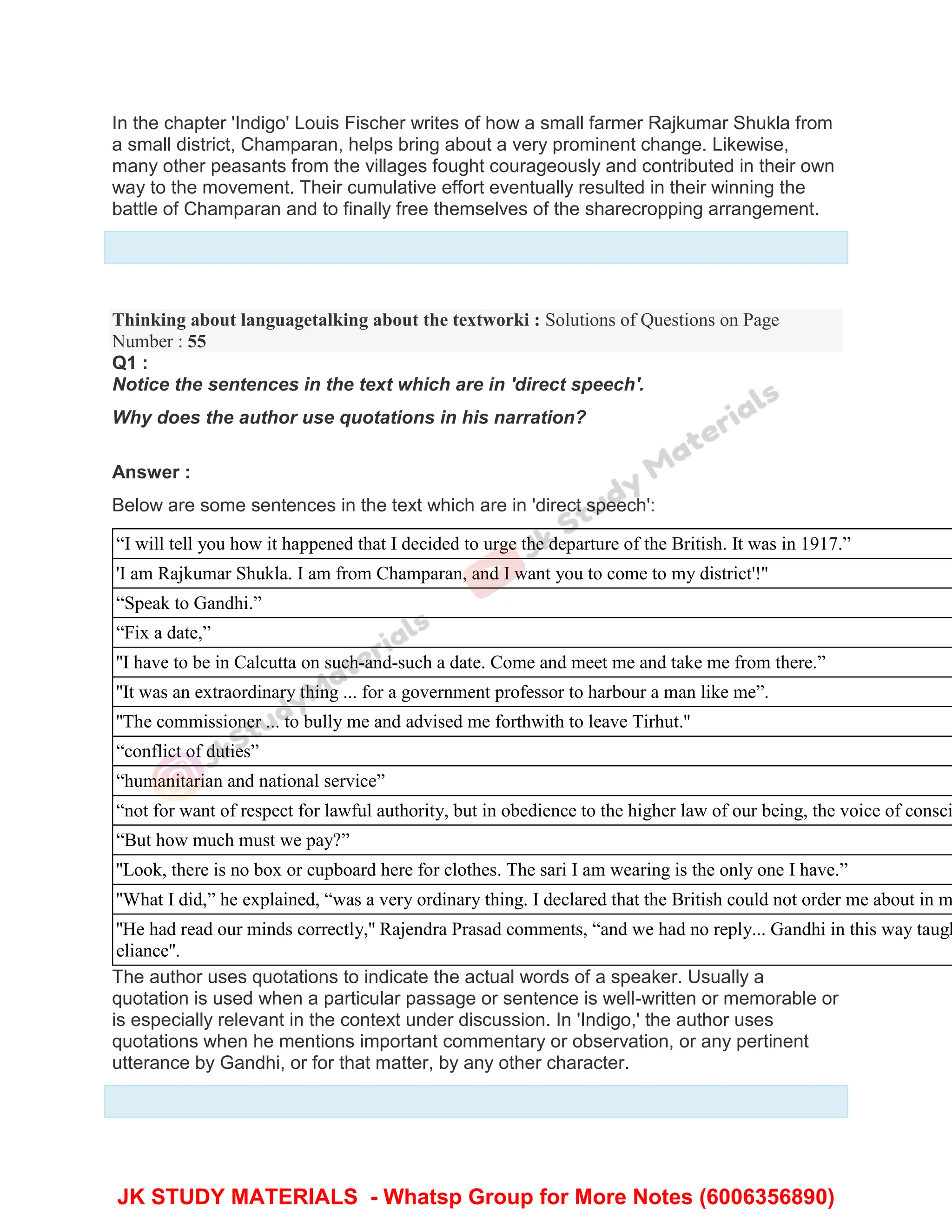
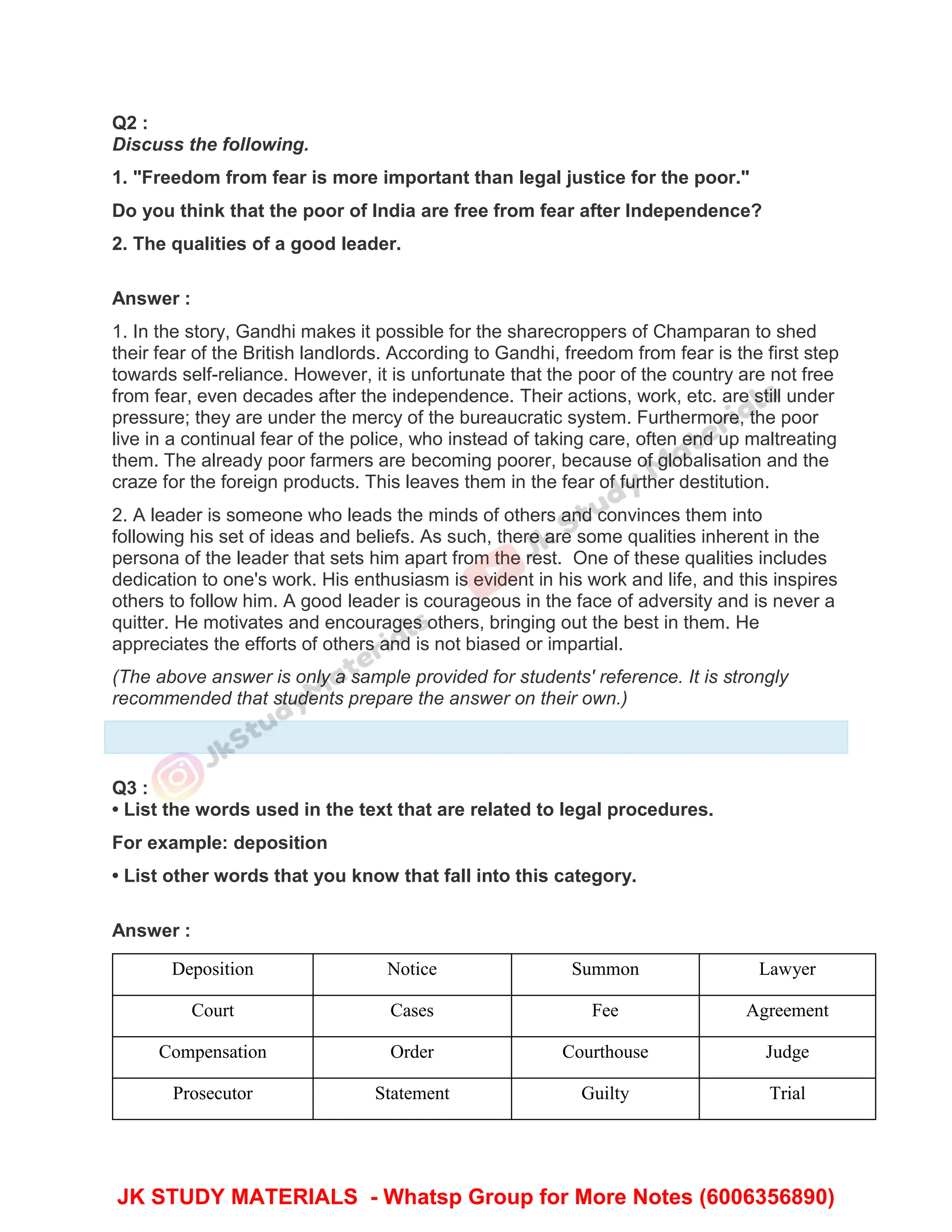

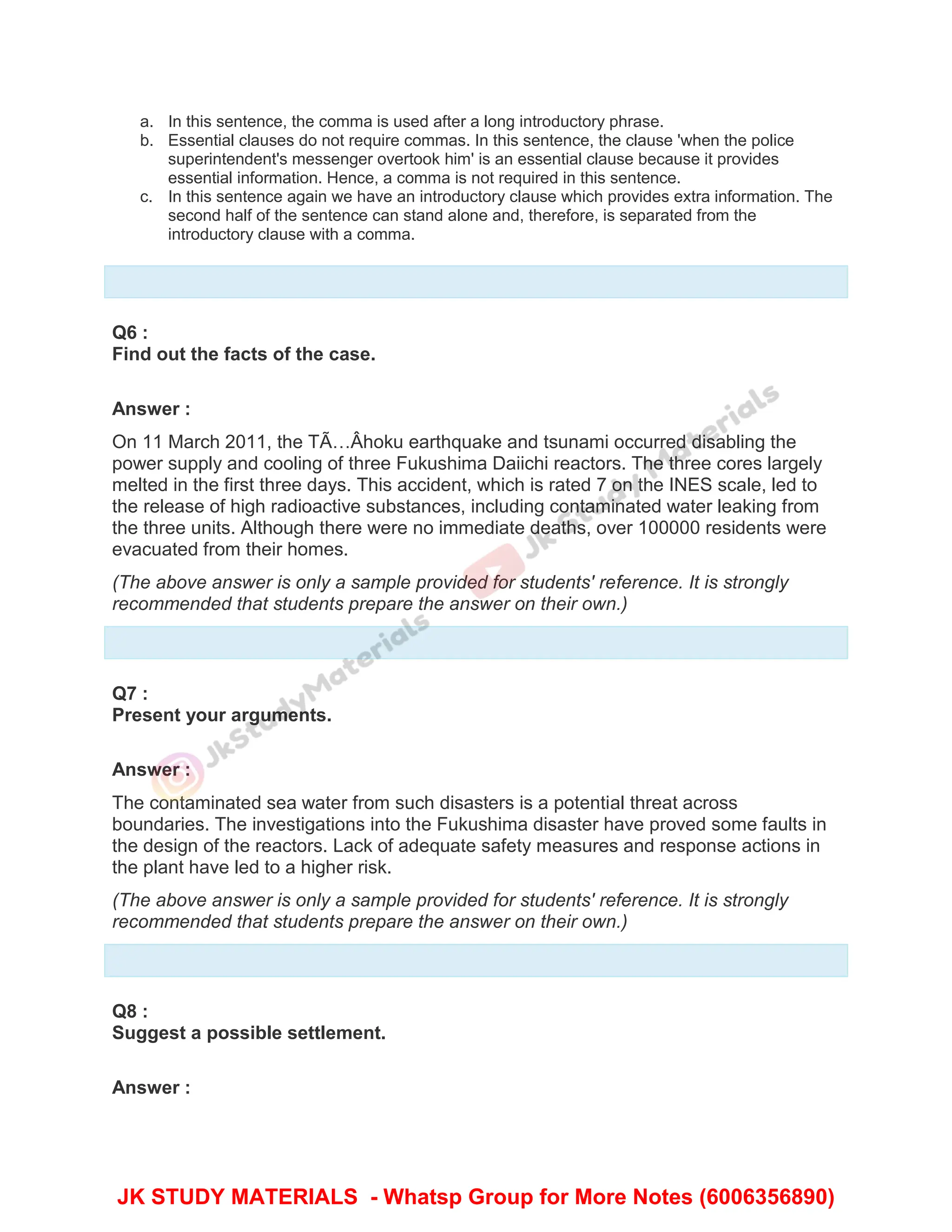

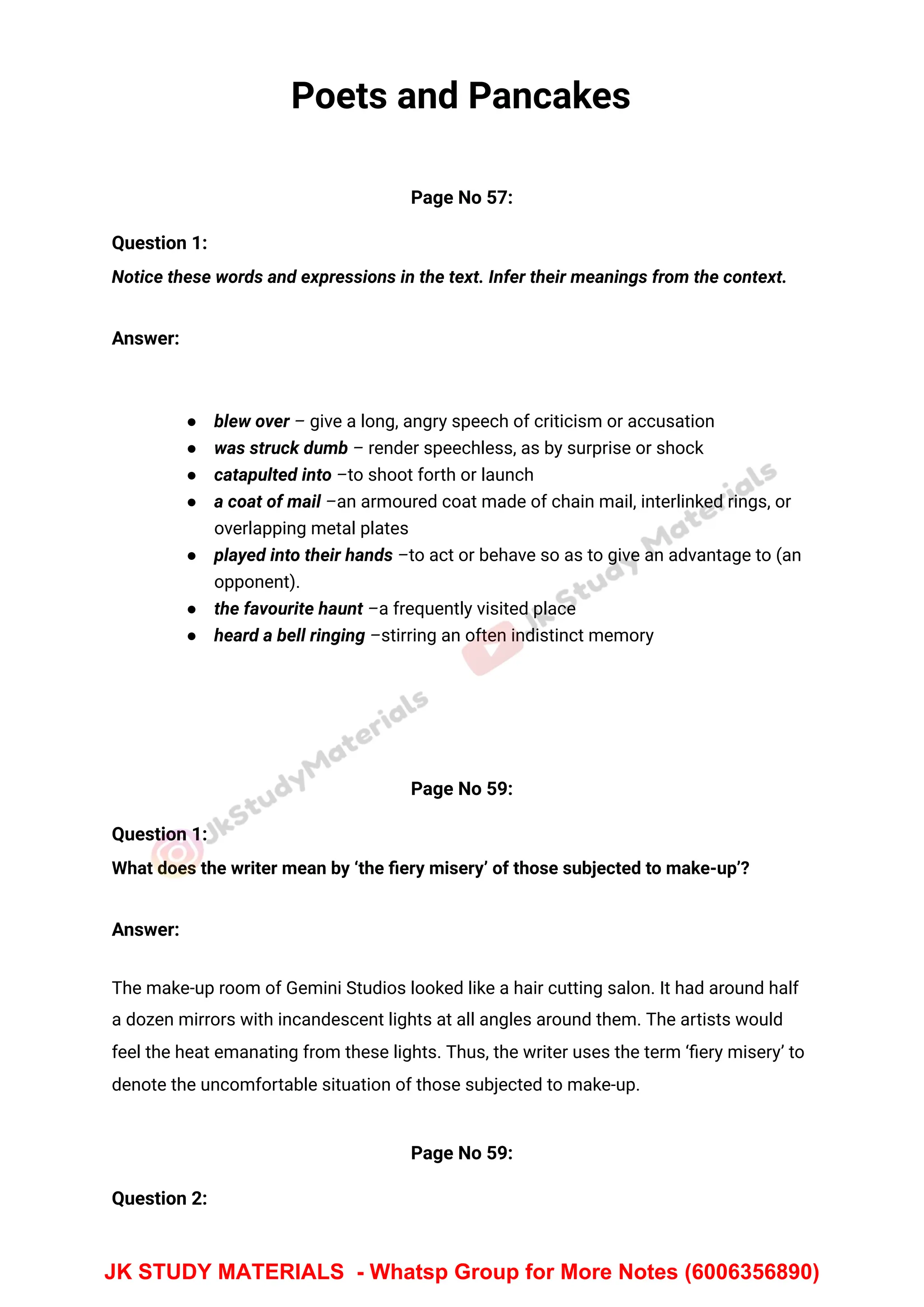
![1. Directions: The students can watch or read an interview of a politician or a bollywood
actor. Some of the issues that can be discussed are:
● The celebrity and his/her life
● His/her work and the career
● The interviewer, his questions and his mood
● The way the celebrity answers the questions- his language, mood, gestures,
body language
● The views and opinions of both the interviewer and the interviewee
2. Each medium has positives and negatives – yet, television is the best medium – more
enjoyable and attractive – visual medium allows us to observe the celebrity, his gestures,
expressions and body language – helps connect better with the interview
3. Everyone has a right to maintain his/her privacy – wrong to ask private and
humiliating questions about his/her past – wrong to consider the private life of public
figures as public – once their privacy is breached, it may be difficult for them to recover
– may affect their personal relationships even
(Directions/pointers have been provided for students’ benefit. It is strongly recommended
that students prepare the answer on their own.)
Page No 75:
Question 1:
If the interviewer Mukund Padmanabhan had not got the space in the newspaper to
reproduce the interview verbatim, he may have been asked to produce a short report of
the interview with the salient points.
Write this report for him.
[The teacher should be able to help the pupils in what to include and what can be
omitted. We could also provide a short report of an interview as a sample.]
JK STUDY MATERIALS - Whatsp Group for More Notes (6006356890)](https://image.slidesharecdn.com/englishtextualquestionans12thclass-250819051613-9ae32843/75/English-Textual-Question-Ans-12th-Class-pdf-65-2048.jpg)
![Sophie dreamt of opening a boutique or becoming an actress or a fashion designer.
She thought that she would be offered the position of a manager and that she would
work there till the time she saves enough money for her boutique.
Keeping in mind their lower middle class family background, Jansie discourages Sophie
to have such dreams. Jansie is more realistic and practical in life, and hence, knows
that big ambitions cost heavy investments, something their working-class status could
not afford.
Q3 :
Why did Sophie wriggle when Geoff told her father that she had met Danny
Casey?
Answer :
She wriggled when Geoff told her father that she had met Danny Casey because she
was well aware of her father's short-tempered nature. She knew that he would scold her
for spreading wild stories. Moreover, she was aware that no one would believe her. It is
also possible that she did not expect Geoff to share her secrets with others, even family
members.
Q4 :
Did Geoff believe what Sophie says about her meeting with Danny Casey?
Answer :
No, Geoff does not believe what Sophie says about her meeting. He calls it "the
unlikeliest thing [he] ever heard".
Q5 :
Does her father believe her story?
Answer :
Sophie's father does not believe her story and he warns her that her "wild stories" might
land her into trouble.
Q6 :
JK STUDY MATERIALS - Whatsp Group for More Notes (6006356890)](https://image.slidesharecdn.com/englishtextualquestionans12thclass-250819051613-9ae32843/75/English-Textual-Question-Ans-12th-Class-pdf-69-2048.jpg)