Page 1 of 6
Scenario based Test Scoping for Automation Projects
8th International Project Management Leadership Conference
(PML2013)
Keerthivardhan Naidu Sunkara
Keerthi.sunkara@adp.com
ADP India Pvt Ltd., Hyderabad, INDIA
Address: Flat No#W-103, VASAVI DREAMS, Road Number#2,
CZECH Colony, SANATH NAGAR, HYDERABAD – 500018, INDIA.
Page 2 of 6
Scenario based Test Scoping for Automation Projects
Abstract
Quality is the ultimate objective which most of us would try to achieve at the end of
any effort in the Software Development Life Cycle Models. More often it is been explored by
many Engineers on how to achieve maximum quality output by implementing various
Methods & Techniques. A continuous effort has been made to further improvise the
Processes & Models used to achieve this ever targeted factor of any Software
Product/Service Delivered to the customers/End users. Over the period various techniques
are been successfully experimented & implemented to optimize the effort without
compromising the on the quality of the Product/Service.
Accuracy & Test Effectiveness of any Software Product/Service will be decided by the
Quality of the Test Analysis efforts. Test Analysis (Testing efforts can be categorized into
Planning, Design, Execution and Analysis) is the key for the success or failure of the
Product/Service AND this is the area where there were not sufficient amount of efforts made
to Identify & streamline processes and techniques which will improvise the Quality of the
Software Product. Many a times Test Resources efforts will be focused on non-important
areas than the needed functional areas of the Product, this is because of the lack of Process
to identify the areas which are critical for that specific version and releases of the Software
Product/Service.
1.0 Introduction
An effort is been made to further fill the gaps by establishing a process to identify
Prioritizing the Test Scenarios (Scenario based Test Scoping) which are key for the
maintaining & Delivering Qualitative Software Product/Services. Till now we always talked
about prioritizing the Test Cases/Test Objectives per release and versions of the software
work units. This specific attempt is to evangelize efficiency levels which can be achieved
through Identifying Scenarios which are key for the specific level of changes made at the
Software Product/Project code. Test Scenario Prioritization is an art of Identifying set of Test
cases which are bundled in a single flow and are key for maintaining good coverage for
Product/Functional areas.
This paper describes a holistic approach towards “Scenario based Test Scoping” for
the Software Projects.
Page 3 of 6
Scenario based Test Scoping for Automation Projects
1.1 Scenario based Test Scoping
A detailed step by step process for Implementing “Scenario based Test Scoping” for the
Software Products/Projects which will have already developed & established Test scenarios
either in terms of Automation scripts or in terms Manual Test Scenarios.
Below Illustration is for Identifying & Optimizing the Test efforts by Implementing “Scenario
based Test Scoping” for QC/QTP Framework Implemented BPT Form of Automation Project.
Scenario based approach
Functional Analyst (BPT Analyst) would be framing the scenarios based on the Components
Developed/Available for a specific Application Area (Application Area formation will be done
based on the implementation, mostly this will be done on Page wise under specific module).
While Analyst forms/develop the BPT, he/she should be grouping up all prioritized scenarios
(if already Test Case Prioritization is done) and develop the Prioritized BPT's. AND they
would be grouping them in to separate folders under Test Lab for their execution. Whereas
ADP Implemented Prioritization of the BPT's is for the existing BPT’s and this is extended to
the BPT’s which are getting developed too.
1.1.1 BPT(Business Process Test) Prioritization
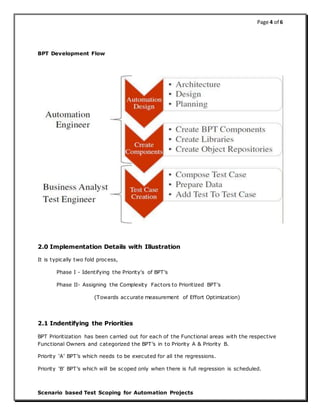
Business Process Test is set of Test Cases/steps grouped in test piece of Functionality in the
Application and it is widely used concept in QC/QTP form of Automation Testing.
BPT Prioritization is first of its kind in the IT Industry; to our knowledge Prioritization of the
BPT's is one of the untouched areas.
Page 4 of 6
Scenario based Test Scoping for Automation Projects
BPT Development Flow
2.0 Implementation Details with Illustration
It is typically two fold process,
Phase I - Identifying the Priority's of BPT's
Phase II- Assigning the Complexity Factors to Prioritized BPT's
(Towards accurate measurement of Effort Optimization)
2.1 Indentifying the Priorities
BPT Prioritization has been carried out for each of the Functional areas with the respective
Functional Owners and categorized the BPT’s in to Priority A & Priority B.
Priority ‘A’ BPT’s which needs to be executed for all the regressions.
Priority ‘B’ BPT’s which will be scoped only when there is full regression is scheduled.
Page 5 of 6
Scenario based Test Scoping for Automation Projects
Prioritization of the BPT’s as ‘A’ or ‘B’ is dependent on the criticality of the functionality
along with its significance to the assigned Test Type. This exercise needs to be performed
typically with the help of respective functional owners as wrong Identification of a particular
set off Test Scenario’s as Priority ‘B’ though it is the candidate for Priority ‘A’ will be risky
and can invite problems/functional failures in the Production.
2.2 Identifying the complexities
Based on the Product/Functional Criticality and effort & expertise required to execute certain
scenarios will be key for assigning the complexities. On a high level these complexities are
designed as
 High
 Medium
 Low
Many of the dataflow connections are often very complex and difficult to analyze and for a
Test Resource this should be rich source for Functional Deviations/Failures.
Complexity Criteria:
 High - The requirement changes, design changes, implementation of code
change; testing involves complex scenarios with high impact on the product.
 Medium - The requirement changes, design changes, implementation of code
change; testing involves are not much complex scenarios with medium impact
on the product.
 Low - The requirement changes, design changes, code changes and testing
the changes are pretty easy and probably the change could be cosmetic
change.
The historical effort ratio for the above mentioned three complexity levels is 1:2:4. This is
industry standard.
3.0 Advantages
Using “Scenario based Test Scoping” which we found the best way to identify the test sets
for various tests efforts like Full Regression/Mini Regression/Target Regression.
Due to the successful implementation of this practice, we could able to achieve 10% of the
Test Efforts.
Page 6 of 6
Scenario based Test Scoping for Automation Projects
Example Scenario:
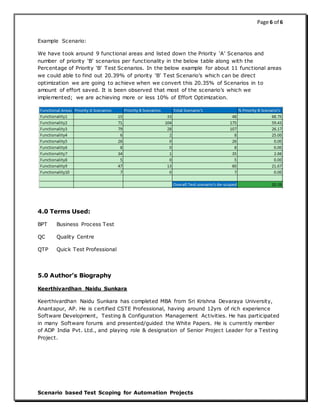
We have took around 9 functional areas and listed down the Priority ‘A’ Scenarios and
number of priority ‘B’ scenarios per functionality in the below table along with the
Percentage of Priority ‘B’ Test Scenarios. In the below example for about 11 functional areas
we could able to find out 20.39% of priority ‘B’ Test Scenario’s which can be direct
optimization we are going to achieve when we convert this 20.35% of Scenarios in to
amount of effort saved. It is been observed that most of the scenario’s which we
implemented; we are achieving more or less 10% of Effort Optimization.
4.0 Terms Used:
BPT Business Process Test
QC Quality Centre
QTP Quick Test Professional
5.0 Author’s Biography
Keerthivardhan Naidu Sunkara
Keerthivardhan Naidu Sunkara has completed MBA from Sri Krishna Devaraya University,
Anantapur, AP. He is certified CSTE Professional, having around 12yrs of rich experience
Software Development, Testing & Configuration Management Activities. He has participated
in many Software forums and presented/guided the White Papers. He is currently member
of ADP India Pvt. Ltd., and playing role & designation of Senior Project Leader for a Testing
Project.

QAIBP

  • 1.
    Page 1 of6 Scenario based Test Scoping for Automation Projects Scenario based Test Scoping for Automation Projects 8th International Project Management Leadership Conference (PML2013) Keerthivardhan Naidu Sunkara Keerthi.sunkara@adp.com ADP India Pvt Ltd., Hyderabad, INDIA Address: Flat No#W-103, VASAVI DREAMS, Road Number#2, CZECH Colony, SANATH NAGAR, HYDERABAD – 500018, INDIA.
  • 2.
    Page 2 of6 Scenario based Test Scoping for Automation Projects Abstract Quality is the ultimate objective which most of us would try to achieve at the end of any effort in the Software Development Life Cycle Models. More often it is been explored by many Engineers on how to achieve maximum quality output by implementing various Methods & Techniques. A continuous effort has been made to further improvise the Processes & Models used to achieve this ever targeted factor of any Software Product/Service Delivered to the customers/End users. Over the period various techniques are been successfully experimented & implemented to optimize the effort without compromising the on the quality of the Product/Service. Accuracy & Test Effectiveness of any Software Product/Service will be decided by the Quality of the Test Analysis efforts. Test Analysis (Testing efforts can be categorized into Planning, Design, Execution and Analysis) is the key for the success or failure of the Product/Service AND this is the area where there were not sufficient amount of efforts made to Identify & streamline processes and techniques which will improvise the Quality of the Software Product. Many a times Test Resources efforts will be focused on non-important areas than the needed functional areas of the Product, this is because of the lack of Process to identify the areas which are critical for that specific version and releases of the Software Product/Service. 1.0 Introduction An effort is been made to further fill the gaps by establishing a process to identify Prioritizing the Test Scenarios (Scenario based Test Scoping) which are key for the maintaining & Delivering Qualitative Software Product/Services. Till now we always talked about prioritizing the Test Cases/Test Objectives per release and versions of the software work units. This specific attempt is to evangelize efficiency levels which can be achieved through Identifying Scenarios which are key for the specific level of changes made at the Software Product/Project code. Test Scenario Prioritization is an art of Identifying set of Test cases which are bundled in a single flow and are key for maintaining good coverage for Product/Functional areas. This paper describes a holistic approach towards “Scenario based Test Scoping” for the Software Projects.
  • 3.
    Page 3 of6 Scenario based Test Scoping for Automation Projects 1.1 Scenario based Test Scoping A detailed step by step process for Implementing “Scenario based Test Scoping” for the Software Products/Projects which will have already developed & established Test scenarios either in terms of Automation scripts or in terms Manual Test Scenarios. Below Illustration is for Identifying & Optimizing the Test efforts by Implementing “Scenario based Test Scoping” for QC/QTP Framework Implemented BPT Form of Automation Project. Scenario based approach Functional Analyst (BPT Analyst) would be framing the scenarios based on the Components Developed/Available for a specific Application Area (Application Area formation will be done based on the implementation, mostly this will be done on Page wise under specific module). While Analyst forms/develop the BPT, he/she should be grouping up all prioritized scenarios (if already Test Case Prioritization is done) and develop the Prioritized BPT's. AND they would be grouping them in to separate folders under Test Lab for their execution. Whereas ADP Implemented Prioritization of the BPT's is for the existing BPT’s and this is extended to the BPT’s which are getting developed too. 1.1.1 BPT(Business Process Test) Prioritization Business Process Test is set of Test Cases/steps grouped in test piece of Functionality in the Application and it is widely used concept in QC/QTP form of Automation Testing. BPT Prioritization is first of its kind in the IT Industry; to our knowledge Prioritization of the BPT's is one of the untouched areas.
  • 4.
    Page 4 of6 Scenario based Test Scoping for Automation Projects BPT Development Flow 2.0 Implementation Details with Illustration It is typically two fold process, Phase I - Identifying the Priority's of BPT's Phase II- Assigning the Complexity Factors to Prioritized BPT's (Towards accurate measurement of Effort Optimization) 2.1 Indentifying the Priorities BPT Prioritization has been carried out for each of the Functional areas with the respective Functional Owners and categorized the BPT’s in to Priority A & Priority B. Priority ‘A’ BPT’s which needs to be executed for all the regressions. Priority ‘B’ BPT’s which will be scoped only when there is full regression is scheduled.
  • 5.
    Page 5 of6 Scenario based Test Scoping for Automation Projects Prioritization of the BPT’s as ‘A’ or ‘B’ is dependent on the criticality of the functionality along with its significance to the assigned Test Type. This exercise needs to be performed typically with the help of respective functional owners as wrong Identification of a particular set off Test Scenario’s as Priority ‘B’ though it is the candidate for Priority ‘A’ will be risky and can invite problems/functional failures in the Production. 2.2 Identifying the complexities Based on the Product/Functional Criticality and effort & expertise required to execute certain scenarios will be key for assigning the complexities. On a high level these complexities are designed as  High  Medium  Low Many of the dataflow connections are often very complex and difficult to analyze and for a Test Resource this should be rich source for Functional Deviations/Failures. Complexity Criteria:  High - The requirement changes, design changes, implementation of code change; testing involves complex scenarios with high impact on the product.  Medium - The requirement changes, design changes, implementation of code change; testing involves are not much complex scenarios with medium impact on the product.  Low - The requirement changes, design changes, code changes and testing the changes are pretty easy and probably the change could be cosmetic change. The historical effort ratio for the above mentioned three complexity levels is 1:2:4. This is industry standard. 3.0 Advantages Using “Scenario based Test Scoping” which we found the best way to identify the test sets for various tests efforts like Full Regression/Mini Regression/Target Regression. Due to the successful implementation of this practice, we could able to achieve 10% of the Test Efforts.
  • 6.
    Page 6 of6 Scenario based Test Scoping for Automation Projects Example Scenario: We have took around 9 functional areas and listed down the Priority ‘A’ Scenarios and number of priority ‘B’ scenarios per functionality in the below table along with the Percentage of Priority ‘B’ Test Scenarios. In the below example for about 11 functional areas we could able to find out 20.39% of priority ‘B’ Test Scenario’s which can be direct optimization we are going to achieve when we convert this 20.35% of Scenarios in to amount of effort saved. It is been observed that most of the scenario’s which we implemented; we are achieving more or less 10% of Effort Optimization. 4.0 Terms Used: BPT Business Process Test QC Quality Centre QTP Quick Test Professional 5.0 Author’s Biography Keerthivardhan Naidu Sunkara Keerthivardhan Naidu Sunkara has completed MBA from Sri Krishna Devaraya University, Anantapur, AP. He is certified CSTE Professional, having around 12yrs of rich experience Software Development, Testing & Configuration Management Activities. He has participated in many Software forums and presented/guided the White Papers. He is currently member of ADP India Pvt. Ltd., and playing role & designation of Senior Project Leader for a Testing Project.