ENVIRONMENTAL
MANAGEMENT
Kwame Atta Ashun, PhD
Course code:
CE/EL/MC 365
GM/MN/RN 365
1
CHAPTER SEVEN (6)
WATER POLLUTION
ISSUES
2
EL/MC/CE 365
GM/MN/RN 365
WATER POLLUTION ISSUES
3
1. WATER USE IN INDUSTRY
Water is utilised in many stages of mining &
mineral processing & other industrial processes:
EL/MC/CE 365
 Cooling Water for equipment & machine parts
e.g., crusher bearings, pumps, compressors, electricity
generating plants, etc.
WATER POLLUTION ISSUES
4
1. WATER USE IN INDUSTRY……….cont’d
EL/MC/CE 365
 Process Water
Used in:
• Wet screening, gravity separation (shaking tables, jigs),
flotation
• Washing water (fines from metal ores, clays from stone)
• Wet scrubbers for air pollution control
WATER POLLUTION ISSUES
5
1. WATER USE IN INDUSTRY……….cont’d
EL/MC/CE 365
 Transport Water
Used in:
• slurry media transportation of ores between different
stages of processing
WATER POLLUTION ISSUES
6
1. WATER USE IN INDUSTRY……….cont’d
EL/MC/CE 365
 Other water uses in industry
 dust control,
 vehicle washing,
 domestic,
 sanitary, etc
WATER POLLUTION ISSUES
7
1. WATER USE IN INDUSTRY……….cont’d
EL/MC/CE 365
 Influence of other activities of mining &
construction:
 Pumped water from water influx due to rainfall or
groundwater interception.
 Run-off after rain or snow.
 Percolation of water into sumps, etc.
 Leaching of ore (e.g. sulphides) after the ground
is disturbed.
WATER POLLUTION ISSUES
8
1. WATER USE IN INDUSTRY……….cont’d
EL/MC/CE 365
 Influence of other activities of mining &
construction…….cont’d:
 Groundwater interception during excavation,
 Spillage of substances to contaminate surface &
ground waters,
 Aerial pollution usually fall out to affect surface
water.
WATER POLLUTION ISSUES
9
2. ACQUATIC ECOSYSTEM
EL/MC/CE 365
 A breakdown of ecosystem’s self-cleaning
capacity may be a result of any or both of the
following: @
i. Overloading a particular conversion
e.g. introducing excess organic matter
ii. Eliminating one or more stages
e.g. killing fish
WATER POLLUTION ISSUES
10
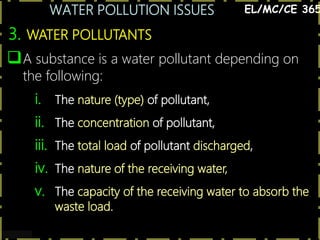
3. WATER POLLUTANTS
EL/MC/CE 365
A substance is a water pollutant depending on
the following:
i. The nature (type) of pollutant,
ii. The concentration of pollutant,
iii. The total load of pollutant discharged,
iv. The nature of the receiving water,
v. The capacity of the receiving water to absorb the
waste load.
WATER POLLUTION ISSUES
11
3. WATER POLLUTANTS
EL/MC/CE 365
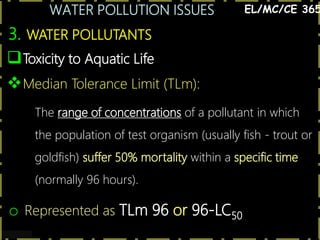
Toxicity to Aquatic Life
Median Tolerance Limit (TLm):
The range of concentrations of a pollutant in which
the population of test organism (usually fish - trout or
goldfish) suffer 50% mortality within a specific time
(normally 96 hours).
o Represented as TLm 96 or 96-LC50
WATER POLLUTION ISSUES
12
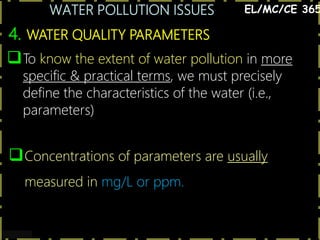
4. WATER QUALITY PARAMETERS
EL/MC/CE 365
To know the extent of water pollution in more
specific & practical terms, we must precisely
define the characteristics of the water (i.e.,
parameters)
Concentrations of parameters are usually
measured in mg/L or ppm.
WATER POLLUTION ISSUES
13
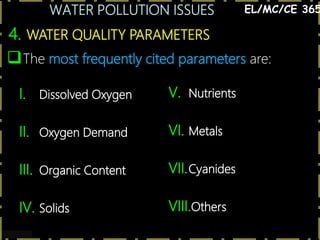
4. WATER QUALITY PARAMETERS
EL/MC/CE 365
The most frequently cited parameters are:
I. Dissolved Oxygen
II. Oxygen Demand
III. Organic Content
IV. Solids
V. Nutrients
VI. Metals
VII.Cyanides
VIII.Others
WATER POLLUTION ISSUES
14
4. WATER QUALITY PARAMETERS
EL/MC/CE 365
I. Dissolved Oxygen
It is the amount of molecular oxygen dissolved in
water.
Also affects wastewater treatment processes that
utilise micro-organisms, corrosion chemistry &
other chemical reactions.
GM/MN/RN 365
WATER POLLUTION ISSUES
15
4. WATER QUALITY PARAMETERS
EL/MC/CE 365
I. Dissolved Oxygen
The amount of DO decreases with increasing
water temperature.
WATER POLLUTION ISSUES
16
4. WATER QUALITY PARAMETERS
EL/MC/CE 365
I. Dissolved Oxygen Measurement
In the laboratory:
o Chemicals (wet chemistry) – Winkler Method
o DO meter
On the field:
o DO meter
GM/MN/RN 365
WATER POLLUTION ISSUES
17
4. WATER QUALITY PARAMETERS
EL/MC/CE 365
II. Oxygen Demand
It is a term for the amount of oxygen required to
oxidise a waste.
it is an indirect measure of the amount of
organic or carbon-containing impurities in water.
WATER POLLUTION ISSUES
18
4. WATER QUALITY PARAMETERS
EL/MC/CE 365
II. Oxygen Demand Measurement
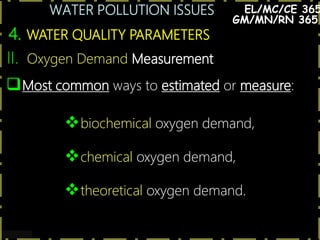
Most common ways to estimated or measure:
biochemical oxygen demand,
chemical oxygen demand,
theoretical oxygen demand.
GM/MN/RN 365
WATER POLLUTION ISSUES
19
4. WATER QUALITY PARAMETERS
EL/MC/CE 365
II. Oxygen Demand Measurement……..cont’d
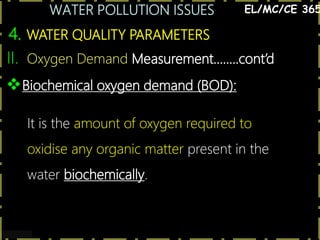
Biochemical oxygen demand (BOD):
It is the amount of oxygen required to
oxidise any organic matter present in the
water biochemically.
20
4. WATER QUALITY PARAMETERS EL/MC/CE 365
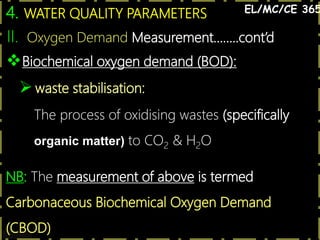
Biochemical oxygen demand (BOD):
waste stabilisation:
The process of oxidising wastes (specifically
organic matter) to CO2 & H2O
NB: The measurement of above is termed
Carbonaceous Biochemical Oxygen Demand
(CBOD)
II. Oxygen Demand Measurement……..cont’d
WATER POLLUTION ISSUES
21
4. WATER QUALITY PARAMETERS
EL/MC/CE 365
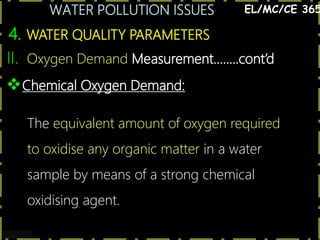
Chemical Oxygen Demand:
The equivalent amount of oxygen required
to oxidise any organic matter in a water
sample by means of a strong chemical
oxidising agent.
II. Oxygen Demand Measurement……..cont’d
WATER POLLUTION ISSUES
22
4. WATER QUALITY PARAMETERS
EL/MC/CE 365
Theoretical Oxygen Demand:
It is the amount of oxygen required to
oxidise a known compound completely to
CO2 & H2O.
II. Oxygen Demand Measurement……..cont’d
WATER POLLUTION ISSUES
23
4. WATER QUALITY PARAMETERS
EL/MC/CE 365
III. Organic Content
The organic content of water is important because
of the oxygen it will consume & because some
organics are toxic.
It is the amount of o
WATER POLLUTION ISSUES
24
4. WATER QUALITY PARAMETERS
EL/MC/CE 365
III. Organic Content Measurement
 Total Organic Carbon
 Oil & Grease:
WATER POLLUTION ISSUES
25
4. WATER QUALITY PARAMETERS
EL/MC/CE 365
III. Organic Content Measurement………..cont’d
 Total Organic Carbon:
The amount of organic carbon in a sample –
used in the estimation of the amount of organic
contaminant in water or waste water
WATER POLLUTION ISSUES
26
4. WATER QUALITY PARAMETERS
EL/MC/CE 365
III. Organic Content Measurement
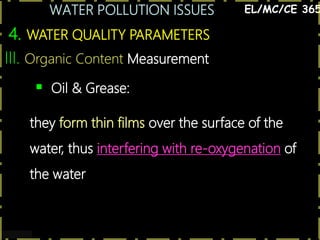
 Oil & Grease:
they form thin films over the surface of the
water, thus interfering with re-oxygenation of
the water
WATER POLLUTION ISSUES
27
4. WATER QUALITY PARAMETERS
EL/MC/CE 365
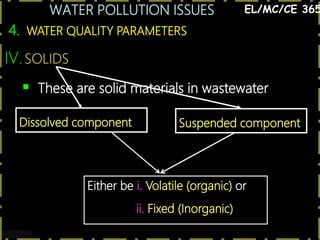
IV.SOLIDS
 These are solid materials in wastewater
Dissolved component Suspended component
Either be i. Volatile (organic) or
ii. Fixed (Inorganic)
WATER POLLUTION ISSUES
28
4. WATER QUALITY PARAMETERS
EL/MC/CE 365
IV.SOLIDS
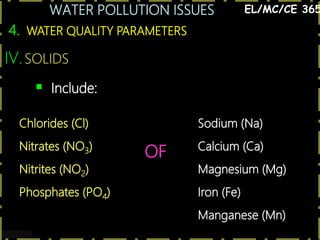
 Include:
Chlorides (Cl)
Nitrates (NO3)
Nitrites (NO2)
Phosphates (PO4)
OF
Sodium (Na)
Calcium (Ca)
Magnesium (Mg)
Iron (Fe)
Manganese (Mn)
WATER POLLUTION ISSUES
29
4. WATER QUALITY PARAMETERS
EL/MC/CE 365
IV.SOLIDS
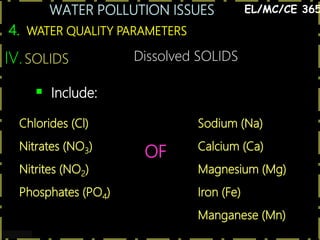
 Include:
Chlorides (Cl)
Nitrates (NO3)
Nitrites (NO2)
Phosphates (PO4)
OF
Sodium (Na)
Calcium (Ca)
Magnesium (Mg)
Iron (Fe)
Manganese (Mn)
Dissolved SOLIDS
WATER POLLUTION ISSUES
30
4. WATER QUALITY PARAMETERS
EL/MC/CE 365
IV.SOLIDS - CLASSIFICATION
 Based on quantity of dissolved solids
 Fresh Water 100 mg/L salts as Cl
 Brackish Water 100 to 1,000 mg/L salts as Cl
 Salt Water 1,000 mg/L salts as Chlorides
Dissolved SOLIDS
WATER POLLUTION ISSUES
31
4. WATER QUALITY PARAMETERS
EL/MC/CE 365
IV.SOLIDS - EFFECTS
 interfere with self-purification of water
by diminishing light penetration (by up
to 50%)
 get deposited as silt over food of organisms
in the water, & could kill fish when ingested
Suspended
SOLIDS
WATER POLLUTION ISSUES
32
4. WATER QUALITY PARAMETERS
EL/MC/CE 365
V. Nutrients
Major Nutrients in water & wastewater
 Nitrogen
 Phosphorus
WATER POLLUTION ISSUES
33
4. WATER QUALITY PARAMETERS
EL/MC/CE 365
V. Nutrients
 Usefulness
 required for growth of the micro-organisms
used in wastewater treatment processes
WATER POLLUTION ISSUES
34
4. WATER QUALITY PARAMETERS
EL/MC/CE 365
VI.Metals
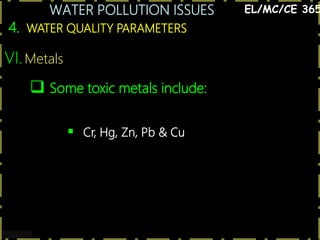
 Some toxic metals include:
 Cr, Hg, Zn, Pb & Cu
WATER POLLUTION ISSUES
35
4. WATER QUALITY PARAMETERS
EL/MC/CE 365
VI.Metals
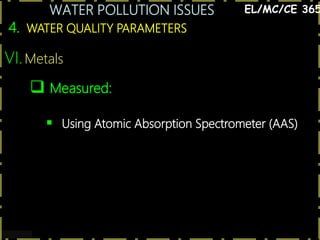
 Measured:
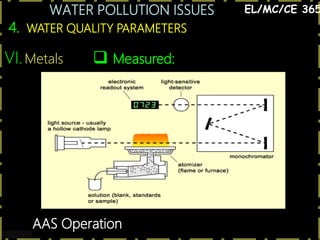
 Using Atomic Absorption Spectrometer (AAS)
WATER POLLUTION ISSUES
36
4. WATER QUALITY PARAMETERS
EL/MC/CE 365
VI.Metals  Measured:
AAS Operation
WATER POLLUTION ISSUES
37
4. WATER QUALITY PARAMETERS
EL/MC/CE 365
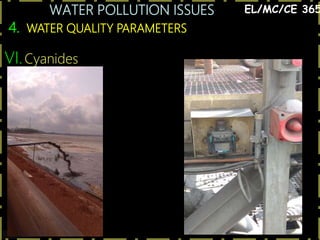
VII.Cyanides  Occurrence:
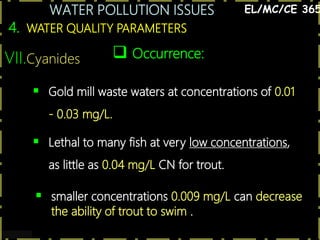
 Gold mill waste waters at concentrations of 0.01
- 0.03 mg/L.
 Lethal to many fish at very low concentrations,
as little as 0.04 mg/L CN for trout.
 smaller concentrations 0.009 mg/L can decrease
the ability of trout to swim .
WATER POLLUTION ISSUES
38
4. WATER QUALITY PARAMETERS
EL/MC/CE 365
VI.Cyanides
WATER POLLUTION ISSUES
39
4. WATER QUALITY PARAMETERS
EL/MC/CE 365
VI.Cyanides
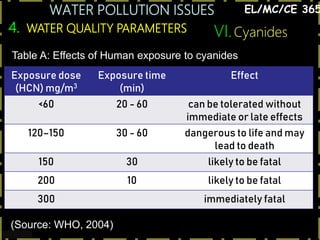
Exposure dose
(HCN) mg/m3
Exposure time
(min)
Effect
<60 20 - 60 can be tolerated without
immediate or late effects
120–150 30 - 60 dangerous to life and may
lead to death
150 30 likely to be fatal
200 10 likely to be fatal
300 immediately fatal
Table A: Effects of Human exposure to cyanides
(Source: WHO, 2004)
WATER POLLUTION ISSUES
40
4. WATER QUALITY PARAMETERS
EL/MC/CE 365
 Other Water Quality Parameters
 Colour
 Temperature
 Turbidity
 Hardness
 Alkalinity
 pH
SPECIFIC WATER POLLUTION PROBLEMS
41
EL/MC/CE 365
 Deoxygenation
 Acid Mine Drainage (AMD)
 Eutrophication
 Heavy metal pollution
I. Deoxygenation
42
 The removal of molecular oxygen (O2) from a
reaction mixture or solvent, or
 the removal of oxygen atoms from a molecule
EL/MC/CE 365
Specific water pollution problems
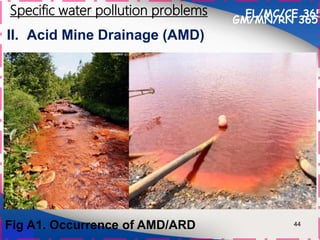
II. Acid Mine Drainage (AMD)
43
 the outflow of acidic water from:
o abandoned metal mines or coal mines
o areas where the earth has been disturbed
o rock weathering process (natural)
 AKA, Acid rock drainage (ARD)
 Results from sulphide minerals upon exposure to
water and oxygen, oxidizes to form sulfuric acid
EL/MC/CE 365
Specific water pollution problems
II. Acid Mine Drainage (AMD)
44
EL/MC/CE 365
Specific water pollution problems
Fig A1. Occurrence of AMD/ARD
GM/MN/RN 365
III. Eutrophication
45
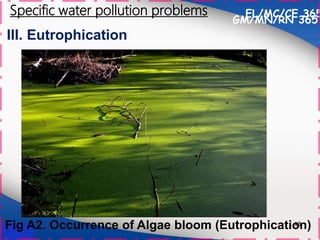
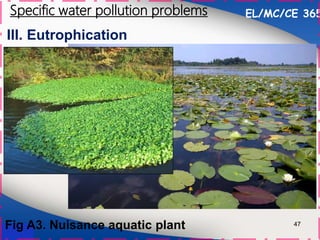
 a process whereby water bodies, such as, lakes,
estuaries, or slow-moving streams receive excess
nutrients that stimulate excessive plant growth
(algal bloom)
 Sources of nutrients into water bodies:
EL/MC/CE 365
Specific water pollution problems
o fertilizer application
o deposition of nitrogen from the atmosphere
o erosion of soil containing nutrients
o Sewage/wastewater treatment plant discharges
III. Eutrophication
46
EL/MC/CE 365
Specific water pollution problems
Fig A2. Occurrence of Algae bloom (Eutrophication)
GM/MN/RN 365
III. Eutrophication
47
EL/MC/CE 365
Specific water pollution problems
Fig A3. Nuisance aquatic plant
IV. Heavy metal pollution
48
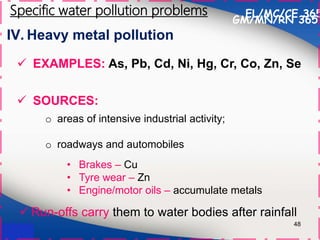
 SOURCES:
o areas of intensive industrial activity;
o roadways and automobiles
EL/MC/CE 365
Specific water pollution problems
 EXAMPLES: As, Pb, Cd, Ni, Hg, Cr, Co, Zn, Se
• Brakes – Cu
• Tyre wear – Zn
• Engine/motor oils – accumulate metals
 Run-offs carry them to water bodies after rainfall
GM/MN/RN 365
IV. Heavy metal pollution
49
EL/MC/CE 365
Specific water pollution problems
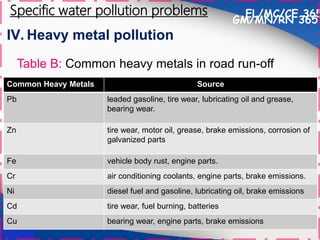
Common Heavy Metals Source
Pb leaded gasoline, tire wear, lubricating oil and grease,
bearing wear.
Zn tire wear, motor oil, grease, brake emissions, corrosion of
galvanized parts
Fe vehicle body rust, engine parts.
Cr air conditioning coolants, engine parts, brake emissions.
Ni diesel fuel and gasoline, lubricating oil, brake emissions
Cd tire wear, fuel burning, batteries
Cu bearing wear, engine parts, brake emissions
Table B: Common heavy metals in road run-off
GM/MN/RN 365
End
50
EL/MC/CE 365
CHAPTER 6

EM 365_Ch6_WATER POLLUTION ISSUES-1.pptx

  • 1.
    ENVIRONMENTAL MANAGEMENT Kwame Atta Ashun,PhD Course code: CE/EL/MC 365 GM/MN/RN 365 1
  • 2.
    CHAPTER SEVEN (6) WATERPOLLUTION ISSUES 2 EL/MC/CE 365 GM/MN/RN 365
  • 3.
    WATER POLLUTION ISSUES 3 1.WATER USE IN INDUSTRY Water is utilised in many stages of mining & mineral processing & other industrial processes: EL/MC/CE 365  Cooling Water for equipment & machine parts e.g., crusher bearings, pumps, compressors, electricity generating plants, etc.
  • 4.
    WATER POLLUTION ISSUES 4 1.WATER USE IN INDUSTRY……….cont’d EL/MC/CE 365  Process Water Used in: • Wet screening, gravity separation (shaking tables, jigs), flotation • Washing water (fines from metal ores, clays from stone) • Wet scrubbers for air pollution control
  • 5.
    WATER POLLUTION ISSUES 5 1.WATER USE IN INDUSTRY……….cont’d EL/MC/CE 365  Transport Water Used in: • slurry media transportation of ores between different stages of processing
  • 6.
    WATER POLLUTION ISSUES 6 1.WATER USE IN INDUSTRY……….cont’d EL/MC/CE 365  Other water uses in industry  dust control,  vehicle washing,  domestic,  sanitary, etc
  • 7.
    WATER POLLUTION ISSUES 7 1.WATER USE IN INDUSTRY……….cont’d EL/MC/CE 365  Influence of other activities of mining & construction:  Pumped water from water influx due to rainfall or groundwater interception.  Run-off after rain or snow.  Percolation of water into sumps, etc.  Leaching of ore (e.g. sulphides) after the ground is disturbed.
  • 8.
    WATER POLLUTION ISSUES 8 1.WATER USE IN INDUSTRY……….cont’d EL/MC/CE 365  Influence of other activities of mining & construction…….cont’d:  Groundwater interception during excavation,  Spillage of substances to contaminate surface & ground waters,  Aerial pollution usually fall out to affect surface water.
  • 9.
    WATER POLLUTION ISSUES 9 2.ACQUATIC ECOSYSTEM EL/MC/CE 365  A breakdown of ecosystem’s self-cleaning capacity may be a result of any or both of the following: @ i. Overloading a particular conversion e.g. introducing excess organic matter ii. Eliminating one or more stages e.g. killing fish
  • 10.
    WATER POLLUTION ISSUES 10 3.WATER POLLUTANTS EL/MC/CE 365 A substance is a water pollutant depending on the following: i. The nature (type) of pollutant, ii. The concentration of pollutant, iii. The total load of pollutant discharged, iv. The nature of the receiving water, v. The capacity of the receiving water to absorb the waste load.
  • 11.
    WATER POLLUTION ISSUES 11 3.WATER POLLUTANTS EL/MC/CE 365 Toxicity to Aquatic Life Median Tolerance Limit (TLm): The range of concentrations of a pollutant in which the population of test organism (usually fish - trout or goldfish) suffer 50% mortality within a specific time (normally 96 hours). o Represented as TLm 96 or 96-LC50
  • 12.
    WATER POLLUTION ISSUES 12 4.WATER QUALITY PARAMETERS EL/MC/CE 365 To know the extent of water pollution in more specific & practical terms, we must precisely define the characteristics of the water (i.e., parameters) Concentrations of parameters are usually measured in mg/L or ppm.
  • 13.
    WATER POLLUTION ISSUES 13 4.WATER QUALITY PARAMETERS EL/MC/CE 365 The most frequently cited parameters are: I. Dissolved Oxygen II. Oxygen Demand III. Organic Content IV. Solids V. Nutrients VI. Metals VII.Cyanides VIII.Others
  • 14.
    WATER POLLUTION ISSUES 14 4.WATER QUALITY PARAMETERS EL/MC/CE 365 I. Dissolved Oxygen It is the amount of molecular oxygen dissolved in water. Also affects wastewater treatment processes that utilise micro-organisms, corrosion chemistry & other chemical reactions. GM/MN/RN 365
  • 15.
    WATER POLLUTION ISSUES 15 4.WATER QUALITY PARAMETERS EL/MC/CE 365 I. Dissolved Oxygen The amount of DO decreases with increasing water temperature.
  • 16.
    WATER POLLUTION ISSUES 16 4.WATER QUALITY PARAMETERS EL/MC/CE 365 I. Dissolved Oxygen Measurement In the laboratory: o Chemicals (wet chemistry) – Winkler Method o DO meter On the field: o DO meter GM/MN/RN 365
  • 17.
    WATER POLLUTION ISSUES 17 4.WATER QUALITY PARAMETERS EL/MC/CE 365 II. Oxygen Demand It is a term for the amount of oxygen required to oxidise a waste. it is an indirect measure of the amount of organic or carbon-containing impurities in water.
  • 18.
    WATER POLLUTION ISSUES 18 4.WATER QUALITY PARAMETERS EL/MC/CE 365 II. Oxygen Demand Measurement Most common ways to estimated or measure: biochemical oxygen demand, chemical oxygen demand, theoretical oxygen demand. GM/MN/RN 365
  • 19.
    WATER POLLUTION ISSUES 19 4.WATER QUALITY PARAMETERS EL/MC/CE 365 II. Oxygen Demand Measurement……..cont’d Biochemical oxygen demand (BOD): It is the amount of oxygen required to oxidise any organic matter present in the water biochemically.
  • 20.
    20 4. WATER QUALITYPARAMETERS EL/MC/CE 365 Biochemical oxygen demand (BOD): waste stabilisation: The process of oxidising wastes (specifically organic matter) to CO2 & H2O NB: The measurement of above is termed Carbonaceous Biochemical Oxygen Demand (CBOD) II. Oxygen Demand Measurement……..cont’d
  • 21.
    WATER POLLUTION ISSUES 21 4.WATER QUALITY PARAMETERS EL/MC/CE 365 Chemical Oxygen Demand: The equivalent amount of oxygen required to oxidise any organic matter in a water sample by means of a strong chemical oxidising agent. II. Oxygen Demand Measurement……..cont’d
  • 22.
    WATER POLLUTION ISSUES 22 4.WATER QUALITY PARAMETERS EL/MC/CE 365 Theoretical Oxygen Demand: It is the amount of oxygen required to oxidise a known compound completely to CO2 & H2O. II. Oxygen Demand Measurement……..cont’d
  • 23.
    WATER POLLUTION ISSUES 23 4.WATER QUALITY PARAMETERS EL/MC/CE 365 III. Organic Content The organic content of water is important because of the oxygen it will consume & because some organics are toxic. It is the amount of o
  • 24.
    WATER POLLUTION ISSUES 24 4.WATER QUALITY PARAMETERS EL/MC/CE 365 III. Organic Content Measurement  Total Organic Carbon  Oil & Grease:
  • 25.
    WATER POLLUTION ISSUES 25 4.WATER QUALITY PARAMETERS EL/MC/CE 365 III. Organic Content Measurement………..cont’d  Total Organic Carbon: The amount of organic carbon in a sample – used in the estimation of the amount of organic contaminant in water or waste water
  • 26.
    WATER POLLUTION ISSUES 26 4.WATER QUALITY PARAMETERS EL/MC/CE 365 III. Organic Content Measurement  Oil & Grease: they form thin films over the surface of the water, thus interfering with re-oxygenation of the water
  • 27.
    WATER POLLUTION ISSUES 27 4.WATER QUALITY PARAMETERS EL/MC/CE 365 IV.SOLIDS  These are solid materials in wastewater Dissolved component Suspended component Either be i. Volatile (organic) or ii. Fixed (Inorganic)
  • 28.
    WATER POLLUTION ISSUES 28 4.WATER QUALITY PARAMETERS EL/MC/CE 365 IV.SOLIDS  Include: Chlorides (Cl) Nitrates (NO3) Nitrites (NO2) Phosphates (PO4) OF Sodium (Na) Calcium (Ca) Magnesium (Mg) Iron (Fe) Manganese (Mn)
  • 29.
    WATER POLLUTION ISSUES 29 4.WATER QUALITY PARAMETERS EL/MC/CE 365 IV.SOLIDS  Include: Chlorides (Cl) Nitrates (NO3) Nitrites (NO2) Phosphates (PO4) OF Sodium (Na) Calcium (Ca) Magnesium (Mg) Iron (Fe) Manganese (Mn) Dissolved SOLIDS
  • 30.
    WATER POLLUTION ISSUES 30 4.WATER QUALITY PARAMETERS EL/MC/CE 365 IV.SOLIDS - CLASSIFICATION  Based on quantity of dissolved solids  Fresh Water 100 mg/L salts as Cl  Brackish Water 100 to 1,000 mg/L salts as Cl  Salt Water 1,000 mg/L salts as Chlorides Dissolved SOLIDS
  • 31.
    WATER POLLUTION ISSUES 31 4.WATER QUALITY PARAMETERS EL/MC/CE 365 IV.SOLIDS - EFFECTS  interfere with self-purification of water by diminishing light penetration (by up to 50%)  get deposited as silt over food of organisms in the water, & could kill fish when ingested Suspended SOLIDS
  • 32.
    WATER POLLUTION ISSUES 32 4.WATER QUALITY PARAMETERS EL/MC/CE 365 V. Nutrients Major Nutrients in water & wastewater  Nitrogen  Phosphorus
  • 33.
    WATER POLLUTION ISSUES 33 4.WATER QUALITY PARAMETERS EL/MC/CE 365 V. Nutrients  Usefulness  required for growth of the micro-organisms used in wastewater treatment processes
  • 34.
    WATER POLLUTION ISSUES 34 4.WATER QUALITY PARAMETERS EL/MC/CE 365 VI.Metals  Some toxic metals include:  Cr, Hg, Zn, Pb & Cu
  • 35.
    WATER POLLUTION ISSUES 35 4.WATER QUALITY PARAMETERS EL/MC/CE 365 VI.Metals  Measured:  Using Atomic Absorption Spectrometer (AAS)
  • 36.
    WATER POLLUTION ISSUES 36 4.WATER QUALITY PARAMETERS EL/MC/CE 365 VI.Metals  Measured: AAS Operation
  • 37.
    WATER POLLUTION ISSUES 37 4.WATER QUALITY PARAMETERS EL/MC/CE 365 VII.Cyanides  Occurrence:  Gold mill waste waters at concentrations of 0.01 - 0.03 mg/L.  Lethal to many fish at very low concentrations, as little as 0.04 mg/L CN for trout.  smaller concentrations 0.009 mg/L can decrease the ability of trout to swim .
  • 38.
    WATER POLLUTION ISSUES 38 4.WATER QUALITY PARAMETERS EL/MC/CE 365 VI.Cyanides
  • 39.
    WATER POLLUTION ISSUES 39 4.WATER QUALITY PARAMETERS EL/MC/CE 365 VI.Cyanides Exposure dose (HCN) mg/m3 Exposure time (min) Effect <60 20 - 60 can be tolerated without immediate or late effects 120–150 30 - 60 dangerous to life and may lead to death 150 30 likely to be fatal 200 10 likely to be fatal 300 immediately fatal Table A: Effects of Human exposure to cyanides (Source: WHO, 2004)
  • 40.
    WATER POLLUTION ISSUES 40 4.WATER QUALITY PARAMETERS EL/MC/CE 365  Other Water Quality Parameters  Colour  Temperature  Turbidity  Hardness  Alkalinity  pH
  • 41.
    SPECIFIC WATER POLLUTIONPROBLEMS 41 EL/MC/CE 365  Deoxygenation  Acid Mine Drainage (AMD)  Eutrophication  Heavy metal pollution
  • 42.
    I. Deoxygenation 42  Theremoval of molecular oxygen (O2) from a reaction mixture or solvent, or  the removal of oxygen atoms from a molecule EL/MC/CE 365 Specific water pollution problems
  • 43.
    II. Acid MineDrainage (AMD) 43  the outflow of acidic water from: o abandoned metal mines or coal mines o areas where the earth has been disturbed o rock weathering process (natural)  AKA, Acid rock drainage (ARD)  Results from sulphide minerals upon exposure to water and oxygen, oxidizes to form sulfuric acid EL/MC/CE 365 Specific water pollution problems
  • 44.
    II. Acid MineDrainage (AMD) 44 EL/MC/CE 365 Specific water pollution problems Fig A1. Occurrence of AMD/ARD GM/MN/RN 365
  • 45.
    III. Eutrophication 45  aprocess whereby water bodies, such as, lakes, estuaries, or slow-moving streams receive excess nutrients that stimulate excessive plant growth (algal bloom)  Sources of nutrients into water bodies: EL/MC/CE 365 Specific water pollution problems o fertilizer application o deposition of nitrogen from the atmosphere o erosion of soil containing nutrients o Sewage/wastewater treatment plant discharges
  • 46.
    III. Eutrophication 46 EL/MC/CE 365 Specificwater pollution problems Fig A2. Occurrence of Algae bloom (Eutrophication) GM/MN/RN 365
  • 47.
    III. Eutrophication 47 EL/MC/CE 365 Specificwater pollution problems Fig A3. Nuisance aquatic plant
  • 48.
    IV. Heavy metalpollution 48  SOURCES: o areas of intensive industrial activity; o roadways and automobiles EL/MC/CE 365 Specific water pollution problems  EXAMPLES: As, Pb, Cd, Ni, Hg, Cr, Co, Zn, Se • Brakes – Cu • Tyre wear – Zn • Engine/motor oils – accumulate metals  Run-offs carry them to water bodies after rainfall GM/MN/RN 365
  • 49.
    IV. Heavy metalpollution 49 EL/MC/CE 365 Specific water pollution problems Common Heavy Metals Source Pb leaded gasoline, tire wear, lubricating oil and grease, bearing wear. Zn tire wear, motor oil, grease, brake emissions, corrosion of galvanized parts Fe vehicle body rust, engine parts. Cr air conditioning coolants, engine parts, brake emissions. Ni diesel fuel and gasoline, lubricating oil, brake emissions Cd tire wear, fuel burning, batteries Cu bearing wear, engine parts, brake emissions Table B: Common heavy metals in road run-off GM/MN/RN 365
  • 50.

Editor's Notes

  • #4 *Mining utilises water for various technological processes on surface, underground, in hydraulic mining, dredging operations, etc.
  • #5 *
  • #6 *Slurry media – transports crude ore to treatment plant, waste product for disposal, etc
  • #7 *Slurry media – transports crude ore to treatment plant, waste product for disposal, etc
  • #8 *Slurry media – transports crude ore to treatment plant, waste product for disposal, etc
  • #9 *Slurry media – transports crude ore to treatment plant, waste product for disposal, etc
  • #10 *1. Overloading a particular conversion e.g. introducing excess organic matter. 2. Eliminating one or more stages e.g. killing fish.
  • #11 *In sufficiently high concentrations, most chemicals can be toxic or lethal to aquatic life.
  • #12 *TLm 96 or 96-LC50: the 96 hour median lethal concentration.
  • #13 *TLm 96 or 96-LC50: the 96 hour median lethal concentration.
  • #14 *There are over 50 common parameters.
  • #15 *TLm 96 or 96-LC50: the 96 hour median lethal concentration.
  • #16 *For example, the amount of oxygen dissolved in water at 20 oC is about 9.2 mg/L, while at 30 oC, it is only 7.6 mg/L.
  • #17 *For example, the amount of oxygen dissolved in water at 20 oC is about 9.2 mg/L, while at 30 oC, it is only 7.6 mg/L. *Winkler method – (Mn(II) salt +OH-+I-) added to water & further oxidzed by the O; I- is converted to I whhich is titrated with thiosulfate soln (S2O3)
  • #18 *For example, the amount of oxygen dissolved in water at 20 oC is about 9.2 mg/L, while at 30 oC, it is only 7.6 mg/L.
  • #19 *For example, the amount of oxygen dissolved in water at 20 oC is about 9.2 mg/L, while at 30 oC, it is only 7.6 mg/L.
  • #20 *Chemical reactions in living organisms
  • #21 *For example, the amount of oxygen dissolved in water at 20 oC is about 9.2 mg/L, while at 30 oC, it is only 7.6 mg/L.
  • #22 *Chemical reactions in living organisms
  • #23 *Chemical reactions in living organisms
  • #24 *Chemical reactions in living organisms
  • #25 *Chemical reactions in living organisms
  • #26 *Chemical reactions in living organisms
  • #27 *Chemical reactions in living organisms
  • #28 *Chemical reactions in living organisms
  • #29 *FeCl3 (ferric chloride)
  • #30 *FeCl3 (ferric chloride)
  • #31 *Sea water contains about 20000 mg/L
  • #32 *Sea water contains about 20000 mg/L
  • #33 *Wastewater - any water that has been adversely affected in quality by anthropogenic influence.
  • #34 *Wastewater - any water that has been adversely affected in quality by anthropogenic influence.
  • #35 *Wastewater - any water that has been adversely affected in quality by anthropogenic influence.
  • #36 *Wastewater - any water that has been adversely affected in quality by anthropogenic influence.
  • #37 *Wastewater - any water that has been adversely affected in quality by anthropogenic influence.
  • #38 *Wastewater - any water that has been adversely affected in quality by anthropogenic influence.
  • #39 *Leaching: extraction or loss of certain materials from a carrier into liquid *Wastewater - any water that has been adversely affected in quality by anthropogenic influence.
  • #40 *Leaching: extraction or loss of certain materials from a carrier into liquid *Wastewater - any water that has been adversely affected in quality by anthropogenic influence. *1m3 = 1000L
  • #41 *Wastewater - any water that has been adversely affected in quality by anthropogenic influence.
  • #42 *Superadiabatic – when the actual decrease in temperature of air (pollutants) is faster than the adiabatic lapse rate (atm is unstable ) *Subadiabatic– when the actual decrease in temperature of air (pollutants) is faster than the adiabatic lapse rate (stable atm conditions) *Inversion: an increase rather than a decrease in temperature with height (strongly stable atm conditions)
  • #43 *N oxides – NO (nitric oxide), NO2 (nitrogen dioxide), N2O (nitrous oxide), N2O3 (dinitrogen trioxide) *pH range for acid rain – below 5.5
  • #44 *N oxides – NO (nitric oxide), NO2 (nitrogen dioxide), N2O (nitrous oxide), N2O3 (dinitrogen trioxide) *pH range for acid rain – below 5.5
  • #45 *N oxides – NO (nitric oxide), NO2 (nitrogen dioxide), N2O (nitrous oxide), N2O3 (dinitrogen trioxide) *pH range for acid rain – below 5.5
  • #46 *N oxides – NO (nitric oxide), NO2 (nitrogen dioxide), N2O (nitrous oxide), N2O3 (dinitrogen trioxide) *pH range for acid rain – below 5.5
  • #47 *N oxides – NO (nitric oxide), NO2 (nitrogen dioxide), N2O (nitrous oxide), N2O3 (dinitrogen trioxide) *pH range for acid rain – below 5.5
  • #48 *N oxides – NO (nitric oxide), NO2 (nitrogen dioxide), N2O (nitrous oxide), N2O3 (dinitrogen trioxide) *pH range for acid rain – below 5.5
  • #49 *N oxides – NO (nitric oxide), NO2 (nitrogen dioxide), N2O (nitrous oxide), N2O3 (dinitrogen trioxide) *pH range for acid rain – below 5.5
  • #50 *N oxides – NO (nitric oxide), NO2 (nitrogen dioxide), N2O (nitrous oxide), N2O3 (dinitrogen trioxide) *pH range for acid rain – below 5.5
  • #51 *N oxides – NO (nitric oxide), NO2 (nitrogen dioxide), N2O (nitrous oxide), N2O3 (dinitrogen trioxide) *pH range for acid rain – below 5.5