Greenhouse Effect
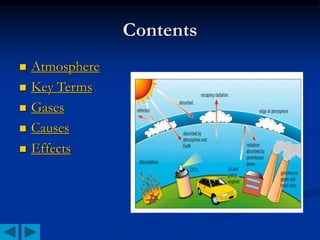
Contents
 Atmosphere
 Key Terms
 Gases
 Causes
 Effects
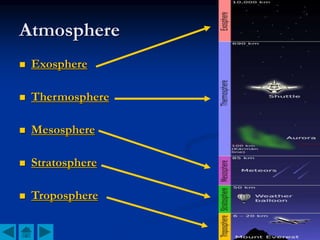
Atmosphere
 Exosphere
 Thermosphere
 Mesosphere
 Stratosphere
 Troposphere
Troposphere
 Lowest portion of earth’s atmosphere
 75% of the entire atmosphere mass
- Water Vapor
- Aerosols
 0 km – 10 km Depth ~ 10 km
 Warmer nearest earth
 Colder the further you go
Travel Back to the Atmosphere
Stratosphere
 Second layer of earth’s atmosphere
 10 km – 50 km Depth ~ 40 km
 Colder nearer the earth surface
 Warmer the further into the atmosphere
 Energy is transferred via heat absorption
by the ozone layer.
 Heating caused by conduction from
above and convection from below.
Travel Back to the Atmosphere
Mesosphere
 Middle layer of earth’s atmosphere
 50 km – 90 km Depth ~ 40 km
 Warmer closer to earth’s surface
 Colder the further you out you go
 This is where meteors burn as they
collide with gas particles
 Most poorly understood part of the
atmosphere
Travel back to the Atmosphere
Thermosphere
 4th layer of earth’s atmosphere
 80 km – 500 km Depth ~ 420 km
 Colder near earth’s surface
 Warmer as you go further into
thermosphere
 This layer absorbs radiation which in
turn electrically charge particles.
Travel back to the Atmosphere
Exosphere
 Outer layer of the atmosphere
 500 km – 10,000 km Depth ~ 9,500 km
 Only layer of atmosphere where gases can
escape
 Main gases found here:
- Hydrogen
- Helium
- Carbon Dioxide
Travel Back to the Atmosphere
Thermosphere
Exosphere
Mesosphere
Stratosphere
Troposphere
Key Terms
 Condensation - process by which gas or vapor changes into a
liquid or solid
 Evaporation - the process by which a liquid changes into a gas
 Convection - upward movement of heat or other atmospheric
properties within the atmosphere
 Photosynthesis – the synthesis of complex organic materials
from carbon dioxide, water, and inorganic salts using light as an
energy source
 Radiation – energy that is transmitted in the form of rays
 Conduction – spontaneous transfer of energy through matter,
from a region of higher temperature to a region of lower
temperature
Gases
 CO2 - Carbon Dioxide
 MH4 - Methane
 O2 – Oxygen Gas
 O3 - Ozone
 N2 – Nitrogen Gas
 Ar – Argon Gas
 H2 – Hydrogen Gas
 He - Helium
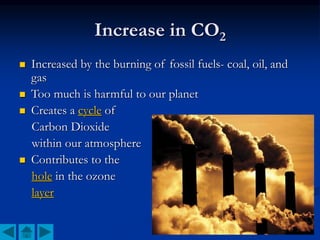
Increase in CO2
 Increased by the burning of fossil fuels- coal, oil, and
gas
 Too much is harmful to our planet
 Creates a cycle of
Carbon Dioxide
within our atmosphere
 Contributes to the
hole in the ozone
layer
3-D Image of the Ozone Hole
Ozone Layer
 Three oxygen atoms bonded together
 Forms a layer above earth that protects us from
harmful UVA UVB rays
 The ozone hole is a depletion of the ozone in
the atmosphere.
What is causing thinning Ozone
Hole?
 Cars
 Factories
 Pollution
 Deforestation
Pollutants
Effects
 Climate change
 Harms animals’ habitats
 Decrease crop production
 Flooding
 Drought
 Hurricanes
QUIZ
1. What is the first atmospheric layer closest to earth?
2. What is the largest atmospheric layer?
3. Define a key term (condensation, evaporation, photosynthesis,
radiation, conduction, convection)
4. What gas is CO2?
5. What is one cause of an increase in CO2?
6. Does CO2 exist in oceans?
7. Which two layers of earth’s atmosphere does the ozone layer
exist?
8. What are two things that are causing the thinning of the ozone?
9. What is an effect of Global Warming?

Greenhouse Effect.ppt

  • 1.
  • 2.
    Contents  Atmosphere  KeyTerms  Gases  Causes  Effects
  • 3.
    Atmosphere  Exosphere  Thermosphere Mesosphere  Stratosphere  Troposphere
  • 4.
    Troposphere  Lowest portionof earth’s atmosphere  75% of the entire atmosphere mass - Water Vapor - Aerosols  0 km – 10 km Depth ~ 10 km  Warmer nearest earth  Colder the further you go Travel Back to the Atmosphere
  • 5.
    Stratosphere  Second layerof earth’s atmosphere  10 km – 50 km Depth ~ 40 km  Colder nearer the earth surface  Warmer the further into the atmosphere  Energy is transferred via heat absorption by the ozone layer.  Heating caused by conduction from above and convection from below. Travel Back to the Atmosphere
  • 6.
    Mesosphere  Middle layerof earth’s atmosphere  50 km – 90 km Depth ~ 40 km  Warmer closer to earth’s surface  Colder the further you out you go  This is where meteors burn as they collide with gas particles  Most poorly understood part of the atmosphere Travel back to the Atmosphere
  • 7.
    Thermosphere  4th layerof earth’s atmosphere  80 km – 500 km Depth ~ 420 km  Colder near earth’s surface  Warmer as you go further into thermosphere  This layer absorbs radiation which in turn electrically charge particles. Travel back to the Atmosphere
  • 8.
    Exosphere  Outer layerof the atmosphere  500 km – 10,000 km Depth ~ 9,500 km  Only layer of atmosphere where gases can escape  Main gases found here: - Hydrogen - Helium - Carbon Dioxide Travel Back to the Atmosphere
  • 9.
  • 10.
    Key Terms  Condensation- process by which gas or vapor changes into a liquid or solid  Evaporation - the process by which a liquid changes into a gas  Convection - upward movement of heat or other atmospheric properties within the atmosphere  Photosynthesis – the synthesis of complex organic materials from carbon dioxide, water, and inorganic salts using light as an energy source  Radiation – energy that is transmitted in the form of rays  Conduction – spontaneous transfer of energy through matter, from a region of higher temperature to a region of lower temperature
  • 11.
    Gases  CO2 -Carbon Dioxide  MH4 - Methane  O2 – Oxygen Gas  O3 - Ozone  N2 – Nitrogen Gas  Ar – Argon Gas  H2 – Hydrogen Gas  He - Helium
  • 12.
    Increase in CO2 Increased by the burning of fossil fuels- coal, oil, and gas  Too much is harmful to our planet  Creates a cycle of Carbon Dioxide within our atmosphere  Contributes to the hole in the ozone layer
  • 13.
    3-D Image ofthe Ozone Hole
  • 14.
    Ozone Layer  Threeoxygen atoms bonded together  Forms a layer above earth that protects us from harmful UVA UVB rays  The ozone hole is a depletion of the ozone in the atmosphere.
  • 15.
    What is causingthinning Ozone Hole?  Cars  Factories  Pollution  Deforestation
  • 16.
  • 17.
    Effects  Climate change Harms animals’ habitats  Decrease crop production  Flooding  Drought  Hurricanes
  • 19.
    QUIZ 1. What isthe first atmospheric layer closest to earth? 2. What is the largest atmospheric layer? 3. Define a key term (condensation, evaporation, photosynthesis, radiation, conduction, convection) 4. What gas is CO2? 5. What is one cause of an increase in CO2? 6. Does CO2 exist in oceans? 7. Which two layers of earth’s atmosphere does the ozone layer exist? 8. What are two things that are causing the thinning of the ozone? 9. What is an effect of Global Warming?