PILOT IMPLEMENTATION OFTHE MATATAG K TO 10 CURRICULUM
8
Lesson Exemplar
for Mathematics
Lesson
6
Quarter 1
Quarter 3
2.
Lesson Exemplar forMathematics Grade 8
Quarter 3: Lesson 6 (Week 6)
SY 2024-2025
This material is intended exclusively for the use of teachers participating in the pilot implementation of the MATATAG K to 10 Curriculum during the
School Year 2024-2025. It aims to assist in delivering the curriculum content, standards, and lesson competencies. Any unauthorized reproduction, distribution,
modification, or utilization of this material beyond the designated scope is strictly prohibited and may result in appropriate legal actions and disciplinary measures.
Borrowed content included in this material are owned by their respective copyright holders. Every effort has been made to locate and obtain permission
to use these materials from their respective copyright owners. The publisher and development team do not represent nor claim ownership over them.
Every care has been taken to ensure the accuracy of the information provided in this material. For inquiries or feedback, please write or call the Office
of the Director of the Bureau of Learning Resources via telephone numbers (02) 8634-1072 and 8631-6922 or by email at blr.od@deped.gov.ph.
Development Team
Writer:
• Yahweh M. Pasahol (Pedro Guevara Memorial National High School)
Validator:
• Ysmael V. Caballas (Philippine Normal University – South Luzon)
Management Team
Philippine Normal University
Research Institute for Teacher Quality
SiMERR National Research Centre
3.
1
MATHEMATICS / QUARTER3 / GRADE 8
I. CURRICULUM CONTENT, STANDARDS, AND LESSON COMPETENCIES
A. Content
Standards
The learners demonstrate knowledge and understanding of systems of linear equations in two variables.
B. Performance
Standards
By the end of the quarter, the learners are able to solve a system of linear equations graphically and algebraically.
(NA)
C. Learning
Competencies
and Objectives
Learning Competencies
At the end of the lesson, the learners are able to:
1. define and illustrate a system of linear equations in two variables.
Lesson Objective 1: Use real-life situations to illustrate a system of linear equations in two variables.
Lesson Objective 2: Define a system of linear equations in two variables.
2. solve a system of linear equations (with integer solutions) by graphing.
Lesson Objective 1: Solve systems of linear equations in two variables by graphing.
3. classify the types of systems of linear equations based on the number of solutions.
Lesson Objective 1: Identify the kind of system of linear equations based on its graph.
Lesson Objective 2: Recognize the number of solutions given the graph of systems of linear equations in two variables.
4. solve algebraically a system of linear equations in two variables:
a) by elimination
b) by substitution
Lesson Objective 1: Solve systems of linear equations by using elimination method.
Lesson Objective 2: Solve systems of linear equations by using substitution method.
D. Content 1. Define and illustrate a system of linear equations in two variables.
2. Solve a system of linear equations by:
a) graphing
b) elimination
c) substitution
3. Classify the types of systems of linear equations based on the number of solutions.
E. Integration
4.
2
II. LEARNING RESOURCES
Colorby Number Spring | Coloring worksheets for kindergarten, Preschool activities, Preschool coloring pages. (n.d.). Pinterest.
https://www.pinterest.ph/pin/839428818021478685/
G. Bernabe, J., Jose Dilao, S., & B. Orines, F. (2009). Intermediate Algebra Textbook for Second Year (Revised). SD Publications, Inc.
Nivera, G., PhD. (2018). Grade 8 Mathematics Patterns and Practicalities. Salesiana Book by Don Bosco Press Inc.
O. Oronce, O., & O. Mendoza, M. (2007). e-math II Intermediate Algebra (First). Rex Book Store, Inc.
Paige, A., & Paige, A. (2024, May 6). 117 Best Riddles for Kids (With Answers). SplashLearn Blog – Educational Resources for Parents,
Teachers & Kids. https://www.splashlearn.com/blog/50-best-riddles-for-kids-of-all-grades-with-answers/#1-27-easy-and-funny-
riddles-with-answers-for-kids-
Premium Vector | Young man making fist pump winner gesture with arms raised smiling and shouting for victory. (2022, January 25).
Freepik. https://www.freepik.com/premium-vector/young-man-making-fist-pump-winner-gesture-with-arms-raised-smiling-
shouting-victory_22701391.htm
Systems of Equations Elimination. (2012). Systems of Equations Elimination.pdf.
https://cdn.kutasoftware.com/Worksheets/Alg1/Systems%20of%20Equations%20Elimination.pdf
III. TEACHING AND LEARNING PROCEDURE NOTES TO TEACHERS
A. Activating Prior
Knowledge
DAY 1
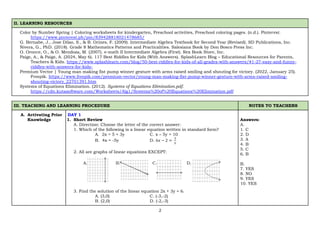
1. Short Review
A. Direction: Choose the letter of the correct answer:
1. Which of the following is a linear equation written in standard form?
A. 2x = 5 + 3y C. x – 5y = 10
B. 4x = -5y D. 6𝑥 − 2 =
3
𝑦
2. All are graphs of linear equations EXCEPT:
3. Find the solution of the linear equation 2x + 3y = 6.
A. (3,0) C. (-3,-2)
B. (2,0) D. (-2,-3)
Answers:
A.
1. C
2. D
3. A
4. B
5. C
6. B
B.
7. YES
8. NO
9. YES
10. YES
5.
3
Given:
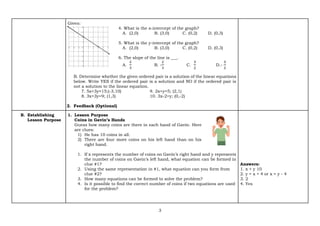
4. What isthe x-intercept of the graph?
A. (2,0) B. (3,0) C. (0,2) D. (0,3)
5. What is the y-intercept of the graph?
A. (2,0) B. (3,0) C. (0,2) D. (0,3)
6. The slope of the line is ___.
A.
2
3
B. -
2
3
C.
3
2
D.-
3
2
B. Determine whether the given ordered pair is a solution of the linear equations
below. Write YES if the ordered pair is a solution and NO if the ordered pair is
not a solution to the linear equation.
7. 5x+3y=15;(-3,10) 9. 2x+y=5; (2,1)
8. 3x+3y=9; (1,3) 10. 3x-2=y; (0,-2)
2. Feedback (Optional)
B. Establishing
Lesson Purpose
1. Lesson Purpose
Coins in Gavin’s Hands
Guess how many coins are there in each hand of Gavin. Here
are clues:
1) He has 10 coins in all.
2) There are four more coins on his left hand than on his
right hand.
1. If x represents the number of coins on Gavin’s right hand and y represents
the number of coins on Gavin’s left hand, what equation can be formed in
clue #1?
2. Using the same representation in #1, what equation can you form from
clue #2?
3. How many equations can be formed to solve the problem?
4. Is it possible to find the correct number of coins if two equations are used
for the problem?
Answers:
1. x + y 10
2. y = x + 4 or x = y - 4
3. 2
4. Yes
6.
4
Two or moreequations considered together for a system of linear equations. The
equations x + y = 10 and y = x + 4 is a system of linear equations.
2. Unlocking Content Vocabulary
SYSTEM OF LINEAR EQUATIONS – two or more linear equations made up of
two or more variables such that all equations in the system are considered
simultaneously.
SYSTEM OF LINEAR EQUATIONS – a pair of equations of the form :
a1x + b1y = c1, where a1, b1 are not both 0
a2x + b2y = c2, where a2, b2 are not both 0
SOLUTION (to a system of linear equations) – ordered pair that satisfies all
conditions of the system of equations.
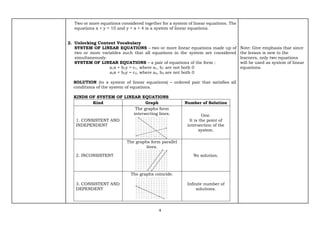
KINDS OF SYSTEM OF LINEAR EQUATIONS
Kind Graph Number of Solution
1. CONSISTENT AND
INDEPENDENT
The graphs form
intersecting lines. One.
It is the point of
intersection of the
system.
2. INCONSISTENT
The graphs form parallel
lines.
No solution.
3. CONSISTENT AND
DEPENDENT
The graphs coincide.
Infinite number of
solutions.
Note: Give emphasis that since
the lesson is new to the
learners, only two equations
will be used as system of linear
equations.
7.
5
C. Developing and
Deepening
Understanding
SUB-TOPICS:
2.Solve a system of linear equations (with integer solutions) by graphing.
3. Classify the types of systems of linear equations based on the number of
solutions.
1. Explicitation
In your previous lessons, you learned how to graph linear equations. You
can either use the Intercept Method or the Slope-Intercept Method to easily
determine the graph of the equation.
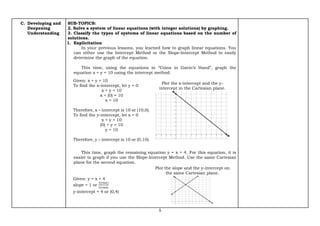
This time, using the equations in “Coins in Gavin’s Hand”, graph the
equation x + y = 10 using the intercept method.
Given: x + y = 10
To find the x–intercept, let y = 0
x + y = 10
x + (0) = 10
x = 10
Therefore, x – intercept is 10 or (10,0).
To find the y–intercept, let x = 0
x + y = 10
(0) + y = 10
y = 10
Therefore, y – intercept is 10 or (0,10).
Plot the x-intercept and the y-
intercept in the Cartesian plane.
This time, graph the remaining equation y = x + 4. For this equation, it is
easier to graph if you use the Slope-Intercept Method. Use the same Cartesian
plane for the second equation.
Given: y = x + 4
slope = 1 or
1(𝑟𝑖𝑠𝑒)
1(𝑟𝑢𝑛)
y-intercept = 4 or (0,4)
Plot the slope and the y-intercept on
the same Cartesian plane.
8.
6
Questions:
1. What canyou say about the graphs of the equations in the “Coins in
Gavin’s Hands”?
2. Do the graphs of the linear equations x + y = 10 and y = x + 4 intersect at
a point?
3. What do you think is their point of intersection?
4. If the intersection is (3,7), the abscissa or the x-coordinate represents the
number of coins in Gavin’s right hand, while the ordinate represents the
coins in Gavin’s left hand. How many coins are there in each of Gavin’s
hands?
5. Do your answers satisfy the given clues?
6. What kind of system of linear equations does the graph represent?
2. Worked Example
One way to solve a system of linear equations is by graphing. This is the
easiest way to identify the kind of system of equations. This method will also
help you determine the number of solutions in the system of equations. The
point of intersection of the lines represents the solution of the system of
equations.
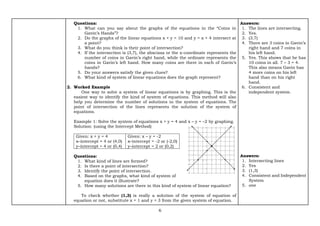
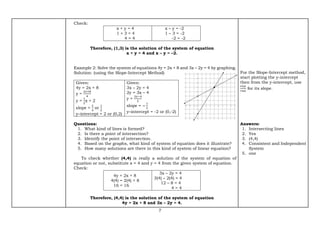
Example 1: Solve the system of equations x + y = 4 and x – y = –2 by graphing.
Solution: (using the Intercept Method)
Given: x + y = 4
x–intercept = 4 or (4,0)
y–intercept = 4 or (0,4)
Given: x – y = -2
x–intercept = -2 or (-2,0)
y–intercept = 2 or (0,2)
Questions:
1. What kind of lines are formed?
2. Is there a point of intersection?
3. Identify the point of intersection.
4. Based on the graphs, what kind of system of
equation does it illustrate?
5. How many solutions are there in this kind of system of linear equation?
To check whether (1,3) is really a solution of the system of equation of
equation or not, substitute x = 1 and y = 3 from the given system of equation.
Answers:
1. The lines are intersecting.
2. Yes.
3. (3,7)
4. There are 3 coins in Gavin’s
right hand and 7 coins in
his left hand.
5. Yes. This shows that he has
10 coins in all. 7 – 3 = 4.
This also means Gavin has
4 more coins on his left
hand than on his right
hand.
6. Consistent and
independent system.
Answers:
1. Intersecting lines
2. Yes
3. (1,3)
4. Consistent and Independent
System
5. one
9.
7
Check:
x + y= 4
1 + 3 = 4
4 = 4
x – y = -2
1 – 3 = -2
-2 = -2
Therefore, (1,3) is the solution of the system of equation
x + y = 4 and x – y = –2.
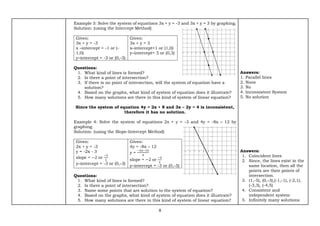
Example 2: Solve the system of equations 4y = 2x + 8 and 3x – 2y = 4 by graphing.
Solution: (using the Slope-Intercept Method)
Given:
4y = 2x + 8
y =
2𝑥+8
4
y =
1
2
x + 2
slope =
2
4
or
1
2
y–intercept = 2 or (0,2)
Given:
3x – 2y = 4
2y = 3x – 4
y =
3𝑥−4
2
slope = −
1
3
y–intercept = -2 or (0,-2)
Questions:
1. What kind of lines is formed?
2. Is there a point of intersection?
3. Identify the point of intersection.
4. Based on the graphs, what kind of system of equation does it illustrate?
5. How many solutions are there in this kind of system of linear equation?
To check whether (4,4) is really a solution of the system of equation of
equation or not, substitute x = 4 and y = 4 from the given system of equation.
Check:
4y = 2x + 8
4(4) = 2(4) + 8
16 = 16
3x – 2y = 4
3(4) – 2(4) = 4
12 – 8 = 4
4 = 4
Therefore, (4,4) is the solution of the system of equation
4y = 2x + 8 and 3x – 2y = 4.
For the Slope-Intercept method,
start plotting the y-intercept
then from the y-intercept, use
𝑟𝑖𝑠𝑒
𝑟𝑢𝑛
for its slope.
Answers:
1. Intersecting lines
2. Yes
3. (4,4)
4. Consistent and Independent
System
5. one
10.
8
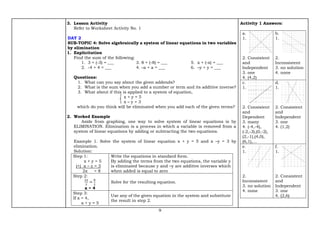
Example 3: Solvethe system of equations 3x + y = -3 and 3x + y = 3 by graphing.
Solution: (using the Intercept Method)
Given:
3x + y = -3
x –intercept = -1 or (-
1,0)
y–intercept = -3 or (0,-3)
Given:
3x + y = 3
x–intercept=1 or (1,0)
y–intercept= 3 or (0,3)
Questions:
1. What kind of lines is formed?
2. Is there a point of intersection?
3. If there is no point of intersection, will the system of equation have a
solution?
4. Based on the graphs, what kind of system of equation does it illustrate?
5. How many solutions are there in this kind of system of linear equation?
Since the system of equation 4y = 2x + 8 and 3x – 2y = 4 is inconsistent,
therefore it has no solution.
Example 4: Solve the system of equations 2x + y = -3 and 4y = -8x – 12 by
graphing.
Solution: (using the Slope-Intercept Method)
Given:
2x + y = -3
y = -2x - 3
slope = −2 or
−2
1
y–intercept = -3 or (0,-3)
Given:
4y = -8x – 12
y =
−2𝑥−12
4
slope = −2 or
−2
1
y–intercept = -3 or (0,-3)
Questions:
1. What kind of lines is formed?
2. Is there a point of intersection?
3. Name some points that are solution to the system of equation?
4. Based on the graphs, what kind of system of equation does it illustrate?
5. How many solutions are there in this kind of system of linear equation?
Answers:
1. Parallel lines
2. None
3. No
4. Inconsistent System
5. No solution
Answers:
1. Coincident lines
2. Since, the lines exist in the
same location, then all the
points are their points of
intersection.
3. (1,-5), (0,-3),(-1,-1), (-2,1),
(-3,3), (-4,5)
4. Consistent and
independent system
5. Infinitely many solutions
11.
9
3. Lesson Activity
Referto Worksheet Activity No. 1
DAY 2
SUB-TOPIC 4: Solve algebraically a system of linear equations in two variables
by elimination
1. Explicitation
Find the sum of the following:
1. 3 + (-3) = ___ 3. 8 + (-8) = ___ 5. x + (-x) = ___
2. -4 + 4 = ___ 4. –a + a = ___ 6. –y + y = ___
Questions:
1. What can you say about the given addends?
2. What is the sum when you add a number or term and its additive inverse?
3. What about if this is applied to a system of equation,
x + y = 5
x – y = 3
which do you think will be eliminated when you add each of the given terms?
2. Worked Example
Aside from graphing, one way to solve system of linear equations is by
ELIMINATION. Elimination is a process in which a variable is removed from a
system of linear equations by adding or subtracting the two equations.
Example 1. Solve the system of linear equation x + y = 5 and x –y = 3 by
elimination.
Solution:
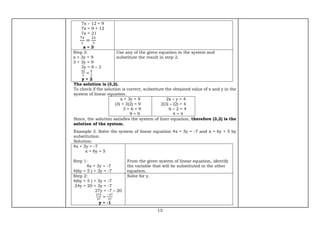
Step 1:
x + y = 5
(+) x – y = 3
2x = 8
Write the equations in standard form.
By adding the terms from the two equations, the variable y
is eliminated because y and –y are additive inverses which
when added is equal to zero
Step 2:
2𝑥
2
=
8
2
x = 4
Solve for the resulting equation.
Step 3:
If x = 4,
x + y = 5
Use any of the given equation in the system and substitute
the result in step 2.
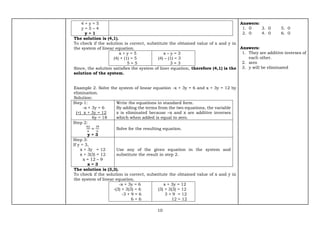
Activity 1 Answers:
a.
1.
2. Consistent
and
Independent
3. one
4. (4,2)
b.
1.
2.
Inconsistent
3. no solution
4. none
c.
1.
2. Consistent
and
Dependent
3. many
4. (-4,-4),
(-2,-3),(0,-2),
(2,-1),(4,0),
(6,1),…
d.
1.
2. Consistent
and
Independent
3. one
4. (1,2)
e.
1.
2.
Inconsistent
3. no solution
4. none
f.
1.
2. Consistent
and
Independent
3. one
4. (2,6)
12.
10
4 + y= 5
y = 5 – 4
y = 1
The solution is (4,1).
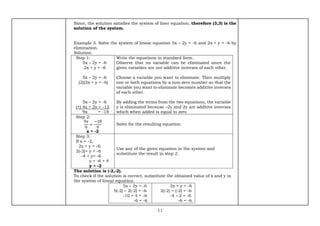
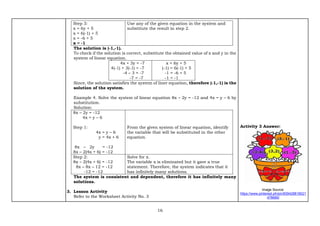
To check if the solution is correct, substitute the obtained value of x and y in
the system of linear equation.
x + y = 5
(4) + (1) = 5
5 = 5
x – y = 3
(4) – (1) = 3
3 = 3
Since, the solution satisfies the system of liner equation, therefore (4,1) is the
solution of the system.
Example 2. Solve the system of linear equation -x + 3y = 6 and x + 3y = 12 by
elimination.
Solution:
Step 1:
-x + 3y = 6
(+) x + 3y = 12
6y = 18
Write the equations in standard form.
By adding the terms from the two equations, the variable
x is eliminated because –x and x are additive inverses
which when added is equal to zero.
Step 2:
6𝑦
6
=
18
6
y = 3
Solve for the resulting equation.
Step 3:
If y = 3,
x + 3y = 12
x + 3(3) = 12
x = 12 – 9
x = 3
Use any of the given equation in the system and
substitute the result in step 2.
The solution is (3,3).
To check if the solution is correct, substitute the obtained value of x and y in
the system of linear equation.
-x + 3y = 6
-(3) + 3(3) = 6
-3 + 9 = 6
6 = 6
x + 3y = 12
(3) + 3(3) = 12
3 + 9 = 12
12 = 12
Answers:
1. 0 3. 0 5. 0
2. 0 4. 0 6. 0
Answers:
1. They are additive inverses of
each other.
2. zero
3. y will be eliminated
13.
11
Since, the solutionsatisfies the system of liner equation, therefore (3,3) is the
solution of the system.
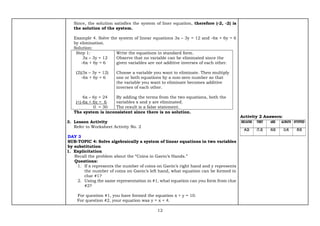
Example 3. Solve the system of linear equation 5x – 2y = -6 and 2x + y = -6 by
elimination.
Solution:
Step 1:
5x – 2y = -6
2x + y = -6
5x – 2y = -6
(2)(2x + y = -6)
5x – 2y = -6
(+) 4x + 2y = -12
9x = -18
Write the equations in standard form.
Observe that no variable can be eliminated since the
given variables are not additive inverses of each other.
Choose a variable you want to eliminate. Then multiply
one or both equations by a non-zero number so that the
variable you want to eliminate becomes additive inverses
of each other.
By adding the terms from the two equations, the variable
y is eliminated because –2y and 2y are additive inverses
which when added is equal to zero
Step 2:
9𝑥
9
=
−18
9
x = -2
Solve for the resulting equation.
Step 3:
If x = -2,
2x + y = -6
2(-2)+ y = -6
-4 + y= -6
y = -6 + 4
y = -2
Use any of the given equation in the system and
substitute the result in step 2.
The solution is (-2,-2).
To check if the solution is correct, substitute the obtained value of x and y in
the system of linear equation.
5x – 2y = -6
5(-2) – 2(-2) = -6
-10 + 4 = -6
-6 = -6
2x + y = -6
2(-2) + (-2) = -6
-4 – 2 = -6
-6 = -6
14.
12
Since, the solutionsatisfies the system of liner equation, therefore (-2, -2) is
the solution of the system.
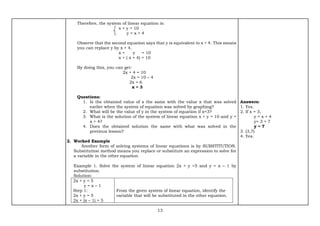
Example 4. Solve the system of linear equations 3x – 3y = 12 and -6x + 6y = 6
by elimination.
Solution:
Step 1:
3x – 3y = 12
-6x + 6y = 6
(2)(3x – 3y = 12)
-6x + 6y = 6
6x – 6y = 24
(+)-6x + 6y = 6
0 = 30
Write the equations in standard form.
Observe that no variable can be eliminated since the
given variables are not additive inverses of each other.
Choose a variable you want to eliminate. Then multiply
one or both equations by a non-zero number so that
the variable you want to eliminate becomes additive
inverses of each other.
By adding the terms from the two equations, both the
variables x and y are eliminated.
The result is a false statement.
The system is inconsistent since there is no solution.
3. Lesson Activity
Refer to Worksheet Activity No. 2
DAY 3
SUB-TOPIC 4: Solve algebraically a system of linear equations in two variables
by substitution
1. Explicitation
Recall the problem about the “Coins in Gavin’s Hands.”
Questions:
1. If x represents the number of coins on Gavin’s right hand and y represents
the number of coins on Gavin’s left hand, what equation can be formed in
clue #1?
2. Using the same representation in #1, what equation can you form from clue
#2?
For question #1, you have formed the equation x + y = 10.
For question #2, your equation was y = x + 4.
Activity 2 Answers:
15.
13
Therefore, the systemof linear equation is:
x + y = 10
y = x + 4
Observe that the second equation says that y is equivalent to x + 4. This means
you can replace y by x + 4.
x + y = 10
x + ( x + 4) = 10
By doing this, you can get:
2x + 4 = 10
2x = 10 – 4
2x = 6
x = 3
Questions:
1. Is the obtained value of x the same with the value x that was solved
earlier when the system of equation was solved by graphing?
2. What will be the value of y in the system of equation if x=3?
3. What is the solution of the system of linear equation x + y = 10 and y =
x + 4?
4. Does the obtained solution the same with what was solved in the
previous lesson?
2. Worked Example
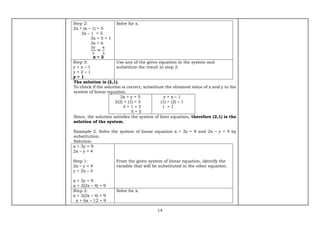
Another form of solving systems of linear equations is by SUBSTITUTION.
Substitution method means you replace or substitute an expression to solve for
a variable in the other equation.
Example 1. Solve the system of linear equation 2x + y =5 and y = x – 1 by
substitution.
Solution:
2x + y = 5
y = x – 1
Step 1:
2x + y = 5
2x + (x – 1) = 5
From the given system of linear equation, identify the
variable that will be substituted in the other equation.
Answers:
1. Yes.
2. If x = 3,
y = x + 4
y= 3 + 7
y = 7
3. (3,7)
4. Yes.
16.
14
Step 2:
2x +(x – 1) = 5
3x – 1 = 5
3x = 5 + 1
3x = 6
3𝑥
3
=
6
3
x = 2
Solve for x.
Step 3:
y = x – 1
y = 2 – 1
y = 1
Use any of the given equation in the system and
substitute the result in step 2.
The solution is (2,1).
To check if the solution is correct, substitute the obtained value of x and y in the
system of linear equation.
2x + y = 5
2(2) + (1) = 5
4 + 1 = 5
5 = 5
y = x – 1
(1) = (2) – 1
1 = 1
Since, the solution satisfies the system of liner equation, therefore (2,1) is the
solution of the system.
Example 2. Solve the system of linear equation x + 3y = 9 and 2x – y = 4 by
substitution.
Solution:
x + 3y = 9
2x – y = 4
Step 1:
2x – y = 4
y = 2x – 4
x + 3y = 9
x + 3(2x – 4) = 9
From the given system of linear equation, identify the
variable that will be substituted in the other equation.
Step 2:
x + 3(2x – 4) = 9
x + 6x – 12 = 9
Solve for x.
17.
15
7x – 12= 9
7x = 9 + 12
7x = 21
7𝑥
7
=
21
7
x = 3
Step 3:
x + 3y = 9
3 + 3y = 9
3y = 9 – 3
3𝑦
3
=
6
3
y = 2
Use any of the given equation in the system and
substitute the result in step 2.
The solution is (3,2).
To check if the solution is correct, substitute the obtained value of x and y in the
system of linear equation.
x + 3y = 9
(3) + 3(2) = 9
3 + 6 = 9
9 = 9
2x – y = 4
2(3) – (2) = 4
6 – 2 = 4
4 = 4
Since, the solution satisfies the system of liner equation, therefore (3,2) is the
solution of the system.
Example 3. Solve the system of linear equation 4x + 3y = -7 and x = 6y + 5 by
substitution.
Solution:
4x + 3y = -7
x = 6y + 5
Step 1:
4x + 3y = -7
4(6y + 5 ) + 3y = -7
From the given system of linear equation, identify
the variable that will be substituted in the other
equation.
Step 2:
4(6y + 5 ) + 3y = -7
24y + 20 + 3y = -7
27y = -7 – 20
27𝑦
27
=
−27
27
y = -1
Solve for y.
18.
16
Step 3:
x =6y + 5
x = 6(-1) + 5
x = -6 + 5
x = -1
Use any of the given equation in the system and
substitute the result in step 2.
The solution is (-1,-1).
To check if the solution is correct, substitute the obtained value of x and y in the
system of linear equation.
4x + 3y = -7
4(-1) + 3(-1) = -7
-4 – 3 = -7
-7 = -7
x = 6y + 5
(-1) = 6(-1) + 5
-1 = -6 + 5
-1 = -1
Since, the solution satisfies the system of liner equation, therefore (-1,-1) is the
solution of the system.
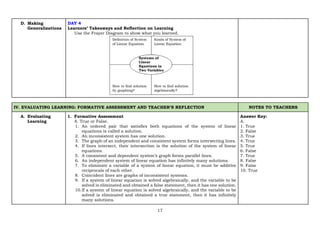
Example 4. Solve the system of linear equation 8x – 2y = -12 and 4x = y – 6 by
substitution.
Solution:
8x – 2y = -12
4x = y – 6
Step 1:
4x = y – 6
y = 4x + 6
8x – 2y = -12
8x – 2(4x + 6) = -12
From the given system of linear equation, identify
the variable that will be substituted in the other
equation.
Step 2:
8x – 2(4x + 6) = -12
8x – 8x – 12 = -12
-12 = -12
Solve for x.
The variable x is eliminated but it gave a true
statement. Therefore, the system indicates that it
has infinitely many solutions.
The system is consistent and dependent, therefore it has infinitely many
solutions.
3. Lesson Activity
Refer to the Worksheet Activity No. 3
Activity 3 Answer:
Image Source:
https://www.pinterest.ph/pin/839428818021
478685/
19.
17
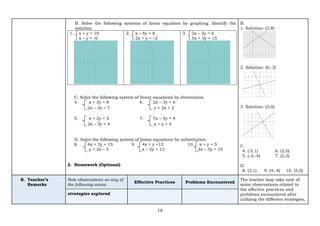
D. Making
Generalizations
DAY 4
Learners’Takeaways and Reflection on Learning
Use the Frayer Diagram to show what you learned.
IV. EVALUATING LEARNING: FORMATIVE ASSESSMENT AND TEACHER’S REFLECTION NOTES TO TEACHERS
A. Evaluating
Learning
1. Formative Assessment
A. True or False.
1. An ordered pair that satisfies both equations of the system of linear
equations is called a solution.
2. An inconsistent system has one solution.
3. The graph of an independent and consistent system forms intersecting lines.
4. If lines intersect, their intersection is the solution of the system of linear
equations.
5. A consistent and dependent system’s graph forms parallel lines.
6. An independent system of linear equation has infinitely many solutions.
7. To eliminate a variable of a system of linear equation, it must be additive
reciprocals of each other.
8. Coincident lines are graphs of inconsistent systems.
9. If a system of linear equation is solved algebraically, and the variable to be
solved is eliminated and obtained a false statement, then it has one solution.
10.If a system of linear equation is solved algebraically, and the variable to be
solved is eliminated and obtained a true statement, then it has infinitely
many solutions.
Answer Key:
A.
1. True
2. False
3. True
4. True
5. True
6. False
7. True
8. False
9. False
10. True
20.
18
B. Solve thefollowing systems of linear equation by graphing. Identify the
solution.
1. x + y = 10
x – y = -6
2. x – 4y = 8
2x + y = –2
3. 2x – 3y = 6
5x + 3y = 15
C. Solve the following system of linear equations by elimination.
4. x + 3y = 8 6. 2x – 3y = 6
2x – 3y = 7 y = 2x + 2
5. x + 2y = 2 7. 7x – 5y = 4
2x – 3y = 4 x + y = 4
D. Solve the following system of linear equations by substitution.
8. 4x + 3y = 15 9. 4x + y =12 10. x + y = 5
y = 2x – 5 x – 2y = 12 2x – 3y = 10
2. Homework (Optional)
B.
1. Solution: (2,8)
2. Solution: (0,-2)
3. Solution: (3,0)
C.
4. ( 5,1) 6. (2,0)
5. (-3,-4) 7. (2,2)
D.
8. (3,1) 9. (4,-4) 10. (5,0)
B. Teacher’s
Remarks
Note observations on any of
the following areas:
Effective Practices Problems Encountered
The teacher may take note of
some observations related to
the effective practices and
problems encountered after
utilizing the different strategies,
strategies explored
21.
19
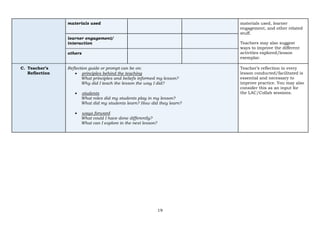
materials used materialsused, learner
engagement, and other related
stuff.
Teachers may also suggest
ways to improve the different
activities explored/lesson
exemplar.
learner engagement/
interaction
others
C. Teacher’s
Reflection
Reflection guide or prompt can be on:
• principles behind the teaching
What principles and beliefs informed my lesson?
Why did I teach the lesson the way I did?
• students
What roles did my students play in my lesson?
What did my students learn? How did they learn?
• ways forward
What could I have done differently?
What can I explore in the next lesson?
Teacher’s reflection in every
lesson conducted/facilitated is
essential and necessary to
improve practice. You may also
consider this as an input for
the LAC/Collab sessions.