INTEGERS
What is an Integer?
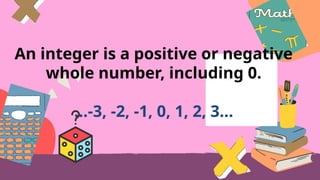
An integer is a positive or negative
whole number, including 0.
…-3, -2, -1, 0, 1, 2, 3…
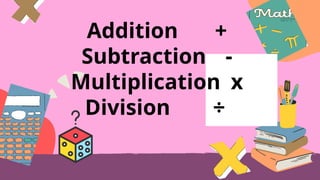
There are
“4” Integer Operations
Addition +
Subtraction -
Multiplication x
Division ÷
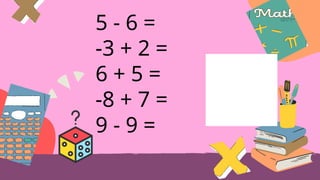
5 - 6 =
-3 + 2 =
6 + 5 =
-8 + 7 =
9 - 9 =
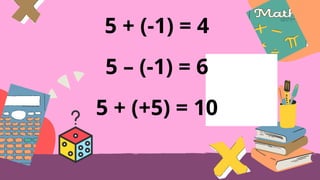
5 + (-1) = 4
5 – (-1) = 6
5 + (+5) = 10
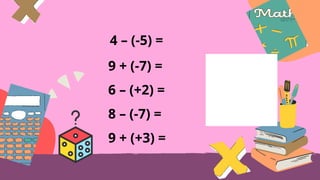
4 – (-5) =
9 + (-7) =
6 – (+2) =
8 – (-7) =
9 + (+3) =
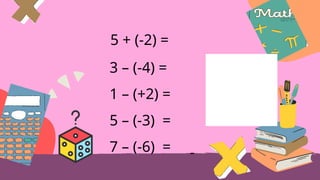
5 + (-2) =
3 – (-4) =
1 – (+2) =
5 – (-3) =
7 – (-6) =
Factoring
Polynomials
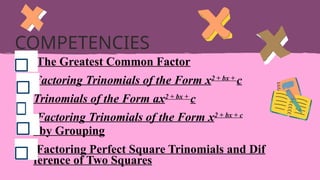
The Greatest Common Factor
Factoring Trinomials of the Form x2 + bx +
c
Trinomials of the Form ax2 + bx +
c
Factoring Trinomials of the Form x2 + bx + c
by Grouping
Factoring Perfect Square Trinomials and Dif
ference of Two Squares
COMPETENCIES
The Greatest Common
Factor
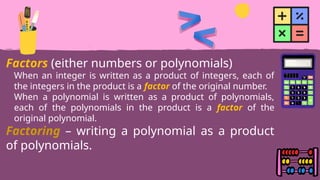
Factors (either numbers or polynomials)
When an integer is written as a product of integers, each of
the integers in the product is a factor of the original number.
When a polynomial is written as a product of polynomials,
each of the polynomials in the product is a factor of the
original polynomial.
Factoring – writing a polynomial as a product
of polynomials.
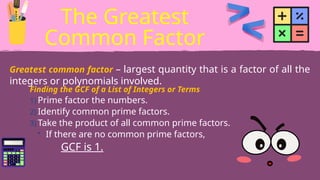
Greatest common factor – largest quantity that is a factor of all the
integers or polynomials involved.
The Greatest
Common Factor
Finding the GCF of a List of Integers or Terms
1) Prime factor the numbers.
2) Identify common prime factors.
3) Take the product of all common prime factors.
• If there are no common prime factors,
GCF is 1.
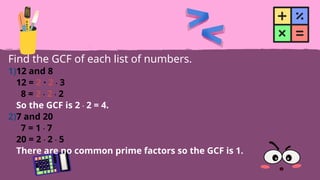
Find the GCF of each list of numbers.
1)12 and 8
12 = 2 · 2 · 3
8 = 2 · 2 · 2
So the GCF is 2 · 2 = 4.
2)7 and 20
7 = 1 · 7
20 = 2 · 2 · 5
There are no common prime factors so the GCF is 1.
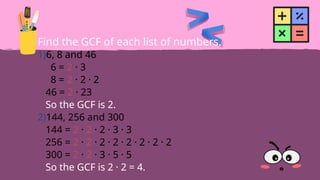
Find the GCF of each list of numbers.
1)6, 8 and 46
6 = 2 · 3
8 = 2 · 2 · 2
46 = 2 · 23
So the GCF is 2.
2)144, 256 and 300
144 = 2 · 2 · 2 · 3 · 3
256 = 2 · 2 · 2 · 2 · 2 · 2 · 2 · 2
300 = 2 · 2 · 3 · 5 · 5
So the GCF is 2 · 2 = 4.
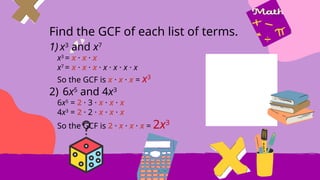
Find the GCF of each list of terms.
1) x3
and x7
x3
= x · x · x
x7
= x · x · x · x · x · x · x
So the GCF is x · x · x = x3
2) 6x5
and 4x3
6x5
= 2 · 3 · x · x · x
4x3
= 2 · 2 · x · x · x
So the GCF is 2 · x · x · x = 2x3
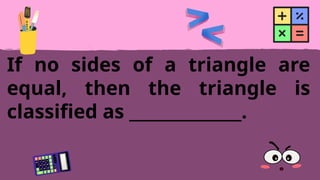
If no sides of a triangle are
equal, then the triangle is
classified as ______________.
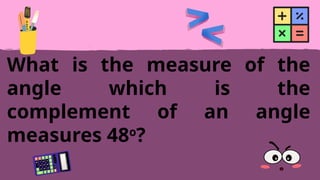
What is the measure of the
angle which is the
complement of an angle
measures 48o
?
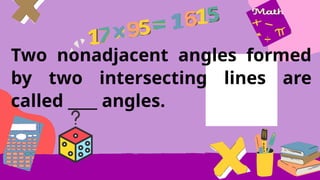
Two nonadjacent angles formed
by two intersecting lines are
called ____ angles.
What property is illustrated in the
statement, “If ∠A ≅ ∠B, ∠B ≅ ∠C
then ∠A ≅ ∠C”?
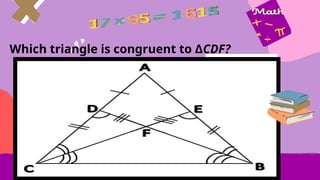
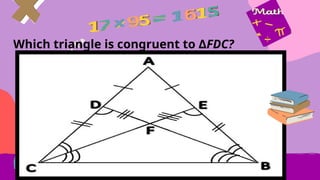
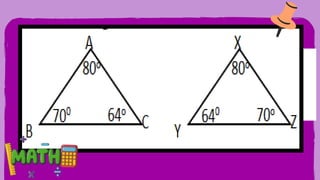
Which triangle is congruent to ΔCDF?
A star in the sky
represents a __________.
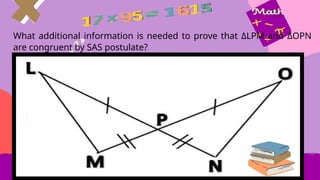
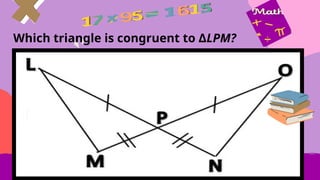
What additional information is needed to prove that ΔLPM and ΔOPN
are congruent by SAS postulate?
Which triangle is congruent to ΔFDC?
Which triangle is congruent to ΔLPM?
If two legs of one triangle is congruent
to the two legs of another triangle, then
the triangles are congruent by what
theorem?
What are the three undefined
terms in mathematical
system?
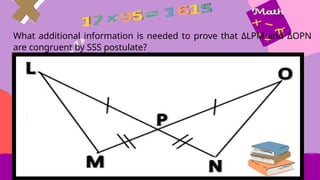
What additional information is needed to prove that ΔLPM and ΔOPN
are congruent by SSS postulate?
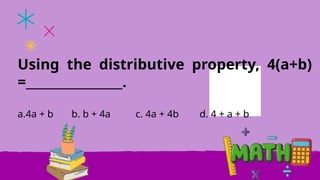
Using the distributive property, 4(a+b)
=________________.
a.4a + b b. b + 4a c. 4a + 4b d. 4 + a + b
If the hypotenuse and an acute angle of one
triangle is congruent to the hypotenuse and
an acute angle of another triangle, then the
triangles are congruent by what theorem?
An angles whose sum
is equal to 180 ?
Angle C and E are
supplementary angles, if m<C
= 78o
, find m < E.
The property of equality
which justifies that if MN =
MN, then MN = MN?
The property of equality
which justifies that if M = N,
then N = M?
FACTORING.pptxgrade 8 mathematics powerp

FACTORING.pptxgrade 8 mathematics powerp

  • 1.
  • 2.
    What is anInteger?
  • 3.
    An integer isa positive or negative whole number, including 0. …-3, -2, -1, 0, 1, 2, 3…
  • 4.
  • 5.
  • 6.
    5 - 6= -3 + 2 = 6 + 5 = -8 + 7 = 9 - 9 =
  • 7.
    5 + (-1)= 4 5 – (-1) = 6 5 + (+5) = 10
  • 8.
    4 – (-5)= 9 + (-7) = 6 – (+2) = 8 – (-7) = 9 + (+3) =
  • 9.
    5 + (-2)= 3 – (-4) = 1 – (+2) = 5 – (-3) = 7 – (-6) =
  • 10.
  • 11.
    The Greatest CommonFactor Factoring Trinomials of the Form x2 + bx + c Trinomials of the Form ax2 + bx + c Factoring Trinomials of the Form x2 + bx + c by Grouping Factoring Perfect Square Trinomials and Dif ference of Two Squares COMPETENCIES
  • 12.
  • 13.
    Factors (either numbersor polynomials) When an integer is written as a product of integers, each of the integers in the product is a factor of the original number. When a polynomial is written as a product of polynomials, each of the polynomials in the product is a factor of the original polynomial. Factoring – writing a polynomial as a product of polynomials.
  • 14.
    Greatest common factor– largest quantity that is a factor of all the integers or polynomials involved. The Greatest Common Factor Finding the GCF of a List of Integers or Terms 1) Prime factor the numbers. 2) Identify common prime factors. 3) Take the product of all common prime factors. • If there are no common prime factors, GCF is 1.
  • 15.
    Find the GCFof each list of numbers. 1)12 and 8 12 = 2 · 2 · 3 8 = 2 · 2 · 2 So the GCF is 2 · 2 = 4. 2)7 and 20 7 = 1 · 7 20 = 2 · 2 · 5 There are no common prime factors so the GCF is 1.
  • 16.
    Find the GCFof each list of numbers. 1)6, 8 and 46 6 = 2 · 3 8 = 2 · 2 · 2 46 = 2 · 23 So the GCF is 2. 2)144, 256 and 300 144 = 2 · 2 · 2 · 3 · 3 256 = 2 · 2 · 2 · 2 · 2 · 2 · 2 · 2 300 = 2 · 2 · 3 · 5 · 5 So the GCF is 2 · 2 = 4.
  • 17.
    Find the GCFof each list of terms. 1) x3 and x7 x3 = x · x · x x7 = x · x · x · x · x · x · x So the GCF is x · x · x = x3 2) 6x5 and 4x3 6x5 = 2 · 3 · x · x · x 4x3 = 2 · 2 · x · x · x So the GCF is 2 · x · x · x = 2x3
  • 18.
    If no sidesof a triangle are equal, then the triangle is classified as ______________.
  • 19.
    What is themeasure of the angle which is the complement of an angle measures 48o ?
  • 20.
    Two nonadjacent anglesformed by two intersecting lines are called ____ angles.
  • 21.
    What property isillustrated in the statement, “If ∠A ≅ ∠B, ∠B ≅ ∠C then ∠A ≅ ∠C”?
  • 22.
    Which triangle iscongruent to ΔCDF?
  • 23.
    A star inthe sky represents a __________.
  • 24.
    What additional informationis needed to prove that ΔLPM and ΔOPN are congruent by SAS postulate?
  • 25.
    Which triangle iscongruent to ΔFDC?
  • 26.
    Which triangle iscongruent to ΔLPM?
  • 27.
    If two legsof one triangle is congruent to the two legs of another triangle, then the triangles are congruent by what theorem?
  • 28.
    What are thethree undefined terms in mathematical system?
  • 29.
    What additional informationis needed to prove that ΔLPM and ΔOPN are congruent by SSS postulate?
  • 30.
    Using the distributiveproperty, 4(a+b) =________________. a.4a + b b. b + 4a c. 4a + 4b d. 4 + a + b
  • 31.
    If the hypotenuseand an acute angle of one triangle is congruent to the hypotenuse and an acute angle of another triangle, then the triangles are congruent by what theorem?
  • 32.
    An angles whosesum is equal to 180 ?
  • 33.
    Angle C andE are supplementary angles, if m<C = 78o , find m < E.
  • 34.
    The property ofequality which justifies that if MN = MN, then MN = MN?
  • 35.
    The property ofequality which justifies that if M = N, then N = M?