Q2 ’18 Earnings Presentation
May 3, 2018
| Q2 ’18 Earnings Presentation
Hillenbrand Participants
2
• Joe Raver
̶ President & Chief Executive Officer
• Kristina Cerniglia
̶ Senior Vice President & Chief Financial Officer
• Chris Trainor
̶ President, Batesville
| Q2 ’18 Earnings Presentation
Disclosure Regarding Forward-Looking
Statements
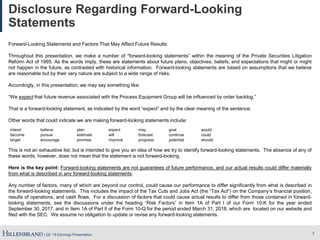
Forward-Looking Statements and Factors That May Affect Future Results:
Throughout this presentation, we make a number of “forward-looking statements” within the meaning of the Private Securities Litigation
Reform Act of 1995. As the words imply, these are statements about future plans, objectives, beliefs, and expectations that might or might
not happen in the future, as contrasted with historical information. Forward-looking statements are based on assumptions that we believe
are reasonable but by their very nature are subject to a wide range of risks.
Accordingly, in this presentation, we may say something like:
“We expect that future revenue associated with the Process Equipment Group will be influenced by order backlog.”
That is a forward-looking statement, as indicated by the word “expect” and by the clear meaning of the sentence.
Other words that could indicate we are making forward-looking statements include:
This is not an exhaustive list, but is intended to give you an idea of how we try to identify forward-looking statements. The absence of any of
these words, however, does not mean that the statement is not forward-looking.
Here is the key point: Forward-looking statements are not guarantees of future performance, and our actual results could differ materially
from what is described in any forward-looking statements.
Any number of factors, many of which are beyond our control, could cause our performance to differ significantly from what is described in
the forward-looking statements. This includes the impact of the Tax Cuts and Jobs Act (the “Tax Act”) on the Company’s financial position,
results of operations, and cash flows. For a discussion of factors that could cause actual results to differ from those contained in forward-
looking statements, see the discussions under the heading “Risk Factors” in Item 1A of Part I of our Form 10-K for the year ended
September 30, 2017, and in Item 1A of Part II of the Form 10-Q for the period ended March 31, 2018, which are located on our website and
filed with the SEC. We assume no obligation to update or revise any forward-looking statements.
3
intend believe plan expect may goal would
become pursue estimate will forecast continue could
target encourage promise improve progress potential should
| Q2 ’18 Earnings Presentation
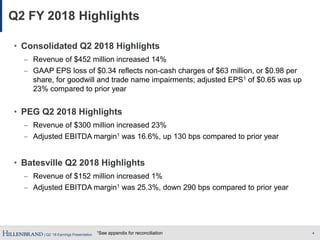
Q2 FY 2018 Highlights
• Consolidated Q2 2018 Highlights
̶ Revenue of $452 million increased 14%
̶ GAAP EPS loss of $0.34 reflects non-cash charges of $63 million, or $0.98 per
share, for goodwill and trade name impairments; adjusted EPS1 of $0.65 was up
23% compared to prior year
• PEG Q2 2018 Highlights
̶ Revenue of $300 million increased 23%
̶ Adjusted EBITDA margin1 was 16.6%, up 130 bps compared to prior year
• Batesville Q2 2018 Highlights
̶ Revenue of $152 million increased 1%
̶ Adjusted EBITDA margin1 was 25.3%, down 290 bps compared to prior year
41See appendix for reconciliation
| Q2 ’18 Earnings Presentation 5
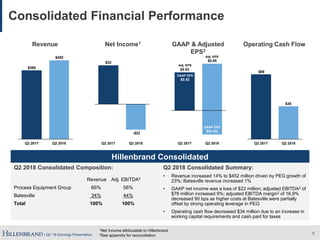
Consolidated Financial Performance
GAAP & Adjusted
EPS2
Net Income1Revenue Operating Cash Flow
$452
$395
Q2 2018Q2 2017
-$22
$33
Q2 2018Q2 2017 Q2 2018
$0.65
Q2 2017
$0.53
Adj. EPS
Adj. EPS
GAAP EPS
$(0.34)
GAAP EPS
$0.52
$35
$69
Q2 2017 Q2 2018
1Net Income attributable to Hillenbrand
2See appendix for reconciliation
Hillenbrand Consolidated
Q2 2018 Consolidated Composition:
Revenue Adj. EBITDA2
Process Equipment Group 66% 56%
Batesville 34% 44%
Total 100% 100%
Q2 2018 Consolidated Summary:
• Revenue increased 14% to $452 million driven by PEG growth of
23%; Batesville revenue increased 1%
• GAAP net income was a loss of $22 million; adjusted EBITDA2 of
$76 million increased 9%; adjusted EBITDA margin2 of 16.9%
decreased 90 bps as higher costs at Batesville were partially
offset by strong operating leverage in PEG
• Operating cash flow decreased $34 million due to an increase in
working capital requirements and cash paid for taxes
| Q2 ’18 Earnings Presentation 6
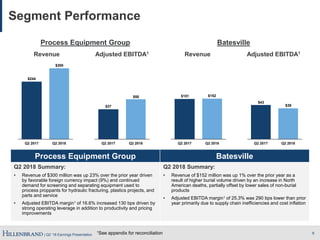
Segment Performance
Process Equipment Group Batesville
Revenue Adjusted EBITDA1 Revenue Adjusted EBITDA1
Process Equipment Group Batesville
Q2 2018 Summary:
• Revenue of $300 million was up 23% over the prior year driven
by favorable foreign currency impact (9%) and continued
demand for screening and separating equipment used to
process proppants for hydraulic fracturing, plastics projects, and
parts and service
• Adjusted EBITDA margin1 of 16.6% increased 130 bps driven by
strong operating leverage in addition to productivity and pricing
improvements
Q2 2018 Summary:
• Revenue of $152 million was up 1% over the prior year as a
result of higher burial volume driven by an increase in North
American deaths, partially offset by lower sales of non-burial
products
• Adjusted EBITDA margin1 of 25.3% was 290 bps lower than prior
year primarily due to supply chain inefficiencies and cost inflation
$300
$244
Q2 2018Q2 2017
$50
$37
Q2 2018Q2 2017
$152$151
Q2 2018Q2 2017
$39
$43
Q2 2018Q2 2017
1See appendix for reconciliation
| Q2 ’18 Earnings Presentation 7
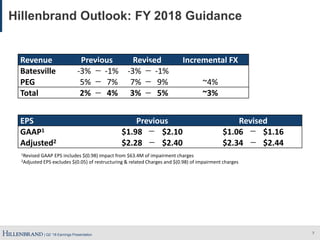
Hillenbrand Outlook: FY 2018 Guidance
1Revised GAAP EPS includes $(0.98) impact from $63.4M of impairment charges
2Adjusted EPS excludes $(0.05) of restructuring & related Charges and $(0.98) of impairment charges
Revenue Previous Revised Incremental FX
Batesville -3% -1% -3% -1%
PEG 5% 7% 7% 9% ~4%
Total 2% 4% 3% 5% ~3%
EPS Previous Revised
GAAP1 $1.98 $2.10 $1.06 $1.16
Adjusted2 $2.28 $2.40 $2.34 $2.44
Q&A
| Q2 ’18 Earnings Presentation
Replay Information
• Dial-in for US and Canada: 1 (800) 585-8367
• Dial-in for International: +1 (416) 621-4642
• Conference ID: 1197739
• Encore Replay Dates: 5/3/2018 – 5/17/2018
• Log on to: http://ir.hillenbrand.com
9
Appendix
| Q2 ’18 Earnings Presentation
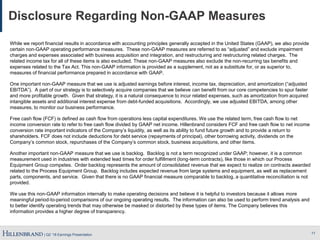
Disclosure Regarding Non-GAAP Measures
While we report financial results in accordance with accounting principles generally accepted in the United States (GAAP), we also provide
certain non-GAAP operating performance measures. These non-GAAP measures are referred to as “adjusted” and exclude impairment
charges and expenses associated with business acquisition and integration, and restructuring and restructuring related charges. The
related income tax for all of these items is also excluded. These non-GAAP measures also exclude the non-recurring tax benefits and
expenses related to the Tax Act. This non-GAAP information is provided as a supplement, not as a substitute for, or as superior to,
measures of financial performance prepared in accordance with GAAP.
One important non-GAAP measure that we use is adjusted earnings before interest, income tax, depreciation, and amortization (“adjusted
EBITDA”). A part of our strategy is to selectively acquire companies that we believe can benefit from our core competencies to spur faster
and more profitable growth. Given that strategy, it is a natural consequence to incur related expenses, such as amortization from acquired
intangible assets and additional interest expense from debt-funded acquisitions. Accordingly, we use adjusted EBITDA, among other
measures, to monitor our business performance.
Free cash flow (FCF) is defined as cash flow from operations less capital expenditures. We use the related term, free cash flow to net
income conversion rate to refer to free cash flow divided by GAAP net income. Hillenbrand considers FCF and free cash flow to net income
conversion rate important indicators of the Company’s liquidity, as well as its ability to fund future growth and to provide a return to
shareholders. FCF does not include deductions for debt service (repayments of principal), other borrowing activity, dividends on the
Company’s common stock, repurchases of the Company’s common stock, business acquisitions, and other items.
Another important non-GAAP measure that we use is backlog. Backlog is not a term recognized under GAAP; however, it is a common
measurement used in industries with extended lead times for order fulfillment (long-term contracts), like those in which our Process
Equipment Group competes. Order backlog represents the amount of consolidated revenue that we expect to realize on contracts awarded
related to the Process Equipment Group. Backlog includes expected revenue from large systems and equipment, as well as replacement
parts, components, and service. Given that there is no GAAP financial measure comparable to backlog, a quantitative reconciliation is not
provided.
We use this non-GAAP information internally to make operating decisions and believe it is helpful to investors because it allows more
meaningful period-to-period comparisons of our ongoing operating results. The information can also be used to perform trend analysis and
to better identify operating trends that may otherwise be masked or distorted by these types of items. The Company believes this
information provides a higher degree of transparency.
11
| Q2 ’18 Earnings Presentation
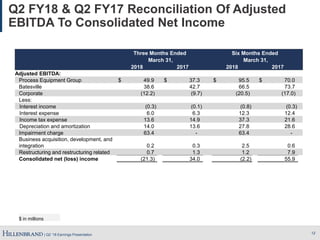
Q2 FY18 & Q2 FY17 Reconciliation Of Adjusted
EBITDA To Consolidated Net Income
12
$ in millions
Three Months Ended Six Months Ended
March 31, March 31,
2018 2017 2018 2017
Adjusted EBITDA:
Process Equipment Group $ 49.9 $ 37.3 $ 95.5 $ 70.0
Batesville 38.6 42.7 66.5 73.7
Corporate (12.2) (9.7) (20.5) (17.0)
Less:
Interest income (0.3) (0.1) (0.8) (0.3)
Interest expense 6.0 6.3 12.3 12.4
Income tax expense 13.6 14.9 37.3 21.6
Depreciation and amortization 14.0 13.6 27.8 28.6
Impairment charge 63.4 - 63.4 -
Business acquisition, development, and
integration 0.2 0.3 2.5 0.6
Restructuring and restructuring related 0.7 1.3 1.2 7.9
Consolidated net (loss) income (21.3) 34.0 (2.2) 55.9
| Q2 ’18 Earnings Presentation
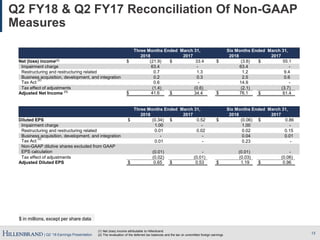
Q2 FY18 & Q2 FY17 Reconciliation Of Non-GAAP
Measures
13
(1) Net (loss) income attributable to Hillenbrand
(2) The revaluation of the deferred tax balances and the tax on unremitted foreign earnings
$ in millions, except per share data
Three Months Ended March 31, Six Months Ended March 31,
2018 2017 2018 2017
Net (loss) income(1) $ (21.9) $ 33.4 $ (3.8) $ 55.1
Impairment charge 63.4 - 63.4 -
Restructuring and restructuring related 0.7 1.3 1.2 9.4
Business acquisition, development, and integration 0.2 0.3 2.5 0.6
Tax Act
(2)
0.6 - 14.9 -
Tax effect of adjustments (1.4) (0.6) (2.1) (3.7)
Adjusted Net Income (1)
$ 41.6 $ 34.4 $ 76.1 $ 61.4
Three Months Ended March 31, Six Months Ended March 31,
2018 2017 2018 2017
Diluted EPS $ (0.34) $ 0.52 $ (0.06) $ 0.86
Impairment charge 1.00 - 1.00 -
Restructuring and restructuring related 0.01 0.02 0.02 0.15
Business acquisition, development, and integration - - 0.04 0.01
Tax Act
(2)
0.01 - 0.23 -
Non-GAAP dilutive shares excluded from GAAP
EPS calculation (0.01) - (0.01) -
Tax effect of adjustments (0.02) (0.01) (0.03) (0.06)
Adjusted Diluted EPS $ 0.65 $ 0.53 $ 1.19 $ 0.96
| Q2 ’18 Earnings Presentation
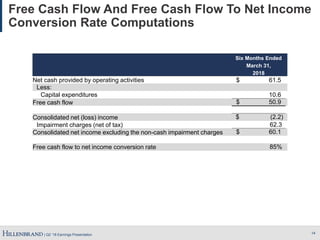
Free Cash Flow And Free Cash Flow To Net Income
Conversion Rate Computations
14
Six Months Ended
March 31,
2018
Net cash provided by operating activities $ 61.5
Less:
Capital expenditures 10.6
Free cash flow $ 50.9
Consolidated net (loss) income $ (2.2)
Impairment charges (net of tax) 62.3
Consolidated net income excluding the non-cash impairment charges $ 60.1
Free cash flow to net income conversion rate 85%

Q2 2018 earnings call presentation 5.3.18

  • 1.
    Q2 ’18 EarningsPresentation May 3, 2018
  • 2.
    | Q2 ’18Earnings Presentation Hillenbrand Participants 2 • Joe Raver ̶ President & Chief Executive Officer • Kristina Cerniglia ̶ Senior Vice President & Chief Financial Officer • Chris Trainor ̶ President, Batesville
  • 3.
    | Q2 ’18Earnings Presentation Disclosure Regarding Forward-Looking Statements Forward-Looking Statements and Factors That May Affect Future Results: Throughout this presentation, we make a number of “forward-looking statements” within the meaning of the Private Securities Litigation Reform Act of 1995. As the words imply, these are statements about future plans, objectives, beliefs, and expectations that might or might not happen in the future, as contrasted with historical information. Forward-looking statements are based on assumptions that we believe are reasonable but by their very nature are subject to a wide range of risks. Accordingly, in this presentation, we may say something like: “We expect that future revenue associated with the Process Equipment Group will be influenced by order backlog.” That is a forward-looking statement, as indicated by the word “expect” and by the clear meaning of the sentence. Other words that could indicate we are making forward-looking statements include: This is not an exhaustive list, but is intended to give you an idea of how we try to identify forward-looking statements. The absence of any of these words, however, does not mean that the statement is not forward-looking. Here is the key point: Forward-looking statements are not guarantees of future performance, and our actual results could differ materially from what is described in any forward-looking statements. Any number of factors, many of which are beyond our control, could cause our performance to differ significantly from what is described in the forward-looking statements. This includes the impact of the Tax Cuts and Jobs Act (the “Tax Act”) on the Company’s financial position, results of operations, and cash flows. For a discussion of factors that could cause actual results to differ from those contained in forward- looking statements, see the discussions under the heading “Risk Factors” in Item 1A of Part I of our Form 10-K for the year ended September 30, 2017, and in Item 1A of Part II of the Form 10-Q for the period ended March 31, 2018, which are located on our website and filed with the SEC. We assume no obligation to update or revise any forward-looking statements. 3 intend believe plan expect may goal would become pursue estimate will forecast continue could target encourage promise improve progress potential should
  • 4.
    | Q2 ’18Earnings Presentation Q2 FY 2018 Highlights • Consolidated Q2 2018 Highlights ̶ Revenue of $452 million increased 14% ̶ GAAP EPS loss of $0.34 reflects non-cash charges of $63 million, or $0.98 per share, for goodwill and trade name impairments; adjusted EPS1 of $0.65 was up 23% compared to prior year • PEG Q2 2018 Highlights ̶ Revenue of $300 million increased 23% ̶ Adjusted EBITDA margin1 was 16.6%, up 130 bps compared to prior year • Batesville Q2 2018 Highlights ̶ Revenue of $152 million increased 1% ̶ Adjusted EBITDA margin1 was 25.3%, down 290 bps compared to prior year 41See appendix for reconciliation
  • 5.
    | Q2 ’18Earnings Presentation 5 Consolidated Financial Performance GAAP & Adjusted EPS2 Net Income1Revenue Operating Cash Flow $452 $395 Q2 2018Q2 2017 -$22 $33 Q2 2018Q2 2017 Q2 2018 $0.65 Q2 2017 $0.53 Adj. EPS Adj. EPS GAAP EPS $(0.34) GAAP EPS $0.52 $35 $69 Q2 2017 Q2 2018 1Net Income attributable to Hillenbrand 2See appendix for reconciliation Hillenbrand Consolidated Q2 2018 Consolidated Composition: Revenue Adj. EBITDA2 Process Equipment Group 66% 56% Batesville 34% 44% Total 100% 100% Q2 2018 Consolidated Summary: • Revenue increased 14% to $452 million driven by PEG growth of 23%; Batesville revenue increased 1% • GAAP net income was a loss of $22 million; adjusted EBITDA2 of $76 million increased 9%; adjusted EBITDA margin2 of 16.9% decreased 90 bps as higher costs at Batesville were partially offset by strong operating leverage in PEG • Operating cash flow decreased $34 million due to an increase in working capital requirements and cash paid for taxes
  • 6.
    | Q2 ’18Earnings Presentation 6 Segment Performance Process Equipment Group Batesville Revenue Adjusted EBITDA1 Revenue Adjusted EBITDA1 Process Equipment Group Batesville Q2 2018 Summary: • Revenue of $300 million was up 23% over the prior year driven by favorable foreign currency impact (9%) and continued demand for screening and separating equipment used to process proppants for hydraulic fracturing, plastics projects, and parts and service • Adjusted EBITDA margin1 of 16.6% increased 130 bps driven by strong operating leverage in addition to productivity and pricing improvements Q2 2018 Summary: • Revenue of $152 million was up 1% over the prior year as a result of higher burial volume driven by an increase in North American deaths, partially offset by lower sales of non-burial products • Adjusted EBITDA margin1 of 25.3% was 290 bps lower than prior year primarily due to supply chain inefficiencies and cost inflation $300 $244 Q2 2018Q2 2017 $50 $37 Q2 2018Q2 2017 $152$151 Q2 2018Q2 2017 $39 $43 Q2 2018Q2 2017 1See appendix for reconciliation
  • 7.
    | Q2 ’18Earnings Presentation 7 Hillenbrand Outlook: FY 2018 Guidance 1Revised GAAP EPS includes $(0.98) impact from $63.4M of impairment charges 2Adjusted EPS excludes $(0.05) of restructuring & related Charges and $(0.98) of impairment charges Revenue Previous Revised Incremental FX Batesville -3% -1% -3% -1% PEG 5% 7% 7% 9% ~4% Total 2% 4% 3% 5% ~3% EPS Previous Revised GAAP1 $1.98 $2.10 $1.06 $1.16 Adjusted2 $2.28 $2.40 $2.34 $2.44
  • 8.
  • 9.
    | Q2 ’18Earnings Presentation Replay Information • Dial-in for US and Canada: 1 (800) 585-8367 • Dial-in for International: +1 (416) 621-4642 • Conference ID: 1197739 • Encore Replay Dates: 5/3/2018 – 5/17/2018 • Log on to: http://ir.hillenbrand.com 9
  • 10.
  • 11.
    | Q2 ’18Earnings Presentation Disclosure Regarding Non-GAAP Measures While we report financial results in accordance with accounting principles generally accepted in the United States (GAAP), we also provide certain non-GAAP operating performance measures. These non-GAAP measures are referred to as “adjusted” and exclude impairment charges and expenses associated with business acquisition and integration, and restructuring and restructuring related charges. The related income tax for all of these items is also excluded. These non-GAAP measures also exclude the non-recurring tax benefits and expenses related to the Tax Act. This non-GAAP information is provided as a supplement, not as a substitute for, or as superior to, measures of financial performance prepared in accordance with GAAP. One important non-GAAP measure that we use is adjusted earnings before interest, income tax, depreciation, and amortization (“adjusted EBITDA”). A part of our strategy is to selectively acquire companies that we believe can benefit from our core competencies to spur faster and more profitable growth. Given that strategy, it is a natural consequence to incur related expenses, such as amortization from acquired intangible assets and additional interest expense from debt-funded acquisitions. Accordingly, we use adjusted EBITDA, among other measures, to monitor our business performance. Free cash flow (FCF) is defined as cash flow from operations less capital expenditures. We use the related term, free cash flow to net income conversion rate to refer to free cash flow divided by GAAP net income. Hillenbrand considers FCF and free cash flow to net income conversion rate important indicators of the Company’s liquidity, as well as its ability to fund future growth and to provide a return to shareholders. FCF does not include deductions for debt service (repayments of principal), other borrowing activity, dividends on the Company’s common stock, repurchases of the Company’s common stock, business acquisitions, and other items. Another important non-GAAP measure that we use is backlog. Backlog is not a term recognized under GAAP; however, it is a common measurement used in industries with extended lead times for order fulfillment (long-term contracts), like those in which our Process Equipment Group competes. Order backlog represents the amount of consolidated revenue that we expect to realize on contracts awarded related to the Process Equipment Group. Backlog includes expected revenue from large systems and equipment, as well as replacement parts, components, and service. Given that there is no GAAP financial measure comparable to backlog, a quantitative reconciliation is not provided. We use this non-GAAP information internally to make operating decisions and believe it is helpful to investors because it allows more meaningful period-to-period comparisons of our ongoing operating results. The information can also be used to perform trend analysis and to better identify operating trends that may otherwise be masked or distorted by these types of items. The Company believes this information provides a higher degree of transparency. 11
  • 12.
    | Q2 ’18Earnings Presentation Q2 FY18 & Q2 FY17 Reconciliation Of Adjusted EBITDA To Consolidated Net Income 12 $ in millions Three Months Ended Six Months Ended March 31, March 31, 2018 2017 2018 2017 Adjusted EBITDA: Process Equipment Group $ 49.9 $ 37.3 $ 95.5 $ 70.0 Batesville 38.6 42.7 66.5 73.7 Corporate (12.2) (9.7) (20.5) (17.0) Less: Interest income (0.3) (0.1) (0.8) (0.3) Interest expense 6.0 6.3 12.3 12.4 Income tax expense 13.6 14.9 37.3 21.6 Depreciation and amortization 14.0 13.6 27.8 28.6 Impairment charge 63.4 - 63.4 - Business acquisition, development, and integration 0.2 0.3 2.5 0.6 Restructuring and restructuring related 0.7 1.3 1.2 7.9 Consolidated net (loss) income (21.3) 34.0 (2.2) 55.9
  • 13.
    | Q2 ’18Earnings Presentation Q2 FY18 & Q2 FY17 Reconciliation Of Non-GAAP Measures 13 (1) Net (loss) income attributable to Hillenbrand (2) The revaluation of the deferred tax balances and the tax on unremitted foreign earnings $ in millions, except per share data Three Months Ended March 31, Six Months Ended March 31, 2018 2017 2018 2017 Net (loss) income(1) $ (21.9) $ 33.4 $ (3.8) $ 55.1 Impairment charge 63.4 - 63.4 - Restructuring and restructuring related 0.7 1.3 1.2 9.4 Business acquisition, development, and integration 0.2 0.3 2.5 0.6 Tax Act (2) 0.6 - 14.9 - Tax effect of adjustments (1.4) (0.6) (2.1) (3.7) Adjusted Net Income (1) $ 41.6 $ 34.4 $ 76.1 $ 61.4 Three Months Ended March 31, Six Months Ended March 31, 2018 2017 2018 2017 Diluted EPS $ (0.34) $ 0.52 $ (0.06) $ 0.86 Impairment charge 1.00 - 1.00 - Restructuring and restructuring related 0.01 0.02 0.02 0.15 Business acquisition, development, and integration - - 0.04 0.01 Tax Act (2) 0.01 - 0.23 - Non-GAAP dilutive shares excluded from GAAP EPS calculation (0.01) - (0.01) - Tax effect of adjustments (0.02) (0.01) (0.03) (0.06) Adjusted Diluted EPS $ 0.65 $ 0.53 $ 1.19 $ 0.96
  • 14.
    | Q2 ’18Earnings Presentation Free Cash Flow And Free Cash Flow To Net Income Conversion Rate Computations 14 Six Months Ended March 31, 2018 Net cash provided by operating activities $ 61.5 Less: Capital expenditures 10.6 Free cash flow $ 50.9 Consolidated net (loss) income $ (2.2) Impairment charges (net of tax) 62.3 Consolidated net income excluding the non-cash impairment charges $ 60.1 Free cash flow to net income conversion rate 85%