QUARTER 1
GRADE 10 ARTS
“PICTURE-
PUZZLE”
1.The Class will be divided into 4.
2.Each group will solve a picture-puzzle in
3 minutes.
3.The solved puzzle should be posted on
the board using the Adhesive Tape.
4.The group that first to finish posting the
solved puzzle wins a “MAKARIT KA”
Learning competencies:
∙ identifies distinct characteristics of arts from
the various art movements (A10EL-Ia-2)
∙ identifies representative artists and Filipino
counterparts from the various art movements
o (A10EL-Ia-3)
∙ reflects on and derive the mood, idea, or
message from selected artworks (A10PL-Ih-1)
WHAT IS
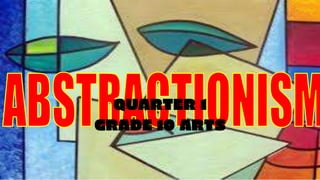
ABSTRACTIONISM
?
Abstract art looks at other non-
objective artistic elements of
shape, form, color, and line.
The main purpose of
abstraction is to tell a story and
not imagination.
Abstractionism emerged at the
same time as the expressionist
movement in the 21st Century.
The primary characteristic of
abstract art is that it has no
conspicuous subject.
Questions to Ponder:
1.Based from our activity earlier,
how will you describe
“Abstractionism”?
2.What are the styles that you
know on Abstractionism?
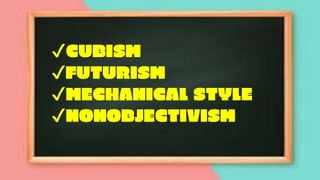
✔CUBISM
✔FUTURISM
✔MECHANICAL STYLE
✔NONOBJECTIVISM
“IDENTIFYING THE STYLES OF THE
PAINTING”
• With the METACARD given
(labeled with abstractionism
styles), identify the following
paintings (puzzle) on the board on
what art style under
ABSTRACTIONISM they belong to.
• You have 20 seconds to answer.
Once timer has done, no POINT.
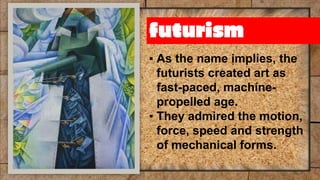
futurism
▪ As the name implies, the
futurists created art as
fast-paced, machine-
propelled age.
▪ They admired the motion,
force, speed and strength
of mechanical forms.
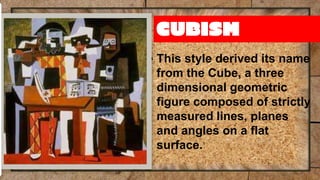
CUBISM
▪ This style derived its name
from the Cube, a three
dimensional geometric
figure composed of strictly
measured lines, planes
and angles on a flat
surface.
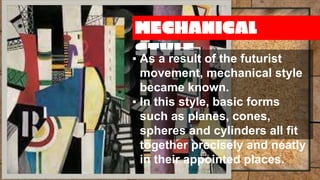
MECHANICAL
STYLE
▪ As a result of the futurist
movement, mechanical style
became known.
▪ In this style, basic forms
such as planes, cones,
spheres and cylinders all fit
together precisely and neatly
in their appointed places.
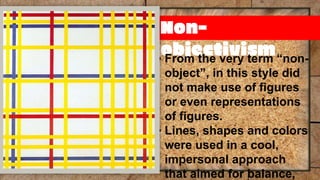
Non-
objectivism
▪ From the very term “non-
object”, in this style did
not make use of figures
or even representations
of figures.
▪ Lines, shapes and colors
were used in a cool,
impersonal approach
that aimed for balance,
FAMOUS
FILIPINO
ABSTRACTIONIS
T
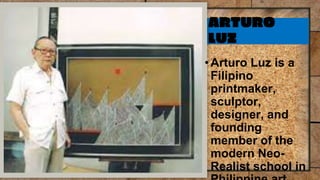
ARTURO
LUZ
•Arturo Luz is a
Filipino
printmaker,
sculptor,
designer, and
founding
member of the
modern Neo-
Realist school in
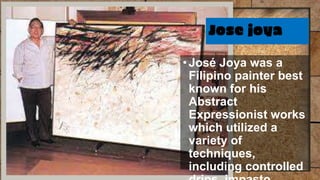
Jose joya
•José Joya was a
Filipino painter best
known for his
Abstract
Expressionist works
which utilized a
variety of
techniques,
including controlled
1. While the GCASH Dance Challenge is playing, I
will ask question(s) which will be flashed on
screen.
2. Whoever who is picked (from class card), he/she
will be the one to answer the question. “No
coaching”(because question can be answered by
the others to give chance)- coach will no longer
be part of the challenge.
3. While answering, he/she will do the GCASH
Dance Challenge Step.
4. After the class, the teacher will ask the number of
the winner to send the prizes.
From the very term “non-
object” this style did not
make use of figures or even
representations of figures.
This style uses basic forms
such as planes, cones,
spheres and cylinders all fit
together precisely and
neatly in their appointed
places.
This style expresses feeling
of dynamism and energy
where human figures can
shown both frontal and side
angles at once.
A Filipino abstract
expressionist which utilized
a variety of techniques,
including controlled drips,
impasto strokes, and
transparent layering.
ASSIGNMENT
“Differentiate
EXPRESSIONISM
and
ABSTRACTIONISM”
1. Create a Cubist Artwork.
(REVIEW the description of
Picasso’s cubist style)
2. It can be a painting or
collage.
3. Give your cubist artwork a
title.
4. CRITERIA: Creativity,

Q1-ARTS10-ABSTRACTIONISM.pptx

  • 1.
  • 2.
    “PICTURE- PUZZLE” 1.The Class willbe divided into 4. 2.Each group will solve a picture-puzzle in 3 minutes. 3.The solved puzzle should be posted on the board using the Adhesive Tape. 4.The group that first to finish posting the solved puzzle wins a “MAKARIT KA”
  • 3.
    Learning competencies: ∙ identifiesdistinct characteristics of arts from the various art movements (A10EL-Ia-2) ∙ identifies representative artists and Filipino counterparts from the various art movements o (A10EL-Ia-3) ∙ reflects on and derive the mood, idea, or message from selected artworks (A10PL-Ih-1)
  • 4.
  • 6.
    Abstract art looksat other non- objective artistic elements of shape, form, color, and line.
  • 7.
    The main purposeof abstraction is to tell a story and not imagination.
  • 8.
    Abstractionism emerged atthe same time as the expressionist movement in the 21st Century.
  • 9.
    The primary characteristicof abstract art is that it has no conspicuous subject.
  • 10.
    Questions to Ponder: 1.Basedfrom our activity earlier, how will you describe “Abstractionism”? 2.What are the styles that you know on Abstractionism?
  • 11.
  • 12.
    “IDENTIFYING THE STYLESOF THE PAINTING” • With the METACARD given (labeled with abstractionism styles), identify the following paintings (puzzle) on the board on what art style under ABSTRACTIONISM they belong to. • You have 20 seconds to answer. Once timer has done, no POINT.
  • 13.
    futurism ▪ As thename implies, the futurists created art as fast-paced, machine- propelled age. ▪ They admired the motion, force, speed and strength of mechanical forms.
  • 14.
    CUBISM ▪ This stylederived its name from the Cube, a three dimensional geometric figure composed of strictly measured lines, planes and angles on a flat surface.
  • 15.
    MECHANICAL STYLE ▪ As aresult of the futurist movement, mechanical style became known. ▪ In this style, basic forms such as planes, cones, spheres and cylinders all fit together precisely and neatly in their appointed places.
  • 16.
    Non- objectivism ▪ From thevery term “non- object”, in this style did not make use of figures or even representations of figures. ▪ Lines, shapes and colors were used in a cool, impersonal approach that aimed for balance,
  • 17.
  • 18.
    ARTURO LUZ •Arturo Luz isa Filipino printmaker, sculptor, designer, and founding member of the modern Neo- Realist school in
  • 19.
    Jose joya •José Joyawas a Filipino painter best known for his Abstract Expressionist works which utilized a variety of techniques, including controlled
  • 21.
    1. While theGCASH Dance Challenge is playing, I will ask question(s) which will be flashed on screen. 2. Whoever who is picked (from class card), he/she will be the one to answer the question. “No coaching”(because question can be answered by the others to give chance)- coach will no longer be part of the challenge. 3. While answering, he/she will do the GCASH Dance Challenge Step. 4. After the class, the teacher will ask the number of the winner to send the prizes.
  • 22.
    From the veryterm “non- object” this style did not make use of figures or even representations of figures.
  • 23.
    This style usesbasic forms such as planes, cones, spheres and cylinders all fit together precisely and neatly in their appointed places.
  • 24.
    This style expressesfeeling of dynamism and energy where human figures can shown both frontal and side angles at once.
  • 25.
    A Filipino abstract expressionistwhich utilized a variety of techniques, including controlled drips, impasto strokes, and transparent layering.
  • 26.
  • 27.
  • 28.
    1. Create aCubist Artwork. (REVIEW the description of Picasso’s cubist style) 2. It can be a painting or collage. 3. Give your cubist artwork a title. 4. CRITERIA: Creativity,