PHT Insights — First Quarter 2009
                                                Improving Trial Efficiencies: Making the Business Case for ePRO


How to Quantify ePRO ROI:                                                      The Four Types of Paper Patients
What Does Paper Cost?
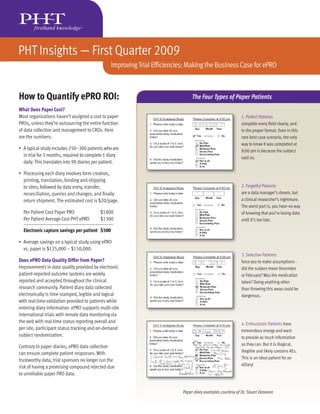
Most organizations haven’t assigned a cost to paper                                                        1. Perfect Patients
PROs, unless they’re outsourcing the entire function                                                       complete every field clearly, and
of data collection and management to CROs. Here                                                            in the proper format. Even in this
are the numbers:                                                                                           rare best case scenario, the only
                                                                                                           way to know it was completed at
• A typical study includes 250–300 patients who are                                                        8:00 pm is because the subject
  in trial for 3 months, required to complete 1 diary                                                      said so.
  daily. This translates into 90 diaries per patient.

• Processing each diary involves form creation,
  printing, translation, binding and shipping
  to sites; followed by data entry, transfer,                                                              2. Forgetful Patients
  reconciliation, queries and changes; and finally                                                          are a data manager’s dream, but
  return shipment. The estimated cost is $20/page.                                                         a clinical researcher’s nightmare.
                                                                                                           The worst part is, you have no way
  Per Patient Cost Paper PRO               $1800                                                           of knowing that you’re losing data
  Per Patient Average Cost PHT ePRO        $1300                                                           until it’s too late.

  Electronic capture savings per patient $500

• Average savings on a typical study using ePRO
  vs. paper is $125,000 – $150,000.
                                                                                                           3. Selective Patients
Does ePRO Data Quality Differ from Paper?                                                                  force you to make assumptions -
Improvements in data quality provided by electronic                                                        did the subject mean December
patient-reported outcome systems are widely                                                                or February? Was the medication
reported and accepted throughout the clinical                                                              taken? Doing anything other
research community. Patient diary data collected                                                           than throwing this away could be
electronically is time-stamped, legible and logical                                                        dangerous.
with real-time validation provided to patients while
entering diary information. ePRO supports multi-site
international trials with remote data monitoring via
the web with real-time status reporting overall and                                                        4. Enthusiastic Patients have
per site, participant status tracking and on-demand                                                        tremendous energy and want
subject randomization.                                                                                     to provide as much information
                                                                                                           as they can. But it is illogical,
Contrary to paper diaries, ePRO data collection
                                                                                                           illegible and likely contains AEs.
can ensure complete patient responses. With
                                                                                                           This is an ideal patient for an
trustworthy data, trial sponsors no longer run the
                                                                                                           eDiary!
risk of having a promising compound rejected due
to unreliable paper PRO data.


                                                                          Paper diary examples courtesy of Dr. Stuart Donovan
2


    Enhanced data integrity further enables              What is the FDA position on ePRO?                                                   Which Trials are Best Suited for ePRO?
    1. Attributable, legible, contemporaneous,           The FDA has reviewed ePRO vs. PRO, and cites                                        Trials with patient-reported endpoints–
    original and accurate (ALCOA) patient data that      unsupervised data entry as a major drawback                                         whether in home or in medical offices–report
    is complete and time-stamped through the use         to paper reported outcomes. PRO instruments                                         rapid gains in efficiencies and data integrity
    of alarms, branching logic and edit checks;          [paper] that require patients to rely on memory,                                    with ePRO. Trials within these therapeutic areas
    2. Reduced data variance for improved quality        especially if they must recall over a period of time,                               (TAs) have been early adopters of ePRO:
    of study results and reduced number of               or to average their response over a period of
                                                                                                                                             • Neurology/CNS
    patients to show efficacy;                            time, may threaten the accuracy of the PRO data.
                                                                                                                                             • Respiratory
    3. Real time access to diary data between            According to the FDA, “If a patient diary or                                        • Behavior Modification
    visits for enhanced safety and compliance            some other form of unsupervised data entry is                                       • Gastrointestinal
    monitoring;                                          used, the FDA plans to review the protocol to                                       • Genitourinary
                                                         determine what measures are taken to ensure                                         • Immunology
    4. Adaptive trial designs with pre-programmed
                                                         that patients make entries according to the
    adaptations and reduced standard deviation for                                                                                           PHT has also demonstrated ePRO efficiencies
                                                         study design and not, for example, just before a
    more conclusive planned interim analyses; and                                                                                            within
                                                         clinic visit when their reports will be collected.”1
    5. Libraries of experience and metrics with                                                                                              • Oncology
    data including compliance and data variance/         The European Medicines Agency (EMEA) has
                                                                                                                                             • Endocrine and metabolic disorders
    standard deviations for specific indications.         also commented on ePRO vs. PRO, providing
                                                                                                                                             • Dermatology
                                                         this Guidance on endpoints in asthma: “If home
    How Does ePRO Enable Faster Trials?                                                                                                      • Ears, nose, throat, eye and teeth
                                                         recording equipment is used, reproducibility is
    Cycle times and therefore trial times can be                                                                                             • Musculo-skeletal
                                                         particularly important and an electronic diary
    reduced with electronic patient-reported             record should be considered to validate the                                         Trials across TAs where patient-reported data
    outcomes. Electronic data capture eliminates         timing of measurements.”2 ; and on efficacy for                                      is sensitive in nature, where it’s critical to
    manual data entry times and other data point         steroid contraceptive, “The separate calculation                                    track adverse symptoms between visits such
    changes. Final data analysis sets can be             of the Pearl Index for method failure requires                                      as worsening symptoms, rescue medications,
    provided within days after a trial’s conclusion.     reliable methods for recording of compliance                                        specific events such as suicide ideation also
    By reducing data variance, fewer patients            (e.g. electronic patient diaries) not to include                                    received increased ROI when utilizing ePRO.
    are required especially in Phase II trials.          non-compliers in the denominator.”3                                                 Summary
    Scientific outcomes are more conclusive,                                                                                                  Sponsors, trial managers and health outcome
    and greater power of study is achieved by                                                                                                directors continue to obtain greater degrees
    reduced standard deviation.                                                                                                              of data quality, program efficiency and patient
    ePRO does not eliminate the need for accurate                                                                                            safety with ePRO. For more information, contact
    data review and monitoring, but it does enable                                                                                           PHT at 1.877.360.2901.
    trial sponsors to improve power of study with
    smaller samples, and to reach no-go decisions        1) Lines 334-337, ‘Guidance for Industry. Patient-Reported Outcome Measures: Use in Medical Product Development to Support Labeling Claims. DRAFT GUIDANCE.’
                                                         U.S. Department of Health and Human Services, Food and Drug Administration, Center for Drug Evaluation and Research (CDER), Center for Biologics Evaluation and
    much faster than they could otherwise.               Research (CBER), Center for Devices and Radiological Health (CDRH). February 2006 2) Section 8.1, ‘Note for Guidance on the Clinical Investigation of Medicinal
                                                         Products in the Treatment of Asthma’, The European Agency for the Evaluation of Medicinal Products, Evaluation of Medicines for Human Use, November 2002. 3)
                                                         Section 3.1, ‘Note for Guidance on Clinical Investigation of Steroid Contraceptives in Women, The European Agency for the Evaluation of Medicinal Products, Evaluation
                                                         of Medicines for Human Use, February 2000.


    Case Study: Novartis
    The FDA approved a Novartis drug for chronic                                                                        Once the study was already underway, the FDA surprised
    constipation for use with women, but indicated more                   Study power was                               Novartis by deciding to approve the drug for men without
    data would be needed for men. Therefore, Novartis                     reached with less                             further data. Novartis stopped the trial, but allowed the 322
    planned another study and estimated a sample size                                                                   enrolled subjects to complete treatment. To the amazement
                                                                          than one-third
    of 1,026 male subjects would be required to prove                                                                   of the clinical team, study power was reached with 69%
    efficacy based on traditional paper variance statistics.               the planned-                                  fewer subjects - representing less than one-third the planned
    Subsequently, the pharmaceutical company elected to                   sample size!                                  sample size!
    use PHT’s LogPad® System instead of paper.
3


Case Study: Merck Research Laboratories

                                                                                                                         Merck initiated the first randomized trial to evaluate the relative
                     MORNING
                                 QUESTIONA
                                              IRE (Continued
                                                                                                                         capacities of paper diaries and electronic patient diaries
                     8. How would                               )
                                    you describ
                                                e the quality
                                                              of your sleep
                         1= Excellent
                                      ❑ 2= Good
                                                    ❑ 3= Fair ❑
                                                                            last night? (ch
                                                                    4= Poor ❑
                                                                                            eck only one
                                                                                                         box.)           (Figure 1) to prove efficacy. 101 patients were randomized to two
                                                                                                                         arms based on data capture method (paper or LogPad) and treated
                                                                                                                         with an approved drug for insomnia. The study examined primary
                                                                                                                         endpoint data of change in minutes of sleep time and compared
                                                                                                                         results from the arms in many categories.
            Figure 1: A study question on the LogPad and paper diary


            Figure 2: Paper Distribution                                                                Figure 3: LogPad Distribution                      Figure 4: Distribution Overlay


Data Analysis                                                                                                           Results
Data captured from both arms revealed statistically equivalent                                                          Analysis performed by Merck showed a 35% lower standard deviation
means (118 minutes from paper, 109 minutes from the LogPad), but                                                        for LogPad data as compared to paper. Merck calculated that this
the ranges were different. As shown in Figure 2, the distribution of                                                    reduced variance would have enabled them to reach study power with
responses on paper varied widely from -20 to 380. This means one                                                        56% fewer patients–saving an estimated $340,000 (assuming $6,000
subject claimed to have average 20 minutes less sleep per night, while                                                  per patient).
another reported an additional 6 hours. Further, the distribution tends                                                 In addition, Merck had to process three times more data changes
to cluster around 30-, 60- and 90-minute intervals. This suggests                                                       and notification forms to clarify paper data, and incurred 58 hours
evidence of recall bias, as responses are more general and less precise                                                 of data entry compared to zero for the LogPad arm. Compliance was
when made after-the-fact.                                                                                               high in both arms (96% for paper, 92% for LogPad), but as discussed
Conversely, the LogPad distribution in Figure 3 is much tighter around                                                  earlier only ePRO compliance can be verified as opposed to purported
the mean and more Gaussian, with fewer and less extreme outliers.                                                       by subjects.
Meanwhile, continuous responses indicate more accurate data                                                             These findings were presented by Jay Pearson, Senior Director at Merck.
reporting. A visual inspection of Figure 4 shows the comparison
of variance.
Electronic Patient-Reported Outcome (ePRO) Solutions

Read About:
Banning Paper Diaries
Why Paper Diaries Should Be Banned in
Clinical Trials
Pharmaceutical Executive Europe, March, 2009

PHT author Valdo Arnera, MD, outlines specific
reasons why pharmaceutical and biotechnology
companies should replace paper diaries
with ePRO.
Read it online at: www.phtcorp.com.
                                                                                 PHT Electronic Patient-Reported Outcome
                                                                                 (ePRO) System Components
For more information:
                                                                                 LogPad
US Account Executives: 1.877.360.2910                                            SitePad®
                                                                                                                   PHT LogPad – The mobile
European Account Executives: 41.22.879.91.00                                     StudyWorks®                     Hand Held for home eDiaries
                                                                                 eSense™ Sensors
                                                                                 ePRO Designer
About PHT Corporation                                                            Study Archive
PHT is the global innovator in ePRO (electronic patient-reported
                                                                                 PROVision™ Scientific Services
outcome) systems that simplify clinical data management and
streamline eClinical trials. Since 1994, patient experiences                     Trial Success Program™ (TSP)
captured by PHT’s ePRO System have been used successfully                        PHT Support Center
in over 440 global trials by more than 100 biopharmaceutical                     Scientific Review and Validation
companies, resulting in at least 14 regulatory submissions                       Site Telecom Assessments
and 11 approvals. By capturing high-quality and time-stamped
                                                                                 Technology Transfer
assessments, trial sponsors are able to run smaller, safer and
more conclusive clinical research programs resulting in significant
R&D cost savings. For more information, review the educational
content and interactive PHT ePRO System demonstrations at                        “I believe the SitePad Tablet
                                                                                  is something that can
PHT’s award-winning site www.phtcorp.com.
                                                                                  help our entire industry,
                                                                                  and patients, as well,” says Joachim Löwin,
                                                                                  Clinical Information Science Leader, AstraZeneca.


PHT Corporation                                                 PHT Corporation Sàrl                                                   Insights Q1 2009
500 Rutherford Avenue                                           2, chemin Louis-Hubert                                                 www.phtcorp.com
Boston, MA 02129 USA                                            1213 Petit-Lancy, Geneva, Switzerland                                  Copyright © 2010 PHT Corporation

Toll-Free: 877.360.2901                                         Phone: 41.22.879.91.00                                                 v8.2010

How to Justify ePRO

  • 1.
    PHT Insights —First Quarter 2009 Improving Trial Efficiencies: Making the Business Case for ePRO How to Quantify ePRO ROI: The Four Types of Paper Patients What Does Paper Cost? Most organizations haven’t assigned a cost to paper 1. Perfect Patients PROs, unless they’re outsourcing the entire function complete every field clearly, and of data collection and management to CROs. Here in the proper format. Even in this are the numbers: rare best case scenario, the only way to know it was completed at • A typical study includes 250–300 patients who are 8:00 pm is because the subject in trial for 3 months, required to complete 1 diary said so. daily. This translates into 90 diaries per patient. • Processing each diary involves form creation, printing, translation, binding and shipping to sites; followed by data entry, transfer, 2. Forgetful Patients reconciliation, queries and changes; and finally are a data manager’s dream, but return shipment. The estimated cost is $20/page. a clinical researcher’s nightmare. The worst part is, you have no way Per Patient Cost Paper PRO $1800 of knowing that you’re losing data Per Patient Average Cost PHT ePRO $1300 until it’s too late. Electronic capture savings per patient $500 • Average savings on a typical study using ePRO vs. paper is $125,000 – $150,000. 3. Selective Patients Does ePRO Data Quality Differ from Paper? force you to make assumptions - Improvements in data quality provided by electronic did the subject mean December patient-reported outcome systems are widely or February? Was the medication reported and accepted throughout the clinical taken? Doing anything other research community. Patient diary data collected than throwing this away could be electronically is time-stamped, legible and logical dangerous. with real-time validation provided to patients while entering diary information. ePRO supports multi-site international trials with remote data monitoring via the web with real-time status reporting overall and 4. Enthusiastic Patients have per site, participant status tracking and on-demand tremendous energy and want subject randomization. to provide as much information as they can. But it is illogical, Contrary to paper diaries, ePRO data collection illegible and likely contains AEs. can ensure complete patient responses. With This is an ideal patient for an trustworthy data, trial sponsors no longer run the eDiary! risk of having a promising compound rejected due to unreliable paper PRO data. Paper diary examples courtesy of Dr. Stuart Donovan
  • 2.
    2 Enhanced data integrity further enables What is the FDA position on ePRO? Which Trials are Best Suited for ePRO? 1. Attributable, legible, contemporaneous, The FDA has reviewed ePRO vs. PRO, and cites Trials with patient-reported endpoints– original and accurate (ALCOA) patient data that unsupervised data entry as a major drawback whether in home or in medical offices–report is complete and time-stamped through the use to paper reported outcomes. PRO instruments rapid gains in efficiencies and data integrity of alarms, branching logic and edit checks; [paper] that require patients to rely on memory, with ePRO. Trials within these therapeutic areas 2. Reduced data variance for improved quality especially if they must recall over a period of time, (TAs) have been early adopters of ePRO: of study results and reduced number of or to average their response over a period of • Neurology/CNS patients to show efficacy; time, may threaten the accuracy of the PRO data. • Respiratory 3. Real time access to diary data between According to the FDA, “If a patient diary or • Behavior Modification visits for enhanced safety and compliance some other form of unsupervised data entry is • Gastrointestinal monitoring; used, the FDA plans to review the protocol to • Genitourinary determine what measures are taken to ensure • Immunology 4. Adaptive trial designs with pre-programmed that patients make entries according to the adaptations and reduced standard deviation for PHT has also demonstrated ePRO efficiencies study design and not, for example, just before a more conclusive planned interim analyses; and within clinic visit when their reports will be collected.”1 5. Libraries of experience and metrics with • Oncology data including compliance and data variance/ The European Medicines Agency (EMEA) has • Endocrine and metabolic disorders standard deviations for specific indications. also commented on ePRO vs. PRO, providing • Dermatology this Guidance on endpoints in asthma: “If home How Does ePRO Enable Faster Trials? • Ears, nose, throat, eye and teeth recording equipment is used, reproducibility is Cycle times and therefore trial times can be • Musculo-skeletal particularly important and an electronic diary reduced with electronic patient-reported record should be considered to validate the Trials across TAs where patient-reported data outcomes. Electronic data capture eliminates timing of measurements.”2 ; and on efficacy for is sensitive in nature, where it’s critical to manual data entry times and other data point steroid contraceptive, “The separate calculation track adverse symptoms between visits such changes. Final data analysis sets can be of the Pearl Index for method failure requires as worsening symptoms, rescue medications, provided within days after a trial’s conclusion. reliable methods for recording of compliance specific events such as suicide ideation also By reducing data variance, fewer patients (e.g. electronic patient diaries) not to include received increased ROI when utilizing ePRO. are required especially in Phase II trials. non-compliers in the denominator.”3 Summary Scientific outcomes are more conclusive, Sponsors, trial managers and health outcome and greater power of study is achieved by directors continue to obtain greater degrees reduced standard deviation. of data quality, program efficiency and patient ePRO does not eliminate the need for accurate safety with ePRO. For more information, contact data review and monitoring, but it does enable PHT at 1.877.360.2901. trial sponsors to improve power of study with smaller samples, and to reach no-go decisions 1) Lines 334-337, ‘Guidance for Industry. Patient-Reported Outcome Measures: Use in Medical Product Development to Support Labeling Claims. DRAFT GUIDANCE.’ U.S. Department of Health and Human Services, Food and Drug Administration, Center for Drug Evaluation and Research (CDER), Center for Biologics Evaluation and much faster than they could otherwise. Research (CBER), Center for Devices and Radiological Health (CDRH). February 2006 2) Section 8.1, ‘Note for Guidance on the Clinical Investigation of Medicinal Products in the Treatment of Asthma’, The European Agency for the Evaluation of Medicinal Products, Evaluation of Medicines for Human Use, November 2002. 3) Section 3.1, ‘Note for Guidance on Clinical Investigation of Steroid Contraceptives in Women, The European Agency for the Evaluation of Medicinal Products, Evaluation of Medicines for Human Use, February 2000. Case Study: Novartis The FDA approved a Novartis drug for chronic Once the study was already underway, the FDA surprised constipation for use with women, but indicated more Study power was Novartis by deciding to approve the drug for men without data would be needed for men. Therefore, Novartis reached with less further data. Novartis stopped the trial, but allowed the 322 planned another study and estimated a sample size enrolled subjects to complete treatment. To the amazement than one-third of 1,026 male subjects would be required to prove of the clinical team, study power was reached with 69% efficacy based on traditional paper variance statistics. the planned- fewer subjects - representing less than one-third the planned Subsequently, the pharmaceutical company elected to sample size! sample size! use PHT’s LogPad® System instead of paper.
  • 3.
    3 Case Study: MerckResearch Laboratories Merck initiated the first randomized trial to evaluate the relative MORNING QUESTIONA IRE (Continued capacities of paper diaries and electronic patient diaries 8. How would ) you describ e the quality of your sleep 1= Excellent ❑ 2= Good ❑ 3= Fair ❑ last night? (ch 4= Poor ❑ eck only one box.) (Figure 1) to prove efficacy. 101 patients were randomized to two arms based on data capture method (paper or LogPad) and treated with an approved drug for insomnia. The study examined primary endpoint data of change in minutes of sleep time and compared results from the arms in many categories. Figure 1: A study question on the LogPad and paper diary Figure 2: Paper Distribution Figure 3: LogPad Distribution Figure 4: Distribution Overlay Data Analysis Results Data captured from both arms revealed statistically equivalent Analysis performed by Merck showed a 35% lower standard deviation means (118 minutes from paper, 109 minutes from the LogPad), but for LogPad data as compared to paper. Merck calculated that this the ranges were different. As shown in Figure 2, the distribution of reduced variance would have enabled them to reach study power with responses on paper varied widely from -20 to 380. This means one 56% fewer patients–saving an estimated $340,000 (assuming $6,000 subject claimed to have average 20 minutes less sleep per night, while per patient). another reported an additional 6 hours. Further, the distribution tends In addition, Merck had to process three times more data changes to cluster around 30-, 60- and 90-minute intervals. This suggests and notification forms to clarify paper data, and incurred 58 hours evidence of recall bias, as responses are more general and less precise of data entry compared to zero for the LogPad arm. Compliance was when made after-the-fact. high in both arms (96% for paper, 92% for LogPad), but as discussed Conversely, the LogPad distribution in Figure 3 is much tighter around earlier only ePRO compliance can be verified as opposed to purported the mean and more Gaussian, with fewer and less extreme outliers. by subjects. Meanwhile, continuous responses indicate more accurate data These findings were presented by Jay Pearson, Senior Director at Merck. reporting. A visual inspection of Figure 4 shows the comparison of variance.
  • 4.
    Electronic Patient-Reported Outcome(ePRO) Solutions Read About: Banning Paper Diaries Why Paper Diaries Should Be Banned in Clinical Trials Pharmaceutical Executive Europe, March, 2009 PHT author Valdo Arnera, MD, outlines specific reasons why pharmaceutical and biotechnology companies should replace paper diaries with ePRO. Read it online at: www.phtcorp.com. PHT Electronic Patient-Reported Outcome (ePRO) System Components For more information: LogPad US Account Executives: 1.877.360.2910 SitePad® PHT LogPad – The mobile European Account Executives: 41.22.879.91.00 StudyWorks® Hand Held for home eDiaries eSense™ Sensors ePRO Designer About PHT Corporation Study Archive PHT is the global innovator in ePRO (electronic patient-reported PROVision™ Scientific Services outcome) systems that simplify clinical data management and streamline eClinical trials. Since 1994, patient experiences Trial Success Program™ (TSP) captured by PHT’s ePRO System have been used successfully PHT Support Center in over 440 global trials by more than 100 biopharmaceutical Scientific Review and Validation companies, resulting in at least 14 regulatory submissions Site Telecom Assessments and 11 approvals. By capturing high-quality and time-stamped Technology Transfer assessments, trial sponsors are able to run smaller, safer and more conclusive clinical research programs resulting in significant R&D cost savings. For more information, review the educational content and interactive PHT ePRO System demonstrations at “I believe the SitePad Tablet is something that can PHT’s award-winning site www.phtcorp.com. help our entire industry, and patients, as well,” says Joachim Löwin, Clinical Information Science Leader, AstraZeneca. PHT Corporation PHT Corporation Sàrl Insights Q1 2009 500 Rutherford Avenue 2, chemin Louis-Hubert www.phtcorp.com Boston, MA 02129 USA 1213 Petit-Lancy, Geneva, Switzerland Copyright © 2010 PHT Corporation Toll-Free: 877.360.2901 Phone: 41.22.879.91.00 v8.2010