INTRODUCTION
TO
PYTHON
Dr. S. SELVAKANMANI,
ASSOCIATE PROFESSOR,
DEPARTMENT OF CSE,
VELAMMAL I TECH
AGENDA
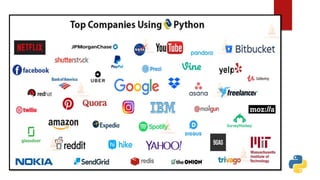
 Companies using Python
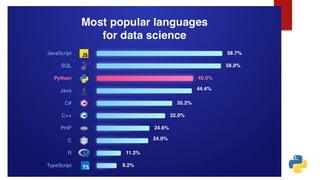
 Top languages for Data Science
 Introduction to Python & Features
 Installation of Python
 Working in IDLE
 Working in Jupyter Notebook
 Interactive Vs Script Mode
PYTHON - INTRODUCTION
 Developed in late 1980 by Guido Van Rossum at National
Research Institute for Mathematics and Computer Science
in Netherlands.
Features of Python:
 Simple – It is simple to learn, read and write
 High level language – Program codes contains easy to
read syntax that is later converted into a low level language
(i.e binary codes)
PYTHON – INTRODUCTION Contd..
 Open Source – It is freely available and the source code is
available for free.
 Cross Platform/Portable - Python can run equally on
different platforms such as Windows, Linux, Unix, and
Macintosh etc.
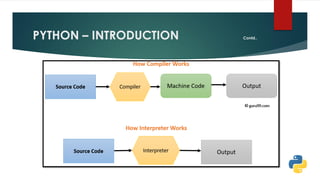
 Interpreted Language – Python program written will be
converted into intermediate language which is again
translated into native or machine language for execution.
PYTHON – INTRODUCTION Contd..
 Interpreter translates just one statement of the program at
a time into machine code.
Vs
 Compiler scans the entire program and translates the
whole of it into machine code at once.
PYTHON – INTRODUCTION Contd..
 Case – Sensitive Language – Difference between
Uppercase and lowercase letters. i.e area, Area.
 Object Oriented Language - Python structures a
program by bundling related properties and behaviors into
individual objects.
 Automatic Type Inference – Doesn‟t need to define the type
of the data during its declaration.
PYTHON – INTRODUCTION Contd..
 Scripting language – Uses an Interpreter to translate its
source code. The interpreter reads and executes each line of
code one at a time (like a “script” in a play/audition)
 No worry about memory allocation
 Interface with existing programming language –
Comes with a large standard library that supports many
common tasks.
 No Semicolon at the end of the statement
PYTHON – INSTALLATION
 Downloads available in www.python.org (Known as Cpython
Installation and it comes with Python Interpreter , Python IDLE
and PIP ( Package Installer )
 Other Python distributions available in Anaconda Python
distribution (https://www.anaconda.com/distribution/),
comes with preloaded packages such as NumPy , SciPy, Pandas
etc .
 Other Popular downloads available in form of Spyder IDE ,
PyCharm IDE etc.. (https://www.guru99.com/python-ide-code-
editor.html)
PYTHON – WORKING IN IDLE
 IDLE – Integrated Development and Learning Environment
 Two modes of working : (i) Interactive mode and (ii) Script
mode
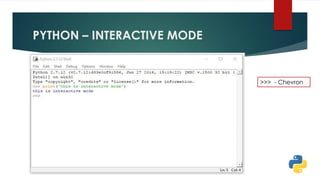
 Interactive Mode : Writing & Executing one command at
a time. ( Click Start – All Programs – Python x.x –IDLE )
 Type the commands in the prompt (>>>) and hit Enter to
see the output.
PYTHON – INTERACTIVE MODE
>>> - Chevron
PYTHON – WORKING IN IDLE
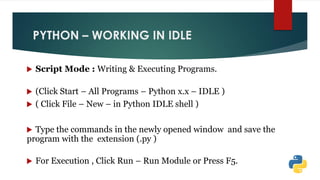
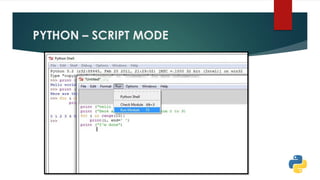
 Script Mode : Writing & Executing Programs.
 (Click Start – All Programs – Python x.x – IDLE )
 ( Click File – New – in Python IDLE shell )
 Type the commands in the newly opened window and save the
program with the extension (.py )
 For Execution , Click Run – Run Module or Press F5.
PYTHON – SCRIPT MODE
PYTHON – FEATURES OF IDLE
 Multi-window text editor with syntax highlighting.
 Auto completion with smart indentation.
 Python shell to display output with syntax highlighting.
PYTHON – WORKING IN JUPYTER NOTEBOOK
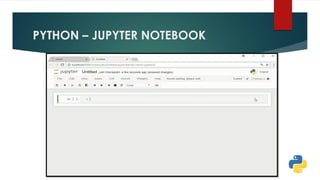
 Launch Anaconda Navigator from Start – All Programs –
Anaconda –Anaconda Navigator .
 Click on Launch JUPYTER Notebook (Opens in Web
Browser)
 Select Python3 by clicking on the drop down arrow mark of
New Option placed on the right hand side of the Dashboard.
 JUPYTER = JUlia, PYThon and R
PYTHON – JUPYTER NOTEBOOK
PYTHON – WORKING IN JUPYTER NOTEBOOK
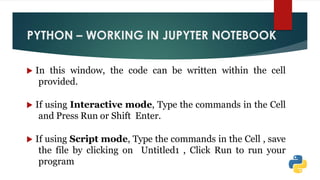
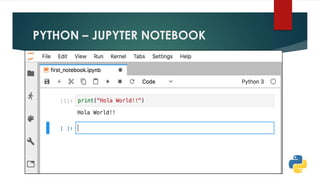
 In this window, the code can be written within the cell
provided.
 If using Interactive mode, Type the commands in the Cell
and Press Run or Shift Enter.
 If using Script mode, Type the commands in the Cell , save
the file by clicking on Untitled1 , Click Run to run your
program
PYTHON – JUPYTER NOTEBOOK
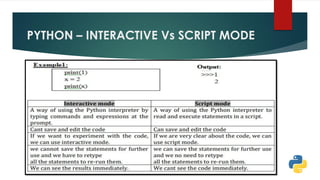
PYTHON – INTERACTIVE Vs SCRIPT MODE
PYTHON – VIRTUAL ENVIRONMENT
https://repl.it
colab.research.google.com
https://www.codechef.com/ide
https://pynative.com/online-python-code-
editor-to-execute-python-code/
https://www.jdoodle.com/python3-
programming-online/
PYTHON – SYNTAX
 Keywords – Set of predefined words. A prescribed rule of
usage for each keyword is called a syntax.
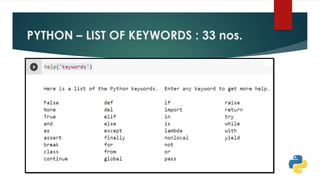
 Python 3.x interpreter has 33 keywords defined in it.
 Since they have a predefined meaning attached, they cannot
be used for any other purpose.
 To know the list of python keywords:
>>>help('keywords')
PYTHON – LIST OF KEYWORDS : 33 nos.
PYTHON – SYNTAX
 Apart from Keywords, Python program can have variables,
functions, classes, modules, packages etc.
 Identifier is the name given to these programming elements.
 An identifier should start with either an alphabet letter (lower or
upper case) or an underscore (_).
 After that, more than one alphabet letters (a-z or A-Z), digits (0-
9) or underscores may be used to form an identifier.
 No other characters are allowed such as @,#,$, etc
 Identifiers are case – sensitive.
PYTHON – SYNTAX
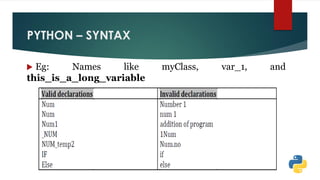
 Eg: Names like myClass, var_1, and
this_is_a_long_variable
PYTHON – STATEMENT
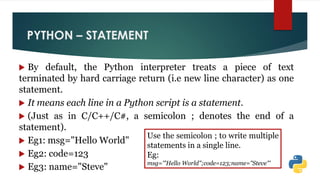
 By default, the Python interpreter treats a piece of text
terminated by hard carriage return (i.e new line character) as one
statement.
 It means each line in a Python script is a statement.
 (Just as in C/C++/C#, a semicolon ; denotes the end of a
statement).
 Eg1: msg="Hello World"
 Eg2: code=123
 Eg3: name="Steve"
Use the semicolon ; to write multiple
statements in a single line.
Eg:
msg='"Hello World";code=123;name="Steve"'
PYTHON – STATEMENT
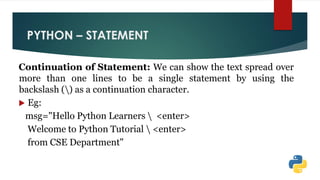
Continuation of Statement: We can show the text spread over
more than one lines to be a single statement by using the
backslash () as a continuation character.
 Eg:
msg="Hello Python Learners  <enter>
Welcome to Python Tutorial  <enter>
from CSE Department"
PYTHON – INDENTS
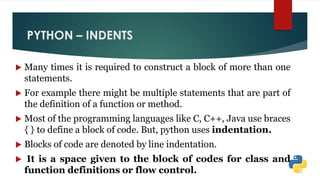
 Many times it is required to construct a block of more than one
statements.
 For example there might be multiple statements that are part of
the definition of a function or method.
 Most of the programming languages like C, C++, Java use braces
{ } to define a block of code. But, python uses indentation.
 Blocks of code are denoted by line indentation.
 It is a space given to the block of codes for class and
function definitions or flow control.
PYTHON – INDENTS
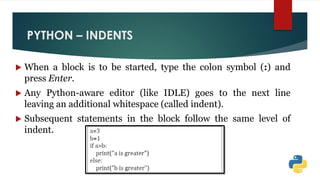
 When a block is to be started, type the colon symbol (:) and
press Enter.
 Any Python-aware editor (like IDLE) goes to the next line
leaving an additional whitespace (called indent).
 Subsequent statements in the block follow the same level of
indent.
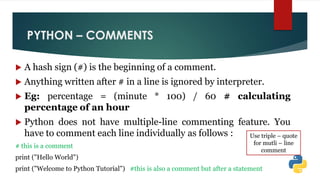
PYTHON – COMMENTS
 A hash sign (#) is the beginning of a comment.
 Anything written after # in a line is ignored by interpreter.
 Eg: percentage = (minute * 100) / 60 # calculating
percentage of an hour
 Python does not have multiple-line commenting feature. You
have to comment each line individually as follows :
# this is a comment
print ("Hello World")
print ("Welcome to Python Tutorial") #this is also a comment but after a statement
Use triple – quote
for mutli – line
comment
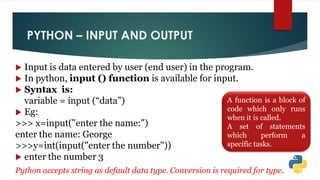
PYTHON – INPUT AND OUTPUT
 Input is data entered by user (end user) in the program.
 In python, input () function is available for input.
 Syntax is:
variable = input (“data”)
 Eg:
>>> x=input("enter the name:")
enter the name: George
>>>y=int(input("enter the number"))
 enter the number 3
Python accepts string as default data type. Conversion is required for type.
A function is a block of
code which only runs
when it is called.
A set of statements
which perform a
specific tasks.
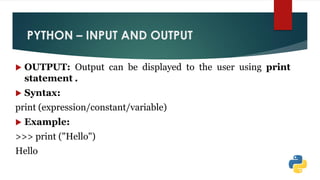
PYTHON – INPUT AND OUTPUT
 OUTPUT: Output can be displayed to the user using print
statement .
 Syntax:
print (expression/constant/variable)
 Example:
>>> print ("Hello")
Hello
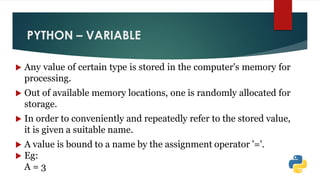
PYTHON – VARIABLE
 Any value of certain type is stored in the computer's memory for
processing.
 Out of available memory locations, one is randomly allocated for
storage.
 In order to conveniently and repeatedly refer to the stored value,
it is given a suitable name.
 A value is bound to a name by the assignment operator '='.
 Eg:
A = 3
PYTHON – VARIABLE
Eg:
A = 3
 A is the identifier and 3 is the value assigned to it.
 The same identifier can be used to refer to another value.
Eg:
A = „hello‟
 So, the value being referred can change (or vary), hence it is
called a variable.
 It is important to remember that a variable is a name given
to a value, and not to a memory location storing the value.
THANK
YOU

Python PPT1.pdf

  • 1.
    INTRODUCTION TO PYTHON Dr. S. SELVAKANMANI, ASSOCIATEPROFESSOR, DEPARTMENT OF CSE, VELAMMAL I TECH
  • 2.
    AGENDA  Companies usingPython  Top languages for Data Science  Introduction to Python & Features  Installation of Python  Working in IDLE  Working in Jupyter Notebook  Interactive Vs Script Mode
  • 5.
    PYTHON - INTRODUCTION Developed in late 1980 by Guido Van Rossum at National Research Institute for Mathematics and Computer Science in Netherlands. Features of Python:  Simple – It is simple to learn, read and write  High level language – Program codes contains easy to read syntax that is later converted into a low level language (i.e binary codes)
  • 6.
    PYTHON – INTRODUCTIONContd..  Open Source – It is freely available and the source code is available for free.  Cross Platform/Portable - Python can run equally on different platforms such as Windows, Linux, Unix, and Macintosh etc.  Interpreted Language – Python program written will be converted into intermediate language which is again translated into native or machine language for execution.
  • 7.
  • 8.
    PYTHON – INTRODUCTIONContd..  Interpreter translates just one statement of the program at a time into machine code. Vs  Compiler scans the entire program and translates the whole of it into machine code at once.
  • 9.
    PYTHON – INTRODUCTIONContd..  Case – Sensitive Language – Difference between Uppercase and lowercase letters. i.e area, Area.  Object Oriented Language - Python structures a program by bundling related properties and behaviors into individual objects.  Automatic Type Inference – Doesn‟t need to define the type of the data during its declaration.
  • 10.
    PYTHON – INTRODUCTIONContd..  Scripting language – Uses an Interpreter to translate its source code. The interpreter reads and executes each line of code one at a time (like a “script” in a play/audition)  No worry about memory allocation  Interface with existing programming language – Comes with a large standard library that supports many common tasks.  No Semicolon at the end of the statement
  • 11.
    PYTHON – INSTALLATION Downloads available in www.python.org (Known as Cpython Installation and it comes with Python Interpreter , Python IDLE and PIP ( Package Installer )  Other Python distributions available in Anaconda Python distribution (https://www.anaconda.com/distribution/), comes with preloaded packages such as NumPy , SciPy, Pandas etc .  Other Popular downloads available in form of Spyder IDE , PyCharm IDE etc.. (https://www.guru99.com/python-ide-code- editor.html)
  • 12.
    PYTHON – WORKINGIN IDLE  IDLE – Integrated Development and Learning Environment  Two modes of working : (i) Interactive mode and (ii) Script mode  Interactive Mode : Writing & Executing one command at a time. ( Click Start – All Programs – Python x.x –IDLE )  Type the commands in the prompt (>>>) and hit Enter to see the output.
  • 13.
    PYTHON – INTERACTIVEMODE >>> - Chevron
  • 14.
    PYTHON – WORKINGIN IDLE  Script Mode : Writing & Executing Programs.  (Click Start – All Programs – Python x.x – IDLE )  ( Click File – New – in Python IDLE shell )  Type the commands in the newly opened window and save the program with the extension (.py )  For Execution , Click Run – Run Module or Press F5.
  • 15.
  • 16.
    PYTHON – FEATURESOF IDLE  Multi-window text editor with syntax highlighting.  Auto completion with smart indentation.  Python shell to display output with syntax highlighting.
  • 17.
    PYTHON – WORKINGIN JUPYTER NOTEBOOK  Launch Anaconda Navigator from Start – All Programs – Anaconda –Anaconda Navigator .  Click on Launch JUPYTER Notebook (Opens in Web Browser)  Select Python3 by clicking on the drop down arrow mark of New Option placed on the right hand side of the Dashboard.  JUPYTER = JUlia, PYThon and R
  • 18.
  • 19.
    PYTHON – WORKINGIN JUPYTER NOTEBOOK  In this window, the code can be written within the cell provided.  If using Interactive mode, Type the commands in the Cell and Press Run or Shift Enter.  If using Script mode, Type the commands in the Cell , save the file by clicking on Untitled1 , Click Run to run your program
  • 20.
  • 21.
    PYTHON – INTERACTIVEVs SCRIPT MODE
  • 22.
    PYTHON – VIRTUALENVIRONMENT https://repl.it colab.research.google.com https://www.codechef.com/ide https://pynative.com/online-python-code- editor-to-execute-python-code/ https://www.jdoodle.com/python3- programming-online/
  • 23.
    PYTHON – SYNTAX Keywords – Set of predefined words. A prescribed rule of usage for each keyword is called a syntax.  Python 3.x interpreter has 33 keywords defined in it.  Since they have a predefined meaning attached, they cannot be used for any other purpose.  To know the list of python keywords: >>>help('keywords')
  • 24.
    PYTHON – LISTOF KEYWORDS : 33 nos.
  • 25.
    PYTHON – SYNTAX Apart from Keywords, Python program can have variables, functions, classes, modules, packages etc.  Identifier is the name given to these programming elements.  An identifier should start with either an alphabet letter (lower or upper case) or an underscore (_).  After that, more than one alphabet letters (a-z or A-Z), digits (0- 9) or underscores may be used to form an identifier.  No other characters are allowed such as @,#,$, etc  Identifiers are case – sensitive.
  • 26.
    PYTHON – SYNTAX Eg: Names like myClass, var_1, and this_is_a_long_variable
  • 27.
    PYTHON – STATEMENT By default, the Python interpreter treats a piece of text terminated by hard carriage return (i.e new line character) as one statement.  It means each line in a Python script is a statement.  (Just as in C/C++/C#, a semicolon ; denotes the end of a statement).  Eg1: msg="Hello World"  Eg2: code=123  Eg3: name="Steve" Use the semicolon ; to write multiple statements in a single line. Eg: msg='"Hello World";code=123;name="Steve"'
  • 28.
    PYTHON – STATEMENT Continuationof Statement: We can show the text spread over more than one lines to be a single statement by using the backslash () as a continuation character.  Eg: msg="Hello Python Learners <enter> Welcome to Python Tutorial <enter> from CSE Department"
  • 29.
    PYTHON – INDENTS Many times it is required to construct a block of more than one statements.  For example there might be multiple statements that are part of the definition of a function or method.  Most of the programming languages like C, C++, Java use braces { } to define a block of code. But, python uses indentation.  Blocks of code are denoted by line indentation.  It is a space given to the block of codes for class and function definitions or flow control.
  • 30.
    PYTHON – INDENTS When a block is to be started, type the colon symbol (:) and press Enter.  Any Python-aware editor (like IDLE) goes to the next line leaving an additional whitespace (called indent).  Subsequent statements in the block follow the same level of indent.
  • 31.
    PYTHON – COMMENTS A hash sign (#) is the beginning of a comment.  Anything written after # in a line is ignored by interpreter.  Eg: percentage = (minute * 100) / 60 # calculating percentage of an hour  Python does not have multiple-line commenting feature. You have to comment each line individually as follows : # this is a comment print ("Hello World") print ("Welcome to Python Tutorial") #this is also a comment but after a statement Use triple – quote for mutli – line comment
  • 32.
    PYTHON – INPUTAND OUTPUT  Input is data entered by user (end user) in the program.  In python, input () function is available for input.  Syntax is: variable = input (“data”)  Eg: >>> x=input("enter the name:") enter the name: George >>>y=int(input("enter the number"))  enter the number 3 Python accepts string as default data type. Conversion is required for type. A function is a block of code which only runs when it is called. A set of statements which perform a specific tasks.
  • 33.
    PYTHON – INPUTAND OUTPUT  OUTPUT: Output can be displayed to the user using print statement .  Syntax: print (expression/constant/variable)  Example: >>> print ("Hello") Hello
  • 34.
    PYTHON – VARIABLE Any value of certain type is stored in the computer's memory for processing.  Out of available memory locations, one is randomly allocated for storage.  In order to conveniently and repeatedly refer to the stored value, it is given a suitable name.  A value is bound to a name by the assignment operator '='.  Eg: A = 3
  • 35.
    PYTHON – VARIABLE Eg: A= 3  A is the identifier and 3 is the value assigned to it.  The same identifier can be used to refer to another value. Eg: A = „hello‟  So, the value being referred can change (or vary), hence it is called a variable.  It is important to remember that a variable is a name given to a value, and not to a memory location storing the value.
  • 36.