BUILT FOR THE SPEED OF BUSINESS
Python Powered Data
Science at Pivotal
How do we use the PyData stack in real
engagements?
Srivatsan Ramanujam, @being_bayesian
Ian Huston, @ianhuston
Data Scientists, Pivotal

© Copyright 2013 Pivotal. All rights reserved.

2
Agenda
Ÿ  Introduction to Pivotal
Ÿ  Pivotal Data Science Toolkit
Ÿ  PL/Python
Ÿ  In-database Machine Learning with MADlib
Ÿ  Live Demos
–  Topic Analysis and Sentiment Analysis Engine
–  Traffic Disruption Prediction

© Copyright 2013 Pivotal. All rights reserved.

3
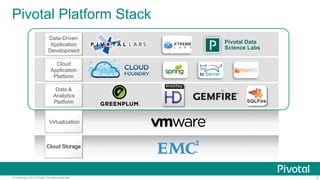
Pivotal Platform Stack
Data-Driven
Application
Development

Pivotal Data
Science Labs

Cloud
Application
Platform
Data &
Analytics
Platform

Virtualization

Cloud Storage

© Copyright 2013 Pivotal. All rights reserved.

4
What do our customers look like?
Ÿ  Large enterprises with lots of data collected
–  Work with 10s of TBs to PBs of data, structured & unstructured

Ÿ  Not able to get what they want out of their data
–  Old Legacy systems with high cost and no flexibility
–  Response times are too slow for interactive data analysis
–  Can only deal with small samples of data locally

Ÿ  They want to transform into data driven enterprises

© Copyright 2013 Pivotal. All rights reserved.

5
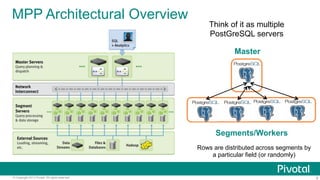
MPP Architectural Overview

Think of it as multiple
PostGreSQL servers
Master

Segments/Workers
Rows are distributed across segments by
a particular field (or randomly)

© Copyright 2013 Pivotal. All rights reserved.

6
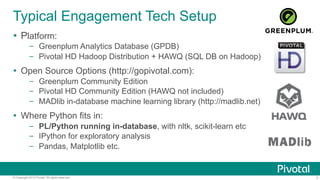
Typical Engagement Tech Setup
Ÿ  Platform:

–  Greenplum Analytics Database (GPDB)
–  Pivotal HD Hadoop Distribution + HAWQ (SQL DB on Hadoop)

Ÿ  Open Source Options (http://gopivotal.com):
–  Greenplum Community Edition
–  Pivotal HD Community Edition (HAWQ not included)
–  MADlib in-database machine learning library (http://madlib.net)

Ÿ  Where Python fits in:
–  PL/Python running in-database, with nltk, scikit-learn etc
–  IPython for exploratory analysis
–  Pandas, Matplotlib etc.

© Copyright 2013 Pivotal. All rights reserved.

7
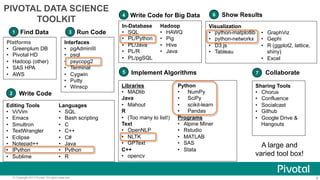
PIVOTAL DATA SCIENCE
TOOLKIT
1

Find Data

Platforms
•  Greenplum DB
•  Pivotal HD
•  Hadoop (other)
•  SAS HPA
•  AWS

2

3

Run Code

Interfaces
•  pgAdminIII
•  psql
•  psycopg2
•  Terminal
•  Cygwin
•  Putty
•  Winscp

Write Code

Editing Tools
•  Vi/Vim
•  Emacs
•  Smultron
•  TextWrangler
•  Eclipse
•  Notepad++
•  IPython
•  Sublime

Languages
•  SQL
•  Bash scripting
•  C
•  C++
•  C#
•  Java
•  Python
•  R

© Copyright 2013 Pivotal. All rights reserved.

4

Write Code for Big Data

In-Database
•  SQL
•  PL/Python
•  PL/Java
•  PL/R
•  PL/pgSQL
5

Hadoop
•  HAWQ
•  Pig
•  Hive
•  Java

6

Visualization
•  python-matplotlib
•  python-networkx
•  D3.js
•  Tableau

Implement Algorithms

Libraries
•  MADlib
Java
•  Mahout
R
•  (Too many to list!)
Text
•  OpenNLP
•  NLTK
•  GPText
C++
•  opencv

Show Results

Python
•  NumPy
•  SciPy
•  scikit-learn
•  Pandas
Programs
•  Alpine Miner
•  Rstudio
•  MATLAB
•  SAS
•  Stata

•  GraphViz
•  Gephi
•  R (ggplot2, lattice,
shiny)
•  Excel
7

Collaborate

Sharing Tools
•  Chorus
•  Confluence
•  Socialcast
•  Github
•  Google Drive &
Hangouts

A large and
varied tool box!

8
Data Parallelism
Ÿ  Little or no effort is required to break up the problem into a
number of parallel tasks, and there exists no dependency (or
communication) between those parallel tasks.
Ÿ  Examples:
–  Measure the height of each student in a classroom (explicitly
parallelizable by student)
–  MapReduce
–  map() function in Python

© Copyright 2013 Pivotal. All rights reserved.

9
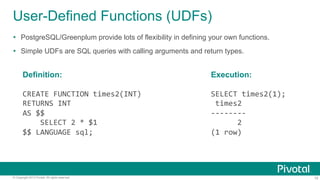
User-Defined Functions (UDFs)
Ÿ  PostgreSQL/Greenplum provide lots of flexibility in defining your own functions.
Ÿ  Simple UDFs are SQL queries with calling arguments and return types.

Definition:

Execution:

CREATE	
  FUNCTION	
  times2(INT)	
  
RETURNS	
  INT	
  
AS	
  $$	


  SELECT	
  2	
  *	
  $1	
  
$$	
  LANGUAGE	
  sql;	
  

SELECT	
  times2(1);	
  
	
  times2	
  	
  
-­‐-­‐-­‐-­‐-­‐-­‐-­‐-­‐	


  2	
  
(1	
  row)	
  

© Copyright 2013 Pivotal. All rights reserved.

10
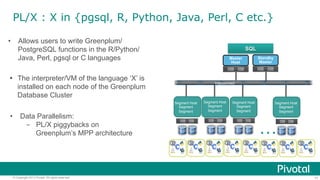
PL/X : X in {pgsql, R, Python, Java, Perl, C etc.}
•  Allows users to write Greenplum/
PostgreSQL functions in the R/Python/
Java, Perl, pgsql or C languages

SQL
Master
Host

Ÿ  The interpreter/VM of the language ‘X’ is
installed on each node of the Greenplum
Database Cluster
•  Data Parallelism:
-  PL/X piggybacks on
Greenplum’s MPP architecture

© Copyright 2013 Pivotal. All rights reserved.

Standby
Master

Interconnect

Segment Host
Segment
Segment

Segment Host
Segment
Segment

Segment Host
Segment
Segment

Segment Host
Segment
Segment

…
11
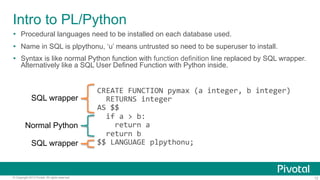
Intro to PL/Python
Ÿ  Procedural languages need to be installed on each database used.
Ÿ  Name in SQL is plpythonu, ‘u’ means untrusted so need to be superuser to install.
Ÿ  Syntax is like normal Python function with function definition line replaced by SQL wrapper.
Alternatively like a SQL User Defined Function with Python inside.

SQL wrapper
Normal Python
SQL wrapper

© Copyright 2013 Pivotal. All rights reserved.

CREATE	
  FUNCTION	
  pymax	
  (a	
  integer,	
  b	
  integer)	


  RETURNS	
  integer	
  
AS	
  $$	


  if	
  a	
  >	
  b:	


  return	
  a	


  return	
  b	
  
$$	
  LANGUAGE	
  plpythonu;	
  

12
Returning Results
Ÿ  Postgres primitive types (int, bigint, text, float8, double precision, date, NULL etc.)
Ÿ  Composite types can be returned by creating a composite type in the database:	
  
CREATE	
  TYPE	
  named_value	
  AS	
  (	


  name	
  	
  text,	


  value	
  	
  integer	
  
);	
  

Ÿ  Then you can return a list, tuple or dict (not sets) which reference the same structure as the table:
CREATE	
  FUNCTION	
  make_pair	
  (name	
  text,	
  value	
  integer)	


  RETURNS	
  named_value	
  
AS	
  $$	


  return	
  [	
  name,	
  value	
  ]	


  #	
  or	
  alternatively,	
  as	
  tuple:	
  return	
  (	
  name,	
  value	
  )	


  #	
  or	
  as	
  dict:	
  return	
  {	
  "name":	
  name,	
  "value":	
  value	
  }	


  #	
  or	
  as	
  an	
  object	
  with	
  attributes	
  .name	
  and	
  .value	
  
$$	
  LANGUAGE	
  plpythonu;	
  

Ÿ  For functions which return multiple rows, prefix “setof” before the return type

© Copyright 2013 Pivotal. All rights reserved.

13
Returning more results
You can return multiple results by wrapping them in a sequence (tuple, list or set),
an iterator or a generator:

Sequence

Generator

© Copyright 2013 Pivotal. All rights reserved.

CREATE	
  FUNCTION	
  make_pair	
  (name	
  text)	


  RETURNS	
  SETOF	
  named_value	
  
AS	
  $$	


  return	
  ([	
  name,	
  1	
  ],	
  [	
  name,	
  2	
  ],	
  [	
  name,	
  3])	
  	
  
$$	
  LANGUAGE	
  plpythonu;	
  
CREATE	
  FUNCTION	
  make_pair	
  (name	
  text)	


  RETURNS	
  SETOF	
  named_value	
  	
  AS	
  $$	


  for	
  i	
  in	
  range(3):	


  yield	
  (name,	
  i)	
  	
  
$$	
  LANGUAGE	
  plpythonu;	
  

14
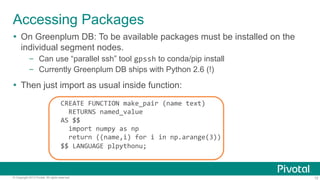
Accessing Packages
Ÿ  On Greenplum DB: To be available packages must be installed on the
individual segment nodes.
–  Can use “parallel ssh” tool gpssh to conda/pip install
–  Currently Greenplum DB ships with Python 2.6 (!)

Ÿ  Then just import as usual inside function:


CREATE	
  FUNCTION	
  make_pair	
  (name	
  text)	


  RETURNS	
  named_value	
  
AS	
  $$	


  import	
  numpy	
  as	
  np	


  return	
  ((name,i)	
  for	
  i	
  in	
  np.arange(3))	
  
$$	
  LANGUAGE	
  plpythonu;	
  

© Copyright 2013 Pivotal. All rights reserved.

15
Benefits of PL/Python
Ÿ  Easy to bring your code to the data.
Ÿ  When SQL falls short leverage your Python (or R/Java/C)
experience quickly.
Ÿ  Apply Python across terabytes of data with minimal
overhead or additional requirements.
Ÿ  Results are already in the database system, ready for further
analysis or storage.

© Copyright 2013 Pivotal. All rights reserved.

16
Going Beyond Data Parallelism
Ÿ  Data Parallel computation via PL/Python libraries only allow
us to run ‘n’ models in parallel.
Ÿ  This works great when we are building one model for each
value of the group by column, but we need parallelized
algorithms to be able to build a single model on all the
available data
Ÿ  For this, we use MADlib – an open source library of parallel
in-database machine learning algorithms.

© Copyright 2013 Pivotal. All rights reserved.

17
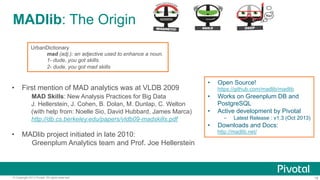
MADlib: The Origin
UrbanDictionary
mad (adj.): an adjective used to enhance a noun.
1- dude, you got skills.
2- dude, you got mad skills

•  First mention of MAD analytics was at VLDB 2009
MAD Skills: New Analysis Practices for Big Data
J. Hellerstein, J. Cohen, B. Dolan, M. Dunlap, C. Welton
(with help from: Noelle Sio, David Hubbard, James Marca)
http://db.cs.berkeley.edu/papers/vldb09-madskills.pdf

•  MADlib project initiated in late 2010:
Greenplum Analytics team and Prof. Joe Hellerstein

© Copyright 2013 Pivotal. All rights reserved.

• 

Open Source!
https://github.com/madlib/madlib

• 
• 

Works on Greenplum DB and
PostgreSQL
Active development by Pivotal
- 

• 

Latest Release : v1.3 (Oct 2013)

Downloads and Docs:
http://madlib.net/

18
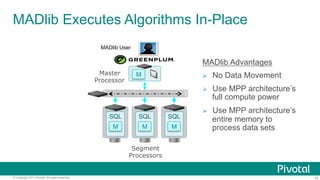
MADlib Executes Algorithms In-Place
MADlib User

MADlib Advantages
Master
Processor

Ø 

SQL

SQL

SQL

M

M

M

No Data Movement

Ø 

M

Use MPP architecture’s
full compute power

Ø 

Use MPP architecture’s
entire memory to
process data sets

Segment
Processors

© Copyright 2013 Pivotal. All rights reserved.

19
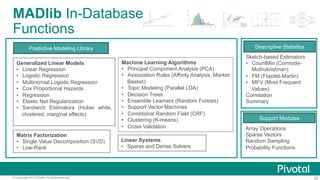
MADlib In-Database
Functions
Descriptive Statistics

Predictive Modeling Library
Generalized Linear Models
•  Linear Regression
•  Logistic Regression
•  Multinomial Logistic Regression
•  Cox Proportional Hazards
•  Regression
•  Elastic Net Regularization
•  Sandwich Estimators (Huber white,
clustered, marginal effects)

Matrix Factorization
•  Single Value Decomposition (SVD)
•  Low-Rank

© Copyright 2013 Pivotal. All rights reserved.

Machine Learning Algorithms
•  Principal Component Analysis (PCA)
•  Association Rules (Affinity Analysis, Market
Basket)
•  Topic Modeling (Parallel LDA)
•  Decision Trees
•  Ensemble Learners (Random Forests)
•  Support Vector Machines
•  Conditional Random Field (CRF)
•  Clustering (K-means)
•  Cross Validation
Linear Systems
•  Sparse and Dense Solvers

Sketch-based Estimators
•  CountMin (CormodeMuthukrishnan)
•  FM (Flajolet-Martin)
•  MFV (Most Frequent
Values)
Correlation
Summary
Support Modules
Array Operations
Sparse Vectors
Random Sampling
Probability Functions

20
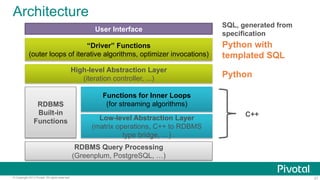
Architecture
User Interface
“Driver” Functions
(outer loops of iterative algorithms, optimizer invocations)
High-level Abstraction Layer
(iteration controller, ...)

RDBMS
Built-in
Functions

SQL, generated from
specification

Python with
templated SQL
Python

Functions for Inner Loops
(for streaming algorithms)
Low-level Abstraction Layer
(matrix operations, C++ to RDBMS
type bridge, …)

C++

RDBMS Query Processing
(Greenplum, PostgreSQL, …)
© Copyright 2013 Pivotal. All rights reserved.

21
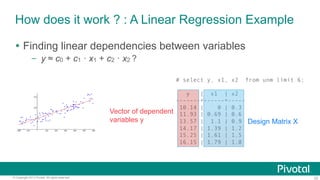
How does it work ? : A Linear Regression Example
Ÿ  Finding linear dependencies between variables
–  y ≈ c0 + c1 · x1 + c2 · x2 ?
# select y, x1, x2

Vector of dependent
variables y

© Copyright 2013 Pivotal. All rights reserved.

y
| x1 | x2
-------+------+----10.14 |
0 | 0.3
11.93 | 0.69 | 0.6
13.57 | 1.1 | 0.9
14.17 | 1.39 | 1.2
15.25 | 1.61 | 1.5
16.15 | 1.79 | 1.8

from unm limit 6;

Design Matrix X

22
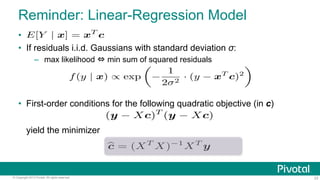
Reminder: Linear-Regression Model
• 
•  If residuals i.i.d. Gaussians with standard deviation σ:
–  max likelihood ⇔ min sum of squared residuals

f (y | x) ∝ exp

−

1
· (y − xT c)2
2σ 2

•  First-order conditions for the following quadratic objective (in c)
yield the minimizer

© Copyright 2013 Pivotal. All rights reserved.

23
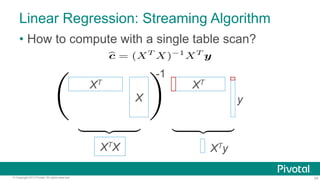
Linear Regression: Streaming Algorithm
•  How to compute with a single table scan?
-1

XT

XT

X

XTX
© Copyright 2013 Pivotal. All rights reserved.

y

XTy
24
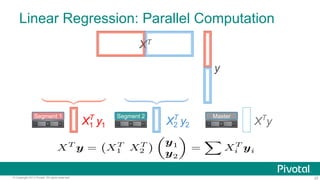
Linear Regression: Parallel Computation
XT
y

Segment 1

T
X1

y1

Segment 2

T
T
X T y = X 1 X2

© Copyright 2013 Pivotal. All rights reserved.

Master

T
X2 y2

y1
y2

=

XTy

T
Xi y i

25
Demos
Ÿ  We built demos to showcase our technology pipeline, using
Python technology.
Ÿ  Two use cases:
–  Topic and Sentiment Analysis of Tweets
–  London Road Traffic Disruption prediction

© Copyright 2013 Pivotal. All rights reserved.

26
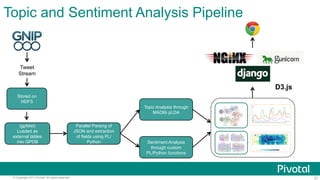
Topic and Sentiment Analysis Pipeline

Tweet
Stream

D3.js
Stored on
HDFS
Topic Analysis through
MADlib pLDA
(gpfdist)
Loaded as
external tables
into GPDB

© Copyright 2013 Pivotal. All rights reserved.

Parallel Parsing of
JSON and extraction
of fields using PL/
Python

Sentiment Analysis
through custom
PL/Python functions

27
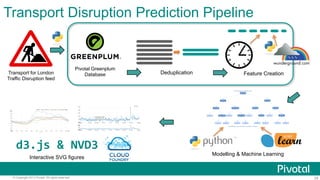
Transport Disruption Prediction Pipeline

Transport for London
Traffic Disruption feed

Pivotal Greenplum
Database

d3.js	
  &	
  NVD3	
  
Interactive SVG figures

© Copyright 2013 Pivotal. All rights reserved.

Deduplication

Feature Creation

Modelling & Machine Learning

28
Pivotal’s Open Source Contributions
http://gopivotal.com/pivotal-products/open-source-software

•  PyMADlib – Python Wrapper for MADlib
-  https://github.com/gopivotal/pymadlib

•  PivotalR – R wrapper for MADlib
-  https://github.com/madlib-internal/PivotalR

•  Part-of-speech tagger for Twitter via SQL
-  http://vatsan.github.io/gp-ark-tweet-nlp/

Questions?
@being_bayesian
@ianhuston
© Copyright 2013 Pivotal. All rights reserved.

29
BUILT FOR THE SPEED OF BUSINESS

Python Powered Data Science at Pivotal (PyData 2013)

  • 1.
    BUILT FOR THESPEED OF BUSINESS
  • 2.
    Python Powered Data Scienceat Pivotal How do we use the PyData stack in real engagements? Srivatsan Ramanujam, @being_bayesian Ian Huston, @ianhuston Data Scientists, Pivotal © Copyright 2013 Pivotal. All rights reserved. 2
  • 3.
    Agenda Ÿ  Introduction toPivotal Ÿ  Pivotal Data Science Toolkit Ÿ  PL/Python Ÿ  In-database Machine Learning with MADlib Ÿ  Live Demos –  Topic Analysis and Sentiment Analysis Engine –  Traffic Disruption Prediction © Copyright 2013 Pivotal. All rights reserved. 3
  • 4.
    Pivotal Platform Stack Data-Driven Application Development PivotalData Science Labs Cloud Application Platform Data & Analytics Platform Virtualization Cloud Storage © Copyright 2013 Pivotal. All rights reserved. 4
  • 5.
    What do ourcustomers look like? Ÿ  Large enterprises with lots of data collected –  Work with 10s of TBs to PBs of data, structured & unstructured Ÿ  Not able to get what they want out of their data –  Old Legacy systems with high cost and no flexibility –  Response times are too slow for interactive data analysis –  Can only deal with small samples of data locally Ÿ  They want to transform into data driven enterprises © Copyright 2013 Pivotal. All rights reserved. 5
  • 6.
    MPP Architectural Overview Thinkof it as multiple PostGreSQL servers Master Segments/Workers Rows are distributed across segments by a particular field (or randomly) © Copyright 2013 Pivotal. All rights reserved. 6
  • 7.
    Typical Engagement TechSetup Ÿ  Platform: –  Greenplum Analytics Database (GPDB) –  Pivotal HD Hadoop Distribution + HAWQ (SQL DB on Hadoop) Ÿ  Open Source Options (http://gopivotal.com): –  Greenplum Community Edition –  Pivotal HD Community Edition (HAWQ not included) –  MADlib in-database machine learning library (http://madlib.net) Ÿ  Where Python fits in: –  PL/Python running in-database, with nltk, scikit-learn etc –  IPython for exploratory analysis –  Pandas, Matplotlib etc. © Copyright 2013 Pivotal. All rights reserved. 7
  • 8.
    PIVOTAL DATA SCIENCE TOOLKIT 1 FindData Platforms •  Greenplum DB •  Pivotal HD •  Hadoop (other) •  SAS HPA •  AWS 2 3 Run Code Interfaces •  pgAdminIII •  psql •  psycopg2 •  Terminal •  Cygwin •  Putty •  Winscp Write Code Editing Tools •  Vi/Vim •  Emacs •  Smultron •  TextWrangler •  Eclipse •  Notepad++ •  IPython •  Sublime Languages •  SQL •  Bash scripting •  C •  C++ •  C# •  Java •  Python •  R © Copyright 2013 Pivotal. All rights reserved. 4 Write Code for Big Data In-Database •  SQL •  PL/Python •  PL/Java •  PL/R •  PL/pgSQL 5 Hadoop •  HAWQ •  Pig •  Hive •  Java 6 Visualization •  python-matplotlib •  python-networkx •  D3.js •  Tableau Implement Algorithms Libraries •  MADlib Java •  Mahout R •  (Too many to list!) Text •  OpenNLP •  NLTK •  GPText C++ •  opencv Show Results Python •  NumPy •  SciPy •  scikit-learn •  Pandas Programs •  Alpine Miner •  Rstudio •  MATLAB •  SAS •  Stata •  GraphViz •  Gephi •  R (ggplot2, lattice, shiny) •  Excel 7 Collaborate Sharing Tools •  Chorus •  Confluence •  Socialcast •  Github •  Google Drive & Hangouts A large and varied tool box! 8
  • 9.
    Data Parallelism Ÿ  Littleor no effort is required to break up the problem into a number of parallel tasks, and there exists no dependency (or communication) between those parallel tasks. Ÿ  Examples: –  Measure the height of each student in a classroom (explicitly parallelizable by student) –  MapReduce –  map() function in Python © Copyright 2013 Pivotal. All rights reserved. 9
  • 10.
    User-Defined Functions (UDFs) Ÿ PostgreSQL/Greenplum provide lots of flexibility in defining your own functions. Ÿ  Simple UDFs are SQL queries with calling arguments and return types. Definition: Execution: CREATE  FUNCTION  times2(INT)   RETURNS  INT   AS  $$          SELECT  2  *  $1   $$  LANGUAGE  sql;   SELECT  times2(1);    times2     -­‐-­‐-­‐-­‐-­‐-­‐-­‐-­‐              2   (1  row)   © Copyright 2013 Pivotal. All rights reserved. 10
  • 11.
    PL/X : Xin {pgsql, R, Python, Java, Perl, C etc.} •  Allows users to write Greenplum/ PostgreSQL functions in the R/Python/ Java, Perl, pgsql or C languages SQL Master Host Ÿ  The interpreter/VM of the language ‘X’ is installed on each node of the Greenplum Database Cluster •  Data Parallelism: -  PL/X piggybacks on Greenplum’s MPP architecture © Copyright 2013 Pivotal. All rights reserved. Standby Master Interconnect Segment Host Segment Segment Segment Host Segment Segment Segment Host Segment Segment Segment Host Segment Segment … 11
  • 12.
    Intro to PL/Python Ÿ Procedural languages need to be installed on each database used. Ÿ  Name in SQL is plpythonu, ‘u’ means untrusted so need to be superuser to install. Ÿ  Syntax is like normal Python function with function definition line replaced by SQL wrapper. Alternatively like a SQL User Defined Function with Python inside. SQL wrapper Normal Python SQL wrapper © Copyright 2013 Pivotal. All rights reserved. CREATE  FUNCTION  pymax  (a  integer,  b  integer)      RETURNS  integer   AS  $$      if  a  >  b:          return  a      return  b   $$  LANGUAGE  plpythonu;   12
  • 13.
    Returning Results Ÿ  Postgresprimitive types (int, bigint, text, float8, double precision, date, NULL etc.) Ÿ  Composite types can be returned by creating a composite type in the database:   CREATE  TYPE  named_value  AS  (      name    text,      value    integer   );   Ÿ  Then you can return a list, tuple or dict (not sets) which reference the same structure as the table: CREATE  FUNCTION  make_pair  (name  text,  value  integer)      RETURNS  named_value   AS  $$      return  [  name,  value  ]      #  or  alternatively,  as  tuple:  return  (  name,  value  )      #  or  as  dict:  return  {  "name":  name,  "value":  value  }      #  or  as  an  object  with  attributes  .name  and  .value   $$  LANGUAGE  plpythonu;   Ÿ  For functions which return multiple rows, prefix “setof” before the return type © Copyright 2013 Pivotal. All rights reserved. 13
  • 14.
    Returning more results Youcan return multiple results by wrapping them in a sequence (tuple, list or set), an iterator or a generator: Sequence Generator © Copyright 2013 Pivotal. All rights reserved. CREATE  FUNCTION  make_pair  (name  text)      RETURNS  SETOF  named_value   AS  $$      return  ([  name,  1  ],  [  name,  2  ],  [  name,  3])     $$  LANGUAGE  plpythonu;   CREATE  FUNCTION  make_pair  (name  text)      RETURNS  SETOF  named_value    AS  $$      for  i  in  range(3):              yield  (name,  i)     $$  LANGUAGE  plpythonu;   14
  • 15.
    Accessing Packages Ÿ  OnGreenplum DB: To be available packages must be installed on the individual segment nodes. –  Can use “parallel ssh” tool gpssh to conda/pip install –  Currently Greenplum DB ships with Python 2.6 (!) Ÿ  Then just import as usual inside function:     CREATE  FUNCTION  make_pair  (name  text)      RETURNS  named_value   AS  $$      import  numpy  as  np      return  ((name,i)  for  i  in  np.arange(3))   $$  LANGUAGE  plpythonu;   © Copyright 2013 Pivotal. All rights reserved. 15
  • 16.
    Benefits of PL/Python Ÿ Easy to bring your code to the data. Ÿ  When SQL falls short leverage your Python (or R/Java/C) experience quickly. Ÿ  Apply Python across terabytes of data with minimal overhead or additional requirements. Ÿ  Results are already in the database system, ready for further analysis or storage. © Copyright 2013 Pivotal. All rights reserved. 16
  • 17.
    Going Beyond DataParallelism Ÿ  Data Parallel computation via PL/Python libraries only allow us to run ‘n’ models in parallel. Ÿ  This works great when we are building one model for each value of the group by column, but we need parallelized algorithms to be able to build a single model on all the available data Ÿ  For this, we use MADlib – an open source library of parallel in-database machine learning algorithms. © Copyright 2013 Pivotal. All rights reserved. 17
  • 18.
    MADlib: The Origin UrbanDictionary mad(adj.): an adjective used to enhance a noun. 1- dude, you got skills. 2- dude, you got mad skills •  First mention of MAD analytics was at VLDB 2009 MAD Skills: New Analysis Practices for Big Data J. Hellerstein, J. Cohen, B. Dolan, M. Dunlap, C. Welton (with help from: Noelle Sio, David Hubbard, James Marca) http://db.cs.berkeley.edu/papers/vldb09-madskills.pdf •  MADlib project initiated in late 2010: Greenplum Analytics team and Prof. Joe Hellerstein © Copyright 2013 Pivotal. All rights reserved. •  Open Source! https://github.com/madlib/madlib •  •  Works on Greenplum DB and PostgreSQL Active development by Pivotal -  •  Latest Release : v1.3 (Oct 2013) Downloads and Docs: http://madlib.net/ 18
  • 19.
    MADlib Executes AlgorithmsIn-Place MADlib User MADlib Advantages Master Processor Ø  SQL SQL SQL M M M No Data Movement Ø  M Use MPP architecture’s full compute power Ø  Use MPP architecture’s entire memory to process data sets Segment Processors © Copyright 2013 Pivotal. All rights reserved. 19
  • 20.
    MADlib In-Database Functions Descriptive Statistics PredictiveModeling Library Generalized Linear Models •  Linear Regression •  Logistic Regression •  Multinomial Logistic Regression •  Cox Proportional Hazards •  Regression •  Elastic Net Regularization •  Sandwich Estimators (Huber white, clustered, marginal effects) Matrix Factorization •  Single Value Decomposition (SVD) •  Low-Rank © Copyright 2013 Pivotal. All rights reserved. Machine Learning Algorithms •  Principal Component Analysis (PCA) •  Association Rules (Affinity Analysis, Market Basket) •  Topic Modeling (Parallel LDA) •  Decision Trees •  Ensemble Learners (Random Forests) •  Support Vector Machines •  Conditional Random Field (CRF) •  Clustering (K-means) •  Cross Validation Linear Systems •  Sparse and Dense Solvers Sketch-based Estimators •  CountMin (CormodeMuthukrishnan) •  FM (Flajolet-Martin) •  MFV (Most Frequent Values) Correlation Summary Support Modules Array Operations Sparse Vectors Random Sampling Probability Functions 20
  • 21.
    Architecture User Interface “Driver” Functions (outerloops of iterative algorithms, optimizer invocations) High-level Abstraction Layer (iteration controller, ...) RDBMS Built-in Functions SQL, generated from specification Python with templated SQL Python Functions for Inner Loops (for streaming algorithms) Low-level Abstraction Layer (matrix operations, C++ to RDBMS type bridge, …) C++ RDBMS Query Processing (Greenplum, PostgreSQL, …) © Copyright 2013 Pivotal. All rights reserved. 21
  • 22.
    How does itwork ? : A Linear Regression Example Ÿ  Finding linear dependencies between variables –  y ≈ c0 + c1 · x1 + c2 · x2 ? # select y, x1, x2 Vector of dependent variables y © Copyright 2013 Pivotal. All rights reserved. y | x1 | x2 -------+------+----10.14 | 0 | 0.3 11.93 | 0.69 | 0.6 13.57 | 1.1 | 0.9 14.17 | 1.39 | 1.2 15.25 | 1.61 | 1.5 16.15 | 1.79 | 1.8 from unm limit 6; Design Matrix X 22
  • 23.
    Reminder: Linear-Regression Model •  • If residuals i.i.d. Gaussians with standard deviation σ: –  max likelihood ⇔ min sum of squared residuals f (y | x) ∝ exp − 1 · (y − xT c)2 2σ 2 •  First-order conditions for the following quadratic objective (in c) yield the minimizer © Copyright 2013 Pivotal. All rights reserved. 23
  • 24.
    Linear Regression: StreamingAlgorithm •  How to compute with a single table scan? -1 XT XT X XTX © Copyright 2013 Pivotal. All rights reserved. y XTy 24
  • 25.
    Linear Regression: ParallelComputation XT y Segment 1 T X1 y1 Segment 2 T T X T y = X 1 X2 © Copyright 2013 Pivotal. All rights reserved. Master T X2 y2 y1 y2 = XTy T Xi y i 25
  • 26.
    Demos Ÿ  We builtdemos to showcase our technology pipeline, using Python technology. Ÿ  Two use cases: –  Topic and Sentiment Analysis of Tweets –  London Road Traffic Disruption prediction © Copyright 2013 Pivotal. All rights reserved. 26
  • 27.
    Topic and SentimentAnalysis Pipeline Tweet Stream D3.js Stored on HDFS Topic Analysis through MADlib pLDA (gpfdist) Loaded as external tables into GPDB © Copyright 2013 Pivotal. All rights reserved. Parallel Parsing of JSON and extraction of fields using PL/ Python Sentiment Analysis through custom PL/Python functions 27
  • 28.
    Transport Disruption PredictionPipeline Transport for London Traffic Disruption feed Pivotal Greenplum Database d3.js  &  NVD3   Interactive SVG figures © Copyright 2013 Pivotal. All rights reserved. Deduplication Feature Creation Modelling & Machine Learning 28
  • 29.
    Pivotal’s Open SourceContributions http://gopivotal.com/pivotal-products/open-source-software •  PyMADlib – Python Wrapper for MADlib -  https://github.com/gopivotal/pymadlib •  PivotalR – R wrapper for MADlib -  https://github.com/madlib-internal/PivotalR •  Part-of-speech tagger for Twitter via SQL -  http://vatsan.github.io/gp-ark-tweet-nlp/ Questions? @being_bayesian @ianhuston © Copyright 2013 Pivotal. All rights reserved. 29
  • 30.
    BUILT FOR THESPEED OF BUSINESS