Python	
  Iteration	
  
Iterators,	
  Comprehensions,	
  Generators,	
  Func4onal	
  
Programming	
  and	
  Idioms	
  
Iterators	
  
•  An	
  object	
  is	
  iterable	
  if	
  it	
  defines	
  the	
  __iter__	
  method	
  or	
  
   implements	
  the	
  sequence	
  protocol	
  (defines	
  __ge4tem__	
  with	
  
   integers	
  star4ng	
  at	
  0)	
  
•  An	
  object	
  is	
  an	
  iterator	
  if	
  it	
  implements	
  the	
  iterator	
  protocol:	
  
     •  Defines	
  the	
  __iter__	
  method	
  which	
  returns	
  itself	
  
     •  Defines	
  a	
  next	
  method	
  which	
  returns	
  the	
  next	
  value	
  with	
  each	
  
        subsequent	
  call	
  
•  for	
  loops	
  implicitly	
  create	
  an	
  iterator	
  
•  iter	
  explicitly	
  creates	
  an	
  iterator	
  
•    Generators	
  encapsulate	
  logic	
  in	
  an	
  iterator	
  
•    All	
  Sequence	
  Types	
  are	
  iterable	
  
•    Dicts,	
  sets,	
  and	
  other	
  collec4on	
  containers	
  are	
  iterable	
  
•    File	
  objects	
  are	
  iterable	
  
•    Many	
  DB	
  cursors	
  are	
  iterable	
  
Comprehensions	
  
•  Comprehensions	
  are	
  iterables
        iterable = [3,6,4]
        list_comprehension = [i for i in iterable] # [3, 6, 4]
        set_comprehension = {i for i in iterable} # {3, 6, 4}
        dict_comprehension = {str(i):i for i in iterable} # { ‘3’: 3, ‘6’: 6, ‘4’: 4 }
        generator_comprehension = (i for i in iterable) # <generator object …>


•  Comprehensions	
  can	
  have	
  1	
  or	
  more	
  for	
  expressions	
  
•  Comprehensions	
  can	
  0	
  or	
  more	
  if	
  expressions	
  
•  Comprehensions	
  can	
  also	
  nested	
  
        [[j for j in i if j % 2] for i in [iterable] * 3] # [[3], [3], [3]]
        [i for i in iterable if not i%2 if i>5] # [6]
        [(i,j) for i in iterable for j in iterable if i < 6 and j > 4] # [(3, 6), (4, 6)]
Generators	
  
•  Generators	
  can	
  be	
  created	
  as	
  a	
  comprehension	
  or	
  by	
  calling	
  a	
  
   func4on	
  that	
  uses	
  yield	
  instead	
  of	
  return	
  
•  Generators	
  are	
  lazily	
  evaluated	
  
•  Generators	
  are	
  both	
  iterable	
  and	
  iterators	
  
         def mk_generator():
            for i in [1, 2, 3]:
               yield i
         generator_a = mk_generator()

         generator_b = (i for i in [1, 2, 3])

         # generator_a and generator_b are functionally equivalent
Functional	
  Programming	
  
•  Solu4ons	
  using	
  comprehensions	
  can	
  oOen	
  be	
  rewriPen	
  using	
  
   Func4onal	
  Programming	
  (FP)	
  idioms.	
  
•  Always	
  choose	
  the	
  implementa4on	
  that	
  provides	
  the	
  least	
  
   amount	
  of	
  code	
  that	
  is	
  readable	
  and	
  maintainable	
  
•  Always	
  use	
  the	
  iterator	
  versions	
  where	
  possible:	
  imap, ifilter,
   izip, reduce,	
  etc.	
  	
  Refer	
  to	
  itertools.*	
  and	
  buil4ns


Differences:	
  
•  Comprehensions	
  do	
  not	
  create	
  a	
  new	
  scope	
  
•  FP	
  idioms	
  oOen	
  require	
  new	
  func4ons	
  to	
  be	
  created	
  
•  FP	
  idioms	
  can	
  be	
  easily	
  generalized	
  to	
  support	
  distributed	
  
   programming	
  
Idiom:	
  Enumerating	
  Lists	
  
Some4mes	
  you	
  need	
  to	
  get	
  the	
  index	
  of	
  each	
  element	
  in	
  an	
  
ordered	
  list.	
  
        # Non Idiomatic
        d = {}
        for i, value in enumerate(values):
           d[value] = i


        # Idiomatic
        d = dict(value, i for i, value in enumerate(values))
Idiom:	
  First	
  Occurrence	
  
Finding	
  the	
  first	
  occurrence	
  in	
  a	
  collec4on	
  of	
  data	
  is	
  a	
  common	
  
problem.	


          # Non Idiomatic
          found_line = None
          for line in logfile:
             if regex.match(line):
                found_line = line
                break
          return found_line

          # Idiomatic
          return next((line for line in logfile if regex.match(line)), None)
Idiom:	
  Collating	
  Lists	
  
You	
  oOen	
  have	
  to	
  collate	
  data	
  from	
  different	
  lists	
  together.	
  	
  This	
  
oOen	
  done	
  to	
  create	
  a	
  data	
  structure	
  that	
  represents	
  the	
  
rela4onship	
  between	
  the	
  data.	
  	
  The	
  can	
  also	
  be	
  used	
  to	
  create	
  
dicts.
         # Non Idiomatic
         collated_list = []
         for i in xrange(max(len(first_list), len(second_list)):

            collated_list.append((first_list[i], second_list[i]))

         # Idiomatic
         from itertools import izip
         collated_list_iterator = izip(first_list, second_list)

Python iteration

  • 1.
    Python  Iteration   Iterators,  Comprehensions,  Generators,  Func4onal   Programming  and  Idioms  
  • 2.
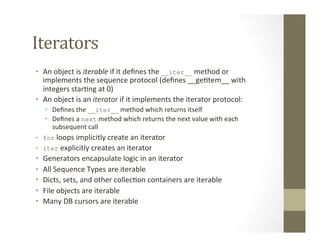
    Iterators   •  An  object  is  iterable  if  it  defines  the  __iter__  method  or   implements  the  sequence  protocol  (defines  __ge4tem__  with   integers  star4ng  at  0)   •  An  object  is  an  iterator  if  it  implements  the  iterator  protocol:   •  Defines  the  __iter__  method  which  returns  itself   •  Defines  a  next  method  which  returns  the  next  value  with  each   subsequent  call   •  for  loops  implicitly  create  an  iterator   •  iter  explicitly  creates  an  iterator   •  Generators  encapsulate  logic  in  an  iterator   •  All  Sequence  Types  are  iterable   •  Dicts,  sets,  and  other  collec4on  containers  are  iterable   •  File  objects  are  iterable   •  Many  DB  cursors  are  iterable  
  • 3.
    Comprehensions   •  Comprehensions  are  iterables iterable = [3,6,4] list_comprehension = [i for i in iterable] # [3, 6, 4] set_comprehension = {i for i in iterable} # {3, 6, 4} dict_comprehension = {str(i):i for i in iterable} # { ‘3’: 3, ‘6’: 6, ‘4’: 4 } generator_comprehension = (i for i in iterable) # <generator object …> •  Comprehensions  can  have  1  or  more  for  expressions   •  Comprehensions  can  0  or  more  if  expressions   •  Comprehensions  can  also  nested   [[j for j in i if j % 2] for i in [iterable] * 3] # [[3], [3], [3]] [i for i in iterable if not i%2 if i>5] # [6] [(i,j) for i in iterable for j in iterable if i < 6 and j > 4] # [(3, 6), (4, 6)]
  • 4.
    Generators   •  Generators  can  be  created  as  a  comprehension  or  by  calling  a   func4on  that  uses  yield  instead  of  return   •  Generators  are  lazily  evaluated   •  Generators  are  both  iterable  and  iterators   def mk_generator(): for i in [1, 2, 3]: yield i generator_a = mk_generator() generator_b = (i for i in [1, 2, 3]) # generator_a and generator_b are functionally equivalent
  • 5.
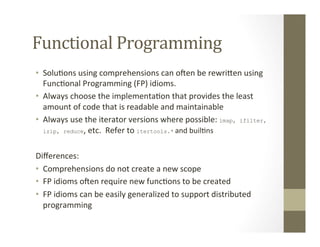
    Functional  Programming   • Solu4ons  using  comprehensions  can  oOen  be  rewriPen  using   Func4onal  Programming  (FP)  idioms.   •  Always  choose  the  implementa4on  that  provides  the  least   amount  of  code  that  is  readable  and  maintainable   •  Always  use  the  iterator  versions  where  possible:  imap, ifilter, izip, reduce,  etc.    Refer  to  itertools.*  and  buil4ns Differences:   •  Comprehensions  do  not  create  a  new  scope   •  FP  idioms  oOen  require  new  func4ons  to  be  created   •  FP  idioms  can  be  easily  generalized  to  support  distributed   programming  
  • 6.
    Idiom:  Enumerating  Lists   Some4mes  you  need  to  get  the  index  of  each  element  in  an   ordered  list.   # Non Idiomatic d = {} for i, value in enumerate(values): d[value] = i # Idiomatic d = dict(value, i for i, value in enumerate(values))
  • 7.
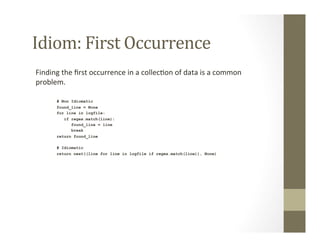
    Idiom:  First  Occurrence   Finding  the  first  occurrence  in  a  collec4on  of  data  is  a  common   problem.         # Non Idiomatic found_line = None for line in logfile: if regex.match(line): found_line = line break return found_line # Idiomatic return next((line for line in logfile if regex.match(line)), None)
  • 8.
    Idiom:  Collating  Lists   You  oOen  have  to  collate  data  from  different  lists  together.    This   oOen  done  to  create  a  data  structure  that  represents  the   rela4onship  between  the  data.    The  can  also  be  used  to  create   dicts. # Non Idiomatic collated_list = [] for i in xrange(max(len(first_list), len(second_list)): collated_list.append((first_list[i], second_list[i])) # Idiomatic from itertools import izip collated_list_iterator = izip(first_list, second_list)