Applications of python
1. Web Development
Web development is a widely known python usage
example for creating dynamic, scalable, and
maintainable web applications. It is known for its
readability and efficiency, making it a popular choice
for backend and full-stack development.
Key Frameworks and Tools
Django: A high-level Python web framework that
encourages rapid development and clean, pragmatic
design. It includes an ORM, authentication, and other
essential tools.
Flask: A micro-framework that provides the
essentials to get an application up and running,
offering flexibility to developers.
Real-World Example
Instagram, one of the most popular apps in Python’s real-time
applications, uses Django to handle its massive user base and large
amounts of data. Django’s ability to manage large-scale applications is
ideal for such high-traffic websites.
2. Data Science
It is used for data analysis, visualization, and predictive modeling.
Key Libraries and Tools
Pandas: Provides data structures and data analysis tools.
NumPy: Supports large, multi-dimensional arrays and matrices and a
collection of mathematical functions.
Matplotlib: A plotting library for creating static, interactive, and
animated visualizations.
SciPy: Provides scientific and technical computing capabilities,
including optimization and integration.
Real-World Example
Netflix uses Python for its recommendation algorithm and
data analytics, leveraging its powerful libraries to enhance user
experience by providing personalized content suggestions.
3. Artificial Intelligence and Machine Learning
Python is extensively used in AI and machine learning due to
its simplicity and robust libraries. It supports the development
of algorithms that allow machines to learn and make decisions.
Key Libraries and Tools
TensorFlow: An open-source library developed by Google for
machine learning and deep learning applications.
Keras: An API designed for human beings, not machines,
which allows for easy and fast prototyping.
Scikit-learn: A library for machine learning built on NumPy,
SciPy, and Matplotlib.
PyTorch: An open-source machine learning library developed
by Facebook’s AI Research lab.
Real-World Example
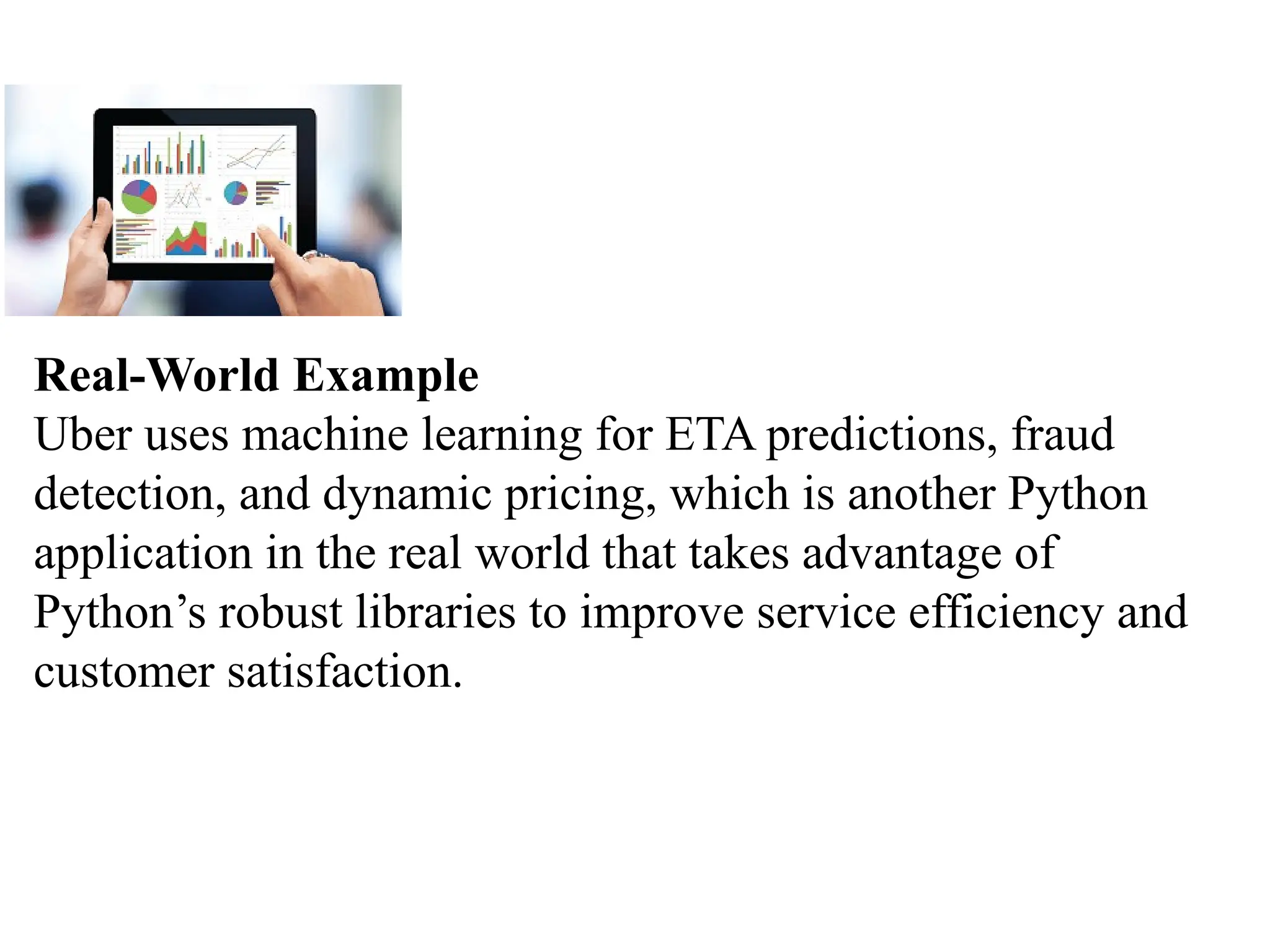
Uber uses machine learning for ETA predictions, fraud
detection, and dynamic pricing, which is another Python
application in the real world that takes advantage of
Python’s robust libraries to improve service efficiency and
customer satisfaction.
4. Enterprise Applications
Python is increasingly adopted for building enterprise-level applications
due to its versatility, ease of integration, and a large ecosystem of
libraries. It allows businesses to develop scalable solutions for various
needs.
Key Frameworks and Tools
Tryton: A high-level, open-source application platform that provides a
set of modules for various business needs, including accounting,
inventory, and project management.
Odoo: A suite of open-source business applications, including CRM,
eCommerce, and accounting, offering customization options and
integration capabilities.
Pyramid: Known for its flexibility and scalability, Pyramid is suitable
for easily developing complex enterprise applications.
Real-World Example
Dropbox utilizes Python for its backend infrastructure and to develop
internal tools. Python’s simplicity and robustness make it ideal for
managing the platform’s large-scale data storage and synchronization
5. Education Sector
Python is widely adopted in education as an introductory
programming language due to its simplicity and readability. Key
Resources
Python Tutor: An online tool for visualizing Python code and its
execution, helping students understand programming concepts.
Python.org Documentation: The official Python documentation
provides comprehensive guides, tutorials, and reference materials for
learners to explore Python’s features and capabilities.
Abundance of Learning Resources: Free online tutorials,
documentation, and interactive platforms make it easy for beginners
to find diverse learning materials and practice coding in a supportive
environment.
Real-World Example
The University of Texas at Austin incorporates Python into its
introductory computer science courses, leveraging its clear syntax and
extensive libraries to teach fundamental programming concepts
effectively.
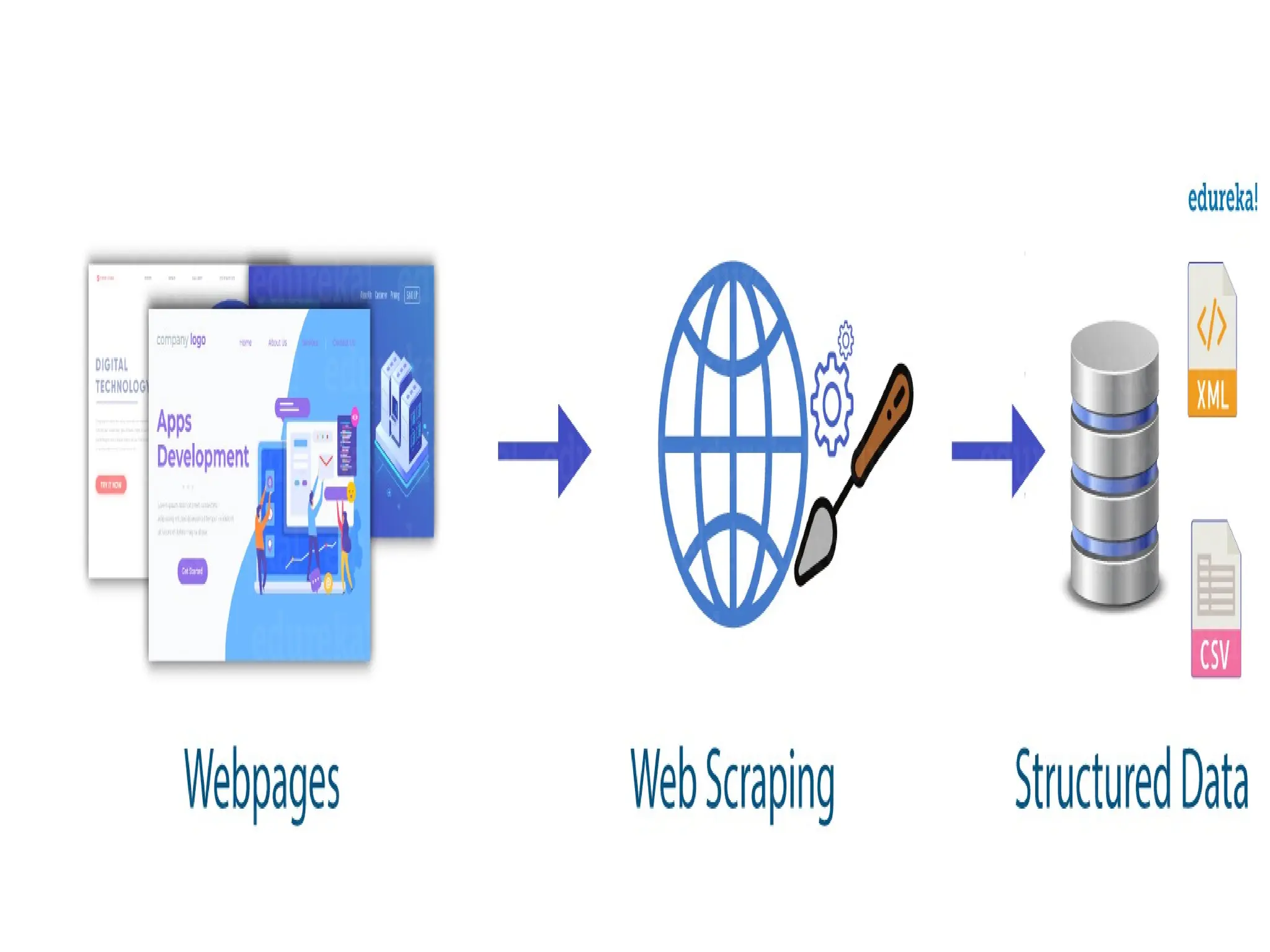
6. Web Scraping Applications
Python’s rich ecosystem of libraries makes it an excellent choice for
web scraping, the process of extracting data from websites. It allows
developers to retrieve and analyze information from the web efficiently.
Key Libraries and Tools
Beautiful Soup: A Python library for parsing HTML and XML
documents, making web scraping easier and more manageable.
Scrapy: An open-source and collaborative web crawling framework for
Python, providing robust features for extracting data from websites.
Selenium: A portable framework for automating web browsers, useful
for scenarios where dynamic interaction with web pages is required.
Real-World Example
Price monitoring services often utilize Python for web scraping to
gather pricing information from various e-commerce websites. This
enables businesses to make data-driven decisions and stay competitive
in the market.
7. Game Development
Several frameworks and libraries cater to game creation, including
graphics rendering, physics simulations, and user interface design.
Key Libraries and Tools
Pygame: A set of Python modules designed for writing video games,
providing functionality for graphics, sound, and input handling.
PyKyra: A fast and versatile game development framework for Python,
focusing on 2D games.
Pyglet: A cross-platform windowing and multimedia library for Python,
suitable for creating games and multimedia applications.
PyOpenGL: A Python binding to OpenGL, allowing developers to
create 3D graphics applications.
Kivy: An open-source Python library for developing multitouch
applications with a natural user interface, including games.
Panda3D: A game engine and framework for 3D rendering and game
development in Python and C++.
Cocos2d: A framework for building 2D games, interactive demos, and
other graphical/interactive applications.
Real-World Example
Battlefield 2, a popular first-person shooter game,
utilizes Python scripting for various game mechanics
and functionalities, demonstrating Python’s
capability to contribute to developing and enhancing
gameplay experiences.
8. Software Development & Engineering
Python’s versatility extends to software development, which is
used to build various applications, from command-line tools to
desktop applications.
Its clean syntax and robust standard library make it suitable
for rapid prototyping and production-grade software
development.
Key Frameworks and Tools
PyQt: A set of Python bindings for the Qt application
framework, enabling the development of cross-platform GUI
applications.
Tkinter: Python’s standard GUI toolkit, providing a simple
and easy-to-use interface for building desktop applications.
Click: A Python package for creating command-line
interfaces, allowing developers to build robust and user-
friendly command-line tools.
10. Operating Systems
Python’s object-oriented design makes it suitable for building entire
operating systems. Its compatibility with most platforms, such as
Windows and Mac, and ease of use for native application development
contribute to its effectiveness in this domain.
Key Tools and Techniques
Python OS Module: This module provides a way to interact with the
operating system, allowing tasks such as file management, process
management, and system information retrieval.
Python Shell Scripting: Python scripts can be used for system
administration tasks, such as managing services, deploying updates, and
configuring network settings.
PyInstaller: Converts Python scripts into standalone executables,
which are useful for packaging and distributing Python applications on
various operating systems.
Real-World Example
Red Hat Enterprise Linux (RHEL), a leading enterprise Linux
distribution, incorporates Python for system administration and
Simple program Guess the name
import random name =
("What is your name? ")
("Good Luck ! ", name) words = ['rainbow', 'computer', 'science', 'programming', 'python', 'mathematics', 'playe
'water', 'board', 'geeks'] word = random.choice(words)
("Guess the characters") guesses = '' turns = 12 while turns > 0: failed = 0 for char in word: if char in guesses:
(char, end=" ") else:
("_") failed += 1 if failed == 0:
("You Win")
("The word is: ", word) break
() guess =
("guess a character:") guesses += guess if guess not in word: turns -= 1
("Wrong")
("You have", + turns, 'more guesses') if turns == 0:
("You Loose")

python bridge course for second year.pptx

  • 1.
  • 2.
    1. Web Development Webdevelopment is a widely known python usage example for creating dynamic, scalable, and maintainable web applications. It is known for its readability and efficiency, making it a popular choice for backend and full-stack development. Key Frameworks and Tools Django: A high-level Python web framework that encourages rapid development and clean, pragmatic design. It includes an ORM, authentication, and other essential tools. Flask: A micro-framework that provides the essentials to get an application up and running, offering flexibility to developers.
  • 4.
    Real-World Example Instagram, oneof the most popular apps in Python’s real-time applications, uses Django to handle its massive user base and large amounts of data. Django’s ability to manage large-scale applications is ideal for such high-traffic websites. 2. Data Science It is used for data analysis, visualization, and predictive modeling. Key Libraries and Tools Pandas: Provides data structures and data analysis tools. NumPy: Supports large, multi-dimensional arrays and matrices and a collection of mathematical functions. Matplotlib: A plotting library for creating static, interactive, and animated visualizations. SciPy: Provides scientific and technical computing capabilities, including optimization and integration.
  • 5.
    Real-World Example Netflix usesPython for its recommendation algorithm and data analytics, leveraging its powerful libraries to enhance user experience by providing personalized content suggestions.
  • 6.
    3. Artificial Intelligenceand Machine Learning Python is extensively used in AI and machine learning due to its simplicity and robust libraries. It supports the development of algorithms that allow machines to learn and make decisions. Key Libraries and Tools TensorFlow: An open-source library developed by Google for machine learning and deep learning applications. Keras: An API designed for human beings, not machines, which allows for easy and fast prototyping. Scikit-learn: A library for machine learning built on NumPy, SciPy, and Matplotlib. PyTorch: An open-source machine learning library developed by Facebook’s AI Research lab.
  • 7.
    Real-World Example Uber usesmachine learning for ETA predictions, fraud detection, and dynamic pricing, which is another Python application in the real world that takes advantage of Python’s robust libraries to improve service efficiency and customer satisfaction.
  • 8.
    4. Enterprise Applications Pythonis increasingly adopted for building enterprise-level applications due to its versatility, ease of integration, and a large ecosystem of libraries. It allows businesses to develop scalable solutions for various needs. Key Frameworks and Tools Tryton: A high-level, open-source application platform that provides a set of modules for various business needs, including accounting, inventory, and project management. Odoo: A suite of open-source business applications, including CRM, eCommerce, and accounting, offering customization options and integration capabilities. Pyramid: Known for its flexibility and scalability, Pyramid is suitable for easily developing complex enterprise applications. Real-World Example Dropbox utilizes Python for its backend infrastructure and to develop internal tools. Python’s simplicity and robustness make it ideal for managing the platform’s large-scale data storage and synchronization
  • 9.
    5. Education Sector Pythonis widely adopted in education as an introductory programming language due to its simplicity and readability. Key Resources Python Tutor: An online tool for visualizing Python code and its execution, helping students understand programming concepts. Python.org Documentation: The official Python documentation provides comprehensive guides, tutorials, and reference materials for learners to explore Python’s features and capabilities. Abundance of Learning Resources: Free online tutorials, documentation, and interactive platforms make it easy for beginners to find diverse learning materials and practice coding in a supportive environment. Real-World Example The University of Texas at Austin incorporates Python into its introductory computer science courses, leveraging its clear syntax and extensive libraries to teach fundamental programming concepts effectively.
  • 10.
    6. Web ScrapingApplications Python’s rich ecosystem of libraries makes it an excellent choice for web scraping, the process of extracting data from websites. It allows developers to retrieve and analyze information from the web efficiently. Key Libraries and Tools Beautiful Soup: A Python library for parsing HTML and XML documents, making web scraping easier and more manageable. Scrapy: An open-source and collaborative web crawling framework for Python, providing robust features for extracting data from websites. Selenium: A portable framework for automating web browsers, useful for scenarios where dynamic interaction with web pages is required. Real-World Example Price monitoring services often utilize Python for web scraping to gather pricing information from various e-commerce websites. This enables businesses to make data-driven decisions and stay competitive in the market.
  • 11.
    7. Game Development Severalframeworks and libraries cater to game creation, including graphics rendering, physics simulations, and user interface design. Key Libraries and Tools Pygame: A set of Python modules designed for writing video games, providing functionality for graphics, sound, and input handling. PyKyra: A fast and versatile game development framework for Python, focusing on 2D games. Pyglet: A cross-platform windowing and multimedia library for Python, suitable for creating games and multimedia applications. PyOpenGL: A Python binding to OpenGL, allowing developers to create 3D graphics applications. Kivy: An open-source Python library for developing multitouch applications with a natural user interface, including games. Panda3D: A game engine and framework for 3D rendering and game development in Python and C++. Cocos2d: A framework for building 2D games, interactive demos, and other graphical/interactive applications.
  • 12.
    Real-World Example Battlefield 2,a popular first-person shooter game, utilizes Python scripting for various game mechanics and functionalities, demonstrating Python’s capability to contribute to developing and enhancing gameplay experiences.
  • 13.
    8. Software Development& Engineering Python’s versatility extends to software development, which is used to build various applications, from command-line tools to desktop applications. Its clean syntax and robust standard library make it suitable for rapid prototyping and production-grade software development. Key Frameworks and Tools PyQt: A set of Python bindings for the Qt application framework, enabling the development of cross-platform GUI applications. Tkinter: Python’s standard GUI toolkit, providing a simple and easy-to-use interface for building desktop applications. Click: A Python package for creating command-line interfaces, allowing developers to build robust and user- friendly command-line tools.
  • 14.
    10. Operating Systems Python’sobject-oriented design makes it suitable for building entire operating systems. Its compatibility with most platforms, such as Windows and Mac, and ease of use for native application development contribute to its effectiveness in this domain. Key Tools and Techniques Python OS Module: This module provides a way to interact with the operating system, allowing tasks such as file management, process management, and system information retrieval. Python Shell Scripting: Python scripts can be used for system administration tasks, such as managing services, deploying updates, and configuring network settings. PyInstaller: Converts Python scripts into standalone executables, which are useful for packaging and distributing Python applications on various operating systems. Real-World Example Red Hat Enterprise Linux (RHEL), a leading enterprise Linux distribution, incorporates Python for system administration and
  • 15.
    Simple program Guessthe name import random name = ("What is your name? ") ("Good Luck ! ", name) words = ['rainbow', 'computer', 'science', 'programming', 'python', 'mathematics', 'playe 'water', 'board', 'geeks'] word = random.choice(words) ("Guess the characters") guesses = '' turns = 12 while turns > 0: failed = 0 for char in word: if char in guesses: (char, end=" ") else: ("_") failed += 1 if failed == 0: ("You Win") ("The word is: ", word) break () guess = ("guess a character:") guesses += guess if guess not in word: turns -= 1 ("Wrong") ("You have", + turns, 'more guesses') if turns == 0: ("You Loose")