Introduction to Python
Welcome to this presentation! We will explore the essence of Python, its
origin, and the myriad of domains where it shines. Let's dive into this
popular and versatile language.
by Amith Bhat
What is Python?
Python is a high-level, general-purpose programming language known for its readability and versatility. As an interpreted
language, it executes code line by line, making it easier to debug. Its dynamically typed nature reduces the need for explicit
type declarations. Python supports multiple programming paradigms including object-oriented, procedural, and functional
approaches.
Python's adaptability allows it to be used in many different application such as web development, data science, artificial
intelligence, scripting, etc.
Interesting Fact
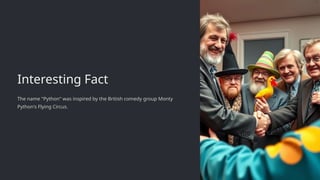
The name "Python" was inspired by the British comedy group Monty
Python's Flying Circus.
Key Features of Python
Python is admired for being easy to learn and use due to its simple syntax. The language boasts a large standard library,
along with a vast collection of third-party libraries and frameworks that extend its capabilities. Python supports cross-
platform compatibility, running seamlessly on Windows, macOS, and Linux operating systems. Furthermore, Python is
open source with a large and active community.
Key features include, dynamic typing, automatic memory management, community support, extensive use of libraries, etc.
• Easy to Learn and Use
• Large Standard Library
• Cross-Platform Compatibility
• Open Source
Python in Web Development
Python plays a significant role in web development. There are several popular frameworks such as Django and
Flask that simplify backend and full-stack development processes. Python can be used for building robust APIs,
server-side logic, and complete web applications. Companies such as Instagram and Spotify have leveraged
Python in their web infrastructure. Frameworks are readily available to use for developers interested in getting
into web development.
Python has a wide array of tools and libraries and can be easily integrated with multiple other technologies and
frameworks.
Python in Data Science
Python is an essential tool in the field of data science. Libraries such as
NumPy, Pandas, Matplotlib, Seaborn, and Scikit-learn provide powerful
capabilities for data analysis, manipulation, and visualization. Data
scientists use Python to perform machine learning, predictive modeling,
and gain insights from complex datasets. Many companies utilize
Python for building analytical dashboards and predictive applications.
Data science projects are easy to produce and deploy with the many
libraries that can be downloaded.
"Data is the new science. Big Data holds the answers."
Python in Artificial Intelligence (AI)
Python has become a leading language in the field of Artificial Intelligence (AI). Deep learning frameworks such as
TensorFlow, PyTorch, and Keras are used to build advanced AI models. Python is applied in Natural Language Processing
(NLP), enabling machines to understand and generate human language. Other AI applications include computer vision,
robotics, and neural networks. Python's flexibility and comprehensive tooling have made it a popular choice among AI
researchers and developers.
Python’s clear syntax and object-oriented approach are making it a favorite to the AI community.
Other Uses of Python &
Conclusion
Besides web development, data science, and AI, Python is used in
scripting and automation to streamline repetitive tasks. It is also utilized
in game development with libraries like Pygame and desktop GUI
applications with frameworks such as Tkinter and PyQt. Python is a
versatile and powerful language that can be used in a wide range of
applications. Its open-source nature, extensive community support, and
ease of use have solidified its position as one of the most popular
programming languages in the world.
Python's dynamic and adaptable nature makes it a top choice in the
software industry.

First of all, what is Python? According t

  • 1.
    Introduction to Python Welcometo this presentation! We will explore the essence of Python, its origin, and the myriad of domains where it shines. Let's dive into this popular and versatile language. by Amith Bhat
  • 2.
    What is Python? Pythonis a high-level, general-purpose programming language known for its readability and versatility. As an interpreted language, it executes code line by line, making it easier to debug. Its dynamically typed nature reduces the need for explicit type declarations. Python supports multiple programming paradigms including object-oriented, procedural, and functional approaches. Python's adaptability allows it to be used in many different application such as web development, data science, artificial intelligence, scripting, etc.
  • 3.
    Interesting Fact The name"Python" was inspired by the British comedy group Monty Python's Flying Circus.
  • 4.
    Key Features ofPython Python is admired for being easy to learn and use due to its simple syntax. The language boasts a large standard library, along with a vast collection of third-party libraries and frameworks that extend its capabilities. Python supports cross- platform compatibility, running seamlessly on Windows, macOS, and Linux operating systems. Furthermore, Python is open source with a large and active community. Key features include, dynamic typing, automatic memory management, community support, extensive use of libraries, etc. • Easy to Learn and Use • Large Standard Library • Cross-Platform Compatibility • Open Source
  • 5.
    Python in WebDevelopment Python plays a significant role in web development. There are several popular frameworks such as Django and Flask that simplify backend and full-stack development processes. Python can be used for building robust APIs, server-side logic, and complete web applications. Companies such as Instagram and Spotify have leveraged Python in their web infrastructure. Frameworks are readily available to use for developers interested in getting into web development. Python has a wide array of tools and libraries and can be easily integrated with multiple other technologies and frameworks.
  • 6.
    Python in DataScience Python is an essential tool in the field of data science. Libraries such as NumPy, Pandas, Matplotlib, Seaborn, and Scikit-learn provide powerful capabilities for data analysis, manipulation, and visualization. Data scientists use Python to perform machine learning, predictive modeling, and gain insights from complex datasets. Many companies utilize Python for building analytical dashboards and predictive applications. Data science projects are easy to produce and deploy with the many libraries that can be downloaded. "Data is the new science. Big Data holds the answers."
  • 7.
    Python in ArtificialIntelligence (AI) Python has become a leading language in the field of Artificial Intelligence (AI). Deep learning frameworks such as TensorFlow, PyTorch, and Keras are used to build advanced AI models. Python is applied in Natural Language Processing (NLP), enabling machines to understand and generate human language. Other AI applications include computer vision, robotics, and neural networks. Python's flexibility and comprehensive tooling have made it a popular choice among AI researchers and developers. Python’s clear syntax and object-oriented approach are making it a favorite to the AI community.
  • 8.
    Other Uses ofPython & Conclusion Besides web development, data science, and AI, Python is used in scripting and automation to streamline repetitive tasks. It is also utilized in game development with libraries like Pygame and desktop GUI applications with frameworks such as Tkinter and PyQt. Python is a versatile and powerful language that can be used in a wide range of applications. Its open-source nature, extensive community support, and ease of use have solidified its position as one of the most popular programming languages in the world. Python's dynamic and adaptable nature makes it a top choice in the software industry.