a
b
c
2
2
2
c
b
a 

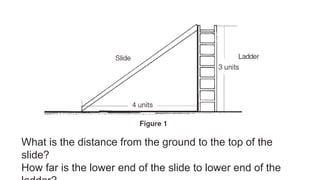
What angle is formed by the ladder and the
ground?
What is the distance from the ground to the top of the
slide?
How far is the lower end of the slide to lower end of the
But how can we compute the length of the
slide?
We can do this by using the Pythagorean theorem given
the length of the ladder and the distance from the lower
end of the slide to the lower end of the ladder.
This is a right triangle:
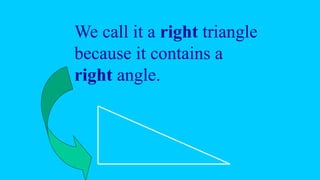
We call it a right triangle
because it contains a
right angle.
The measure of a right
angle is 90o
90o
The little square
90o
in the
angle tells you it is a
right angle.
About 2,500 years ago, a
Greek mathematician named
Pythagorus discovered a
special relationship between
the sides of right triangles.
Pythagorus realized that if
you have a right triangle,
3
4
5
and you square the lengths
of the two sides that make
up the right angle,
2
4
2
3
3
4
5
and add them together,
3
4
5
2
4
2
3 2
2
4
3 
2
2
4
3 
you get the same number
you would get by squaring
the other side.
2
2
2
5
4
3 

3
4
5
Is that correct?
2
2
2
5
4
3 

?
25
16
9 

?
It is. And it is true for any
right triangle.
8
6
10
2
2
2
10
8
6 

100
64
36 

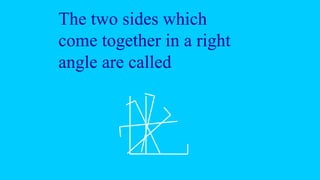
The two sides which
come together in a right
angle are called
The two sides which
come together in a right
angle are called
The two sides which
come together in a right
angle are called
The lengths of the legs are
usually called a and b.
a
b
The side across from the
right angle
a
b
is called the
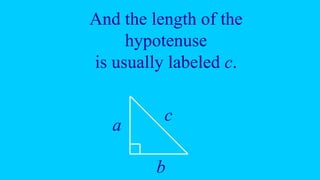
And the length of the
hypotenuse
is usually labeled c.
a
b
c
The relationship Pythagorus
discovered is now called
The Pythagorean Theorem:
a
b
c
The Pythagorean Theorem
says, given the right triangle
with legs a and b and
hypotenuse c,
a
b
c
then
a
b
c
.
2
2
2
c
b
a 

LETS
WATCH
THIS
VIDEOS
STEP 1
Identify the hypotenuse and the legs of the triangle.
The hypotenuse c is the side opposite to the right
angle. Therefore, c = length of the slide.
The two legs of the triangle are represented by the
ladder and the ground. Therefore, a = length of the
ladder and b = distance between the lower end of the
slide and the lower end of the ladder.
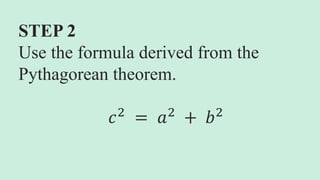
STEP 2
Use the formula derived from the
Pythagorean theorem. If c is the hypotenuse
of the right triangle and a and b are its legs,
we will then
have:
𝑐2 = 𝑎2 + 𝑏2
STEP 3
Substitute the given values to the variables (a, b and c) in the
formula and solve for the unknown. Recall that:
a = length of the ladder = 3 units
b = distance from the bottom of the ladder to the bottom of the
slide = 4 units
c = length of the slide
𝑐2
= 𝑎2
+ 𝑏2
𝑐² = 42
+ 32
𝑐² = 16 + 9
𝑐² = 25
STEP 4 To get the final answer, we need to remove
the exponent of the term on the right. We do this by
getting the square roots of both terms on the right and
left as in:
𝑐2 = 25
c = 5 units
So, the lenght of the slide or the hypotenuse of the
right triangle is 5 units long.
How far must a diver swim to be 12 meters below
sea level (as shown in the figure below)?
STEP 1
Identify the hypotenuse and the legs of the
triangle.
The distance that the diver must travel is the
side opposite the right angle. This means
that the said distance represents the
hypotenuse of the triangle.
Therefore c = distance that the diver must
travel.
The two legs of the triangle are represented
by the distance below sea level and the
distance between the diver at Point C and
Point B below sea level. Therefore, a =
distance below sea level, and b = distance
between the diver at Point C and Point B.
STEP 2
Use the formula derived from the
Pythagorean theorem.
𝑐2
= 𝑎2
+ 𝑏2
STEP 3
Substitute the given values to the variables in the formula and solve
for the unknown.
Recall that:
a = distance below sea level = 12 meters
b = distance between the diver at Point C to Point B = 5 meters
c = distance that the diver must travel
𝑐2
= 𝑎2
+ 𝑏2
𝑐² = 122
+ 52
𝑐² = 144 + 25
𝑐² = 169
STEP 4 Get the final answer by:
𝑐2 = 169
𝑐 = 13 𝑢𝑛𝑖𝑡𝑠
The diver must therefore travel or the hypotenuse of
the right triangle = 13 meters.
A boy is flying a kite at a
height of 17 meters from
the ground. The boy is
holding the string of the
kite 12 meters away from
the point directly below the
kite. If the height of the boy
is 1 meter, how long is the
string of the kite?
STEP 1
Identify the hypotenuse and the legs of the triangle.
The length of the string of the kite to the boy is the side opposite the
right angle or the hypotenuse of the triangle.
The two legs of the triangle are represented by the height of the kite
from the ground minus the height of the boy and the distance of the
boy from Point B.
Therefore a = distance of the boy from Point B and b = height of the
kite minus the height of the boy.
STEP 2
Use the formula derived from the
Pythagorean theorem.
𝑐2
= 𝑎2
+ 𝑏2
STEP 3
Substitute the given values to the variables in the formula and solve
for the unknown.
Recall that:
a = distance of the boy from Point B: ____ m
b = height of the kite minus the height of the boy:
____ to ____ = ____ m
c = length of the string
If we substitute the values in the formula, we then have:
𝑐2
= 𝑎2
+ 𝑏2
= ____________
= ____________
= ____________
17 1 16
12
𝒄𝟐
= 𝟏𝟐𝟐
+ 𝟏𝟔𝟐
𝒄𝟐
= 𝟏𝟒𝟒 + 𝟐𝟓𝟔
𝒄𝟐
= 𝟒𝟎𝟎
STEP 4
Get the final answer by:
𝑐2 =
𝑐 = _____
The length of the string is ______ m.
400
20
20
You can use The Pythagorean
Theorem to solve many kinds
of problems.
Suppose you drive directly
west for 48 miles,
48
Then turn south and drive for
36 miles.
48
36
How far are you from where
you started?
48
36
?
482
Using The Pythagorean
Theorem,
48
36
c
362
+ = c2
Why?
Can you see that we have a
right triangle?
48
36
c
482
362
+ = c2
Which side is the hypotenuse?
Which sides are the legs?
48
36
c
482
362
+ = c2

 2
2
36
48
Then all we need to do is
calculate:

1296
2304

3600 2
c
And you end up 60 miles from
where you started.
48
36
60
So, since c2
is 3600, c is 60.
So, since c2
is 3600, c is
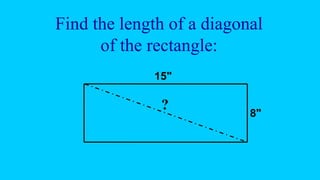
Find the length of a diagonal
of the rectangle:
15"
8"
?
Find the length of a diagonal
of the rectangle:
15"
8"
?
b = 8
a = 15
c
2
2
2
c
b
a 
 2
2
2
8
15 c

 2
64
225 c

 289
2

c 17

c
b = 8
a = 15
c
Find the length of a diagonal
of the rectangle:
15"
8"
17
Practice using
The Pythagorean Theorem
to solve these right triangles:
5
12
c = 13
10
b
26
10
b
26
= 24
(a)
(c)
2
2
2
c
b
a 

2
2
2
26
10 
 b
676
100 2

 b
100
676
2


b
576
2

b
24

b
12
b
15
= 9

Pythagoras.pptx

  • 2.
  • 3.
    What angle isformed by the ladder and the ground?
  • 4.
    What is thedistance from the ground to the top of the slide? How far is the lower end of the slide to lower end of the
  • 5.
    But how canwe compute the length of the slide? We can do this by using the Pythagorean theorem given the length of the ladder and the distance from the lower end of the slide to the lower end of the ladder.
  • 6.
    This is aright triangle:
  • 7.
    We call ita right triangle because it contains a right angle.
  • 8.
    The measure ofa right angle is 90o 90o
  • 9.
    The little square 90o inthe angle tells you it is a right angle.
  • 10.
    About 2,500 yearsago, a Greek mathematician named Pythagorus discovered a special relationship between the sides of right triangles.
  • 11.
    Pythagorus realized thatif you have a right triangle, 3 4 5
  • 12.
    and you squarethe lengths of the two sides that make up the right angle, 2 4 2 3 3 4 5
  • 13.
    and add themtogether, 3 4 5 2 4 2 3 2 2 4 3 
  • 14.
    2 2 4 3  you getthe same number you would get by squaring the other side. 2 2 2 5 4 3   3 4 5
  • 15.
    Is that correct? 2 2 2 5 4 3  ? 25 16 9   ?
  • 16.
    It is. Andit is true for any right triangle. 8 6 10 2 2 2 10 8 6   100 64 36  
  • 17.
    The two sideswhich come together in a right angle are called
  • 18.
    The two sideswhich come together in a right angle are called
  • 19.
    The two sideswhich come together in a right angle are called
  • 20.
    The lengths ofthe legs are usually called a and b. a b
  • 21.
    The side acrossfrom the right angle a b is called the
  • 22.
    And the lengthof the hypotenuse is usually labeled c. a b c
  • 23.
    The relationship Pythagorus discoveredis now called The Pythagorean Theorem: a b c
  • 24.
    The Pythagorean Theorem says,given the right triangle with legs a and b and hypotenuse c, a b c
  • 25.
  • 26.
  • 27.
    STEP 1 Identify thehypotenuse and the legs of the triangle. The hypotenuse c is the side opposite to the right angle. Therefore, c = length of the slide. The two legs of the triangle are represented by the ladder and the ground. Therefore, a = length of the ladder and b = distance between the lower end of the slide and the lower end of the ladder.
  • 28.
    STEP 2 Use theformula derived from the Pythagorean theorem. If c is the hypotenuse of the right triangle and a and b are its legs, we will then have: 𝑐2 = 𝑎2 + 𝑏2
  • 29.
    STEP 3 Substitute thegiven values to the variables (a, b and c) in the formula and solve for the unknown. Recall that: a = length of the ladder = 3 units b = distance from the bottom of the ladder to the bottom of the slide = 4 units c = length of the slide 𝑐2 = 𝑎2 + 𝑏2 𝑐² = 42 + 32 𝑐² = 16 + 9 𝑐² = 25
  • 30.
    STEP 4 Toget the final answer, we need to remove the exponent of the term on the right. We do this by getting the square roots of both terms on the right and left as in: 𝑐2 = 25 c = 5 units So, the lenght of the slide or the hypotenuse of the right triangle is 5 units long.
  • 31.
    How far musta diver swim to be 12 meters below sea level (as shown in the figure below)?
  • 32.
    STEP 1 Identify thehypotenuse and the legs of the triangle. The distance that the diver must travel is the side opposite the right angle. This means that the said distance represents the hypotenuse of the triangle. Therefore c = distance that the diver must travel. The two legs of the triangle are represented by the distance below sea level and the distance between the diver at Point C and Point B below sea level. Therefore, a = distance below sea level, and b = distance between the diver at Point C and Point B.
  • 33.
    STEP 2 Use theformula derived from the Pythagorean theorem. 𝑐2 = 𝑎2 + 𝑏2
  • 34.
    STEP 3 Substitute thegiven values to the variables in the formula and solve for the unknown. Recall that: a = distance below sea level = 12 meters b = distance between the diver at Point C to Point B = 5 meters c = distance that the diver must travel 𝑐2 = 𝑎2 + 𝑏2 𝑐² = 122 + 52 𝑐² = 144 + 25 𝑐² = 169
  • 35.
    STEP 4 Getthe final answer by: 𝑐2 = 169 𝑐 = 13 𝑢𝑛𝑖𝑡𝑠 The diver must therefore travel or the hypotenuse of the right triangle = 13 meters.
  • 36.
    A boy isflying a kite at a height of 17 meters from the ground. The boy is holding the string of the kite 12 meters away from the point directly below the kite. If the height of the boy is 1 meter, how long is the string of the kite?
  • 37.
    STEP 1 Identify thehypotenuse and the legs of the triangle. The length of the string of the kite to the boy is the side opposite the right angle or the hypotenuse of the triangle. The two legs of the triangle are represented by the height of the kite from the ground minus the height of the boy and the distance of the boy from Point B. Therefore a = distance of the boy from Point B and b = height of the kite minus the height of the boy.
  • 38.
    STEP 2 Use theformula derived from the Pythagorean theorem. 𝑐2 = 𝑎2 + 𝑏2
  • 39.
    STEP 3 Substitute thegiven values to the variables in the formula and solve for the unknown. Recall that: a = distance of the boy from Point B: ____ m b = height of the kite minus the height of the boy: ____ to ____ = ____ m c = length of the string If we substitute the values in the formula, we then have: 𝑐2 = 𝑎2 + 𝑏2 = ____________ = ____________ = ____________ 17 1 16 12 𝒄𝟐 = 𝟏𝟐𝟐 + 𝟏𝟔𝟐 𝒄𝟐 = 𝟏𝟒𝟒 + 𝟐𝟓𝟔 𝒄𝟐 = 𝟒𝟎𝟎
  • 40.
    STEP 4 Get thefinal answer by: 𝑐2 = 𝑐 = _____ The length of the string is ______ m. 400 20 20
  • 41.
    You can useThe Pythagorean Theorem to solve many kinds of problems. Suppose you drive directly west for 48 miles, 48
  • 42.
    Then turn southand drive for 36 miles. 48 36
  • 43.
    How far areyou from where you started? 48 36 ?
  • 44.
  • 45.
    Why? Can you seethat we have a right triangle? 48 36 c 482 362 + = c2
  • 46.
    Which side isthe hypotenuse? Which sides are the legs? 48 36 c 482 362 + = c2
  • 47.
      2 2 36 48 Then allwe need to do is calculate:  1296 2304  3600 2 c
  • 48.
    And you endup 60 miles from where you started. 48 36 60 So, since c2 is 3600, c is 60. So, since c2 is 3600, c is
  • 49.
    Find the lengthof a diagonal of the rectangle: 15" 8" ?
  • 50.
    Find the lengthof a diagonal of the rectangle: 15" 8" ? b = 8 a = 15 c
  • 51.
    2 2 2 c b a   2 2 2 8 15c   2 64 225 c   289 2  c 17  c b = 8 a = 15 c
  • 52.
    Find the lengthof a diagonal of the rectangle: 15" 8" 17
  • 53.
    Practice using The PythagoreanTheorem to solve these right triangles:
  • 54.
  • 55.
  • 56.
    10 b 26 = 24 (a) (c) 2 2 2 c b a   2 2 2 26 10  b 676 100 2   b 100 676 2   b 576 2  b 24  b
  • 57.