NATIONALISTIC SONG
ALS MOBILE
TEACHER
“TEACHER SHERVIN”
“Sir SHEB”
Objectives ‐ By the end of the activity,
participants will be able to:
a. Identify long and short term goals.
b. Identify the steps needed to reach a goal,
possible obstacles and needed resources.
c. Recognize that people learn in different ways,
using different skills.
d. Appreciate different ways of learning new
things.
Short Term Goals:
•Buy a new iPhone,
write a resume, pass
the module.
Long term Goals:
•Usually takes longer to
accomplish
•Usually accomplished
quickly
• Learn a second language and speak
fluently, buy a house in 5 years, go
back to college for second degree
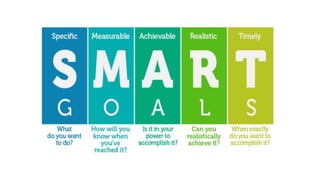
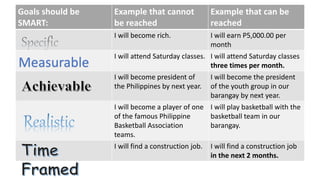
Goals should be
SMART:
Example that cannot
be reached
Example that can be
reached
I will become rich. I will earn P5,000.00 per
month
I will attend Saturday classes. I will attend Saturday classes
three times per month.
I will become president of
the Philippines by next year.
I will become the president
of the youth group in our
barangay by next year.
I will become a player of one
of the famous Philippine
Basketball Association
teams.
I will play basketball with the
basketball team in our
barangay.
I will find a construction job. I will find a construction job
in the next 2 months.
Measurable
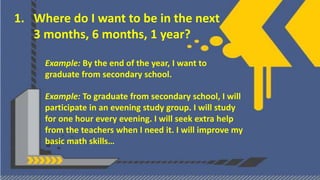
1. Where do I want to be in the next
3 months, 6 months, 1 year?
Example: To graduate from secondary school, I will
participate in an evening study group. I will study
for one hour every evening. I will seek extra help
from the teachers when I need it. I will improve my
basic math skills…
Example: By the end of the year, I want to
graduate from secondary school.
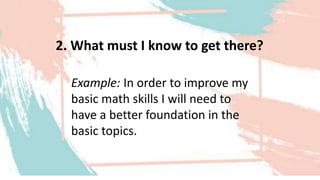
2. What must I know to get there?
Example: In order to improve my
basic math skills I will need to
have a better foundation in the
basic topics.
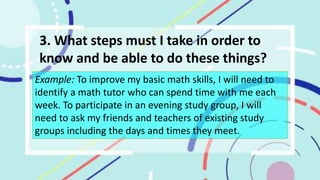
3. What steps must I take in order to
know and be able to do these things?
Example: To improve my basic math skills, I will need to
identify a math tutor who can spend time with me each
week. To participate in an evening study group, I will
need to ask my friends and teachers of existing study
groups including the days and times they meet.
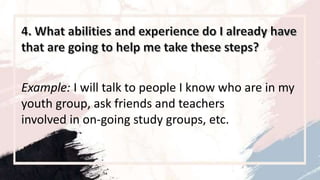
Example: I will talk to people I know who are in my
youth group, ask friends and teachers
involved in on-going study groups, etc.
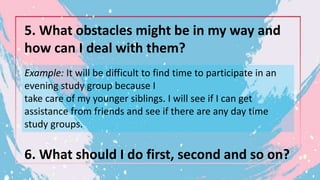
5. What obstacles might be in my way and
how can I deal with them?
Example: It will be difficult to find time to participate in an
evening study group because I
take care of my younger siblings. I will see if I can get
assistance from friends and see if there are any day time
study groups.
6. What should I do first, second and so on?
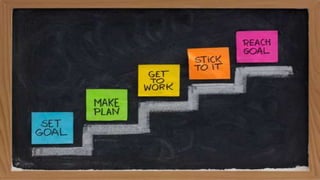
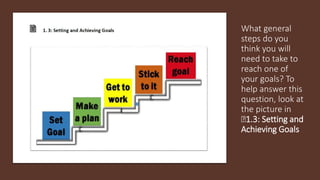
What general
steps do you
think you will
need to take to
reach one of
your goals? To
help answer this
question, look at
the picture in
1.3: Setting and
Achieving Goals
Agreement
•manila paper, markers, tape,
participants’ work from the session,
glue, scissors, old magazines or
newspaper

module 1SETTING GOALS AND L.STYLE.pptx

  • 3.
  • 5.
  • 10.
    Objectives ‐ Bythe end of the activity, participants will be able to: a. Identify long and short term goals. b. Identify the steps needed to reach a goal, possible obstacles and needed resources. c. Recognize that people learn in different ways, using different skills. d. Appreciate different ways of learning new things.
  • 12.
    Short Term Goals: •Buya new iPhone, write a resume, pass the module. Long term Goals: •Usually takes longer to accomplish •Usually accomplished quickly • Learn a second language and speak fluently, buy a house in 5 years, go back to college for second degree
  • 15.
    Goals should be SMART: Examplethat cannot be reached Example that can be reached I will become rich. I will earn P5,000.00 per month I will attend Saturday classes. I will attend Saturday classes three times per month. I will become president of the Philippines by next year. I will become the president of the youth group in our barangay by next year. I will become a player of one of the famous Philippine Basketball Association teams. I will play basketball with the basketball team in our barangay. I will find a construction job. I will find a construction job in the next 2 months. Measurable
  • 17.
    1. Where doI want to be in the next 3 months, 6 months, 1 year? Example: To graduate from secondary school, I will participate in an evening study group. I will study for one hour every evening. I will seek extra help from the teachers when I need it. I will improve my basic math skills… Example: By the end of the year, I want to graduate from secondary school.
  • 18.
    2. What mustI know to get there? Example: In order to improve my basic math skills I will need to have a better foundation in the basic topics.
  • 19.
    3. What stepsmust I take in order to know and be able to do these things? Example: To improve my basic math skills, I will need to identify a math tutor who can spend time with me each week. To participate in an evening study group, I will need to ask my friends and teachers of existing study groups including the days and times they meet.
  • 20.
    Example: I willtalk to people I know who are in my youth group, ask friends and teachers involved in on-going study groups, etc.
  • 21.
    5. What obstaclesmight be in my way and how can I deal with them? Example: It will be difficult to find time to participate in an evening study group because I take care of my younger siblings. I will see if I can get assistance from friends and see if there are any day time study groups. 6. What should I do first, second and so on?
  • 24.
    What general steps doyou think you will need to take to reach one of your goals? To help answer this question, look at the picture in 1.3: Setting and Achieving Goals
  • 26.
    Agreement •manila paper, markers,tape, participants’ work from the session, glue, scissors, old magazines or newspaper