All content Copyright © 2017 QuantumBlack Visual Analytics Ltd.
Bayesian optimization
PyData London 2017
6th of May, 2017
Thomas Huijskens
All content Copyright © 2017 QuantumBlack Visual Analytics Ltd. 2
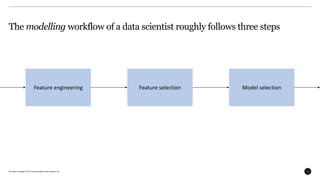
The modelling workflow of a data scientist roughly follows three steps
Feature engineering Feature selection Model selection
All content Copyright © 2017 QuantumBlack Visual Analytics Ltd. 3
In this talk, we will focus on the last step of this workflow
Feature engineering Model selection
Focus of this talk
Feature selection
All content Copyright © 2017 QuantumBlack Visual Analytics Ltd. 4
Most models have a number of hyperparameters that need to be chosen a
priori..
• Typically, we want to optimize some performance metric 𝑓ℳ for a model ℳ, on a hold-out
set of data.
• The model ℳ has some hyperparameters 𝜃 that we need to specify, and the performance
of ℳ is highly dependent on the settings of 𝜃.
• Example: For a classification problem, ℳ could be a support vector machine, and the
performance metric 𝑓ℳ could be the out-of-sample AUC.
• Because the performance of the SVM depends on hyperparameters 𝜃, the metric 𝑓ℳ
depends on 𝜃 as well.
All content Copyright © 2017 QuantumBlack Visual Analytics Ltd. 5
𝑓ℳ 𝜃 𝐷)
Learner ℳ
Performance
function 𝑓
𝑓 depends on the hyperparameters 𝜃 of
the model ℳ
.. and our goal is to find the values of 𝜃 for which the value of the (out-of-
sample) performance 𝑓ℳ is optimal
𝑓 is conditional on the
data 𝐷
All content Copyright © 2017 QuantumBlack Visual Analytics Ltd. 6
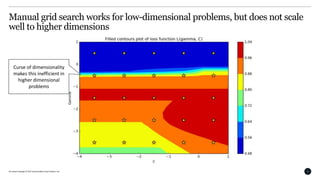
Manual grid search works for low-dimensional problems, but does not scale
well to higher dimensions
Curse of dimensionality
makes this inefficient in
higher dimensional
problems
All content Copyright © 2017 QuantumBlack Visual Analytics Ltd. 7
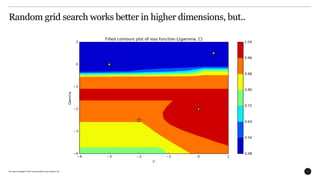
Random grid search works better in higher dimensions, but..
All content Copyright © 2017 QuantumBlack Visual Analytics Ltd. 8
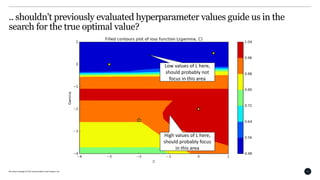
.. shouldn't previously evaluated hyperparameter values guide us in the
search for the true optimal value?
Low values of L here,
should probably not
focus in this area
High values of L here,
should probably focus
in this area
All content Copyright © 2017 QuantumBlack Visual Analytics Ltd. 9
Bayesian optimization
All content Copyright © 2017 QuantumBlack Visual Analytics Ltd. 10
Bayesian optimization is only beneficial in certain situations
In Bayesian optimization, we are building a probabilistic model for the performance metric
𝑓ℳ(𝜃). This introduces computational overhead.
As a result, applying Bayesian optimization only really makes sense if
• The number of hyperparameters is very high (𝜃 is of high dimension); or
• It is computationally very expensive to evaluate 𝑓ℳ(𝜃) for a single point 𝜃.
All content Copyright © 2017 QuantumBlack Visual Analytics Ltd. 11
Evaluate performance
of learner f with
parameters 𝜃
Update current belief
of loss surface of the
learner f
Choose 𝜃 that
maximises some
utility over the
current belief
The classic Bayesian optimization algorithm consists of three steps
𝑓 | 𝑦 𝑛𝑒𝑤
𝑦 𝑛𝑒𝑤 = 𝑓 𝜃 𝑛𝑒𝑤
𝜃 𝑛𝑒𝑤
All content Copyright © 2017 QuantumBlack Visual Analytics Ltd. 12
Evaluate performance
of learner f with
parameters 𝜃
Update current belief
of loss surface of the
learner f
Choose 𝜃 that
maximises some
utility over the
current belief
The classic Bayesian optimization algorithm consists of three steps
𝑓 | 𝑦 𝑛𝑒𝑤
𝑦 𝑛𝑒𝑤 = 𝑓 𝜃 𝑛𝑒𝑤
𝜃 𝑛𝑒𝑤
All content Copyright © 2017 QuantumBlack Visual Analytics Ltd. 13
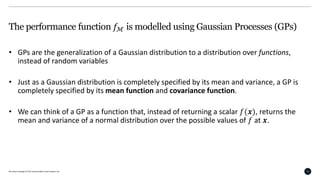
The performance function 𝑓ℳ is modelled using Gaussian Processes (GPs)
• GPs are the generalization of a Gaussian distribution to a distribution over functions,
instead of random variables
• Just as a Gaussian distribution is completely specified by its mean and variance, a GP is
completely specified by its mean function and covariance function.
• We can think of a GP as a function that, instead of returning a scalar 𝑓(𝒙), returns the
mean and variance of a normal distribution over the possible values of 𝑓 at 𝒙.
All content Copyright © 2017 QuantumBlack Visual Analytics Ltd. 14
GPs are the generalization of a Gaussian distribution to a distribution over
functions, instead of random variables1
1A Tutorial on Bayesian Optimization of Expensive Cost Functions, with Application to Active User Modeling and Hierarchical Reinforcement Learning, Eric Brochu, Vlad M. Cora, Nando de Freitas, 2010. https://arxiv.org/abs/1012.2599
All content Copyright © 2017 QuantumBlack Visual Analytics Ltd. 15
Evaluate performance
of learner f with
parameters 𝜃
Update current belief
of loss surface of the
learner f
Choose 𝜃 that
maximises some
utility over the
current belief
The classic Bayesian optimization algorithm consists of three steps
𝑓 | 𝑦 𝑛𝑒𝑤
𝑦 𝑛𝑒𝑤 = 𝑓 𝜃 𝑛𝑒𝑤
𝜃 𝑛𝑒𝑤
All content Copyright © 2017 QuantumBlack Visual Analytics Ltd. 16
How do we use our current belief to make a good guess about what point to
evaluate next?
All content Copyright © 2017 QuantumBlack Visual Analytics Ltd. 17
Acquisition functions are used to formalize what constitutes a ”best guess”
𝐸𝐼 𝜃 = 𝔼[max
𝜃
0, 𝑓ℳ 𝜃 − 𝑓ℳ 𝜃 ] ,
𝜃 𝑛𝑒𝑤 = argmax
𝜃
𝐸𝐼(𝜃)
All content Copyright © 2017 QuantumBlack Visual Analytics Ltd. 18
The expected improvement acquisition function can be evaluated analytically
𝐸𝐼 𝜃 =
𝜇 𝜃 − 𝑓 𝜃 𝛷 𝑍 + 𝜎(𝜃)𝜙(𝑍), 𝜎 𝜃 > 0
0, 𝜎 𝜃 = 0
,
𝑍 =
𝜇 𝜃 − 𝑓( 𝜃)
𝜎(𝜃)
All content Copyright © 2017 QuantumBlack Visual Analytics Ltd. 19
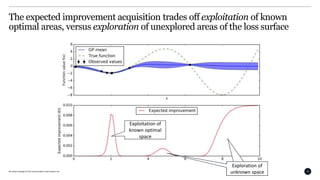
The expected improvement acquisition trades off exploitation of known
optimal areas, versus exploration of unexplored areas of the loss surface
Exploitation of
known optimal
space
Exploration of
unknown space
Exploration of
unknown space
All content Copyright © 2017 QuantumBlack Visual Analytics Ltd. 20
Evaluate performance
of learner f with
parameters 𝜃
Update current belief
of loss surface of the
learner f
Choose 𝜃 that
maximises some
utility over the
current belief
The classic Bayesian optimization algorithm consists of three steps
𝑓 | 𝑦 𝑛𝑒𝑤
𝑦 𝑛𝑒𝑤 = 𝑓 𝜃 𝑛𝑒𝑤
𝜃 𝑛𝑒𝑤
All content Copyright © 2017 QuantumBlack Visual Analytics Ltd. 21
How do we use this in real-life?
All content Copyright © 2017 QuantumBlack Visual Analytics Ltd. 22
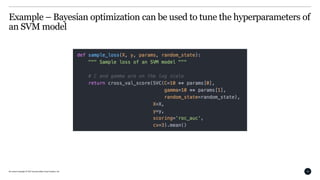
Example – Bayesian optimization can be used to tune the hyperparameters of
an SVM model
All content Copyright © 2017 QuantumBlack Visual Analytics Ltd. 23
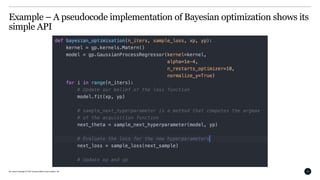
Example – A pseudocode implementation of Bayesian optimization shows its
simple API
All content Copyright © 2017 QuantumBlack Visual Analytics Ltd. 24
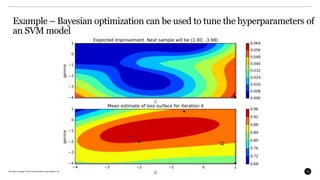
Example – Bayesian optimization can be used to tune the hyperparameters of
an SVM model
All content Copyright © 2017 QuantumBlack Visual Analytics Ltd. 25
Example – Bayesian optimization can be used to tune the hyperparameters of
an SVM model
All content Copyright © 2017 QuantumBlack Visual Analytics Ltd. 26
GPs can not be used as a simple black-box, and some care must be taken
1. Choose an appropriate scale for your hyperparameters: For parameters like a learning
rate, or regularization term, it makes more sense to sample on the log-uniform domain,
instead of the uniform domain.
2. Choose the kernel of the GP carefully: Each kernel implicitly assumes different properties
on the loss function, in terms of differentiability and periodicity.
All content Copyright © 2017 QuantumBlack Visual Analytics Ltd. 27
Multiple production-ready, and open-source, modules for Bayesian
optimization are available online
1. Spearmint
2. Hyperopt
3. MOE
4. Hyperband (model-free)
5. SMAC (model-free)

Pydata presentation

  • 1.
    All content Copyright© 2017 QuantumBlack Visual Analytics Ltd. Bayesian optimization PyData London 2017 6th of May, 2017 Thomas Huijskens
  • 2.
    All content Copyright© 2017 QuantumBlack Visual Analytics Ltd. 2 The modelling workflow of a data scientist roughly follows three steps Feature engineering Feature selection Model selection
  • 3.
    All content Copyright© 2017 QuantumBlack Visual Analytics Ltd. 3 In this talk, we will focus on the last step of this workflow Feature engineering Model selection Focus of this talk Feature selection
  • 4.
    All content Copyright© 2017 QuantumBlack Visual Analytics Ltd. 4 Most models have a number of hyperparameters that need to be chosen a priori.. • Typically, we want to optimize some performance metric 𝑓ℳ for a model ℳ, on a hold-out set of data. • The model ℳ has some hyperparameters 𝜃 that we need to specify, and the performance of ℳ is highly dependent on the settings of 𝜃. • Example: For a classification problem, ℳ could be a support vector machine, and the performance metric 𝑓ℳ could be the out-of-sample AUC. • Because the performance of the SVM depends on hyperparameters 𝜃, the metric 𝑓ℳ depends on 𝜃 as well.
  • 5.
    All content Copyright© 2017 QuantumBlack Visual Analytics Ltd. 5 𝑓ℳ 𝜃 𝐷) Learner ℳ Performance function 𝑓 𝑓 depends on the hyperparameters 𝜃 of the model ℳ .. and our goal is to find the values of 𝜃 for which the value of the (out-of- sample) performance 𝑓ℳ is optimal 𝑓 is conditional on the data 𝐷
  • 6.
    All content Copyright© 2017 QuantumBlack Visual Analytics Ltd. 6 Manual grid search works for low-dimensional problems, but does not scale well to higher dimensions Curse of dimensionality makes this inefficient in higher dimensional problems
  • 7.
    All content Copyright© 2017 QuantumBlack Visual Analytics Ltd. 7 Random grid search works better in higher dimensions, but..
  • 8.
    All content Copyright© 2017 QuantumBlack Visual Analytics Ltd. 8 .. shouldn't previously evaluated hyperparameter values guide us in the search for the true optimal value? Low values of L here, should probably not focus in this area High values of L here, should probably focus in this area
  • 9.
    All content Copyright© 2017 QuantumBlack Visual Analytics Ltd. 9 Bayesian optimization
  • 10.
    All content Copyright© 2017 QuantumBlack Visual Analytics Ltd. 10 Bayesian optimization is only beneficial in certain situations In Bayesian optimization, we are building a probabilistic model for the performance metric 𝑓ℳ(𝜃). This introduces computational overhead. As a result, applying Bayesian optimization only really makes sense if • The number of hyperparameters is very high (𝜃 is of high dimension); or • It is computationally very expensive to evaluate 𝑓ℳ(𝜃) for a single point 𝜃.
  • 11.
    All content Copyright© 2017 QuantumBlack Visual Analytics Ltd. 11 Evaluate performance of learner f with parameters 𝜃 Update current belief of loss surface of the learner f Choose 𝜃 that maximises some utility over the current belief The classic Bayesian optimization algorithm consists of three steps 𝑓 | 𝑦 𝑛𝑒𝑤 𝑦 𝑛𝑒𝑤 = 𝑓 𝜃 𝑛𝑒𝑤 𝜃 𝑛𝑒𝑤
  • 12.
    All content Copyright© 2017 QuantumBlack Visual Analytics Ltd. 12 Evaluate performance of learner f with parameters 𝜃 Update current belief of loss surface of the learner f Choose 𝜃 that maximises some utility over the current belief The classic Bayesian optimization algorithm consists of three steps 𝑓 | 𝑦 𝑛𝑒𝑤 𝑦 𝑛𝑒𝑤 = 𝑓 𝜃 𝑛𝑒𝑤 𝜃 𝑛𝑒𝑤
  • 13.
    All content Copyright© 2017 QuantumBlack Visual Analytics Ltd. 13 The performance function 𝑓ℳ is modelled using Gaussian Processes (GPs) • GPs are the generalization of a Gaussian distribution to a distribution over functions, instead of random variables • Just as a Gaussian distribution is completely specified by its mean and variance, a GP is completely specified by its mean function and covariance function. • We can think of a GP as a function that, instead of returning a scalar 𝑓(𝒙), returns the mean and variance of a normal distribution over the possible values of 𝑓 at 𝒙.
  • 14.
    All content Copyright© 2017 QuantumBlack Visual Analytics Ltd. 14 GPs are the generalization of a Gaussian distribution to a distribution over functions, instead of random variables1 1A Tutorial on Bayesian Optimization of Expensive Cost Functions, with Application to Active User Modeling and Hierarchical Reinforcement Learning, Eric Brochu, Vlad M. Cora, Nando de Freitas, 2010. https://arxiv.org/abs/1012.2599
  • 15.
    All content Copyright© 2017 QuantumBlack Visual Analytics Ltd. 15 Evaluate performance of learner f with parameters 𝜃 Update current belief of loss surface of the learner f Choose 𝜃 that maximises some utility over the current belief The classic Bayesian optimization algorithm consists of three steps 𝑓 | 𝑦 𝑛𝑒𝑤 𝑦 𝑛𝑒𝑤 = 𝑓 𝜃 𝑛𝑒𝑤 𝜃 𝑛𝑒𝑤
  • 16.
    All content Copyright© 2017 QuantumBlack Visual Analytics Ltd. 16 How do we use our current belief to make a good guess about what point to evaluate next?
  • 17.
    All content Copyright© 2017 QuantumBlack Visual Analytics Ltd. 17 Acquisition functions are used to formalize what constitutes a ”best guess” 𝐸𝐼 𝜃 = 𝔼[max 𝜃 0, 𝑓ℳ 𝜃 − 𝑓ℳ 𝜃 ] , 𝜃 𝑛𝑒𝑤 = argmax 𝜃 𝐸𝐼(𝜃)
  • 18.
    All content Copyright© 2017 QuantumBlack Visual Analytics Ltd. 18 The expected improvement acquisition function can be evaluated analytically 𝐸𝐼 𝜃 = 𝜇 𝜃 − 𝑓 𝜃 𝛷 𝑍 + 𝜎(𝜃)𝜙(𝑍), 𝜎 𝜃 > 0 0, 𝜎 𝜃 = 0 , 𝑍 = 𝜇 𝜃 − 𝑓( 𝜃) 𝜎(𝜃)
  • 19.
    All content Copyright© 2017 QuantumBlack Visual Analytics Ltd. 19 The expected improvement acquisition trades off exploitation of known optimal areas, versus exploration of unexplored areas of the loss surface Exploitation of known optimal space Exploration of unknown space Exploration of unknown space
  • 20.
    All content Copyright© 2017 QuantumBlack Visual Analytics Ltd. 20 Evaluate performance of learner f with parameters 𝜃 Update current belief of loss surface of the learner f Choose 𝜃 that maximises some utility over the current belief The classic Bayesian optimization algorithm consists of three steps 𝑓 | 𝑦 𝑛𝑒𝑤 𝑦 𝑛𝑒𝑤 = 𝑓 𝜃 𝑛𝑒𝑤 𝜃 𝑛𝑒𝑤
  • 21.
    All content Copyright© 2017 QuantumBlack Visual Analytics Ltd. 21 How do we use this in real-life?
  • 22.
    All content Copyright© 2017 QuantumBlack Visual Analytics Ltd. 22 Example – Bayesian optimization can be used to tune the hyperparameters of an SVM model
  • 23.
    All content Copyright© 2017 QuantumBlack Visual Analytics Ltd. 23 Example – A pseudocode implementation of Bayesian optimization shows its simple API
  • 24.
    All content Copyright© 2017 QuantumBlack Visual Analytics Ltd. 24 Example – Bayesian optimization can be used to tune the hyperparameters of an SVM model
  • 25.
    All content Copyright© 2017 QuantumBlack Visual Analytics Ltd. 25 Example – Bayesian optimization can be used to tune the hyperparameters of an SVM model
  • 26.
    All content Copyright© 2017 QuantumBlack Visual Analytics Ltd. 26 GPs can not be used as a simple black-box, and some care must be taken 1. Choose an appropriate scale for your hyperparameters: For parameters like a learning rate, or regularization term, it makes more sense to sample on the log-uniform domain, instead of the uniform domain. 2. Choose the kernel of the GP carefully: Each kernel implicitly assumes different properties on the loss function, in terms of differentiability and periodicity.
  • 27.
    All content Copyright© 2017 QuantumBlack Visual Analytics Ltd. 27 Multiple production-ready, and open-source, modules for Bayesian optimization are available online 1. Spearmint 2. Hyperopt 3. MOE 4. Hyperband (model-free) 5. SMAC (model-free)

Editor's Notes

  • #12 Mention the similarity with general sequantial model based optimisation algorithms  this is just a special instance of an algorithm in that class.